Loading summary
Transcript131 lines
- [00:08]
A
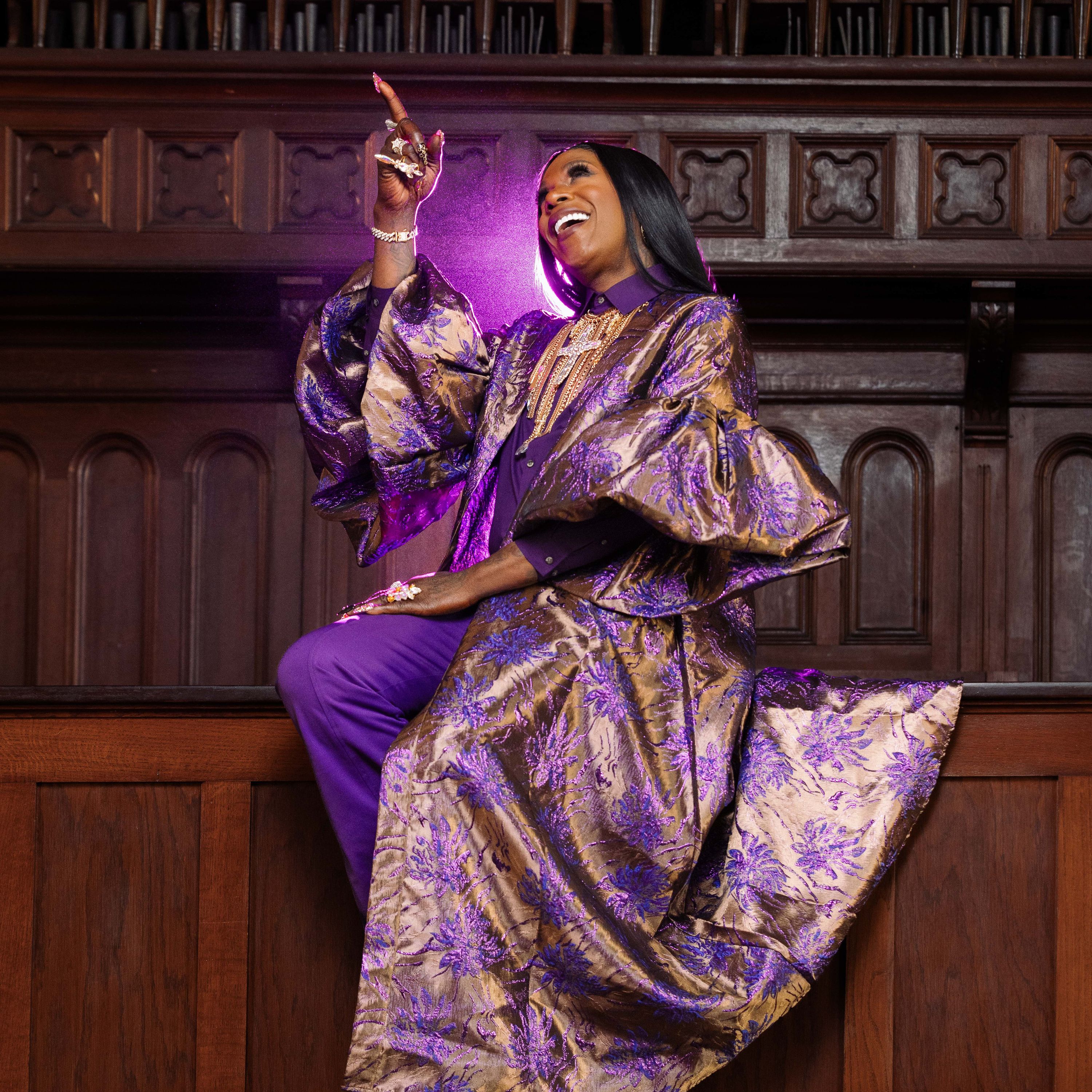
This is all of it from wnyc. I'm Alison Stewart. After an unforgettable turn on Beyonce's Break My Soul, Big Frida, the Queen of New Orleans bounce, returns this time to the church in her latest album Pressing Onward. The album bridges the gap between her signature bounce beats and gospel. Let's listen to the first track, titled Revival.
- [00:55]
B
Hey, hey, hey, hey it's our revival get up, up Bring your Bible beat me down S R I V E R Life without faith you won't make it too far Open your eyes up and open your heart God made the galaxy and made you a star Bring your confessions, trade them for blessings Sometime I worry the horse and reset It's a revival can you do it? Get up, get up, get up.
- [01:22]
A
A Rolling Stone review says pressing Onward serves as a metaphor for Big Frida and by extension, her fans who might be moving through grief. Be it personal or political, the album also cultivates spaces where divinity and humanity can coexist. The album is dedicated to Devin Hurst, her partner of over 20 years, who passed away in May. Frida brings forth a big voice and strong message of love and acceptance. Pressing Onward is out now. She'll be performing at the third annual Stonewall in Brick Awards Gala at Sony hall on West 46th street on Monday, December 8th. But right now, she's joining me or for a listening party. Welcome to all of it.
- [02:02]
C
Thank you so much for having me. How you doing, Allison?
- [02:05]
A
I am doing well. As you saw. Everybody likes that song.
- [02:09]
C
Yes, indeed. That's everybody bopping their head over there. Yes.
- [02:13]
A
The album is named after your church.
- [02:15]
C
Yes, yes. I grew up going to Preston Onward Baptist Church. Yes, ma'.
- [02:19]
B
Am.
- [02:19]
A
You've often called it a safe haven.
- [02:21]
C
Yes, indeed. It was my safe haven.
- [02:23]
A
How did it bring you a sense of belonging, of comfort?
- [02:26]
C
You know, when I first walked in the church, you know, I felt welcome, I felt loved. You know, they opened their arms and wrapped them around me and they protected me. You know, growing up in New Orleans and growing up in the hood, the church was the place where we were safe as kids and, you know, we were protected by the elders of the church.
- [02:47]
D
How long have you been waiting to make this album?
- [02:49]
C
I mean, God just put it on my heart and it just, you know, came full circle moment for me. I actually went to do a dance album and I did 50 songs in five days. And out of doing the 50 songs in five days, I did one song which was a gospel song celebration. And that's what sparked my idea to do a gospel Album and then the gospel album happened before the dance record even came out.
- [03:14]
D
Tell me about the song Celebration.
- [03:16]
C
I mean, it is a celebration. It is about, you know, we only have one life to live, and so we should celebrate it while we're here, you know? And this song is for, you know, everybody. Everybody needs to celebrate life. No matter if you have upset downs, trials and tribulations.
- [03:32]
D
Let's take a listen.
- [03:48]
E
This is our celebration. I say oh, I did the work for all the salvation but in time they give me flowers for my dedication Every day I had to fight let's celebrate. Cause all we got is this life.
- [04:05]
B
Working Finding my purpose Told on my.
- [04:07]
C
Soul and thought purchase Deep down I know I'm not perfect Lord knows I've been a good servant Now I lay me down to sleep Pray the Lord.
- [04:15]
B
My soul thank you for the air I breathe Protect me from my enemy.
- [04:19]
E
Message to the people northwest, east and south. You're a blessing to the music. The time is now. This is.
- [04:42]
D
You're listening to Big Frida. Her first gospel album is titled Pressing Onward. She joins us for a listening party. When you were a kid, you were in the choir?
- [04:51]
C
Yes, I was in the choir. I was the choir director. I was the choir director at my high school. I sung with the Gospel Soul Children of New Orleans. The Gospel Music Workshop of America. Yes. Choir and church was my whole life.
- [05:04]
D
How did it give you confidence being in the choir?
- [05:08]
C
It actually helped mold me to be able to be an artist today because I used to be stage frightened. I used to throw up before I have to perform. And church is what helped me to get over that fear. You know, my godmother, Georgia, pushing me out there and saying, you're gonna lead this solo. You know, we gonna put you on front street. We gonna, you know, give you that spotlight. So church is what helped me to have the confidence I have to be.
- [05:34]
A
Wow, that must have been a real difficult moment, that moment when you had to go out on stage and just you be you.
- [05:41]
C
Yes.
- [05:42]
A
And also sing the word yes.
- [05:44]
C
Yeah, it was very scary, you know, and over time, you know, standing on that quiet stand, that was my practice. That was my practice getting me ready to be a performer.
- [05:57]
A
You have a song on the album called Sunday Best featuring Tamar Braxton. When did you realize you wanted Tamar on your record?
- [06:05]
C
You know, I immediately. Because she comes from church as well. And I was thinking of some of my celebrity friends who I can put on the record. And Tamar, definitely, you know, the Braxton family, they are. They come from the church mom was their choir director, so I immediately said, tamar is one that I want to use for the record.
- [06:24]
A
All right, so what's your Sunday best? What does it look like?
- [06:26]
C
Oh, I mean, my Sunday best. I'm fresh in my Sunday best honey from head to toe with my three piece suit, you know, maybe have my ascot around my neck with fabulous shoes and the bag to match, you know.
- [06:39]
A
Let's take a listen to Sunday Best featuring Tamar Braxton. On pressing forward.
- [06:46]
C
Pressing on.
- [06:47]
A
Thank you.
- [07:08]
E
I look good.
- [07:16]
B
I look oh, yes, oh, yes Believe I'm in my Sunday best Sunday best.
- [07:21]
E
Thankful, thankful, thankful thank you, Lord Giving me another day Lord, I'm thankful, thankful, thankful for giving me your styling grace.
- [07:59]
A
Third chord change.
- [08:02]
C
Yeah. Modulation, you know, my guess is New.
- [08:08]
A
Orleans bounce legend Big Freeda. She's released her first gospel album titled Pressing Onward. By the way, you have a performance tomorrow at Crown Hill Theater.
- [08:17]
C
Yes, I do gather. Yes. It's a fundraiser, and I'll be there tomorrow, me and my team, and we're coming to help, you know, raise some funds for a great cause. But, you know, I always come to shake things up.
- [08:31]
A
How exactly did you decide to blend that sort of iconic Big Freeda sound with classic gospel hymns and church music?
- [08:41]
C
What I did was just brought Big Freeda to church. You know, I grew up as Freddie, you know, in church, but this time, you know, I stayed and remained who I am, and I brought Big Freeda to church. It was time for Freda to go to church and to give God just the glory and the praise that, you know, keeping me thus far and, you know, keeping me in music for over 20 years, you know, it was a full circle moment for me.
- [09:07]
A
How did you decide which moments you wanted to keep traditional and which moments you wanted to let your bounce energy take over?
- [09:14]
C
So I actually did about 40 gospel songs, and so I started to let certain friends listen to the record. And I kind of did a polling, you know, where I was like, everybody gets to pick their favorite songs. Give me your favorite top 10 songs. And, you know, we would rate it one through five. And then I was just. I put them all in a hat and we did the numbers and we added them up. So there's still another batch of gospel songs in case I do my second album.
- [09:43]
D
All right, well, for folks who are thinking, like, bounce music, I've heard of it. I don't really know what it is.
- [09:50]
C
It is a New Orleans sound. And when I describe bounce music, it's up tempo, it's heavy bass, it's call and response. It has a lot to do with moving of the body. But when we do bounce, it's like we catch the spirit.
- [10:03]
D
And why is New Orleans the right place for this to be born? Bounce music?
- [10:07]
C
I mean, because it's just. It happened that way. You know, it was grace that came before me that created the sound and created the movement of bounce. And so I'm grateful to be even standing in the position that I'm in for the people that made way for us to even be here today.
- [10:24]
D
How does the sound of bounce music reflect New Orleans culture and its attitude?
- [10:28]
C
Oh, it's. It's all of New Orleans. I mean, from babies to grandmother, they bounce around, you know? Yes. This work from babies to grandmothers in New Orleans, and it's in our spirit, it's in our food, it's in our culture, is the love and spirit of New Orleans, as well as jazz.
- [10:45]
D
This year marks the 20th anniversary of Hurricane Katrina, which devastated New Orleans. You lost everything, your family, but you didn't give up on New Orleans. You moved back.
- [10:55]
C
I did not.
- [10:56]
D
You moved back.
- [10:57]
C
Yeah. I did not give up.
- [10:58]
D
You didn't know you didn't give up. Right. And when you came back, you took part in FEMA Fridays.
- [11:04]
C
Yes, I did.
- [11:05]
D
Okay, first of all, why didn't you give up? Let's start there.
- [11:07]
C
I didn't give up because I'm born and raised from New Orleans, and so there's no place like home. I had worked so hard to get bounce music to where it was. There was no turning back. I had to rebuild the culture. I had to get people to come back home and help rebuild the city. And that was my mission. Like, if I didn't have bounce music, I didn't have anything.
- [11:31]
A
FEMA Fridays. Describe FEMA Fridays for me. I believe at one point, you said it was off the chain.
- [11:36]
C
Oh, it was off the chain. It was the only club open in New Orleans. So everybody was coming to FEMA Fridays. It was a line down the street around the corner to get in FEMA Fridays. Everybody had their little red cross money or their little FEMA money. So they was popping bottles and, you know, got their new outfits and their hair done. It was a party that was like no other. I mean, when I would rap and be on the mic, it was like the roof was about to come off the building. How the response of the crowd would.
- [12:06]
A
Be, because the response also meant, we're here for New Orleans. We're not just here for a great concert.
- [12:12]
C
Yeah. I mean, it was all New Orleans people. And this was a chance to. Even though we were going through something, this was a moment to just relieve that stress, relieve that moment where we could lay our hair down and have a good time.
- [12:25]
A
How has bounce music changed over the last 20 years?
- [12:29]
C
Oh, I mean, I've saw it go from one, you know, BPM to even faster and then to flipping it to all kind of different ways. It's changed in so many ways because, glory be to God, I'm the one who made it national. And, you know, it was only in New Orleans for such a long time, but I traveled far and near, overseas, all kind of places, and brought the culture around the world. A lot of music today is standing on bounce music, a lot of it.
- [13:01]
A
We are talking to New Orleans bounce legend Big Freeda. It's the release of our first gospel album titled Pressing Onward. She's joining us for a listening party. Let's listen to another song. This is Let It Rain. Do you want to tell us a little bit about this song?
- [13:16]
C
Let It Rain is a song that I created to, you know, even when I'm going through something, you know, I want God blessings to keep on raining on me, you know, overflowing like a volcano. This song is about even when you go through something, God still, you know, give you the power to. To wash all of that away and let those blessings rain down on you.
- [13:40]
A
Let's listen to Big Frida.
- [13:57]
E
Rain. Let's see. Start to fall like rain Washes away like rain Whenever I call any rain.
- [14:09]
B
I've been through the storm I've been through the rain I've been through so much can't even explain I kept on praying for something to change to get to the sun I need God's rain so let it rain on me like a tornado Keep it overflowing over me like a volcano I know I was holding on to pain I had to let go Made it through the night I made it through the light I, I, I.
- [14:50]
C
To fall.
- [15:04]
D
Look at what God did that is from pressing Onward. My guest is Big Frida. You said this album started as a message of healing to the world.
- [15:18]
C
Not only to the world, but to me as well.
- [15:20]
D
Yeah. Your partner. You lost your partner.
- [15:22]
C
Yes, I did.
- [15:23]
A
Of 20 years.
- [15:24]
D
I'm so sorry.
- [15:25]
C
Thank you.
- [15:27]
D
How has this project been healing for you?
- [15:29]
C
You know, only God knows that. You know, he was going to call Devin home. And so this record has really been my healing process. Being able to bring a little light and joy to myself, to the world. The world is going through so many Things right now, you know, from political to personal things. And I made this record for everybody. But even. Even before I was making this record, Devin was able to be at home with me listening to this record, you know, while I was in the process of making it. And it has really been my strength to be able to go out and perform these songs, to go out and to. To give people just a little bit of joy and a little bit of light at the end of the tunnel.
- [16:16]
D
Is there any song do you think really carries his spirit along?
- [16:20]
C
I mean, just the whole record. You know, he loved the whole album. We would talk about it, he would say how proud of me he is, and, you know, it just. It feels so good just to reflect those moments that we share before his passing.
- [16:36]
D
A lot of people think the church and the LGBTQ community, that they can't coexist, right?
- [16:42]
C
Yes.
- [16:43]
D
But your journey through Christ has been one of acceptance.
- [16:46]
C
Yes, it has.
- [16:47]
D
Who do you imagine as the listeners? Who do you imagine as your listener when you were creating these songs?
- [16:53]
C
I mean, I imagine that every person that's in our community, they can have their connection back with God, because a lot of times I tell people, we are the people that make up the church. That's just the building. The church is inside you.
- [17:09]
D
Right.
- [17:10]
C
You know, and you have to have a personal connection with God. And so this record is for everybody. You don't have to have a certain type of religion. You don't have to actually step into some type of building. But long as you have your relationship with God, you can connect back with your upper power and your higher being.
- [17:29]
D
Billy Porter is on your record?
- [17:31]
C
Yes, he is.
- [17:32]
D
Tell me how that came to be.
- [17:33]
C
Billy Porter's another one who comes from church, you know, grew up in a choir, and so we are friends. Billy. I did a project for Billy, and when he asked me to do the project, immediately, I said, I have a guy gospel album that I'm doing, and I want you on that project. He was like, no problem. He was excited to do it, and, I mean, he killed the track.
- [17:55]
D
Tell me about the track.
- [17:56]
C
Holy Shuffle. We're dancing for the Lord. We're doing the Holy Shuffle for the Lord. And I mean, lots of great energy, and it's talking about just dancing for the Lord, giving praise with those feet.
- [18:09]
D
Let's listen to Holy Shuffle. And we got it. And Juliana's on it. She's gonna make it happen.
- [18:19]
A
There we go.
- [18:20]
E
Yay. Come on. Put your hands together.
- [18:29]
C
I'm so excited.
- [18:30]
B
Tell me why.
- [18:31]
E
I just can't Hide it I wanna share it My testimony Testimony it from here to there Let him know everywhere I got a joyful dance.
- [18:46]
C
We going.
- [18:47]
B
To do the holy sh we going to do the holy sh Come on. We going to do the holy sh we going to do the holy water. Left, right, left, right Heel, thigh, heel thigh Left, right, left, right.
- [19:43]
C
The holy shuffle don't you feel that spirit?
- [19:46]
D
I can tell you what, we're going to be playing at my Thanksgiving already.
- [19:49]
B
Yes, indeed.
- [19:50]
C
Yes, indeed.
- [19:52]
D
I. You know, I'm on a serious note.
- [19:55]
A
When you're thinking about young, queer listeners listening to this album, what do you hope they hear?
- [20:02]
C
I hope they hear the message of, you know, this is for them. This is a record that they can listen to, that they can enjoy, that they can have their spirit connected back with their higher power. And that, you know, it ain't about judgment. It ain't about, you know, not being able to step into that building. It's about being able to feel good inside, feel good with what's inside the heart.
- [20:29]
A
Is there anything you wanted to say about the record before I wrap up?
- [20:33]
C
I mean, I'm just so proud of the record. To me, this record is my best music to date.
- [20:39]
A
Really?
- [20:39]
C
Yeah.
- [20:40]
A
You feel that in your heart?
- [20:41]
C
I know it in my heart. You know, I'm so proud of this record and the work that I put in this record will definitely do something bigger than anything that I've done before.
- [20:54]
A
My guest has been Big Freeda. The album is called Pressing Onward. Thank you so much for being with us.
- [21:01]
C
Thank you so much, Alison. Appreciate it.
- [21:03]
A
We're gonna go out on highway to Heaven.
- [21:18]
B
Thank you Lord, for all of you.
- [21:20]
E
The highway to heaven Pick me up.
- [21:24]
C
And take me home.
- [21:28]
B
Take a ride Take to take a ride Take to take a ride to take a ride over.
- [21:46]
C
Walk through the rain Even under the darkest cloud the sun gonna shine.
- [21:54]
F
Pacifico is a Mexican lager brood to be discovered. It's like fresh tracks on a powder day like that uncharted trail A stone's throw away like the perfect wave on a sunny day Pacifico find your own way. 21 plus drink responsibly. Imported by Crown Imports, Chicago, Illinois.
- [22:18]
G
Since WNYC's first broadcast in 1924, we've been dedicated to creating the kind of content we know the world needs. Since then, New York Public Radio's rigorous journalism has gone on to win a Peabody award and a DuPont Columbia Award, among others. In addition to this award winning reporting, your sponsorship also supports inspiring storytelling and extraordinary music that is free and accessible to all. To get in touch and find out more, visit sponsorship.wnyc.org.