Loading summary
Transcript75 lines
- [00:00]
Commercial Narrator
Your new home is now ready. Dr. Horton, America's builder, has new homes that are ready today with new construction communities in Ellensburg and throughout the Greater Seattle area. Dr. Horton has the right home for you. At Dr. Horton we're still building with flexible living spaces, smart home technology and two and three car garages. More communities and more homes available every day. Find your new home in Ellensburg now ready@dr. Horton.com Dr. Horton, America's builder and Equal Housing Opportunity Builder when you invest
- [00:31]
Financial Services Advertiser
with Fidelity, Fidelity Go it does all the work for you. So while Fidelity Go monitors the markets, rebalances your portfolio and tracks your progress to keep your investments aligned with your goal, you can invest your time however you want, all while paying no advisory fees. Under 25k. Invest your money, not your time with Fidelity Go. Get started@fidelity.com go Advisory services offered by Strategic Advisors, LLC, a registered investment advisor. Brokerage services provided by Fidelity Brokerage Services, llc, Member NYSE and SIPC Wherever your family is headed, every mile should feel like part of the adventure. With room for seven, the 2025 Jeep Grand Cherokee is built for your whole crew. Quick morning drop offs, weekend tournaments and those unplanned sunset chases that bring everyone together. 4x4 capability keeps you confident through surprises, detours and let's see where this goes moments. Because the laughter, the stories and the everyone talking at once rides are the ones that become family legends. The 2025 Jeep Grand Cherokee, made for family adventures that matter. Jeep and a Jeep Grill are registered trademarks of FCA US llc.
- [01:39]
Alison Stewart
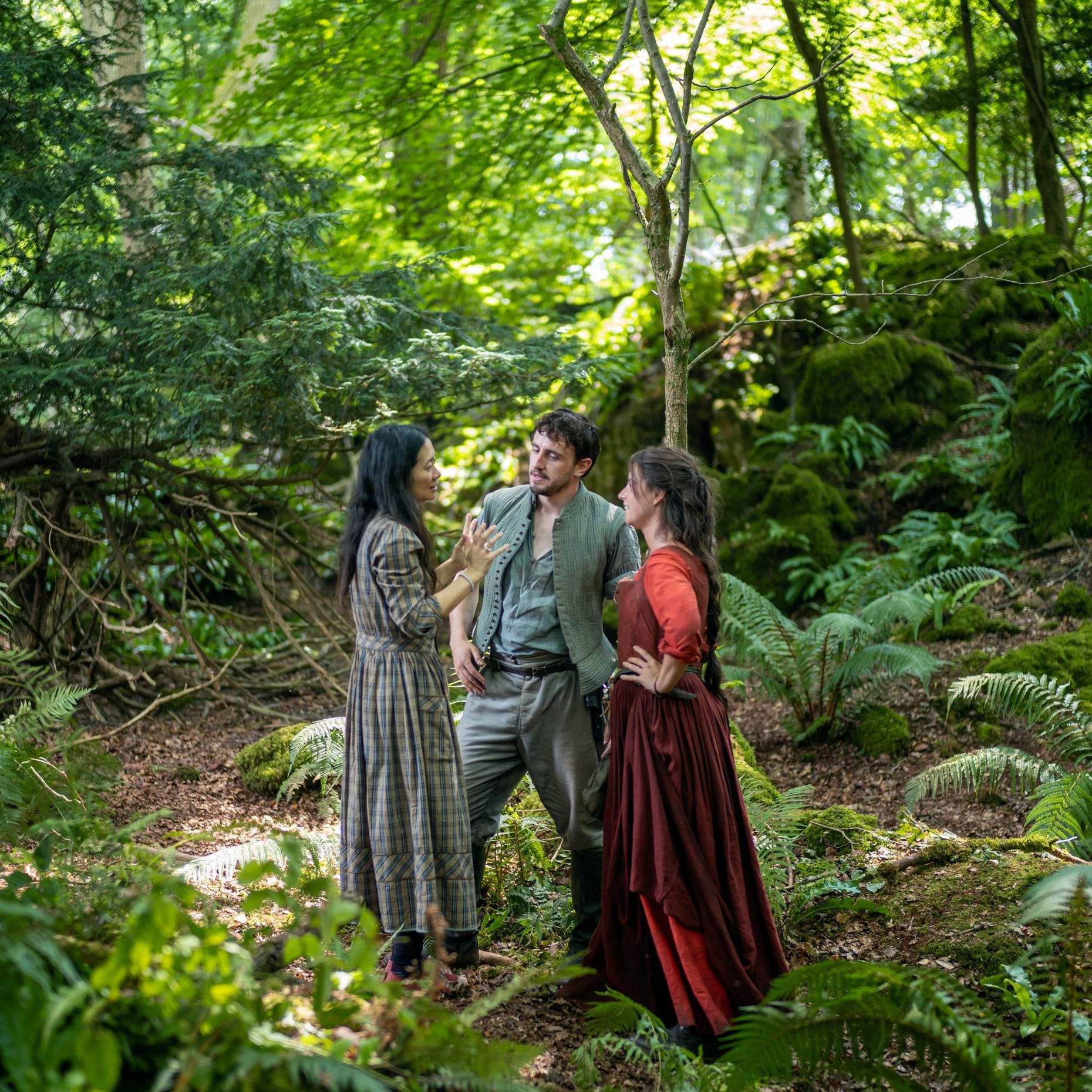
You are listening to all of it on wnyc. I'm Alison Stewart. This week we are counting down the days until the 98th Academy Awards. They're happening this Sunday. A quiet film that focuses on the way we each experience grief. Hamnet is nominated for eight Oscars, including Best Picture, Best Best Adapted Screenplay and Best Director. Chloe Zhao. This was her first time adapting a novel. Zhao described the process as like an hourglass, beginning with Maggie o' Farrell's original book and distilling it piece by piece and then allowing it to expand again for the cinema. Chloe Zhao joined me to talk about the movie, which follows William Shakespeare and his wife Anne Hathaway as simply Will and Agnes. They are a young married couple who find a lot of joy in each other. Agnes is considered a bit odd around town. She's gifted with special foresight and has a deep connection with the forest, but Will appreciates what makes her her. Soon they have three children, Judith, Susanna and Hamnet. When young Hamet dies without Will being there, Agnes is left alone with her grief. Will channels his pain into a new play. I think you can guess what that play might be. Here's my conversation with the Oscar nominated director of Hamnet, Chloe Zhao. Thank you for being here.
- [03:06]
Chloe Zhao
Thank you for having me.
- [03:08]
Alison Stewart
When you first read Hamnet by Maggie o', Farrell, what impressed you about it the most?
- [03:15]
Chloe Zhao
I love the world building. I love the little intimate little moments of everyday life, domesticity, but also how grand and cosmic it feels because the way he connects the characters to nature and to the world that is unseen.
- [03:43]
Alison Stewart
You had a very interesting working relationship with Maggie. Tell us a little bit about how.
- [03:50]
Chloe Zhao
Define interest.
- [03:51]
Alison Stewart
Interesting meaning like. Interesting like, like it's a. It's like, oh, you can work that way. She would have an idea, she would send it to you. Would you explain that for our audience?
- [04:04]
Chloe Zhao
I think it's the other way around. Like, I would. I would have an idea and I would send her voice notes.
- [04:10]
Alison Stewart
Voice notes, okay.
- [04:11]
Chloe Zhao
She tells the story better, but I will send. She'll wake up in Scotland and her phone will go off and there will be many, many voice notes from me. And I. I don't talk linearly. I tend to talk in a spiral shape. I'll talk and I think and I'll get to a place and I'll just stop. Okay. And then I'll get. And then my. The point will show up. But I don't always go in knowing what I'm going to say. It's a feeling, an intuition. And then. So they're long. And I believe there was one time it was 58 minutes long. And her daughter walked in and said, what podcast are you listening to? She said, it's Chloe. I'm taking notes. Shh.
- [04:55]
Alison Stewart
You had a 58 minute.
- [04:57]
Chloe Zhao
I didn't know it was 58 minutes. Felt like five minutes to me.
- [05:02]
Alison Stewart
Well, you had something to say.
- [05:04]
Chloe Zhao
I guess so.
- [05:07]
Alison Stewart
That's so interesting. So you took a 58 minute phone message. Voice message. And you gave it to her. And then what did she do? It could be a 2 minute, 58 minute. Whatever it was, whatever voice message you sent to her. What did she do with that?
- [05:20]
Chloe Zhao
That I'm not sure. I think she has a notebook. She takes notes. And then she tried to do what I asked her to explore. It's like I have a seed. And she puts in her garden and her greenhouse and she comes back not with the final product, but with a seedling strong enough. Right. And then I plant it, water it, put the compost on my. And occasionally, like I bring it back to the greenhouse with her and go like, you know, like maybe he wants a companion plant with something else, you know, that I don't. Because she's my bridge to the wild forest beyond the garden. That's her world. Right. I don't have access to that.
- [06:09]
Alison Stewart
What did you learn about writing a novel? The way you write a novel that you didn't know before. Because now you had to take this novel you've read, you liked, you loved, and you had to turn it into a film.
- [06:21]
Chloe Zhao
Uhhuh. Like the process of adapting a novel that I didn't know before. I've never adopted a novel, so it's my first time. No, my land was non fiction. It was a journalistic piece. So it's the first time I adopted a novel. So this is. I guess this is what I learned that I haven't learned it before. Maggie described it as like the process, like an hourglass. So the sand has to it sort of get distilled to the central. The little neck of the hourglass. That's what we do when we take the sand of the novel. We allow it to distill it down to this little shape and then allow the filmmaking process to expand it again. So so much is about taking things out and be very clear on what of everything in the novel. The novel is about so many things. What is the path we want to walk, you know, back to the forest. We have to choose one path. And sometimes that means letting go some sceneries. Really beautiful ones. Yeah.
- [07:44]
Alison Stewart
My guest is Chloe Zhao. We are talking about her film Hamnet. In your research, what did you want to know about William and Agnes?
- [07:56]
Chloe Zhao
My research really started when I found my cast, you know, because Maggie already done her research and her book is her interpretation to that research. Right. And so I myself don't need more than that, but my job is to how to take that that is written on a page has a different quality when it comes to time. Because when something is written, it's written in the past, a script. My job is to take that character that exists in the past. Not past because it's Shakespearean, but it's written a month ago, a day ago. But bring that character to the present moment, allow the camera to capture that character existing in the present moment. And that's my job. Half of that character will show us who they are through our actors, moment to moment. So my research is on the day. It's almost like the research happens all the time until we say cut at the end of the day.
- [09:08]
Alison Stewart
You always knew that you wanted Jessie Buckley for this part.
- [09:12]
Chloe Zhao
Yes.
- [09:13]
Alison Stewart
What skills does she have that you knew that she would be your Agnes?
- [09:21]
Chloe Zhao
You know, beyond being an actress, she's a storyteller. You know, she's a. She's an artist herself. And she needs to. She has that same compulsion to create in order to survive in this world the way Shakespeare does. Just her language is a bit different, you know, and so I knew she's going to be able to create Agnes language for me because Agnes had a different language to create the way Shakespeare did. And that is a language we have forgotten. And Jesse is looking for that language, that lost language, as an artist, as an actress, and also as a woman.
- [10:04]
Alison Stewart
She also has a beautiful singing voice.
- [10:06]
Chloe Zhao
Yes. I actually didn't know these things when I thought of her. I have not seen Wild Rose. And then once I cast her, I started to watch more of her films and I saw that film. Oh, wow, you can sing. And then I recently discovered she was like, not only she could sing, she was singing at really epic events and singing competitions, things like that.
- [10:31]
Alison Stewart
But she sat in that chair and sang practically acapella. And we were blown away.
- [10:37]
Chloe Zhao
Really.
- [10:37]
Alison Stewart
It was amazing.
- [10:39]
Chloe Zhao
Yeah, I tried to get her to sing lately, just sing something. She's like, no, too shy. Too shy. But yeah, her voice is amazing in
- [10:49]
Alison Stewart
the book and in the movie. She has sort of a special quality about her. Yeah, she's got like a sixth sense. It's almost witchy in the best way. How did you and Jessie talk about this special sense and what it would mean for her character?
- [11:10]
Chloe Zhao
The word witch has. The meaning has been quite misunderstood. And there's a lot of projection for tens of thousands of years on that word. Because what is a weather witch, for example? It's just somebody who's taken their time to watch the weather, who are a bit more sensitive to the changing temperatures and who has an intuition with animals. And really it's just a level of sensitivity. And so then they see patterns and they recognize these patterns and then they can, quote, unquote, predict the weather and it's same. And all of us are, you know, we. All our bodies are designed to speak that language. But modern life does shut down that sensitivity. I love your face right now.
- [12:07]
Alison Stewart
I was like, yes,
- [12:10]
Chloe Zhao
so particularly for women, you know, we were born more so with that sensitivity. And that's our power. And I understand why it was, you know, considered dangerous because it's extremely powerful. And that's the language of Agnes, you know, so. So for her to have this sensitivity, this Intuition about him, to have a vision about him. You know, in many, many cultures around the world, vision is considered a feminine quality, you know, and then the masculine quality can go out there and make the vision become true. And that's within all of us. We have intuition, we have action within all of us. Unfortunately, the intuition part is missing. So we keep going out there and act and act and build and conquer. But we don't sometimes forget, why are we doing this? So it's really satisfying for me and Jesse. We talk about a lot like, how can we, even while making the film, try to make the film in the language of Agnes, not worry too much about logic and about knowing everything, about controlling everything, and just allow the mystery to guide us half of the time.
- [13:32]
Alison Stewart
Let's listen to a scene from Hamnet. This is Anya talking to her son about what she sees in his future.
- [13:45]
Chloe Zhao
What do you see? I see you grown and very strong. I see you in London working with your father in the theatre at the playhouse. What will I be doing? What do you wish to do, Hamnet? I should do? Be one of the players with a sword. Sword, yes. And I shall clash it against the sword of the other player. Show me. There'll be a terrible fight and everybody watching will be frightened out of their wits.
- [14:33]
Alison Stewart
And who will win?
- [14:34]
Chloe Zhao
I shall, of course. Of course you shall.
- [14:38]
Alison Stewart
That is from Hamnet. My guest is Oscar winning director Chloe Zhao. We're talking about her new movie, which she also co wrote. It follows William Shakespeare and his wife Agnes as they grieve the loss of their young son, Hamnet. It's in theaters now. This is also a portrait of a marriage as much as it is a story about motherhood and about grief. What did you want the audience to either understand or to feel about Will and Agnes and their relationship before the loss?
- [15:17]
Chloe Zhao
They're very different and they're different in a way that you understand why they needed each other. So he was all about structure and order and control. You meet him, he's inside a frame and his wild animal is locked away. He grew up in an environment that's violent and not accepting of who he is. He has to only be a certain way to be safe. Her wildness is in full display and yet could be very chaotic and out of control because she had no structure around her. You know, she loves her mother at a young age and she knew the structure that Joan, her stepmother provided is going to. Is going to turn her into someone else. So she's looking for someone who can hold all of her and accept her and see her for who she is. So he needed someone to see what he could be and she needed someone to accept and see her for who she is.
- [16:34]
Alison Stewart
You're listening to my conversation with writer director Chloe Zhao about Hamnet, which is nominated for eight Academy Awards. We'll have more after a quick break. This is all of it. This is all of it on wnyc. I'm Alison Stewart. You're listening to my conversation with Chloe Zhao, co writer and director of Hamnet, which is up for eight Oscars, including best Picture, Best Director and Best Adapted Screenplay. Here's more of my conversation with Chloe. I can't remember if I read it or I saw it, but you said that you were a tantric practitioner and you did.
- [17:28]
Chloe Zhao
I am a level one, very early training in training.
- [17:34]
Alison Stewart
But. But you use that with your actors. Yes. The, the feminine.
- [17:38]
Chloe Zhao
Yes.
- [17:38]
Alison Stewart
And the masculine side. How did that help you with the relationship and creating those characters?
- [17:46]
Chloe Zhao
Well, first thing first, you help you put them in their bodies. You know, is, that's, that's the best. Where the best acting come from. And, and then secondly, there's a lot of how people should be. You know, we haven't, we come, we're better now, but we still have different sides of how people should act, what is appropriate, what isn't, but in a safe place. And this is what theater is for. This is what art is for, storytelling is for. It's for us to show a full spectrum of human condition and experiences. Right. So people, they can see themselves in and not hide anything. And so to create a container and to allow them to physically embody the energy of their gender self to the full extreme and giving consent and safety for them to interact with each other physically with those energies. What happens that you have chaos, total chaos, meaning total order. And that's how the universe is created. You know, in nature, this is this. These two energies clashing into each other and harmonizing and making up with each other. That's how the universe expanding. So it's really beautiful to see them embodying these energies and then, and then finding how they mold with each other. Because then when you plant that in your actors bodies somatically, it doesn't accomplish anything like rehearsing a scene, but when you're shooting, it's going to come out in ways that you would recognize. You go, ah, there's that moment. Ah, there's that moment. So it's a spiral shape, right. It's not going from A to B to C to D. Sort of go in circles and then you, you know, on a good day, you land on the spot, you go, that's why we did that.
- [19:47]
Alison Stewart
In this movie, you grapple with Will, not necessarily Shakespeare, the man, sort of the iconic writer. You deal with him as a man.
- [19:59]
Chloe Zhao
Yeah.
- [20:01]
Alison Stewart
How hard was that?
- [20:04]
Chloe Zhao
Not hard at all, because he's just a man. And that's the thing. All of us like all these things that we put on top of us, right? Names and accomplishments and titles and this and that. But at the end of the day, biologically, we have to eat. You know, we will die. We will die. And so I think that's actually very easy for me.
- [20:35]
Alison Stewart
It was interesting. One of our colleagues, I didn't realize it was Will Shakespeare until he. It was clear to him. They said it in the film. And I thought that was a good testament to the film.
- [20:48]
Chloe Zhao
During test screenings, there were moments when it gets to that last moment. You see people in the audience go, oh. And I thought, I don't know if that's a good thing. We need them to know. Let's make sure when we market the film, it's very clear. Yeah, I think it's great that people feel that way, even though if they know it's him, but. But it is important that they know it's him because it helps give some tension to the film.
- [21:15]
Alison Stewart
My guest is Oscar winning director Chloe Zhao. We're talking about her new movie, Hamnet. There are two birthing scenes in this movie, and they're very intense in different ways. What did you want to accomplish with those childbirth scenes?
- [21:31]
Chloe Zhao
Maggie rolled so beautifully in her book, and I think she feels very passionate about the way a woman's body, you know, and really all of our bodies have been constrained into, like, how it should behave intellectually or societally, as opposed to listen to the wisdoms of our bodies and say, what. What do you need right now? How would you like to give birth? You know, and the body knows. We're designed to know how to be born, how to give birth, how to make love, and how to die. I also recently trained as a death doula. Really?
- [22:12]
Alison Stewart
Now my friend is training that. Yeah.
- [22:14]
Chloe Zhao
You know, and that's a whole different conversation. But the body knows how to die. And so the first birth is very much. She's trying to listen to her own body and not romanticizing it. You know, it's. It's very. It's also. Things happen so like it is in nature. So when she goes to the place where her mother also gave birth, you know, in the. In the hollow of this Tree. She's not. We're not saying right there is the safest way to do it. Nothing will go wrong. Actually, that idea is why we start controlling it. She's going surrendering herself to the rhythm of nature and to what her body wants to do in that moment. And the second time, not so much. You know, it's a little bit more difficult. But at the same time, there is a different kind of surrender to that, which is also beautiful because this is the reality we live in now. So there's the. Is human beings community. You know, the way she connected with Mary in that birth scene, you know, so, yeah, it came up in the
- [23:22]
Alison Stewart
film that death is a part of life. And they have a discussion about children dying. And I spoke to Maggie O' Farrell when the book came out in 2021, and she talked about the fact that childhood mortality rates were high back in that time.
- [23:40]
Chloe Zhao
Very high.
- [23:41]
Alison Stewart
Let's listen to the clip. We could talk about on the other side.
- [23:43]
Chloe Zhao
Yeah. I just refused to accept, and have always refused to accept that, you know, anywhere in the world at any time in history that losing a child is anything less than catastrophic. I refuse to believe that people's hearts weren't broken over and over again. I mean, Shakespeare himself had three sisters who died, two of whom died as infants before he was born. And he had another sister who died age 7. And I don't believe that his parents didn't grieve for those daughters. I mean, who would be callous enough to suggest such a thing?
- [24:15]
Alison Stewart
Do you agree with her?
- [24:17]
Chloe Zhao
I do. I do. And I think grief is something. Grief is something that something much bigger than us had designed us to have for a reason. Because without grief, there's no empathy and there's no love. And we connect with each other through our grief more than our joy. And so I agree. At the same time, I think how we deal with that grief has been changing. So the narratives we put on, that gives a different weight now than before.
- [24:59]
Alison Stewart
Hamnet is about motherhood. It's about a couple. It's about individuals, and it's about grief and how two different people will handle grief so very differently. Do you relate to that as a creative person?
- [25:20]
Chloe Zhao
I do, and I have. I see these two trends, not the most graceful word, but of how grief or doubt, and you kind of sign them sometimes to these two different energies we talked about earlier. And what they love about each other at the beginning turned out to be a big obstacle because they're so different. Right. And then they are drawn to each other. But Also because they're so different. When something like this happens, it's almost impossible to see it from someone else's perspective. He can't express that grief. For him, if he starts crying, then he will be crying until the end of the day. He's held every tear in since he was a little boy, so he can't do it. And he also needs to hold space for people in his lives and for her. Her grief is so overwhelming, and I can relate to her in that sense. Without some kind of container, I'm just grabbed by the complexes. I can't get out of it. Right. Frozen. So in a beautiful way, the only way for him to survive is to find a way to express it. And that is his safe place, is his art, his fantasy, which I also can relate to. But because he did that, like many, many artists. Right. That's how they deal with their grief. Because they did that, she and that audience is able to have a container. And that container is in the shape of a play, a film the size of a theater room or a circle of a globe. Within that container, the chaos of their grief gets to have meaning. So in the end, they needed each other as much as they did at the beginning.
- [27:17]
Alison Stewart
When you and the cast had a particularly tough day, you would dance at the end.
- [27:23]
Chloe Zhao
Yeah.
- [27:24]
Alison Stewart
What did the dancing do for you? What did it do for your cast members? What did it do for the DP and the grip and everybody else on set?
- [27:33]
Chloe Zhao
Well, part that I learned that in my tantric training, you know, is emotions, is energy, motion. A lot of the. Not only the emotion you feel in the moment, but the things that trigger from your trauma, and maybe not just yours, but things you held in yourself for generations. Sometimes Audi really needs is to shake it off, to move it out of you. And that's scary because when you do that, more will come. You really feel like you have to let go of that control of that emotion, and. Which we've been told to control it. Right. And. And. But if you. When you start dancing, you go into your body, and then the body's gonna do what it needs to do, and you have to let go of the control. So when you start blasting rihanna and when 300. And when you're told, you know it's part of the scene, because it's not just turn on the music, by the way, we. We choreograph it. Oh. We start the scene as how the scene is like, Hamnet's dead, and then he comes back to life when Staying Alive playing. So, like in the middle of the scene, music will come and they have to dance themselves out of the scene and then the crew would join. So it feels very purposeful. But also when you see others do it, it gives you the permission and it's not mandatory, but everyone ends up joining even if just waving their arms.
- [29:00]
Alison Stewart
And what do you hope people will talk about after viewing the movie? After people stop crying first of all, and then they go out, they have coffee. What do you hope they talk about?
- [29:20]
Chloe Zhao
I feel that if they could share a little bit about themselves with the person they're with or just with themselves that maybe they haven't felt safe or comfortable sharing and just say to each other and to themselves, I see you and all your emotions or feelings are welcome. It's okay.
- [29:44]
Alison Stewart
That was my interview with Chloe Zhao, co writer and Director of Hamnet. The film is nominated for eight Academy Awards, including Best Picture, Best Best Adapted Screenplay, and she is nominated for Best Director. We'll have more conversations with Academy Award nominees throughout the week. Ahead of Sunday's ceremony and our and on our Instagram stories, we'll have our big picture conversations. For those whose work is behind the camera, our Instagram is of it WNYC
- [30:13]
Financial Services Advertiser
when you invest with Fidelity Go, it does all the work for you. So while Fidelity Go monitors the markets, rebalances your portfolio and tracks your progress to keep your investments aligned with your goal, you can invest your time however you want, all while paying no advisory fees. Under 25k. Invest your money, not your time, with Fidelity GO. Get started@fidelity.com go Advisory services offered by Strategic Advisors, LLC, a registered investment advisor. Brokerage Services provided by Fidelity Brokerage Services, llc, Member NYSE and SIPC there's an
- [30:44]
Commercial Narrator
SUV that turns the unthinkable into the unforgettable. The new Nissan Pathfinder. Built for big adventures and all that family chaos. It's powered by a strong V6 engine with a nine speed automatic transmission. Inside, it's rugged and capable, but still premium and tech forward with room for up to eight passengers. It's also available with seven passenger seating and second row captain's chairs. With massive hauling capability. Now you can bring all the gear you and your family need for unforgettable adventures. The new V6 Nissan Pathfinder power your adventure.