Loading summary
Transcript45 lines
- [00:09]
A
This is all of it on wnyc. I'm Alison Stewart. To tell the story of Victor Frankenstein and his creation, director Guillermo del Toro and his team built a colorful version of Victorian England that popped on the big screen. And a big part of that vision involved my next guest, Oscar nominated costume designer, Kate Hawley. From electric blue feathered headpiece to blood red gloves to ice encrusted uniforms by soldiers, Kate's costumes are bold. Kate drew inspirations from all different places, from David Bowie to Tiffany and company. Her work on Frankenstein has earned her an Oscar nomination for best costume design. It's her first. She joins me now to discuss it as part of our ongoing series, the Big Picture, celebrating Oscar nominees who work behind the scenes. Kate Hawley, welcome to all of it.
- [01:00]
B
Thank you, Alison. What a treat.
- [01:02]
A
So you've worked with Gilmour. Excuse me, You've worked with the director before.
- [01:09]
B
I think it's like three and a half times. Am I allowed a half?
- [01:12]
A
You're allowed a half. What did you were. What did you learn from those experiences working with him that helped you on this project?
- [01:20]
B
I think, I mean, I'm always surprised in the process. You know, he always throws a curveball somewhere in there. But I think when we met for the very first time we met, it was a shared love and language of books. I think he looked at my bookshelf and that was the deciding factor as to whether we could work together. I mean, it was a kind of obscenely grotesque bookshelf. I had Goya and other painters like that, but we had a common language and I think that's. And a foundation of art history in that. And he's an incredible man of literature, of art, of music. So. So, you know, it's not hard to sort of develop that language when you have someone who's so visual.
- [01:58]
A
It's so interesting. What was on that bookshelf?
- [02:01]
B
I had Joel Peter Whitcomb. I mean, you know, you go through your student days and you go as grotesque as you can and then, and then you sort of become sort of more grown up and middle aged and you want carpet and the books change a little bit, but lots, lots of art books, lots of, you know, all kind. I'm interested in books of all kinds. I think books are something to cherish. So I'm a big collector of them.
- [02:22]
A
So you get a project like this and they're known for their amazing costumes. Guillermo's projects have makeup and production design. But you said in an interview, and I thought this was so interesting that you usually start with one moment. When something is so extreme, you've got so much to do, you start with one moment. What was your moment on Frankenstein?
- [02:45]
B
Oh, well, actually, I think first of all, after reading the script, it was. It was the moment of. We first discussed the moment being Victor on stage in the medical lecture theatre. And then there were a couple of other moments. Sometimes they're not big moments, sometimes it's just a small moment, but you have a clear moment of what the vision and language is. You know, that's the texture of it, the feel of it. So I work across things and I think the bride was another one, you know, like. And then gradually you sort of. As you put pins in the wall, you know, you start to build the framework and the language from there. So lots of moments within drawing as well, lots of sketches to find it.
- [03:24]
A
What role does Guillermo want the costumes to play in his films?
- [03:28]
B
He always describes. He goes, kate, you have to. You reflect the set, you reflect the architecture, the environment. And I think the important thing when you're working with Guillermo is for everybody to know that he regards all of us as one department. So that includes, under that umbrella, production designer, cinematography. In this case, Dan Lausden, production designer Tamara Deverell. You know, we're all. And Mike Hill, the creator of the creature. So we're all. All really one department. So when he asks me to reflect the environment in that, it's. I'm looking at how that relates to. In color, texture, mood. Does the character sit within it or without that, out of that world, you know, are there. You know, there's lots of language that we use in composition and form that I use, and there's repetition of imagery. There's all sorts of things that are sort of layered through, both through color, both through texture, both through form and imagery. You know, he. The imagery within the script, which is the Bible for me, that's where I come back to had images of religion and mythology and nature. So all of that, all of that gets tied up in what does this character wear?
- [04:38]
A
That's interesting, though. It sounds like a collaboration is involved.
- [04:42]
B
It's always a collaboration, I think. Many years ago, I studied at Motley Theatre Design course in London, and I was always taught that, you know, the sets aren't complete until the characters is standing within them. And it's the same with when I build a character until hair and makeup have contributed there, but. And of course, most importantly, the actor, you know, you have to. It isn't collaboration. What each department does is emphasising or echoing what every other Person does. And, you know, really, I liken us to, you know, parts of an orchestra that Guillermo is conducting. And, you know, so we sort of, you know, come and go in terms of focus with that. And I. You can't. All our work is elevated by each other's work, you know, because we share the language, because we understand the. What Guillermo is trying to do for his overall vision. It makes everything stronger, you know, you can't be an island in this world, you know.
- [05:38]
A
Hope not. We're discussing the costumes of Frankenstein with costume designer Kate Hawley. Her work has earned her an Oscar nomination for Best Costume Design. We're speaking to her as part of her ongoing Oscar series, the Big Picture. When you sat down to think about the designs, were you committed to historical accuracy, or did, you know, you wanted to change things up a little bit?
- [06:02]
B
Guillermo, definitely, when we started talking, he said, kate, let's push things. I want it to have. He wanted a very operatic feel, the sort of melodrama we talked about, the dream of it, you know, the melancholy and tone. All of those things are more poetic, kind of demands a more poetic language and a more heightened language. So I always use, you know, by the nature of him putting in the Crimean War as the backdrop, meant that I still had to use a sense of historical silhouette and, you know, a level of, you know, some level of realism there. But everything was pushed within that, and some moments were pushed more and some less. As he'd always go, Kate, too much.
- [06:43]
A
He's not.
- [06:44]
B
He's not that good in coming forward. But that. But that's what's wonderful about having a relationship that you've. You know, when we've worked together before, you know, ego stands at the door very firmly, and, you know, it's about getting to the best idea and the best thing for the production.
- [06:59]
A
Oh, that's interesting. You can go too far with Guillermo del Toro.
- [07:03]
B
Yeah, I can. Well, I did once tell.
- [07:06]
A
Oh, do you mind telling us what it is?
- [07:09]
B
Oh, well, innumerable times, I would say. But. But also. But. But also, what is. You know, this is such a personal story. He's lived with this for so long, so he's got the bigger picture as director and as, you know, an artist himself, he's got the overall picture. So I'm always discussing things in relation to costume and possibly to set, because Tamara and I are always in those conversations. But, you know, the way I can describe it is then when you see him edit, and he would share with us the edit of the day, or he was cutting it in front of us sometimes on set and invite us to that. And then you go, oh, I was asked to do this thing. And then I never understood why at the time. I mean, you don't always question him. And then the next minute you see the cut and you go, oh, that's what. Why it was happening, you know, because it was answering to another thing. So, you know, there's a kind of benevolent hierarchy here. And. But it works. He's a. He's a. He's the visionary behind it, and he's got all these complex things he's weaving in. That isn't just my department.
- [08:08]
A
Let's talk about the creature costume. The first time we see the creature Frankenstein, he's walking across the frozen tundra and this, like, gigantic fur coat. It makes sort of a dramatic silhouette for the creature.
- [08:21]
B
He's a gigantic man.
- [08:23]
A
He is a gigantic man. He's. He's a big guy. How much were you keeping silhouettes in mind when you were designing clothing?
- [08:31]
B
You know what? That's where I very. I start very at the beginning, because sometimes in terms of process, you can lock yourself in by doing a finished illustration, and that's not what the process is. It's a tool. So often when I'm working with Guillermo, and it depends on, you know, who you're working with. But with Guillermo, I'll do lots and lots of quick sketches. And I have illustrators like, I had Dane Magwick working with me on this, and we did many, many little thumbnail sketches because Guillermo is interested. And we discussed the idea is, you know, what is the point of view from the sailors when we first see this creature? Is it a beast or a, you know, a bear coming out of it? So, you know, by doing that, we can kind of lock off a silhouette and then work the details from within and then also use that idea, that kind of process, sort of sketching out the whole arc of the character. So I'll do this with every character going through all the main story points, and then work in with the detail and start building fabrics and applications into that.
- [09:28]
A
Let's talk about Elizabeth, the woman Victor is in love with, who takes a real interest in the creature. Elizabeth doesn't seem to be like other women. She loves bugs. She likes science. She's not at all afraid of the creature. How did you want to convey what is special about her or different about her? Through her costumes?
- [09:49]
B
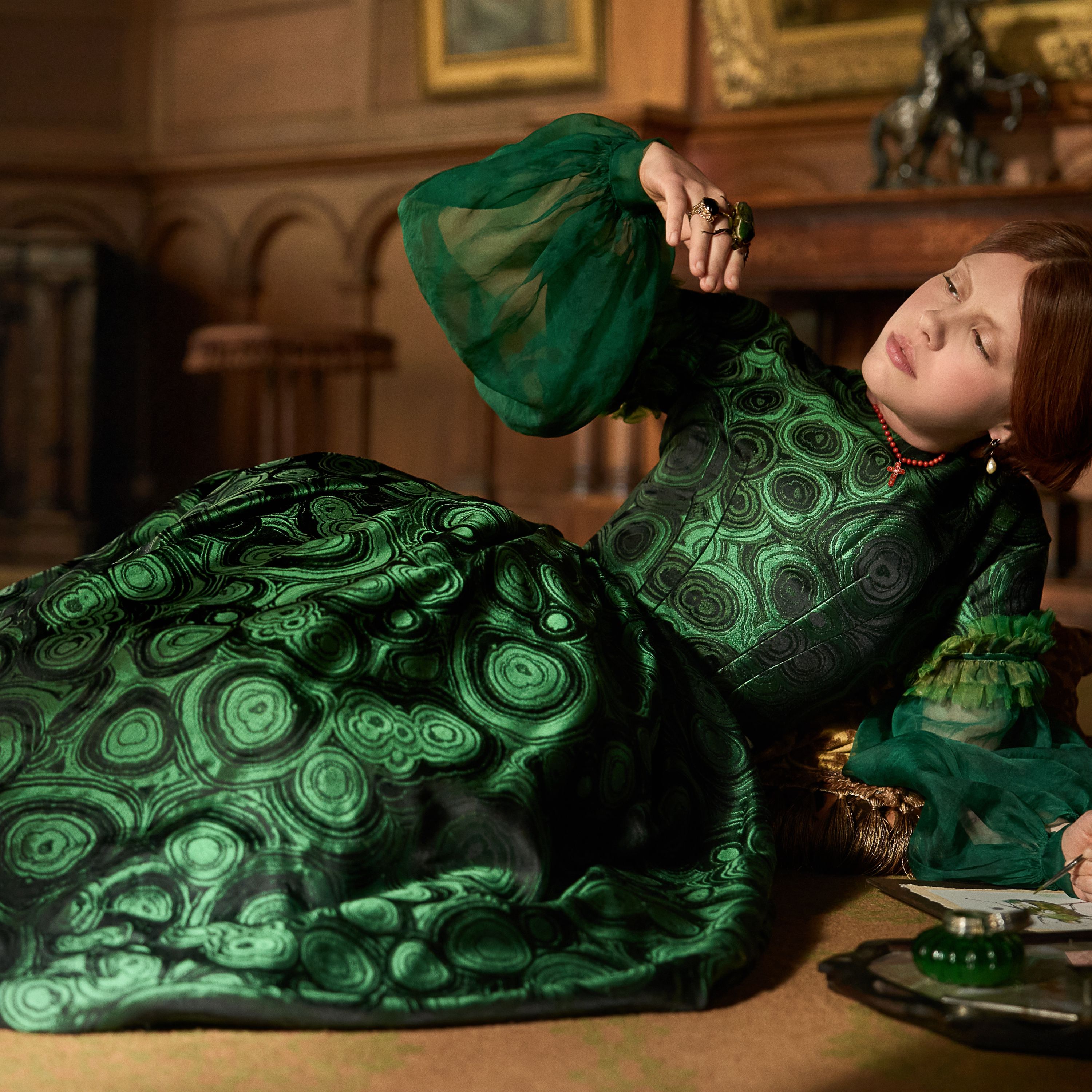
I think she sees the beauty and the imperfection in nature. And then for her, Guillermo again wrote these little character biographies, and in it, she Reads a book. She's a follower of William Paley, who was a theologist of the time and believed that God was present in every aspect of nature. So I think for her, when she sees the creature, she sees the beauty in him, and it's not the ugliness and the horror at all. And so, you know, this conversation of, you know, the Beatles and her being a little outside the norm, you know, in one of the earlier scripts, and I think it's mentioned in the text anyway, is that she is in a convent, you know, trying to find her own space in this world. And in some cases, she's an object of highlanders. So all of these things came through. And as we were starting to build the color palette, you know, Victor's world was red, white and black. Then we talked about looking at the reference for Beatles for color, these blues and greens that sort of echoed Harlander's world, but hers were more intense, stronger. And then Guillermo asked, you know, because she sort of. She's almost got a dreamlike quality. And I've say this about Mia as much as I would about Elizabeth, and that she's almost, you know, you can't catch her. There's this almost constant change in metamorphosis, and she has this dreamlike melancholy to her. So Guillermo asked me to make her quality feel very ephemeral and ethereal. So the colors became strong, and we used. Looked at iridescent beetles for reference, the blues, the greens. And then that worked its way through fabrics in terms of textiles that we wove created patterns for. And then using the use of veils and that and the layers of transparency. And then sometimes you'll see patterns that change and move with her as we go through. And how we look at her all the time is changing. And then this image of her behind veils is all about memory, you know, layers and layers of memory within it. So Mia brought a lot of that with her performance as well. And often, you know, I mean, it's a huge part of what we do with characters, really sort of supporting what the actor's doing as well. So again, it's another kind of collaboration. And I feel like I'm just trying to pull out and emphasize those moments that we see with her.
- [12:04]
A
Yeah, it's interesting you're talking about the actor, because Mia Goth is a particular kind of actor. Jacob Elordi is another kind of actor. His physicality. How often does an actor help you shape the designs of the costume? You may have an idea, but then you meet the actor and do you have to shift your thoughts at all.
- [12:26]
B
I think you always have to be open to, you know, you again. Everyone comes with their own. You know, they've read the script, they come with their own vision. I do have in the fitting room the whole world around me. So I have all Tamara's production design images, I have all the other character images. You know, I try and give them a sense of the world as much as possible. Guillermo is with us at the beginning fittings because that's when the shaping is coming. It's really important your director's part of that process, and things are discovered. And often, you know, sometimes I can be a bit of a bullet agate, but I've really learned to stand and watch. You know, when you're doing that first fitting, letting them move and it discover things, explore things. You know, there's things that came out of that fitting with me. The way she moved and the way she would fall into the floor. And we gave her beetles to play with, not live ones, you know, and then the whole thing, you know, then there's this wonderful conversation with her and Guillermo. And so your job's to listen as much as to offer things and then shape through that. And, you know, it can be a very ordinary thing. Like, you know, how does this fit? What's the practical elements of that? What has to happen to it is the comfort. And then there's what would Elizabeth, you know, how do we capture a moment and emphasize it? You know, what is she feeling? A lot of it was a lot of based on feelings. And Mia has such an unusual, mercurial quality to her. And both she and Jacob, you know, all our actors, Oscar, they're so dedicated to their process, but also to play and trying things. And, you know, we build things and then we. We create things to play with amongst that, too. And finding the moments. And, you know, watching how Jacob moved when he first came, I mean, that poor man was thrown into this in such a fast. He only had a few weeks, and next minute he was being shoved into a fitting room and. But we had Micah as part of that process and seeing what Mike was doing, how Jake would move and articulate those limbs, how he would work and exaggerate his performance. It's about that, about movement, all of those things.
- [14:34]
A
We're discussing costumes with Kate Hawley. She designed them for Frankenstein, and her work earned her an Oscar nomination for Best Costume Design. Talk to me about creating Elizabeth's wedding dress.
- [14:48]
B
Oh, yes. No small feat to be no small burden, should I say, when Gemmo wants a Bride. And it's Frankenstein. You know, he and Mike are creature designer. They call themselves Frankenheads. So I came knowing the novel. Yeah, I know. No, this is a very real thing. And, you know, they have help sessions on it. But I came knowing that only knowing Shelley's work. But the Guillermo. Mike knew every iteration, every film iteration, every. You know, they're total geeks and, you know, of course, some of that rubs off in the ether. And we were talking about the bride, and I know we wanted to do. Create a sort of. It was a lovely moment to do a homage to Elsa Lancaster. And, you know, working. You know, I started working within the silhouette and playing with this idea. Just as I reflect the sets and the environment. Elizabeth, at this part of the story reflects the creature's world. And so his world is full of anatomy in the body. And even the cell that you look at that Tamara is designed is almost like a rib cage. So I sort of took those elements and then played with it. And we exaggerated that in the bodice that she wears. But we really approached it like the layers of an X ray. So that dress has about five or six layers. We wove a silk to match the weight because we knew movement was a really important part of this. Then we had the layers of the sort of ribbon corset that echoed the bandages of the creature and also the rib cage of a human. And then we had layers and layers of very fine transparent fabrics that sort of were ombre and dyed. So the moment when she is killed, the bleeding through the bloom of blood comes through the dress and transforms her into, you know, an atomical piece of flesh, really, you know, sort of like more reminiscent of Those sort of 19th century human anatomy paintings. And so that, at that point then completes the sort of visual story of the red that Guillermo is telling throughout the story. So there's many layers. And then the jeweled cross that she wears and the two heraldic brooches which also echo the creature's chains. We collaborated and created that with Tiffany's. So that was an amazing. An amazing process to be doing that. So the jewellery was part of that as well.
- [17:05]
A
I wanted to ask about a moment with Victor, who's played by Oscar Isaac.
- [17:09]
B
Oh, we love Oscar Isaac.
- [17:11]
A
Yes, we do. He messed up an element of his costume. He got it rumpled or messed up in some way. And you decided to just leave it and not adjust it.
- [17:20]
B
Yeah.
- [17:21]
A
Why did you do that?
- [17:23]
B
Well, it supported his performance as Victor. He was being Victor and Victor, in a way of being a passionate artist. And all about the work. He has beautiful clothes, but wears them in a really irreverent way. Guillermo wanted him to strut around like a bit of a rock star. You know that medical lecture theater where we first see Victor, that's his stage. And Oscar walked on and, you know, sort of, you know, with his hands outright and a posture that kind of reminded you of Bowie or Prince. And his physicality was always playing to the audience. And so the clothes move and get pulled out. And we actually resisted the. There's always a temptation in the middle of continuity to go up and tidy everything up. But this was such a big part of Victor's physicality, and it was fine to be rumpled and not perfect. He wears his clothes irreverently, and it's part of. He doesn't care. You know, he's about passionately trying to sell his idea and tell his story. And Oscar was so fantastic like that to work with, you know, constantly, you know, in fittings, playing with these things. And, you know, how can we emphasize that? How can we exaggerate this? You know, could this be a good moment to wear that? You know, it's a constant play. The play never stops. And I love that when you have your actors doing that.
- [18:37]
A
We talked to another costume designer who worked on Nightmare Alley with Guillaume. Yes, Luis Acciara, and he said, very brilliant. And he told me that little details like a button, might seem small, but when it's blown up on the big screen, it becomes much more visible.
- [18:53]
B
Yes.
- [18:54]
A
What's an example for you in this film?
- [18:56]
B
Well, I think. I think the whole film, really, you know, and tomorrow will speak to this, is that we're dealing with the macro and the micro. So maybe it's Highlander shoes, the heels of Highlander shoes, or the detail in a glove, the little Medusa that the Leopold Victor's father's wearing. You know, the stitching on the back of the dresses that echo the spine of the creature. You know, all of that language is just there as our layers. We just build layers all the time. So sometimes the layers are small and sometimes they're bigger, so and so. And sometimes it's just the way we're dealing with the textile effect. You know, it's all part of that storytelling. We made buttons for the creature's coat based off the Crimean War. You know, we've got all these buttons. So we made. Because we made many Crimean War coats for the. The battle scene and things, so. Or the, you know, the. The battleground. So, you know, it. It's part of giving the reality to the character. I mean, we're walking onto sets where they're 360 and the world is complete, and why would we not do the same for the clothes and to support our actors in the world that they're in? You know, you do feel and notice things. You know, if you didn't think about it, it would stand out like a sore thumb, I think.
- [20:11]
A
I have been speaking with Kate Hawley. She's a costume designer. Her work earned her an Oscar nomination for best costume design, her first ever. It's part of ongoing series the Big Picture. Kate, congratulations to you.
- [20:26]
B
Thank you so much. I think we're very thrilled. And my crew are being celebrated and we're. It's a wonderful moment to enjoy. Thank you. We heard you. Nine years of bring back the snack wrap and you've won. But maybe you should have asked for more. Say hello to the hot honey snack wrap. Now you've really won. Go to McDonald's and get it while you can.
- [20:50]
C
This is Ira Flato, host of Science Friday. For over 30 years, the science Friday team has been reporting high quality science and technology news, making science fun for curious people by covering everything from the outer reaches of space to the rapidly changing world of AI to the tiniest microbes in our bodies. Audiences trust our show because they know what we're driven by. A mission to inform and serve listeners first and foremost with important news they won't get anywhere else. And our sponsors benefit from that halo effect. For more information on becoming a sponsor, visit sponsorship wnyc. Org.