Loading summary
Transcript30 lines
- [00:00]
A
All of it is supported by Progressive Insurance. Do you ever think about switching insurance companies to see if you could save some cash? Progressive makes it easy to see if you could save when you bundle your home and auto policies. Try it@progressive.com Progressive Casualty Insurance Company and affiliates. Potential savings will vary. Not available in all states.
- [00:29]
B
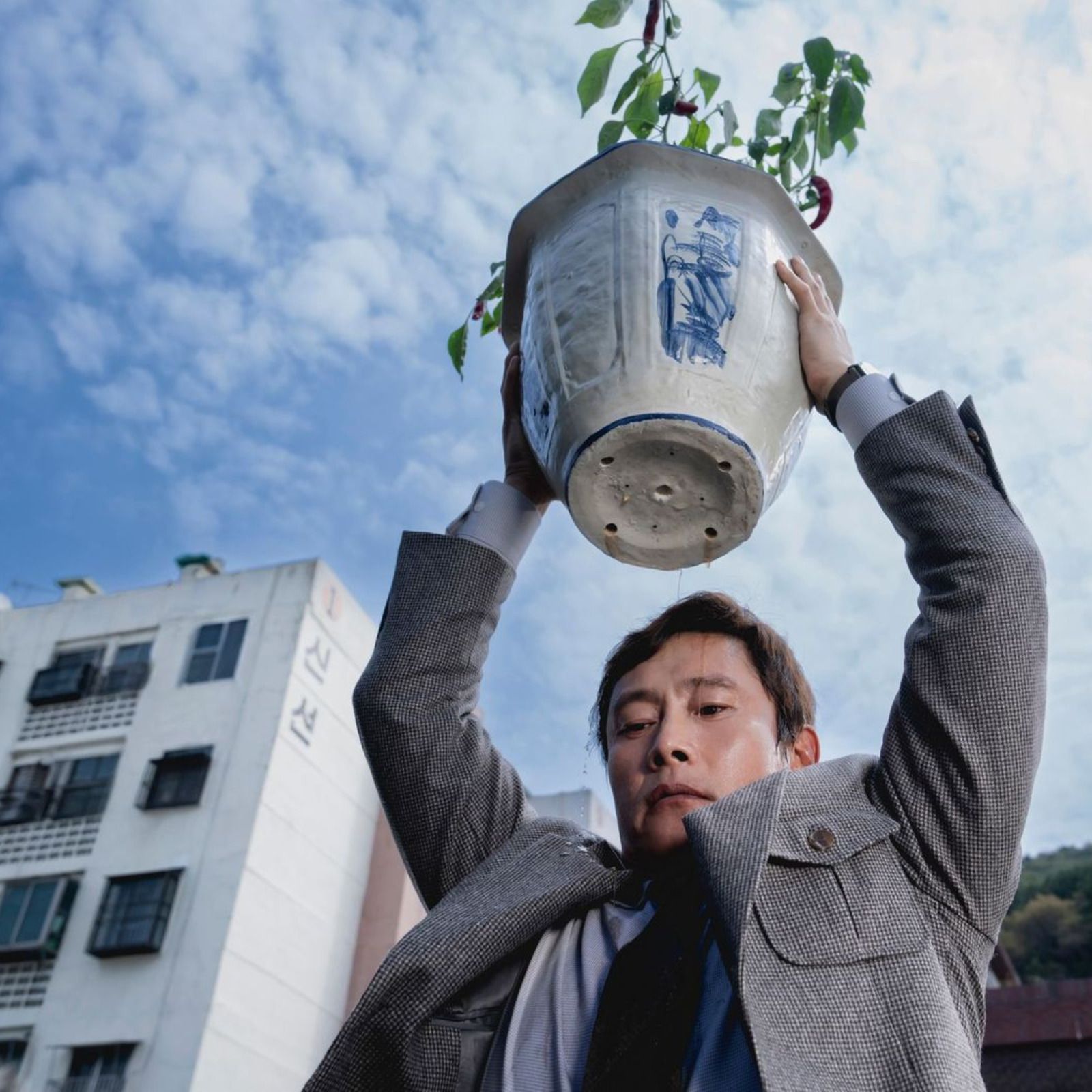
This is all of it on wnyc. I'm Alison Stewart. The Golden Globes are this weekend. This year there are three nominees for Best Non English Language Film that will also compete for Best Motion Picture. They are France's It Was Just an Accident, Norway's Sentimental Value, and Korea's no Other Choice from my next guest, Park Chan Wook. His previous films include Oldboy, the Handmaiden and Decision to Leave. No Other Choice stars Lee Byung Yeon, who you might know as the mysterious masked man behind the murderous challenges of Netflix's Squid Game. In Park's new film, he is more bumbling but just as violent. He plays Yu Man Su, a family man and recently laid off manager of a paper factory in a shrinking job market, shrinking even faster because of automation and artificial intelligence. Mansu decides the only way to ensure his getting a new job job is to eliminate the competition himself, one by one. No Other Choice is based on an American novel from 1997 called the Axe. Park actually tried to get his film made in the United States for many years before deciding to adapt it for his home country. Speaking through translator Jiwon Lee, I asked Director park what it was like to adapt a three decade old novel in into a biting and funny satire of the modern workforce. Here's how he responded.
- [02:06]
C
Nothing felt truly outdated. I guess you could point out the development of smartphones and I think people have difficulties dealing with that issue when they're adapting older literature or remaking older film. But in my case it wasn't a fundamental issue, but something I did have to add in regards to portraying the issue of job security was AI technology. Because at this point in our time and because of the subject matter, it was just impossible to leave out that issue. Which was why I decided to add that in.
- [02:40]
B
The film stars Lee Byung Hun, who most people know from Squid game. And the two of you worked together.
- [02:46]
D
About 2025 years ago on your movie Joint Security Area.
- [02:51]
B
Did you expect that you would ever work with him again?
- [03:05]
C
Yes, we've stayed very close friends since JSA and because of that we have endless conversations about possibly working together again. But we just couldn't find the right opportunity because of scheduling conflicts. So as soon as I decided to change no Other Choice into a Korean film. That's when I immediately decided to cast Lee Byung Hun for the main role. In fact, I think those two decisions occurred at the same time. So even before we started working on the Korean version of the screenplay, I sent the initial American version to Lee Byung Hun right away. Because I knew that if I give him more time, then he will immediately have something else come up again. And then we'd have to deal with the scheduling conflict all over again.
- [03:45]
D
Americans know Lee Byung Hun from It's a Good Game where he sort of an antagonist, sort of a ruthless and cold person in no Other Choice. He's obviously violent, but he's sort of bumbling and trying to figure out is he doing the right thing? Why did you think he would be the right person for the role?
- [04:13]
C
And he also played the voids of the demon king in the popular movie K Pop Demon Hunters. So I think a Western audiences might consider him as someone who plays a lot of evil characters. But the truth is, he's played a lot of variety of roles in a different variety of projects. So in Korea, he actually comes off more as a very familiar and everyday man. But he's rarely ever played a role as funny as he did in the movie no Other Choice, but when I worked with him on the movie Joint Security Area, it's a very tragic story, but there's also a lot of funny scenes in the movie. So through working on that project, I realized that he had a great sense of humor, which is why I thought of him for the role.
- [05:00]
B
How did you balance the humor with the dark side? In no Other Choice.
- [05:10]
C
I was truly happy about the fact that this film was categorized as a comedy film in the award shows because I've always considered that I've made films with strong comedic elements and black humor, but perhaps the violent violence and the tragic nature of the films kind of overshadowed that bit a little bit more. So I was very happy about the fact that this film finally acknowledged the humorous side of my work and the attitude that I go in with in terms of mixing those elements. I don't approach it like a cocktail recipe where I think, oh, I need a few spoons of this, a few milligrams of this, a few drops of that. I don't consider them as mixing different things. I've always considered them as one single entity. Because if you think about our experiences in life, nothing is purely just sad or purely just funny. There's always two sides to things, and we always experience different emotions mixed up together. And I think that's life. So that's also the approach I take in my films as well.
- [06:14]
B
The phrase no other choice appears in a few different ways in this movie. One character says he has no other choice but to work in the paper industry. Another character says it about having to dilute the quality. Of course there's the idea of murder. He has no other choice to do anything. What does that mean to you, the idea of no other choice?
- [06:39]
C
I think it's a phrase that we subconsciously use and we basically just spit it out of us without putting much thought into it. In the Korean version of the title, it is the same phrase, no other choice. But even though it's made up of different words, we put it together without the spacing, as if it's one word. My intention behind that is to really express how it's a phrase that just comes out of us in a single moment. And I think it's really just a cowardly excuse. We use that phrase when we don't seriously think about the other choices that we have and we're trying to justify that fact as well.
- [07:12]
D
Oh, I wish that could be the title in the American version. One word. It's mentioned in the film that Mansu, the main character's wife Miri, has a job where she earned more money than he did. Why was that an important detail for the audience to know?
- [07:42]
C
So in the past, before she got married, Mary was a very active and independent woman. She was actively leading and crafting her own life. And she doesn't believe her marriage life to have been an unfortunate experience. But she did become a housewife after having kids. But after her husband got fired from his job, she returns to her old job, even though it's a part time job. And she feels a little happy about that fact. Of course she isn't glad that her husband was fired, but she's happy that she's able to work again. And I believe that even after the story of the movie ends, she would continue to work her job.
- [08:16]
B
I'm speaking to director Park Chan Wook about his new film, no Other Choice. It's in theaters now. It's nominated for a Golden Globe for Best Motion Picture, Musical or Comedy. In the film, the wife says to the husband, miri tells Mansu, if you're going to do something bad, I'm going to do it with you. Okay, what did you want to show about their commitment to each other in that moment?
- [08:52]
C
If you really think about the movie, you might realize that the person who gave a critical inspiration for Mansoo's evil plan was Miriam. Because there's a scene where they're watching a YouTube video of the last target's hunter and she says a little joke along the line of, oh, wouldn't I hope he's carrying a pointy umbrella and he gets hit by lightning. And that's the moment that Mansu found the inspiration for his plan. And on top of that, in how Mansu deals with the last victim, Miri also talks about to Mansu, oh, there was a time when you almost choked yourself to death after drinking. And that's also what gives Mansu the inspiration for the murder method for the victim as well. So even though Miri wasn't intentionally doing so, she is. She holds somewhat of a responsibility for what has happened, even though it's not to say that she's an immoral person. And Miri is someone who believes that as a wife, if her husband does something wrong, then it's not solely his fault. Because they're a married couple, they have to take responsibility together as a team. And through her belief, I wanted to show how Miri is a more mature person than Mansu is.
- [10:01]
D
Mansou has worked in paper for 25 years. Sort of in the background, or actually the foreground of this is about technology, about how automization eliminates jobs. One of Mansu's competitors says, if we don't use paper, who will? Do you think about those things when you think about movies and AI, how certain technologies will affect the way that you do your work and the way movies will be made in the future?
- [10:34]
C
Yeah. When I was reading the novel, I initially thought I wouldn't be able to empathize with it because I haven't met anyone in the paper industry. I haven't even imagined what those people would look like. And it felt like such a story that was far, far away from me. But I able to immerse myself in the story because I realized that how they think about paper is how I think about movies. So there are things that people, everyone considers as important, like building a power plant or baking bread to feed people. But there are other things that people don't consider quite as important. For instance, movies might just be two hours of entertainment for people. And just like how people in the paper industry consider paper as very important, I also consider movies, just like everyone else in the film industry, as my entire lives, despite how other people might think. And with the film, with the change in the film industry due to the development of technology, many changes will and have come and many people will lose their jobs as well. And I think I overall feel very afraid about that change. And I almost have this defeatist feeling of we've already lost and I can't do anything about it. But there are also going to be benefits to the technology, technological development. I'm sure that wiser people might be able to use the technology to better use. For instance, younger filmmakers with less resources might be able to visualize their vision with the help of the AI or the new technology and really use AI as a great tool. And another thing that just occurred to me in regards to that subject matter is I don't think AI is just going to take away jobs in the film industry. I think it's also going to bring a fundamental change to the aesthetic of film as well. And I am also concerned about how different that new aesthetic is going to be from the traditional method aesthetic that we are used to. Just like I do as well, I also have a traditional method of filmmaking.
- [12:48]
D
I hope people won't stand for it. The AI version of filmmaking, just personally.
- [13:03]
C
Yes, I really hope that it won't at least replace actors.
- [13:07]
B
I'm speaking with director Park Chan Wook about his new film, no Other Choice. It's in theaters now.
- [13:13]
D
This film was made in Korea, but you spent more than a decade looking for financing around Hollywood for this film. It didn't happen, but now it's a success. This film you made in Korea, what lesson did you learn from all the time that you spent looking for financing, but you ended up making it in Korea?
- [13:41]
C
I don't exactly know what would have happened if I did end up making the film in America, since it's a path I didn't take. So these are all just predictions in my head. But so the studios came to me that with, oh, with this kind of screenplay, we can give you that amount of money. And so if I did listen to them and decided to go forward in that direction, I would have made it as a smaller scale American film. And sometimes I do wonder about what that would have ended up being. But I think my method of filmmaking requires some level of budget. I'm a director who though used some capital in my art department and in location scouting as well and in building my sets. So I think it did end up being better that way that I did have a little more capital to work with because I was able to make this in Korea.
- [14:30]
B
No Other Choice is nominated for a Golden Globe for Best Motion Picture and Best Foreign Language Film. It's also shortlisted for an Oscar for international feature film. What has all this success meant for you?
- [14:46]
C
I think every director would feel the same way. Even very avant garde or art house filmmakers. I think all of us feel the same way, which is that we all hope that one more person would be able to see our films. And these awards, great honor for me as an individual to be nominated and to win awards. But I think what's more important than that is that through these awards, it helps more people know about the film. And as a result, more people will be able to watch the film as well. And I think that's what's most important to me about all of these successes.
- [15:26]
B
The film is called no Other Choice.
- [15:29]
D
My guest has been Director Park Chan Wook. Thank you for being with us.
- [15:32]
B
Thank you.
- [15:33]
E
I'm Ira Flato, host of Science Friday. For over 30 years, our team has been reporting high quality news about science, technology and medicine. News you won't get anywhere else. And now that political news is 24 7, our audience is turning to us to know about the really important stuff in their lives. Cancer, climate change, genetic engineering, childhood diseases. Our sponsors know the value of science and health news. For more sponsorship information, visit sponsorship.wnyc.org.