Loading summary
Transcript81 lines
- [00:08]
A
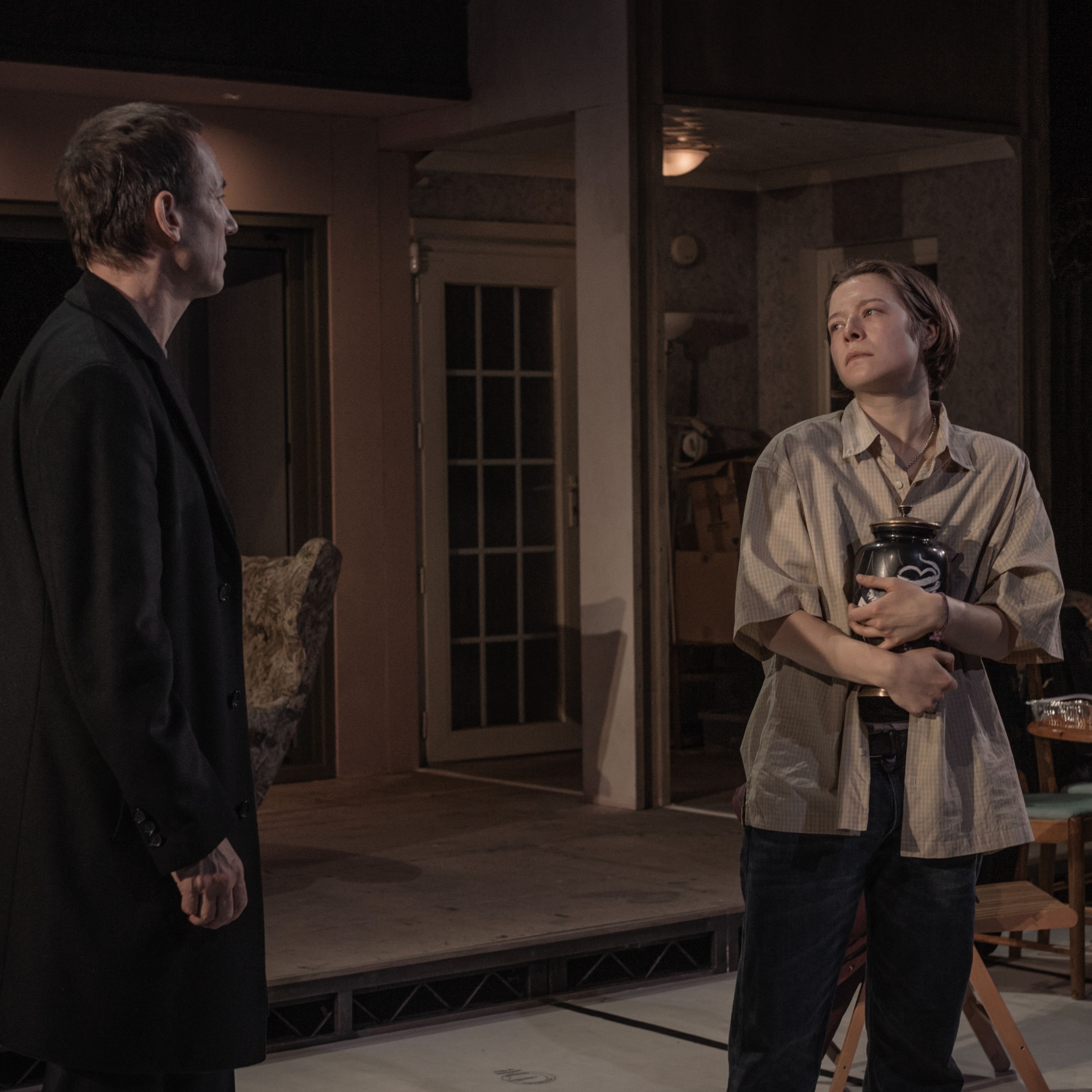
This is all of it on wnyc. I'm Alison Stewart. I wanted to preview some of the conversations coming up on the show this week. Tomorrow, we'll speak with the directors of a new PBS documentary series focusing on the intertwined relationships between the black and Jewish communities in America throughout the decades. On Thursday, musician Jesse Mallon will be here to preview his new Off Broadway show and perform live in WNYC Studio 5. And on Friday, we'll learn about the new exhibit at the Noguchi Museum that's in the future. Let's get this hour started with the other plays. There are several plays you can see this season that take inspiration from Greek tragedy and specifically the Theban plays of Sophocles. We had on Mark Strong last week on the show to discuss his recent starring role in Oedipus on Broadway. And another Sophocles play, Antigone, has inspired two shows running in New York this win. The first, which started performances over the weekend and it opens on Thursday, is called the Other Place. The play is a loose adaptation on the story of Antigone, who in Greek mythology is the daughter of Oedipus. That's a little bit of information that's worth keeping in mind, but this show is a modern reimagining that quickly deviates from its source material. Antigone is now Annie, played by Emma Darcy, who has returned to their childhood home on the anniversary of their father's death. Annie is kind of late and apparently always seems upset. Even their sister Izzy admits to the home is now occupied by Annie's Uncle Chris and his family, who took it over after his brother's death. Tobias Menzies plays Chris. Chris wants to scatter his brother's ashes. He has a whole event planned elsewhere, which Annie discovers and is very much against it. She wants the ashes to stay in the house and we learn why over the course of the play. The play the Other Place is now at the Shed. It opens this Thursday and It runs through March 1st. Tobias and Emma, welcome to all of it.
- [02:05]
B
Thanks for having us.
- [02:06]
C
Yeah, thanks for having us.
- [02:08]
A
So this play was written with both of you in mind, even though it's a modern adaptation. Did you Tobias, did you read reread Sophocles?
- [02:18]
C
We did. It was part of we had quite a long there were various of development workshops in the year leading up to when we actually went into rehearsal full time. And yes, reading the original was part of that, but it was also a lot of improvisation. Alex Zeldin, the writer, director, writing off the back of those Improvisations as we looked for a sort of modern language, a lot modern frame to tell this. This ancient story.
- [02:52]
A
Emma, do you remember when you first read Antigone?
- [02:55]
B
Yeah, I do. I mean, I actually read it as a teenager.
- [02:59]
A
Sure.
- [02:59]
B
And I think I was really, like, struck even then by the vividity of sort of siblinghood as it's drawn in that text. And then, of course, I reread it when Alex had sort of this invitation from the National Theatre in London to consider a contemporary adaptation. And some of the early conversations I had with him were about how we can. How we can understand fate in a modern context and like. And whether actually the idea of being fated can be about a sort of traumatic history and the way that that past plays out in the present and the future is a kind of, like, fatalism or something.
- [03:40]
A
We need to get Mark Strong in here. We can have a whole discussion about fate. You know, Alex is Alex Zeldin, and he wrote this for you. And he said he loves to write with actors in mind. Tobias, how did being involved in this play from early on help you have a unique understanding of it?
- [04:00]
C
Yeah, it's a really privileged way to work. Time is expensive. And so, yeah, to be, you know, have a structure where we can take this time over the best part of a year, really, before we even hit a rehearsal room. It's. I think it can result in very different work, hopefully deeper work, in that, you know, Alex is able to respond in a way to what his group of actors are bringing to the text, what they're responding to. And I think that can really help with the particular type of performance that we're. The play is, which is this hyper naturalism, but looking to find moments that have sort of an epic quality, that have a Greek quality, and trying to find a world in which, you know, or a language, a theater language, where those two things can exist together.
- [04:49]
A
Emma, can you see in the play where Zeldin had you in mind as an actor?
- [04:56]
B
Oh, God, it's hard to answer because I think, at least in the Sophocles, Antigone is quite like, difficult dramatic device to get your head around in the sense that she's like a sort of true antagonist, an unflinching antagonist. And transposing that into a contemporary context is difficult. I mean, I don't know whether I should be sort of flattered or not that I was the person that he thought of. I suppose. It's funny, I was just thinking. I was just listening to Dubais talk about this sort of protracted process Generative process. And when. When it first came. When it first came to, like, looking at this character of Annie and how she might sort of function in the modern day within a domestic context, it was really challenging. It was really challenging to believe it. It was challenging to believe someone with a kind of such an unflinching conviction or something. But I think what I came to understand over time and part of this improvisation work allowed for was the creation of a territory. And it's actually a sort of territory war that's taking place over the past, over a sort of a history. And once I realized that the question is, like, what happened? It was way easier to find a kind of plausible conviction.
- [06:24]
A
I think, well, where's the audience? What's going on with Annie when the audience first meets her?
- [06:30]
B
Well, I think when the audience first meets Annie, I think they meet someone who is completely un. Ingratiating. Who doesn't feel the need to submit to sort of nicety or, in fact, maybe someone who perceives nicety as a form of disguise or there's something insincere about it. And I think I was thinking about it last night, actually, and we had an early preview last night. And when I was. Wait, sort of before the show, I was wondering if part of Annie's job is to sort of kill the joke. That's sort of like the first gesture of her character.
- [07:12]
A
Right. Right. Where's Chris? What's going on with Chris when we meet him?
- [07:16]
C
So Chris is obviously. He's the authority within the structure of the play. Creon, in the original. I think what Alex and myself are both interested in is exploring patriarchy and possibly the shame and suppression that is baked into that. Those structures. Yeah. And so I think that's. That felt like the sort of modern lens through which to try and investigate the Sophoclean version of that. You know, there's a decree is laid down in the play which Annie breaks. But to try and find what is the sort of modern equivalent that can really resonate for a modern audience without, I guess, without watering it down and making it too domestic. Because obviously, you know, part of what the transposition that we've done is take it from a. From Thebes, from a city state to a family. But. And that does, I think, does the work of bringing it much closer to an audience, to a modern audience. But the danger is you don't want to lose the scale and the stakes and there's epicness of it. And. Yeah, so that was a lot of the work of those workshops and rehearsal was to sort of find that balance.
- [08:36]
A
I was going to ask you about that because there's tension right away when you're watching it, and your characters know why, but the audience maybe doesn't.
- [08:44]
B
And.
- [08:45]
A
But they can feel something's up and no spoilers, but they can tell there's. There's something there. How did you. How did you work with your director on creating that tension?
- [08:56]
B
That's a really good question. I. I think. I mean, I think being super specific about the sort of the historic ground on which this. This, like, contemporary meeting is taking place, I think it's that. I think, again, as Tobias says, it's a crazy privilege to be able to work kind of slowly and methodically over like, you know, weeks and months periodically. And. Yeah, and I think what it allows is for like a. Yeah. A real specificity. And so I hope that we're just. We're sort of playing circumstances that feel really vivid. I think.
- [09:37]
C
I think the other thing that the show is trying to do is also work as much with what's not said as what's said. You know, I think that's certainly Alex's instincts and ours too, in terms of. So the. The atmosphere, the air in the room is doing. Hopefully doing a lot of work as well. And. And I think part of the reason why we needed maybe the sort of the cooking period we had was to be able to sort of charge up the characters, the performances, the story with a lot of subtext, a lot of unspoken history.
- [10:10]
B
And actually it makes me think that like. Like tragedies have. Like have a. Mechanics, require a mechanics, I think, in order to have a sort of tragic payoff. And in a funny way, like both in the Sophocles and hopefully in this transposition, the mechanism in a way, is really simple. Like, you have one character, Annie, who is driven to exhibit, to preserve the past. And you have another character, Chris, who is desperate to sever, to bury his history. And those wants to go forward.
- [10:44]
A
I just want to move forward, is all you say.
- [10:45]
B
Exactly, exactly. And then you have this sort of tragic mechanism. And in there, there are sort of immediately stakes. I think.
- [10:51]
A
I'm speaking to Tobias Menzies and Emma d', Arcy, who sar in the other plays at the Shed. The play opens this Thursday and runs through March 1st. The play takes It's. It's held entirely in this room, in this house, Chris's former home, Annie's childhood home. How long does it. From when Annie has been in the house?
- [11:14]
B
So 10 years. So it's a 10 year gap. So this is sort of. This marks the first return after. Yeah, a ten year absence.
- [11:22]
A
And why does she decide to come?
- [11:25]
B
Well, I suppose there are a few interpretations available, but ultimately I think she believes she's invited.
- [11:32]
C
And.
- [11:35]
B
The. The destination of her father's remains, which is the, you know, the sort of inciting incident, a desire to scatter, to memorialize him, is of profound importance to her, I think.
- [11:51]
A
So the house is sort of in a transitional state. This part of the house that we see anyway, some of the walls are unfinished. There's a big glass window in the back. They comment on the window constantly. You know, walls hide things, windows open things. You can take that whichever way. But what do you think we understand about the changes made to this house, Tobias, that Chris and his wife have made?
- [12:17]
C
Um, yes, I think the. The big kind of drive of Chris within the play is about, as you said, I use this phrase, I just want to move on. But obviously underneath that is the desire to erase, to forget. You know, the. The amnesia of the makeover, you know, of gentrification, of these ways that we seem benign but actually can have violence sort of in them. And I think thematically the play is sort of scratching at that idea as well, again as a sort of a modern way of communicating what that old play was trying to do. Obviously, at the heart of Sophocles is a dispute around burial rites. And I feel like, you know, tiling over stuff, plastering over stuff, does the same job in a way, it speaks to the same desire, which is, should it be, should we look at this stuff or should we try and forget it?
- [13:26]
A
So there's this moment when Annie tries to hide the asses and Chris searches for them and things happen. And on one hand is. Sometimes it's kind of funny, and on the other hand it's really shocking and sort of violent. And the tone switches rapidly between these two events. First of all, what is that experience like for you on stage, to have the tone switch so quickly?
- [13:49]
B
I suppose, for my taste, I find it really thrilling. It's definitely thrilling to perform because in a way it's super technical, I think, and I certainly. Well, when we played in London, it's. It was like a really vivid show to perform. Not least, like, in terms of, like, audience response. Like, it was a very kind of. Yeah. Like you got, like, visceral feedback, you know, And I think part of that is about that kind of rapid. Yeah. From the audience.
- [14:19]
A
Oh, that's interesting.
- [14:20]
C
You don't like it when you mess with ashes. Do not Touch the ashes.
- [14:25]
A
Especially the way you touch the ashes. How do you deal with the tonal shift as an actor when you're going from something that's kind of funny to not funny?
- [14:34]
C
It's what I like, you know, it's what I like to watch myself. So it's partly why I was interested, I guess, in, you know, having seen some of Alex's work. He seems like he was interested in the same kind of where you don't. I guess you don't resolve it for an audience. The audience have to sort of, like, work out. They have to do a bit of work about what's okay. And I think that can be very electrifying to watch. I like it when. Yeah, there's a bit of jeopardy. You're like, is that. And I said, there are definitely moments it feels like what's. When it works, this. This production is at times where it feels genuinely a little bit sacrilegious. And I think that's an important. You know, there aren't that many spaces really left where you're allowed to do that. And hopefully the theater is still one of those, you know.
- [15:17]
A
How does the audience react? There's at this point when he's, like, kind of going in your clothing to retrieve the ashes, how does the audience react?
- [15:26]
C
Have you noticed there's just really thumbs up from everyone, really, isn't it? This is great. This is great behavior. No, I'm joking. No, it's. Again, yeah, a lot of. A lot of shock. Yeah. And what's exciting about is that, you know. You know, we live in a very permissive society, so it's. In a way, it's hard to find things that genuinely exercise people. And it's. The ashes do that. The attack does that.
- [15:54]
B
The hope, I think, is that it. That an audience are kind of prevented from a. A passive seat, you know, like. Like, kind of for better or for worse, there's, like, quite a. They're quite implicated in quite a profound way.
- [16:08]
A
I think you told Variety. This is a quote. There were lots of times when we were genuinely ahead of the audience. And that's an increasingly hard thing to do because audiences are very story literate. Tobias, how do you think this play stays ahead of the audience a little.
- [16:26]
C
Bit by restricting information? It's a pretty spare text. So, again, a lot is being unsaid. And so hopefully, I think partly what you're demanding of an audience is them to sort of fill in the gaps. And in that way, hopefully, yeah, we can keep ahead of them just about.
- [16:50]
A
Emma, you've only done it a couple of times in front of New York audiences. You played it, obviously, in London. What have you noticed is the difference between American audiences and British audiences?
- [17:02]
B
To be totally honest, I'm not sure that we. That we have. I've. I'm in the flow of the show enough to have a clear answer for that yet.
- [17:13]
C
Small sample size.
- [17:14]
B
Yeah, yeah, yeah, yeah. I don't know how accurate my. My feedback would be, but I. I do.
- [17:22]
A
Is there a difference at all? At all?
- [17:26]
C
They have been quieter.
- [17:27]
B
Yeah.
- [17:27]
C
Thus far. I mean, it's only two. Two shows in, but that's interesting. Yeah, there was. Yeah, there was a sort of an attentiveness and a sort of. It ended up being a lot more raucous in the Littleton. A sort of. Yeah. Around some of this sort of the Ashes and the sort of more, as I say, more so sacrilegious stuff. There was a sort of willingness to sort of take that.
- [17:54]
A
Oh, that's really interesting.
- [17:55]
C
And I think there was a little more. A little more shock, I think, in the room.
- [17:59]
B
I think so.
- [18:00]
A
No, that's interesting. Or maybe they're paying very close attention to you as well.
- [18:05]
C
I hope so. Or they're asleep. One of the two.
- [18:09]
B
The other thing to say, I mean, like, not only have we changed sort of, you know, site and continent, but it's also like we. We performed this show in autumn of 2024 in London, and inevitably we are in a different political, social climate. And I don't have anything smart to say about that right now, but I imagine it must have implications.
- [18:31]
A
It has to.
- [18:32]
B
Yeah.
- [18:33]
A
Have you noticed that your performance has changed at all because of the timing?
- [18:39]
B
I don't know whether it's. Yeah, I think I'm gonna say.
- [18:42]
A
Yeah.
- [18:42]
B
Yeah, I think it has. I mean, we obviously, in remounting the work, have wanted to refresh and reinvestigate and. And I think we've. It's been nice. It's been an opportunity to seek a slightly more nuanced path, possibly. And I don't doubt that that is in part influenced by kind of the scale of the moment that we're living through. And I actually think that, you know, it's funny you said that Mark Strong was here recently, and I, like, can't help but notice this sort of resurgence of interest in, like, Greek text. And I wonder if a part of that, at least, is, like, the scale that the Greeks achieve within, like, domestic and familial space. Like, there is a kind of a verticality that maybe feels appropriate for an extreme moment.
- [19:35]
A
Do you have any thoughts on why there seems to be this re. Emergence of Greek tragedy in theater in New York?
- [19:43]
C
Yeah, I think it's because we're reaching for bigger tools. You know, we need a bigger boat to sort of. To overextend the metaphor, ride these sorts of waves. You know, it's. Yeah, it's obviously very. We're in pretty challenging times. You know, you've obviously. What's going on with ice on sort of American streets. So I think inevitably, I think culture then reaches for, hopefully, stories that can speak to it more directly. And I think Greeks are, you know, help us with that.
- [20:17]
B
I also think, like, I don't know if this resonates with you, but, like, when I sometimes when I read Greek. The Greek texts, there's. There's a degree of unintelligibility. Like, I don't read them and go, like, great, I get it. I sort of. I kind of. I know I sort of understand what's happening, but I don't. I have to really interrogate what the resonance is and sort of. And it be. Yeah, it can be sort of quite so headache inducing, but I also don't find the current moment wholly legible. And so I wonder if there's also something there about. Yeah. About giving us the tools with which to at least like, sit with and try to understand what we're like, currently living through.
- [20:57]
A
What do you like about theatre?
- [21:02]
B
I like that real things can take place in rooms. I like that people can have a shared experience in real time. I like that once you sit in a theater, you're not setting the program. I think that's powerful too. There's a. There's. I hate myself. There's a Chekhov quote that I can't fully remember and I'm going to butcher. But it's like. He sort of approximately says something about, like, art doesn't need to provide the answer, it just has to present the problem fully in a way that sort of doesn't hide or disguise anything. And I suppose at its best, I think that it has the capacity to do that, to show us our reality in a full way and allow us to kind of reflect on it. And I don't know that there are that many spaces in which that's possible now.
- [21:58]
A
How about for you, Tobias?
- [22:00]
C
I think I love the sort of analog quality of theatre increasingly in obviously a very sort of digitalised world. And I just think, yeah, it's. It's just fundamentally harder to manipulate in a theater in some way, you know, yeah. And so therefore, I think necessarily there's this greater transparency and greater honesty occurs with this art form, just more easily. Yes, you can sort of, you can put some music on and stuff, and you. But fundamentally, you can't control where people are looking. They're kind of, they're physically in the room with that, that person's actor's body. And so they, they're picking up a load of info from that. And so it's just much harder to control. You can't harvest the data. So in that way, it just feels baggier, less controllable. And I like that.
- [22:54]
A
I've been speaking with Tobias Menzies and Emma Darcy, who star in the Other Place at the Shed. The play opens this Thursday and it runs through March 1st. Thanks for spending some time with us.
- [23:04]
C
We've also got shows tomorrow and Wednesday as well.
- [23:07]
A
Okay.
- [23:08]
C
Just in case you want to come before, before the reviews are in. They can just come.
- [23:12]
B
They can come.
- [23:13]
A
Yeah. Come on down.
- [23:14]
C
Come on down.
- [23:17]
A
Thank you.
- [23:18]
C
Get in your lane, Menzies.
- [23:22]
A
I'm Ira Flato, host of Science Friday. For over 30 years, our team has been reporting high quality news about science, technology and medicine and news you won't get anywhere else. And now that political news is 24 7, our audience is turning to us to know about the really important stuff in their livescancer climate change, genetic engineering, childhood diseases. Our sponsors know the value of science and health news. For more sponsorship information, visit sponsorship.wnyc.org.