← All Of It with Alison Stewart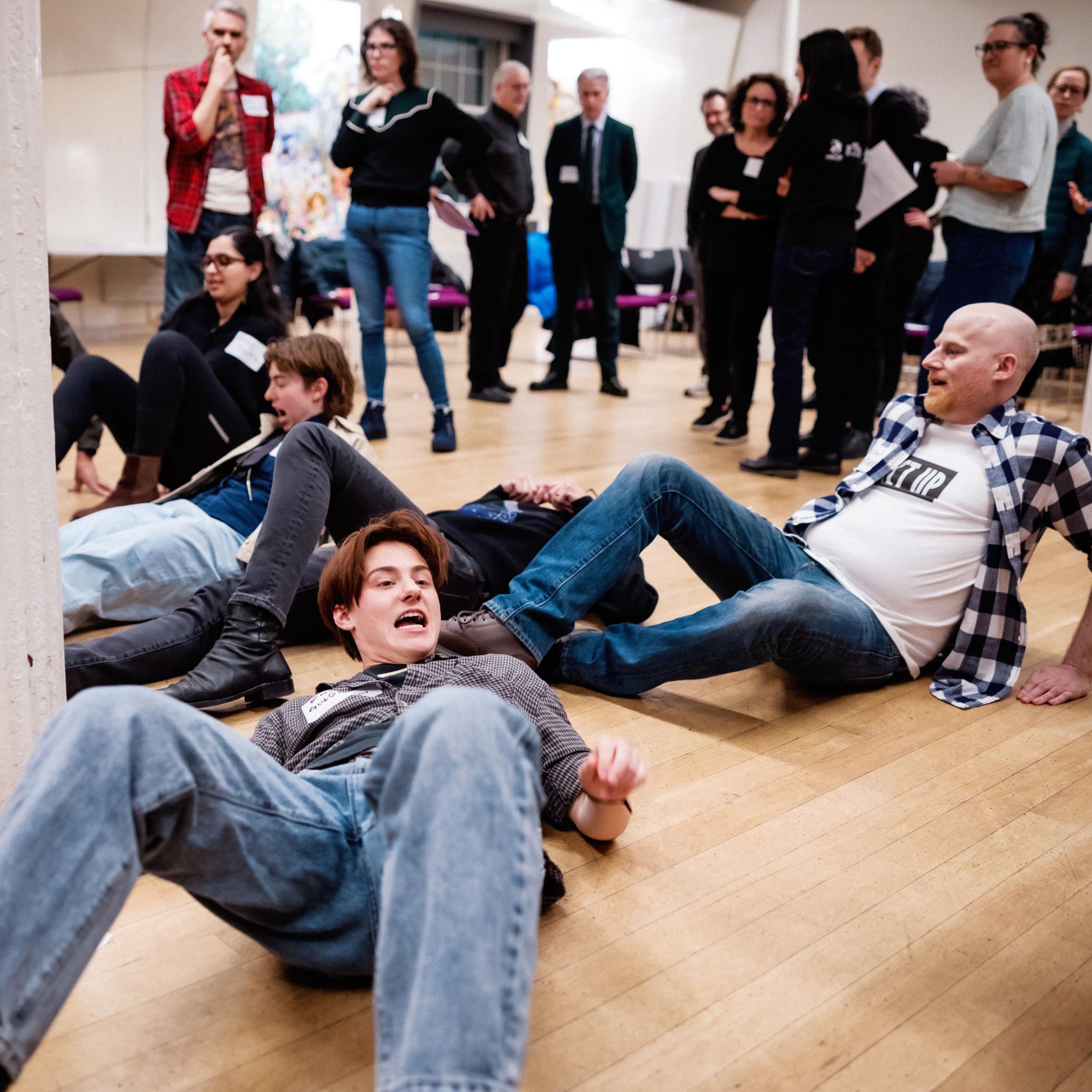
All Of It with Alison Stewart
'Fight Back' Turns Audience Members into Participants in an Act Up Meeting
00:25:35
Loading summary
Transcript64 lines
- [00:09]
A
This is all of it on wnyc. I'm Alison Stewart. From Tony Kushner's play Angels in America to the hit musical Rant Theater has always been a key part of the conversation about HIV and aids. Now we'll turn to an innovative production called Fight Back. The show brings people into a 1989 meeting of the activist group Act up while the members were planning a day of direct action targeting City hall and then Mayor Ed Koch. The production takes place in the same room at the LGBT community center on 13th street where the real meeting took place. And if you want to see it, you can't go as yourself. You're assigned a particular person who is at the meeting and expected to inhabit that Persona until the production ends. The meeting covers what to do if you're being arrested and shows how an activist group like ACT UP navigated internal disagreements, particularly about the role of women in the organization. Fight Back is running on May 11 and May 18, and joining me now to talk about it is its creator, David Wise. David, it is nice to speak with you.
- [01:11]
B
Nice to speak with you, too.
- [01:12]
A
You've said that one of your inspirations for this production was Sarah Schulman's book Let the Record Show a Political History of ACT UP New York, which we covered here on all of it when it came out. How did that book change the way you understood the. The work of AIDS activism?
- [01:27]
B
Yeah, I had always known about the actions that ACT UP did, but reading her book, so many people talked about the weekly meetings, the planning meetings, the minutia as so formative to their experience, that that was where they realized their power. That was where they realized their. That there was. That they were in the right, that they were fighting for something right. Even though their government wasn't doing anything, even though their families were telling them, might have been telling them that they were wrong, even though all of society was telling them that they were wrong. And they found their power in that meeting. And the meetings were cruisy and electric and boring all at once. And when I read Sarah's book, I thought, wow, wow. I never thought about that part of it, and I'd love to experience that. And so Fight Back is an attempt to try to experience that.
- [02:29]
A
When did you decide it was going to be a participatory experience?
- [02:33]
B
Right from the beginning, because the. I've always worked in that sort of realm, but I think when people think of immersive theater or things like that, they think that there's someone there who is leading them along and that they are along for the ride. They're in the world, but they're not real participants. There are no plants at fightback. Everybody from the people facilitating the meetings, everybody is a participant on equal footing. And the goal is to try to experience what they were experiencing. It's not to show anybody anything else. And it uses some advanced theater techniques, but they're simple. Anyone can do it. In fact, I don't think it's even better to be an actor to do it. I think that you just have to try. That's it.
- [03:28]
A
What were some of the challenges that you had to face as you were developing this show?
- [03:34]
B
Well, one of the big challenges was learning about populating the room and all of the people. And thank goodness that Sarah Schulman to create that book. That book was based on oral histories that she did. And so there's a rich collection of oral histories by people. And I feel a bit conflicted about it because most of the oral histories are made by people who survived. And so to some extent, the people who didn't survive are underrepresented. And that eats at me a little bit. They're also represented obviously in the room, but I have less information about many of them.
- [04:19]
A
I was interested in how the show balances those who know the history, who perhaps were there, or who know people who were there, versus people who are just learning this history. People born after 2000.
- [04:32]
B
It really works for everyone. For many people who remember the time, their experience is trying to inhabit someone who's by definition much younger than they are. For people who weren't there, they very much could be someone who was of the age, but they don't remember the time. It's really interesting. Some of the people who were from the time when people do one of the. Like to show approval in a meeting now you would do like a little snap your fingers. Snap your fingers, Right, exactly. Well, of course, that wasn't done in the late 80s. And so it really grates on some of the people who remember the meetings. But do you just translate that in your mind to what it obviously means now? You know, some of the younger people also, you know, when they, when they sign up, they want to be, you know, say, oh, I'd like someone who's gender non conforming or non binary. And it's like, well, those weren't words that we were using at that time, so.
- [05:31]
A
Oh, that so interesting.
- [05:32]
B
And that's great too.
- [05:34]
A
We are talking about the theatrical experience Fight Back, which invites participants to help recreate an Act UP meeting in 1989. My guest is the show's creator, David Wise. Listeners, if you are a member of Act up in the 80s, we want to hear from you. Particularly if you help plan or attend the Target City hall protest on March 28, 1969, give us a call to talk about it. Our number is 2124-3396-9221-2433. WNYC or if in the immersive theater experience, fight back. And you want to share what you took away from it, we want to hear from you as well. Our Phone number is 2124-3396-9221-2433, WNYC. I want to do a little bit of history for people to get them in the mindset. Where was the fight against AIDS in 1989?
- [06:24]
B
So it had been going on for about eight years and at the beginning the community was shell shocked. Service organizations had risen to take care of people who are dying. But by around 1987, people started getting angry and especially Larry Kramer gave a famous speech at the center in the same room where this happens saying, where is the anger? Where is the fight? Because the federal government wasn't doing anything. The city government was doing very little. And it was clear that nobody was going to save us, that we had to save ourselves. And that is where it was. And the effectiveness is astounding. That I believe, and many people believe that ACT UP brought about faster access to effective treatments. I believe that ACT UP was one of the early people who believed that health care is a human right, was one of the early people to really make it so that people had contributed to their own involvement in their health care and was effective direct action, which I think people are so hungry for right now.
- [07:51]
C
Why did you pick this particular meeting?
- [07:55]
B
So I wanted to pick a regular meeting. Part of the idea of Fight Back is that it's not about the big action, it's about the minutia, the tedium, the inner workings. But I also wanted it to be a good introduction. And so it's two weeks before a big, big action. And so there's a lot of things to sort of get people ready for that. The other reason that I chose it is that the minutes for this meeting, and I've read all the minutes for all the meetings over many years, the minutes are very, very specific about what happened at this meeting. So I was able to sort of reconstruct the agenda for the meeting based on the minutes. Now what happens at Fightback isn't always what happened at the meeting, people, because people come in with the same given circumstances of what the past was, but where it goes. For instance, there's a facilitator election to elect someone new to be facilitator. It hasn't gone the same way twice, and it hasn't gone the way that it went historically, ever.
- [09:07]
A
Oh, that's so interesting. Why did you pick this particular moment in the arc of the AIDS crisis to cover?
- [09:15]
B
So this was about two years after ACT UP had formed, and. And there was a level of excitement that there was actually things that were getting done. A few years later, ACT UP would have really interesting and difficult rifts about whether it's about drugs into bodies
- [09:41]
A
or
- [09:41]
B
whether it was for a healthcare organization in general. And I thought that that would be too difficult for people to really bring into the room. Knowing very little here. It's just enough that I feel like people can come in knowing nothing about ACT UP other than what you can learn in about an hour in your prep material, less than that, and still succeed and have a good experience.
- [10:08]
A
Why did ACT UP target City hall and then Mayor Koch for such a large action?
- [10:13]
B
I think that there was a big feeling that the city that was the epicenter of the AIDS crisis in the country just wasn't devoting enough resources, wasn't doing enough, was in the pocket of the church who was advocating abstinence. That was just not providing enough education and enough effort towards the crisis.
- [10:39]
A
How much did you do research into this, into the Target City hall, and
- [10:44]
C
about the March meeting before you started this project?
- [10:49]
B
Probably a good couple of years. Yeah.
- [10:52]
C
Oh, wow.
- [10:52]
A
A couple of years on this one event.
- [10:54]
B
Sure.
- [10:55]
A
So tell us why.
- [10:56]
B
Well, the oral histories sort of acted as my guide star. And so when you come ideally, you have one oral history, and you might listen to a little bit of it. I listened to a couple of hundreds of them, and it was so interesting to hear the same story told a different way by a different person from a different perspective each time. And that's one of the really special things about this project, is that a lot of things try to heroicize one person and say, you know, or three people, because that's an easier narrative to tell in traditional ways. This explores the stories of so many more people because there were so many people who were involved, and they were regular people who, because of circumstances, because they had to, came together and did something heroic. But it's really important that they were just regular, regular people.
- [11:56]
A
Go ahead.
- [11:57]
B
No, that's okay.
- [11:58]
A
We're talking about the theatrical experience, Fight Back, which invites participants to help recreate an Act up meeting in 1989. My guest is the show's creator, David Wise. Listeners, we want to get you in on this conversation. If you are a member of ACT up in the 80s, we want to hear from you. Give us a call at 212-443-3969, 2212, 433, WNYC. Or if you've participated in this immersive experience, fight back. We want to share what you took away from it. Please give us a call. 212-433-969-2212, wnyc. We'll take a quick break and when we come back, we'll talk a little bit about stagecraft. This is all of It. You are listening to all of it on wnyc. I'm Alison Stewart. My guest is David Wise. He is the creator of Fight Back, which is a theatrical experience inviting participants to help recreate an ACT UP meeting in 1989. It is happening May 11 and and May 18 at the LGBT Community center on 13th street just off of 7th Avenue. Let's take a call. David, this is Jamie's calling from New York. Hi, Jamie. Thanks for calling all of it.
- [13:17]
B
Hi.
- [13:17]
D
How are you doing?
- [13:18]
B
Well, great.
- [13:21]
D
So the reason I called in, I was listening to show and I am a documentary photographer, and one of the things I've done a lot of is shooting political protests. And I shot the 1989 protest at City hall. And there's a bunch of images of that protest in my book called American Protest, which I'm happy to share with the people doing this show.
- [13:46]
A
Thanks so much for calling in. We appreciate it. Let's talk about the theater experience as well. So you go in and to give people a sense of what it's like to participate. David, you participate as Jason Heffner, an ACT UP leader. You're kind of leading from behind in many ways. Has it changed the experience to walk into that room other than David Wise?
- [14:11]
B
At first I thought that it would be like a separation, but it's more like a fusing that I'm both me and Jason at the same time. The time, as with all things, it's very difficult to stay immersed in a book, in a movie. The full time. Your mind wanders, you come out of it. That happens here, too, and that's fine and that's okay. Just put yourself right back in. When it really works is when you're not thinking about it, when you're just doing. When you're doing something, when you're chanting something, when you're actually planning an action when you are meeting with your group, then if your body is doing it, it's actually happening, even if the circumstances are fictional.
- [15:12]
A
We get a text that says 1990. I was new to New York, a grad student at Columbia University Teachers College. We used to travel downtown to the ACT UP meetings at Cooper Union. It was so empowering. And it's interesting because a New York Times write up says the production gives a strong sense of, quote, an admirably nerdy commitment to rigorously. The rigorously democratic process. Why did you want to communicate so much of the procedural part of that meeting? It was empowering, but you also had to deal with the minutiae.
- [15:43]
B
One thing I love about it, sort of dramaturgically, is that there's all of these emotions going on. The people in that room were going through the worst times imaginable. Their friends were dying, they were dying. People didn't care about it. And all of that stuff is in the room, but it's all underneath. It's not what's actively happening. What's actively happening is minutia. And it's, to me, a more interesting artistic way of exploring it because a. It's truthful that very often when we're dealing with something like this, and when these people were dealing with something like this, the way that they actually activated their power was by planning these theatrical events. And by events, I mean actions, and. And that that was their gateway into empowerment.
- [16:52]
C
This text says, in the early 1980s, I worked for the Department of AIDS, as it was then called, in the Division of Epidemiology at New Jersey Department of Health. I was contacted by several people in ACT UP to help out with data requests they wanted. I helped out as much as I could, but I had to walk a fine line between my duties as a bureaucrat, like protecting confidentiality and wanting to join the activists. I would love to particip in the immersive experience and play myself back then. This sounds like a really cool idea. What have people told you about participating in this event?
- [17:27]
B
Almost everyone has said that they were nervous about doing it because it's not something they have done before, because it's kind of not like anything most people have done before. Almost everyone has said afterwards that they were fine. It was completely fine. I think when again, when people were thinking, am I gonna have to perform in front of people? And that's not really what's happening. You are inhabiting together with people, and it's a very natural thing to do. And people catch Onto it very quickly.
- [18:03]
C
Let's go to another call. Charlie is calling from Midtown. Hey, Charlie, thanks for making the time to call. All of it.
- [18:11]
E
Hey. Hi. Great to be on. Thank you. Longtime listener to your particular program. Thank you. I go past, I had a darkroom down on Charles street right around the corner from St. Vincent's and it's no longer St. Vincent's I think it's fancy condos now. But every time I went past there, I think of some of my friends who passed in St. Vincent's when they had one of the first, I would say, AIDS stations where people with aids, full blown AIDS could go. A lot of people passed there. A very good friend of mine, Louis Falco, a modern dancer, and Robert Christian, an actor. Dear Robert Christian. And every time I go past there and I think of the activism of Kramer and what he did. I mean, historic, historic. Whole generation of people, I think of everybody, oh, my God. You can still go back and think of, I wonder what happened to. And then you go, all of a sudden you say, oh, my God. Yeah, they died. It was during that period of time. Yeah.
- [19:28]
C
Charlie, thank you so much for calling in. This text Sundays, I was 23 at the time and went to many ACT UP protests. They were often very fun, like blocking Union Square through D made Time magazine's photo in front of the post office. I only attended a few planning meetings. As a straight woman, I felt it wasn't my place. I also worked on the AIDS hotline. There was so much anxiety around the lack of info. I often got questions like, will I get it from a mosquito? And how long is a kiss dangerous?
- [19:59]
B
Interesting that you felt that way because the women were such heroes because they weren't in general directly affected by aids, but they. Many of the women there came from activist backgrounds and really had a deep knowledge about how to do activism that the gay men who were involved because it directly affected them and were not accustomed to not having power. Suddenly there was such a wonderful camaraderie between them. It was prickly sometimes, too. And all of that is. Is what we try to explore and experience.
- [20:44]
C
Let's talk to Mark, who's calling from the Upper east side. Hi, Mark, thanks for calling, all of it. You are on the air.
- [20:51]
F
Thank you. It's good to be talking to you guys. What you were talking about reminded me of when I was an extra in a series called Pose, in which act up in 1989 invaded St. Patrick's Cathedral and did a die in and Pose. This episode that I was in recreated that Entire thing. And it was chaotic. People were lying in the aisles. The audience was up in arms. The police came in with stretchers to take the people out. O' Connor and his people were in shock. And I thought, if I was there in 1989, this is what it would have been like. And it was so chaotic that the director had to blow a whistle every time he wanted the action to stop. So that was my introduction to what it might have been like. Similar to what you were doing with your production.
- [21:57]
C
Thank you so much for calling. Mark, have you ever had to intervene? Has there ever been a situation you thought, this is getting out of control, or maybe it's getting a little too emotional?
- [22:09]
B
No. There was one time that the security from the center came in because we were doing some civil disobedience training, and it got a little loud, but it's never had to break. There are certainly times that things happen in the room where someone references something contemporary. And it's so interesting the way that the entire room bands together and just says, okay, that happened, and now we're moving on, and the room does it together. It's what. I wasn't sure in creating it whether everyone would just be standing around saying, like, what am I supposed to be doing? But that doesn't happen. People really come, really engage and really try.
- [22:58]
A
You do civil disobedience training. How much has it changed since 1989?
- [23:03]
B
Oh, boy, probably not that much. The difference is the police's relationship to people with AIDS was particularly fraught at that time. The police were afraid of touching the people, and that could be a useful tool when doing civil disobedience then. But I think that one of the big differences between now and then is the technology is obviously very different now. People don't take out their phones during Fight Back, and that's such a big difference. And people are so love being in a room together and doing something together group rather than being on a device.
- [23:53]
A
Yeah, that's kind of an interesting question. A little bit of an essay question is how would social media have helped act up, or how might it have hurt it?
- [24:01]
B
It certainly would help get the word out about things. I mean, we talk a little bit at Fightback about the phone tree, which some people probably would never have heard of, that you actually had to, like, if you wanted to get the word about something, you actually had to pick up the phone and call them. But. So it certainly would help get the word out. But I wonder if people think of the device as a replacement for actually doing something in person. And putting your body on the line. And one thing about Fight Back is that it's actually happening in your body.
- [24:36]
A
How important has theater been in the history of AIDS advocacy when we're talking about this as a theatrical experience?
- [24:43]
B
Oh boy. I think that theater tends to be on the forefront of drawing a lot of things to public attention, even if it's not the thing that people know the best. It tends to be at the forefront of there were AIDS plays long before there were any AIDS TV shows and movies. So theater's so important that way.
- [25:11]
A
The name of it is Fight Back. It's happening on May 11 and May 18 at the LGBT Community center on 13th Street. Its creator, David Wise, has been our guest. Thank you so much for being with us.
- [25:23]
B
Thank you for having me.
- [25:25]
A
Coming up, we'll celebrate Asian American and Pacific Islander Heritage Month with three authors who are publishing debut works of fiction. That'll happen next after the news.
- [25:35]
G
If you walk into a room and can't remember why, it could be nothing or something more. If you confuse a familiar recipe, it could be a slip up or it could be associated with amyloid plaque buildup in the brain. Amyloid is a protein that your body produces naturally, but a buildup in the brain could lead to memory and thinking issues. To see what may be behind your memory and thinking issues, talk to your doctor about getting a full assessment. It's never too early to start the conversation. Visit amyloid.com to learn more.
- [26:06]
H
You're great at protecting your data, but lots of places could still expose you to identity theft.
- [26:10]
A
I thought it was safe.
- [26:11]
H
If that happens, LifeLock gives you a US based restoration agent who will stick by your side from start to finish. Phone calls, filing documentation, preparing insurance claims. Your agent handles it all. In fact, we're so confident restoration is guaranteed for your money back. Isn't it nice to have someone like that on your side? Save up to 40% your first year at lifelock.com Pandora terms apply.