← All Of It with Alison Stewart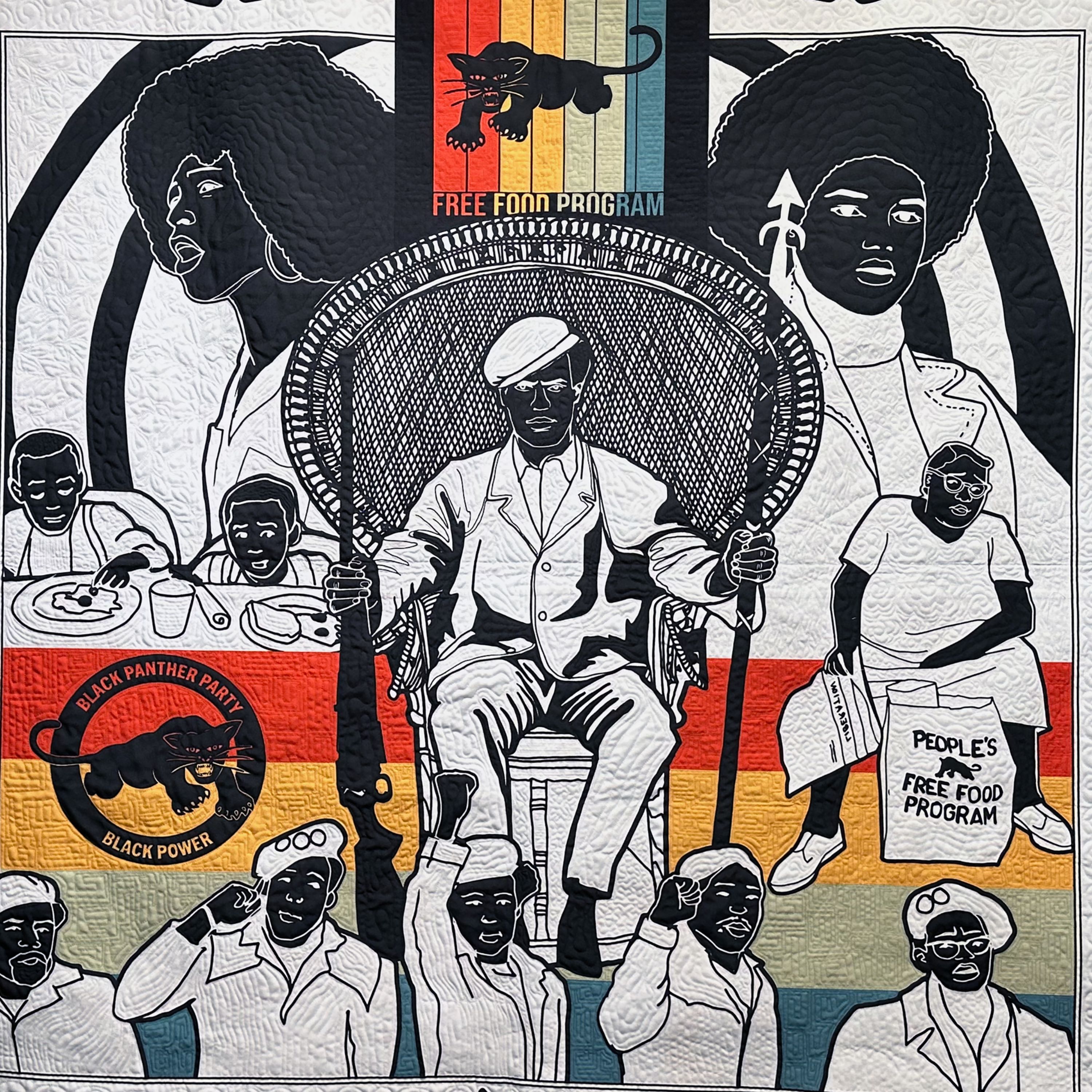
Loading summary
Transcript29 lines
- [00:10]
A
This is all of it from wnyc. I'm Alison Stewart. Carolyn Mazloomi is an artist, a quilter, a grandma, a curator, an author, and an aerospace engineer. Once upon a time, she saw a quilt at a Dallas showroom, and it caught her attention. And. And that was the beginning. Over her lifetime, she became an advocate for the fiber arts, founded the African American Quilt Guild of Los Angeles, and the Women of Color Quilters Network. Carolyn Mazloomi's work has appeared in numerous museums, including the Cincinnati Art Museum, the Fine Arts Museum in Boston, and the High Museum in Atlanta. She was friends with Faith Ringgold and with Bisa Butler. It was through Butler she met Claire Oliver, whose gallery is now her home. Masloomi's current show is a partnership with her friend Sharon Carey Harlan. It's called Certain Restrictions Do Apply, and it's on display at the Clairoliver Gallery in Harlem at 2288 Adam Clayton Powell Jr Boulevard. Joining me now are Carolyn Masloomi. It's nice to meet you, Carolyn.
- [01:12]
B
Hello. Thank you.
- [01:13]
A
And Claire Oliver. Hi, Claire.
- [01:16]
C
Hey, how are you?
- [01:17]
A
Alison? I'm doing well. So, Carolyn, you were an aerospace engineer earlier in your career when you. Why did you decide to switch to quilting? Why do you decide to make it your life's work?
- [01:28]
B
Well, the first career was 60 years ago. I'm almost 80. But I wasn't really necessarily happy in that. As most Americans, I've had many careers, and I just happened to land in quilt making. And it's quite addictive. And anybody that's involved in it will know that once you get started, you just. You just can't stop. And I so much enjoy it because it's a way for me to tell. Tell stories. And I like that. I love visualizing African American history in. In story form and narrative form.
- [02:18]
A
And for people who want to see your work, you should log on to our Instagram olivenyc. You can see some of the images that we're going to talk about. Claire, how did you meet Carolyn? What did you think when you first saw her work?
- [02:31]
C
Well, I've known of Carolyn, let's say, for many, many years. I mean, she is really the OG of quilt making in the country right now. And her work has always garnered respect, and her, you know, is. Is among the genius of quilt makers. So we actually met on a phone call. Very typical of Carolyn. She called in a generous way to tell me about some other quilters that she knew that she thought I would love. And I said to her, carolyn, how about your Work. I love your work. And a great friendship was born right there.
- [03:17]
A
Carolyn, you were raised in a family of artists. Your brother painted. You had an uncle who could draw. I listened to an interview you gave. You talked about your family a little bit, but you didn't necessarily think of yourself as an artist. No. When did you realize that? Wait a minute. I'm an artist, too?
- [03:34]
B
Well, I've been making quilts now for 45 years, so it can't. Yeah, that. That. That thought came 45 years ago, and it came at a time when I saw quilts being made by a cooperative in Kentucky. And I saw those quilts and just became mesmerized by them and decided, gee, okay, I'm going to teach myself how to quilt. And one thing led to another. I started out making patchwork geometric quilts. Very, very traditional. Very difficult for me. My favorite types of quilts are traditional quilts. However, when I make them, I can't get not one corner to meet, not one angle meets. Okay. And for me, as an engineer, that's quite vexing when you see all these mishapped squares and triangles that don't meet. So there had to be something better. So I decided, okay, I'm gonna do narratives, and I'm getting rid of the squares and the geometrics and just concentrate on narratives. And at this point, I feel any and everybody can draw. If I can draw, anybody can do it.
- [05:08]
A
Let's talk about your show. Certain Restrictions do Apply. This is a question for both of you. And, Claire, I'll ask you to start. What does the title of the show mean?
- [05:18]
C
Well, that's up to the viewer. I mean, it is the title of a work in the show that Carolyn did. That's where the title comes from. However, if you want to get, like, very narrative analytical about it, that particular quilt is talking about people who are trying to come into America right now, and they're being stopped at the border. So it's a. The piece is Statue of Liberty holding her hand out with a stop sign and people who are trying to come into the country in boats, and the boats are capsizing. And so just speaking about Carolyn's work asks more questions than it answers. So it's sort of one of those things where we hope that the people who come to see the quilts will ask more questions, and that will stimulate new conversations and hopefully come up with some new answers to all of the questions that are facing our country right now.
- [06:25]
A
Carolyn, what does the name of the show mean? Certain Restrictions Do Apply?
- [06:31]
B
It means that there are Restrictions on people that some people that are not necessarily restrictions on others. Central to that theme is the quilt. Certain restrictions do apply. Certain restrictions do apply, but they don't apply equally to everybody. And I was inspired to make that quilt years and years ago when Haitian people were coming on these raggedy folks trying to make it to Miami or any place along the southern shores of this country to escape the poverty in Haiti. So many of them lost their lives trying to come to. To America. You know, America represents promise. It represents prosperity. But that's not for all who want to come here. You just have to look at what's happening now. We have a government that has restricted so many countries, mainly African and Middle Eastern countries. They've restricted their people from coming here to the United States. So they want others, not necessarily brown or black people, to come into the country. So when I say certain restrictions do apply, yes, they do apply, but not equally to everybody.
- [08:17]
A
And, Carolyn, when you make your work, they're mostly. Most of the quilts in the show are black and white. Why do you choose to do that?
- [08:25]
B
I love making quilts in black and white because. Well, first of all, I'm not a colorist. Okay. But there's nothing to get in between. The message that I want to give to the public, black and white is very plain. It's in your face. There's nothing hidden. It's quite straightforward. And two, going deeper. When I think about life in this country, living it as elder black woman born and raised in the Jim Crow segregated South. I think about the dynamics, the political and social structure of this country. Everything is about black and white. Everything is about race. Race enters into the fabric of everything that we do here in this country. So it's symbolic to black and white of the country that we live in.
- [09:37]
A
My guests are artists Carolyn Malzum. Sorry Malzumi. And curator Claire Oliver were discussing the show Certain Restrictions Do Apply with works by Caroline and her longtime friend Sharon Kelly Harlan. It's at the Clairoliver Gallery until March 7, and that's at 135th street and Adam Clayton Powell Jr Boulevard. Claire. The subjects in this show, Carolyn's subjects, they range from Harriet Tubman to the Black Panthers to the Statue of Liberty with her stop sign. I'm curious, as a curator, how did you decide to hang the work? In what order?
- [10:16]
C
I wouldn't say it's necessarily an order. I wanted each quilt to have a relationship with the quilts that were next to it and have a conversation, but not necessarily. It's not like a timeline of history or anything like that. We start out with Harriet Nedman as the first quilt when you come in. And my reasoning for that wasn't necessarily the subject, but the way that it was created, because the figure is very central, very bold, very big, and she is in your face and walking in the front door. There she is, and you cannot miss her. And she has been like a magnet, drawing in all of the local people coming in. And I have to say, this show has really been very fulfilling for me and the staff because people come in, and they immediately start telling us the stories. They know those stories, and there is an interaction with the community, and that's the reason that we moved the gallery to Harlem. So this is really. We feel like mission accomplished with this exhibition. But as you walk through the show, each quilt has its own space. We actually have certain restrictions do apply on the back wall because the Statue of Liberty with the stop sign is so impactful and so sort of Harriet and the Statue of Liberty are sort of the two anchors for the exhibition.
- [11:52]
A
Yeah. Carolyn, I want to talk about that first image. You walk right in the door, and the first person you see is Harriet Tubman. And she's just sort of leading us through the night and coming. She's sort of coming at us in a way. Could you tell us a little bit about the origin of this quilt?
- [12:10]
B
Well, I. First of all, I love black history, and Harriet has been an important figure in that history leading enslaved African Americans to freedom. In this particular show, however, there had, for me, there had to be a balance, because two, we're in the month of black history. Okay. I wanted to have quilts in the show that celebrated black history by telling stories, positive stories of contributions of African Americans to this culture, to this history. And it's really very important, too, for me, especially in this year, America 250. We're celebrating 250th year of America, that our accomplishments as African Americans be duly noted, especially at a time when our history is trying to be erased every day. So half of the quilts in the show celebrate important African Americans and their contributions, such as Harriet tubman and Madam C.J. walker, who was the first African American. Well, first woman millionaire in this country. It celebrates the Black Panther Party, who did a lot of positive things for African Americans, like feeding the poor and giving health care to people who could not afford it. So these quilts, along with certain restrictions, do apply, are shown. And there's another quilt in there called Sit Ins, which it's almost like.
- [14:08]
A
It's almost like A collage of different things.
- [14:11]
B
Yeah, yeah. It describes the. Visualizes the first sit in that happened in North Carolina where African Americans during the civil rights movement were trying to integrate restaurants throughout the South. So I wanted these positive stories to be in the show. And then at the end, well, you have the two quilts that are not necessarily positive with good news. Okay. Like, certain restrictions do apply. And Uncle Sam. Yes, Uncle Sam.
- [14:57]
A
Believe it, dad.
- [14:58]
B
Yes, yes, yes. And it depicts in that quilt all the rights and you know, that we lost the last few years, it's been. It's been. So it's been somewhat bad. We have had the banning of books and taking away courses on in black studies, LBGTQ studies, gender studies. So a lot of that has fallen by the wayside. It doesn't make it less important. I feel it's all important. It's history. You can't deny history. So a lot of the quilts that I make are about difficult subjects that people don't want to talk about. And I like being able to visualize these tough subjects in quilts. Why quilts? Because most people here in this country are familiar with quilts, but they see them in a different way. They see them as something to keep themselves warm and they think about hearth and home and, you know, good times when you think about quilts. And it's. It's fabric. Yeah. And everybody can relate to fabric. It's the first thing we're swathed in at birth and the last thing that touches our body upon our death. So there's a familiarity there. So I feel what a wonderful way to tell these difficult stories using materials that we are familiar with already and have a good feel for Claire.
- [16:46]
A
I want to get in real quick. Sherry, Sharon, Carrie Harland's work is also in this show. Tell us a little bit about putting these two artists together.
- [16:57]
C
Well, that was absolutely their idea. They were very longtime friends and we represent both of their work, Both artists work. But when I spoke to Sharon about having a show, she said, well, how about if we do a. Do the two Friends show, We do a two person show and it'll be me and Carolyn. Our work will have a conversation. And I thought that's absolutely perfect. Especially Black History Month and this, you know, what is going on in the country right now. We need to have these two powerful voices that are bringing up a lot of questions that. That need to be discussed and talked about. And hopefully we can come up with some solutions.
- [17:39]
A
The name of the show is Certain Restrictions do Apply. My guests have been Carolyn Masloomi and curator Claire Oliver. It's at the Claire Oliver Gallery in Harlem at 135th street at Adam Clayton Powell Jr Boulevard until March 7th. Thank you so much for joining us and thank you for your art.
- [18:01]
B
Carolyn thank you for having us.
- [18:04]
C
Thanks for having us. Allison. Since WNYC's first broadcast in 1924, we've been dedicated to creating the kind of content we know the world needs. In addition to this award winning reporting, your sponsorship also supports inspiring storytelling and extraordinary music that is free and accessible to all. To get in touch and find out more, visit sponsorship.wnyc.org.