Loading summary
Transcript33 lines
- [00:00]
Progressive Insurance Announcer
All of it is supported by Progressive Insurance. You chose to hit play on this podcast today. Smart Choice. Make another smart choice with Auto Quote Explorer to compare rates for multiple car insurance companies all at once. Try it@progressive.com Progressive Casualty Insurance Company and affiliates not available in all states or situations. Prices vary based on how you buy.
- [00:30]
Alison Stewart
This is all of it on wnyc. I'm Alison Stewart. Full Bio is our book series where we spend a few days with the author of a deeply researched biography to get a fuller understanding of the subject. Our first full bio of 2026 has to do with America's 250th anniversary from the point of view of three women, the Schuyler Sisters. We're discussing the book Pride and the Schuyler Sisters in an Age of Revolution by author Amanda Vale. The book is about 600 pages that alternates back and forth between the developments of the American Revolution and the family dynamics of three extraordinary women and their family. Today we'll arrive at the eldest of the Schuyler children, Angelica, born February 20, 1756. She was often called Anne as a child. As a young woman, she was vivacious and smart. She would often bask in the attention of men, including Thomas Jefferson, Aaron Burr and Alexander Hamilton, with whom she had an epistolary relationship. That said, she did elope fairly quickly with John Carter in 1777, a man her father, Philip Schuyler, did not think was worth her time and was a huge headache to him. Carter was sent to see if General Schuyler was mishandling money during the war, and as we find out, John Carter was not who he said he was. But that was okay because he made oodles of money that Angelica liked to spend. When she moved to Europe in 1783, she would not return to live in America for more than 15 years. Here's Amanda Vale, the author of Pride and the Schuyler Sisters in an Age of Revolution.
- [02:18]
Interviewer
Angelica was often called Anne. She was the oldest of the Schuyler children. She was described as left to nature as a young girl. What did that mean for her?
- [02:30]
Amanda Vale
Actually, that was all of those. Actually, that would have been true of Eliza, Angelica and Peggy, and probably the younger ones as well. That phrase came from a memoir by a woman who had known the Schuyler sisters, great aunt, Aunt Schuyler, Margaretta Schuyler. And this woman, Anne McVicker Grant, was actually the same age as the Schuyler sisters. So she's describing the way children in Albany at that time were brought up, and they basically were left to run wild all over their family's country estates when they had them. And this meant, you know, going berry picking and running up and down the hills and wading in the river and, you know, just generally having an Arcadian childhood in which they could do pretty much what they wanted. Until, of course, the time came when things had to get serious and they had to go to school and learn how to write and sew and do all those things. But before that, they were left to nature.
- [03:40]
Interviewer
As Angelica grew older, what was expected of her as the. The eldest daughter?
- [03:47]
Amanda Vale
Well, the same thing that was expected of all of the children, which was that they behave properly, make a good marriage, bring up their children and manage their households. They were all expected to be sort of participants in this dynastic society that the Schuylers themselves represented. And this did not mean that they couldn't participate in commercial ventures or have rights of their own. One of the interesting things about the Dutch colonies is that women in the Dutch colonies, because Dutch law allowed this, they were allowed to own property, they were allowed to sign legal documents.
- [04:34]
Interviewer
Wow.
- [04:35]
Amanda Vale
So they were allowed to do things that women were. Were not expected to do, or in some cases, allowed to do in the colonies in which English law had prevailed. So, you know, I think they all. She and all of them expected that they would. They would do this. But then the war came and it changed everything for them.
- [05:02]
Interviewer
Explain that.
- [05:04]
Amanda Vale
Well, first of all, you know, a war comes in, the young men disappear. They're just. They're not. They're. They go to the army, they. They go to fight. They go to be ed Decond to a general. They, they're not going to dancing assemblies in Albany with you anymore, or at least not much. And. And then, of course, there's fighting and that disrupts things. The whole country was convulsed by. This was a civil war. I mean, it was not a war between some foreign power and they're fighting somewhere else. It was on the colonist territory. There was the. The Schuylers lost their house at Saratoga because General Burgoyne burnt it to the ground. So, you know, that. That will affect you pretty fast. And I would say they also, to a certain extent, all of these women participated in the war effort. They didn't necessarily boycott things the way the women in Massachusetts did. The Schuylers didn't seem to do that, but they did make do with. Without social seasons. There were no, you know, you didn't go to New York to the assemblies anymore because New York had been Taken over by the British. You just. Things became very different.
- [06:39]
Interviewer
We're talking about pride and pleasure. The Schuyler sisters in an age of Revolution. It's by Amanda Vale, my guest. It's our choice for full bio. You often read about Angelica Schuyler as being vivacious. Was this something that was something that she knew about herself and realized she could use to her advantage?
- [07:06]
Amanda Vale
Oh, I think Angelica was an extremely self aware young woman and very aware of the effect that she had on people. She was not without vanity. There was a. When she was ill, later on in her life, she wrote a letter to someone saying. Describing her illness and then saying, my eyes have not lost their luster. She was always sure that she looked great and, you know, she didn't want anyone not to think that she was. She had a really self aware quality about her and she was critical of people. She said once of an American minister to London that who she considered to be too bourgeois to really associate with people like herself. She said he didn't have the ease and genesis quoi of a gentleman. You know, she really. This is a woman who she. Yeah, she really. She was very self aware. She was very self confident and she. And she was fame, actually. Yes.
- [08:31]
Interviewer
It says in the book, marriage is the only honorable provision for well educated young women.
- [08:37]
Alison Stewart
Who is she looking to marry?
- [08:39]
Interviewer
What does she want in a mate?
- [08:41]
Amanda Vale
Well, originally, of course, she would probably have been searching for someone of an equal social class to the Schuylers, someone from her own background. But again, the war came, that kind of supply chain was busted. She was not gonna find someone like that very easily in wartime in Albany. What she did find was, and again, this is a period when women are reading. Young women are reading novels full of romance and excitement and elopements and duels and this and that and the other. And what should come to Albany but a mysterious Englishman who is transplanted himself to America, a sympathizer to the revolution. He has given himself to the Continental Congress. He is working as an auditor. He has been sent by the Continental Congress to Albany to audit the books of General Philip Schuyler, whom the Continental Congress suspects of fraud, waste and abuse, I think. And he shows up there and he sees that General Schuyler has a very beautiful young daughter, the elder daughter. She's, you know, almost 20. She's 20, actually. And he realizes that if he makes up to her, all of his money troubles will be over. He will never have to worry about anything again. Because, of course, in Dutch New York estates were not entailed so in the case of Philip Schuyler, all of his children can inherit his estate equally. They are not. It's not a question of the sun gets everything. That didn't. It didn't work that way. So this guy who called himself John Carter, made up to Angelica, told her tales of how he had run away from England because he had killed a man in a duel. And she was absolutely smitten. Her father was suspicious. Who was this guy who showed up flaunting a gold signet ring, you know, blah, blah, blah. He was really not. His story didn't check out to Skyler, and he didn't know anything about his forebears, his antecedent, his family, his friends, his background, anything. And nothing really seemed to check out. So he forbade this man to pay his addresses to Angelica. That only made Angelica more desperate to have him. And she enlisted her young cousin, Philip van Rensselaer, Excuse me, Stephen van Rensselaer, to help her. Stephen Van Rensselaer was able to compel his stepfather, who was the chief priest of the Dutch Reformed Church in Albany, to secretly marry them. He. She eloped with this guy John Carter got. The two of them got married illicitly with the connivance of Stephen Van Rensselaer. And, you know, there was nothing Philip Schuyler could do about it. He absolutely blew his stag. And then within sort of three weeks, they made it all up. Because Philip Schuyler, always with his children, when one of them would do something he didn't like, he would be furious with them for a week. Then he'd be grumpy for another week, in which he'd be saying, well, if they just apologize properly, I could do something. And then the week after that, he'd be wanting to buy them a set of china or fix them up with somebody. Unbelievable. But he did it that way every single time. That's what happened with all of these children. So in the case of Angelica, he is helping John Carter find himself a new job with. In. In Boston, hooking him up with merchants there. And lo and behold, John Carter ends up working as a supplier to the American and French armies during the Revolution. He makes so much money that unimaginable amounts, literally millions of dollars in Revolutionary War money, which, you know, just think about what that is in current dollars. It boggles the mind. At any rate, that's what she did.
- [13:30]
Interviewer
She found that guy, okay, she found John Carter, but his name is not John Carter. We learned his name is John Barker Church, and he escaped England because of a potential scandal of his own. First of all, what happened and how long did Angelica know about this?
- [13:55]
Amanda Vale
Well, she moved to Paris with John Carter, as she thought of him, in 1783, and he was going to collect on the debts that the French government owed him and his business partner. Debts that, by the way, ended up bankrupting the French government when they paid them, so that the French government had to try to get new taxes called the Estates general, and which is what caused the French Revolution. So in a certain sense, you could say John Carter caused the French Revolution. However, we'll leave that thought. Having got all this money, John Carter went back to England and squared things with the people he needed to square them with, returned to Paris, where his unsuspecting wife was, and told her, well, I know I told you that I was called John Carter and that I had fled England because I killed somebody in a duel, but in fact, my name is John Barker Church. I fled England because I was a bankrupt and I didn't want to pay up and I didn't have the money. So I ran away from my debts to America. But now I have all this money and I have gone back to England and I've paid up my debts, and now we can go to England together and I can resume my former name. Can you imagine what that was like for her? I certainly can't.
- [15:24]
Interviewer
I. How did that go over back at home?
- [15:28]
Amanda Vale
Well, you know, everybody. I wish that I had letters from all the people that I wish I had from about this somehow. The letter from her explaining this to her parents, or the letter from her parents reacting to it. We don't have those. What we do have is letters from his business partner and from other people, all of them going, oh, my God, did you know this? So you realize that everybody is quite shocked. But then they just, well, okay, that's his name. We'll just go on. And they do.
- [16:04]
Interviewer
Well, he had money, and she liked to spend money. What did Angelica like to spend money on?
- [16:11]
Amanda Vale
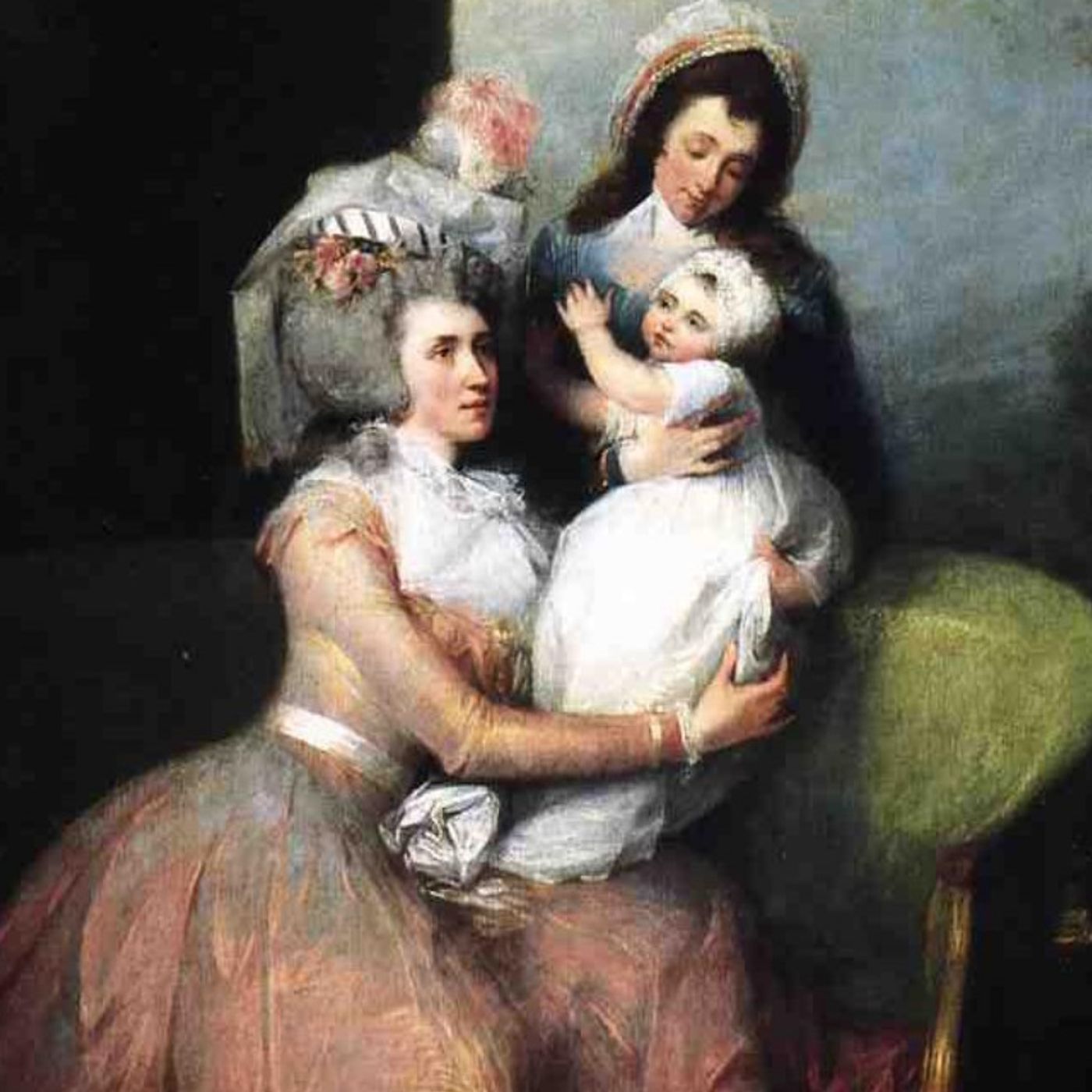
Oh, Angelica. Angelica loves pretty clothes. She has gorgeous clothes. I mean, if you look, there's a fabulous portrait by her of her by John Trumbull. She is wearing the most extraordinary iridescent bronze taffeta dress. It's just incredibly beautiful and elegant. She has on her head a hat that looks as if the entire contents of a milliner's shop had been just piled on it. There's the little pill box. Then there's the. Which looks like a candy box. Then there's a bouquet of flowers. Then there's a poof of tulle then there's something. It just. It's unbelievable what she's wearing. She also liked to go to the opera, to the theater. She had a box at the Drury Lane theater. A box at the opera. She liked to go to the assemblies at Renly and at Vauxhall Gardens. And of course she had. And John Church had they together bought a really beautiful, not palatial, but like mini palatial house on the Thames outside of London, which they was called Down Place and is. It's still there, the house. It was sold by them and when they came back to America in 1797. But it is. It was a beautiful house and the churches did it up gorgeously apparently. They had a little temp like a Grecian temple, the gardens that had a frescoed ceiling that was painted by Angelica's great friend Mariah Cosway. And she threw parties there. People came to see her. It was really very glamorous.
- [18:10]
Interviewer
Angelica, her smarts were well known. She was beautiful. She was good to other women. She helped them sort of get involved in society. But I was curious, did she use her smarts for anything more substantial?
- [18:26]
Amanda Vale
Well, here is the thing. My take on Angelica is that she always really wanted to be a star. Her interest in politics, to the extent that she had them, were less about politics themselves than about her own prominence and her own influence and her ability to influence people and be where she thought she could matter. She wanted to be in the room where it happened, whatever it was. And as a young woman, she was upset when a friend of hers was placed under house arrest because the friend's husband was a loyalist and had fled to Canada where he was fomenting attacks on the American colonies from the other side of the border. And so she went. But. But the. But the wife thought that possibly he was dead and was very upset about this. And so Angelica thought, oh, I don't want her to think that and I don't want her to think that badly of me. So I'm going to go and tell her that he is not dead. And as soon as Angelica told her that the woman, Mary Watts Johnson, disguised herself as a maid and escaped from her house arrest and fled, taking military secrets with her to Canada. So to join her husband, who she knew was there something she probably wouldn't have done if Angelica hadn't told her. But it was more important to Angelica to show herself to be a mover and shaker here, you know, to. To insert herself into this situation. She, when she was in England with John Barker Church and The French Revolution had broken out. The Marquis de Lafayette, or the former Marquis de Lafayette, had been imprisoned by the Austrians since his actions in support of the revolution had, in the view of the Austrians, caused Marie Antoinette, the aunt of the Austrian emperor, to lose her head. So Lafayette had been thrown in prison in Austria. And Angelica, in part because she was motivated, I think, by sympathy. How could you not be? I mean, Lafayette had been a friend and she was fond of him, as everyone who knew him was, but she managed to persuade a bunch of emigres that she was friends with. They all got together and she persuaded the American ambassador to London to violate the terms of America's neutrality policy and back a completely cockamamie scheme bus Lafayette out of prison in Austria.
- [21:48]
Interviewer
And these.
- [21:49]
Amanda Vale
So these French emigres and Angelica cook this thing up. One of them, the guy, one of the two people who were supposed to do the busting out, is writing Angelica coded letters about where he is and what he's seeing and how he's going to do this. And Angelica is, you know, pulling all these strings. And she must have felt like she was in her element because she was at the center of this plot. And unfortunately, the whole thing completely blew up in everybody's face in a way that it's like the gang that couldn't shoot straight. It's actually was one of the funnier things that I wrote when I was writing this, and if people's lives hadn't been at stake, I think I would have laughed even harder. But, you know, it's just such a disaster. Fortunately, everybody in the end made it out alive out of this mess. But Angelica got them all into it because she just wanted to be a mover and shaker. It's. She didn't actually know what the hell she was doing, but she just went ahead and did it.
- [22:50]
Interviewer
A lot is made of her relationship with Alexander Hamilton, who is married to her sister Eliza. There were letters, there were meetings. If I read between the lines, there was one suggestion that maybe one of her children looked like Hamilton. How would you describe the relationship between Hamilton and Angelica?
- [23:11]
Amanda Vale
Well, you know, we don't. We have no smoking gun, I guess I would say we have only highly suggestive letters, which, when you consider them in the context of the fact that Eliza, and indeed the Schuyler family in general, is completely ignorant of these letters, you begin to see that it is entirely possible that there was an illicit relationship going on between the two of them. Angelica wrote to Eliza, I love your husband very much, and if you were as generous as the old Romans. You would lend him to me for a little while. I mean, that's a. Whoa.
- [24:03]
Interviewer
Yeah.
- [24:03]
Amanda Vale
And you know, there are people want to say, people have said, oh, she was just joking. Well, I find that very difficult to believe. One of the things that over and over sticks out in this relationship is that Angelica who met the flirtatious Hamilton and he was a. He was a verbally flirtatious guy. He apparently, you know, he would write letters to women who were his friends that were very flirty. They weren't as flirty as the letters he wrote to Angelica. Ones in which he would say things like yours as much as you desire, as you desire. He would write things that said had a comma misplaced. And he would write adieu, ma chere, and then put a comma, and then put sir after it. Goodbye, my dear comma sister. You know, that's. That he did not do that with other women. He met Angelica after three years, after she had married John Church, when she'd had two children. And she really was maybe not as enamored of her husband as she had been when she first married him because he really was kind of a boob. But he and Angelica immediately began what seems to have been at first, at least an epistolary flirtation. But after Washington was inaugurated and Angelica had come to America for six months, what turned out to be a six month stay during which she was alone in New York with Hamilton while Eliza was upstate with the family, the letters that they wrote to each other after that period take on this very superheated quality that really, really seems suggestive to me. And she writes Hamilton from the ship when she was leaving finally In November of 1789, this amazing letter in which she says, you know, goodbye, my dear Hamilton, believe. Please be as faithful to me as you say you will be. I mean, you know, this is very heavy stuff to be writing to your brother in law, in my view. And I, I can't believe there wasn't something going on there, but, you know, I obviously don't have the proof.
- [26:56]
Interviewer
That was Amanda Vail, the author of Pride and the Schuyler Sisters and the Age of Revolution. Tomorrow it's Eliza Schuyler. Hey, it's January. It's so nice when slipping on the slide Nice to sip hot chicken soup with rice that Carole Kane children's song has been struck by, by many in the head during this cold snap. So coming up, we're going to scratch the soup itch with New York Times food writer Melissa Clark.
- [27:22]
State Farm Announcer
Finding ways to be financially savvy is a smart move, and knowing you could be saving money for the things you really want, like that dream home or new ride, is a great feeling. That's why the State Farm Personal Price Plan can help you save when you choose to bundle home and auto bundling. Just another way to save with the Personal Price Plan. Prices are based on rating plans that vary by state. Coverage options are selected by the customer, availability, amount of discounts, and savings and eligibility vary by State.
- [27:52]
Progressive Insurance Announcer
Since WNYC's first broadcast in 1924, we've been dedicated to creating the kind of content we know the world needs. In addition to this award winning reporting, your sponsorship also supports inspiring storytelling and extraordinary music that is free and accessible to all. To get in touch and find out more, visit Sponsorship wnyc. Org.