Loading summary
Transcript63 lines
- [00:09]
A
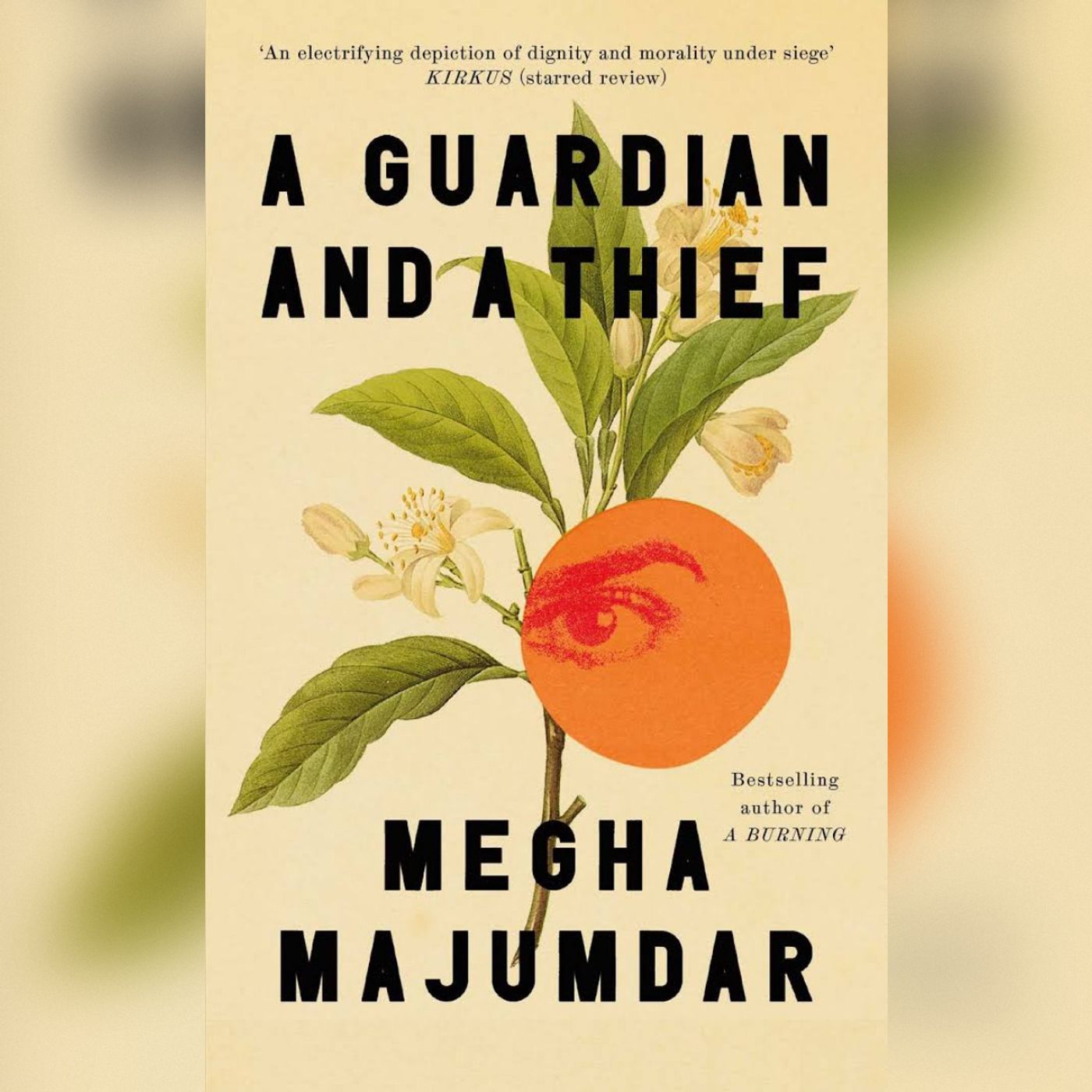
You are listening to all of it on wnyc. I'm Alison Stewart. The latest novel for Megha Majumdar explores how the effects of climate change can make people do desperate things, things they thought they would never do. It's titled A Guardian and a Thief. The story is set in a future version of the city of Kolkata, India. The effects of climate change have made the city unbearably hot and food is scarce. Ma is the head of a middle class family who hasn't gone hungry yet, thanks in part to the food she steals from the shelter where she works. Ma, her toddler daughter and her father are all preparing to leave India to live with Ma's husband in Michigan. But that plan is foiled when a thief named Boomba sneaks into Ma's house looking for food and money. He inadvertently takes the family visas. With only a few days before their flight to the U.S. ma and her family discover just how far they will go to recover the documents. A Guardian and a Thief was our march get lit with all of it book club selection. We gathered in the Stavros Niarchos Foundation Library earlier this week for a sold out event with author Megha Majumdar. I began our conversation by asking Megha what she wanted to explore about human behavior in a crisis.
- [01:27]
B
That's a beautiful question, Alison. Thank you. A Guardian and a Thief for me is very much a book about the push and pull between our greater and lesser selves. I think a lot about how we make choices to be or not to be our ethical selves. I think a lot about the conflict between loving the people that we love and being good moral selves for our neighbors, for strangers. And I think about that. I think because I perceive those flaws in myself, I see that I want to believe I am a moral person, but I often behave in ways that betray that idea.
- [02:22]
C
In A Guardian and a Thief, you note early on the media doesn't quite acknowledge as a crisis.
- [02:28]
A
You write for weeks.
- [02:29]
C
The news said there was no shortage. This was all a hoax perpetuated by those who rejoice at the region's downfall. Why was this an important line to include?
- [02:42]
B
That's a great question. So I was writing about shortage of food in the near future in Kolkata in India. And I wanted to show how people have different narratives around the same crisis. So I wanted to show how some footage might say, no, there's nothing happening. All of this is a hoax. Because the stories that we tell about realities are often in contradiction. They don't match up. They don't align and we have to make choices what we will believe and what is the story that matters to us.
- [03:23]
C
Kolkata is your home city.
- [03:25]
B
Yes, it is.
- [03:26]
C
What did you want to capture about Kolkata?
- [03:29]
B
Is there anyone here from Kolkata? Well, Kolkata is a beautiful city, and I wanted to capture how dense the social relationships are. I wanted to capture how you have relationships not just with your neighbors, but with the man who irons clothes at the corner of the street, with the barber who has a little shop on the sidewalk. They know who you are. They know the people in your family. And I think that those relationships, which can look thin, are waiting to be activated in a time of crisis. I think those are the relationships which make a city resilient. And I wanted to bring that into the book. I also have to say I wanted to bring Kolkata's humor into the book. People are very funny there. I am struck by that every time I go home. It's a city where people face daily problems and they face those problems with humor.
- [04:40]
C
So you have this trio who's preparing to go to Michigan. Mishti, the little girl, Ma, Dadu, her grandfather, the mother's father. But Dadu seems a little reticent about going. Why doesn't he want to leave Calcutta? What does he think about it?
- [04:57]
B
You know, one way for me to think about characters is characters are instruments who allow me to ask questions that I am interested in. So Dadu, the grandfather in this novel, is reluctant to leave Kolkata because he feels that it is in Kolkata that he can be truly and fully himself. It is in that city that he is known, that people know his boyhood self. And when he moves to Michigan, who will he be?
- [05:31]
C
Who will he be?
- [05:32]
B
I think that is a question that many of us who grew up elsewhere and now live in a different place think about, you know, who were you? Who could you have been in your hometown? And who are you in this other place?
- [05:46]
C
Ma says to Dadu, I think that maybe you and I have lived in two different cities. How has Ma's experience been in the city? How has it been different?
- [05:58]
B
One of the hardest things about writing this novel was trying to say everything with as much precision and truthfulness. And as I aspired to, and Ma's experience of the city was really drawn from my experience of Kolkata growing up, which is that it can be a hard place to be a girl. I found it a hard place to be a girl. I would take, for instance, the public bus to and from school. And often on the bus, me and my friends would get touched and groped and harassed and to the point where we would joke about it at school and joking about it was our way of saying, is this happening to you? It's happening to me. So it's a very hard place to be a girl sometimes. And I did not want to erase that from the truth of the city.
- [06:59]
C
In the book, because of the climate crisis, there's a lack of food. What kind of research did you do into hunger?
- [07:10]
B
I found that while I was reading about climate change, I came across a lot about water and relatively less about the future of food. And food is very important to me. It's how my family and I connect. It's how we share joy and love. And I was very worried about what the changing landscape of agriculture will do for something like your treasured family lunch. So I read a lot of books about the future of agriculture. I learned how, for instance, soil quality is going to change in the future, which will result in. In fruits and vegetables which are less nutritious. I learned how pests are going to spread more widely and go into new regions as the weather changes and they are able to thrive in new regions. And these are all things that were new to me. And I also read really hopeful things. I remember reading about women in southern India who go diving for seaweed. They collect seaweed, and that seaweed is currently used for things like making gelatin. But I wonder if in the future it will become a more direct food source.
- [08:43]
C
Ma and Dadu are solidly middle class. They have a nice home. Are they under the illusion that they are protected in some way?
- [08:55]
B
I think that's exactly right. I think that in the book, the family that I wrote about to begin with, Ma and Dadu, they have this big house. They are safe. They have this idea that the crisis will not get as bad for them as it has gotten for many of their neighbors. And what happens is that the book offers ways, through a couple other characters, to look at how crisis is experienced by people located in different places on the class spectrum. You know, growing up in India, class difference was so apparent to me, and it felt really vital to acknowledge that somebody was who lives in a village and is struggling to find a dry place to live, is experiencing the climate crisis in a completely different way from a person who has a stable, solid home.
- [10:06]
C
Let's talk about Boomba. What was your process for creating Boomba?
- [10:12]
B
Boomba is a young man, a villager in the novel, who, who is looking for a place in the city where he can make his home, where he can bring his family Over. And he is particularly driven by a wish to keep his younger brother safe. I was so dismayed when I realized I had to write this character because for a long time I thought the novel would be about the middle class family and there would be this thief who comes in and disrupts their lives. But then I realized that if I did that, you would have a hero and a villain, and that's very boring. And so I thought, well, who is this young man who comes in? What is his story? What is driving him? And I wanted to make Boomba as complex and complicated as I could. I think that's one of the things that I'm always chasing in fiction, is complexity, because none of us is a simple person.
- [11:21]
C
What does Bhuma think he can accomplish by moving to Calcutta?
- [11:28]
B
Bumba thinks he can give his family a safe and protected future. Bumba thinks he can give his family a home where they can live and be protected. And Bumba thinks that he is the person to do it.
- [11:48]
C
It's interesting. Boomba does not seem to leave Ma alone. Like, they kind of go at it, the two of them, regularly. Why do they keep going at one another, these two people, Bumba and Ma?
- [12:04]
B
I think they each sense what the other has to hide, and it puts them in a relationship where they cannot let the other person go because it would be dangerous for themselves. And that kind of relationship is so thrilling to write in fiction because you see these two people who are each motivated by love. They want to protect the children in their family. That is all they want. And yet you see them making worse and worse choices. They reveal the parts of their natures that they would perhaps prefer to hide, the parts that they are perhaps ashamed of. And that is such a thrilling, exciting thing to chase in fiction.
- [13:01]
C
I'm not giving any spoiler alerts here, but we learn that Ma is a thief as well. She's been taking food from the shelter. How does she justify this?
- [13:13]
B
Ma works at a shelter for newcomers to the city, and she has been taking food for her child. You know, while I was writing this book, I had my first child. I had my older son. And the vastness of that love, as, as all the parents in the room know, was astonishing to me. It made me feel that the ferocity of that love can destabilize your sense of self. It can really destabilize your sense of who you are. It can make you abandon elements of yourself that you thought you would never give up. And that brought me to the question of what will you do for your Child. And what happens when the things you do take you really far away from who you thought you were.
- [14:09]
C
I'm interested in where you put it in the novel where you let us know that she's been taken from the shelter right away.
- [14:17]
B
Page one.
- [14:21]
C
Why?
- [14:25]
B
Why is this revealed on page one one? You know, I was thinking a lot about how that opening couple paragraphs should work. This is the kind of fiction craft talk that I love. I was thinking a lot about what should those paragraphs do? And I felt that there is. This is page one. So right away you see that Ma is watching a person go by, and she wonders if that person on the street is a thief. And there's a whole paragraph about her imagination of the stranger as a thief. And then it turns out that she is a thief herself. And I wanted that paragraph to take you deep into the mind of this person who is afraid, and then to jostle that paragraph and tell you, look, this person is a thief herself.
- [15:26]
C
You're great at writing children about. Writing about Robbie Boomba's baby brother and Mishti, the little girl. Why was it important that each family has a very young child?
- [15:42]
B
Probably because I had a very young child, and I wanted to write the way in which a child can hold so much within a family. The children in this book provide the motivation for the grownups to behave in the ways that they do. And I just said grownups. Like our preschool messages asked, who are the grownups coming today? But I also wanted to write children who felt alive and vital. I wanted to write the ways in which they are very funny. I wanted to write their concerns and their questions. So they needed to hold the moral weight of the book, and they also needed to be children.
- [16:36]
C
I wanted to ask you about writing a phone conversation because I read the book and I listened to the book, and did anybody listen to the book? It's interesting because they have the phone conversations sound like they're happening over the phone.
- [16:51]
B
I have not listened to the audiobook.
- [16:52]
C
I haven't listened to it. It's great. Well, the phone conversations happen over the phone, and you can sort of imagine it. But I was interested in how did you write a phone conversation?
- [17:01]
B
That's a great question. It's a good craft exercise, I think, to see how two people can speak and their words speak say one thing, and what they know is being communicated can differ from the words. So I was interested in letting the reader know that there is more going on here. The words in this conversation are not the only thing to pay attention to. I had fun writing those conversations. And really they also came out of I moved to this country to go to college when I was 19 and I had a lot of phone conversations with my family back home in India. And I remember parts of my life. I moved to New York after college and I had a very rough several months after school when I didn't have the financial aid of school anymore. I didn't have a job. I was applying to everything. I couldn't find a job. I lived on this bunk bed in the Lower east side that somebody had vacated because it was her bunk and she had broken her leg so she couldn't climb up. So it was available and on Craigslist. And I remember having so little money that I would go to the bodega and buy bread and spinach and turkey and that's what I would eat. And none of that I communicated to my parents when I spoke with them. I said that everything was fine, I was looking for jobs, things were okay. And meanwhile I was calculating whether I could pay the subway fare or walk somewhere. So I think that many of us who live far away from the people that we love hide when things are difficult because we don't want to burden them with the worry. And saying I am okay, don't worry about me is a form of our love for them. And I wanted to bring that into the phone conversations in this book.
- [19:19]
A
You're listening to my conversation with author Megha Majumdar. Her novel A Guardian and a Thief was our March get lit with all of It Book Club selection. We'll have more with Megha after a quick break. This is all of It.
- [19:39]
B
Foreign.
- [19:42]
A
You're listening to all of it on wnyc. I'm Alison Stewart. Let's continue my conversation with Megha Majumdar. Her novel A Guardian and a Thief was our March Get Lit with all of It Book Club selection. Our event was sold out and thanks to our partners at the New York Public Library, 3,863 readers were able to check out a copy of the novel to read along with us this month. As usual, our audience had great questions for our author. We'll hear some of those in just a moment. But first, here's more of my conversation with author Megha Majumdar.
- [20:25]
C
I wanted to ask you about the pacing in the novel over the course of seven days. It happens in a week. We Was that always the plan? Was it always going to be seven days?
- [20:36]
B
For a long time I thought it would be 10 days, and I struggled to make 10 days work it really did not work. I have spreadsheets where I mapped out the 10 days, and they were so wobbly and so bad.
- [20:50]
C
Interesting.
- [20:52]
B
And then I realized, well, maybe there's enough here for seven days. And I brought it back to seven days.
- [20:59]
C
Was the editing process difficult?
- [21:02]
B
It was really hard. Yeah, it was very hard. You know, for me, I am constantly editing my own work, and I think that is really the only way to get to the most vigorous, powerful version of your book is to edit ruthlessly for a long time. And I knew that I wanted to write a book which would have something intellectually serious to say. It would put forward the questions that mattered to me, but it would also be fun and swift and move. I think that the question of how do you entertain a reader? Is a very serious craft question. I love when I am immersed in something and I want it to produce that feeling.
- [21:53]
C
Let's go to the audience for questions. Who's got a question?
- [21:58]
D
I was really interested in the namings in the novel, like calling them ma da dum, like the simplest of docnoms or nicknames. Did you have any thoughts around that while you were creating the names for the characters?
- [22:12]
B
Thank you for that question. You know, when I began writing, I wrote the characters as Ma and Dadu, and I think I believed that I would change those and give them real names. But when I tried to do that down the line, it did not feel right. And it was one of those moments where you really trust your intuition as a maker of anything. And I wondered if it would be confusing to readers. But it felt right to me, so I stuck with it. Hi, could you talk a little bit about the billionaire that plays a very important role in the book and what you were thinking crafting that character?
- [22:57]
C
Yeah, there's a billionaire who lives on a hexagon in the middle of the river who donated some things to the community, but is also planning a lavish wedding.
- [23:07]
B
The billionaire was really a way for me to ask the reader to think about class, because I had a family who are middle class. I had a family who are quite poor. And, you know, in India, in Kolkata, there are people who are very rich. There are people who are very wealthy. And I did not want to put that out of the picture completely because I realized that in such a situation, a billionaire such as this character would face her own unique puzzles. She would probably think about the optics of what she was doing. She would probably think about the line between sincerity and performance. And I wanted to urge the reader to think about those, too.
- [24:05]
C
Did you always know she would be a woman.
- [24:07]
B
Yes.
- [24:09]
C
Any more questions from the audience?
- [24:12]
E
Something you make clear in sort of the subtext of the novel is that Matt is a character who's not just stealing food for her daughter. She's also stealing discretionary funds from the charity. So. And this is while the stealing of the food is something that her family is aware of, this other stealing is something that is not. So my question is, why was it important to you that Ma be this character who has layers of secrets?
- [24:40]
B
That's a great question. And I think that is half of a line that nobody has ever brought up. To me, it felt really important to show that Ma has a certain ruthlessness in her as well. She believes that she is a decent person. She has a narrative of herself as just a mother doing what is needed for her child. And that is the narrative that allows her to move through the world. But there is something in her which is much more selfish and which sees the crisis as pertaining to her perhaps more severely than it pertains to anybody else. And I think that that can be a very human impulse. There's a scene in the book where she refuses to help a beggar. And I wonder often about moments like that because I think that I make choices like that. I make choices that, you know, if my son asked me to justify them, I don't think I could. I make choices that I don't believe are the best ones, you know, in the grand scale of things. I think I often do things which I cannot defend morally. And so I'm very curious about that. I'm trying to understand it.
- [26:18]
D
Hi. Thank you so much for writing this book. I have not finished it yet, but in reading it, I was thinking it reminded me a bit of the White Tiger in some of the moral questions that it raises. And one of the thoughts that I had was, is the concept of being moral or the. Is it a luxury to even wrestle with questions of morality? And is that something that. Because one of the questions the White Tiger raises is like, look, if you're asking. If you have the bandwidth to do things because they are moral and you have room to make those choices, you're already in a certain place. And that's a summation of a White tiger that maybe not everyone would agree with, but that. That was my takeaway from that book. And I was wondering if as you. Your middle class character wrestles with these moral questions and other people are equally pushed or maybe more pushed into making moral compromises. How you thought about that?
- [27:23]
B
If you thought about that, that's a great question. And I think you are urging me to think about something which I really wrestle with, which is what can a book do to help anybody? You know, I think that I really struggle with what is the purpose of putting these questions in a book. I struggle with how useless it is for many people to have a book which engages these questions. You know, a book is not going to feed anybody. It is not going to give somebody money who needs money. What is the purpose of writing a book? It is something that I really wrestle with, and I think you are right that it is a matter of huge privilege to think about moral questions. You know, kind of turning back to the previous question I was. You both are making me think about, you know, when the migrants started showing up in the subways here in the city. And, you know, they've been selling candy for a while now. But when I first started seeing them, I would always buy candy because I was so heartbroken by the sight of the little kids, you know, bound to the back and the parent moving through the subway car selling candy. I would always buy candy. I saw them on the platform and I sometimes gave them money. And then I stopped. I stopped because I saw so many of them. Every time I went on the subway, I saw them and I stopped, and I don't know why I stopped. And it's a matter of huge privilege that I chose to give and I chose to not give. It's not something I'm proud of, but these are all things that I'm thinking through, and I think maybe that is why I write fiction, is because I'm very troubled by the person that I fail to be often.
- [29:28]
C
Thank you for your candor. That answer. I interviewed you. I think it was on your pub day. We did a short interview and we loved the book and we said, yes, we want to do this for book club and. But it's been several months since we last saw each other. I'm curious about people's reactions during that time. The reactions to the book. What have they been like?
- [29:53]
B
I've heard from people saying that the book moved them. I've heard from people saying the end made them really angry and they threw the book across the room. I've had people DM me saying, why is this the ending? So it's been a range. But you know what? I think it's. I feel very lucky to be published at all, to get to do this with people like you. I feel very lucky to be in a room with all of you. I mean, you all showed up at the end of your work day or school day and you're spending your time here with me. How lucky am I?
- [30:39]
A
That was my conversation with author Megha Majumdar about her novel A Guardian and a Thief from our March get lit with all of it book club event. Up next, we'll hear some music from a fellow Kolkata native, sitar master Purbayan Chatterjee. Stay with us.
- [30:55]
F
Drafty windows Rising energy bills Worn out windows making you uncomfortable in your home? Renewal by Andersen can help. We offer custom built energy efficient windows that block drafts, open and close easily and can help lower your energy costs. You can buy now and pay nothing until September2027. No money down, no monthly payments and no interest for 18 months with a minimum of six. But don't wait. This offer ends March 31st. Visit renewalbyandersonhome.com for more information and enjoy your new windows for years to come.