Loading summary
Transcript29 lines
- [00:00]
A
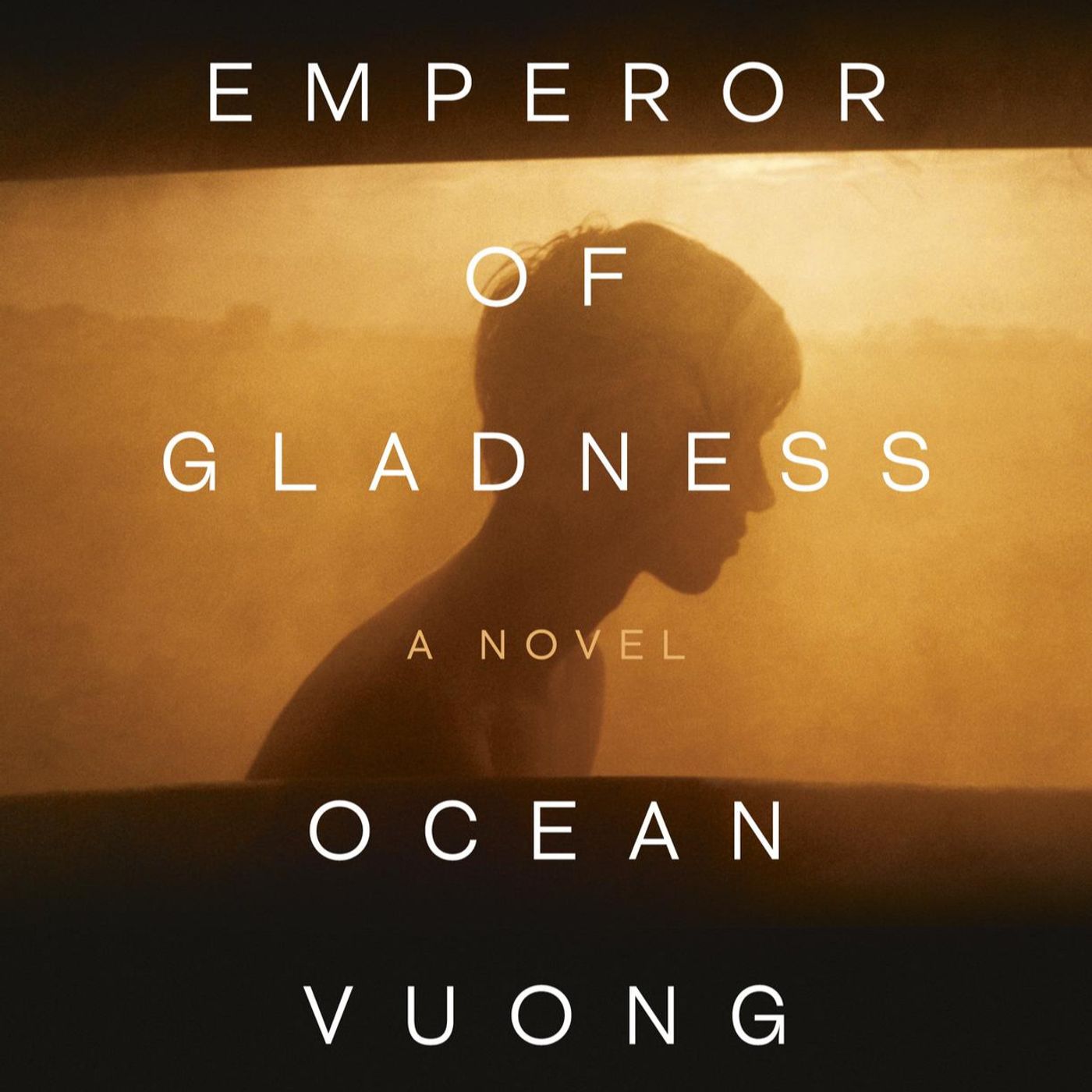
All of it is supported by Progressive Insurance. You chose to hit play on this podcast today. Smart Choice make another smart choice with Auto Quote Explorer to compare rates for multiple car insurance companies all at once. Try it@progressive.com Progressive Casualty Insurance Company and affiliates not available in all states or situations. Prices vary based on how you buy. You're listening to all of it on wny. Welcome to nyc. I'm Alison Stewart. The latest novel from poet and author Ocean Vuong was named one of the best books of 2025 by the New Yorker, NPR and Kirkus Reviews. It's titled the Emperor of Gladness. The story follows a young man named Hai who lives in East Gladness, Connecticut. Hai is struggling with addiction. He's dropped out of school and hasn't told his mom. One day he heads to a bridge to end his own life, but an elderly woman named Gragina sees him and stops him. She invites Hai to live with her as her caretaker. Hai agrees before realizing that Grajina has dementia. Their relationship quickly becomes deeper and more intimate than either of them bargained for. In the background of all of this is Hai's time working at a fast casual restaurant called Home Market. There, Hai encounters a diverse group of employees, all with hopes and dreams of their own, including his Civil War obsessed cousin Soni. The Emperor of Gladness is a semi autobiographical novel based on Ocean's own experiences as a caretaker for a woman with dementia. You'll hear about more of those real life memories and more on my conversation with Ocean Vuong from our January get lit with all of it book club event. We had a sold out crowd at the Stavros Niarchos Foundation Library. I began the conversation with Ocean by asking him why he wanted to begin the book with an in depth description of the fictional town of East Gladness, Connecticut.
- [02:09]
B
You know, I didn't know Connecticut had a reputation, you know, because you don't know where you grew up has a reputation until you leave it, you know. So when I came to New York to go to school, I told folks I'm from Connecticut and people said, ooh, fancy whale pants. And I said, what do you mean by that? He said, well, you know, private schools, yachts, you know, mansions, and we have a few of those. But actually what we have more of is a lot of working class immigrants who came particularly Caribbean from the Caribbean after World War II to work on the farms and the fields when the labor was at such a high shortage. And that led to the communities that I encountered coming to America in 1990. The first flag I ever saw in my life was a Puerto Rican flag hung on a dash with a pair of boxing gloves. And, you know, so I would grow up hearing Spanish, and it was surrounded by Haitian Creole, Jamaican, and. And to me, that was the bedrock of my imagination as an immigrant. And so I wanted to capture this because I think when I look up, like stories about Connecticut, you would of course, hear about Mark Twain, Walter Stevens, but they were different Connecticuts. They were from the past. And I wanted to update it with this place. And I think a fictional place is a wonderful conduit because it is stained with history but still holding the potentials of something else. Which is why I love fiction, because in a way, it's a suggestion of an otherness that perhaps we can still move forward towards. And I think on any January night, people are probably leaving second shifts with a paper bag of something good for their families and children. Waiting. I remember waiting outside, looking out the window for my mother's little Toyota Camry to come home. And I think that kind of anticipation of arrival and warmth because the winters are rough. And so I think, to me, it's about waiting. And you don't realize how. How much waiting being poor requires of you. When we were in the welfare lines, we were waiting. When we were asking for heat assistance, you wait. So time. People say time is money. And when you already don't have it, you're asked to consume it while begging. And so I think for me, it's this kind of anticipation of. Of the simplest things that I wanted to capture that mundanity in this place. East Gladness Much of the novel is.
- [05:12]
A
Based on your own life experience. What resources did you have? Did you keep novels? Is it mostly from memory?
- [05:23]
B
It's memory, but I think everything comes from one's life. The question for art is implementation. There's a lot about my life that people will never know because I haven't found a way to implement it into resonance, into meaning. Right. Otherwise I'll just scribble down diaries and just tell you what I ate for breakfast. That's autobiographical too, but I don't think it's very interesting to read. And so I think for me, it's about looking. And I tell my students this too. I said, you look at your life and you'd have to think, does it have a kind of radiance that could resonate with other people? Is there more meaning to it other than just experiencing time? When you can implement it into a story, then it has this kind of web of attachments. And it has repercussions and circumstances, and then it becomes art, because you now taken something you've experienced, and then you've woven it into something much larger, much more contrived, formed, and deeply considered. I think that's ultimately what it is. There's many ways to go about telling stories, but ultimately all stories, when they're worthwhile, is just life deeply considered. So when you hear someone's story or when you're reading a novel, you're like, this is the most considered version of this person. And. And I can get it without them even being in front of me through the technology of the sentence. I mean, forget about going to the moon. That is such an incredible invention. We as a species has invented the words that could differentiate between thatness and this ness, that and this. Right. Like, in the very fundamental way. And from that is the building blocks of compassion, empathy, and meaning. I don't know. I'm just still. From that kid in Hartford county, working in fast food in the tobacco farms, to be sitting and talking about language with you is something I've never imagined. And I'm grateful every day that I get to do it.
- [07:41]
A
Yeah. Christina in the novel is based on a real woman named Grazina, who you helped care for. Why did you decide not to change her name?
- [07:56]
B
I wanted the history attached to that name to be felt and marked to me. I lived with a woman named Grijina Versalis. She was a refugee from Lithuania fleeing Stalin. She lived in Richmond Hill, which at the time, after World War II was a Lithuanian community. Now it's a Guyanese Caribbean community. And I lived there while going to school at the very end of the A train. And funnily enough, a few blocks away was Jack Kerouac's home, that he lived there for a while while editing on the Road. So it's really interesting that, again, we never think about the outskirts as places of American mythologies, but it was there. And. And I don't. As a novelist, I don't go out to tell people stories, you know, like Georgina's autobiographical life. Her stories are hers. I don't believe I have the right to tell it, so I make it up. But the context, I wanted people to see that this woman lived as a historical figure. But the story I'm telling comes from my own research and my own imagination. But she lived that life. The context of her life is there with me. And also, Geina, as I learned, means beautiful. You know, like, for. For a mother, her mother, to experience so much war from World War II to one, and then the devastation prior to that, to then grow up and then name her child. Beauty was so, so special. And I wanted to carry that beauty into the book and have it become a braid that sustains.
- [09:50]
A
As you worked on the story of Grijina, you had to learn about dementia and how it works, and you had to decide how it would work in your story. What did you learn about dementia that helped you write Geina's character?
- [10:09]
B
Well, when I was caretaking for her, I was 19 years old, and I didn't know what it was. I remember being on WebMD reading about it, but it was what's in front of me. It was my way of making it through college. That was the exchange I had. I would take care of her in exchange for a room. So we were kind of these strange bedmates. And I mean that literally. Sometimes I would sleep in her bed because her attacks were so bad that I would have to be there. Or she had carpeting, so I would sleep right under her bed. It was the only way you could hear if she was getting a bad nightmare. You can come up and help her. But what I learned is actually, it's very similar to writing dementia and Alzheimer's, because often we think of it as a memory disease, and we often say it's a loss of memory. But from my experience, I think the loss of memory happens at the very end stage in life, but for the majority of of the experience is actually memory without choice. There is memory, There's a lot of memory. It's just not in this time. And so I learned that very similar to writing something, you can't force the issue. You have to follow. Because the difference between her and I was that I had a choice. I get to choose what I was remembering. So I had agency, I had authority. I was an author of my own memory. And memory is very expensive. You know, when we remember, we forsake the present. So to remember something is to displace the present is to the cost of memory is your very life. So to choose that, it's a very. You know, we remember things all the time. Remember our birthdays, our anniversaries, memories of last week. But in fact, we leave the present to go back. And so when someone loses that agency, they lose so much of their personhood. And I learned that the only way to find grace and compassion that's worthy and necessary in caretaking is to come to them. So there are days where I would just follow her. You know, I would walk in the kitchen, and she'll be talking to somebody. And she said, this is Anna. She came all the way from Schenectady. And I said, hi. Hello, Anna. How's Schenectady? I don't even know where that was at the time. Because I think the worst thing you can do is tell someone that they're wrong when they have no choice. So it was really about shame and respect and dignity. And I think so much of what I understood of love, it's a big subject I learned from caretaking for Gurgina, because we often think about love as something we do or make. We make love, we do something, or we possess it. Right? I have love. But for me, I thought what I learned then was that the most capacious part of loving someone is surrender, is making room, is saying, I'm going to step aside to hold you because you can't hold yourself right now. And, you know, I wasn't a medical professional, but I learned that if you adapt to somebody and no matter what you're doing, if you can retain someone's dignity. And I think this is true of what I'm interested in, the book too, is this Working Class and Dignity. There was so much because, you know, when you're poor, everything about the world tells you that you are a bad person. You can't afford to donate nothing, you can't afford to give things away to charity. And so no matter what you want to do as a citizen, you can't do it. So with decades of that, you start to believe that you are a bad person, that you are incapable of goodness, but it's actually impoverishment, systemic poverty. And so I think I'm just deeply interested in using the sentence as a way to re dignify American life.
- [14:39]
A
When Gergina invites Haya to come live with her, it's just about as he's about to take his own life. I think she's a hero in that moment.
- [14:48]
B
Personally.
- [14:50]
A
Hei says, yeah, I'll live with you. Why does he say yes?
- [14:56]
B
Why? I think sometimes in those moments, we always ask of our characters, of our stories to have big reasons to live or big reasons to step out of life. That's what we expect. But I think I was more interested in how we actually slip back into life. And sometimes in that case, you know, he's at the end of his rope, he's contemplating ending it all. And this woman who's doing her laundry spots him, yells at him. And I think what happens is that he actually doesn't really choose life. He just forgets to die. And I think what I want to say is that sometimes that's enough. Whatever it takes. You don't need the big reason. It's just the little reason, you know? And this is a personal moment for me because I lost my uncle in 2012 to suicide, and he left a note. And there are things I won't disclose in that note, but one thing I think is important to implement into this conversation that's always stuck with me. And he said in his note, he just said, I'm sorry, I had enough. He worked his whole life in factories, and I think what I heard there was that he was tired. And sometimes we want the big reasons because it's for us, it's substantial to us. But I thought it was so honest to say I'm. I'm tired. America has made me too exhausted. As if he was just pushing, pushing away from a chair, right, and getting up from the table. And I wanted to kind of center that and say, sometimes it's these small little actions we don't. We don't have the answer to go on. But sometimes we go on when we realize that we can be more useful to somebody else than we ever were to ourselves. And it's not the reasons for the big stories, the Hollywood films or what have you that we come to expect, but it is often enough, and I wanted to see if I could use that small thing, the realization that you can help somebody else as a catalyst for the whole story.
- [17:19]
A
How would you describe hai and Sonny's relationship? Sonny is his cousin.
- [17:29]
B
Hard love, you know, And I think. I think for me, that cousins are kind of the most overlooked parts of relationships, because, you know, there's just enough distance from cousins to meet each other on your own terms. Because sometimes you owe things to your siblings, you know, from your parents. That's your brother, that's your sister. You gotta be there. You gotta do it. And sometimes, like, I didn't choose you, but cousins, it's like you can see each other across the room through the years, and then you can make a choice, and you say, you know, I actually like you, and there's enough autonomy. And I was really interested in that. And so they were. Cousins are strange enough, but close enough that they can't completely turn away from each other. And so I wanted to really explore that reciprocal bond that they start to develop. And in a way, they become what brothers should be. Perhaps what's close siblings to me, I'm interested in kind of using the time of the novel to obliterate the dogmas of Those relationships. And at the end of the day, it's like, what do you owe each other? And what can you do for each other? And that, I hope, goes beyond kinship and into communities.
- [19:00]
A
Why does Sunny like the Civil War so much?
- [19:04]
B
Well, I said a novel is a place to implement, right? So, like, fortunate. Whether it's fortunate or unfortunate is yet to be determined. But the Civil War obsession is actually mine.
- [19:17]
A
Yes, true.
- [19:19]
B
And one character was too much to hold, so I had to spread it out. I didn't know that. And so when I was growing up in Hartford, we had, like, depending on where you turned the antenna and how much tin foil you had, you had like, four channels. And I had kind of like a quintessential American boyhood education, because almost every darn holiday, there'll be a war marathon, A marathon of war film. So Veterans Day, July 4th, President's Day, and there was this film called Gettysburg, starring Jeff Daniels. And it's like a five hour film, but throughout my childhood, with commercial breaks and all, it just played again and again. I watched the entire film multiple times on the four channels. And I was so taken and perplexed by it because it was so moving, so beautiful, so tragic. And also, like, I was like, well, I think I heard somewhere that I come from a civil war too, in Vietnam. So what's going on here? Also with a North and a South, right? But when I watched was really, really startling because it was portrayed the power of storytelling portrayed the Confederate soldiers with such humanism and humanity that is deeply startling. So as a child, I kept rooting for them. This is the power of cinema and storytelling. Right? There was never a single enslaved person in that film. It was hard. It was never really central. You saw Robert E. Lee, played by Martin Sheen, close up. You saw these men playing the Dixie Song and the Stars and Bars with no shoes. And I said, gosh, they feel close to what I'm experiencing. Impoverishment. And all the generals were played by people much older than the ages of the generals. So they all look like very worried grandfathers. So you have Robert E. Lee in a rocking chair in a blanket, and it's like Santa Claus being stressed out. And all they talked about was, like, going back to Virginia. And I was like, why can't these just let these old grandpas go back to Virginia? What's going on? Why are they fighting so hard to go home? But that is part of the American propaganda. And the miseducation of American child begins on screen. And so when I found out, because I was like, let me go to the library. New York Public Library, y'. All. Thank you. The cure for American Hollywood propaganda is the library. Exactly. And when I found out that this they were fighting to keep people as property and how that film just completely occluded that central reality, I realized the power of the zoom. It's not just a technique of the camera. It's also used in fiction. How you accelerate, how you decelerate, what you spend time on creates meaning. And they had all the opportunity to show, you know, the enslaved people who were fleeing the Confederate army in Gettysburg at the time who were being hunted down. They had all the time to show that. Instead, they zoomed in on Robert E. Lee being worried about trying to go home. And when I realized that big lie, I realized that I had to really need to understand that war to understand this country. And when I went to Brooklyn College, I studied 19th century American literature to pursue that.
- [23:15]
A
You're listening to my conversation with author Ocean Vuong. His new novel, the Emperor of Gladness was our January get lit with all of it book club selection. We'll have more with Ocean after a quick break. This is all of It. You are listening to all of it on wnyc. I'm Alison Stewart. If you love reading and if you are a fan of get lit, we have good news for you. We are launching the Get Lit with all of it newsletter. It will have updates on our authors and events, feature author interviews you might have missed, and of course, there will be plenty of great book recommendations. To sign up now, head to wnyc.org getlit and speaking of get lit, we continue my conversation with author Ocean Vuong. His novel the Emperor of Gladness was our January Get Lit with all of it book club selection. Thanks to our partners at the New York Public Library, 3,892 people were able to check out a copy of the novel to read along with us this month. Our sold out audience had great questions for our author. You'll hear some of those in a moment. But first, let's dive back into my conversation with Ocean Huang. One of the heartbreaking moments when Georgina's family suddenly decides to take an interest in her and to get more involved in her life. Even though they're absent for most of.
- [24:53]
B
The book.
- [24:55]
A
Why didn't she want them to show interest in her earlier?
- [25:02]
B
I wanted the family to kind of appear as a sudden interruption. I think life is often a series of interventions and interruptions. And I wanted to show that, well, there was this kind of wonderful potential technique in Fiction where you don't know if the family's real or not because she keeps talking about it. You're like, oh, she's just hallucinating again. And so there's a wonderful kind of classic twist that when the family really manifests, you're like, oh, how much of this is real and fake? And that's also a central part of the book, is how much of Gergina's illness is exaggerated by her. Because I didn't want her to just create a medical victim, you know, for me, like, in life, you know, like, that was the reality, you know, Gergina in life was deeply in decline, and it was all very evident, but I didn't want to just replicate that because we know that we have people like that. So, again, implementation in fiction is almost like a chance to create a strategy. And one of the things I wanted to do is give Geina fictive agency. So she's. She is also playing a game where she's exaggerating her illness to keep him there, you know, because she's alone, she's lonely, and you don't know how much is real, how much is true. And you start to wonder. He starts to wonder, right? At one point, he's like, what's going. What's really going on? And you realize that the power dynamic, even for people who are completely bounded together, is filled with manipulations of all kinds. And so when the family enters, it's a financial negotiation that they're both moving through. So it's a wonderful moment to kind of increase the tension in the story around the midpoint.
- [27:04]
A
Let's get to some questions from the audience.
- [27:07]
B
So I lost my mom to dementia about two years ago. And I think that it's really important, the spotlight that you put on it, because so many Americans have dementia. It's about one in nine right now, but it's not spoken about. And so when you were writing the character of Georgina, and from your own experiences, I was curious, were you more interested in describing what you lose to dementia or kind of the new dynamic in relationships that you gain? I think both. I think it's a. The richness of it is a dialectic between losing and gaining. And in the loss, you also gain a lot. Right. And I think even scientifically, you know, neuroscience would say that we don't truly remember in the sense that we recall. All memories are new neurons being made from old data. So that's a kind of. It's very beautiful in that sense. You know, the word poetry poet is to make maker and so in a way, a poet is a remember, it's a memory artist. And what I found was, you know, when I was living with the real historical Gergina, she was, all of her humor and her personality was still there even when she was out of time, you know, she would crack the same jokes. And so I don't know, it gets a little more philosophical here. But I just think, I think what I learned was that there is still a personhood, even if the mechanism cannot express it. It's something beyond just the brain. We can get woo woo and say, call it a soul. But I saw it. I said, you're still you even as you're changing. The operating system is, is misfiring, but the you ness is still there. And I think with all of my characters, I'm after that kind of you ness, that deep mystery. And I think if I, if I know more about, if anything becomes clearer to me after writing a book, I think I've done it wrong. I think it actually should get messier, the question should get bigger, the horizons further and further away. That's when you know you really asking the right questions as an artist, at least for me. And I think as a 19 year old kid trying to make it through college, taking care of an 84 year old woman literally losing her mind, I was, we were both losing a lot. But I think I've gained something that no school could ever give me at the time.
- [29:54]
A
So, Ocean, you're a poet, you're a novelist and a photographer. You have your first solo museum show opening up at the end of the month in Kingston, New York, January 31st. When did you start taking pictures?
- [30:14]
B
Oh, thank you for asking about that. Well, I took photos long before I was a poet. I didn't know you could be an artist. You know, when I was growing up, it was like Factory Nail Salon or the Army. Those are the major career paths that my friends went into. And that was presented to me. And so to me, like being an artist or a poet, I was like, oh, I didn't get that card. I thought you had to get, it's in your wallet. You know, you're born with a wallet and it says poet. You know, oh, I didn't get that card. So there it goes. And so it wasn't clear to me, but I started writing and I got my first publication, the Connecticut River Review, a tiny little local journal. And I remember running home to the nail salon with my publication. I was like 17 years old. It was like a little prize. And I said, mom, I did it. I didn't waste my life. Poetry is real. My name is in print.
- [31:22]
A
Only 17 waste my life.
- [31:26]
B
I know. Say dramatic poet. And I gave it to her. I said, ma, look, look, look. See Ojian vuong right there. And it's not a court document. It doesn't come from the government. It's not a detention slip. And being a typical mother, she looked at it. She flipped a couple pages. It's only one page, though. Who's all these other people, you know? I was like, all right, all right, you know? But then her face fell. And then she said, well, I wish I could read it, son. And it's just a stupid thing, you know, but, like, in my triumph, I just forgot that my mother's illiterate. So I was so happy, you know, that I just. I didn't consider what I was doing. And I realized that if I'm going to pursue this, every poem I published is going to be one step further from my mother. So how do I stay here? And I borrowed my friend's camera, a Nikon 17, and I started photographing our town to show my mother, like, our life, you know. And it's interesting because sometimes, you know, this book, in the Emperor of Gladness, the son and mother are estranged. They're in the same town, but they keep dodging each other. And it's interesting because a lot of people write to me, say, how is that possible? How can two people in a town not see each other? And I'm not being hyperbolic when I say that I have never seen my mother walk in a park. We have a local park. I've never seen my mother step foot in our local park. To be of the working poor, your life is just this triangle of labor. Grocery store, post office, home. Like there was a whole town that she never stepped foot in. So I thought, let me just take pictures of this town. I wasn't being artful about it. These run down mills of New England, you know, these empty streets and old gas stations, you know, And I thought it was really beautiful. And I get. I went to cvs, printed a stack of photos to her. I said, ma, look, this is where we live. This is. And she became kind of my first critic, you know, because she says something that would become true for the rest of my career. And she looked at the stacks and she said, gosh, I didn't know our life was so sad. And I think that's been what I'm interested in, sadness. Not just as a feeling, but as a historical system of knowledge. That this feeling is a kind of way of thinking, thinking through place, race, politics and history. And I just kept on taking photos and just showed that was all what I would. And I started studying photographers. And then I learned that the project of taking a well composed photograph helped me download the subject into my brain so that I can write about it and depict it later in my writing. But it was all process. It was. I never meant to show it, you know, until a friend of mine said, you should. You've been taking photographs for over 20 years. Why don't you start sharing it? So here we are. But it's it was just a way to make what was not legible to my mother finally legible.
- [35:07]
A
That was my conversation with Ocean Vuong. His novel is titled the Emperor of Gladness and it was our January get lit with Olivet Book Club selection. Did you know 39% of teen drivers admit to texting while driving? Even scarier, those who text are more likely to speed and run red lights. Shockingly, 94% know it's dangerous, but do it anyway. As a parent, you can't always be in the car, but you can stay connected to their safety with Greenlight Infinity's driving reports. Monitor their driving habits, see if they're using their phone, speeding and more. These reports provide real data for meaningful conversations about safety. Plus, with weekly updates, you can track their progress over time. Help keep your teens safe. Sign up for Greenlight Infinity@Greenlight.com podcast Since WNYC's first broadcast in 1924, we've been dedicated to creating the kind of content we know the world needs. In addition to this award winning reporting, your sponsorship also supports inspiring storytelling and extraordinary music that is free and accessible to all. To get in touch and find out more, visit sponsorship.wnyc.org.