Loading summary
Transcript79 lines
- [00:08]
A
This is all of it. I'm David Fuerst in for Alison Stewart. Coming up on today's show, actor Carol Kane joins us to talk about the new documentary Carol and Joy, along with her mom and director Nathan Silver. We'll speak with Natan Last about his new book, across the the Past, Present and Future of the Crossword Puzzle. And jazz vocalist Kate Cordham is here with her band. They're going to be perform live in WNYC's Studio 5. That's the plan. So let's get started with everyone's favorite transit hub. 600,000 people pass through New York's Penn Station every day and probably more during holiday travel season. It is the nation's busiest transit hub, handling New Jersey transit and Long Island Railroad commuters, Amtrak passengers and half a dozen subway lines. And when those hundreds of thousands of people leave their trains and step inside Penn Station, let's just say they're not entering a fantasy out of the pages of Architectural Digest. Plans to fix Penn Station have been in the works for practically as long as the station has existed in its modern form. But the inability to move any of them substantially forward has been a perennial problem. New York times reporter Patrick McGeehan recently wrote about this in his article why Can't New York Fix Penn Station? It's part of the paper's America Inertia series, and he joins us now. Hey, Patrick.
- [01:45]
B
Hello.
- [01:46]
A
And also here is Michael Kimmelman. He's the architecture critic for the New York Times. He's been writing about Penn Station for years. Michael, you wrote in an article in 2012, it begins, it's time to address the calamity that is Penn Station. So this is back in 2012, so going back a while already. But you have also recently written that our frustration with infrastructure inertia may signal a new willingness to tackle it. Michael, welcome to all of it.
- [02:16]
C
Thanks very much. I'm obviously an eternal optimist.
- [02:20]
A
That's immediately apparent. Yes, that's right. Well, let's start with what's wrong with Penn Station. What doesn't it do that it needs to do? And is the critique aesthetic or functional or both? And Patrick, let's start with you. As a transit hub, how would you rate its performance?
- [02:40]
B
Oh, it's probably maybe three or a four on a scale of one to ten.
- [02:45]
A
Okay.
- [02:47]
B
It's overcrowded. It's way beyond capacity, what it was built for. It's not very clean. It's not modern. You know, it lacks the normal modern amenities of a transportation hub like the new airport Terminals, people just generally don't like it. It's underground is part of the problem.
- [03:10]
A
Right. And as an entrance way to New York City, it may be somewhat lacking. And I think, Michael, you're going to get to that. What about Penn Station as a, a public space and this welcoming point to New York City?
- [03:25]
C
Yeah, I mean, the, you know, the transit hubs are also the gateways. Right. They're the announcement of what you're entering, what a city represents. And part of the problem of the current Penn Station, as Patrick says, it's underground, it's a rat's maze, is that the previous Penn Station famously was one of the grandest buildings in New York, really one of the grandest buildings in America. So its demolition represented both the loss of a great work of architecture, but also of something that really had been imagined as a very great gateway to the city, commensurate with the city's ambitions and quality. So that's part of the kind of persistent issue that the station, that destruction.
- [04:06]
A
That you're talking about, for those of us who never saw it, but have only seen the photos, it's shocking that that was demolished.
- [04:14]
C
Yeah, I mean, this is a whole episode in itself. Right. But what had happened was by the early Sixt, the station had fallen itself into disrepair. There was, you know, an emphasis on car travel. And this was a huge station, hard to maintain. There's a lot of romantic memories of this station, but the truth is it was one of the great buildings and the loss of it actually helped to inspire the landmarks preservation movement. And the idea when the new station was built was that people just wouldn't be taking the trains. As Patrick said, it was built for a capacity that has nothing to do with the modern use.
- [04:54]
A
Listeners, we want to hear from you during this conversation as well. What do you think should happen at Penn Station? What would make it a better transit hub? You can call or text us the number. 212-433-9692. That's 212433, WNYC. And you know, not that this is all about me, but I commute on New Jersey transit on a pretty regular basis. Patrick could describe the New Jersey transit waiting area, the, the crowds, the chaos, the. The last minute track assignments.
- [05:30]
B
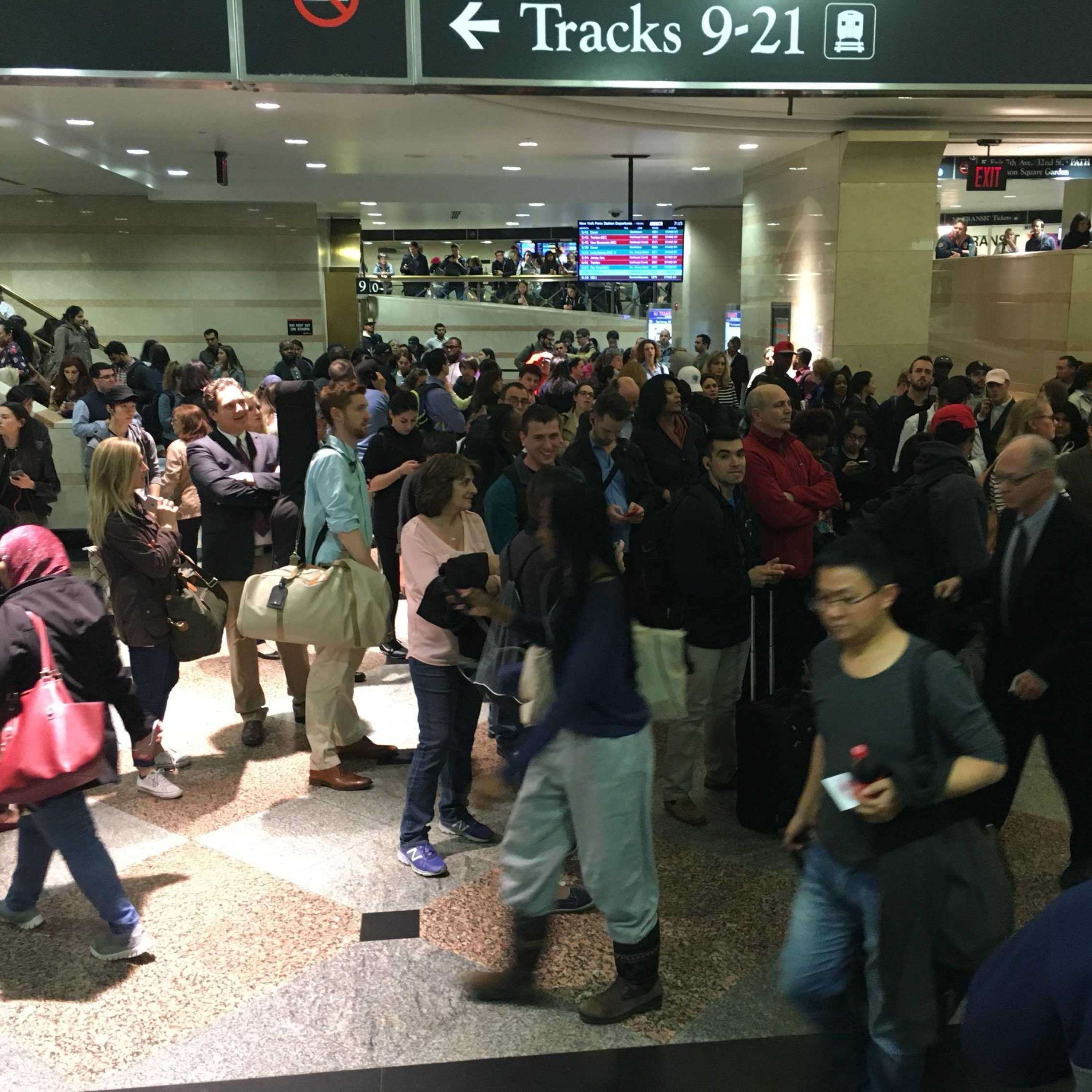
Well, a lot of people call the area there the Pit, because when it fills up, when it. Whenever there are delays or any problems, and there often are in the tunnels or in the station itself, people just end up congregating in a big crowd, sitting on the steps. There's not really adequate room for all the people that. That the station draws. There's so many people trying to get home to New Jersey every evening, and they get stuck there. And it just becomes one big clot of people who would rather be almost.
- [06:06]
A
Anywhere else and waiting to see that track assignment so they can all run to the. To the appropriate door. But life is a little better for Amtrak passengers and Long Island Railroad commuters. Right. Some progress has been made. Moynihan Hall.
- [06:21]
B
Yes. A lot of money was spent across the street, across the avenue to make Moynihan Train hall into, you know, a really nice place to wait for a train, but it's really built for the Amtrak commute, Amtrak passengers and some LIRR riders. And in the meantime, the. And the MTA has fixed up the LIRR concourse. So New Jersey Transit passengers have a much worse. By comparison, they're in a much worse situation.
- [06:53]
A
And you could see the two kind of side by side and immediately have this feeling of, oh, my goodness. Yeah. But you also call this train hall mostly ornamental. Is that right?
- [07:03]
B
Well, it is, because it's only used, really by Amtrak passengers, and Amtrak passengers make up a minority of the users of Penn Station. So it's a beautiful train hall, but most of the commuters aren't going through it at all. They're still going through the old Penn Station, which is sort of the brunt of the problem.
- [07:25]
A
Well, we're getting some texts and calls already if you would like to join this conversation or perhaps if you have a question, if you want to know who could be possibly in charge of rebuilding anything that at Penn Station, give us a call or text us. 212-433-9692. That's 212-433-WNYC. I'll just read a couple of texts here to give us a flavor. So far, Penn Station, low ceilings are immediately depressing. Penn Station and Madison Square Garden were a tragic error of judgment. There's no way to fix this monstrosity other than that. Tear the whole thing down and start again. Another text rid us of Madison Square Garden. So, Michael, maybe you want to comment on some of those and maybe add some of your thoughts on Moynihan.
- [08:17]
C
Yeah, so it's kind of funny because I'm getting a vibe the two of you are also commuters. Everyone's being almost nice about Penn Station. There's a kind of way in which we all hate it so much, we almost love to hate it. It's just so terrible. I think it's.
- [08:32]
A
What else are we going to talk.
- [08:33]
C
About finding things for New Yorkers. So Moyn is interesting, and I'll let Patrick talk about this, too, but Moynihan is interesting, I think, because Cuomo, when he. Andrew Cuomo, when he was governor, set about to do this. This has been a project itself, had been proposed for decades to essentially transform the interior of the former post office, also a McKim building like the original Penn Station. And partly that happened because it was possible for him to do it. And what I mean by that is he could sort of take over and force people to complete that. Penn Station itself is, you know, as Patrick explained so well in the article, is basically this insane patchwork of different entities that control different parts of it. One of the reasons that New Jersey Transit is so bad and LAR is better is because within the building, there are different people controlling it. So we got a haul with Moynihan that was better because the governor was able to, with Amtrak, negotiate essentially, a deal to put that across the street. But, you know, this is, in a sense, the problem itself. You need to have some way to oversee the whole project. Otherwise, you're doing these sort of patches and fixes. And that's what people, I think, sense. It's even embodied in those low halls and the kind of maze, like, it feels like a place that's completely disorganized, because it is.
- [10:07]
A
And meanwhile, while we're giving some compliments to Moynihan Hall, I just got a text saying I would dispute the claim that Moynihan hall is a nice place to wait for a train. Last time I was there, there's no place to sit.
- [10:21]
C
Yeah, this is an ongoing complaint. Not enough benches. There is a seating area. This opens a whole other can of.
- [10:30]
A
Worms, obviously, about seating, a whole other can of worms. And you were alluding to all of the players involved. Can you break it down for us, Patrick? All of the players involved with Penn Station, Amtrak, NJ Transit, MTA, Madison Square Garden, go through the whole list here.
- [10:44]
B
Yeah, it's complicated because it's a federal building. It's owned by Amtrak. Amtrak operates the station. It operates the tracks. It's basically in charge of the tra, the train traffic at Penn Station. But only about a quarter or less of the traffic at Penn Station is Amtrak. Amtrak trains running on the Northeast Corridor between Boston and Washington. So the main users of the station are two other railroads, two commuter railroads, the New Jersey Transit and the Long Island Railroad. They make up the bulk of the users of the station, but they're tenants of Amtrak, so they have to get Amtrak to agree and cooperate with them on anything they want to do, any changes that they want to make. And there's been very little cooperation among those railroads, just essentially the bare minimum to keep the thing operating over the years. Now we have this new. The advent of the Trump administration stepping in and saying, well, if it's our station, we'll take control of it, and we'll. We'll decide what. What happens now. So that's. That's the question is what. What will the Trump administration do?
- [11:59]
A
Will that do? Will that break some gridlock that you're talking about?
- [12:04]
B
Well, they can just crack heads, right? I mean, they're, you know, they're the federal government, so. And it is their building, so they. They can take control. But as Kathy Hochul, the governor of New York, has said to them, okay, if you're in charge, let me know when you've built me a new train station. You know, I'm not. I'm out. It's all yours.
- [12:28]
A
Now, I also remember during the first Trump administration when there was this running thing of every week was infrastructure week, and something was coming and it didn't happen.
- [12:38]
B
Right. I mean, there, you know, I don't. Nobody's holding their breath on this happening anytime soon, but, you know, we're talking, bill, billions of dollars to get this thing fixed up, even to a sort of a bare minimum, modern standard. And Nobody's put up $1 of that so far.
- [12:57]
A
Well, let's take a phone call if you'd like to join this conversation. The number 212-433-9692. That's 212433, WNYC. And let's hear from Harry in Midtown. Welcome.
- [13:13]
D
Hi. Thank you. I'm so excited to have Michael Kimmelman in the group. Native New Yorker, grew up reading the paper. Michael, if you had a blank sheet of paper with all of your background, history of architecture, everything you know about New York City, we all know the problem. What is Michael Kimmelman's ideal for Penn Station?
- [13:44]
A
Okay, this is your problem now, Michael.
- [13:46]
C
Oh, gosh. Well, thank you, Harry. I don't really want all that weight on my shoulders. You know, I'm gonna weasel out of it by saying this. I think when I started to write about Penn Station years ago, one of the things that I felt was, this is a problem that's central to the identity of New York. It affects hundreds of thousands of people a day. It affects the economy, the economy of the Eastern seaboard. Let's just tackle it at scale how can it be that there's a arena sitting on top of this with one landlord? And that is what holds back the welfare of the city and of all these people. You know, we've also been sort of dancing around the fact that it's actually a dangerous place, too. So the feeling I had was, let's restore to the city what it had before, a place of great dignity. I'm not talking about the original building, but something worthy of New York. Over the years, I've come to have a somewhat more pragmatic view of things. And I think one of the problems, and Patrick and I were writing about this in this series, is that we've become a nation so incapable in a city, too, of actually getting stuff done, even at the point at which we are on the verge of collapse, you know, the bqe, for instance, that we have to be able to have pragmatic answers to things. And I think the best answer I can give you is that there are ideas out there for how Penn Station can become a dignified, useful, safe, more practical place. And we just need to act upon them and come together around them. I'm not going to pick one of them because first of all, that's not the role, it's my role. But I also think it's really about the public coming together, New Yorkers coming together around the idea that not everything may satisfy everybody, but that we can agree that there is something better than this.
- [15:44]
A
And I wanted to ask about. You've touched on this already, but why do aesthetics matter? Is it important to have a Penn Station that is not only functional, but beautiful?
- [15:59]
C
So when I started to write about this, one of the things I realized was that the conversation around Penn Station had become atomized. So there were people who were focused on architecture, who lamented the loss of the original Penn Station, and they were very focused on creating something, perhaps replicating the previous building. But there were millions of people who used the building and people involved in transportation who found that a kind of elite and effete problem. There are capacity problems, there are safety problems. There are economic issues involved in this. One can't really separate out the aesthetics from the rest of the conversation. And the truth is, they shouldn't be. One doesn't have to make a choice between the two. The best station that it could be is a place that functions better and that is suited to the needs of the city and the. The region, but that also represents the values of the city. I mean, Grand Central is an example of this. Why do we value Grand Central because the arrival in Grand Central says something about us and about the way in which we view the public and the aspirations of the city. So I sort of refuse to separate out aesthetics. But I think you can see the problem when you don't care at all. And that is the current Penn Station.
- [17:23]
A
If you'd like to join this conversation, I'm going to take another call right now. 212-433-9692. Let's hear from Maria. Welcome to all of it. Do you have a question?
- [17:36]
D
Yes, I have an observation and a question. I am a disabled senior citizen. I ambulate with two canes, and the thought of Penn Station terrifies me because when you're waiting for the train, the when they post the track, it is a mad rush to get to the track, to get to the entrance. And if I can make it down the stairs without getting mowed over, it's impossible. It takes forever. I know there are certain elevators, but you can't get to your train on time. It's really, really terrifying. People will knock you right down the stairs or the escalators or whatever. So that's my observation. The question I have for your guest is Penn Station, the old Penn Station at all ADA compliant as the new Moynihan hall, which I really like, is compliant. ADA compliant.
- [18:21]
A
Maria, great question and observation, Patrick. Do you want to jump in on that?
- [18:26]
B
Yeah, she's right. There's all kinds of accessibility issues at Penn Station. It's not a modern building in any way. And the stairwells are really narrow. The platforms are really narrow. I mean, it's sort of survival of the fittest on a daily basis there. And I can't imagine what it would be like to try to navigate it with, you know, with a walker or a wheelchair. It's just not built for that.
- [18:55]
A
We're going to have to continue this conversation after a quick break, and we're going to get to more of your calls and questions for excuse me. For Patrick McKeon and Michael Kimmelman, New York Times reporters taking your transit questions, your Penn State questions, Pen State, Penn Station questions. 212-433-9692. This is all of it on WNYC. This is all of it on wnyc. I'm David Fuerst. And for Alison Stewart, we're asking about how to fix Penn Station. Today we're speaking with two New York Times reporters, Patrick McGeehan and Michael Kimmelman. And we're also taking your calls. 212 433-9692 and Patrick, we just got a text here saying tarting up the station is superficial. The tunnels and tracks must be rebuilt. And let's get into the Gateway project and how that fits into all of this. I guess the first question, does everyone, maybe everyone is too big a word, but does everyone at least agree that we need things like rail capacity expansions?
- [20:11]
B
Yes, everyone does. Because the tunnels that now connect Penn Station to the rest of the country, you know, to the, to the west, they are barely hanging on. So they're, they're being supplemented by a new rail tunnel that's about to begin construction that will double capacity across the Hudson. When it does, there's going to be a lot more demand. You're going to have a lot more people wanting to commute in from New Jersey and you're going to need a place to put all those trains. And right now they don't have any place to put all those trains.
- [20:45]
A
Right. So, yeah, I guess let's really break this down. How does the Gateway Project fit in here? And if we build that new tunnel that can't add capacity because of some of those other limitations, what will the Gateway project address and what will it not address?
- [21:04]
B
Well, it will immediately. It would solve the problem of the fear that the tunnels we have, the 110 year old tunnels we have, are going to collapse before we replace them. So at the very least it will, it will replace those, but at the very best, it will double that capacity across the Hudson and bring twice as many trains per hour at rush hours into the station. The problem is, like I said, there's no place to put them at the moment. So you'd have to increase the number of tracks. Or the other idea is to change the way the trains run through the station so that they don't all come from New Jersey, turn around, go back to New Jersey, come from Long island, turn around, go back to Long island, but they actually cross the rivers all the way through. They pass through the city of, onto the other territory.
- [21:57]
A
Great point.
- [21:58]
B
That's, that's a big idea that is being entertained. But it's very complicated to get there. It means cooperation for one thing, between Long Island Railroad and New Jersey Transit, which has never happened and maybe never will. We'll see. There's no central authority to make that happen at the moment. Right. Those are two state run transit operations that have very different purposes and they don't have a particular reason to cooperate with one another. And who's going to make them?
- [22:37]
A
I guess we'll see. Let's take Another couple of calls I want to hear from Nicole. Thanks for joining us. I think, Nicole from City island, you wanted to respond to a previous call that we had. Is that right?
- [22:51]
D
Yes, I have the answer. And it's a great. Probably a secret and probably this is.
- [22:55]
A
The answer to ambulatory issues.
- [22:58]
D
Ambulatory issues. There is at least, I believe it's still there, Red cap service, capital R, capital C. And they have, or at least they did, a separate seating area. You show the ticket, you have to, you know, obviously have ambulatory issues. So not everyone can use the space. And before the train comes in, one of the red cap guys comes with those gigantic rollers and puts all your skills on, brings you down in an elevator so you're on the track before the train arrives.
- [23:30]
A
Is that possible with New Jersey Transit?
- [23:33]
D
I'd use this on Amtrak.
- [23:35]
A
On Amtrak, okay.
- [23:36]
D
Yes. I don't know what New Jersey Transit does, but they have that and it's a system that works. Why not replicate it?
- [23:42]
A
That's a great idea. Thanks for that information, Nicole. And let's also hear from Meg in Boston, listening. Welcome to all of it.
- [23:54]
D
Hello, can you hear me?
- [23:56]
A
Oh, yes. Did you have a question or a complaint or an observation?
- [23:59]
D
I have two. I have an addendum to the ambulatory issue. And the caller before me beat me to the punch, which is, I hate to give this service away, but the red caps are the greatest people. And if you call ahead, you can get a wheelchair. And they everything the caller said is true, including you will be escorted by wheelchair on that elevator. And just remember to tip. I always tip. I have one bag. I tip $5. If I were rich, I would pit more. These people really deserve our love and help. But you can do something about that. The trouble that I have is that there aren't enough bathrooms in the new Moynihan train station. And I say this as an older woman, but I raised kids and it's, you know, women and children are out of the mix. And I'm listening and hearing that the people you're interviewing are male architects, male planners, et cetera. And I have a son and I love men. But gosh, work on the bathrooms, architects and send, make somebody take the trains. And that's all I have to say.
- [25:20]
A
Make a user do that designing work. That is a great point, Meg. Thank you so much for adding that question to the conversation and certainly a topic I've heard a lot of people talking about as well. And, oh, let's just jump right to another call. Claudia in Manhattan. Welcome to all of it.
- [25:40]
D
Thanks so much. First of all, I'm in the construction industry and so I have found the time coverage of infrastructure and particularly Penn Station, fascinating. As a person, however, I will do everything in my power to avoid Penn Station, which is quite inconvenient since I am a New Jersey. We touched upon a bunch of things about Penn station, and Pat McGeehan has done it in great detail. However, I have found that it is not even a secondary mode of transportation for me. For instance, if I am in the city and I normally take a fast ferry that goes into the Jersey Shore, it's quick and easy for me, clean 45 minutes. However, if I'm here after those ferries close and I have to take a train, not only is it dangerous and we touched upon filthy and everything else at that, but at 11, 12 o' clock at night, it is beyond anything that should be representative of a New York experience. And, you know, I think it will not be fixed in my lifetime or at least while I'm still ambulatory. But I, you know, there are no solutions that we're seeing quickly. But I just, you know, I'm just saying as a, as a secondary point, it's not even usable after hours, and I think they lose a lot for that. For instance, I took a $350 Uber home the other night.
- [27:18]
A
Well, yes, and on top of all of that, it is expensive to, to take the train as well, you know, for what you're talking about. And I have to give a plug again for your article. Patrick McGeehan, New York Times. Why can't New York fix Penn Station? The visual breakdown that you have up there right now, you got to check it out because you can explain better than me, but you go through all the different layers from Madison Square Garden all the way down underground and all.
- [27:49]
B
Of the.
- [27:51]
A
Steel support columns that support Madison Square Garden that plunge right through and make everything so crowded. You can explain better than me, but make it so crowded down there in Penn Station by the tracks and everything.
- [28:03]
B
Yeah, I've been surprised by how many people who are regular commuters through Penn Station have told me, you know, I didn't really understand that all those columns that break up and crowd the platforms were holding up Madison Square Garden or the rest of the station. I don't know what they thought they were doing there, but, you know, people get, just get used to it. It's one of those, you know, things you get, you kind of become ignored.
- [28:29]
A
To, and that's what makes it so there's, there's some places where it's a very narrow space to walk along along the tracks.
- [28:36]
B
Right. And it's so narrow that unlike there are only a couple of platforms that are sort of what you would call modern train station size, that you could have two trains loading at the same time, one on either side of the platform, or one. One train unloading and one train loading at the same time. So for all, almost all of the New Jersey Transit and a lot of the Long Island Railroad trains, they. They cannot load those trains until they unload. You know, they can't. They just can't have people going in both directions because the stairwells and the platforms are just too narrow.
- [29:08]
A
And let me just finish here with. Maybe I can ask you to be Mr. Optimist again, Michael Kimmelman, because you're. Your piece, which you also have to check out. It's called America Wants to Build Again. If you squint, you'll see hopeful signs. So how much do we need to squint? And what are those hopeful signs?
- [29:28]
C
Yeah, we need to squint a lot, to be honest. But look, I mean, I think here we are having this conversation, certainly not the first about Penn Station, but it's part of a larger conversation that's happening not just in New York, but in general in America, about these problems that have become endemic. We used to be a country that could build things, and now I think there's an agreement across political aisles that this has become a problem to be solved. That itself seems to me a step in the right direction. And I think, you know, I don't just mean to sound optimistic about this. I think that there are signs, there are things that are happening here and there which we don't often give enough credit to. There are affordable housing projects being built. There are new parks opening. There are things that happen. But we remain focused, of course, on what's broken. And the example I give in the article I always return to the Brooklyn Bridge was three times over budget, took three times as long to build as promised, was a scandal. People were like, this will never happen. This is terrible. And as soon as it opened, it became the great shining emblem of American promise, artistry, ingenuity, and so forth. And so I think that when you're in the midst of the problem, and obviously Penstagion's been going for about 60 years, so it's long, but it can seem hopeless. But I do think, as Patrick said earlier, there is now a conversation that may just, you know, break the ice. And there are some plans out there and if we remain vigilant as New Yorkers about following through and demanding it, who knows?
- [31:18]
A
Well, we will keep squinting and following your coverage in the New York Times. New York Times reporters, excuse me, Michael Kimmelman and Patrick McGeehan, thank you so much for joining us today.
- [31:30]
B
Thanks.
- [31:31]
C
Thanks for having us.
- [31:35]
B
And Doug, here we have the Limu Emu in its natural habitat helping people customize their car insurance and save hundreds with Liberty Mutual. Fascinating. It's accompanied by his natural ally, Doug.
- [31:50]
A
Limu is that guy with the binoculars watching us.
- [31:53]
C
Cut the camera.
- [31:54]
B
They see us.
- [31:55]
A
Only pay for what you need@libertymutual.com Liberty.
- [31:58]
B
Liberty Liberty Liberty Savings Very underwritten by.
- [32:01]
A
Liberty Mutual Insurance Company and affiliates. Excludes Massachus.
- [32:03]
D
It's NYC now delivers breaking news, top headlines and in depth coverage from WNYC and Gothamist every morning, midday and evening. By sponsoring our programming, you'll reach a community of passionate listeners in an uncluttered audio experience. Visit sponsorship wnyc. Org to learn more.