Loading summary
Transcript57 lines
- [00:08]
A
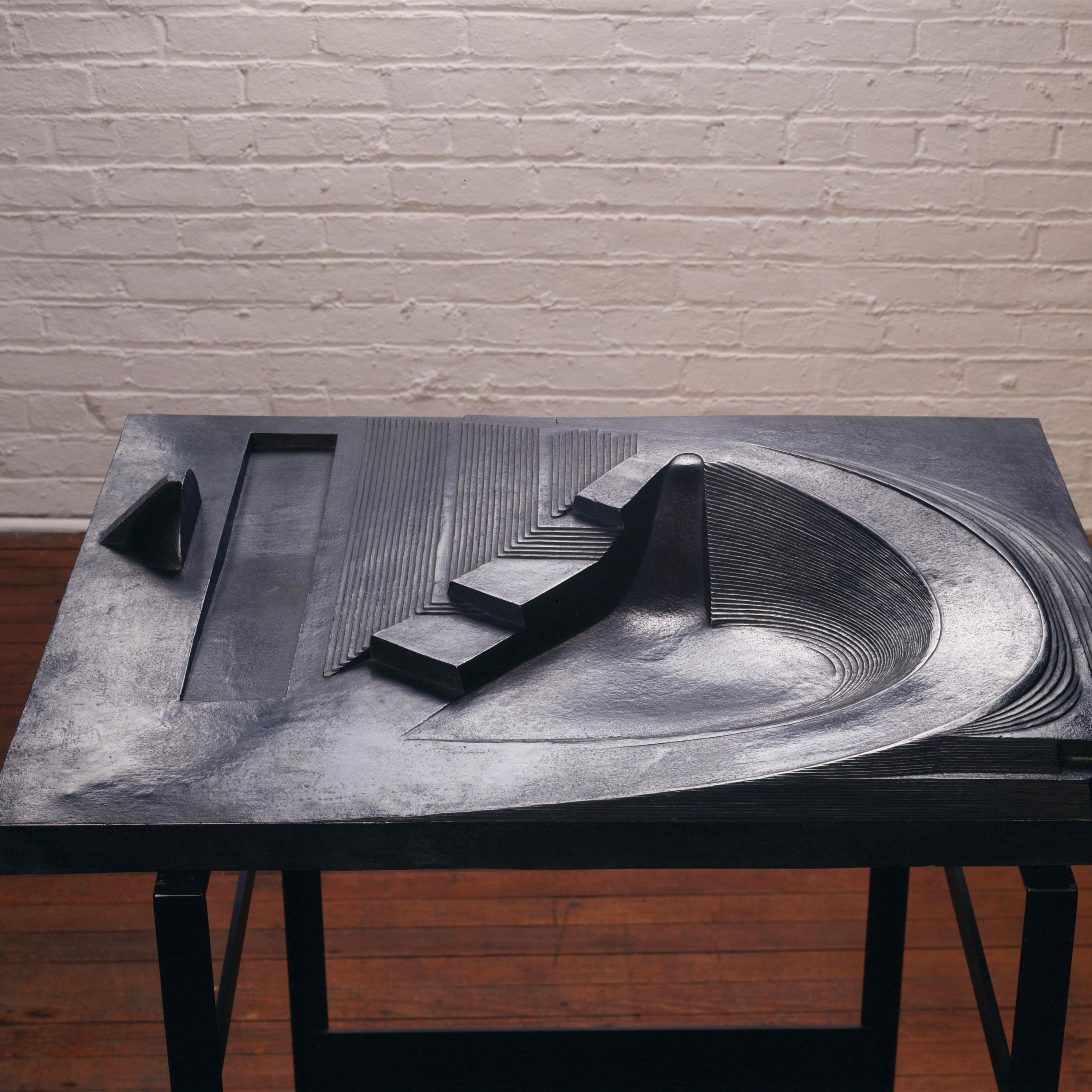
This is all of it. I'm Alison Stewart live from the WNYC studios in soho. Thank you for sharing part of your day with us. I'm really grateful that you are here on today's show. Andy Jurgensen, the Oscar nominated editor of One Battle After Another, joins us to talk about how he took everything his director threw at him and turned it into one fantastic film. And we'll talk about a new exhibit at the center for Brooklyn History that commemorates the largest battle of the Revolutionary War, one that for years the borough wanted to forget ever happened. That's the plan. So let's get this started with a sculptor who loved Queens. Asamu Noguchi, an artist the Smithsonian calls one of the most innovative of the 20th century, understood that Queens, New York would have a special meaning for him. In 1961, Noguchi bought an old industrial building. He lived in it and filled it with his work. Then he bought a lot across the street, which now houses the Noguchi Museum. It is said he identified as a New Yorker later in his life, saying, I am, quote, not Japanese, not a citizen of the world to just a New Yorker who goes wandering around. A new show that opened at the museum this week is called Noguchi's New York. It features his works of projects that you can see to this day, like the big red cube on lower Broadway, the ones that were in his mind, the project he proposed like a playground for the Upper west side that never came to fruition. It even has a map of where he lived before hunkering down in Queens. Joining us to talk about the exhibit is the director of the museum, Amy Howe. Hi, Amy.
- [02:00]
B
Hi, Alison.
- [02:00]
A
And his curator, Kate Weiner. Nice to meet you, Kate.
- [02:03]
C
Nice to meet you.
- [02:03]
A
Meet you too. Okay, Amy, do your best. You've got a little bit of a cold today. Noguchi died in 1988 at age of 84. And you and you worked with him?
- [02:12]
B
Yes, for about two years before he passed away.
- [02:15]
A
What's something that you feel comfortable telling us about him or sharing about him that would help us understand him as a person and as an artist?
- [02:24]
B
I think he was very much a. Very often people will call him a polymath. And he really was in so many ways. In the time that I worked with him, he would be on 10,000 projects. It seemed like he could be sitting in the room talking about a book project, planning an exhibition and have several sculptural projects in mind. And the minute he got out of New York to travel, he would be working on those ideas always, always bringing home this Idea that we have to push ourselves to kind of think about our environment, think about things that surround us, people who surround us, how to build community. So those are the lessons I learned from him in those early days.
- [03:13]
A
Cady designed furniture. He made sets for Martha Graham. He made these beautiful sculptures. In your mind, what was similar about these items, and then what was different for him?
- [03:23]
C
Yeah, that's an interesting question. I mean, I think for Noguchi, all of this fell within his broad definition of sculpture. And he had a really beautiful way of talk about how he thought all sculpture should be useful. But use could mean a light that you use in your house, a table that you use, but also a carved stone that helps you understand your place in time and your relationship to nature. For him, they were all tools for helping us better relate to each other and to the world around us. But he did have an incredibly prolific and multifaceted practice.
- [03:58]
A
Amy, how did Noguchi, who lived all over the world, use that cough button?
- [04:02]
C
It's okay.
- [04:04]
A
How did he lived all over the world? Why did he decide he was a New Yorker?
- [04:10]
B
You know, he was born in Los Angeles, was raised in his formative years in Japan. And coming to New York as a teenager, really, you know, thinking about his career, what he was going to do in life. And, you know, he had mentors who were directing him to Columbia for a medical program. And his mother came back from New York at that time. I mean, long story. You can all read it in various books. But she was really a big influence on him and suggested that he should, you know, give up everything else but just focus on art making. And I think New York just spurred so much inspiration for him. He met incredible people here in New York in the early days, really kind of explored so many different facets of life in New York. There are writers, there are other artists, there are thinkers. His best friend, Buckminster Fuller was somebody who was so influential. I mean, the two of them were just bonded for life, but spent a lot of time here in New York thinking about the future of the world, the future of their careers and what they thought were important and how to go about realizing those projects. I think just, you know, like all of us who come to New York and stay here in New York, I mean, we find it so invigorating, and there's so much diversity here. I think anybody who is interested in the world would gravitate to being here, to be surrounded by the diversity of people here, that we don't have to travel all the time, you know, but we don't have to. And that's so exciting to this day. Yeah.
- [05:58]
A
Before we get into the exhibit, Kate, what was Queens, what was the studio like when he first moved in?
- [06:04]
C
Yeah, so he initially, when he moved out there, he had first, he had been traveling around the world, and he came back to New York City. He gave this great interview with the Village Voice where he said, you know, I traveled around the world six times over like a homeless waif. And I can say there's no place like home. And New York is the center from which all ide is radiate. Can't get better than that. But he first was trying to move back to Greenwich Village, where he initially had a studio, but like many, got priced out. And remembering the kind of old stone yards in that industrial neighborhood in Queens where he used to go to source materials, he found this location where he could kind of be at a remove in some sense, but also still kind of deeply connected to the city. And when he first created the museum, there was actually this window that we still have, but you could see out to the Empire State Building and the Chrysler Building. So I think there was always that connection between the two spaces.
- [07:05]
A
We're talking about an exhibit at the Noguchi Museum in Queens called Noguchi's New York. My guests are museum director Amy Howe and curator Kate Weiner. It's on view through September 13th. All right, Kate, how did the exhibition come about?
- [07:18]
C
Yeah, so we're celebrating the 40th anniversary of the museum this year. And we were really trying to think about this institution in context of his larger practice and how in many ways, it's kind of the culmination of his decades long effort to really sculpt New York City into a place for connection, for community, for coming together. And it was really a triumph for him after so many projects that he was dreaming of didn't come into fruition, to be able to create this space fully according to his wishes. The sculpted environment was an incredible achievement. So the show, in many ways, is trying to think about our institution in the context of that story.
- [08:00]
B
Amy, where did you start in terms of the exhibition? Yeah, I mean, I think, you know, I came back as director in 2024, and, you know, in speaking with Kate, I was very interested in celebrating Isamu Noguchi, of course, but the museum that he founded, and I just recall that he had said to me once, you know, this was a gift to the city. What he created here was not for. It was not a vanity project. He really wanted to share his environment with the public. He wanted People to come. And it just, you know, remained with me this whole time that, you know, he really thought of this as a way to reach others. And being a community member within Queens, I lived there, you know, practically all my life. It was just a really resounding pride, you know, for me to have this privilege of sharing this with our community, larger New Yorkers at large, and international visitors. And our growth has been just extraordinary in the 40 years since the beginning back in 1985. And that's the key. Like, we really wanted to think about how Isamu Noguchi, you know, just a single artist on his own, thinking about his career, but not in a, you know, sort of extraordinary way. Very humbly, just wanting to share what he did and to share these ideas and hope to inspire younger generations coming through to see life and environment and art all differently.
- [09:44]
D
Kate, there's a map that shows his unrealized projects, the projects that were realized that are no longer there, and the ones that still exist. Out of the projects which went unrealized, what do they have in common?
- [09:58]
C
They're really quite diverse. And actually, in doing research for the show, I learned about ones that I had previously not known. But there are kind of scraps of records in our archive that at one point he was asked to design the sculpture garden at moma. That never happened. And my favorite, I think, is he was asked by the president of the Zoological Society to design play equipment for apes at the Bronx Zoo. No record of that, but I would have loved to imagine what he might have created. But I think in all of them, they were really spaces of coming together, of playfulness, of joy, of connection with nature. A lot of them were projects for new sky rises that were coming up in the city. So he was really tied into that kind of modernist history also. But, yeah, they're really far, far ranging.
- [10:49]
D
Which one seemed like a long shot to you, Amy?
- [10:52]
B
The New York Zoological Society. I think that was really eye opening for me. I mean, I thought, I've seen everything over the. Working through, you know, the archives and looking at Noguchi's work, and that was astonishing to have that discovery. I'm like, wow. We knew that he spent a lot of time at the Bronx Zoo because there are drawings in the collection where he did many sketches of different animals. And I think there was a letter somewhere that he talked about going to the Bronx Zoo for sketching. So this tie in to a potential project was very exciting for us to discover. And it was early on. It was very early on. In the 40s.
- [11:30]
D
Yeah, one of the things that caught my eye was something that said, a sculpture to be seen from air, which tells me a lot about him, that he thinks about things, I think outside the box, but he thinks about things in a different way.
- [11:45]
B
You know what I mean?
- [11:46]
C
Yeah. The remarkable thing about that is actually. So his first proposal for New York City was called Play Mountain, and he was envisioning transforming an entire city block into a mountain for kids to play on. He pitched this very earnestly to Robert Moses. So he remembered laughing him out of the room. And also an early New Deal organization, the pwap, and they turned him down vigorously. They said. They turned their thumbnails down, their thumbs down so hard they almost broke their thumbnails. And they asked him to come back with a project with a more sculptural character if he was going to get on the payroll. And his response was to pitch them. Sculpture to be seen from the air. So an enormous earthwork that you would only see from planes over Newark Airport. And I just love that. You know, for him, that was pure sculpture. That was what it meant to create artwork for the city and for the people, and that there's an incredible idealism that runs through all of these projects that was quite extraordinary.
- [12:49]
D
Yeah. Amy. It's interesting, as I was looking at the list of things he planned, they were third spaces, which we talk about a lot, and playgrounds a lot. What interest did he have in playgrounds?
- [13:01]
B
Yeah, people often ask me that question. I always think that, you know, a child at heart, perhaps. But I think more so than that, he really treasured encouraging people to use their imagination. To use your imagination to transform a space, to use your imagination to think about, you know, what are good designs, what are bad designs, what are, you know, things that inspire you. How do you interact with nature. Again, as Kate mentioned earlier, I think these are just provocations for us to help us traverse the world.
- [13:39]
A
I'm speaking with museum director Amy Howe and curator Kate Weiner at the Noguchi Museum. We're talking about Noguchi's New York, which is on view now through September 13th. Amy, we see his contribution to the World's Fair in 1939. Would you describe what he contributed to this?
- [13:59]
B
I think I'll let Kate take that one.
- [14:01]
A
Sure.
- [14:02]
C
Yeah. He had a bunch of different proposals. The ones that we highlight in the show are a realized project that he was able to create for the Ford Pavilion. That was this incredible fountain that was at the center of the pavilion, and swirling around it was what was called the Road of Tomorrow. So you could be driven around in a new Ford car. And his sculpture, he said was, was supposed to be like the guts of a new V8 engine, celebrating that kind of technology driving us forward. But we also found records that he was working on a Labor Pavilion sculpture. The Labor Pavilion never came to be, but he was going to create an enormous sculpture of a worker kind of holding up the institution. And we found some records that he was also working on a mural for that with Philip Guston. But we haven't been able to find any kind of documents, sketches, unfortunately.
- [14:58]
A
But one of the things that you can see in the museum, Amy, is how many mediums he worked with. Bronze, stone, marble. Do you have a favorite one?
- [15:09]
B
Oh, so many long list of favorites. But I think in the show, what's very interesting is to see all the different materials that he displayed in carving all the portraitures he did in his lifetime. Probably I say approximately 150 portraitures. And, you know, with each sitter, he really brought out their personalities and he, you know, deployed different techniques and also mediums for those. Of course, one of my favorites is Buckminster Fuller's head. That's shiny chrome, and it just personifies who Bucky was, you know, an incredible futurist. And just the shiny chrome finish from it was the 30s, wasn't it? It's just so ahead of its time. And, you know, in portraying other sitters, he used marble.
- [16:06]
A
Clare Blut Luce. He used marble.
- [16:08]
B
Gorgeous, gorgeous marble. He also did one of Ginger Rogers. That's not in the show. But he did so many portraits, and each one so uniquely to the individual that he was portraying.
- [16:24]
D
Also in the exhibit, there's a map of his existing. His existing sculptures which were in the.
- [16:31]
A
City, but also places where he lived and his studios. He had so many homes in New York before he went to Queens. Why was it important to show all.
- [16:42]
D
The different places he lived?
- [16:43]
C
I mean, it was extraordinary for me. I had just never really plotted them out on a map before or tried to make a list. And in doing that, it was just incredible to see how many different places in the city he was connected to that he was working and meeting people. I think we often think of him rooted in Queens, and he was at some point, because that's where his institution is. But he was making connections all over the place and really saw the city through so many shifts in the six decades that he was here.
- [17:12]
D
I didn't know 33 McDougal Alley. I walk by there all the time that he had a studio and lived there.
- [17:19]
C
A gorgeous studio that had a garden in the back. There are really phenomenal photographs that are taken of him there.
- [17:25]
D
All right, so people are very excited about Noguchi's work. Where can they see it in the city? Amy?
- [17:31]
B
Well, there's the Red Cube, of course. Everybody's been talking a lot about that. I think there'll be crowds at the Red Cube.
- [17:37]
D
My son loved it. I have a picture of him as a little kid in front of that. He loves it. He's 17 now.
- [17:43]
B
And a block away from there is the Folsom center, which was the Chase Manhattan Bank Plaza that was commissioned back in the 50s, 60s. I'm forgetting my dates. But also, you know, the Associated Press plaque in Rock Center. So that's a little known one. I think people are surprised to know, to learn that, you know, Isamu Noguchi did that work and so many other objects, you know, sculptures themselves in museum collections. So the Whitney right now has a wonderful display of about 6, 7 objects in their collection. They loaned us a couple, which was fantastic. Thank you, Whitney, for the loan. And, you know, the Met also the beautiful sculpture outside, Unidentified object, which is displayed as part of our brochure. That object is actually in front of the Met now. That was installed by the Public Art Fund back in the 80s, and after that it went to the Met. And the Metropolitan Museum also has, you know, a wide variety of works by him. They collected his work very early on, and Even in the 80s, about a year before he passed away, and they were redoing their Asian wing and Japanese wing, they invited him to come and install the waterstone there. So I was really privileged to have witnessed him installing that the day of. And it was so exciting as a young person working for great master Kate.
- [19:19]
A
When you look at the show, it's clear he has civic ambitions for this city. What were they?
- [19:27]
C
Yeah, I mean, I think partly what was interesting for me in doing research on the show was realizing that some of that civic ambition was really bred in 1930s New York, when artists were thinking in a new way about what it meant to be a public servant, about creating public art. And I think that that really deeply impacted him, even though his style changed quite deeply from, you know, Associated Press, the plaque he made. But I think that idea that he could use his art to serve people, to create spaces for connection, for community, for contemplation that he held onto his entire life. And it was an idea. Yeah, really, that he cultivated here.
- [20:08]
A
What do you hope that people get out of the show?
- [20:10]
B
A sense of joy. Absolutely. A sense of joy and to really be inspired to think about what they can do in their own practice in life, sharing with nature, sharing with friends and community the ideas about art.
- [20:28]
A
What do you hope people get out of the show?
- [20:30]
C
As a curator, I guess I was really inspired by Noguchi's kind of restless idealism and ambition and this kind of lifelong belief that he could transform the city and the world that he lived in, even kind of against the odds and facing so many rejections that he still held onto that belief. And I hope it inspires people to kind of think of their city anew and how they might want to continue to improve it and make new spaces for joy and connection and creativity.
- [21:00]
A
The show is called Noguchi's New York. It's at the Noguchi Museum in Queens. My guests have been museum director Amy Howe and curator Amy Case Weiner and is on View through September 13th. Thank you for coming to the studio.
- [21:13]
B
Thank you, Alison.
- [21:14]
C
Thank you so much. Such an honor.
- [21:17]
E
It's tax season, and at LifeLock, we know you're tired of numbers, but here's a big one you need to hear. Billions. That's the amount of money and refunds the IRS has flagged for possible identity fraud. Now here's another big number. 100 million. That's how many data points LifeLock monitors every second. If your identity is stolen, will fix it, guaranteed. One last big number. Save up to 40% your first year. Visit lifelock.com specialoffer for the threats you can't control. Terms apply.
- [21:47]
F
This is Ira Flato, host of Science Friday. For over 30 years, the science Friday team has been reporting high quality science and technology news, making science fun for curious people by covering everything from the outer reaches of space to to the rapidly changing world of AI to the tiniest microbes in our bodies. Audiences trust our show because they know we're driven by a mission to inform and serve listeners first and foremost with important news they won't get anywhere else. And our sponsors benefit from that halo effect. For more information on becoming a sponsor, visit sponsorship.wnyc.org.