Loading summary
Transcript65 lines
- [00:00]
WNYC Announcer
WNYC Studios is supported by Odoo. When you buy business software from lots of vendors, the costs add up and it gets complicated and confusing. Odoo solves this. It's a single company that sells a suite of enterprise apps that handles everything from accounting to inventory to sales. Odoo is all connected on a single platform in a simple and affordable way. You can save money without missing out on the features you need. Check out Odoo at O d o o dot com. That's O d o o dot com.
- [00:39]
Alison Stewart
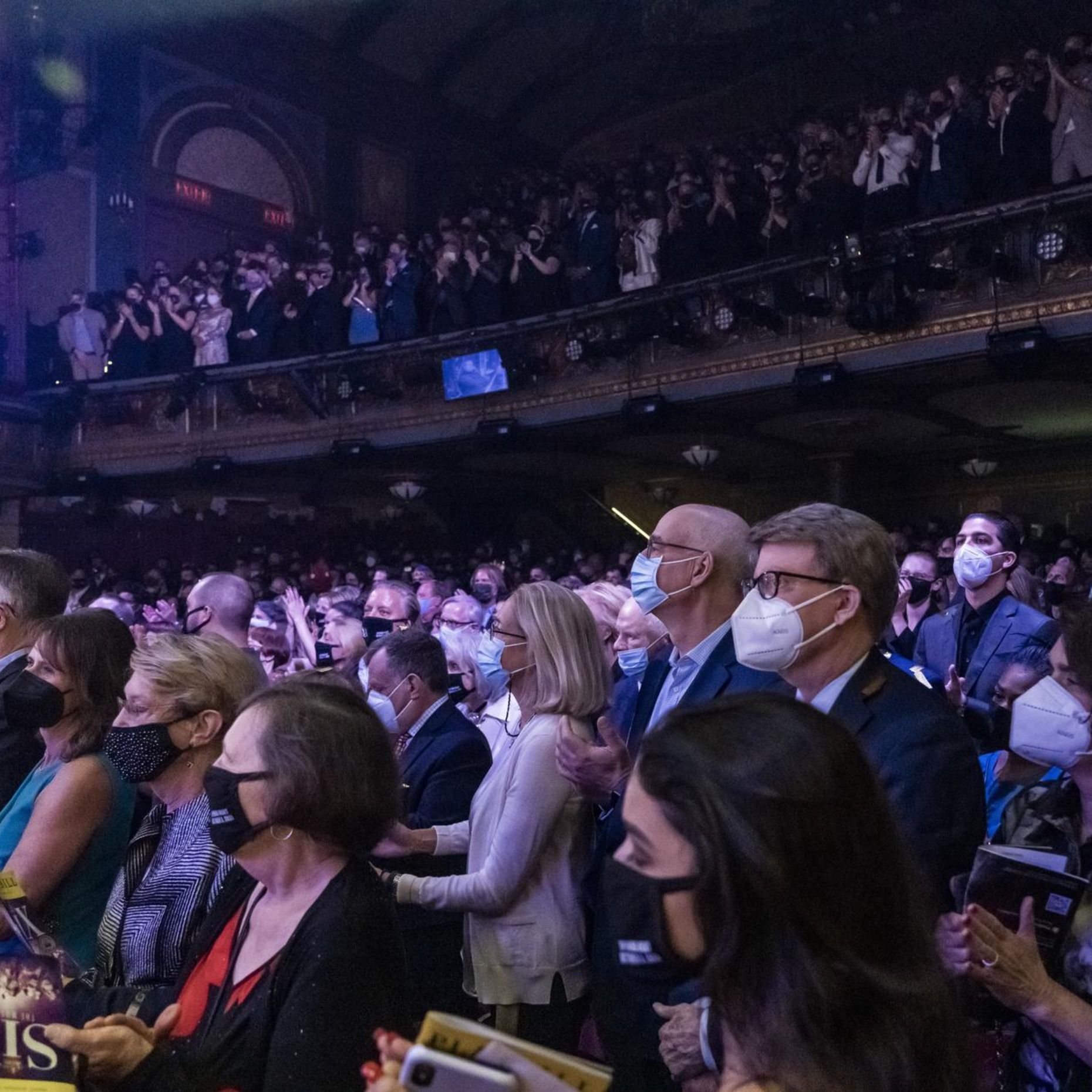
This is all of it on wnyc. I'm Alison Stewart. Now here on all of it. We are theater lovers. We see a lot of shows and have conversations with creative people like actors and playwrights, directors, set designers who are at the core of making the experience interesting. What happens when your fellow theater goers make things a little stellar in terms of interaction? You may have seen the video about an altercation at Mamma Mia. A man gets into it with some women seated behind him. We aren't the only ones eager to talk about this. Our guest was at that show and after the clip went viral, he took to Reddit to have a conversation about theater etiquette framed around respect and, and compassion. His name is Larry Smiglesky and he's also a production manager for that show. And he happens to be a therapist, so he's pretty much at every performance. But today he's here in his capacity as a therapist and a person who has seen what he calls, quote, the decline of behavior in the theater. Larry, thank you so much for making time for us.
- [01:48]
Larry Smiglesky
Thank you so much for having me, Allison. Thrilled to be here.
- [01:51]
Alison Stewart
I don't want to dwell on what happened at Mamma Mia because we're kind of using it as a jumping off point for this convers. But I think we should explain a little bit about what happened that day. Could you explain for listeners what happened?
- [02:04]
Larry Smiglesky
Sure. So there was some behavior that was going on behind this gentleman who was at the theater with his wife and his two nieces who were teenagers. The women behind him, as far as I know, were perhaps having a few glasses of wine.
- [02:25]
Alison Stewart
A little overserved, maybe.
- [02:26]
Larry Smiglesky
A little overserved, yes. And there was a lot of singing and carrying on during the first act. Throughout the first act, he had asked calmly multiple times for them to just sort of quiet down. Then at intermission is when the video that went viral occurred, is when he, I, what is, I would say not speaking for him, but looks like he sort of had. Had had enough.
- [02:55]
Alison Stewart
His voice was A bit raised.
- [02:56]
Larry Smiglesky
It was a bit raised. There were also moments of a little bit of bizarre behavior. One of the women was raising her arm and like chanting over one of the nieces heads, but also using inappropriate language while doing so. So the behavior was unusual and, and so that is ultimately what the incident was. He asked for security, security came over, spoke with him, spoke with the women, spoke with the people sitting in that section, and the decision was made to remove the women from the rest of the performance.
- [03:33]
Alison Stewart
This story was in a myriad of publications, it was online, it went viral. Why do you think this particular interaction, aside from it being on tape, but why did it get so much attention?
- [03:47]
Larry Smiglesky
You know, what's interesting is if you just watch the video and you have no context, it looks like a man freaking out on women who are saying all we were doing is singing. And so at first there were news articles that jumped on the bandwagon that the women were in the right and this man should not have been yelling the way he was. Would I have raised my voice to that level if it were me? Maybe not. But I, you know, I can only speak for myself. I will say I do also have a teenage niece and if someone was bothering her and using profanity at her, I would probably get a little loud as well. I think why this story turned was the fact that his humanity was what was missing in the original take on this story. That it was like, oh, I'm just an angry man who's screaming. And then all of a sudden it was like, no, no, no, wait a second. This was an inappropriate interaction that had been going on for an entire act. He didn't stop the show, he didn't make a scene during Act 1. He waited until intermission. He, if you watch the full video, he is loud at first with them, but when security comes over, he quiets his voice down. He says, I'm really sorry twice to the. So there's a kindness to his behavior that I think all of a sudden started to resonate with people in a different way than the way the video first was approached.
- [05:20]
Host/Producer
What do you think was the breakdown in the social etiquette, the social agreement we have with one another in this story?
- [05:31]
Larry Smiglesky
You know, it's fascinating. And I, and you mentioned the Reddit post and I have to tell you that I'm going to physical therapy for my hand now because I've talking so much because I've been trying to comment back as much as possible and, and the fascinating thing that I keep noticing is everyone is trying to find the moment like what changed our society in terms of etiquette in the theater? Etiquette is in common day and everyday life. You know, some people, the, the, the thing that comes up the most is this time that we spent apart during COVID That is, that comes up over and over again in people's sort of theory of why we are where we are right now after spending time alone and just forgetting some of the grace that we should be giving and spending so much time enjoying art in the privacy of your own home. You know, we were so lucky during COVID to get like the Hamilton on Disney plus. You know what I mean? That was amazing. So then that became. There was an ownership over that. People started to believe it was something that they were a part of. So then when, now you hear. And this was like things that people were posting on the Reddit as well. You know, you go to a show like Hamilton or even Wicked, which just came out with the movies, and people know these shows in a more intimate way, and there is this belief that they are a part of the show and going to a movie or watching a movie at your house and is very different than the experience of sitting in a theater. And so I think that that is the best pinpoint that I can find of how and when this change started.
- [07:22]
Host/Producer
Our guest is Larry Smingleski. He's a production stage manager and a therapist, and we're talking about theater etiquette. Listeners, we'd like to get you in on this conversation. Do you have a question about theater etiquette or a story to share? Give us a call, 212-433-969-22124. WNYC. We're especially interested if you're a performer or a theater worker which wants something that you wish people would do differently in your audience. Give us a call, 212-433. WNYC 212-433-9692. Yeah, it was interesting you said about COVID because I interviewed Professor Tracy McMillan Cotton and she said that post Covid, people, quote, forgot how to public. Like they forgot how to. Yeah, they forgot how to behave in public. Is this a New York City thing or is this something that's happening in other cities as well?
- [08:18]
Larry Smiglesky
To your knowledge, it is not a New York City thing? I don't think I. So post Covid, I toured with multiple musicals for the past four years before coming to Broadway with Mamma Mia. I will say that I have seen this basically everywhere except for Canada, where they are extremely polite and clap very Quietly for you, but. But I've seen it across the country. You know, we've. We've had those issues in many places. I think one of the reasons that it gets heightened in the conversation of New York is the tourist versus local conversation, which has also come up. Oh, interesting. There's a lot of conversation around do we blame. And I don't blame anyone because I think any human can be at fault wherever your address is. But there are a lot of locals who say tourists come and don't know how to behave in the theater. There's a lot of tourists who say locals are not see theater in a different way. And if you're, you know, not seeing it the way that they're seeing it, that you are at fault. So there is a very interesting dichotomy there between who's. Who's quote unquote right and who's wrong.
- [09:34]
Host/Producer
Well, all people considered, what do people need to keep in mind when they're at the theater?
- [09:42]
Larry Smiglesky
I have been doing theater for more years than I want to admit. I love it. I have always loved it. And I think the reason that I love it so much is that there is a relationship that's built between an audience and a cast. And when you are distracting other audience members, you're breaking that relationship. And that is, to me, the fundamental, you know, way that we build empathy, the way that we learn about the human condition in theater happens by having that connection. If you are a person that's breaking that connection for others, then the experience of theater is. Is gone. And so if I'm sitting for two hours irritated because someone loud behind me and singing along and things like that, I have lost my ability to join with the show. And that ultimately is the biggest struggle that I think we need to sort of work on.
- [10:45]
Host/Producer
We've got a couple texts here. I wish Broadway theaters would go back to tossing out the phone users loud singers and stop selling cocktails in sippy cups. That only exacerbates issues like this. We pay too much to be forced to endure people who don't know how to behave outside their own living room and bars on 9th Avenue. This text says, hi, Olivet. I pay to attend a musical or a concert to hear the performers, not the audience members. Let's talk to DJ who's calling us from demons. Hi, dj. Thanks for calling Olivet.
- [11:21]
Caller
Hi, I concur fully with the gentleman. You know, years ago, if somebody was speaking in a theater, you could turn around and they would and say, please, quiet. And they would do so. These days, People are so incredibly rude on the spot. They become aggressive and loud. And the thing is, you know, we have got to exercise more civility in the theater. And I think it's up to the maintenance folks to see what's going on and to stop it before it gets to the point where that poor gentleman had to speak up and make the scene.
- [12:11]
Host/Producer
Thank you so much for calling. Yeah. What. What is the role of an usher in a situation like this?
- [12:18]
Larry Smiglesky
You know, it's really an interesting question, because ushers, to me, are the unsung heroes of theater. I mean, the work that they have to do to get that audience in that fast, to make sure that everyone is se and quiet, it's unbelievable. Their jobs have gotten exponentially more difficult, really, starting with cell phones. And one of the things that I struggle with as a production stage manager is the balance of when do you disrupt the performance. So, for instance, if someone in the 12th seat in from the aisle is causing a. Is filming or is talking, that usher is going to have to disturb that whole row to get to. So where do you find the balance of that right moment to do it and when you know it's happening? Too much, too little. And I think that that's where part of this struggle is, is knowing when that right moment to land is. And unfortunately, ushers shouldn't have to be police men and women. You know, they should be. They're there to help you safely get to your seat and assist you in the theater. They shouldn't have to be, you know, guarding everyone. We do. We have security at the theater to make sure that things are safe as well. Part of the problem is sometimes you don't know it's a problem until after it's been a problem. So I think that that's also a little bit of the challenge. And I would say to anyone that's listening, as soon as you realize there is something that is a little off, that's when you should alert an usher or a security guard. That's. That's my take on it. Because also, if you go back to that original video, no one else in that section is moving. And I think that that goes to the comment of there's a fear. You know, there's a fear of how to respond to something. You know, if you could 10 years ago, you could say, could you please be quiet? And people would be quiet. But now there is this sort of aggression that comes, and it's a. You know, one of the things that I mentioned online is that, like, you know, you look at that as a microaggression, that's a very small moment. But we also live in a country where there are major macro aggressions happening every day all over the country. So. So how do you connect? And this is like the work. As a, as a therapist, I'm like always interested in, you know, that person that yells back at you for you, asking them to be quiet in the theater. What is their bigger world like? And that is a concern for.
- [14:57]
Host/Producer
We have two performers on the phone. First, let's go to Marca. Hi, Marca, thanks for calling.
- [15:03]
Caller
Hi, how are you?
- [15:04]
Host/Producer
I'm doing well.
- [15:07]
Caller
Hi, I'm an actor. I've done some off Broadway, but I wanted to comment mainly on the outdoor theater that I've done and my notice over the years of audiences sort of not feeling like they had to respect the performers that are on stage, or maybe not on stage, but in a park. We've had children run on stage and parents just let it happen. And I think I see it personally, and this may be unpopular as I feel like there was a shift in parenting like decades ago where there's been a softer hand. I know this is probably unpopular, but that we've sort of allowed ourselves. I mean, like those children have now grown up and I feel like I see a difference in generations. I'm a Gen X and I see, I work with older adults. I teach dance, and I know a lot of obviously younger people. And I see this shift in humanity and consideration and compassion with each other. And I think this is a microcosm of that where people feel free to be aggressive to each other and not have respect for, say, performers that are giving a live performance. That was a lot.
- [16:23]
Alison Stewart
That's okay. Margaret, thanks for calling in. And Matthew is calling in from Brooklyn. Hey, Matthew, thanks for calling all of it. What's been your experience?
- [16:32]
Caller
Yeah, so I'm a stand up comedian. I perform at the clubs around New York City and all around the country. And I've just noticed a shift of people being a little more interactive because of, I think, social media and shrinking attention spans. But we have the problem in that people, sometimes comedians will speak to the crowd, but a lot of the comedians just would like to do their performance and there's less respect towards that lately, especially with attention spans.
- [16:59]
Alison Stewart
That's very interesting. Thanks. Thanks for calling in. Did you want to respond to either call?
- [17:04]
Larry Smiglesky
Sure. Yeah. I, you know, with what Marca is saying, there is one of the things that I've observed is the, the Gen Z sort of COVID situation, not to Keep going back to Covid. But, you know, there is a large population of young adults who lost really important things that I know meant so much to me in my childhood, like my senior prom, my muse, you know, senior musical, first year of college. You know, like a lot of these things that are huge, defining moments in your life. And I think there has been a shift to really make them feel supported because there was a loss. And so there is, I think, a lot about this play called the House of Yes, written by Wendy McLeod. And there's an author note in it where she says she saw graffiti that said, we're living in a house of yes. And the play is basically about what happens when you're never told no. I'd like how that affects you as a human being. And it's just that, to me, is really fascinating. And I do think that there is this, not just generationally, but I think that it sort of came out of COVID This like, I shouldn't need to hear no. I shouldn't be told no. I should be allowed to do what what I want to. I do see a lot of that in a shift in a way that I did not recognize five or six years ago. And I do also agree that social media plays a huge part in this because there is so much attention to, you know, catching footage like this. And I will, I will say that, you know, my, my response to the video at Mamma Mia was really to start this conversation like you and I have been have having about the greater sort of humane existence. But there were many people who would say, oh, you're just posting this to gain more followers. You' you're just trying to. And it wasn't that. It was like I was really invested in having this conversation. But people expect that there is an ulterior motive.
- [19:24]
Alison Stewart
We're talking to Larry Smiglesky. He's a production stage manager and a therapist. We're talking about theater etiquette.
- [19:32]
Host/Producer
We'll take more of your calls after a quick break.
- [19:34]
Alison Stewart
This is all of it.
- [19:45]
Host/Producer
You're listening to all of it on wnyc. I'm Alison Stewart. My guest is Larry Smgleski. He's a production stage manager and a therapist. We're talking about theater etiquette. Can I ask you just a couple of basic questions? Is it ever acceptable to sing along.
- [20:02]
Larry Smiglesky
At a musical if it is asked by the cast? So, for instance, you know, one of the newer sort of ideas that has have come up in especially like jukebox musicals would be this mega mix at the End of the show or some sort of like post finale thing. That's usually the. The cathartic moment of let's all get together and sing. The theater history geek in me says that like, you know, when we bow in curtain call, that's our acknowledgment of thank you for being here. And when we rise back up, that's sort of the moment that we break out of the character and we become ourselves. And so after that curtain call, that music is meant to be shared at that point. Otherwise, unless there's sort of like a sing along moment, like Pippen has one, and there are certain shows that do, but other than that, no, there's not.
- [20:59]
Host/Producer
Let's talk to Julie. Hi, Julie. Thank you so much for calling, all of it.
- [21:04]
Caller
Oh, thank you for taking my call.
- [21:07]
Host/Producer
And what did you want to say?
- [21:10]
Caller
I was in summer stock performance in the audience this summer when Elvis met the Beatles. And I'm in my seat swaying to the music. I'm less than 5ft tall and the woman behind me was complaining. I don't know how anyone could sit still listening to the Beatles or Elvis. I was wondering if that was fair.
- [21:33]
Host/Producer
Let me ask you a question. Was she rude when she spoke to you?
- [21:38]
Caller
No, she wasn't rude. But, you know, I felt self conscious, like I was just trying to enjoy my experience of the musical.
- [21:47]
Host/Producer
That's a hard one, Larry. What do you think?
- [21:49]
Larry Smiglesky
That is a hard one? Because I, you know, one of the things that comes up is like, is it distracting if you are moving too much? That I have to figure out if I'm behind you, where my best angle of viewing is. I will say I am six foot one. So I always feel horrible for whoever is sitting behind me because I feel like I'm going to ruin part of their experience. I think if she was kind about it, I hate that it made you self conscious, but I wonder if that's when it becomes like a. Like a sensible toe tap or something that gives you that same sort of joy without maybe enough movement that may be distracting to someone behind you.
- [22:34]
Host/Producer
Someone asked the question, what's the best way to respond to someone who says, I paid good money for my ticket, I have the right to speak.
- [22:45]
Larry Smiglesky
You know, that's a really hard question because I don't think that that's what theater is based upon. Yeah, I don't think that theater is based upon the amount of money you give gives you more power over anyone else. That's like saying, I'm sitting in the front row, so I am More elitist than the person who saved a lot of money. Just. And, and they were sitting in the back mezzanine, you know. So for me, it again goes back to human connection. And so no matter how much money you're paying, if you are talking, you're not there to receive the information the cast is trying to give to you.
- [23:27]
Host/Producer
I'll tell you what happened to me on Saturday at Bug, which actually asks you to put your phone in a yonder pouch because there's nudity on stage. And it was a matinee and somebody's watch was going off and we realized the person had fallen asleep.
- [23:45]
Larry Smiglesky
Oh, no.
- [23:46]
Host/Producer
So it kept ringing every 15 minutes and nobody. People were getting angry and they didn't know what to do. And finally somebody just reached over and pushed the person, push the person awake because we finally realized it was this guy's watch. I'm not sure that was the right thing to do, but it stopped it from happening.
- [24:06]
Larry Smiglesky
I mean, sometimes that, you know, it's interesting because from where I call the show, I can see the conductor and I can see the first couple of rows. And you'd be surprised some of the things that you see happen in the first couple of rows. Definitely some natural steps happen. But I think that that's, you know, it's still anything you can do to stop that kind of distraction. I think as long as you do it in a way that's not mean spirited, I think it's totally fine to say, sir, your, your watch is going off, you know, or. And if that, if you need to give a little firmer of a tap to wake him up, then, then, you know, that's okay.
- [24:47]
Alison Stewart
What are some of the other big problems that you've seen from backstage that you thought if I could just get out there, I could fix this?
- [24:53]
Larry Smiglesky
Yeah. You know, it really is trying to find the balance between joy and going too far that is like, you know, we, we want the audience to have a great time. We love the applause, we love the, the laughter. And it's, you know, the. One of the difficult things is, you know, you're, you're like on a teeter totter. I want you to have this great experience, but I need you to just understand when it goes a little too far. You brought up earlier about the, the sippy cups of wine and things like that. And I will. I want to share a story. It was 2005. It was the first time I had ever traveled outside of the country. I went to London and I saw a couple things in the West End. And you could order, pre order your drinks for intermission. And I thought, oh, boy, I hope we'd ever do that in New York. It was like, really the first thought that I had. And. And I think that, you know, just knowing yourself and knowing what you is a responsible amount that you can have to drink before a show and still enjoy that. You know, these are sort of the things that we see in an audience. And also the other thing I do have to mention is the respect for the work. You know, I work on a show where there are people in bathing suits and nightgowns and like, not a lot of clothing. And so if you're catcalling about that, that's not appropriate. And it also, again, ruins the experience, not just for the people in the audience, but also for the performers who are trying to give you the experience that you deserve.
- [26:31]
Alison Stewart
Have you spoken to the man on the video, that mama video, MIA video that we started talking about?
- [26:36]
Larry Smiglesky
I have, yes.
- [26:37]
Alison Stewart
What was that conversation like?
- [26:40]
Larry Smiglesky
I really. We've. We've messaged back and forth for a couple of days now. I wanted to check in and see how his nieces were doing. I wanted to see how he was doing with, you know, sort of being thrust into a spotlight that he didn't necessarily ask to be put in. There was a specific news article that I felt was really unfair against him, and I wanted to make space for him and share that.
- [27:07]
Alison Stewart
That.
- [27:07]
Larry Smiglesky
That I saw that and that I had sort of rallied against that on my tick tock. And he was very appreciative of the fact that I reached out. And so I would like to continue that conversation. Obviously, it's tricky because, you know, you don't want to spend so much time being stuck in the negativity of. Of things when. When there's so much joy about the theater that you want to be celebrating. But I do think this is a great moment to have these conversations more.
- [27:42]
Alison Stewart
This text kind of gets to the. To everything we've been talking about. It says, my friend and I saw.
- [27:47]
Host/Producer
A girl from the north country during COVID We were so deeply moved that we both began to cry silently and tried to comfort each other by putting our heads together. We were both short. The person behind us tapped us on the shoulder and complained it was upsetting. But afterward we apologized and told him. We were just so moved. We couldn't help ourselves. And then he was very kind.
- [28:09]
Larry Smiglesky
Beautiful. That's. That's so. That's. I mean, to be moved like that and to have that support. And then for that person to be kind to them, I think is, you know, that's, that's the joy of theater. I, I can, I can think of the times that I have cried in the theater and the times that, that I've laughed so hard and been moved in all these different ways. And it's like, like, wow, if we could just all share that experience together, how amazing would that be? And I know that sounds like a pipe dream, but I think it's, I think we can get back to that.
- [28:46]
Alison Stewart
I've been speaking with therapist and production manager Larry Smigleski. Larry, thank you for taking calls and for joining us.
- [28:53]
Larry Smiglesky
My pleasure. Thank you for bringing attention to this. I think it's so important and I really appreciate it.
- [28:59]
Blue Apron Announcer
Father. Or should I call you Steve? Since it's a new year, maybe we should start cooking fresh with fewer smoke alarms this time. Your cooking's improving, but I can see the stress in your eyes. Anna's mom used this Blue Apron assemble and bake thing during our playdate. Pre chopped ingredients, over 40 grams of protein and just one pan to clean up. She just tossed it in the oven and boom plating like she's got followers. So go to blue apron.com steve make 2026 the year you win dinner.
- [29:22]
Host/Producer
Blue Apron.
- [29:23]
Blue Apron Announcer
Get $50 off your first two orders plus free shipping with code STR50. Terms and conditions apply. Visit blueyprint.com terms for more.
- [29:29]
WNYC Announcer
Since WNYC's first broadcast in 1924, we've been dedicated to creating the kind of content we know the world needs. In addition to this award winning reporting, your sponsorship also supports inspiring storytelling and extraordinary music that is free and accessible to all. To get in touch and find out more, visit sponsorship.wnyc.org.