← All Of It with Alison Stewart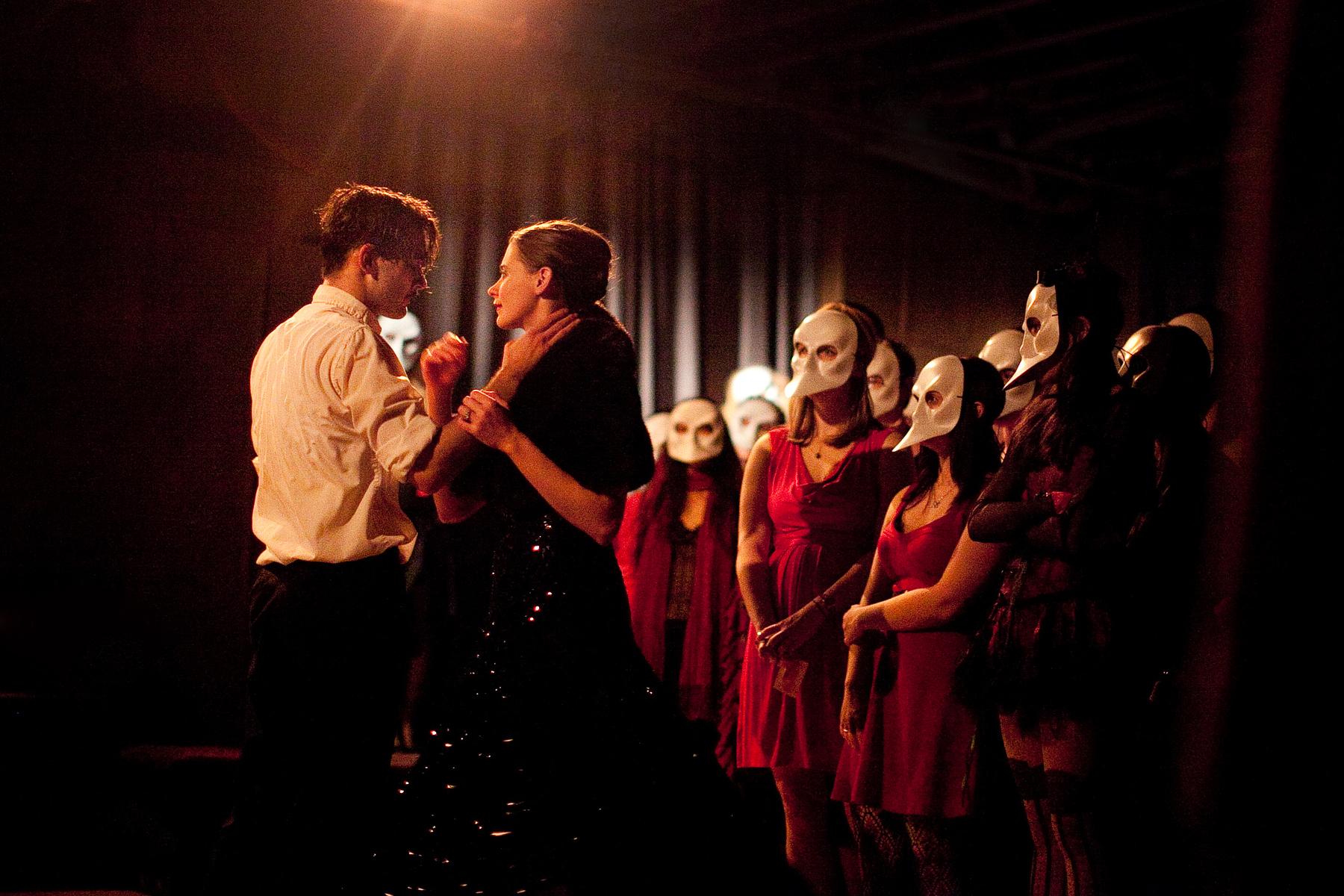
All Of It with Alison Stewart
Immersive Play 'Sleep No More' Closing In March
00:15:34
After a few recent extensions, the immersive theater production "Sleep No More" will wrap up its 13 year run this March.
Loading summary
Transcript53 lines
- [00:00]
McDonald's Advertiser
I' ma put you on, Nephew.
- [00:01]
Jonathan Hockwell
All right, Unc.
- [00:02]
Alison Stewart
Welcome to McDonald's.
- [00:03]
McDonald's Employee
Can I take your order, miss?
- [00:04]
McDonald's Advertiser
I've been hitting up McDonald's for years. Now it's back. We need snack wraps. What's a snack wrap? It's the return of something great. Snack wrap is back.
- [00:15]
MultiCare Announcer
For 140 years, MultiCare has been in Washington prioritizing long term solutions, partnering with local communities and expanding access to care. Together, we're building a healthier future. Learn more@mycare.org.
- [00:35]
McDonald's Advertiser
Listener support WNYC Studios.
- [00:49]
Caller Christina
This.
- [00:49]
Alison Stewart
Is all of It on WNYC. I'm Alison Stewart. And now we're going to talk about a show in its final weeks after a long, very successful run. Sleep no More is the immersive theatrical experience inspired by Shakespeare's Macbeth. But unlike most of the city's theater offerings, the show doesn't take place in a black box theater. It doesn't take place in the round. It takes place at the McKittrick Hotel, which is not a real hotel, but a performance space made up of six floors, each with a maze of rooms, including an infirmary, a character's bedroom, a taxidermy studio, an apothecary, candy store, ballroom crypt, and, of course, a room for witches to do their dark magic. And members of the audience are encouraged to explore these rooms at will and to follow actors from room to room as they play out some very dramatic scenes, not with words, but with ballet like movements that create a surreal, dreamlike experience of Shakespeare's classic story of power, ambition and murder. It was announced that Sleeping Moore would be closing down production after 13 years and more than 5,000 performances, with a final show set for this coming weekend. That's why we booked the segment for today, but it has been extended twice, first through February and now through March 31st. So you have a little more time to catch this longtime staple of experimental theater in New York City. So we're glad to be able to tell you about it. Joining me now to talk about the show and its run is Ileana. Sorry, wait, I got your last name right now. Ilana Gilovich.
- [02:14]
Caller Christina
Sorry.
- [02:14]
Ilana Gilovich
Yes.
- [02:15]
Caller Christina
Perfect.
- [02:15]
Alison Stewart
Chief storyteller. And also joining us in studio is Jonathan Hochwald, producer, sleep no More, and owner of Immersive Productions. He's been with the show since before its first performance. Thank you for coming in.
- [02:27]
Jonathan Hockwell
Absolutely.
- [02:28]
Alison Stewart
Listeners, have you been in the audience for Sleep no More or maybe you've been an audience member a few times? Give us a call. Tell us about your experience. 212-433-WNYC 212-433-9692. If you do, call in, no spoilers, Everybody. No spoilers, please. 212-433. WNYC 212-433-9692. Jonathan, when this project first got underway A little over 13 years ago, what do you remember about some of the initial challenges?
- [03:00]
Jonathan Hockwell
Wow. You know, it was really, for us, I think, thinking about staging this sort of new art form as native New Yorkers and believing that New Yorkers would really embrace this, that once they could experience it and sort of jump in with both feet and figure out what it is. I think the biggest challenge was like, you know, this had been starting sort of, you know, in a smaller way in the uk, this development of what we were called, we called our company Immersive. And now that's become a catchword that's used sort of by seemingly everyone and anyone. But at the time, for us, it was like we really were committed to the idea that this would be a word of mouth phenomenon if it was going to work at all. We really set out with a short run in mind of six weeks, and we've just continued to extend ever since. And now for over 13 years, it was really just what I think the biggest challenge was, really believing instinctively that this would connect and then wondering how the word of mouth would spread and if it would spread and if people would see it the same way we did, which is this just very compelling, one of a kind, only in New York type experience. It's like a reason we all want to be in New York is for things like this. And so I think that was the biggest challenge was trying to imagine a future where people could talk about it and figure out what it is and want to be a part of it.
- [04:31]
Alison Stewart
So, two questions, Alana. Do you say the Scottish play or do you say the name of it when you're there?
- [04:36]
Ilana Gilovich
It's funny, I tend to say the name of the play. I know that there's so much lore and so much superstition around saying the term Macbeth, but one of the things that I love so much about sleep. No, more specifically as a Shakespeare adaptation is it is this very singular hybrid between all of these different art forms. So mostly when you're thinking about the suspicions around the Scottish play, they're in very traditional proscenium theaters, but we're talking about the idiom of contemporary dance. We're talking about this strange tapestry of artists, thinkers, dreamers, musicians, dancers. And so a lot of them don't come with the knowledge of that. Particular superstition. So we're very brazen and bold at the McKittrick. We say the title name all the time.
- [05:18]
Alison Stewart
And Jonathan, this is what's known as Promenade Theatre. Would you explain what that term is?
- [05:23]
Jonathan Hockwell
That's a term that's sometimes used. It basically means that the audience is free to roam. So the audience arrives, they're allowed into the space and they follow whatever interests them. And it's, in a sense, a world that we've tried to create where almost like in a dream, you follow what interests you and piece things together. And the more you come, the more you discover you can come and some have hundreds of times and still not see everything. There's so many things happening simultaneously in this enormous warehouse space. And so the audience is not seated, they're free to roam. And I would say that's the main kind of characteristic of Promenade. This is really site specific and immersive, where you're really just in the world in this dream, kind of following your instincts, really, and piecing together this incredible story.
- [06:16]
Alison Stewart
Let's talk to Alexander, who's seen the show twice. Alexander, you're on the air. Thanks.
- [06:21]
Caller Alexander
I saw. Just have to say this quick because I have to get back to work. But I love the show. I saw it many years ago. The first time I went, I was right up front trying to follow as much of the action as possible. The second time I decided to hang back and watch the interacting action of the audience, participate and watch the show. And it was both very wonderful experiences. I went with a group of friends. Both times we've got separated. And that is the best way I can recommend going is just with a group of people. Go your own route, connect at the end, have a drink and tell your tales. Thank you.
- [06:56]
Jonathan Hockwell
Love that.
- [06:56]
Alison Stewart
Get back to work, Alexander. Thank you for taking a moment. My guests are Ilana Gilovich as well as Jonathan Hockwell. We are talking about Sleep no More. So what is your job as chief storyteller? I know you've worn a number of hats, you've been a performer, you've been a copywriter. What does chief Storyteller mean?
- [07:12]
Ilana Gilovich
Yes, it is a very fun, whimsical title that I have been bestowed, which is wonderful. So I have been with the show since 2012, both. Both as a performer and in a number of different departments. But I also earned my master's degree, my PhD in English literature, specifically specializing in contemporary adaptations of Shakespeare. So I've thought a lot about this production as a modern retelling of Macbeth. And so in Coming back to this production company with that wealth of experience, it has felt so wonderful to think about audience experience from the very beginning that they enter our space until they leave the show and kind of having this lingering sensation. So really, as a storyteller, particularly in a production without words, we're trying to think about how to scaffold information, how to provide a lot of structure and just enough so that people can have freedom to roam and still retain that sense of mystery.
- [08:07]
Caller Michael
The way you distinguish between the actors and your fellow audience members is that the audience is all wearing uniform masquerade masks. How was that production choice designed?
- [08:17]
Jonathan Hockwell
Well, our original, you know, the creator and director of the show, Felix Barrett and Maxine Doyle there. I'm sure there is a huge origin story of how that came about, but I think once it was discovered, the power of that, because it really. It sort of cuts off a little bit of your peripheral vision, allows you to be a bit anonymous and gives you agency, really, to kind of explore all the spaces and feel like you can get close to performers and really absorb the story in a different way. It's really unique, but it kind of came with the original conception of the show.
- [08:54]
Ilana Gilovich
I also think we've invoked one aspect of the show, which is Macbeth, but the McKittrick Hotel is a 1930s era, kind of Hitchcockian film noir setting. And so a lot of it calls upon these filmic and cinematic legacies. So part of the beauty of the mask is it's sort of letting an audience member be a camera and look out from behind their eyes. But it also is meant to represent the divide between the proscenium. So when you're in a traditional theater, the audience are in their seats, the performers are on stage, and the mask acts as that kind of fourth wall to distinguish between audience member and performer.
- [09:30]
Caller Michael
Let's talk to Christina from Staten Island. Hi, Christina. Thanks for calling all of it. You're on the air.
- [09:35]
Caller Christina
I'm so thrilled you have them on.
- [09:37]
Caller Alexander
Oh, my God, the memories.
- [09:39]
Caller Christina
I saw it just before COVID and I'm glad you said it's going to be a little longer. You know, you almost forget about these things. I'm definitely going back, but the whole. The concept. Oh, my God, we loved it, loved it, loved it. Bob went. My husband went into a different, you know, different route than I did. And then getting back later together was just amazing. But just talking and listening to you, the two. It all came back. The shops, the bedroom. I mean, all the dance performances. I mean, it was just very compelling. The whole thing very memorable. And of course, the setting makes it just incredible. And the wearing of the masks. At first you think, oh, my God, what is this? You know, but yet it is very compelling. Looking around at everyone else wearing the masks around the performances, you're like, yeah, it's spooky, it's eerie. But, yeah, very interesting. Anyway, loved it. Loved it. And congrats. I can't believe. 13 years. Wow.
- [10:33]
Caller Michael
Thank you, Christina. Thank you for calling in. We are talking about Sleep no More in its final weeks. There's still time to catch it at the McKittrick Hotel. My guests are Jonathan Hockwell, producer, Sleep no More, and owner of the McKittrick Hotel where the show is set, and Ilana Gilovich, chief storyteller for Immersive Productions because they're. Oh, by the way, if you want to join us, if you've seen the show, 212-433-WNYC 212-433-9692. You can text in your experience or you can join us on air. So, Jonathan, I have to imagine this casting the show must be a little bit challenging because there's a. I'm. What skill set are were you all looking for? What do performers need to have to be successful and Sleep no More, you know, I think.
- [11:18]
Jonathan Hockwell
Alana, do you want to answer that one more? Because you were directly in it. But obviously there's some very specific actually and some general skills, but go ahead.
- [11:27]
Ilana Gilovich
One of my favorite aspects of Sleep no More is we're trying. We're striving for as lifelike an experience as possible. We don't want people to attend the production and say, I want to tell you about what I saw last night. We want to say, this is what happened to me last night. And so it engenders this kind of very participatory post mortem with friends and family. And so we're really thinking about virtuosic dancers and actors who can then pare down to very lifelike pedestrian movements. And that's a strange paradox. That's a very strange skill set to be able to wield. And so in auditions, you're thinking about people who both have incredible talent, but also the awareness and the sensibility to really tell a very simplistic story and let this gargantuan, really meticulously designed set also speak for itself. So it's, it's kind of having the humility and the restraint to be really dedicated to your craft, but also tell a very simple, direct, archetypal story.
- [12:23]
Caller Michael
John, we have an interesting question Here is this a piece of performance art that I see before my eyes, that.
- [12:30]
Jonathan Hockwell
I see before me? I mean, it's definitely a work of art that requires, you know, an enormous amount of people and effort and passion and energy to create each and every night. And as such, I think the power of, you know, live entertainment is that sort of ephemeral nature that it's something that you can only experience that night live. It's not something that, you know, you can go watch on a rerun type of thing. It's really, you're impacted each time you go and you can be impacted very differently on follow up visits. It's very, very unusual in that way, in that it's an organic, living, breathing masterpiece, I think of theatrical art that you're actually in as an audience member and able to experience and a countless, myriad number of ways. I think that's been a big part of why it's connected and really touched the nerve here in New York.
- [13:23]
Caller Michael
Michael from Brooklyn Haste said, you have to see it more than once because you can't take it all in the first time. Leave room to plan your second visit when choosing your first and wear comfortable shoes. What are a few actually, what are a few things people should know if they decide to take on an evening at Sleep no more?
- [13:42]
Ilana Gilovich
I think trusting yourself. We have such scant experiences nowadays to be off of our phones, present, embodied really in the moment. And this is such a glorious opportunity to really check in with yourself and honor your instincts. So there are some people who love rifling through the set. Each room is different temperature, different scent, different soundscape. And so some people really love just interfacing with the environment. Other people really want more aspects of the story and so they will follow a performer. So I would say take this wonderful opportunity to sense where you inherently want to go and follow those instincts as best you can.
- [14:21]
Alison Stewart
Got a great text. I've been to Sleip no More three times and I wonder if the producers know how inspiring it's been to my field museums. I've gone with several museum colleagues and we've always left mind blown and inspired about what is possible with immersive design. Even in museums of art and history, its influence will be lasting. That's from Michelle in New Jersey.
- [14:40]
Jonathan Hockwell
Oh, how great.
- [14:42]
Alison Stewart
This is a hard question. Why is it closing?
- [14:45]
Jonathan Hockwell
You know, as I was saying before about live entertainment and live theater and this art form in particular, it's always bittersweet in a way that it has a beginning, a middle and an end. Whether it's a great book that you've read or a great TV series that you're watching at some point to. To finish up at the right time and to finish up strong and to essentially be able to hopefully have it out there long enough for as many people as possible to have experienced it and seen it and have that in their memories. I think it's just really important that unlike a typical theater show, which oftentimes will announce on a Wednesday, they're closing on a Sunday, or even announce that we're closing that night. To be able to kind of manage this last phase of this chapter of this book, I think was really important to us and to kind of end in a place where, you know, we were going out on top with, like, the best cast and the best experience and hopefully want people, you know, to come back someday in the distant future with something else in the right time.
- [15:55]
Alison Stewart
In the right way. Sleep no More. You have until March 28th. 28th. To see sleep no More. My guest has been Jonathan Hockwell and Ilana Gilovich. Thank you so much for coming to the studio and have a great final few weeks.
- [16:09]
Jonathan Hockwell
Thank you so much for having us.
- [16:11]
Alison Stewart
There's more, all of it, on the way.
- [16:13]
Caller Michael
I'll meet you right back here after the news.
- [16:15]
McDonald's Advertiser
I'm gonna put you on, Nephew.
- [16:16]
Jonathan Hockwell
All right, Unc.
- [16:17]
Alison Stewart
Welcome to McDonald's.
- [16:18]
McDonald's Employee
Can I take your order, miss?
- [16:19]
McDonald's Advertiser
I've been hitting up McDonald's for years. Now it's back. We need snack wraps. What's a snack wrap? It's the return of something great. Snack wrap is back.
- [16:30]
McDonald's Employee
At Capella University, we believe accessible education can make a difference. That's why we offer scholarship opportunities to all eligible students. Un futuro di ferente estamma serca de lo que cres con Capella University. Learn more at Capella. Eduardo.