← All Of It with Alison Stewart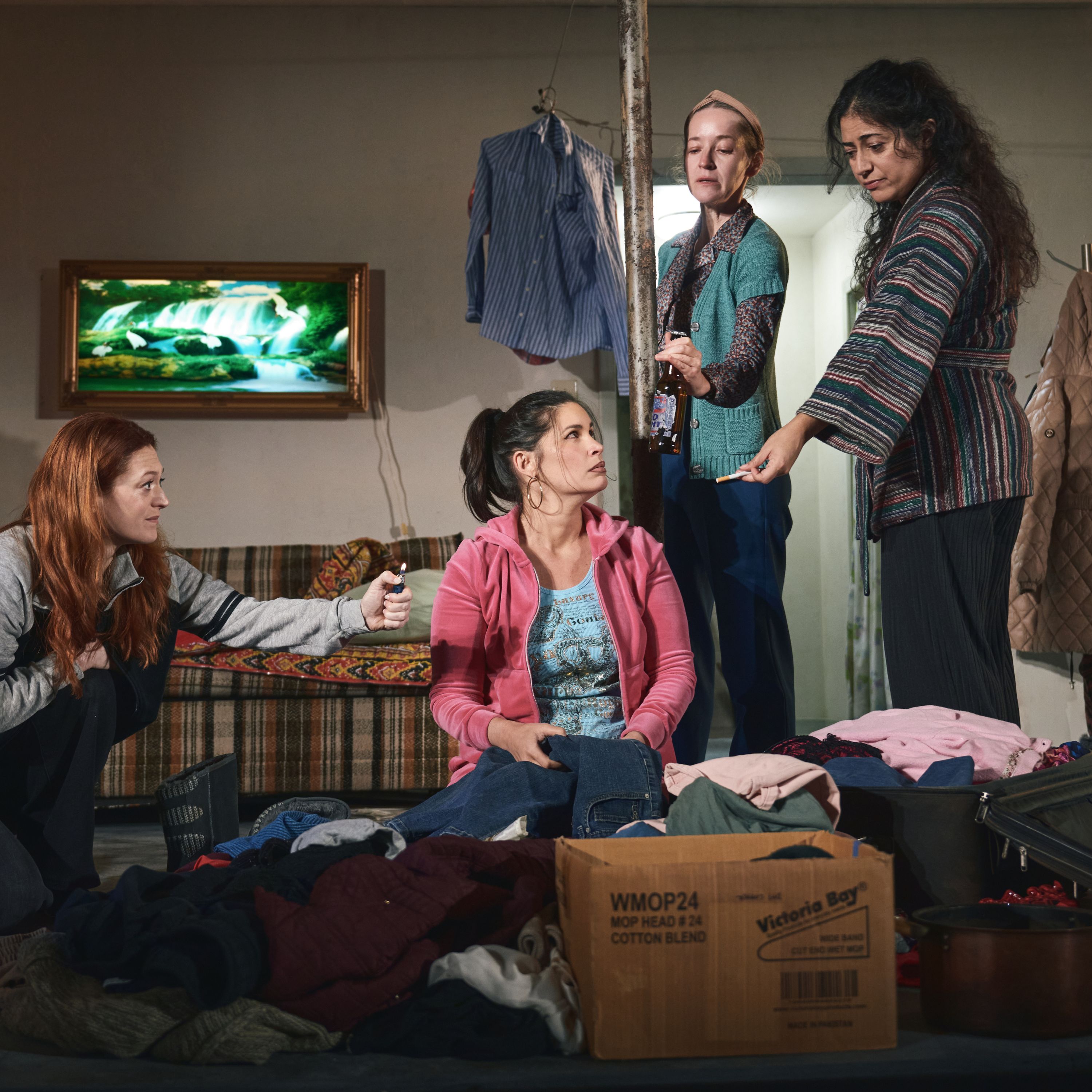
Loading summary
Transcript78 lines
- [00:09]
Alison Stewart
This is all of it. Shush. This is all of it. From wnyc, I'm Alison Stewart. The play Queens from Pulitzer Prize winning playwright Martina Mayock is set in an illegal basement apartment in Queens, which is a thoroughfare for immigrant women. Afghanistan, Belarus, Honduras. Some people live there for years, some, some only a few weeks. All are trying to achieve their piece of the American dream. One of the women who has arrived is a Polish immigrant named Raina. She's played by Marin Ireland. Raina is shy and doesn't want to share too much about her story. But we learn she has a daughter back at home who wants to come to America. Marina is cut off from her old life and has a falling out with her fellow Polish immigrant friend Agata. She's played by Anna Chlumsky. Years later, Raina is the owner of the basement apartment she once lived in. A young Ukrainian woman named Ina arrives at her doorstep with an attitude. She's played by Julia Lester. Ina sue learns that this basement apartment holds secrets. Queens is running at the New York City center through December 7th. I am joined now by playwright Martina Mayok. Nice to see you.
- [01:21]
Martina Mayock
Nice to see you.
- [01:21]
Alison Stewart
Also joining us is Marin Ireland. Hi, Marin. Hi. Anna Chlumsky.
- [01:25]
Martina Mayock
Hi, Anna.
- [01:26]
Alison Stewart
Hi. And Julia Lester. Hi, Julia. Hello, Martina. What was going on in your life when you decided to sit down and write this play?
- [01:33]
Martina Mayock
So many things. I began writing the play during the first travel ban, shortly after the first Trump election. And there's a few things that I was weighing during that time. I realized that in trying to pursue a life as a playwright who comes from a working class background, any sort of money that I made, I'd have to make a choice between do I use this for my education and for writing plays in hopes of somebody producing them later on down the line, or do I go visit my family in Poland? And I realized after a few of my closest family members had passed away and I couldn't. I realized I couldn't even afford to go back for their funerals, that I, in choosing to stay in America and pursue a life as an artist, that I accidentally became American and I lost touch with that part of my family. And that made me. That sent me back to thinking about many of the stories of the immigrant, especially immigrant single mothers that I had grown up with when I first came to the country and what they had to give up and their sacrifices and their fights. And out of their stories came Queens.
- [02:42]
Alison Stewart
Marin, you've worked with Martina before. Yes, I have. On Ironbound.
- [02:46]
Marin Ireland
Yes, that's right.
- [02:47]
Alison Stewart
What do you admire about her work?
- [02:49]
Marin Ireland
Oh, my goodness, everything. She is funny and fierce and a truth teller, and it feels like a full meal as an actor to sit down with her work. It really feels like I get to do everything I ever dreamed of doing as an actor. When I am handed something she wrote, no matter what character it is, that's also the incredible thing. No matter what character you're playing, no matter what play it is, I feel like everybody gets to sort of rise to the occasion and do everything they ever hoped to get to do as an artist. Truly, it sounds like a hyperbole, but it is not.
- [03:33]
Alison Stewart
Julia, you're on stage with a cast of veteran actors, so you're the closest to the beginning of your career. We'll say, what have you learned in this production that's been helpful to you that you think you'll continue to use in your stage career?
- [03:47]
Julia Lester
Wow, that's a great question. Because I look at all these people, and I'm like, what haven't I learned? I feel very, very lucky to be surrounded by so many people who emulate the kind of actor and person that I want to, like, grow to. And I've seen everybody lead this cast and lead the show with such grace and humility and kindness. And we all hold each other very closely backstage so that, you know, the product on stage feels real and lived in. And every single person has really shown me the kind of person that I am trying to grow into and how I want to hopefully be to, you know, younger cast members when I'm. When I'm in a position to lead somebody or mentor somebody in that way. So it's been. It's been very wonderful. And it's the kind of thing that I look for. The kind of thing that I want to look for in everything that I do is working with good people.
- [04:46]
Alison Stewart
Anna, you have done this since you were a kid. Tv, stage. What do you like about stage acting?
- [04:54]
Anna Chlumsky
Stage acting is how I came to this entire profession. It is something that is really noble in that you're communicating a text, and it's with the hopes, in my opinion, of standing the test of time. You know, a play is something that anybody can pick off a bookshelf for centuries. You know, we still read Shakespeare, we still read Chekhov. And when you're making plays by living playwrights, you feel like you're a part of shaping culture, and that's. And then just the work of it is everything, you know, like being nerdy, being a nerdy actor, you're into the moment to moment Work, you're being present every night is a bit new because you're a new human, and so is the story. Even though it's the same text every single night, eight shows a week, you have to be present. Cause that is how you make art, and that is how you communicate a text. And that's why I love it.
- [06:03]
Alison Stewart
Martina, in the original production that ran in 2018, there were 11 different women in this. In this. And you had to cut it down to eight for this particular production. What was behind the decision and how did you go about cutting down the women?
- [06:20]
Martina Mayock
It wasn't even. It wasn't just the women. It was time. It was. It ran three and a half hours in the first week. Don't worry, you guys. It's a solid two hours, less than two hours. Don't worry. And actually, the women, they're still a part of the story. We just don't see them. So I focused on, actually, when I was first developing the story, I just kept falling in love with all of these women and expanding their story and expanding and expanding to the point, as well as the actors who were playing them, to the point that I think I sort of lost control of the spine of the story, the engine of it. And so this new iteration of queens has been trying to wrest them all into a tighter narrative drive without sacrificing the stories of the women who were and are in the basement. So there are ghosts there. They live off stage. But by not showing them, it focuses it on the people who we are present with in an effort to hopefully give as full of an experience to a singular story that is supported by a number of other women.
- [07:30]
Alison Stewart
Why did you choose women rather than immigrant men and women?
- [07:34]
Martina Mayock
Because I like higher stakes. Tell me more. I think there's a lot of pressure for women to not just do the work with their bodies to make money to support themselves, but to also support their families and also to uphold a culture and some kind of a family. The amount of mental workload, labor that. That goes. It goes there to just, like, keep your life and the lives of your family afloat is rarely talked about. And I also drew inspiration from my mother's story. We came to the country together. And the stories of a number of immigrant women that I grew up with and essentially was raised by. So the play is really an homage and a love letter to them.
- [08:30]
Alison Stewart
We're talking about the play Queens, about immigrant women sharing illegal basement apartment. My guests are playwright Martina Mayok, as well as actors Marin Ireland, Anna Chlumsky, and Julia Lester, Queens is running at the New York City center through December 7th. Did I get your name right?
- [08:46]
Martina Mayock
Perfect. Got it.
- [08:47]
Alison Stewart
All right. All right, Marin and Anna, you're both from Poland. Your characters are both from Poland. What kind of research did you do?
- [08:57]
Marin Ireland
Oh, my goodness. Well, I've played a Polish character in Ironbound. I've done that play now a few times. But I will just say briefly that Anna and I, A big element of our research was learning Polish for the play.
- [09:16]
Alison Stewart
It's so true.
- [09:17]
Marin Ireland
And that took longer than I gave myself a lot of time to work on it, but it was. I have experience speaking some other languages. It's not like anything else I've ever had to say. I spoke a few words of Polish in Ironbound, and that felt like. That was like, one of the hardest tasks I had before me in terms of approaching a character from Poland in this particular way. That was a whole new element for me.
- [09:44]
Anna Chlumsky
How about for you, Anna, as far as just researching the experience? I mean, I think we did lean on Martina a lot. We have the gift of having Martina in the rehearsal room, and nobody in our room knew what it was like to be from Poland better. So that was sort of, you know, the fast track. And for me, it's. Yeah, I'm not Polish, but I am absolutely through and through Slavic. I am, you know, so I was just jumping at the chance for me to finally play a person of a similar heritage to my own. And, yeah, the. It's such a. It's so much fun speaking in another language, just in general. And. And getting the chance to. To do a whole scene in Polish is just. It's like a dream come true.
- [10:37]
Martina Mayock
I love it.
- [10:38]
Marin Ireland
I know you have the. The Czech. And.
- [10:40]
Anna Chlumsky
Yeah, I speak. I speak Croatian. So, like, I. I'm Czech, and she's a Croatian. Yeah, we're. We're Czech crew. You know, we're both Czech. And then I've got Croatian and Romani as well, and so. But the Croatian helped me with the. With the language because structurally, it's still a Slavic language, so it's similar, but.
- [10:56]
Martina Mayock
Man, they sound great. My mom was like, thumbs up.
- [11:03]
Anna Chlumsky
I mean, you know, Polish. The sounds. It's like a code. It's so fun. It's so fun.
- [11:10]
Alison Stewart
Julia. The story begins with Ina. She's a Ukrainian woman. She's desperate to find her mom in America. She comes across Reyna. There's a little bit of something that goes on with them. I don't want to give too much away. What is Julia? What do you think? She's hoping to find in America. Does she want to find her mother?
- [11:31]
Julia Lester
Yeah, it's a big question. I do think that she is in search of her mother as a person, but also just I think she's searching for answers of why did her mother go to America? And maybe it's not necessarily finding her as a human being, but finding the reason or the idea of what was so, as we say in the show, remarkable for her to go to a different country and find something better than what she had at home. And yeah, I mean, there's a lot that goes on that is a part of her journey to America. But I think that what she is really searching for is the American dream. What is so remarkable? What is this thing that her mother left her for and whether or not she finds it or finds the person she's searching for the answer, I think.
- [12:24]
Alison Stewart
It'S clear things haven't gone that well for her. When we first meet her, what conversations did you have with Martina about Ina's experiences when she arrived in America?
- [12:37]
Julia Lester
Yeah, I mean, I think it's really interesting that we talk about these experiences that all of these women face when they come to the country. And there was so much to play from actually, Martina suggested I watched this documentary called Love Me that is about this mail order bride business that people get into in order for a reason for them to come to America. And that was really helpful to watch and to see all of these stories of these women, whether or not they had a successful marriage or whether or not it was more out of necessity. And we deal a lot with the complexities of that in this show. And it was really helpful to watch that and see firsthand from the women who have experienced that, to see and pull sort of from what they experienced, to see what felt real for Ina and what felt real for her trajectory in America.
- [13:37]
Alison Stewart
We're talking about the play Queens. We'll have more after a quick break. This is ALL OF it. You're listening to ALL OF IT on wnyc. I'm Alison Stewart. We're talking about the play Queens about immigrant women sharing an illegal basement apartment. My guests are playwright Martina Mayock, actors Marin Ireland, Anna Chlumsky and Judy Lester. Queens is running at New York City center through December 7th. Let's talk about the basement apartment. In the apartment, the women leave behind things for other women, or sometimes they just leave behind things. Tell me a little bit about that decision.
- [14:27]
Martina Mayock
When I lived in a basement apartment when I first came to the country with my mom, we began in Greenpoint, which for Polish people was America for big. And then moved to Newark and Carney Harrison, basically end of the PATH train. And when I graduated from grad school and I moved to the city to pursue a career in playwriting, I ended up again living in a basement apartment. And the only reason I was able to get that apartment, I hopped between or amongst 13 different apartments my first year in New York City because I couldn't afford a secure. I couldn't afford the security deposit. So I was. I was on a couch here. I was on this place there. And finally I realized I was like, I should just go back to Greenpoint and go do the immigrant hack of trying to ask people for their help who also speak my language. And they sent me to this Polish Craigslist essentially called Bazarinka. They're online now. And I found this apartment in Ridgewood, Queens, but it wasn't ready for me yet. So I lived in the basement for a little bit. And I discovered this room in the basement that remind. The whole setup reminded me of when we first came. It was a bunch of subdivided partitions, like makeshift rooms. And in one of the rooms, I discovered all these discarded objects. There were paintings. There was guitars. They were like random tchotchkes. And I just, like. They felt so alive to me. They felt like they contained all the stories of the people who. Why did they leave this behind? What were they trying to do when they first came here? And I think a lot of the women in the play are. They're weighing what's worth keeping in their lives in a large way and in the smallest ways between the objects. And when the newcomers come into the apartment, I think they're faced with the things that other people did not choose to take with them, and that causes them to wonder about what they will end up abandoning and what they will end up keeping.
- [16:30]
Alison Stewart
Marin, when you're. When we first meet your character, what does the basement mean to her? And then what does it mean to her 15, 16 years ago? Or you can do it vice versa.
- [16:42]
Marin Ireland
Yeah. I mean, without giving too much away, I think the basement, when we first meet her, chronologically speaking, the basement is a refuge and a sanctuary. She's in desperate need of a place to stay the night. Just a roof over her head, but it also is a place. There's nobody there when she arrives that speaks her language. There's nobody from her country there when she arrives. So she's starting at the bottom of the food chain and has to sort of learn by getting thrown into the deep end, how the Structure of this place works, how the hierarchy works, how we do things there, how it operates. And I think we watch her learn the ropes.
- [17:34]
Alison Stewart
She kind of comes to run the basement.
- [17:36]
Marin Ireland
We'll say, yeah, we won't give too much away.
- [17:40]
Martina Mayock
But.
- [17:42]
Marin Ireland
I mean, that's the only space, you know, we see her in, really, in the play. And so over many years, it becomes lots of things. But that's the space that then she feels some. She has authority in that space after a while, just after living there so long and seeing so many people come and go. So, yeah, it's a queendom for her, I think.
- [18:10]
Alison Stewart
When your character, Anna comes on, you say, watch Reina. You tell the other people to watch this woman. What are you referring to again?
- [18:22]
Anna Chlumsky
I think we can't give too much away.
- [18:24]
Alison Stewart
Too much away. But something about her.
- [18:26]
Anna Chlumsky
Yeah. I mean, it's funny. Throughout the play, there's warnings about Renia. There are warnings all over the place. And I think that as audience members, you know, anybody watching gets to kind of go along with that same curiosity of, like, wait, why do I have to. The same way that the roommates would have to. The same way that Ina would have to. Any. Yeah, we're all being warned about Rania, you know, everybody who comes into, even our basement theater. And, yeah, so I know her the best, I suppose, considering that I've known her from, or my character's known her since Poland.
- [19:13]
Martina Mayock
And.
- [19:15]
Anna Chlumsky
We discover more about their history together, and Polish speakers will discover even more.
- [19:24]
Alison Stewart
I did want to know what you were talking about. I have to tell you.
- [19:27]
Anna Chlumsky
No. But I keep on checking in with those. I know. And I'm like, did you get hit? Eventually, everything is revealed.
- [19:34]
Martina Mayock
Yeah, there's been. There was one performance where there was a group of Polish people who were rolling. They were having.
- [19:40]
Alison Stewart
Oh, really?
- [19:44]
Anna Chlumsky
Yeah, it was cool. It was cool.
- [19:45]
Marin Ireland
Yeah.
- [19:46]
Alison Stewart
Yeah. So, Julia, when you arrive at the basement, when Ina arrives at the basement, what are her hopes when she gets there, when she finally agrees, okay, I'm gonna spend the night here, and I'm gonna. I'm gonna clean up and stay.
- [20:01]
Julia Lester
Yeah, I think more than anything, I think she's faced with the idea that nothing is safer than where she is right now. Whether or not that's because of the person who lets her into the basement, or just the idea that there's, like, a bed and a place to stay for the night and there's a lock on the door. So I think that it's more of. She stays there out of necessity rather than desire. But, yeah, I Mean, I think that there's kind of nothing. She doesn't really have any other options. And so it's either this or continuing her journey that she's already on and sleeping outside and facing what's on the street. So it's sort of out of necessity that she has to stay.
- [20:46]
Alison Stewart
Martina, English isn't the first language for any of the women in the basement. Poland, Ukraine, Afghanistan, Honduras. What did you learn about these various languages in order to understand how these women might speak or learn English differently?
- [21:03]
Martina Mayock
I've always thought that there's such beautiful poetry and what some people consider broken English because of how I grew up. When I first came to the country, it was a multicultural, immigrant landscape. And so everybody. When people's children were learning to walk, they were learning to talk, speak English. And the way that people make meaning when, like, I'm fascinated by concepts that don't exist in other languages and how telling that is about what we value in what those cultures value because they have a word for it, or how people make sense of how they put their sentences together. And so I find a lot of, like, beauty and also drama of people putting together with their limited understandings. They're trying to communicate. The whole thing is dramatic conflict. They're trying to translate something that for them, lives in a different language to other people. And so, like, for example, in Polish, like, there are no articles. There's no the. There's no that. Like, so. So, like, then in transition for English, like, that's. That's missing and. And, you know, certain sounds and letters that don't exist in people's mouths from. From their first year, the first years of learning. I think it just makes this beautiful music together. And I loved hearing different. Different dialects, different accents together, because to me, that's. That was the soundtrack of my. Of my childhood. And I want. And also what I understand the to be. And I wanted to share that with an audience.
- [22:31]
Marin Ireland
Can you tell Martina's godmother.
- [22:33]
Anna Chlumsky
Do you mind if I share that? I don't remember what she does on opening night. Marisha, your godmother? Yeah. Martina's godmother is from Poland. Even now.
- [22:47]
Martina Mayock
Yes, she lives there. She just came for the moment.
- [22:48]
Anna Chlumsky
She just came for this. And she. She speaks very little English. And so we were trying. And I even said. I was so silly. I was just like. I was like, we, like. I was trying to say, like, we love Martina, but I was like, we like. And then she said, oh, I am in the sky, is what she said.
- [23:11]
Martina Mayock
And that's. I'M so happy I'm in the sky. Yeah.
- [23:13]
Anna Chlumsky
She said that I'm in the sky. And that's. Yeah. And we got it. You know, that's what's so great about. About understanding all the different ways that we communicate and all the non verbals and, you know, you can be somebody who doesn't share a lot of language and still completely understand each other's experience just from trying.
- [23:31]
Martina Mayock
Sometimes it might be an asset, I think, like something I'm in. I'm so happy I'm in the sky. To me, feels like more like the actual thing. I think it's gorgeous. They're all poets, of course.
- [23:45]
Alison Stewart
Immigration is big in our politics today. Just a few weeks ago, we saw ICE conduct raids on Canal street right here in New York City. How do you hope this play speaks to our current moment? Who wants to take it?
- [24:00]
Martina Mayock
We were in tech rehearsal during that week because ICE was also in Times Square, which is where our theater is, closer to where a theater is located. And the company management gathered us all around and we were like, uh, oh, what do we do? It's certainly our fault. And they told us this information so that we'd be. We'd need to call who we needed to call and be careful ourselves. And most of us burst into tears because I don't understand why this administration is coming after people who for the most part are just trying to embody the ideals of what the American experiment's supposed to be. They're trying to create a fuller life for themselves and oftentimes contributing very, very deeply to the culture that they are. That they are moving into. And I. For people that are just seen as headlines, I hope that this play contributes a deeper portrait of human beings that are actually very similar to the people that are in the audience. It's a story about friendship and about sacrifice and cost of dreams. It's funny, it's fiery, it's feisty, like they're. It's daughters, mothers, families. I think we're more alike than we are dissimilar. And this play is endeavoring to include and welcome people that may not think that they have anything in common with the people that are on stage and for the people who. Who are some of the people on stage to make them feel welcome and to make them all feel less alone.
- [25:38]
Alison Stewart
The play is called Queens. It is at New York City center through December 7th. My guests have been playwright Martina Mayok, actors Marin Ireland, Anna Chlumsky, and Julia Lester. Thank you so much for coming to the studio.
- [25:52]
Martina Mayock
We really appreciate. Thank you for amplifying the play. Appreciate you.
- [25:56]
Alison Stewart
There's more.
- [25:57]
Anna Chlumsky
All of it on the way Way.
- [26:01]
Atlantic Union Bank Announcer
Life is full of exciting moments. Whether you're buying a new home, opening an account as you welcome a new family member, or planning for retirement, you need a bank that's there when it matters. At Atlantic Union bank, you'll find helpful people and digital tools to make banking for all of life's moments a little easier. Because you deserve a financial partner who cares as much as you do. Call Visit us online or drop by a branch to learn more. Atlantic Union Bank Any way you.
- [26:33]
Martina Mayock
Are you ready to get spicy?
- [26:35]
Doritos Commercial Voice
These Doritos Golden Sriracha aren't that spicy.
- [26:39]
Martina Mayock
Sriracha sounds pretty spicy to me.
- [26:43]
Doritos Commercial Voice
Um, a little spicy, but also tangy and sweet.
- [26:46]
Marin Ireland
Maybe it's time to turn up the heat.
- [26:49]
Doritos Commercial Voice
Or turn it down. It's time for something that's not too spicy. Try Doritos Golden Sriracha spicy but not too spicy.