← All Of It with Alison Stewart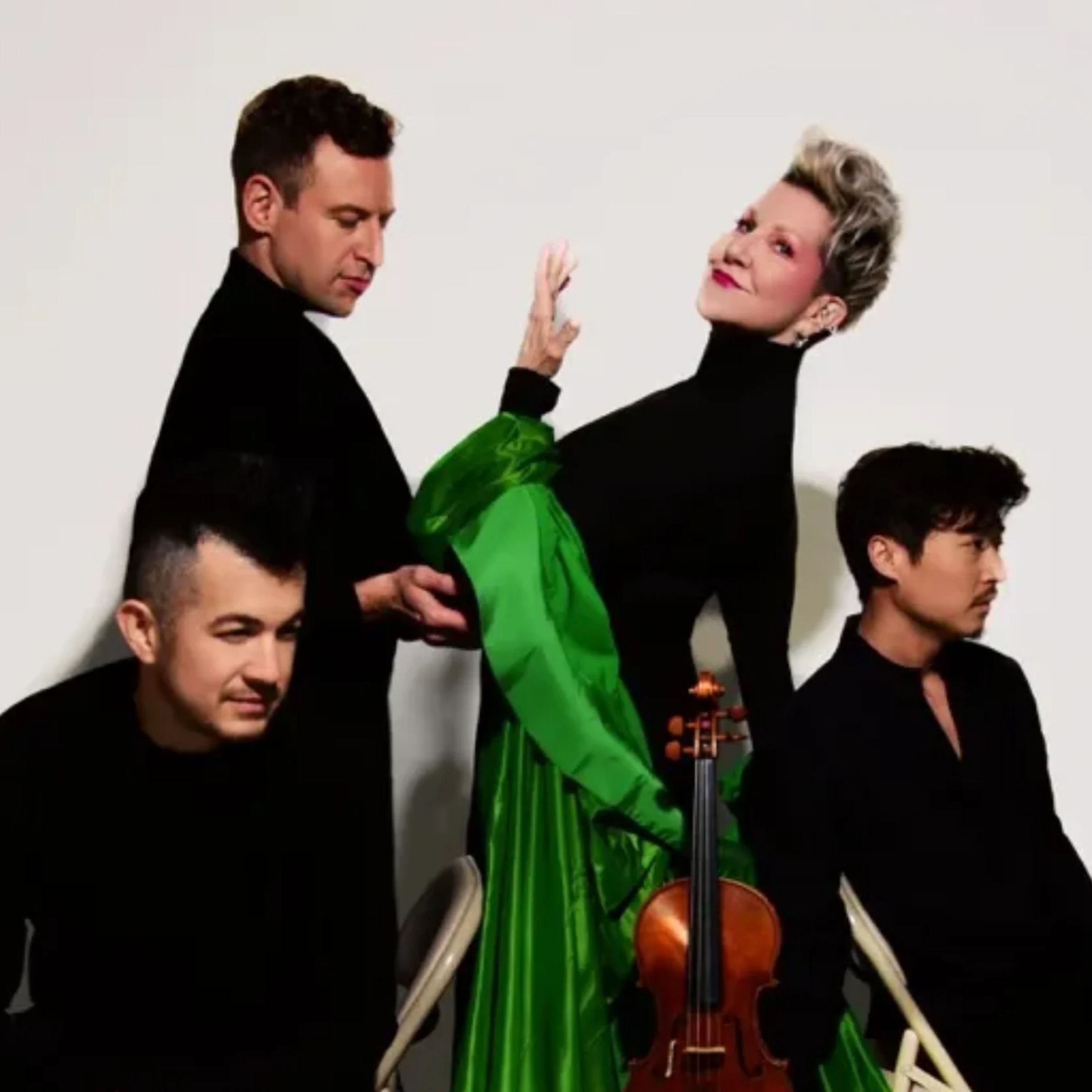
Loading summary
Transcript74 lines
- [00:08]
A
This is all of it on wnyc. I'm Alison Stewart. Hey, if you're a fan of the HBO series the Gilded Age, and if you really aren't, you should be. You should know that one of the things it does really well is explore the rarely depicted black professional community in the 19th century New York City. Coming up tomorrow evening, I'll be hosting a conversation about the world of black women in New York. From the tenements to brownstones right in NYC's green space. I'll be joined by Danae Benton, who plays Peggy in the Gilded Age, as well as historian Leslie Harris and the Tenement Museum's Marquis Taylor. The event is called Peggy Scott's New York Tickets. Well, they're sold out, but you can watch the livestream. It starts tomorrow evening at 6:30. Head to wnyc.org events for more information. David Furst will be sitting in the hosting chair on all of it tomorrow. And I will see you tomorrow night in the green space. And speaking of the green space, our next guests will be there tonight. My next guests are a powerhouse team up from the classical world. Joyce Didonato is an Olivier award winning opera singer. Time for Three is a Grammy and Emmy winning string trio made up of Nick Kendall, Renan Meyer and Charles Yang. Did I say Meyer? Did I say that right?
- [01:21]
B
Oh yeah.
- [01:22]
C
Oh yeah.
- [01:22]
A
All right, together. Their new album celebrates the work of Emily Dickinson. It's called Emily no Prisoner be. Composed by my other guest, Pulitzer winner Kevin Putz. The song cycle incorporated the world of the 19th century poet. The group will be performing tonight at the Green space and on Thursday at Carnegie Hall. Welcome to all of you. Thank you so much for coming to the studio. Thank you. All right, you're gonna start us off with music. What are we gonna hear first?
- [01:49]
D
This is the first song of the cycle. Emily was born into a world that was prose, church and dogma and society and being a woman. But she thrived in her world of poetry. So this first song is called they Shut me Up in prose.
- [02:19]
C
They shut me up in pro. They shut me up in pro. When a little girl they put me in a closet because they light me still. When a little girl it put me but closet because they like me still. Still. Could they themselves have peeped and seen my brain go wrong? They might as wise have lodged a bird for treason in the palm Himself has but to win and easy as a star, abolish his captivity and have no more ammo.
- [03:58]
A
That was Joyce Sonato and Time for Three. We also have in studio with us, Kevin puts. Kevin, let's go back to the origin of this collaboration. Where had you worked with Joyce and Time For Three before?
- [04:10]
E
I had worked with them in kind of different areas of my profession in classical music. Joyce was absolutely electrifying as Virginia Woolf in the Hours at the Metropolitan Opera. Actually, I talked to you about that.
- [04:22]
A
I was gonna say, I know you. I was like, I'm looking in your face. I'm like, I know this man.
- [04:26]
E
Yes, we met before, and then in a different kind of sector of our. Of our little classical world, I worked with Time For Three, this amazing trio that breaks all the boundaries of classical music. I wrote them a concerto called Contact, and I had talked to all of them, really, about their desire to do an album with a singer. And I just thought, you know, I have a kind of amazing singer in mind. And I wasn't sure if she would want to do something like this.
- [04:53]
B
And I. I thought we were gonna. It was gonna be my mom.
- [04:57]
D
Oh, don't make me compete with your mom.
- [05:01]
A
Mom's got. That's okay. Joyce, how did this group come together?
- [05:06]
D
Well, it was Kevin's idea, actually. And I have to say, all of this, the way he channeled Emily's poetry and the way he imagined the four of us coming together was really extraordinary, because from the first moment we met, it was magic. And then we got into a studio, we started workshopping the first songs. This one being the very first thing that we read with Kevin. We all just synced up in terms of our expectation, a musical level, but also our desire to just rip through something and make it really compelling. I feel like they're my musical spirit animals, and we're out there doing it.
- [05:47]
B
Yeah, we are.
- [05:48]
A
Nick, what made you want to work with Kevin again and working with Joyce as well?
- [05:53]
B
Well, for us, Kevin. So this was before even he was writing a concerto for us. I think it meant. I think it meant so much we wanted to collaborate, but it meant so much that he came out to our shows. In fact, here in New York City, he came out to Joe's Pub. I think that was, like, one of the first things you came to see. And he kept. It's almost as if he was studying us, which was unbelievable.
- [06:19]
A
Were you.
- [06:19]
B
But he was.
- [06:20]
A
Were you studying them a little bit?
- [06:21]
E
Well, I mean, they have a very, very special kind of vibe, very atmosphere as a trio, and I wanted to kind of fil my voice through that. So, yes, I was. I guess I was studying them. Not in a. You know, not in a strange way, but In a way that I could, you know, feel like it gave them something that they could really communicate with.
- [06:39]
B
It was it through the process, though, with Kevin, it really has felt like our concerto that he wrote because we're also vocalizing, so there's actually six voices happening within time for three. And the concerto was almost like this perfect suit fitted for this unique group. And it's really hard. Like, what do you do with two violins and upright bass? I'm actually. This next thing we're about to do. I'm actually holding a viola for those of you who can't see. But he wanted to add the element of viola for Emily. No, Prisoner B. But real quick, with Joyce, I mean, when Kevin.
- [07:15]
C
I remember.
- [07:15]
B
We remember very clearly when he sent that text. It's like, well, y' all want to do something with Joyce Cdonato? And we thought he was totally kidding. But Joyce is one of these. I mean, obviously, she's known as one of the world's greatest opera singers in that genre, but for us, I think it's so deeper than that. She's this consummate soul artist. She. Every sound that she creates, every phrase that she turns is kind of like how Time for Three spins our sound. A lot of stuff that we write is through improvisation and the way we phrase, I guess, in classical music called chamber music, but the way we listen and play together is. Is. And so it was a perfect fit in that way, on top of her just being an extraordinary human.
- [07:59]
A
Charles, what is. What did you think about performing with Joyce?
- [08:04]
F
You know, it's, as Joyce said, we're just kind of. We found each other as spirit, musical animals, soul mates, in a way. And from the recording studio to even practicing it onto the stage, you know, it's always an exciting adventure, but it's not any different.
- [08:22]
C
It's.
- [08:22]
F
It feels so intimate on stage between the four of us, and it's always different. And that's what great music is. And Kevin wrote us this thing that sometimes Joyce will come in that day and say, I feel this differently. The texts are. I feel these texts in a certain way today. And we'll try to kind of concoct that with our sound as well. And it's an ongoing journey, and that's what makes it so fun.
- [08:48]
D
If I can just interject about what it's like to play with you guys, it's like flying. It's just absolutely like flying. And because we're all here to serve the project of Emily, no prisoner be. Give her words and give this unique, amazing, beautiful Music flight. We're all aligned on the same purpose. And so we're just there serving the music. And her words.
- [09:12]
A
Renan, what is. And I mean this in the best way. What is challenging about this project?
- [09:18]
G
I think there's. It's full of challenge. Kevin wrote us, you know, it's interesting. We got off the stage, we've been on tour. We started off on the west coast and then made our way to the Midwest. And our last show was in Kansas City, Joyce's hometown. It was incredible to be in front of that hometown crowd. And we got off the stage and some young people that we had worked with previously came up to us and said, wow, it's like watching the Olympics, watching you guys. And I tell you what, I've personally never gotten that as a comment before, but I think there's a similarity to that because it's really been a two and a half year journey with Kevin. Kevin's conception of this music, the way that he takes what we can do very well and innocently, but then he finds this really extraordinary way of pushing all of us. We all agree on this and we all talk about it a lot. If there's something that we thought we could do previously, he finds a way to just kind of push us in this direction and that direction. And then, you know, even if maybe there's a little bit of a feeling of not so sure, we find it, you know, together as a group, we keep on discovering it. So it's a wonderful challenge.
- [10:32]
A
All right, before we hear another song, tell us a little bit about the album. Emily.
- [10:36]
E
No prisoners Be well, you know, I was so eager to start writing for them when we kind of decided that we'd do it. And I. Well, who can I just, you know, who's an amazing poet that I can just start writing? And, you know, the poetry is public domain, you know, and I thought, well, look up Emily Dickinson. And the first thing I saw online. And of course, I knew many of her poems, they shut me up. And prose, this first poem about sort of freedom and, you know, the futility of trying to shut someone of her character, you know, up in a little box. And then it just started with that, because I could imagine that musically. And then I delved into all the poetry, and it's unbelievably musical. I mean, so many composers over the last 125 years have set her poetry to music. It's not an original idea, but I can see why, because there's so much music in the poetry.
- [11:26]
A
Joyce, what are we going to hear next.
- [11:28]
D
Ah, Renan. Do you want to share what we're doing? This is your favorite. Your son sings this piece?
- [11:33]
G
Yes.
- [11:33]
C
Yeah.
- [11:33]
G
It's probably not one after you hear it that you would imagine a child singing, but I've heard it.
- [11:40]
D
He's very good.
- [11:41]
G
Well, they both are into musical theater. We played the first of 26 movements of this gorgeous song cycle that Kevin came up in the Journey. Now, this is the seventh part of this 26. There are 24 poems. 26 movements. And this poem is one of her more famous ones. And it's called Because I Cannot Stop for Death. Because I could not stop for death.
- [12:30]
C
He kindly stopped unkindly stopped for carriage.
- [12:37]
G
Help but just ourselves an immortal and.
- [12:43]
C
Immortality slowly drove he knew no haste and I had put away had put.
- [12:54]
G
My labor and my leisure to for.
- [12:59]
C
His severity, for his civility. We passed the school where children strove on recess we passed the fields of gazing grain we passed the sea or rather he passed us the dew drew quivering. My tippet on the shore. Swirling of the ground the roof was scarcely visible the cornice in the ground since then centuries I did feel a shorter than a day I first sunized the horses heads were torn I first surmise the horses heads were to eternity. For cause I could not stop for if he kindly stopped he kindly stopped for me he kindly stopped for me.
- [15:05]
A
That was Joyce DiDonato and time for three playing music from their new album Emily no Prisoner Be. They'll be at the Green Space tonight and Carnegie hall this Thursday. Thursday. We'll be right back with some more music featuring the Young People's Chorus of New York. This is all of it on wnyc. I'm Alison Stewart. I'm here in studio with Joyce De Donato and Time for Three. That's Nick Kendall, Renan and Charles Yang, as well as Kevin Putz. They're playing music from their new album, Emily no Prisoner Be. They'll be at the green Space tonight and Carnegie hall this Thursday. Let's hear some more music. We're going to hear her face.
- [16:12]
D
Sa.
- [16:45]
C
Like flower. More tender than the two that totters in the leave.
- [18:37]
A
That is from the new song cycle, Emily no Prisoners Be. I'm in studio with Joyce DiDonato and time for three. Charles, the liner notes on this album say the narrative logic of an opera with the unified thread of. Of a pop album. All right. What can opera learn from pop?
- [18:55]
F
Oh, that's a heavy question. That's a heavy question. I don't know if I'm qualified to answer.
- [19:01]
C
That.
- [19:01]
F
But what I've learned from this is this is our foray into an operatic voice in a way, our first collaboration with someone like Joyce in an operatic way. But this is in no means a song cycle in the operatic form. It does feel like. It does feel like rock and roll, almost like a rock opera in a way, and something the next thing you'll hear actually is definitely a qualifying act upon this thought that I think we all share. So, yeah, it's just a celebration. It's a celebration of Emily Dickinson's words and also how Kevin envisioned putting Time for Three, pairing Time for Three up with Joyce Cdonado. It was a conscious decision to do something like that.
- [19:52]
G
So I'm gonna jump in and just add to this because I. I feel like, you know, there's. There's a lot of, you know, when you're learning to be a classical musician, you're going to conservatory or wherever, you're going to learn this. It's. It can be overwhelming. It could, you know, take a lot. You know, I remember, you know, school, practicing 10 hours a day for a long time, you know, and you're kind of isolated. And I remember always looking for, like, the. Where is the ease, where is the simplicity? Where is the, you know, that minimal feel? And so sometimes like, you know, I play the double bass, I would literally pretend I would put the instrument on my knee and pretend it was a guitar, you know, trying to create like some sort of a levity or lightness to the mood, pretending. I'm a singer songwriter. Make no mistake about it. You know, being a singer songwriter, you have to put in those hours as well, you know, so there's always this depth in every art form, right? And there's that struggle, but there's also this. This lane where eventually the light bulb goes off or the pixie dust, you know, falls into your mind or whatever, and then you can find a way to just be, you know, so it's more like a comfort zone, you know, Time for Three and Joyce were cut from this classical cloth, but we have like this inquisitive nature where we want, you know, and Kevin as well, where we want to look outside of those boundaries. And we don't necessarily look at music as in these lanes, you know, it's more like this homogenous thing where it's all working together. It's all this, like one incredible, all learning together.
- [21:12]
D
So, like, every genre is informing the other that we do.
- [21:16]
A
The concert version of that piece is described as semi staged. That's what we're told it is. What does that mean? Joyce?
- [21:23]
D
Just means we're putting it in a context. So when the audience comes in, they're entering an atmosphere that might be slightly more mysterious than just a concert hall. And what that does is it peaks the imagination immediately of the audience, and they're a little bit saying, okay, wow, I'm going to have to pay attention in a different way. And in this particular case, we've created with. Andrew Staples is our director and came up with this idea. We want the audience to feel like they're entering, at first, Emily's room, her famous room where she was a recluse and where she wrote all this poetry. But really, they're crashing into her brain and her mind and eventually her heart. And so we just present it in a way that comes in, and people themselves will be able to shed their everyday life a little bit more easily and enter into this space fully.
- [22:17]
A
Nick, the final song we're gonna hear will feature all those people standing behind you.
- [22:21]
C
Oh, yes.
- [22:22]
A
Y' all can see in the. The Young People's Chorus of New York, who've been waiting very patiently. Thanks, guys. Tell us a little bit how you connected with the young people of New York. What are we gonna hear?
- [22:35]
B
Oh, my gosh. Time for Three's relationship with YPC and Francisco and all of the amazing instructors. It's like a huge family, goes back a long ways, almost 10 years. And, I mean, I think one of the. I mean, there's so many wonderful programs in New York City. One of the things that we love about Young People's Chorus is that. But it's really all these kids, they take themselves so seriously, and you see that in the work that they do in their schoolwork that they make sure that they come early so they can finish their studies so they have time to work on their craft. And we've met so many people now in the professional New York scene who not only are on stage as singers, as performers in some of the biggest shows, but are also on the tech crew and, like, calling the shows or are now executives at companies. I mean, it's awesome what this program does, but none of that would happen unless there was this excellence, this human excellence that each one of these young people have within them. And we got to jam a little bit on this. We haven't seen each other in a long time, but we wanted to bring them in for our final song, which finishes the whole cycle with Kevin. And actually Charles did this arrangement for them that we're going to show you.
- [23:53]
F
We had them in mind. We really had them in mind when we were doing this recording. This was one of those last songs where we're like, how do we tie the whole room together? No prisoner be and what better way to do it than these? Amazing.
- [24:07]
B
Yeah. Kevin, when he was conceiving this, how do we end this whole thing? Should it be, what kind of song? At the end. But then he and all of us said, let's have this as an anthem. Was it a classical anthem? No, let's bring it in as like a pop anthem. Let's use a hook that everybody will sing. And.
- [24:26]
D
Because it's nine word.
- [24:28]
B
Nine words.
- [24:29]
A
All right.
- [24:29]
B
And it's. It's awesome. It's totally.
- [24:31]
A
Kevin, do you want. Anything you want to say before we listen?
- [24:33]
E
No, I would just say that when I first wrote this song and I played it for Joyce, I thought it was gonna be in the middle somewhere. This little thing. She said, no, that's the end. That's the rock anthem that we get the whole audience singing. So I gotta give Joyce credit for framing this piece in this way.
- [24:45]
A
This is for you, Joyce. Let's listen.
- [25:09]
C
Sam. No prisoner, No prisoner when liberty herself abide with thee no prisoner be no prisoner be when liberty herself abide with me thee no prisoner, no prisoner be when liberty has. Me no prisoner, No prisoner.
- [28:07]
A
Since WNYC's first broadcast in 1924, we've.
- [28:11]
D
Been dedicated to creating the kind of content we know the world needs.
- [28:15]
A
In addition to this award winning reporting.
- [28:17]
D
Your sponsorship also supports inspiring storytelling and extraordinary music that is free and accessible to all. To get in touch and find out more, visit sponsorship wnyc. Org.