Loading summary
Transcript36 lines
- [00:10]
A
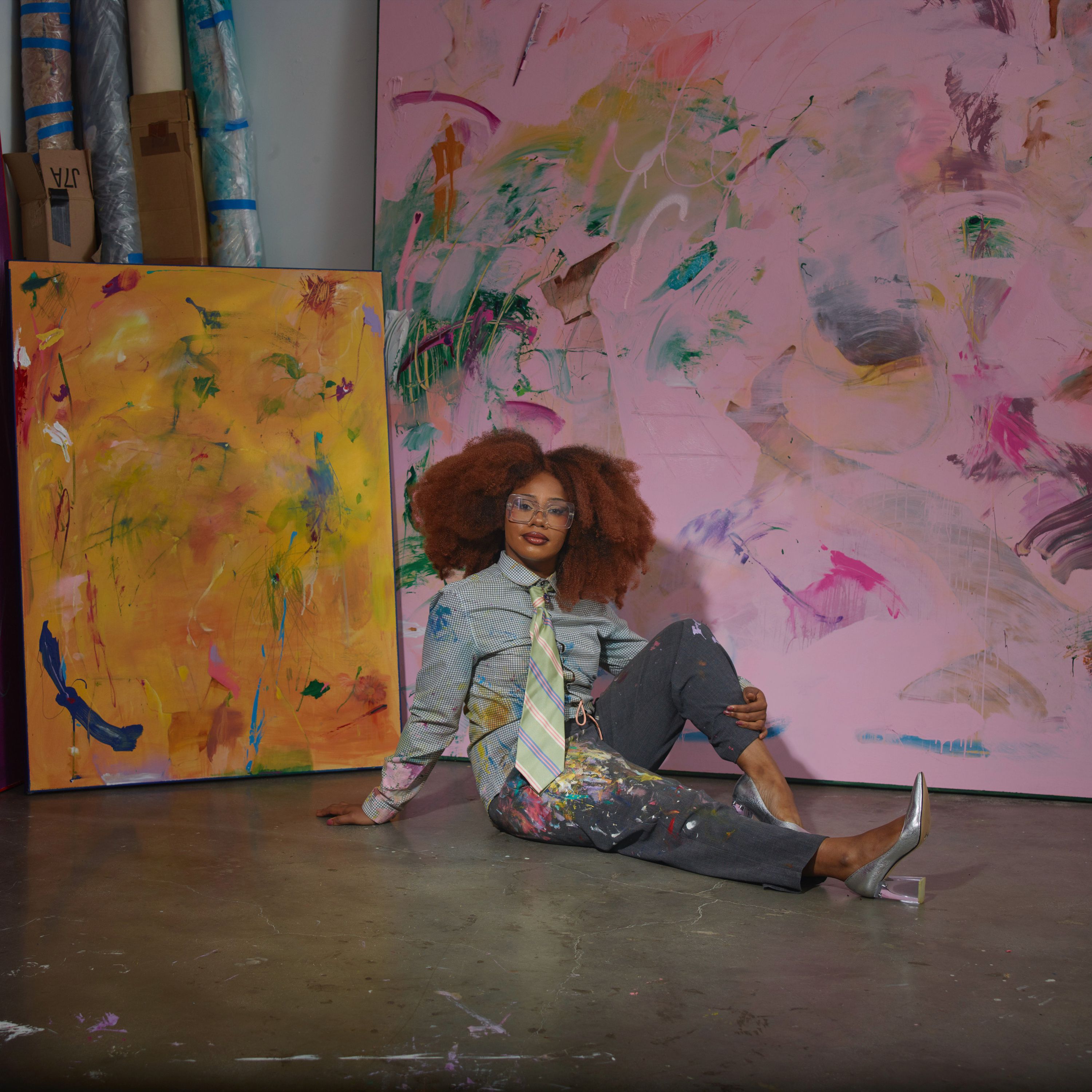
You're listening to all of it on wnyc. I'm David Fuerst in for Alison Stewart. The paintings of artist Kwame Azur Gomez don't just sit still. They move through a process of layering, erasing and reworking paint. Her canvases take shape as dense, immersive worlds where figures emerge and dissolve in flashes of motion. Her new exhibition, Set the Atmosphere, is on view at the Marianne Boesky Gallery. It is on display through Saturday, April 18th. And Kwame Azur Gomez joins us now to discuss. Welcome to all of it.
- [00:47]
B
Hi. Thank you for having me.
- [00:49]
A
This is your first solo exhibition at Marianne Boesky Gallery. Tell us about the name. Why did you choose that title, Set the Atmosphere.
- [00:58]
B
So Set the Atmosphere was the title of a song that my dance group that I was in for over 10 years in Ohio danced to. And the song is Set the Atmosphere by Kurt Carr and Kurt Carr Singers. It's a gospel song. And the group that I was in was a traveling liturgical praise worship group. So we traveled to many different churches and danced for at least like a decade of my life. And so recently I came across the video of us dancing when we were younger.
- [01:28]
A
And when would you say that was from?
- [01:30]
B
That was around, I want to say, 2012, 2013. So I was around like 12, 13 years old. And so when I recently came across it, it kind of stopped me in my tracks. I hadn't gone back and watched those videos in a really long time. And so watching the videos, something was just deeply moving about the people in the crowd, in the congregation getting up and falling out of their seats because usually they would just pan to the dancers. But this kind of gave us a zoom out of the entire church. And so something about that, that ritual, people getting up and being deeply moved reminded me of, like, the rituals of queer nightlife when I moved to Chicago for gradu at saic. And so I was deeply immersed in, like, the history of ballroom out there and queer nightlife. And so I got just taken to a different world. And so it reminded me of that movement in Gesture. So those two worlds mixed together is like the birthing of this exhibition.
- [02:26]
A
Fascinating. Does all of that movement and all of that ritual find its way into your work?
- [02:31]
B
Yeah, definitely. I'm definitely moving while I'm making the work. I would say towards the end of the day, creating a piece, I definitely start dancing. Like, that's the way that in my body, like, somatically, I know that I'm getting close to the end or that I know that A piece is going
- [02:45]
A
to be resolved when you're dancing.
- [02:47]
B
Yes.
- [02:49]
A
Interesting. We gotta get that video playing somewhere in the gallery space.
- [02:52]
B
Yeah, yeah. It's interesting because I also have experimental film work background, so I do a lot of editing and kind of pulling these, like, gospel songs and also just house music and the history of that in Chicago, like, pulling all those worlds together. So that's definitely on my radar.
- [03:10]
A
Well, we know you're dancing, but let's talk about the paintings. These are huge canvases.
- [03:14]
B
Huge.
- [03:16]
A
So this is an immersive experience with striking colors and such a feeling of movement. How do you do your work?
- [03:23]
B
So, for me, I have two primary ways of working. I have, like, an additive method and a subtractive method. And so depending on if the color palette is lighter, I would usually start with a wash of color, and then I would go in with, like, the figures. So some of the dancing figures that you see, that would be, like, the second layer. And then from there, I would go back on top with a completely different layer of paint, and I'll start wiping away, erasing, adding, wiping away again. And it's a process that's kind of like a give and take, and I start to reveal what I've uncovered. So in a way, I'm kind of finding truth in that aspect of painting.
- [03:58]
A
You have to peer at the canvas sometimes for a while, staring into this wild color to see something that's actually lurking in the back there somewhere.
- [04:06]
B
Yeah, yeah. It's definitely immersive process. And the end result, and for the second way that I work is I usually just layer, and then I'll just go on top. And so I'm like, adding. So there's, like. There's this almost like spiritual excavation that happens in the process of me working, but it's the end result of something deeply, like, cinematic.
- [04:25]
A
What effect do you hope these large paintings have on a viewer? What do you want someone to feel?
- [04:31]
B
I want someone to feel in touch with themselves. I feel like being confronted by large works of art. For me, that's the biggest way that I feel like I am able to come face to face with my own. Like, humanity is being confronted with something so large you realize, like, the scope of where you are in relation to the world. It's almost like thinking about being confronted by space and time. And one of the people at the gallery came for a studio visit, and we were talking about how there's this kind of, like, aura that feels like. Kind of like you're confronting a greater spirituality or like a godlike experience when you're standing in front of a large piece of art. And I always think about, you know, Octavia Butler and Parable of the Sower and the main character, Lauren. She's a young black girl who's very existential. She has all these different ideas about God and what that represents. And so in my work, I'm kind of confronting those things in, you know, confronting what's been kind of told to me growing up and finding my own, like, evolutions of spirituality.
- [05:34]
A
We're speaking with the artist Kwame Azur Gomez. The show is on display at the Marianne Boesky gallery through Saturday, April 18th. I wanted to ask you about one of the pieces, the inspiration behind one of the first pieces that you see walking into the show, Backwater Blue New Moon After Diane. In this piece, you get a glimpse of these objects inside the painting, whether it's an outline of a hand or the African continent or the number seven. How much of an emphasis do you place on these symbols in your work? Or are there recurring symbols that have meaning to you?
- [06:13]
B
Yeah, absolutely. That piece is in reference. There's two pieces in the show that being one of them in reference to both of my maternal and paternal grandmothers. And so that's dedicated to my paternal grandmother, Diane. And in thinking about that piece, I love Dinah Washington's song Backwater Blues. And thinking about kind of moving through the world with the melancholy but also the hope that many black women femmes kind of move through and thinking about that. I didn't know a lot about my grandmother. Her life was most. It was really a mystery to me, honestly, because I was so young. But I do remember the distinct memories of, like, these moments where she would just hold up a slice of Swiss cheese to the moon, to the full moon, and, like, these really, like, special, magical moments that kind of reminded me, like, we might not see all the phases of the moon, but we know it's there. And so there's a lot of numbers. And my family. My family plays like my parents specifically would play the number, like the lottery system. And so my dad would leave behind, like, all these pieces of paper lying around the house, like, with certain number sequences representing my grandmother's. And so that, for me, it's a way that I, like, spiritually encode my ancestors while also visually protecting them in the pieces.
- [07:27]
A
Fascinating. What role does color play in your work?
- [07:30]
B
It's like, I have a very synesthetic relationship to color. Like, I'm very specific about color, and so I can't even start a paper unless I know the exact color. Like, usually you'll come to me in a dream, which, more so recently, I've had a specific color that's kind of come to me that way, or I'll just be kind of thinking and thinking about the history of a color. And I had a piece with the gallery at Art Basel that was a color palette of my aunt's makeup and makeup tones on the cocoa of her skin and the blush. So it comes in so many different mundane, ritual ways.
- [08:03]
A
Well, whatever color you dream up, you better make sure you have access to a lot of it, because these are huge canvases.
- [08:09]
B
These are huge.
- [08:11]
A
I want to mention another one of the paintings. It's called lovers scene 2. Them their eyes on this one, you have to stare into this brilliant, bright red canvas, and then you can see these two figures walking together.
- [08:26]
B
Yeah.
- [08:27]
A
What stories are you interested in telling through your artwork?
- [08:30]
B
Yeah, I'm interested in the rituals that happen on the dance floor, but also what happens off the dance floor. And so what you're looking at is these two figures. They're two men. They're kind of sitting, dressed, they're walking away off the end of the canvas, but they're wearing, like, 1970s flair. And so there's something deeply beautiful about, like, finding a lover on the dance floor and then leaving and then going into, you know, continuing, you know, queer intimacy after, you know, outside of, like, the public gaze. So there's something about holding that special. Something holding that very special to your heart. So that piece is also titled after Billie Holiday's song Them, Their Eyes. It's very upbeat, it's flighty, it's. And I would see the song as red. Like, hot, passionate, like red. So that's, like. That piece kind of encompasses that.
- [09:15]
A
And it's fascinating work with a lot of layers, but you can just lose yourself in the color of it all and the scale of it all. And just on a practical level, as we have about a minute left, I shouldn't even do this, but I want to ask, what is a typical day like in your studio as you're approaching all of this work?
- [09:35]
B
Yeah, so usually I try to come in. I try to come in pretty early. The earliest, I think, leading up to the show was I would come in, like, 6am and I would paint most of the day, but I would take little breaks in between to read 6am 6am and on an off day, I usually come in, we'll say like, around 10 or 11, but I like the quietness of 6am and usually I'll come in. I'll work a little bit. I'll read poetry. I love Lucille Clifton, who's my favorite poet. And I'll kind of like, read the poems as I'm like, making as like in a way, like almost like a prescription. Like, what do I need for today? Like, what poem do I need to help me in the studio? Because I also write poetry and that's also like a family tradition as well.
- [10:19]
A
So, yeah, you can head to our instagram @olive NYC to see some of the images that we've been talking about all of this hour. Artist Kwame Azur Gomez. The new exhibition is called Set the Atmosphere. It is happening at the Marianne Boesky Gallery on display through April 18th. Thank you so much for being here today.
- [10:39]
B
Thank you for having me.
- [10:48]
C
Presents in the red corner, the undisputed, undefeated weed whacker guy, champion of hurling grass and pollen everywhere. And in the blue corner, the challenger, extra strength Pataday eye drops and work all day to prevent the release of histamines that cause itchy allergy eyes. And the winner by knockout is Patternay Patterday. Bring it on.
- [11:17]
A
Every day, WNYC Studios is working to get closer to New York and to New Yorkers. The underwriting we get from businesses helps power our independence. Learn how your organization can join in at sponsorship wnyc. Org.