Loading summary
Transcript53 lines
- [00:11]
A
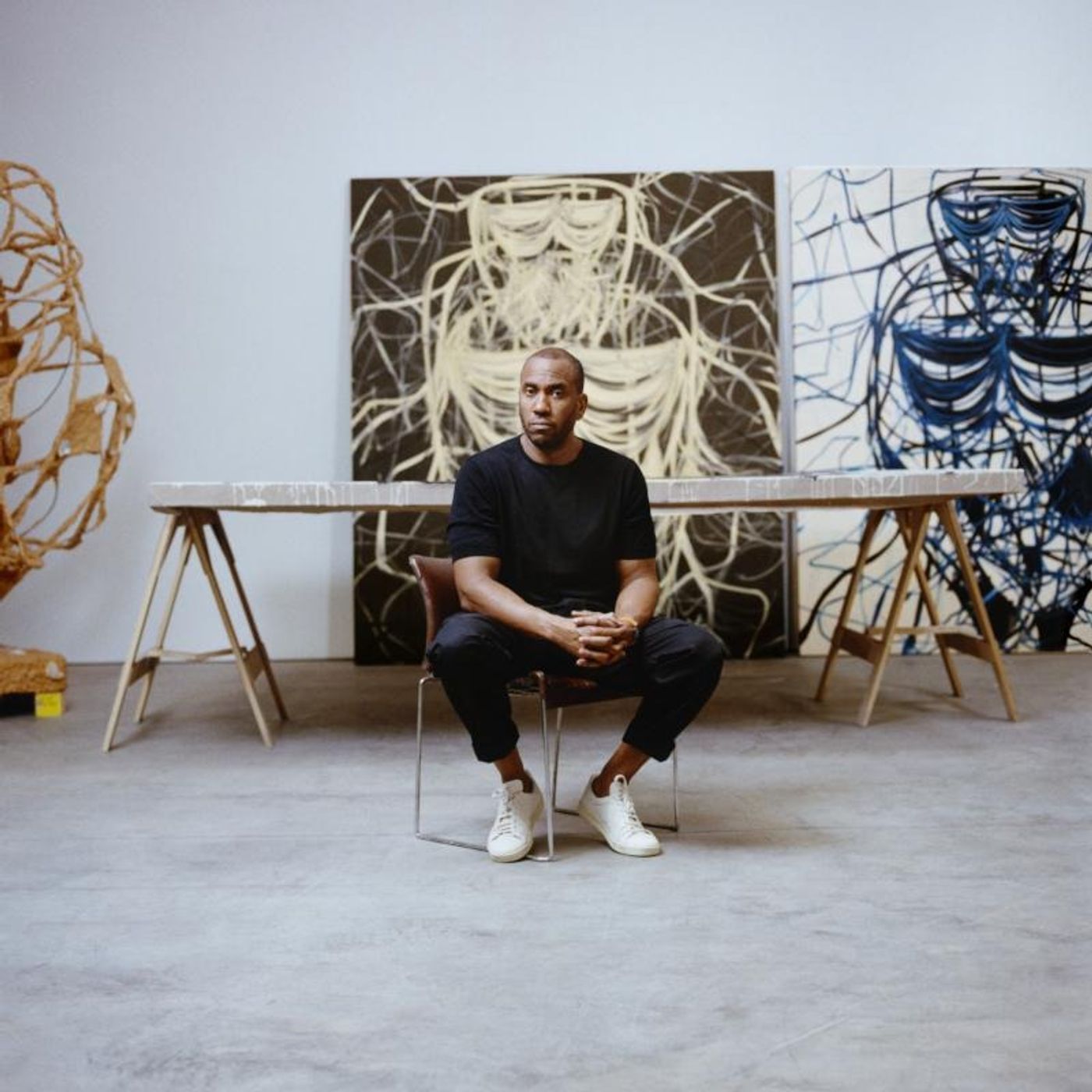
This is all of it on wnyc. I'm Alison Stewart. Rashid Johnson, a poem for deep Thinkers, which currently fills the entire rotunda of the Guggenheim, closes on Monday. It features work from as early as 1998, when Johnson photographed unhoused black men in his home city of Chicago for his Seeing in the Dark series. There are also more recent pieces like his soul painting series and even work that was newly created last year. The exhibition has also featured live performances curated by community partners like the Academy of American Poets and featuring celebrated artists like Mahogany Brown. There will be four more performances in the space throughout the weekend, and all are free with admission. In this show, you'll see more than 90 artworks of various mediums, painting, books, mosaic, photography, sculpture and film. And then there is a vibe that's happening at the Guggenheim. There are plants everywhere, even hanging from the ceiling. Artist Rashid Johnson joined me in April to discuss the show when it opened, along with Naomi Beckwith, Guggenheim deputy director and chief curator. Here's our conversation. So, Rashid, this is a mid career survey, and you told Harper's Bazaar the survey is a dangerous game for artists. What were you concerned about with this kind of survey? And then what were you really excited about?
- [01:39]
B
No, it's a great question I guess I was referencing when I was discussing. The danger of it is that it often can feel like a stopping point for an artist. There's this moment of reflection that's born of a mid career survey or something that people often refer to as a mid career retrospective, where you just are forced to, which is different than almost any other profession, to stop, put your pencils down and look at what you did when you were in your early 20s. And anyone who would be facing that kind of obstacle can imagine what it would look like to look at an earlier version of yourself or a less evolved version of yourself and then have that platformed kind of equally to some degree with your more evolved self to some. So that idea of that kind of equal footing, equal platforming of different versions of your evolution is complicated and in a lot of ways dangerous.
- [02:42]
A
How is it a concern for you as a curator when you're looking at an artist's mid career?
- [02:51]
C
Well, the first thing I would say is we were very careful to use the word survey, which is to say a retrospective implies an end. And we wanted to say this is not the end. This is really the midpoint. Rashid is young. God willing, he'll be around for quite some time. And I think part of my job as Rashid, she'd already alluded to was to allow him to be kind to the earlier self and really trust the person who had ideas. They may be, in your words, less evolved, but they were strong and they were speaking to something in the moment. And so for me, the concern was less about making sure everything stood up to each other in terms of strength, but also the question of how do we talk about what was happening during Rashid's life 20, 25 years ago? What was happening in the art world 20, 25 years ago, and how do cogent some of the things that the art was reacting to, and how do we make cogent some of the grains of ideas that were there during the younger days that are still here with Rashid's work in mind now, when you.
- [03:52]
A
Decided we're going to do this, we're going to make this survey, what was your first step?
- [03:59]
B
Well, the first step was really to start the process of looking back. And Naomi and I sat down and Naomi and I are lucky to have been friends for many, many years and have worked together for many, many years, several different exhibitions and different stages in our careers. So Naomi had the really kind of, I think, prescient and thoughtful idea that we should put a real emphasis on how the catalog functions, which allowed us to gather images, gather ideas, and gather different voices to illustrate through words some of the ideas that were really present in the work. So we really started with the idea of how do you make a great book? And from there we felt like the exhibition would evolve.
- [04:48]
A
As you said, you've been friends forever a while. When you first encountered Rachid's work, what struck you the most?
- [04:57]
C
Oh, that's a really interesting question, because I have to say, I think I don't remember so much the first time seeing Rashid's work. I remember meeting Rashid mostly for the first time, though. I know I'd seen the work already, but I think by the time we met it, his star was already ascending. So in many ways he was already becoming a mythical figure. And I almost hate to say it, but there was a little hateration already in the world. There was a sense that Rashid was gonna be this muy macho man, that once he opens the door, the studio, he was gonna answer the door basically topless, rubbing shea butter all over his chest.
- [05:34]
A
Right.
- [05:36]
C
I don't know if you knew this, this was circulating, but that was the reality of the rumors, that is. And I just remember our first studio visit being incredible, which had already followed from some amazing conversations where we'd already had, I think, a similar sensibility of how art could be functioning even in our 20s. I want to add one note, too, about the process. One thing Rashid and I did was decide to step aside, step apart, and make an ideal checklist. If there were works that you should think should be in the show, put it on the list. And then we compared the list, and they were almost identical. And I think that was already a very good sign about the process.
- [06:17]
B
Very true.
- [06:18]
A
Rasheed, how did you want to use the Rotunda?
- [06:21]
B
The Rotunda is a fascinating space and something that people, when you ask them their thoughts, will always tell you that it's incredibly complicated. And so they often approach it with this. This idea that there's this enormous obstacle born of Wright's vision for the building. Sometimes the ceilings are low. Everything in the building is crooked. You can see almost every angle of the building from almost every angle of the building. So inherently, it feels complicated. But the thing that I'm really attracted to in that building and in other spaces as well, is we've started the process of making the artist's job easy through these big white cubes. And it's not to blame the architects who have kind of flattened the earth for the artists, but it's not. And it doesn't have to be that easy. You know, sometimes artists are at their best when they're facing strange angles and decorative elements and things that seem inherently challenging. This building is not a building you want to approach with a tape measure. It's a building you want to approach kind of with a more soulful understanding of how you can occupy it and how your work kind of lives and sings in the space. And you have to really visit it. You have to be very present for it if you want to make an exhibition that I think is successful.
- [07:46]
A
What do you think Rashid's work works in the Rotunda?
- [07:49]
C
Well, I think first of all, it's because Rashid was so dedicated to dancing with the architecture. I mean, Rashid walked from his home downtown every Sunday to the building for almost two years and really looked at the space, felt the space with his body, watched how people occupied the space and looked their behavior through the building. And so that important, his kind of understanding that you really have to work with what the building offers rather than push against it. But the second thing is there's a real sensibility that both Frank Lloyd Wright and Rashid hold, which is they believe in life inside of architecture, life inside of structure. So, as you mentioned before already, Alison, there's just a beautiful hanging garden in the exhibition. And when Wright built the building, he said he always wanted living plants inside of the building. He always wanted to think about this entire building as a kind of terrarium, a place for vivacity.
- [08:50]
A
I'm speaking with Rasheed Johnson and Naomi Beckwith. We are talking about the new survey of Johnson's work at the Guggenheim. It's called Rachid Johnson, A Poem for Deep Thinkers. Before we even enter the museum, there's an outdoor sculpture called Black Steel in the Hour of chaos from 2008. Why did you want people to engage with that statue before they go inside the building?
- [09:15]
C
This is an interesting work, Black Steel in the Hour of Chaos, because it's one that pretty much sets the stage for, I think, how Rashid works as an artist, which is being able to interweave several references all at once. So for those people who will recognize the symbol visually, it's basically a target outside looks like the image you would see if you were looking through a gun scope. And many people see that and stop there. Really imagine the work is somehow a kind of gesture around a commentary on violence, or maybe even violence against African American men. But those who may recognize the title or even the visual object may also see that it's a reference to Public Enemy. So you have this layer of referencing hip hop, and hip hop itself is usually put together through a series of interwoven references. And the second level reference, of course, is that Chuck D, the founder of Public Enemy, was a graphic designer and having done many books now. And for those who work in publishing, they may recognize, if you look at the proofs, on the edges are trim lines. And the symbol where you should trim is that target. So there's then the second level of reference to sort of printing culture, visual culture. And then, of course, lastly, if you, like me, are an art nerd, generally your first reference in thinking about a target is Jasper Johns. So thinking through so many layers of referential points is, I think, the gift of Rashid's work. And I wanted people to take that with them as they walked through the building.
- [10:51]
A
You brought up music. I'm going in there. There's Al Green, there's Public Enemy, there's Tribe Funkadelic, George Clinton. How is music a part of your practice? How is it a part of your, well, part of your life?
- [11:07]
B
Music is such an enormous part of my life. And it's really kind of the background of everything that I've ever done to reference, again, the sculpture that's in the front of the museum, which is a reference to the song Black Seal in the Hour of Chaos. You know, the first time I heard Public Enemy, I was with my brother, and we were driving down the street and he had just gotten his driver's license. My brother's, you know, many years older than me. He had just got his driver's license and he was playing Public Enemy. And I asked him, what is this? Because it was just so. It had just so blown my mind. And he said, public interview. But what I heard. Public interview. What I heard was public interview. And I thought, oh, my God, public interviews are incredible. You know, I thought these.
- [11:52]
A
This is public radio.
- [11:53]
C
It's awesome.
- [11:54]
B
Yes, it's amazing to be here today and I'm gonna start my rap career. No, I won't. But that idea that music can become an anthem for how you live and is not necessarily only the background of your experience, but also kind of foregrounds your experience and leads you down different pathways. I mean, hip hop, in a lot of ways led me to jazz, and in some ways jazz led me to rhythm and blues. And then some of that led me to some of the kind of critical engagement that happens in my work. Louis Armstrong led me to some of the Negritude poets, led me to some kind of post colonial African writers and thinkers like Ame Cesaire and a number of other things. So it's just amazing how kind of interwoven it is to the fabric of our lives and experience and is really the kind of illustrative soundtrack for my life and my story.
- [12:54]
A
The title of the show, A Poem for Deep Thinkers, I believe it's Amiri Baraka.
- [12:58]
B
Yes, it is.
- [13:01]
A
Why was a poem by Amiri Baraka meaningful to you?
- [13:05]
B
Baraka is someone I've thought about for many years, and he's someone that even my mother would read poems by to me when I was a young boy. In particular, a book called the Dead Lecturer. And Miri Baraka is just a fascinating man through the transitions that he experienced in his life. I mean, going from Leroy Jones previously to Amiri Baraka, I often joke that Leroy Jones will never die because there's never going to be a gravestone or an obituary for Leroy Jones. So this idea of kind of transition and growth and development and radical change and transgressive radical change and what that looks like and what that feels like. And so Naomi and I, in looking at the work and thinking about what the exhibition did and what its ambitions were, kind of recognized that this particular poem, A Poem for Deep Thinkers, kind of captures the two ness of my project. So, one being the idea of poetry and the symbol of poetry and the surreal kind of nature of poetry. And the fluidity that we often associate with it, but also the idea of making a space for deep thinkers and a space for contemplation. And so my work oftentimes kind of navigates that two ness, that space of the ethereal or the aesthetic or the beautiful or the complicated. But at the same time, ideally, it makes space for you to kind of think critically and to have things to unpack and explore throughout the process.
- [14:36]
A
I'm speaking with artists Rashid Johnson and Naomi Beckwith, Guggenheim Deputy director and chief curator. We're talking about the new survey of Johnson's work that is at the Guggenheim right now. Rasheed Johnson, A Poem for Deep Thinkers. Okay, so we go in the lobby and there is a piece of work, Naomi, which is a new piece that was made this year. It's huge. It's a mosaic, titled Untitled. Describe this for us a little bit.
- [15:03]
C
Yes. So as you mentioned, Alison, it is a mosaic, which is to say that it's a large scale work that is almost wall sized, and it's bigger than most people's living rooms. And it is broken shards of ceramic tiles that come together in the pattern of three figures. I read them as female, three sort of figures outlined and floating in a kind of cornucopia of color and scintillating light and glass and mirror frames. This is a kind of extension of Rashid's spirit series. Spirit or soul? Soul series, pardon me. Which is to say these figures look as though they're floating in space. They are disembodied, yet at the same time very present. And I like to think of this work, Untitled, as almost a survey in and of itself. It has so many references that one will see throughout the exhibition. It has the material references, tile and ceramics. The humble bathroom tile is a frequent reference for Rashid. It has glass, especially sort of shards of broken glass. And the mirror is a common reference for Rashid. There are bits of wood, there's bits of bronze. So the kind of material mix that happens in this work is really important. Oyster shells are another things that show up. But it also has the gestures that Rashid often uses. Gestures and symbols like the wispy figure when he's drawing. The soul figure it has in the sort of chest area, which is why I read them as female. They are these boat forms that you'll see later on in the exhibition. There is a beautiful almond shape symbol that is a common reference point for Rashid as well. It is the shape where that is made by two intersecting circles. If you think of the center of a Venn diagram and it's called the vesicapissis, the bladder of the fish. It is a symbol that sort of arose in the Byzantine era and it was a symbol of the divine. It's a symbol that Rashid has used often, but really appears in the God paintings later in the exhibition. So you can almost go to this work, Untitled, at the bottom of the exhibition and kind of start picking out elements that you know, you can name later on, all the way up to the very top of the rotunda.
- [17:26]
A
It's interesting. In the first gallery, off of the rotunda, there's like a little. It's like a tangent, a little sidebar. What are you trying to do in that first gallery? I was curious because there's so many different kinds of artwork in this one area.
- [17:38]
C
Yes, it's a show within a show in many ways, and almost a Whitman sampler. So like Untitled on the bottom floor, it's also a way to kind of walk through these gestures and materials that Rashid has used. There is his early work, Spray Paint, which is a great mix of that kind of hip hop culture meets painting practice and text work. There is a large scale work on bathroom tiles, the Anxious Audience, which also holds another popular symbol for Rashid, these sort of cartoonish figures called the Anxious Men. Those are made with black wax and soap. So again, there's a sample of another material that's very important to Rashid. Black soap, along with shea butter, have been sort of constant in the practice. Big bronze work, large scale bronze work that look really modeled and handled and pushed against with Rashi's Hands are there. And in that sampler, we also wanted to think about maybe this theme of transcendence, of change, of moving into a more spiritual realm. The very first work that you see, even before you go into that gallery, is a work called Me at the Grave of Jack Johnson, which is a little bit of a snide, you know, joke and a bit of a performance. But it also already shows Rashid thinking about legacy, the afterlife, the stories that are still with us even when people are not.
- [19:03]
A
The written word has an element in your sculpture. On different sculptures, I see different books. I see books by Frantz Fanon and Gwendolyn Brooks and Paul Beatty on all different sculptures. What is your relationship to the written word and its relationship to the visual arts?
- [19:22]
B
Yeah, I mean the written. I come from a family of academics. My mother was a professor when I was growing up of African and African American history, with a kind of emphasis on post colonial feminist theory in West Africa specifically. So I grew up in a space With a lot of books, to be honest, My mother's library and the kind of ambition that it served was. Was a real influence for me, Hurley. And it's an interesting thing because early on in the process of coming across books, whether they were kind of academic or literary in nature, they were more objects to me than anything else. They were kind of signs and signifiers because I couldn't unpack the content, you know, at a young age. I'm 5, 6, 7, kind of surrounded by these walls of objects. And so I would often cut of pick them up and I'd feel their weight and I'd look at their titles. And of course, I wasn't reading Harold the Crisis of the Negro Intellectual when I was seven, but the idea that I would maybe be asked to acquire what was in that text at another time and kind of preparing myself at a really early stage to navigate these kind of bold objects and looking at their covers and looking at their kind of weight and pres. As I got older, I became, you know, really a really, you know, a big reader and someone who continues to kind of pour through text, literary and critical. And I still have a real investment in philosophy. So, you know, what. And how the content has informed me is continued to push my work forward.
- [21:11]
A
What's one of those books that you tell people that they should read now?
- [21:14]
B
If you're reading something now and you want something really contemporary. Danzy Senna, Color Television.
- [21:22]
A
It's so good.
- [21:22]
B
It's incredible as a great book. Yeah, Danzi's brilliant. And that work and its relationship to a certain version of satire is unbelievable. But it also really unpacks space to think about kind of race and a certain, you know, time in a woman's life in ways that I think very few books have made space for, because within the space of mixed race ness, I think we get to unpack kind of some of the complications of how color functions and how we transition into certain identifying characteristics and the weight and gravity that we place on certain themes and ways of seeing.
- [22:08]
A
That's such a good book. I'm sorry, I interrupted you. You're going to say something else?
- [22:11]
C
No, I was going to say I wasn't going to add a book to that. But I also wanted to talk about this one work in exhibition called the Reader, which is. It's funny because I always assumed that that book was a quotation of a 19th century painting by Mary Cassatt, the American artist who went to France. And she has a great image of a young woman in a white dress reading a Book just called the Reader. And here is Rashid in a white robe in a garden. Already. The garden's a motif in your work.
- [22:42]
B
In France, by the way.
- [22:43]
C
In France, reading a book. And the work is called the Reader. And he didn't know the Mary Cassatt work, which is incredible. So that's a wonderful thing also about doing exhibitions. It not only allows you to look at your work, but it allows you to rethink even your relationship to historic forms and these precedents that come before you, you are in conversation with without even being aware.
- [23:05]
A
I'm sort of curious what's gonna happen on the stage?
- [23:08]
C
Ew. What's not gonna happen on the stage?
- [23:10]
A
This is gonna be up for a while, but. But back to that idea. There's a vibe that is. With the exhibition. There's going to be different performances. Tell us what's happening on the stage.
- [23:20]
C
Yeah. It was really important for us to not only think about this exhibition as merely a survey of Rasheed Johnson's work, but there were a few things that we wanted to accomplish besides the book. One thing that Rashid does so well in his work is make platforms for other people. So Rashid literally built a stage in the exhibition. Inside the garden, there is also a piano where people can perform. And the stage is a space that can be used as part of our poetry program. We have had an ongoing one at the Guggenheim for quite some time. It is a space that can be a didactic one. So we're inviting people even to hold classes, seminars there. But one of the things that's most important, and I would love to hear your thoughts about this, Rasheed, is that we really wanted the show to be a place for young people, that we want to see teenagers, youth in the space. And so we did an incredible series of partnerships with organizations around the city. We were working with the Poet Laureate of the. Of New York. We're working with the Poet laureate of the U.S. inviting young people to bring their friends and their programming to the stage. And they. The teams will have the stage on Tuesdays.
- [24:33]
A
Did you want to add to that?
- [24:35]
B
No. This is a. An aspect of the exhibition that I'm incredibly proud of, and I'm proud of the museum for its commitment to what it is I kind of initially brought, which was an enthusiasm for seeing younger folks come into institutions. The place that I first fell in love with something outside of my family was at a museum. So although I recognize that museums over time have in some ways created obstacles to bringing in more diverse audiences and have faced challenges in how they can really create outreach to communities that are more diverse. This museum, on this particular occasion, has recognized the opportunity that it has with an exhibition like mine. And the opportunity that's born of it is to bring in younger folks who then can maybe fall in with love. Love not dissimilarly from how I fell in love in an institution at an. At an earlier stage. So this is something that I think is just really exciting and can be really fun. I'm not doing any of the programming. What I do is I kind of set the stage, I really kind of platform the space, and then we make this great invitation. Because oftentimes it's not enough to just open the doors of these spaces and expect people to come in. You have to really make an invitation. And we see this as a real invitation.
- [26:00]
A
If you would like people to spend an extra minute or two in front of any piece in the show, what is it today, you might change. It might be a different show piece.
- [26:09]
B
Tomorrow, but today, that is a very, very difficult question. If I were thinking about one work in particular that you can kind of go to and that could synthesize the exhibition, I could not answer it because my project is very, very much kind of this index. It's an index of everything that I've done. And I feel like if you just read one work, then you're just reading one chapter. And that's what an exhibition like this gives me the opportunity to do, is to highlight the wholeness of my vision. And. And if you see one work, I think you have to see a second. And one of the things that I'm really hoping to do, and I know it's ambitious in some ways absurd, is to invite people to come not once to the exhibition, but to come twice. Like, give me two days. Give me two days. That's where my ambition follows, is that I want not one afternoon, I want two afternoons. And if you give me that, I think that the exhibition can be really rewarding for the viewer.
- [27:18]
A
I'm not giving up. Tell me a piece in the show that you enjoyed making.
- [27:23]
B
That's. That's a different question. Joy is. Is complicated, but I will say at the top of the rotunda. So this forces you to ideally walk the entire exhibition. One of the last. One of the last works in the. In the exhibition is a film that I made called Sanguine. And that film consists of myself, my father and my son performing different acts of care and spending time together. And what it really symbolizes, partially for me, is this opportunity at this time in my life. Where I'm both a father to a son and the son to a father. And so that liminal space, that space in the middle where I'm, you know, actively caring for and teaching, but continuing to be taught and cared for by my own father, and thinking about how that transition functions, that one day I will probably pivot to being the caretaker for my father, more so, and that my son will pivot to being the caretaker for me. And so that sense of kind of transition, that sense of recognizing a time in one's life is really at the center of where my project is right now. And that film is a great illustrator.
- [28:35]
A
Of that was my conversation with artist Rashid Johnson and Guggenheim Deputy Director and Chief Curator Naomi Beckwith. Rashid Johnson, A Poem for Deep Thinkers closes on Monday.
- [28:47]
B
The new year brings new health goals and wealth goals. Protecting your identity is an important step. Your info is in endless places that could expose you to identity theft leading to lost funds. LifeLock monitors millions of data points per second. If your identity is stolen, our restoration specialists will fix your exit guaranteed or your money back. Resolve to make identity, health and wealth part of your New year's goals. With LifeLock, save up to 40% your first year. Visit LifeLock.com Special offer terms apply NYC.
- [29:18]
A
Now delivers breaking news, top headlines and in depth coverage from WNYC and Gothamist every morning, midday and evening. By sponsoring our programming, you'll reach a community of passionate listeners in an uncluttered audio experience. Visit sponsorship.wnyc.org to learn more.