Loading summary
Transcript101 lines
- [00:03]
A
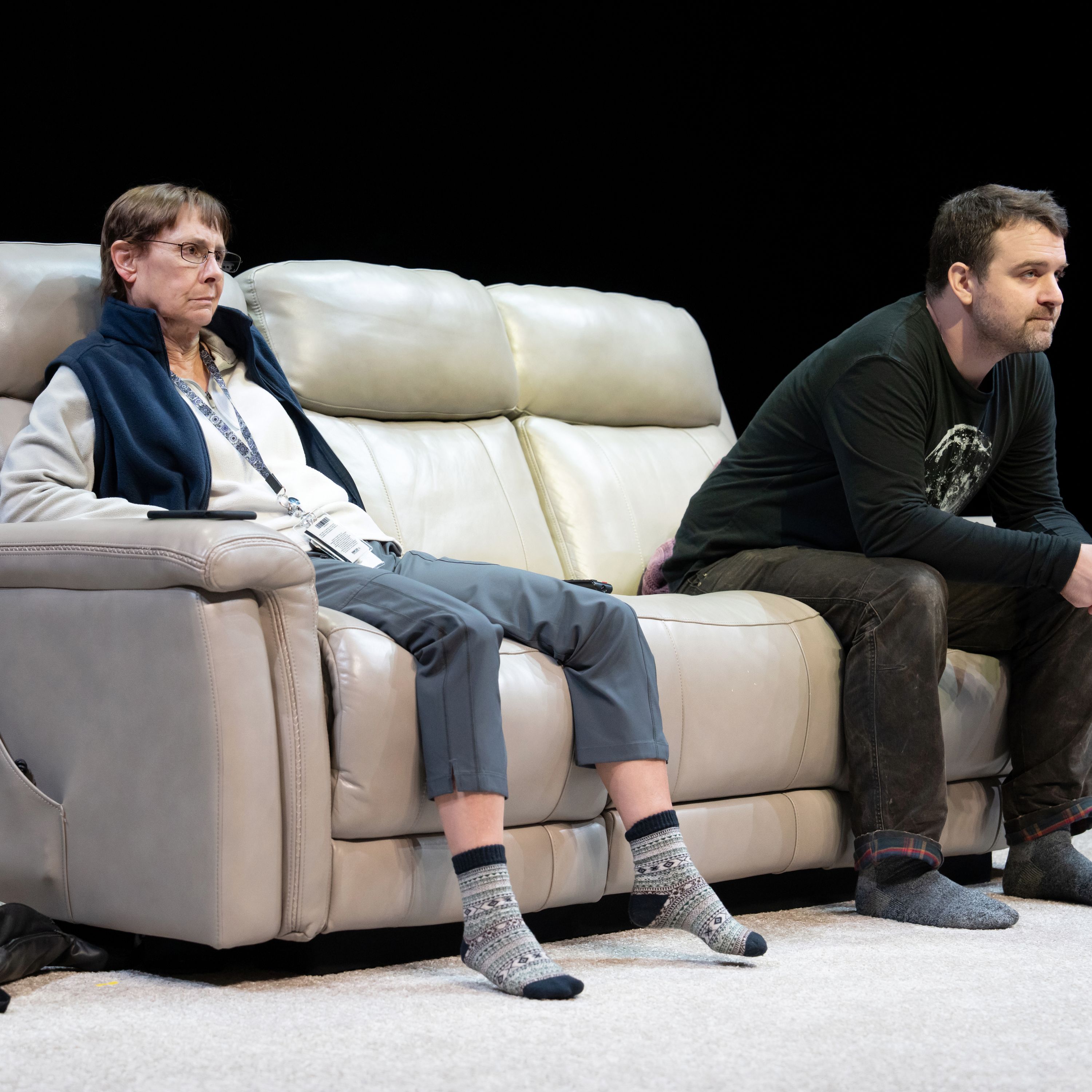
Okay, here we go. This is all of it on wnyc. I'm Alison Stewart. In the play Little Bear Ridge Road, Sarah, a nurse, lives by herself in a small town in Idaho and likes just fine. Her daily life is disrupted by her estranged nephew Ethan, who shows up to settle his father's estate, who was left with, oops, you can't hear me.
- [00:31]
B
I can hear you in the room, but not through here.
- [00:34]
A
Okay, we'll work on that in a second. Her daily life is disrupted by her estranged nephew Ethan, who shows up to settle his father's estate. Sarah has a few ideas about how to handle her brother's house, but Ethan, he's not really having it. He wants to get it all settled and headed to. Well, he's not exactly sure. The pair discovers so much about each other over two years. One because of COVID and two, because of a trust that builds between them. But it takes a lot to get there. The New Yorker called Laurie Metcalfe's work as Sarah stunning. Her co star, Micah Stock, has been described as a revelation. And the play by Samuel D. Hunter has been called a jewel, and it is his Broadway debut. Little Bear Ridge Road is playing now at the Booth Theater until February 15th. We are very happy to have Laurie, Micah, and Sam in studio with us. All right, can everybody hear me?
- [01:25]
B
Yes.
- [01:26]
A
Okay. You can hear me. Okay. I'm so glad. It's nice to speak to you, Laurie. Can you use your imagination? What is Sarah doing, let's say, a week before Ethan shows up at her house in remote Idaho? What's she up to?
- [01:39]
B
Well, she's definitely cleaning. She's a, you know, a clean nut. And she is fighting with her bosses about how many shifts she's going to get that week at the hospital. And she's watching a lot of tv.
- [01:56]
A
And that's her life.
- [01:57]
B
Yes.
- [01:58]
A
So what's Micah doing before he. A week before he shows up?
- [02:02]
C
Oh, Ethan. Ethan.
- [02:03]
A
Ethan.
- [02:03]
C
I'm sorry, Ethan. No, no, that's okay. He is, you know, making his way slowly back home to deal with the mess that his family left him and sleeping in his car, crashed on couches, which is very difficult given that the pandemic has just begun.
- [02:21]
A
Sam, a lot has happened between these two people, Sarah and Ethan. As a writer, how did you decide what to signal to us, what's been going on with them and when to signal it?
- [02:34]
D
I think, you know, that's. That's kind of the work of developing a script is sort of like managing exposition. And I think when I write a first Draft. I try not to think about that too much because I just want to focus on the characters in the situation and then you can kind of diagnose later on, really like when I wrote this, because I wrote this play specifically for Laurie. Laurie and the director, Joe Mantello approached me maybe two years ago, a little less than two years ago, about writing a play for them, which I happily signed on to. So really it was just the work of. It was having Laurie in my head for four months while I was writing it, which was a pretty great voice to have in my head.
- [03:09]
A
Laurie, what does Sarah think when Ethan shows up?
- [03:15]
B
I think she's had a little bit of notice that he's on his way, he's going to come. She's very surprised at what he looks like. They haven't seen each other for years and years. She's a bit put out because she doesn't have a lot of people over. She's sort of allergic to people now and has moved as far away from everybody as she can but still be able to commute to the grocery store and into work at the hospital. And so. But she did not expect to have to host him. He is there to pick up something that she has and some paperwork. But it turns out, you know, that the ties that they have as aunt and nephew and because we are entering the pandemic stages at the top of the play make it, you know, pretty. It's a given now that he's going to have to stay at her place for a while in the pull out in the spare bedroom.
- [04:17]
A
How's she feeling about having this person in her space?
- [04:19]
B
Not too good. She doesn't like to. She hasn't shared her space in a long, long time. We just get a little hint of, you know, of a past relationship that she had. We don't know how it ended or what she really felt about the way it ended. And so, yeah, she's not. She's very set in her way. Not too happy about sharing her space.
- [04:42]
A
Does Ethan want to be at his aunt's house?
- [04:45]
C
I think it's the last thing he would have hoped for when he walks in the door, you know, it's a little bit like it would be hard enough, you know, that life is going awry and you have to go back and crash on your parents couch. But one, he doesn't have a parent's couch to crash on. And two, this is a person who he is allergic to. In his mind. She never showed up for him, never saved him, never did anything for him. And so the fact that he has to lean on her in any regard is just disgusting.
- [05:22]
A
Sam, how would you describe when they meet? Is it a reuniting? Are they there for family business? Is it just an exchange of paperwork?
- [05:32]
D
Yeah, I think it's a very technical start. I mean, I really like Micah's character, I think expects to spend maybe all of two, three minutes in here. I mean, there's just too much awful shared history between the two of them. And I think that, you know, his father, her brother, dies right before the play starts, and he was a deeply complicated man. And Ethan grew up in a deeply toxic household. And I think any reminder of that is. Is just awful. So the entire house is radioactive, I think, from the start.
- [06:09]
A
It's so interesting writing about an aunt and her nephew. Yeah, you know, that's not. You don't hear that pairing very often. Why did you want to write about that?
- [06:17]
D
Well, you know, what's interesting is. So the play is organized into three parts. It's set pretty much during the course of the pandemic. It's not about the pandemic in any way, but it's set during. No, no. It's really just like a reason for them to isolate together. But when I wrote part one, which is at the very beginning of the pandemic, the first version that I wrote was a mother, a son. And I wrote it, and I remember thinking something was off about it, and I showed it to my husband John, who is a dramaturg and who I work with on every play, and we both kind of agreed, like, it's not working. And what I immediately thought was, like, oh, these characters are overly familiar with one another. And so there's really not. Yeah, there's really not. If you think about it, like, if they share that much history, there's not a lot of new stuff. And especially this is a play about these people isolating and watching television. So, like, I need them to be able to discover things about one another. And what's interesting about an aunt and a nephew is there's not a lot of preconceptions that people have about that relationship that can be very close or almost nothing. So there's a lot of, like, dramatic juice there.
- [07:21]
B
I think there's also, like, it could be vaguely parental or not. It could be peer like or not. Yeah, it's wide open.
- [07:32]
D
Wide open, yeah. Yeah. And I think the play plays with that openness throughout, and we kind of learn that Ethan's character could have used some parenting in the past and didn't get it?
- [07:46]
A
Why did you name him Sarah and Ethan?
- [07:48]
D
Oh, it's funny, I assign no meaning to my. To my character name sometimes when I write, when I read a play and it feels like the character's name is a metaphor, I get annoyed. So I just felt like they're really inert names.
- [08:01]
A
We're talking about the play Little Bear Ridge Road playing at the Booth Theater. It's an about an estranged aunt and nephew living together in rural Idaho and how they help each other after reconciling the past. My guests are Sam Hunter, the playwright, and actors Laurie Metcalfe and Micah Stock. So it becomes clear that after this first time they meet that Ethan doesn't have a place to stay. Right. Or does he think he has a place to stay?
- [08:29]
C
No, he walks in the door thinking that he's gonna sleep in his car, which I imagine he's been doing for a while. He recently went through a pretty horrible breakup, which was horrible timing, given the pandemic. And I do sort of imagine that he is, you know, for a while. I think there used to be a line in the play about, you know, leaning on friends or acquaintances of which he has very few.
- [08:52]
D
Oh, yeah.
- [08:55]
C
So it really does become necessity. Cause also he has no cash. He has nothing coming in and nothing going out. So when she offers him, reluctantly, a place to stay because it's freezing at night, he knows he has to take it. And I don't think he imagines that he is going to be there for as long as he is. I think he thinks, oh, you know, I'll come, I'll deal with my dad's estate, and then I'll take off again and I never have to see her again. But obviously it happens very differently.
- [09:26]
A
Sarah, do you think. Sarah. Laurie, do you think that there's any love between these two characters at the beginning of the play?
- [09:34]
D
Hmm, that's a good question.
- [09:36]
B
Yeah. No, not in the way that I would think of love. But they have a shared history. They are blood related, but it's a troubled past that I think they've both stuck in the closet and walked away from. And now just even seeing each other is triggering to both of them. So. Yeah, no love lost there. No.
- [10:14]
A
No.
- [10:14]
C
I think for Ethan too, especially, he has considered her a religious fanatic monster in his mind, partially as a way of defending himself from his childhood and trying to better than where he came from. And he's sort of constantly shocked by her own intellect and the fact that she might have cared.
- [10:35]
A
She has the greatest line about him being Gay. It's the most interesting thing about. I think that's what you say. He's the most interesting thing about you. And I like that because it sort of took sort of a level off of this, off of the script. It's like, this is not gonna be about politics. This is about these two people.
- [10:56]
D
Yeah, exactly.
- [10:57]
A
Right?
- [10:57]
D
Ye. Yeah. Yeah. Cause I think. I mean, anybody familiar with my work knows that religion has been a frequent topic that I go back to. I attended a fundamentalist Christian school when I was a kid. But, no, this play is decidedly irreligious. As she states in the first scene, I'm an atheist.
- [11:14]
A
I want to talk about that big couch.
- [11:17]
B
Oh, I love that couch on the set.
- [11:19]
A
It's this giant couch. It's on sort of a tilt, but behind. It's like a really rough couch, hewn wall behind it. Laurie, what does a minimal set do for you as an actor? How does it help you creatively?
- [11:34]
B
It was very interesting. This is called a couch and a void. Is that what you wrote on the title page? Couch and avoid? And that's. That's what you get. And I think it is absolutely a gorgeous set in its sparseness, and it looks like it's surrounded by black, and it's just floating there on this disc that is sort of planet like, you know, because the. The night sky plays kind of part in the play. But I. Because we're on a disc and we only have the couch, I thought, oh, this might be problematic in the rehearsal room, but as soon as we stepped on it, I said, this feels so comfortable. I don't know. It feels cozy. It feels. I love that with minimal things that the couch does, we're transported to different environment. I like that. It's. The audience can use their imagination to fill in where we are. And I think the couch actually went through some auditions, didn't it?
- [12:38]
C
Yeah, it was an intense audition process.
- [12:40]
B
Tell me more.
- [12:41]
C
You and I both read opposite the couch.
- [12:44]
B
This is the couch that won the part because she. I guess she is. Has some surprises.
- [12:54]
A
That's one of my notes. Does the couch. Is it considered an actor in the show?
- [12:59]
D
I think it's a character. Definitely.
- [13:01]
B
It is a character. Yeah. It tells a story. It has just as an important role in telling, as putting the story forth, as all of us do.
- [13:15]
A
How about for you, Micah? What does the couch do for you as an actor?
- [13:19]
C
You know, in rehearsals, it became this thing because initially the sparseness was terrifying. Right. Actors, we love to hide behind furniture and, you know, find things to mess With. And it was astonishing what depth of play there was just in one piece of furniture. And you see as the play goes, I mean, there's a real transformation. It becomes almost a dance that we get to do with it. It spins, it flips, it, you know, it transforms like a transformer. And so there was an immense amount of joy in discovering what exactly it could do. Occasionally I accidentally hit the massage button.
- [13:57]
D
I didn't know there was a massage button.
- [13:59]
C
There's a massage button on the couch and I have a couple times sat on it and had vibrations during the show.
- [14:09]
A
How about the wall behind them? What does that signify?
- [14:12]
D
Oh, it's so beautiful. I mean, I think that's the void that I. That I, you know, like, like Laurie said, the setting of the play just says the couch, no void. And I think Scott Pask, our amazing set designer, just took that and just ran with it in such a beautifully simple. Isn't the right word just elegant. Beautifully elegant way. And that back wall of the sort of. I mean, it's wood, I assume, this sort of like rough human wood. And when it lights up, I mean, it's like the core tension of the play is like these two tiny lives in the vastness of the universe. And when that back wall comes up, it's just like it's. The universe shows up.
- [14:47]
C
It's a credit to Heather Gilbert, our lighting designer, too, the way that she uses the texture of that wood to change the space.
- [14:55]
A
We're talking about Little Bear Ridge Road. We'll have more after a quick break. This is all of. You're listening to all of it on wnyc. I'm Alison Stewart. We're talking about the play Little Bear Ridge Road. It's playing now at the Booth Theater. It's about an estranged aunt and nephew living together in rural Idaho and how they help each other out after reconciling the past. My guests are playwright Sam Hunter and actors Laurie Metcalfe and Micah Stock. So the play takes, appear, takes. It goes over about a two or three year period. Right. Laurie, what changes the most for Sarah? Is it that she now loves Ethan or feels responsible for Ethan? What do you think changes the most in her?
- [15:51]
B
I think they do build a relationship. I think both of them grow in ways individually and start to try to come together a little bit. But don't make so the growth between them is, I think, more individual. And I think you're rooting for them to find a path towards each other. It's very tender the way it's left off at the end and probably not what was expected, but I think they both finally are able to hear each other and at least understand this riff, this horrible rift that they had when Ethan was growing up and try to explain to each other, try to explain themselves to each other. And at least they, they. It's. They bring it out in the open after all these years.
- [17:00]
A
What changes the most for Ethan? Micah.
- [17:04]
C
I think it's a little bit like fostering a dog. Right. For a while. Because they've never learned to feed, care, love another person within their family. And as much as they change, it's also inescapable. And they can't stay together because they won't be able to grow beyond that. There's too much bile and too much old blood that I don't think will ever go away, though it is remedied slightly. And I think that they do make each other better for a time.
- [17:44]
A
It was sort of interesting, the years you pick, Sam. The sort of like it's during the pandemic and then it goes through and sort of the other side of the pandemic. So the hangover.
- [17:53]
D
Yeah, that's right.
- [17:54]
A
Of the pandemic. And it sort of leaves Ethan sort of stuck. Yeah, the pandemic behavior. Why is it okay with Ethan to stay in Idaho and watch TV with his aunt two years later?
- [18:09]
D
I mean, I think very slowly through the course of the play, Sarah's house transforms from being that radioactive place that I described when he walks in there to being a place where he feels safe. And I mean, these are two deeply unsentimental characters. And so like, you know, there's no tearful forgiving and hugs and I loves yous. But I think they both save one another in very small ways. I think, like if a full on redemption is a mile, Ethan goes 20ft. Do you know what I mean? Like, it's. It's. Which to me is real life. It's inching forward. It's not leaps and bounds.
- [18:52]
A
There is great humor in this play. They're big laughs. Laurie, what is a line that just makes you laugh in the play?
- [19:02]
B
It won't make any sense out of context, but one of my favorite lines is, I'm gonna check on that band saw.
- [19:11]
A
It's funny any way you say it. No.
- [19:14]
D
Which is not a laugh line.
- [19:15]
C
Funny the way Laurie says.
- [19:16]
D
Yeah, that's the thing. There are like.
- [19:19]
B
Here's another line that wasn't supposed to be a laugh line either. Do you want some coffee? It's already made. Oh, yeah, that one Gets a bit of a spin that, you know, you wouldn't expect to get a laugh out of.
- [19:30]
A
But what happens when you get a surprise from the audience? Like, they either laugh at something or something that's supposed to be outlined. You're supposed to, you know, land it, and it doesn't hit.
- [19:42]
B
I'm trying to think back on when we first put it on its feet, you know, to see. Because that is the real testing ground is when you finally. You do what you can in the rehearsal room, and then you. But you have to put it in front of an audience and test it out. And so I'm trying to remember if there were surprises of. I think that everything that we found hysterical in the rehearsal room transferred to the audience. I think they get it, too. But it's with the subject matter that we've been talking about so far, you wouldn't expect this many laughs in the play. But they're all the way through. I mean, they're to the very end.
- [20:23]
A
Yeah.
- [20:23]
D
Yeah, it was. You know, one of my favorite things about Laurie is her ability to have humor and tragedy right next to each other. I think I've always been interested as writer, but that's why I think Laurie and I are, you know, are in kind of lockstep together with this play that, like, you know, there'd be, like, a big laugh line in the play, and then three lines later, one of the darker moments of the play would come out of there. And I think. I think, like, I love that kind of whiplash effect. And Laurie navigates it. Like. I mean, I feel like in a past life, you were like a air traffic controller. You just were so precise and just like. You know what I mean?
- [21:00]
B
Surgical.
- [21:01]
D
Yeah, exactly.
- [21:02]
A
Exactly. Micah, how does the audience's response. How does it affect your performance?
- [21:07]
C
You know, it's interesting because I always have to remind myself and maybe Lourdios, too, but we're hams in life, but we can't let it get away from us in this play. As much fun as we both have and get a lot of satisfaction, I think, out of people enjoying it that way.
- [21:25]
D
Way.
- [21:25]
C
It's not a play that rests on that. I mean, that's the magic of it. It does. It's on the head of a pin, really. That minor thing between leaning into a laugh and trying actually to pull it back into going back to story and what's actually happening between them. And it's interesting. People have varied responses. I mean, the other night we had someone. It was somewhere between a sob and a guffaw. We're still not sure what. This person made a sound that was like. I don't know if I could repeat it, but it was that. But I love that about this play. I mean, sometimes we're very cruel to each other. These two people are. And some people think that's hilarious. And some people sit back and are shocked by it because they're not used to hearing people talk to each other that way.
- [22:12]
A
One part of the story I think that's interesting to get into before we wrap up is there's an element of the story about a class divide.
- [22:19]
D
Yeah.
- [22:19]
A
Ethan has a relationship with a young academic who comes from sort of a fancy world. He doesn't seem to understand his privilege. Micah. What really seems to get under Ethan's skin the most?
- [22:32]
C
Being cared for. I think he never felt it growing up. And so if someone is showing him care now as an adult, they must have an ulterior motive. They must be lying. They must have no sense of who they are. I mean, it's. So John Dray, who plays. Who plays James in the play, is also so winning. I mean, he's so great. He makes. It's a beautifully written part, but it's also a very sensitive one where he can almost seem too good to be true. And you're sort of like, why is he interested in this? You know, grumpy, you know, you know, schlubby, you know, kind of behind sort of guy. But John makes it work beautifully. But, yeah, I think it's. Love is very scary, as much as he wants it.
- [23:25]
A
What did you want to investigate about class with these two characters?
- [23:29]
D
Yeah, I mean, when I first moved to New York, when I went to college in 2000, I remember seeing a lot of plays, and I was surprised that it seemed like money didn't exist. Like, people just lived these lives in brownstones or wherever. And, like. And I was always like, how. What's going on here? You know? And so I think I made this conscious decision early on that I really want money in my plays to be real. And so I think the story I'm telling is somebody who, in John Dreya's character, who grew up with money and therefore never really had to think about it. And I think that is something that Ethan has had to think about his entire life. And, I mean, the reason he comes into this play is because he thinks he can sell his father's house. And he does, but he makes a fraction of the money that he thought he was going to make. We're talking like 8,000 right. Is what you say, you know, and then at one point, John Dreyer's character kind of like drops the $120,000 as if it's sort of like not paltry, but that it's not a huge deal, you know, And I think that just sets off alarms in your.
- [24:34]
C
He may as well said 5 million.
- [24:36]
D
Yeah, yeah, yeah. It's an unfathomable amount of money.
- [24:40]
C
Triple digits is just not in his lexicon.
- [24:42]
D
Yeah.
- [24:43]
A
Laurie, what do you hope people will talk about after seeing the play?
- [24:51]
B
I like that people that I talk to afterwards are identifying with the characters and the story on a lot of different levels. And it's appealing to people of all ages. And I don't know about how to talk about the themes of it or whatever, but everyone that has stayed afterwards, it's resonated with them, whether it's something that they're going through personally or a family member. And they all point out to me that Sam has written about what my specific character is going through in such an honest, unsympathetic way that they appreciate.
- [25:46]
A
That we've been talking about Little Bear Ridge Road. My guests have been Sam Hunter, Laurie Metcalfe and Micah Stock. Thank you so much for coming to the studio.
- [25:55]
D
Thank you.
- [25:56]
C
Thank you.
- [25:57]
A
And that is all of it. I'm Alison Stewart. I appreciate you listening and I appreciate you. I will meet you back here on Monday.
- [26:08]
E
Our state has changed a lot in the last 140 years. We know because MultiCare has been here guided by a single purpose, making our communities healthier. That comes from making courageous decisions, partnering with local communities to grow programs and services, and expanding healthcare access to those who need it most. Together, we're building a healthier future. Learn more@ multicare.org NYC now delivers breaking news, top headlines and in depth coverage from WNYC and Gothamist every morning, midday and evening. By sponsoring our programming, you'll reach a community of passionate listeners in an uncluttered audio experience. Visit sponsorship.wnyc.org to learn more.