Loading summary
Transcript133 lines
- [00:00]
WNYC Sponsor Announcer
All of it is supported by Progressive Insurance. Do you ever find yourself playing the budgeting game? Well, with the Name youe Price tool from Progressive, you can find options that fit your budget and potentially lower your bills. Try it@progressive.com Progressive Casualty Insurance Company and affiliates Price and coverage match limited by state law. Not available in all states. WNYC Studios is supported by Odoo. When you buy business software from lots of vendors, the costs add up and it gets complicated and confusing. Odoo solves this. It's a single company that sells a suite of enterprise apps that handles everything from accounting to inventory to sales. Odoo is all connected on a single platform in a simple and affordable way. You can save money without missing out on the features you need. Check out odoo@o d o o dot com. That's o d o o dot com.
- [01:01]
Alison Stewart
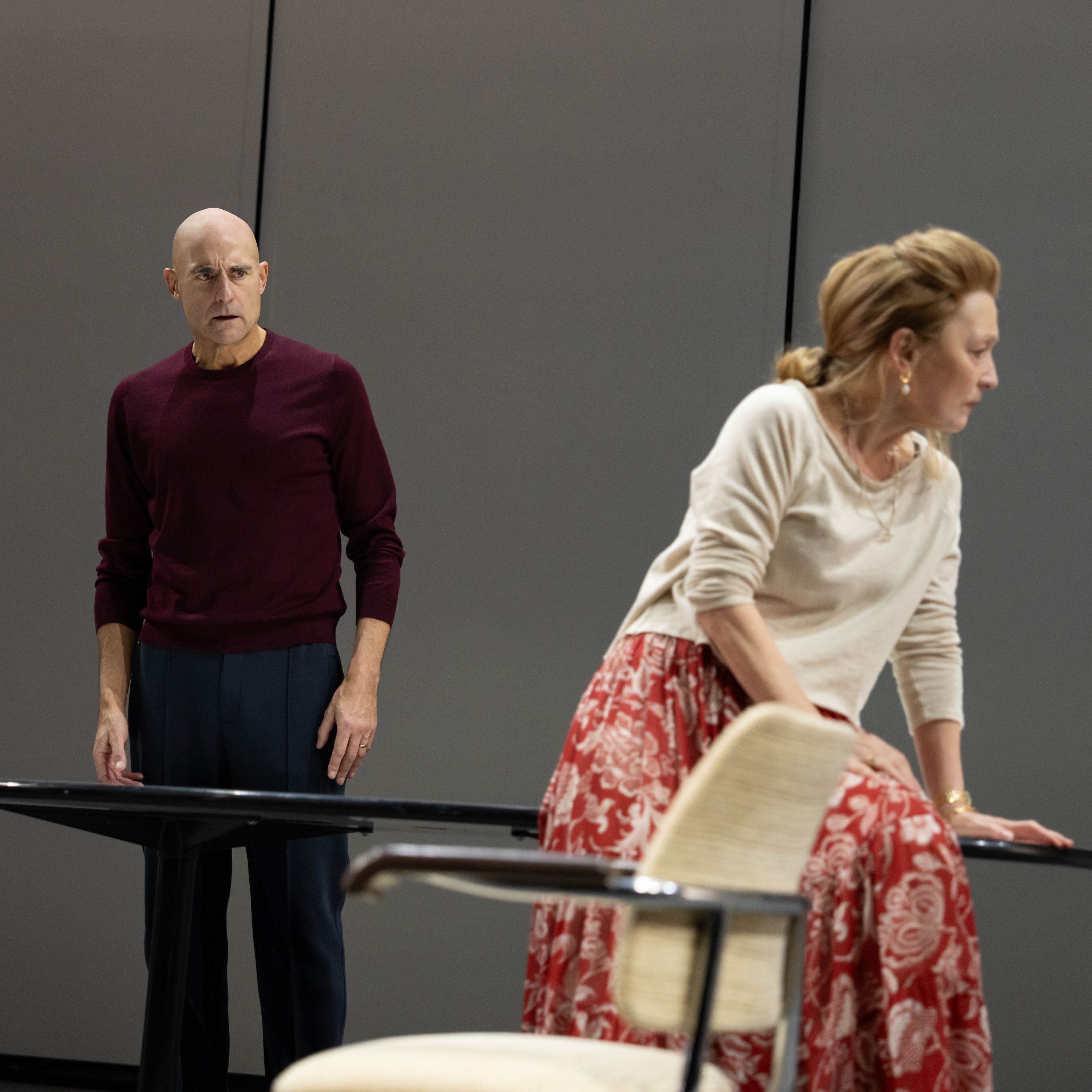
You're listening to all of it on wnyc. I'm Alison Stewart. You probably know the ancient story of Oedipus, but you've never seen it like this before because it takes place in modern times. Video screens, cell phones, the media, but with the same ending. The Oedipus adaptation on Broadway stars Mark Strong as the title character. In this version, he's a powerful politician and it's election night and he's about to win big. Never mind the persistent questions about his birth certificate, which the candidate says he plans to release if he win. When we meet Oedipus and his wife in the campaign office, she's played by Leslie Manville. They are, hey, a powerful and a passionate couple. They're about to have it all. And then a disturbed individual breaks into the campaign office. He's got a strange message for Oedipus about killing his father and marrying his mother. Oedipus dismisses this as a raving conspiracy addled man. He's at the apex of his power and nothing can take him down. Or so he thinks. This version of Oedipus was written and directed by Robert Icke. It won two Olivier Awards in Life, including best revival of the play. It's running now on Broadway for two more weeks, closing on February 8th. And we're joined now by Olivier Award winning actor Mark Strong. And it's nice to meet you.
- [02:15]
Mark Strong
Pleasure to be here. Thanks for having me.
- [02:17]
Alison Stewart
It was funny in the hallway. We had the meeting of the Broadway actors.
- [02:21]
Mark Strong
Seems like you're having Broadway hour. Yeah, yeah.
- [02:23]
Alison Stewart
It's interesting when you run into another actor who is a big part of a play. What would you like to have talked to him about.
- [02:32]
Mark Strong
Oh, just you share the same experience of eight shows a week, different audiences, how your play is doing, the need to kind of be on the minute the play starts. I mean, one thing I could have shared with him is the fact that I feel like I wake up every morning, I'm exhausted until 7 o' clock in the evening when for two hours I'm on the top of my game.
- [02:53]
Alison Stewart
Yeah.
- [02:53]
Mark Strong
And the minute the play's over, you're exhausted again.
- [02:55]
Alison Stewart
When was the first time that you encountered Oedipus?
- [03:00]
Mark Strong
Well, Rob and I did a play together at the National Theater nine years ago, a David Hare play written by David Hare, and it was called the Red Barn. And we did it in the national with Hope Davis and Elizabeth Debicki and it was a big success. And Robert, that's where we met and we always talked about doing something else together. And he mentioned this play, Oedipus. We say Oedipus. Oedipus, Oedipus. I found out the Greeks actually say Oedipidus.
- [03:24]
Alison Stewart
Oh, third one.
- [03:28]
Mark Strong
And we did a reading of it actually pre Covid with Helen Mirren playing Jocasta and with a group of actors, some of whom are in the. Were in the play finally when we did it. But then Covid hit and Rob was very concerned that he didn't want to do a play to a half empty theater. As much as people tried to kind of do distancing and all of that, it just wasn't the same. Also people in masks and the whole thing, it was just not. So we waited. Anyway, we found out that Lesley was available and wanted to do it. And so we mounted it in London last year in the West End, and now we're here.
- [04:05]
Interviewer/Producer
So Oedipus or Oedipus, it's a play about free will.
- [04:10]
Alison Stewart
Right. Are we all destined to fulfill our free will or is there a preordained.
- [04:15]
Interviewer/Producer
Plan and that is that. How are you thinking about that as you tackled your role?
- [04:21]
Mark Strong
Well, do we believe in fate? Fate is a, you know, it's a very powerful idea. I think in my life I move in and out of believing in fate because some things happen that seem to just come from nowhere and you think, how on earth is this possible? And then others are created by free will, the idea that you can achieve something if you want it. I think the play is a mix of both of those things, to be honest.
- [04:45]
Alison Stewart
You know, we meet Annabess when he's sort of at the, the top of his game, sort of at the Peak of it all. And we know that by the end of it, it will all be gone. What is challenging or tricky about portraying a character whose fall is so steep?
- [05:04]
Mark Strong
Well, all good Greek tragedies work in the same way, which is that a lot of the events have happened offstage. So Oedipus. Oedipus has already accidentally killed his father. He's already married his mother, he has children with her. So he's already living a life where these incidents have occurred in the past. And what happens on stage is that you watch the descent as he begins to realize that his life and the world isn't as he thought it was. And Rob very cleverly makes this into a two hour, real time production. So the minute we open, the polls have just closed and basically it runs for two hours. And the idea is that's when the results are announced. And over that two hours, it's real time. There are no scene breaks, there's no act breaks, there's no opportunity to change the tempo. So if you're doing something real time, the challenge of that is you really have to create your own music within that two hours. You can't just have two people chatting or a bunch of people chatting on the same level for two hours. It wouldn't be interesting enough. So he's done it like a piece of music almost. You know, there are moments of rage, there are moments of joy, there are very quiet moments. And it almost operates like that as a piece of music over two hours.
- [06:23]
Alison Stewart
I was interested when I went to see it.
- [06:25]
Mark Strong
Well, you've seen. What did you think? Do you think that.
- [06:27]
Alison Stewart
Oh, yeah.
- [06:29]
Mark Strong
Do you think that works, that idea?
- [06:30]
Alison Stewart
It's an interesting. Well, I was. I'm like most people, I have to say, I was fixated on the clock at first.
- [06:37]
Mark Strong
Yeah.
- [06:38]
Alison Stewart
You know.
- [06:38]
Mark Strong
Yeah, that's not a bad thing.
- [06:39]
Alison Stewart
It's not a bad thing because I'm looking at the clock and I know I'm counting down to this man finding out the truth.
- [06:48]
Interviewer/Producer
And that's it.
- [06:49]
Alison Stewart
These are the last hour and 45 minutes of his life being normal. Yeah, right as you're looking at the clock.
- [06:55]
Mark Strong
But that gives you a power as an audience because you know that something is coming. I think that's why the clock is there. I mean, it's on stage.
- [07:02]
Alison Stewart
The clock is there because it's election night and you're counting down to him.
- [07:06]
Interviewer/Producer
Winning the results coming in.
- [07:08]
Mark Strong
Exactly. So on stage, it's there because that's when the result's gonna be announced. But for the audience, you realize it's there for another reason, you know, that there's going to be some cataclysmic revelation or something's going to happen at the end of that time. And the suspense that's created by having the clock visible and counting down becomes really palpable by the end.
- [07:27]
Alison Stewart
I was interested, though, in the first few minutes because it's giant. You on a screen, on a huge screen with media all around you and you're giving a speech. First of all, what was it like to see yourself, what, how many feet high? Forty feet high? It's huge.
- [07:45]
Mark Strong
It's crazy. Well, I'm backstage when that goes out, so, yeah, I saw it once when, when we'd done it and they mounted it. I didn't realize he was going to put that on the curtain, so I didn't realize it would be quite that huge. But you know what was interesting about filming that day? Having. And we filmed all day with people holding up pictures with me on and shouting my name and shaking my hand and being joyous. It suddenly makes you realize, as a politician, how easy it must be seduced into thinking that you are, you know, top of the heap.
- [08:20]
Alison Stewart
My guest is actor Mark Strong, the star of Oedipus on Broadway. It's up for two more weeks. It's up until February 8th. How have you and the rest of the creative team been thinking about how to surprise the audience and to keep them on their toes, even if they.
- [08:37]
Interviewer/Producer
Already know the story?
- [08:40]
Mark Strong
It's the drip feed of information that keeps them on their toes. Because if you know the story, what you're thinking is, how are they going to do this? How is he going to find out the truth about himself? How are we going to see that happen? So I think what you're waiting for is, I know the excellence of Rob's translation, really, or adaptation, I should say, which is that he feeds you that information in a very subtle way. You hear things, people make speeches, you learn things, things. And by the end of it, you realize that everything has been encapsulated in that two hours. And the story of Oedipus as written by Sophocles, it's all there, but he's given it to you piecemeal through various bits of everybody giving information. Maripe, my mother's speech, for example, about me being not her son, or, you know, Leslie talking about the child that she gave birth to that's gone missing, you know, that she presumes is dead. That's all drip fed. And then by the end, it all comes together. And you realize what all that information means.
- [09:44]
Interviewer/Producer
It's dot after dot, after dot, after dot. I'm curious about the set. How was it described to you?
- [09:53]
Mark Strong
How was it described to me? Yes. As a campaign headquarters.
- [09:57]
Interviewer/Producer
But it's not yours. It's rented.
- [09:59]
Alison Stewart
Right.
- [09:59]
Interviewer/Producer
They're, like, trying to clear it out, which is kind of odd in the middle of it, I thought.
- [10:03]
Mark Strong
Yeah. Well, the idea is that it's a space that they've hired. That's their campaign headquarters. That's where they've been for a year, running the campaign. So they've all been in there. So when the curtain opens, you see this mess everywhere. You know, there's bits of pizza, there's sort of campaign hats, all of that lying around. And people are slowly removal. People are slowly getting rid of everything. So in a way, that's a symbolic, you know, pointer to the fact that all of the. Everything he believed about his life is being removed until all you're left with is a totally bare and empty stage, which is kind of where he's at at the end of finding out all this stuff about himself. But then there is a final scene, as you say, where you see, it's a flashback to the beginning where you realize that he's hired this place and he wants to show it to Jocasta and he's very proud of it. But that's the idea. Yeah. It's a rented space which is their campaign headquarters, where he chooses to spend the last couple of hours of the polls.
- [11:02]
Interviewer/Producer
Are there people who are still surprised by the revelation of what the two leads mean to each other?
- [11:12]
Mark Strong
Yeah, there are. There's loads of people. I mean, literally every single performance, there are gasps at varying times as the penny drops with people.
- [11:21]
Interviewer/Producer
Oh, that's. Oh, that's interesting.
- [11:23]
Mark Strong
Yeah. Different people get it at different times. Sometimes it's when Merope, the mother, is making her speech about him not being her son. Sometimes it's even when Leslie's talking about a baby that's been taken away from her that she had when she was young, and you realize she was so young that it's possible that actually in terms of age, she could be his mother. So it drops at different times. And I've said it before, but it bears repeating. There was a lady in the stalls one day who, clear as a bell a particular moment, went, oh, my God, she says, mother, literally. And everybody cracked up. She couldn't help herself. Yeah.
- [12:01]
Alison Stewart
She must have been so shocked.
- [12:03]
Mark Strong
Yeah. Oh, yeah, yeah, yeah. But people are shocked. I don't know if the when you saw it, if anybody gasped or if there was any.
- [12:09]
Alison Stewart
Oh, there were gasps. Yeah, there were gasps. I was kind of, kind of waiting to see as the clock ticked down, like, oh, who doesn't know?
- [12:17]
Mark Strong
Yeah, yeah.
- [12:17]
Alison Stewart
Who doesn't know around me?
- [12:19]
Mark Strong
But it works on both levels because I think if you know you're watching the Revelation, if you don't know it's.
- [12:25]
Alison Stewart
A detective story about the clock, are you aware it's there as an actor because you have a certain amount of time to get to the Revelation?
- [12:36]
Mark Strong
Yeah, I know it's there, but I don't look at it.
- [12:39]
Alison Stewart
Okay.
- [12:40]
Mark Strong
It's kind of irrelevant really. And it couldn't. It can throw you off, I suppose it can take your concentration if you're looking at that suddenly. But should anything go horribly wrong, there is a way of adjusting the clock to ensure that it still finishes on time. Having said that, every time we've done this show and we've done it in London and here, it pretty much always finishes within a minute of itself, which is amazing. Over a two hour period, over eight shows a week and a long period of time, it literally, it usually finishes 1:58,159.
- [13:12]
Alison Stewart
We're talking with Mark Strong, the star of Oedipus. We'll have more after a quick break. This is all of It. You're listening to all of it on wnyc. I'm Alison Stewart. My guest is actor Mark Strong, the star of Oedipus on Broadway. In this version, Oedipus is a powerful politician about to win a consequential election before receiving information that changes his life forever. It's running for two more weeks until February 8th. Why do you think this story works in the world of modern politics?
- [13:51]
Mark Strong
Well, because I think you see him at the top of his game at the beginning. He's king of the heap. He's gonna win this landslide election which kind of affords the original Oedipus. He's the king. It's Oedipus Rex is the original one. So he's the king. And I think that's the closest we can kind of maybe equate a king to in modern times, is a lead politician who's about to win a landslide election. And then I think the fact that he loses everything, I mean, what more can you lose? How can you lose everything in life other than if you're a politician? Literally, you win your polls, you win the polls, but you lose your family, you lose your life, you lose everything about who you thought you were out.
- [14:37]
Alison Stewart
Of all the politicians in the world, were there any that you drew inspiration from? Dead Live. I mean, it could be from anyone.
- [14:45]
Mark Strong
No, not really. I didn't actually. I purposefully didn't. There is a nod to Obama because he talks about releasing his birth certificate. And I think obviously that was something that Obama was struggling, well fought with when he was running. But I think that's the only, if I think of it, that's the only real connection to any politician that I can think of. And I purposefully didn't. Because he describes himself as not being from the body politic. He's of peasant stock is what he says and he has no experience of political office. So he's a newcomer.
- [15:17]
Alison Stewart
Well, at the time though, who would have thought our current mayor would be that guy?
- [15:22]
Mark Strong
Well, that's true. Yeah, absolutely.
- [15:24]
Alison Stewart
You know, as I listened to it, I was like, oh. And then he sort of got the stature of Gavin Newsom, sort of the chest forward kind of person. It was interesting trying to figure like.
- [15:33]
Interviewer/Producer
Gosh, who, Gosh, who could he be?
- [15:34]
Mark Strong
Yeah, I think you can see elements of lots of different politicians in him, but I didn't choose anyone particularly.
- [15:39]
Alison Stewart
How would you describe Oedipus relationship with his wife?
- [15:45]
Mark Strong
They're in love.
- [15:45]
Alison Stewart
Yeah.
- [15:46]
Mark Strong
You know, they are a great couple. They've been together 23 years. They row and get over the argument. They know how to handle one another. They know how to be loving towards one another. They're still kind of active together and yet they can still disagree but get over it. I think that's a sign of a long term relationship and they are in love. And it's important in the play that they are in love, I think, because at the end, I think you need to want them to be together despite the fact that they've realized that they can't be.
- [16:20]
Interviewer/Producer
What was your rehearsal process like with Lesley Manville to build that kind of relationship?
- [16:26]
Mark Strong
Well, Leslie's amazing because to be that close, I mean, that's a weird thing that actors have to do. You know, you turn up on set, on filming, for example, and you're suddenly meant to be, I don't know, be very intimate with somebody that you're supposed to have known for years and you've just met them that morning. In terms of the theater, you have more rehearsal time, obviously. We had six weeks and Rob very cleverly left the intimate moments until the end of the rehearsal period. So we rehearsed everything else first and then we came back to those once we got to know each other. And she's a pro. And so am I. And we knew where we had to get to, so we just. We just looked at each other, said, let's go for it, and did we.
- [17:02]
Interviewer/Producer
Got a funny text here that says, shout out to Mark Strong for getting dressed and undressed on stage with the most amazing balance.
- [17:13]
Alison Stewart
Also, Mark is the bomb. Love him.
- [17:15]
Interviewer/Producer
Especially as Jim in Tinker Tailor, Soldier Spy.
- [17:18]
Mark Strong
Oh, that's very lovely. Thank you.
- [17:21]
Interviewer/Producer
In terms of rehearsal, what. What was the most challenging part of the rehearsal?
- [17:26]
Mark Strong
The.
- [17:26]
Interviewer/Producer
Leslie, was it. Was it your balance? Was it entrances? I mean, well, you only make one or two entrances because you're basically on stage.
- [17:33]
Mark Strong
But Leslie was never, you know, that. That was easy, actually. That was. That was two actors who. Who trust each other, and we got on really well. And it. The cast were amazing. So that wasn't a problem. I think if there was an issue for me, it was just that, as I described earlier, that idea that it needs to be musical in order to achieve that music and in order to achieve 2 hours real time and make it interesting and engaging and give it highs and lows and nuance. My character, Oedipus, is responsible for a lot of the energy in the play.
- [18:07]
Alison Stewart
Oh, interesting.
- [18:07]
Mark Strong
So I come on at the beginning, and the first thing I do is I get cross with Tiresias. Then I rage at Creon. And then when. When the boys come on, I'm throwing hacky sacks around and chasing around and I'm being very, very physical. And I. I realize in retrospect that Rob always saw Oedipus as being the engine room of the play, if you like, so that we can then get to the scene in which the driver has a very nuanced speech about being the driver of the. Of my father, Laius, who was killed. And it allows Leslie to do her speech about what's happened to her in her life. And then it allows my mother character, Maripe, to make her speech about why I'm not her son. If you think about it, in the second half, they're almost two halves. The play. The first one is full of energy, vitriol, performance. You know, it's big. And the second half is much more thoughtful.
- [18:59]
Alison Stewart
What do you do as an actor when you're on the listening end?
- [19:05]
Mark Strong
You listen. That. That is the art of acting, as far as I'm concerned, is listening, truly listening, not waiting for your turn to speak, not standing there knowing when your cue is going to come in about sort of half a page time, literally listen to every word. And that makes the thing doubly exciting for me because it means when I'm on stage listening to people doing their speeches, I call it active listening. Because you're the conduit for the audience, because you're listening in the same way that they're listening. You're hearing it for the very first time. And if you can achieve that and persuade the audience that that's what you're doing, then, you know, that's the gig. That's my job, you know.
- [19:44]
Alison Stewart
There are plenty of us who learn family secrets which are somewhat shocking or surprising to us. How do these revelations. How does Oedipus, these revelations, reshape his understanding of himself?
- [20:01]
Mark Strong
Well, it's cruel, because right at the very beginning of the play, he says to Tiresias, I know who I am. And right at the very end of the play, he says, I don't know who I am. And what these revelations do is make him realize that he's been living a life that he thought was one thing but isn't. So his children are not his children. They're actually, bizarrely, his brothers and sisters, which is why he rejects them at the end of the play, because it's too much to deal with. And, of course, his wife turns out to be his mother, which is also just his lover, is somebody he can't be with. That. That's what happens to him. All these revelations basically make him realize that all these family relationships and these loving relationships and the world that he thought he was living in is just all evaporated.
- [20:52]
Interviewer/Producer
Have you ever had that, Something like that happen to you in your personal life?
- [20:57]
Mark Strong
Well, no. I mean.
- [20:58]
Interviewer/Producer
I mean, not like that.
- [21:00]
Mark Strong
No. No. No. The Greeks are pretty good at making it very profound. I've not had anything like that. I mean, I've been married for 25 years, happily. I've got two boys who I'm very proud of, and I've been touchwood, very lucky in that respect.
- [21:14]
Interviewer/Producer
I just remember my mom, one day dropping like, oh, I had a sister who died and I didn't know about it.
- [21:20]
Alison Stewart
It just sort of.
- [21:21]
Interviewer/Producer
It was sort of like, wait, this was.
- [21:23]
Alison Stewart
But this was part of your life.
- [21:25]
Interviewer/Producer
That I didn't know about. And it. And it didn't change anything, but it gave me. I guess it gave me more sympathy towards her.
- [21:31]
Mark Strong
Yeah.
- [21:32]
Interviewer/Producer
In that moment.
- [21:33]
Mark Strong
Well, it would. I don't know. My father, I mean. But. Yeah, but there's no. There's no nuance in that. I mean, I don't know anything about it. So, yeah, there's no revelations to be had there yet.
- [21:47]
Alison Stewart
My Guest is actor Mark Strong. The story at the start, the star.
- [21:51]
Interviewer/Producer
Of Oedipus on Broadway.
- [21:53]
Alison Stewart
As I mentioned, the set, it's sort of.
- [21:55]
Interviewer/Producer
It's just one. One room. What does that do for you creatively to just have to be in one room?
- [22:02]
Mark Strong
It makes it very simple. I mean, you. Everything has to happen there, and there's something very bold about it all happening in one room. I did a play years ago, Iceman Cometh, which was a four hour play which takes place in one bar on the Bowery. It's about a bunch of guys, all with hopes and dreams, pipe dreams, but they're all basically a bunch of drunks hanging out on the Bowery in the sort of early 1900s. And that's a four hour play that takes place in on one set. There's something very focused about that because you're not being distracted by set changes or movement, things being different. You don't sit there as an audience, go, oh, okay, that looks different. Oh, that's interesting.
- [22:41]
Interviewer/Producer
You.
- [22:43]
Mark Strong
It makes the words resonate more because the set you're on isn't changing.
- [22:48]
Interviewer/Producer
You mentioned that it takes place with no intermission. Do you like a show with no intermission?
- [22:55]
Mark Strong
Love it.
- [22:56]
Alison Stewart
Why?
- [22:57]
Mark Strong
Because it means people don't go out at halftime and compare notes, you know, so nobody's going, oh, I liked him, I didn't like her. What do you think of that? Is that what you think? And nobody's comparing notes about what they think, which means that when you're doing it, each person is getting their own version of what they're seeing. Also, you know, I don't know what it's like in America, but in the UK everyone goes out and has a gin and tonic and comes back slightly more rowdy.
- [23:22]
Interviewer/Producer
Speaking of, what's the difference between. I know you've been asked this before, but what's the difference between a New York audience, it's not an American, but a New York audience, and a London.
- [23:32]
Mark Strong
Audience, as we discussed, it's. It's. It's more present, it's more voluble, there's more reaction, you hear more, there's more laughter, there's more knowing laughter when people get the joke. There's even people calling out, there's a lot of gasping, there's. And also, bizarrely, there's this thing where you come on stage, we had it last night, and people applaud you as you come on. Now, that isn't something we do in the uk, this idea of an entrance round.
- [24:02]
Interviewer/Producer
Yeah.
- [24:04]
Mark Strong
It's difficult for the Actor. It's difficult for us. We found it difficult. It's very nice that people are acknowledging you, but I think it's a way of the audience letting you know that they're there, that they know who you are and they're happy to be there. But actually, what you're trying to do is come on stage in character, not as the actor. And that applause reminds you before you start that you're the actor rather than the character. So it's not unwelcome, but it's different.
- [24:27]
Interviewer/Producer
That's so interesting because we've had a lot of discussion the show, like, what is proper etiquette and should you clap when someone comes on stage? Is a real. It's a bone of contention for people, really.
- [24:38]
Mark Strong
Well, like I said, it doesn't happen in the uk. I did a play called the man who Came To Dinner at the Royal Shakespeare Company years ago, directed by a man called Gene Sachs, who I think had done a lot of Neil Simon comedies. And he directed it and said to people as they came on, okay, you stand there, you wait. You gotta wait a second, because they'll applaud. And we all kept trying to say to him in rehearsals, I don't think they're going to applaud, Gene. This was in London. And of course, nobody did. It's not a tradition back home.
- [25:06]
Interviewer/Producer
Well, you know, you talked about New York, New Yorkers responding to you, and you're in here doing the play. Do you get to spend time in New York?
- [25:15]
Mark Strong
Yeah. Love New York. Yeah, absolutely. Love it. Love it. Those. I think London and New York are my two favorite cities in the world. And part of the reason is you can never. You can never conquer them. I keep turning corners, going, oh, my God, I didn't know this was, you know. And bars and restaurants, they turn over as well. So it's always lively. New Yorkers are, you know, they're great, they're fun. I've got a lot of friends here. And I was here 10 years ago with A View from the Bridge, the other play that I've done on Broadway. And so I lived here for 10 months with my family. I brought my sons over, put them in school. So we. New York is. Occupies a big part of our life.
- [25:53]
Interviewer/Producer
You know, Antigone, another Sophocles play which follows the stories of Oedipus Daughter. There are two adaptations of that play. They're gonna be running off Broadway in New York. Yeah, a West End production starring Emma Darcy and Tobias Menzies.
- [26:07]
Mark Strong
Oh, yes, that was in London. That One.
- [26:09]
Interviewer/Producer
Yeah. And we're actually gonna talk to them about it on Monday. First of all, did you get to see the production?
- [26:14]
Mark Strong
I've seen clips of it, but I didn't get to see it because it was on, I think while we were rehearsing or just before us. But I know what it's about.
- [26:22]
Interviewer/Producer
And what do you think I should ask them considering it's your daughter?
- [26:25]
Mark Strong
Well, it's a very, that's a very modern version. You see, at least in ours we're still calling people by their original names. You know, Oedipus isn't called Brian or something. Whereas they totally adapted it to, made it, made it a modern idiom. So it has a whiff of Antigone, but really it's a modern based story.
- [26:42]
Interviewer/Producer
I'm looking forward to get to see a tape of it this weekend. I'm very excited about it.
- [26:46]
Mark Strong
Yeah.
- [26:48]
Interviewer/Producer
When you leave the theater or when you're incognito and people don't know it's you, what do you hope people are talking about when they leave Oedipus?
- [26:58]
Mark Strong
Oh, I just, when I, when I sign for people afterwards, you know, people want to stay behind sometimes and get you to sign their playbill or have a selfie or whatever. And whatever, what I say to all of them is, I hope you got something from it because theater that has that, you leave clapping politely going, yes. Well done everybody. That was rather good. You know what I mean? And it's mediocre. I mean, nobody wants to make a mediocre, mediocre production. But sometimes I don't know. The alchemy doesn't work. Plays where the alchemy works are, they're second to none. So I hope people just get something from it, whatever it is.
- [27:32]
Alison Stewart
The play is called Oedipus. It's on Broadway for two more weeks. Mark Strong has been my guest. Thank you for being with us.
- [27:38]
Mark Strong
Thanks, Alison. Thank you.
- [27:39]
Alison Stewart
And that is all of it for today. I'm Alison Stewart. I appreciate you listening and I appreciate you. I will meet you back here next time.
- [27:50]
WNYC Sponsor Announcer
NYC now delivers the most up to date local news from WNYC and Gothamist every morning, midday and evening with three updates a day. Listeners get breaking news, top headlines and in depth coverage from across New York City by sponsoring programming like NYC now, you'll reach our community of dedicated listeners with premium messaging and an uncluttered audio experience. Visit sponsorship.wnyc.org to get in touch and find out more.