Loading summary
Transcript160 lines
- [00:00]
Progressive Insurance Announcer
All of it is supported by Progressive Insurance. Do you ever find yourself playing the budgeting game? Well, with the name your price tool from Progressive you can find options that fit your budget and potentially lower your bills. Try it@progressive.com Progressive Casualty Insurance Company and affiliates Price and coverage match limited by state law. Not available in all states.
- [00:23]
Liberty Mutual Representative
And Doug, there's nowhere I wouldn't go to help someone customize and save on car insurance with Liberty Mutual. Even if it means sitting front row at a comedy.
- [00:33]
Alison Stewart
Hey everyone, check out this guy and his bird. What is this your first date?
- [00:36]
Liberty Mutual Representative
Oh no. We help people customize and save on car insurance with Liberty Mutual together. We're married. Me to a human, him to a bird.
- [00:43]
Alison Stewart
Yeah, the bird looks out of your league anyways.
- [00:45]
Liberty Mutual Representative
Only pay for what you need@libertymutual.com Liberty
- [00:48]
Alison Stewart
Liberty Liberty Liberty
- [00:53]
Nigel Robinson
so much baseball. Direct TV has the most MLB games in one place.
- [01:02]
Brian Quijada
DIRECTV baseball, baseball stats and baseball scores and streaming baseball on your couch and at the park and wherever you want on DirecTV.
- [01:12]
Visit directtv.com today. It's DirecTV like you've never seen it. Claim based on total games on national and regional sports networks. RSNS included with choice or higher. Availability varies by zip code and package all by lap us only up to three concurrent streams. MLB trademarks used with permission.
- [01:32]
Alison Stewart
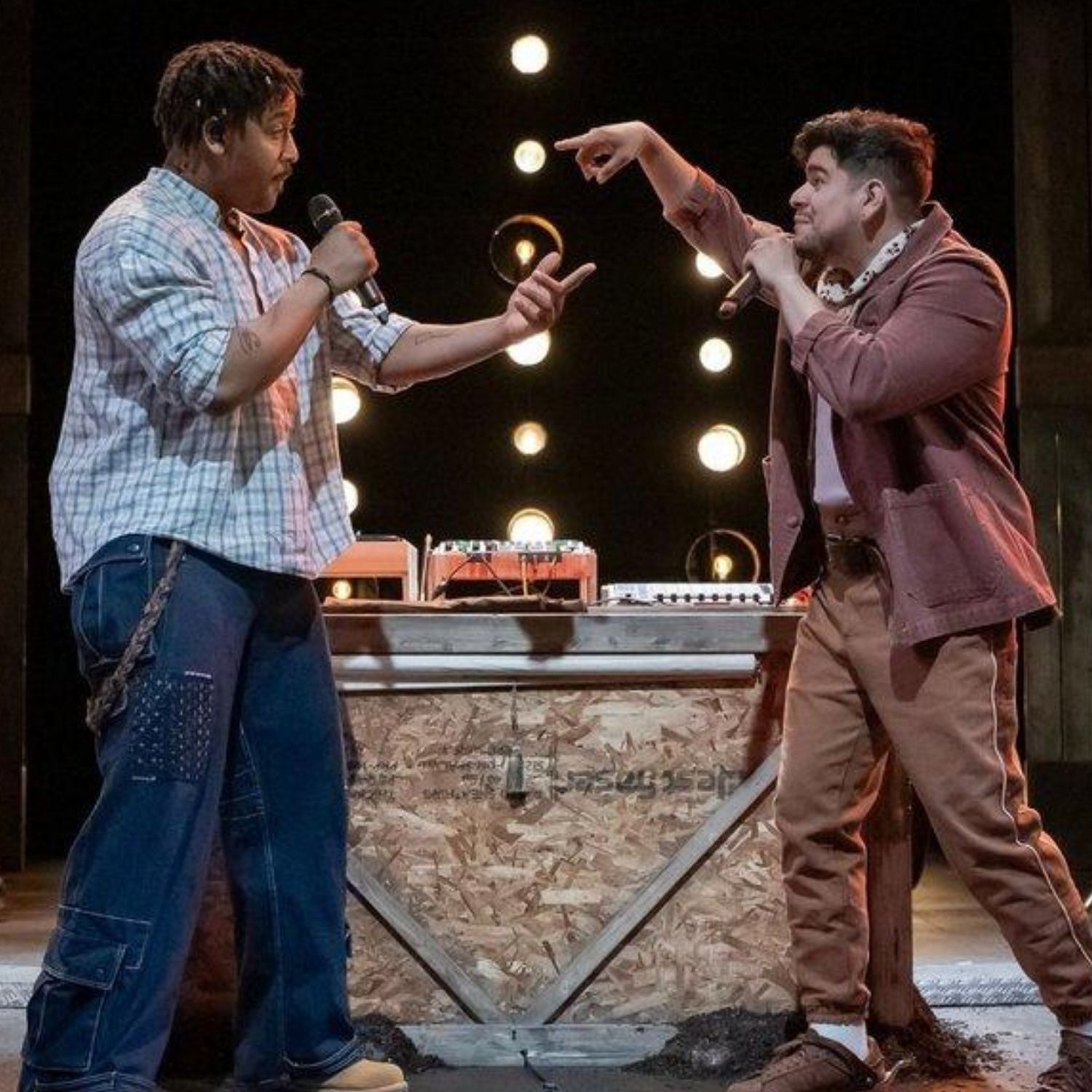
This is all of it on wnyc. I'm Alison Stewart. Critics called the musical Mexicus a thrilling multicultural hip hop history lesson and something truly dynamic. Now the show is back for an encore run at the Darrell Roth Theater on Union Square. It resurrects a little known history of the Underground Railroad that ran south into Mexico. Researchers estimate between 5 and 10,000 people fled enslavement in the United States by migrating into Mexico where slavery was fully outlawed in 1837. In the show, the history is reflected in the characters Henry and Carlos. Henry is an injured slave who flees his Texas plantation across the Rio Grande where Mexican sharecropper Carlos finds him unconscious and tends to his wounds. It is as much about the past as it is about the present, reminding us to lend a hand to those in need today. The musical is titled Mexicus is running at the Derov Theater. Whew. I'm out of breath. I'm sorry. It has now been extended through Sunday, June 14th.
- [02:37]
Progressive Insurance Announcer
Woohoo.
- [02:38]
Alison Stewart
Its creators and stars, Brian Quijada, who plays Carlos, and Nigel D. Robinson. D. Robinson, who plays Henry. The two joined us talk about the show a little while ago, but now they are here in Studio 5 with a big Old bass and a guitar and they're gonna perform for us. Thank you so much for coming back to the studio.
- [02:55]
Brian Quijada
Oh my God. Thank you for having us.
- [02:57]
Alison Stewart
All right, tell us about the first song we're gonna hear.
- [02:59]
Nigel Robinson
Oh, you know, you gotta come out hot.
- [03:03]
Alison Stewart
All right.
- [03:04]
Nigel Robinson
I mean, we come out and like, the whole thing about the show is that we come out as ourselves, introduce ourselves, and are like. We learn some history that you probably haven't heard about. And we're gonna share what we researched
- [03:16]
and what we learned in a groovy, fun way.
- [03:18]
Brian Quijada
Yeah. All right, here's the first track. It's called Two Bodies. Come on. Yeah, yeah, yeah. Make it funky.
- [03:30]
Make it a little spunky. It's too early in the morning for that.
- [03:33]
Come on. Yeah, come on. Yeah. Keep it steady, keep it steady. Uno, dos, uno, dos, tres, quatro.
- [03:48]
Nigel Robinson
Look, ma, no hands, just in the
- [03:51]
Brian Quijada
loop machine, just like that.
- [03:57]
Nigel Robinson
1, 2, 1, 2, 3.
- [04:01]
Come on,
- [04:14]
Brian Quijada
Come on, come on. Yeah. You know what the song needs, though?
- [04:23]
What it needs?
- [04:24]
Some dirt, some grime, some grease, some
- [04:27]
like,
- [04:37]
Nigel Robinson
You know what else in these dogs.
- [04:38]
Brian Quijada
What's that?
- [04:39]
Nigel Robinson
A little something smooth on top. You know what I'm saying? Yes.
- [04:41]
Brian Quijada
Smooth it over, baby.
- [04:43]
Come on, Bring it back in. Come on. Yeah, yeah.
- [05:09]
Nigel Robinson
Come on.
- [05:19]
Brian Quijada
We only singing it.
- [05:20]
Cause that's the way we live with it.
- [05:21]
Nigel Robinson
Oh my dear love give us a
- [05:24]
Brian Quijada
freedom Spare your pity we don't need a light oh my dear Lord, have mercy on her pride Go ahead and stare at us we are two bodies in America we bleed the same blood of this country and stories will share with you Of a time left out the books but all it took was deep diving into a sad imagination A true examination of a nation's early trouble. Cause from the wrecking rubble we came out the other side side sippity side when you're living in this country is do or die and we can tell you how uh huh, yeah. But let's break it down.
- [05:55]
Nigel Robinson
Take no shackles off my hands oh Lord, I'm free wow.
- [06:00]
Brian Quijada
Wow.
- [06:00]
Nigel Robinson
And take that noose from around my neck no stopping me Take those shackles off my hands oh Lord, I'm free and there's no stopping me no, there's no stopping me yo, my name is Nigel D. Cobbleson. A descendant of Masamusa who was shipped from the east to the coast of Cuba, then up to of Africa, Land of the free. 400 years later. And here you have me standing here before you with the new manifesto. Todo estamos.
- [06:31]
Brian Quijada
Call me Brian Quijada. I'm a child of Latino immigrants Equivalent no different than any founding participants who cross the sea. You cross the border in order to build a life much better than the one they knew before Just on the other side Struggle just to break it in. So once they made it in, fought hard to be accepted in a land it's barricaded in.
- [06:47]
Nigel Robinson
So where did we meet? In the middle.
- [06:48]
Brian Quijada
Yo give em the truth.
- [06:50]
Nigel Robinson
Okay, okay. From 1829 to 1865, four to 10,000 slaves escaped to Mexico to thrive.
- [06:55]
Brian Quijada
Did you know this shop? We didn't know this stuff. Did you know this stuff? We didn't know. Why? Cause it wasn't allowed. It wasn't allowed. It wasn't allowed. It wasn't spoken.
- [07:05]
Nigel Robinson
Yo that was no loud mouth deep south secret way of speaking Whispers only fingers of our mouths just to avoid the beatin that keeps the locks of
- [07:12]
Brian Quijada
our mouths held pretty tight. So we struggle to uncover America's other founders fight to live in this America.
- [07:17]
Nigel Robinson
They're scared of us. They came for us, brought all of us and now we're we are here
- [07:20]
Brian Quijada
Old rose dead folks new laws new
- [07:22]
Nigel Robinson
flaws the same holy cross and the same northern star Here we are we
- [07:26]
Brian Quijada
got far to go but we won't keep it low we only singing it cause that's the way we live with it oh my dear love give us some freedom Spare your pity we don't need it like oh my dear Lord have mercy on a proud Go ahead and stare at us. We are two bodies in America whose
- [07:43]
Nigel Robinson
stories span a country's history that no one's heard about.
- [07:45]
Brian Quijada
Kept it out of our minds cause they were kept from history class.
- [07:48]
Nigel Robinson
So today we're going to guide you through our story.
- [07:49]
Brian Quijada
From the past of the underground railroad that led south.
- [07:52]
Nigel Robinson
A story will pass down by word of mouth.
- [07:55]
Brian Quijada
Oh so here we go yo Here
- [07:56]
Nigel Robinson
we go yo so this, this, this is the scenario you see.
- [08:00]
Brian Quijada
In 1821, Mexico won independence from the colonizers of Spain, whose language they injected into indigenous tribes. With them, they bought all types of European investing just attesting their new model of civilization. Not to a nation that didn't need it. But 300 years later, the Spaniards were defeated.
- [08:18]
Sound familiar?
- [08:20]
In 1821, Mexico celebrated their big victory.
- [08:25]
Nigel Robinson
In 1829, Mexico said good riddance to slavery.
- [08:30]
Brian Quijada
But on the other side of the divide, Mexico's neighbor to the north was a little far behind cause. Life and liberty was vital to the cause. But what gave them pause was major financial loss. The need to make money money, make money money Money make money Money make money money, money Greed leads to many,
- [08:46]
Nigel Robinson
many a war on Earth.
- [08:50]
Brian Quijada
In 1848, it was America that won
- [08:54]
Nigel Robinson
the ten territories from Mexico, including the behemoth of Texas. Yo.
- [09:00]
Brian Quijada
And what would that land be used for, oh, Lord? To pick a bell of cotton. And what was slaves most common chore? To jump down, turn around and pick a bella day cotton. America's original sin.
- [09:12]
And it's then and there where our story begins.
- [09:15]
Nigel Robinson
Take those shackles off my hands oh, Lord, I'm free wow.
- [09:19]
Brian Quijada
Wow.
- [09:20]
Nigel Robinson
Take that noose from around my neck no stopping me Take those shackles off my ears oh, Lord, I'm free and there's no stopping me no, there's no stopping me.
- [09:40]
Alison Stewart
Oh, we had harmonica just at the very end.
- [09:44]
Brian Quijada
Little surprise.
- [09:46]
Alison Stewart
My guests are Brian Quijada and Nigel Robinson. They are Mexican, which is performing at the Daryl Roth Theater in Union Square. It's extended through Sunday, June 14th. Brian, you could have told the stories many, many ways. Why did a musical make sense?
- [10:03]
Brian Quijada
Oh, wow, that's a great question.
- [10:05]
Nigel Robinson
You know, musicals always make sense.
- [10:07]
Brian Quijada
I love me a good musical. I just, you know, it's. It's. There's a reason why it's. We're so proud of it.
- [10:14]
I think it's an American. It is as American as apple pie musical theater.
- [10:19]
And I really, truly believe that music is. It's the. You know, they say it's the first language of humans. Right. It's the first way we communicated was through rhythm and beat and melody. And so I just think it's so powerful, you know, to be able to sing these songs. We say, you know, we say we only sing in it because that's the way we live with it. And truly, I do believe that. I mean, by the end of the show, we get people singing with us, and it's just so powerful.
- [10:50]
Alison Stewart
Why do you think musical makes sense for the story?
- [10:53]
Nigel Robinson
Oh, I think when. I think the reason why we sing in a musical to begin with is because our emotions are so high and it's so heightened that we must sing. We cannot speak it. And I'm one of those guys who's like, if I'm in a theater watching something, don't talk to me, sing at me.
- [11:11]
It's already ridiculous.
- [11:13]
Let's make it more ridiculous. But, no, we're only singing it because that's the way we're living it. And also, like, music is such a. Is in the fabric of both of our cultures, you know, and it's a means of protest. It's a Means of revolution and especially hip hop music in particular, that we're using a lot in the show style that we both grew up with. And Lin Manuel, I do love this. I want to quote him. He said hip hop is the language of revolution. And this show is a small part of a very general revolution and awakening that is happening right now. So we have to use music in order to tell this story.
- [11:50]
Alison Stewart
Brian, tell us what Carlos is about. What is he feeling in the show?
- [11:55]
Brian Quijada
Yeah, Carlos is. Well, both of these characters are composite of a bunch of research, but Carlos is a veteran of the Mexican American War, so he fought. He was a medic in the war and fled the war and his brothers on the field was displaced, moved farther south into what now has remained the southern border of the United States and is a sharecropper now is a farmer. And his whole world is really kind of flipped upside down when he finds Henry floating in the river and takes him out and, you know, kind of goes back to his instincts of being a medic. Yeah, yeah.
- [12:47]
Alison Stewart
What's Henry's backstory, Nigel?
- [12:49]
Nigel Robinson
Henry's backstory, when he was eight years old, he got split from his mom and other family members in Kentucky and got sent down to Victoria, Texas. And we meet him when he's like around 20 years old. He is an enslaved individual who for I can't tell you exactly why he runs away. You have to come see the show for that.
- [13:13]
Alison Stewart
Yes, you will.
- [13:14]
Nigel Robinson
I don't want to give that up. But the secrets, it's a situation where it's either be killed or kill and run away. He chooses to kill and run away and he washes up on the shores of Mexico. But like Brian said, these people are composites and there's a lot of us in them. The way I write, the way I think, there's a lot of that. And Henry very contemplative and like musing and trying to figure out like, why, why am I in this? What is this? What do these things mean? And try and like explore that in an artistic way. So that's like a lot of like this next song is very musing on like what it is and then also using old spiritual to do so.
- [13:56]
Alison Stewart
And we'll get to the next song after a break. This is all of it. You are listening to all of it on wnyc. I'm Alison Stewart. I'm in studio with Brian Quijada and Nigel Robinson. They make up Mexico. It's an off Broadway show about a little known underground railroad that ran in Mexico. It's Back for an encore run at the Darrow Ross Theater at Union Square through Sunday, June 14th. Okay. Before the break, you promised us a song.
- [14:32]
Nigel Robinson
I did promise a song.
- [14:33]
Alison Stewart
Wade in the Water. That's a Negro spiritual.
- [14:36]
Nigel Robinson
Tis.
- [14:37]
Tis.
- [14:41]
Henry finds himself on the banks of the Rio Grande. And a storm is coming up. And for this moment, I was like. I've used some juxtaposition. Like, use this. Like, very. I mean, it's not calm, but it's like wade in the water. As if the water is calm. But using that in the mind to get through this storm. So this is Wade in the water.
- [15:15]
I spent four days running Running through this spacious land I'm gunning, gunning for the Rio Grande of running with anyone, a certain death Keep running Tomorrow I can catch my breath no gun in my hands no food, no water Just blood on my hands from the vengeful slaughter no sun in the sky when I go running I'm a thief in the night I'm tired, I'm done in but if I can just make it to the Rio Grande if I can just make it to the Rio Grande I'll get to the land where slavery's banned I'll get to the land where slavery's been I can almost hear the current. But my current state makes me proud to hallucinate but wait. In the distance I can see the moon's reflection from off of my heart's affection the Rio Grande. To the glory of the Father is displayed Just wait in the water Wait in the water, children Wait in the water God's gonna trouble the water Wait in the water Wait in the water, children Wait in the water God's gonna trouble the water I made it here. So now what? I can't swim. I never learned how. But I gotta figure out how to get across today. I probably should have put some thought into this on the way.
- [17:08]
Alison Stewart
Wait.
- [17:09]
Nigel Robinson
Yo. I need a bush with a ram in it. Or I need the Rio Grande to have a dam in it. I'm damned if I can't cross. Cause I'm certain there's a search party waiting to take me back to the cotton field. Wait a damn minute. I remember I got a cup of water. And I noted that a piece of cotton fell in and it floated. I see a cotton bale laying nearby. It's crazy, but I have to give it a try. If I can just cross that Rio Grande I'll get to the land where slavery's banned hold fast, boy, and be not dismayed the glory of the Lord will be displayed so just wait in the water Wait in the water, children. Wait in the water God's gonna trouble the water Wait in the water Wait in the water, Henry. Wait in the water God's gonna trouble the water Boom goes the thunder, crack goes the lightning the wind keeps whipping and my grip keeps tightening Halfway across and I'm on the br. Sinking. What was I thinking? Am I like the children of Israel, Punished for the worship of baal? Floating on a cotton bell with no proper sail I weep and wail to no avail. Who will hear this tale if I'm bound to fail? Just a little more then I'll reach the shore if I stay brave, I won't be enslaved. There's a finish line. But I'm out of time and I can't be saved from this massive wave.
- [18:59]
Alison Stewart
You are listening to Mexodus. My guests are Brian Quijada and Nigel Robinson. We just got a text that said, this is extraordinary. Is there going to be a recording? Fantastico.
- [19:11]
Brian Quijada
Yes. Interesting.
- [19:12]
Alison Stewart
Will there be a recording?
- [19:13]
Brian Quijada
Yes, there is.
- [19:14]
You know, you can go to Mexical.com and pre order it. It's coming out on audible. The audible platform on April 15th. 14th.
- [19:25]
April.
- [19:26]
April 16th.
- [19:28]
Nigel Robinson
It is gonna come out on one of those days.
- [19:31]
Brian Quijada
April 16th. April 16th, for sure.
- [19:33]
We're dropping the entire ALB. It's the play through the audible platform again. You can go to mexicodismusical.com and pre order it.
- [19:39]
Alison Stewart
Now, as you have sort of expanded to the Daryl Roth theater, what have been the challenges of taking this play to a bigger space?
- [19:48]
Nigel Robinson
Well, it's not bigger.
- [19:49]
Brian Quijada
It's actually less seats. It is, yeah. It's actually quite more intimate, which is quite nice. So you really see us sweating up there and spitting.
- [19:58]
Alison Stewart
Oh, that's interesting.
- [19:59]
Brian Quijada
It's great.
- [20:01]
You know, it's only like eight rows deep, and so it's a truly. You go in there, we are, like, talking straight to the audience. Yeah, it's amazing.
- [20:11]
Nigel Robinson
It's a different kind of storytelling where you're not, like, trying to play up to the mezzanine and play way, way back. Like, we're like 10ft away from the nearest audience member.
- [20:21]
Alison Stewart
What kind of reactions have you gotten from people being that close?
- [20:24]
Brian Quijada
Oh, people are more vocal. I mean, people really. I mean, we invited. We say, hey, listen, you come here, you yell, you dance, but people. People really chat with us.
- [20:34]
Nigel Robinson
Yeah.
- [20:35]
Alison Stewart
It's interesting because there have been shows that have been at the Daryl Roth, which have gone to Broadway. Is that something that you see for yourself for the show?
- [20:43]
Nigel Robinson
If you say it out loud from
- [20:44]
Brian Quijada
your mouth to God's ears, start a
- [20:47]
Nigel Robinson
rumor that it's going to Broadway. I hear rumors are.
- [20:49]
Rumors are just manifestation techniques.
- [20:51]
Alison Stewart
How does the show keep developing and growing over time?
- [20:56]
Brian Quijada
Well, yeah, go ahead.
- [20:57]
Nigel Robinson
Well, I mean, as the times get more turbulent that we respond to that, and different lines mean different things today than it did a year ago, there's
- [21:11]
Brian Quijada
a line in the show that goes, you know, we are given reasons to fight and start wars. And that hits different. A little different than it did two weeks ago, but little things like that that I think, you know, we wake up and, you know, we're talking about black and brown solidarity, and you wake up to the news cycle and we get to go to work every day.
- [21:35]
Alison Stewart
I understood there was a line in the show about Cesar Chavez.
- [21:39]
Brian Quijada
Yes.
- [21:39]
Alison Stewart
Tell us a little bit about that and what you decided to do.
- [21:42]
Brian Quijada
Yeah, just recently, obviously, the New York Times, I mean, a lot of news outlets came out with the allegations against Cesar Chavez, which is incredibly sad, and we feel terrible for the victims and, you know, and kudos in respect to, you know, California changing it from Cesar Chavez Day to Farm Workers Day. And so, you know, there is a line in the show that was. When we're talking about moments of black and brown solidarity in history, and one of the places that we cited was Cesar Chavez joining to have a civil rights. Civil wrongs righted, we say, and we swapped it out with Dolores Huerta. And it is amazing. You know, I think we're artists should be a reflection of the. Of the times, of society, of our communities. And that's one where we're like, we have. The art has to reflect what's going on, and we have to listen and be in solidarity with the survivors and plays that aren't.
- [22:42]
Nigel Robinson
I mean, Broadway is like, when you have to lock something. For sure, for sure. Like, there's no changing it immortalized, whatever. But, like, you know, being in a space where, like, Off Broadway is technically still, like, development, like, we could. We can change things whenever we want. And I like to think of plays and musicals as living documents until they have to be set in stone. So, like, this show is a living document, and if something happens and we catch it, we'll change it on the fly.
- [23:10]
Brian Quijada
Yeah.
- [23:11]
Alison Stewart
As artists, what. How do you see your role as artists in fostering these sort of critical dialogues about the society we live in?
- [23:21]
Nigel Robinson
We. I think we get to express feelings
- [23:27]
in a different way.
- [23:28]
Like, you know, rather than try to talk you into feeling something, we get to, you know, what does that mean to the heart rather than words. But we get to put words on top of it. But, I mean, we get to, like, sing out feelings. And I think, like, people don't like being preached at. They like being shown. They like being, you know. So if I can, like, invite you in and try to get you in a moment and not preach at you, but just show you something. Like, I think my favorite thing about this show Is that we're not preaching about solidarity. We're showing you what it can look like.
- [23:58]
Brian Quijada
Yeah.
- [23:58]
Nigel Robinson
Like, Brian hits a button for me, I'll record something. I hit a button for Brian. We're, like, helping each other the whole
- [24:03]
Brian Quijada
time and what it means for just two people to create an orchestra's worth of sound, you know, Like, I think. I mean, what's amazing about being an artist is that we. We are able to kind of create bones, you know, I think people come into our theater thinking that they're gonna, you know. Yeah. I mean, the first third of the play is a slave narrative. I mean, Nigel kind of goes into his ancestral history with it, but. But by the end, you are dancing with us and singing with us. And I think it is an act of rebellion. It is a triumph to be singing in times of, I think, troubled times. And so it's quite moving for us, healing, for us to be able to do the show, but also for our audiences who, I think, need a place to sing and dance.
- [25:03]
Alison Stewart
Let's hear one final song. What are we going to hear?
- [25:05]
Nigel Robinson
It's called libre.
- [25:09]
Brian Quijada
Libre means free.
- [25:36]
Nigel Robinson
Why does a bird in a cage still have a tune when he's working in the heat of the afternoon when he spends every day in the field and it feels like the face have sealed him in an awful tomb why does the bird in the cage still have hope? Why does the bird in the cage sing the highest notes? Why does the bird in the cage have a song today? Because today is the day that he might believe.
- [26:51]
Brian Quijada
I see I see I. Y.
- [27:31]
Alison Stewart
That was Brian Quijada and Nigel Robinson. They are part of the off Broadway hip hop musical mexodus. It's back for an encore run at the Darryl Roth theater on Union Square through Sunday, June 14th. You should definitely go see it. It is a great, great show. And the album is dropping.
- [27:51]
Brian Quijada
April 16th.
- [27:53]
Liberty Mutual Representative
Yes.
- [27:53]
Nigel Robinson
That is the date we landed on.
- [27:56]
Alison Stewart
Thank you so much for coming in and performing for us.
- [27:59]
Brian Quijada
Oh, you're the best. Thank you for having us.
- [28:04]
Liberty Mutual Representative
And, Doug, there's nowhere I wouldn't go to help someone customize and save on car insurance with Liberty Mutual, even if it means sitting front row at a comedy show.
- [28:13]
Alison Stewart
Hey everyone, check out this guy and his bird. What is this, your first date?
- [28:17]
Liberty Mutual Representative
Oh no. We help people customize and save on car insurance with Liberty Mutual together. We're married. Me to a human, him to a bird.
- [28:23]
Alison Stewart
Yeah, the bird looks out of your league anyways.
- [28:26]
Liberty Mutual Representative
Only pay for what you need@libertymutual.com Liberty
- [28:29]
Progressive Insurance Announcer
Liberty Liberty Liberty Drafty windows Rising energy bills Worn out windows making you uncomfortable in your home. Renewal by Andersen can help. We offer custom built energy efficient windows that block dry drafts, open and close easily and can help lower your energy costs. You can buy now and pay nothing until September, 2,027. No money down, no monthly payments and no interest for 18 months with a minimum of six. But don't wait. This offer ends March 31st. Visit renewalbyandersonhome.com for more information and enjoy your new windows for years to come.