Loading summary
Transcript80 lines
- [00:08]
A
This is all of it on wnyc. I'm Alison Stewart.
- [00:11]
B
Hey.
- [00:11]
A
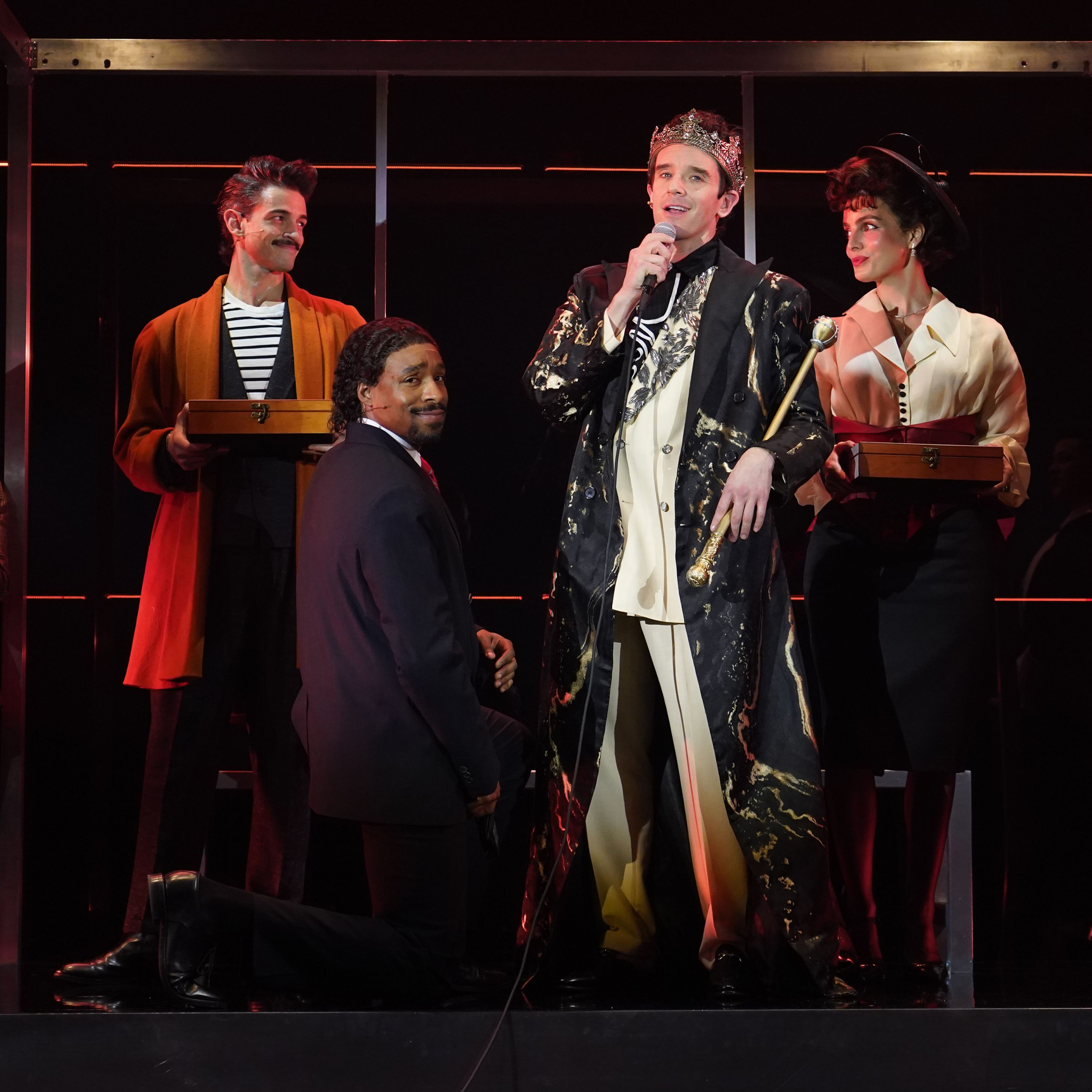
It's almost Thanksgiving, which means media outlets are publishing gift guides and the algorithm is feeding you all kinds of things to buy. We here at all of it like to shop local. So next week we'll be kicking off a series of conversations with Caroline Weaver. She's a shop owner herself as well as the founder of the locavore guide. She's joining us to talk about how to spend your month in a way that is meaningful and keeps it in the community. She'll share some recommendations in all five boroughs and we want yours as well. So starting Monday, get ready to call in and tell us your favorite place to buy gifts. That is happening in the future. Now let's take a trip back to 1980s New York and the setting for Richard II. A new off Broadway production of Richard II takes place in 1980s Manhattan, full of pastel colors, mullets and boxy suits. No worries, though. It's the traditional text, just with shoulder pads. It's about a vain king who likes being kingy, played by actor Michael Urie. He's at odds with his moral cousin Henry Bolingbroke, played by my other guest, Grantham Coleman. Richard gets a bit greedy and takes Bolingbroke's title and inheritance and exiles him from England for six years. However, his pursuit of the crown comes at a devastating cost and quite a bit of drama. Richard II is now running at the Astor Place theatre on Lafayette street through Sunday, December 14th. Joining me now are two of the show stars. Michael Urie. Nice to talk to you.
- [01:48]
B
You too. Thank you.
- [01:49]
A
And also Grantham Coleman. It's nice to welcome you back to wnyc.
- [01:52]
C
Love to be here.
- [01:53]
A
So tell me, when was the first time, Michael, that you ever heard of Richard ii? When did you read it?
- [01:59]
B
I saw a production of it when I was at Juilliard. I was a second year at Juilliard in the fourth year class was doing it and Lee Pace, the great actor Lee Pace was playing Richard. And it was a great product. Very traditional production, very Juilliard and capital J, but very good. And he was really, really good. And I said, I want to do that. I think a lot of, you know, I don't. I have. This happened to me a few times where I've seen a great actor play, especially a Shakespeare role, and it cracks it open for me and I say, oh, I see it and I want it. And I. And I'm gonna steal and then I'm gonna make it my Own. And it took 20 years, but I got somebody. I finally talked someone into doing it.
- [02:45]
A
Grantham, when was the first time you read Richard ii?
- [02:48]
C
The first time I actually read it was maybe a few months ago.
- [02:51]
A
Really?
- [02:52]
C
It was not done when I was at school, when I was at Juilliard, we didn't see it. It wasn't the play that they really taught from. I've heard a lot of the speeches before, but growing up, I was like a Hamlet guy. Romeo and Juliet, mackers. All those, like, the histories were kind of foreign to me. And every time I would see a history play, I would have that immediate response of like, oh, we're gonna do this medieval style. And as a consumer of classical text, I love it. But I was always. I always felt distant from it. And Richard II that we're doing, I love because it's kind of like you said, cracks it open in a new way so that it's more accessible, and we're having a blast. But, yeah, Richard ii, I've seen it only once, and it was in San Diego. Robert Shawn Leonard did a beautiful job. Beautiful job. But I was like, oh, yes, this is a history play. And going to work on it. I was like, oh, there's so much more here than just English history.
- [03:47]
A
Now. Both of you went to Juilliard. Yes.
- [03:49]
B
Yeah. Yeah.
- [03:50]
A
What is something from that experience that you thought of during the play that you bring with you to Richard ii doesn't necessarily have to be about Richard ii, but something from your training that you use all the time?
- [04:04]
B
Oh, gosh. I mean, like, all of it. The bulk of the training. All of it. I'm a guy with Alison Stewart. The bulk of it. The bulk of the training is to do Shakespeare. It's to prepare you to do Shakespeare. The theory being that if you can do Shakespeare, you can do anything.
- [04:23]
C
And.
- [04:24]
B
And so this is a. This is a very challenging play. Huge text. We both have very big parts, lots to say. And. And. And the Shakespeare works best when it's embodied physically. It's, you know, it's not meant to be read. It's meant to be acted. It's meant to be spoken. And so that's why everyone who reads it and gets bored doesn't want to go see it. But the truth is, if you, like, listen to it and. Or watch it, and it's. It's way more exciting. And when. When you're an actor who's lucky enough to get cast in Shakespeare plays embodying it is extremely thrilling, and that is that. So. But specifically, Robert Neff Williams is his teacher. We had at Juilliard, and he assigned me one of the. He's no longer with us, but he assigned me one of the Richard II speeches. And I worked on it with him, and he gave me some very specific stuff that I do still in the play. It's the hollow crown speech. It's the. Where he talks about how death sits within the hollow crown of a king and keeps his court. And then eventually, with a little pin, bores through his castle wall. And I remember very vividly, Neph, we called him, saying, and why don't you just pick up the pin and bore through the castle wall and kill yourself right then and there? And so in the moment, I always do it every night. I pick up a pin, he says, bores through his castle wall, and farewell, king. And the castle wall is the crown. And I do all of it. I do everything he. And I think of him every night. It's a very special memory.
- [06:01]
A
What do you remember from Juilliard that you use every night?
- [06:04]
C
I completely agree with everything you said, but I would just boil it down to dexterity. I feel like a lot of our early classes in the first couple of years are about giving everyone a palette to pick from and options to choose. And there's numerous ways to say words, but there was definitely something to be beaten into us of, like, there. This is the right way to say this word. And as monotonous as it could be, practicing schwas for half an hour, schwa with a compact mirror in front of your mouth, going, ah, ah, ah.
- [06:40]
B
It works.
- [06:41]
C
Cause eventually your mouth gets so used to the. The tool and instrument that it is and what it can do with these words that then your body is able to meet what your mouth is doing. When you speak Shakespeare, which is why I love seeing American actors do Shakespeare. We tend to inhabit the words, like, physically and literally, in a way that is definitely my cup of tea. And so watching Michael work every night is a joy because I get the best scene in the house. I'm this close to him.
- [07:08]
B
Oh, my gosh, ditto.
- [07:10]
A
You spent weeks reading and doing table reads for this play.
- [07:14]
B
Yeah.
- [07:15]
A
Why was that important to you? And what was something you figured out about your character?
- [07:19]
B
Well, it's so vital to spend time together with the text at a table, because we have to be on the same page about what everyone's saying, and it's sometimes really, really complicated. And our director, Craig Baldwin, knows this play inside and out, and now so do we. But he knew it on day one. Which was very valuable. And so if ever any of us were even a little bit unclear about what we were saying or what someone else was saying, he would know, and that was great. But, like, for example, I speak a lot. Grantham speaks a lot. We speak a lot. But other characters have to listen to us. And it's very important for them to know what we're saying, too, because their reactions to what we're saying will help the audience. An audience is not just going to understand what we're saying right off the bat, necessarily, but if they see the way it lands on the other character, it will help them. It'll give them the context clues of what's going on in the moment. So it's not only important for the person speaking to know what's being said, it's important for all the actors on stage to know, too.
- [08:34]
A
My guests are actors Michael Urie and Grantham Coleman. We're talking about the new production of Richard II. It's set in 1980s Manhattan. It's running at the Astor Place theater through Sunday, December 14th. What did you think, Grantham, when you heard the setting was going to be 1980s Manhattan?
- [08:51]
C
Oh, that's a question that's still on my mind every day. Because as you were saying about table work, the other half of what we spent our time doing for those for the first week of rehearsal at the table and then multiple weeks after is trying to marry the two worlds, trying to meet the text with what it says and who these people are. And like, you know, kings. Okay, we don't have kings in 1980s New York, but we kind of do. We have the equivalent. All right, a court. We don't have a court, but we kind of do so making the extrapolations and like having these group huddle sessions and asking Craig, our director, like, so does it. Do we still have gloves that we throw on the ground like in the 1980s? And you know what we do, and we make a lot of the marriages work. But the 1980s, for me, I think it was more of a time where you did have some black figures stepping up and being in the frontal face of the society, but not necessarily as a civil rights leader. You know, we had businessmen, we had other figures to see and look at for, to me, the first time, like in movies, you know, Eddie Murphy had a number one song, a number one movie. And like, that hadn't happened before.
- [09:58]
A
Yeah, you look like Billy Dee Williams in your suit.
- [10:00]
C
Thank you. That is who I went for. That is who the wig is supposed to be. Like that is it. I get a lot of Al Sharpton's, but the Billy Dee, the wig is supposed to be Billy Dee. That is exactly what I was going for.
- [10:14]
B
I'm so glad that moment happened. That was. He does talk about Billy Dee a lot.
- [10:18]
C
The man Epitomize is cool. He is cool. But, yeah, the 1980s. Craig said a beautiful thing one day where he was like, we cast this play because everyone is who they are, and you can't leave yourself behind when you walk on stage. As actors, we are ourselves, and we try to bring more than ourselves to roles and use the pieces of us that fit. So being a black man and our story in the 1980s, we're like, yes, we're cousins. Okay, that's acceptable. Many families look many ways, but we're also kings and princes and, okay, well, what does a black Prince in the 1980s look like? And I was like, billy Dee Williams looks like Billy Dee Williams. And it kind of shaped and informed a lot of the choices that everyone made by trying to put our bodies in the space together.
- [11:10]
A
So a lot of this play is about what's mine is mine, or what was yours is now mine. As far as you're concerned, Michael, what felt particularly 80s about this script?
- [11:24]
B
Well, part of it is that is that the 80s, in many ways, was the beginning of Greed is Good was the beginning of kind of where we are now. It was sort of set the stage, and Richard II is the beginning of the War of the Roses, Shakespeare's history cycle, the War of the Roses. So Craig really liked the idea of putting it at the beginning of our War of the Roses, kind of where we are, like, where we've kind of ended up. Now we have, you know, like a potential trillionaire. Where did that begin? And was it the Wall street era, when Wall street sort of began? I also think, you know, our production is very queer, and our King Richard is a very queer character. And he has created this inner circle which is in the play of flatterers, hangers on. At one point, Grantham's character calls them the caterpillars of the commonwealth. And in our play, they're very queer. And the rest of the court does not like them. The rest of the country, they do not like that these people are influencing Richard so much. And the 80s was a breaking point for queer people for a lot of reasons. The AIDS crisis, obviously, which we do not address in our play, but that was a point where suddenly queer people who had been enjoying many freedoms lost them. And I think a lot of Influential queer people. I'm thinking about, like, you know, on one end of the spectrum, Roy Cohn.
- [13:15]
A
Yeah.
- [13:15]
B
On another, Halston, a brilliant, famous, closeted, but. But pretty queer. Yeah. Celebrity who. Who had beautiful women on his arm, but also this secret life that was kind of a secret kind of not. And his bubble burst. And I think that where we meet Richard and his court, it's the end of this little paradise that they've created. This, like, amazing kingdom of queer royalty. And the bubble gets burst because the rest of the kingdom doesn't like that. They don't like the way they're running things.
- [13:56]
A
I thought it was a pretty sexy play.
- [13:58]
B
Yeah.
- [13:59]
A
Actually, if you want to know the truth, I was like, what do you think of sexuality in the play?
- [14:04]
B
I think. Well, you know, I think it's. It was very important to all of us that. That we. That. That. That this is a man who doesn't fear anyone. I mean, he has his. He has his fears, but he's all powerful. He's the king. So if anyone is going to explore their sexuality, it's a king. And he does. And. And he's got a. He's got a lot of interests and he's surrounded by the people that he. You know, he's given. He's. He's chosen the most fabulous queen he can. And he also has a boyfriend. And that is very supported in the text. I mean, it's not explicit in Shakespeare's text that he is lovers with this character of Omerle. But o' Merl is loyal to the end and is often referred to as the king's friend and sort of quotes. And. And. And I think there's even a beautiful. There's a beautiful passage where they're basically, the jig is up and it's all gonna. It's all gonna go away. And they see the writing on the wall. And Richard says to o', Merl, should we just. Should we just let our tears dig us holes in the ground and be buried together? And it's quite beautiful. And. And, you know, whether or not Shakespeare's audience saw them as lovers, that's the kind of thing you say to a lover.
- [15:33]
A
Grantham. In the beginning of the play, we're introduced to Henry Bolingbroke as the king's cousin who publicly accuses another nobleman of treason. It leads this big Russian roulette shooting duel. What's at stake for your character in.
- [15:47]
C
That moment so much? Because as the story goes, the person that I am accusing is complicit, but through accusing that person. I am also accusing the king that sits to my Left over here, Mr. Michael Urie, but also King Richard, because as in the history, apparently Richard did kill his uncle Gloucester. And Mowbray may have been involved historically, he may not have. But Shakespeare, who wrote this play 200 years after that had happened. So it was already a little bit of a Netflix special for the medieval people. He was giving them the crown. He makes it pretty well known in our play that Richard has hired Mowbray, who is now the Duke of Norfolk, which in our story, we chose to make a very recent thing. Like last week, he was just Thomas Mowbray and now he's the Duke of Norfolk and our uncle's dead. How did that happen? So there's a lot of high stakes gambling going on with Northumberland and myself by accusing Mowbray, knowing that in some way it is also coming at the king. And if at any point Mowbray is like, you know what? I can't take the heat. I'll just admit what happens then. We may have a reason to outwardly revolt, but, yeah, I don't know. It was a very hard thing to wrap my head around because today's deposition is very much different than, like, what it means to depose someone back then as a king. And I think this might have been one of the first plays that dealt with actually deposing a king, because that was probably something you were not allowed to write about when there were kings and queens, right?
- [17:36]
B
And wasn't it that the queen. When the queen saw this place, she said, you're talking about me here. There was something, you know, like, it was dangerous for Shakespeare to write about these. You know, that's why he waited. You know, he was telling old stories.
- [17:51]
A
It's interesting because I pulled out my book from college to look up for just a second. And yours starts with you in jail. It doesn't start that way originally. And you're on stage before, as the audience is settling in in this box. First of all, what are you thinking about in that moment? Are you in character? Are you getting in character? What's going on?
- [18:15]
B
So I'm kind of both getting in character and in character. There's definitely a part of me that's listening to the audience and wondering what they're thinking. I can't really hear them, but it's more of a din. And sometimes when I walk out, because I'm not there from the very beginning, depending on when you come into the theater, sometimes I go out there and Then they all get quiet like it's starting. And that's annoying. But, you know, this framing device that we use of Rich in prison I think is really effective because he doesn't go to jail until Act 5. But in our play, that's where we meet him. And then he's kind of remembering. It's become a memory play. He's remembering everything that happened to him, and then he's filling in the gaps when he doesn't know. And it's sort of his imagines. I think that's what would have happened. I think that's what would have happened. And it's very cool for me as an actor to get to go through all that and get to build. I sort of Play 2 Richards. I play the guy in the story and the guy remembering the story. But when I'm in the box, to answer your question about what am I thinking about, my first line is, I have been studying how I may compare this prison where I live unto the world. So I'm really, like, trying to do that. That's sort of what I spend the pre show doing, is how is this where I am now? Like the world I was in and the world that everyone else is in? And there's this beautiful idea of being. Of becoming nothing that's throughout the play, that when once you are no longer a king, you're not anything. You don't have a name, you don't get to keep anything. You are nothing. And this idea that until you are pleased with that, until you're at peace with that, you will never be a settled spirit and your soul will never settle. And so that's sort of my big journey is. That's the question I pose to myself in the cell when we first start the play. And that's what I'm trying to get to by reliving the events, is becoming at peace with it so that I can go and maybe get to heaven and no longer have to endure this.
- [20:34]
A
This is a practical question, Grantham. It's about two and a half hours long with an intermission. How do you keep your stamina up for that long?
- [20:44]
C
Oh, that's a better question for Michael. I was thinking about it all the time because he is on stage the whole time.
- [20:49]
A
You are on him. Yeah, you are.
- [20:51]
C
It's always a fun challenge as an actor to do a play when you do it. And the one time I did it, I was like, this was a mistake. I should not have done this. I should not have signed on for this. Like, your bladder must be Incredible. And you have incredible control. I can't imagine it myself, but in terms of how I keep the stamina, I mean, it's.
- [21:12]
A
Cause you go out, but you come back, like, sort of looking like a black panther.
- [21:16]
C
Yeah, yeah, yeah. I gather a lot of it from the people on stage. Like, you know, there's wild and crazy tunnels back there in that theater. And so you can easily find yourself in a small room going, like, what's happening on stage right now? But when you do find out, it's your time to go on. And you go out and you see Michael and he's just giving you the business, making you feel like the worst guy ever. And then you realize, wait a minute. You did this to me. You took my land, you took my title, you basically killed my dad. And then now you're sad that I'm here. And it just reinvigorates every single cell in my body. It's one of my favorite roles, which I did not know was going to happen. I remember every day of rehearsal being like, michael, I don't know what I'm doing. I don't know who this guy is. And then I realized, like, oh, well, basically, people tell you who you are in real life and in the text and in acting and his character and all the people around me in the show tell me who I am. So I stopped trying to find who Bolingbrook was, and I just kind of went with like, oh, I'm the person that you're telling me I am. So thank you.
- [22:26]
A
Well, how do you keep your stamina up?
- [22:28]
B
Well, it is definitely. It's tricky because I can't drink a lot of water. And when you do a play, you drink a lot of water. But I can't, because then I'll have to go pee. So I can't. And I can't, you know, But. But it is. It's the. It's the other people. It's. I'm very. This is a really good cast.
- [22:48]
A
It's a great cast.
- [22:49]
B
Oh, my gosh. It's just such an. Every time somebody new comes out and. And. And I get to watch them every night, and it's. I'm very inspired by them. And. And to have a foil like Grantham, who. We're so different, but we also. We come from the same training program, and we both think about this, I think, in very similar ways. We both really love Shakespeare. And so, you know, it's the other people that keep me. And the audience, of course, you know, like, an audience is always gonna keep you Energized.
- [23:25]
A
When I was there, one of your co workers from shrinking was in the audience.
- [23:29]
B
Ted McGinley.
- [23:30]
A
Oh, you said his name. I was gonna give him his anonymity.
- [23:33]
B
Somebody else in the audience. Sorry, sorry, sorry.
- [23:37]
A
You just did it. Well, how's. How does it feel when someone you work with regularly on another situation sees you in this situation?
- [23:46]
B
Oh, well, I actually didn't know he was there until after he surprised me. But that performance, there was a bunch of students from Juilliard.
- [23:54]
A
Really?
- [23:55]
B
Yeah. So we were all. You got a good one. Because we were all very excited to have Juilliard in the house. But it is. When I found out he was there, I was very touched that he came, but also, I was very excited that I was. I was really. Honestly, I was really glad someone from shrinking saw the show because I'm so proud of what we've done. I'm so proud of what we made, and it's so different than shrinking. And. And he'll go tell everyone. You know, he'll go tell everyone that we did a good job and that. And that we made something really cool.
- [24:27]
A
Yeah. Be nice to him at crafty next time.
- [24:29]
B
Yeah, exactly. So that. Yeah. And, yeah, it's really. It's. I love that. It's because I'm so lucky that I get to do such very different things with these two projects. And that is not lost on me. And so when the world's. You know, I feel the same way when one of my cast members brings up shrinking, you know, it's like, oh, you watch that show? That's so cool.
- [24:56]
A
All right, what is the next Shakespeare play you would like to be in? Grantham.
- [25:04]
C
I've always thought I have a Henry 5 in me.
- [25:07]
A
Henry 5?
- [25:08]
C
Yeah. I think. I think, because that was the history that I actually, like, was like, oh, yeah, this is, like, the other place. This has, like, a really cool character and some really cool stuff happening and some really cool speeches. And I think in, like, the five roles that, like, I've always wanted to do, it's the last one that's still there. So. Yeah, maybe Henry Van.
- [25:29]
A
What do you think?
- [25:30]
B
Well, I had a plan to pitch Grantham on doing Othello and Iago together, but then I found out Grantham wants to play Iago. Yes. So that plan was dashed.
- [25:44]
A
Who else do you want to play?
- [25:45]
B
Well, I really want to play Benedict in which Ado I'd love to play Bottom in Midsummer. There's a lot. I have a long list. I have Bottom in Midsummer. I want to play Leontes in the Winter's Tale. I wouldn't mind revisiting a few role I played. I got to play Hamlet. That'd be a fun one to do it. You know, that's always a good one. I'm a little old. I could play an old Mercutio, which I've done before. There's a lot, it's, you know, there's, it's an amazing canon of work and I want to do it. I want to do it all. Whenever I'm doing Shakespeare, I think this is all I want to do. But it is harder to, you know, it's hard to get cast in them all the time.
- [26:29]
A
You'll find a way.
- [26:30]
B
Yeah.
- [26:31]
A
My guests have been Michael Urie and Grantham Coleman. The Nate Coleman. Coleman, yeah. We're talking about Richard ii, which is set at the Astor Place theater through Sunday, December 14th. Thank you for coming in.
- [26:45]
B
Thank you.
- [26:46]
C
Lovely to be here.
- [26:48]
A
Since WNYC's first broadcast in 1924, we've been dedicated to creating the kind of content we know, the world. In addition to this award winning reporting, your sponsorship also supports inspiring storytelling and extraordinary music that is free and accessible to all. To get in touch and find out more, visit sponsorship.wnyc.org.