Loading summary
Transcript47 lines
- [00:00]
A
WNYC Studios is supported by Odoo. When you buy business software from lots of vendors, the costs add up and it gets complicated and confusing. Odoo solves this. It's a single company that sells a suite of enterprise apps that handles everything from accounting to inventory to sales. Odoo is all connected on a single platform in a simple and affordable way. You can save money without missing out on the features you need. Check out Odoo at o d o o.com that's o d o o dot com.
- [00:39]
B
This is all of it. I'm David Fuerst in for Alison Stewart. And this next hour is all about art. Wendy Red Star will be here to discuss her new exhibit, One Blue Bead. And later, artist Kwame Azur Gomez is here to talk about her exhibit set the atmosphere. You can head to our Instagram llovenyc to see images of some of the art that we're going to be talking about this hour. And let's get things started with Love and Fury. A new museum exhibition reflects on the HIV and AIDS crisis through posters that started appearing in the late 1970s and and encourage people to stay informed and practice safer sex. It's called Love and New York's Fight against aids. On display at the lower level of Poster House in Chelsea, the exhibition features posters, flyers, magazine covers and other examples of graphic design showcasing grassroots efforts to raise public awareness about AIDS from 1979 to 2003. From for example, there's a poster for a 1983 circus show at Madison Square Garden that served as a benefit to fight the disease and a magazine ad in American Vogue featuring some of the 90s top fashion designers. Love and New York's Fight Against AIDS is on display at Poster house now through September 6, and curator Ian Bradley Perrin, who is also a historian of HIV aids, joins us to discuss. Ian, welcome to all of it.
- [02:17]
C
Thank you so much for having us and for giving me an opportunity to talk about the show.
- [02:21]
B
Well, you've been studying the history of HIV and AIDS for years and even wrote your dissertation on the first five years of the AIDS response. What was your guiding vision in creating this exhibition, Love and Fury?
- [02:39]
C
We wanted to, of course, Poster House is a poster museum, right. And so we wanted to feature this material in a way that best spoke to how posters as a medium were powerful in the response. We wanted to feature the work of communities, the variety of communities in New York City and create an exhibition where multiple generations could come in and experience this time in the city's history together. People who Lived through the period. Perhaps lost people in the period may remember events that are featured in some of our posters. And then a younger generation of people who perhaps have experienced a more recent epidemic, but are less familiar with the AIDS epidemic itself and how it played out in the streets of New York City.
- [03:26]
B
How did you get involved with studying this history? What made you want to put a show like this together?
- [03:34]
C
Great question. So I've been interested in hiv, AIDS as a subject of historical study since I was 18. When I was 20 and tested positive for HIV, my own interest became more personal, and it just further deepened my interest. I've been passionate about history, particularly oral history, and the way that people tell the stories of their own lives. And I think that within the gay community, especially, the AIDS epidemic just looms large, Larger than almost any event sort of in the 20th century. And I think until recently, it hasn't really been deemed a subject of historical study. Historians prefer events that are much further in the past.
- [04:23]
B
Well, this is getting further and further in the past, Right?
- [04:26]
C
Exactly. And since I started studying it, the interest has grown. And I think this exhibition is a testament to it. And people's response is a testament that they're ready to start rethinking that period that many people remember. And as I said, a new generation of people are being introduced to.
- [04:42]
B
Well, set the scene for how the public and the government viewed this disease in the early 1980s. And then tell us about the role that these posters played in raising awareness.
- [04:55]
C
Absolutely. The exhibition actually opens a few years before the epidemic is formally recognized. Our earliest poster, as you said at the beginning, is from 1979, and it's a poster for one of the bathhouses in New York City. New York City was sort of a playground of sexual liberation and gay sexual liberation. And this bathhouse and poster for the bathhouse is really a stand in for this remarkable community that existed in the 70s.
- [05:24]
B
And it's a very striking image.
- [05:26]
C
Absolutely. And it's being used as sort of one of our promotional pieces for the show. It encapsulates the power of the community, the strength of the community, as well as the stage on which the AIDS epidemic emerged. The earliest responses to the epidemic, and this has really been the focus of my research for a long time, came from the gay community itself, and particularly people who were themselves living with a disease that would later become known as aids. It was people who were getting sick and whose lovers were starting to show symptoms of a mysterious illness that first began asking questions, finding out ways to share information publicly, gathering groups of like minded individuals to strategize and beginning to build connections with institutions where they could get real answers to their questions. In 1981, in a now famous scene, Larry Kramer gathered a number of men in his apartment in New York City and heard for the first time formally about this disease from the public health institutions of the country. From there, the community began planning for themselves to government response was slow. But one thing that I do want to emphasize and that I think the show does well is it demonstrates that although government response was slow, the gay community, as it organized, worked with them. So you see that the earliest funding from the city of New York comes in 1983. I think that's a lot earlier than people might imagine. And one of the messages and the takeaways for the show is the power of coalition building. Sort of this idea of strange bedfellows. Perhaps the government wasn't comfortable speaking to the issues at the time and instead funneled money to organizations like Gay Men's Health Crisis who were able to disseminate information more effectively. That's one of the interesting things that came out of my research and that we try to incorporate into the show.
- [07:25]
B
The name of the show, Love and New York's fight against AIDS. This is on display through September 6th and at poster house. And explain what do we see in the show?
- [07:37]
C
Absolutely. So the show, we've broken it up into four different parts. It's not chronological necessarily, but more thematic because it's a show at a museum in New York. It's a story about New York City. We wanted to show the different facets of the city at the time and how they responded to the epidemic. The first section focuses on community responses and community public health messaging with the poster as a critical medium for communicating this new concept of safer sex that gay men and people living with aids, as they called themselves at the time developed. The messaging is very explicit, exactly on the nose, very clear, nothing sort of mysterious in the language that gets used. We start there. From there we move into a section that looks at how creative communities in the city responded to the epidemic. This is such a New York specific story. And the epidemic was felt very hard and very early in these creative communities. I use that term to cover the breadth of stage and screen and musicals, design and fashion, marketing, advertising, retail, textiles, sort of this broad range of industries that I think are so quintessentially New York City. It's really exciting to be able to retell this portion of the story in the show.
- [09:14]
B
Oh, sorry, were you.
- [09:16]
C
Oh, no, sorry. I thought you were about to say something. I can keep going. We're excited to.
- [09:21]
B
Let me just mention this because I do want to hear more about that. But if you would like to join this conversation, we'd love to welcome you to join us. Did you live in New York City during the time that this exhibit covers? What are the visuals that you associate with that time? Are there any posters, comics, ads or magazine covers that come to mind? Feel free to give us a call. 212-433-WNYC. That's 212-433-9692. And let's pick up right where we were there. And was it important for you to center this exhibition specifically in New York City?
- [10:01]
C
I think the story of AIDS is really a multiplicity of different stories. If you want to go deep on the story, you really have to ground yourself in a particular location at a particular time. By telling the story of New York rather than say all of the United States or a global story, we were able to go a lot deeper on particular communities and individuals and actors and really explore what was specifically New York about the response to the epidemic in New York City. But of course, there is a range of other stories that could be explored. But what was exciting was the idea, as we said earlier, that individuals who lived in New York City at the time could come into the exhibition and be transported in their memory to a time or to a group of people that are no longer there potentially. And it could both enable them to remember and then share those memories with others. It's been exciting in the first few weeks of the show to sort of listen in as folks walk through the exhibition and recollect the 1980s and 1990s in the city.
- [11:10]
B
We're speaking with Ian Bradley Perrin about this new show, Love and New York's Fight Against AIDS, currently on display through September 6th at Poster House. And I wanted to ask you about the importance of these images in the show. How did the visual arts help to shape public understanding of HIV AIDS during the early years of the crisis? And what role did grassroots design play when official public health messaging fell short?
- [11:41]
C
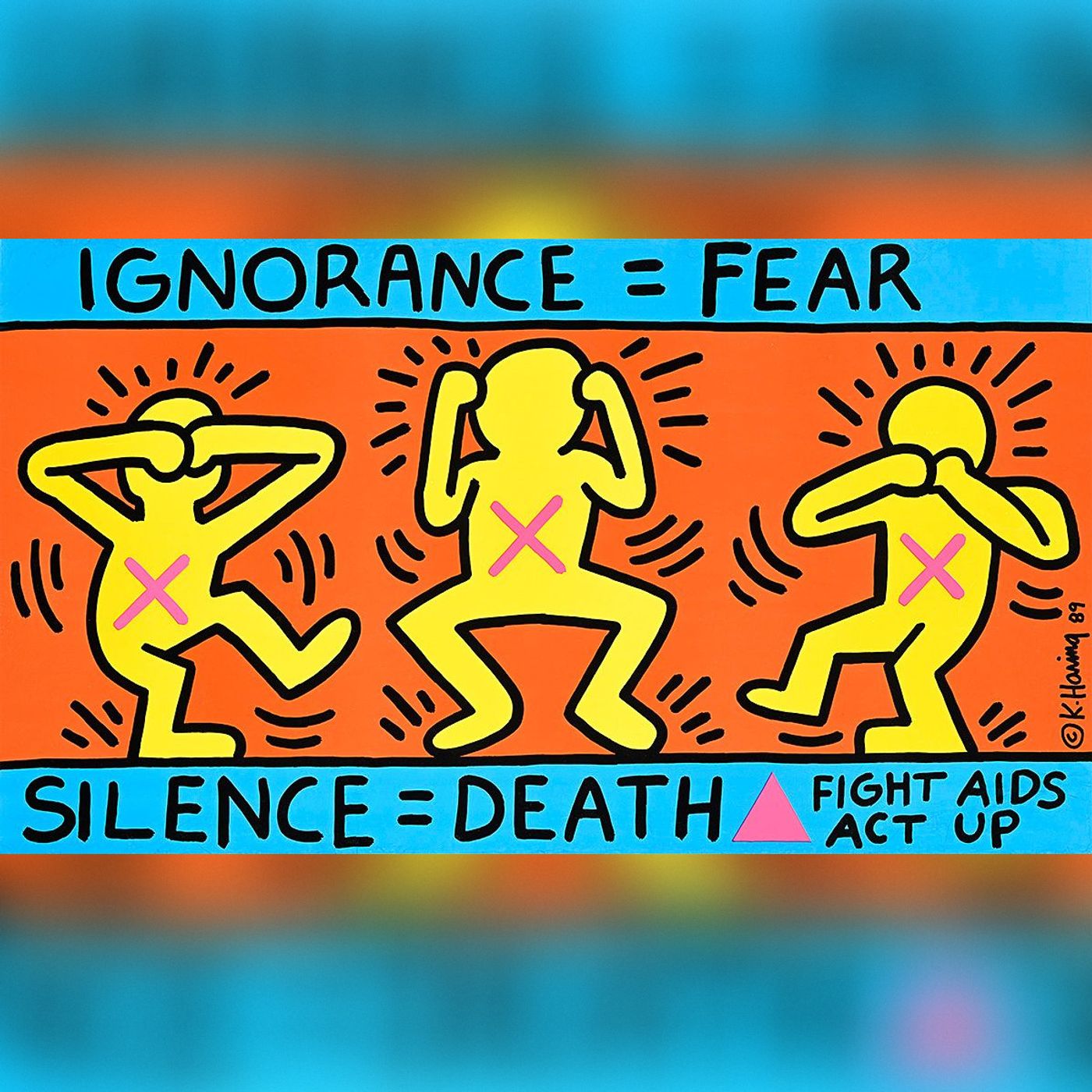
Absolutely. So design came in many forms and is expressed in a number of different ways through the posters. Earlier we were talking about community public health messaging and design enabled them to tell these stories directly and way that was familiar to their audience. Additionally, the fashion industry, as we said, and other creative communities were important early respondents to the epidemic. They were able to bring their tools and techniques of design, you know, typeface colors, logos, really eye catching posters that spoke to A number of different audiences simultaneously. All of this was brought to bear on the construction of public messaging in the form of the posters. Additionally, we know that Broadway Cares was another early respondent to the epidemic, using the famous musical and theater stages of the city to raise money and awareness. Additionally, design was critical in the advertising of fundraisers and and dance party fundraisers, which were essential economic engines for the response. Certainly the government response and financial response was slower and insufficient. So organizations had to very early figure out a way to self fund. And then perhaps most importantly, design was critical in the activist and advocacy messaging. I think everyone is likely familiar with the works of Keith Haring. The Silence Equals Death poster is among the most well known icons of this era. And the Silence Death Collective themselves created this poster. Before there was a direct action response, it was almost a poster that was in hope of a direct action response that generated just months later, the ACT UP organization and movement that I think people are very familiar with and associate with this period.
- [13:42]
B
And when you think about all the different messages, were there conflicts between activists over messaging styles? How best to communicate? What should we communicate?
- [13:53]
C
Yeah, I mean, that's a great question, right? I think organizations were operating in an environment of limited information and adverse political moment as well. So there certainly were a difference, a number of differences of opinion in how they should approach the issue, how they should think about funding, how they should think about the government. Some favored more of a service oriented response, others favored more of a direct action response. I think that what was the most powerful though is that all of these things were happening simultaneously. There doesn't need to be one single response that is successful. It's the combination of strategies and the enormous breadth of techniques and tools and skills, access and finances that made possible many of the successes of the era.
- [14:47]
B
And I wanted to ask about how did visual culture shape public understanding for a public that didn't really know what was going on? Is this the first interaction people are having with even hearing about something like HIV aids?
- [15:07]
C
I mean, I think it dramatically changed the public visual landscape. We have examples of posters that were displayed on subways and on billboards that were displayed sort of quite frank expressions of gay sexuality for the first time, very explicit discussions of safer sex for people in a gay sexual relationship. All of this would have been fairly new, especially in such a public sphere. But at the same time, I think the exhibition also takes us back to an era where the visual landscape of the public world was not so curated. If you walked around the city of New York, I mean today you have sort of, say, Instagram or Facebook. Your visual landscape is sort of determined by an algorithm. But to walk around the city of New York in 1980s was a cacophony of different ideas being fed to you simultaneously. And I think, I hope that the exhibition evokes that memory for folks who lived in the city at the time.
- [16:10]
D
Right.
- [16:10]
B
Remember the time where, like, every place you thought about walking into, you didn't click and check a review of.
- [16:16]
C
Right, exactly.
- [16:17]
B
Handheld device.
- [16:19]
C
Yeah, absolutely. And I think that what was so powerful about some of the advocacy and activist responses was that they knew this and leveraged it for their purposes. So you would have sticker versions of the blood on your hands poster that were on the toll booths that everyone had to go through to get on the highways. You would have the silence equals death sticker in the money machines, the ATM machines that sort of physically opened up, and they would just be plastered with them. So there was sort of a forced experience of the visual world that the activists fully understood and took advantage of to great effect.
- [16:59]
B
If you'd like to join this discussion, you can give us a call. 212-433-9692. That's 212-433-WNYC. We're talking about the exhibition Love and New York's fight against AIDS, which is on display at Poster House through September 6th. Talking with curator Ian Bradley Perrin. We have a text right here. Someone says, I worked at the Helen Hayes Theater at the time. Torch Song Trilogy. We lost several great actors. We didn't even know what was happening to them. But right away, we were doing what we could. Even before Broadway Cares.
- [17:37]
C
Absolutely. And I think that what I hope people take from the exhibition is the sense that everything was happening at the same time and so much earlier than many people imagine or remember. I think that small, informal gatherings where information was shared and money was. Was raised or happening as early as 1982 and 1983. That's remarkably early. We know that there were fundraisers well before there were formal organizations responding. And so what we see is these small sort of social, sexual, professional networks of individuals getting together, sharing information, and pooling what resources they had, be it money, skills, tools, techniques, materials to make a difference.
- [18:23]
B
You know, for the last 40 years, stigma has been considered a major barrier to an effective response to diagnosing and treating the disease. Talk about some of the misconceptions people held about the disease or people who contracted it within those initial years, and also how these posters really serve to fight the stigma and fear.
- [18:47]
C
Absolutely. I Mean, I think we all have a more recent memory of an epidemic where there's a lack of clear information and guidance. Right. So people's imaginations do run wild when you combine that with the early groups that were most affected by the HIV epidemic who at the time were fairly marginalized. So homosexuals, people who injected drugs. These are groups of people that society already have preconceived notions of. So there was an idea that maybe you could get it from a toilet seat or you could get it through kissing simultaneously. There was an idea that it only affected gay men, which was detrimental to all of the many people who had it who did not identify as such.
- [19:34]
B
Well, we have a comment coming in right now via text. Just a comment. AIDS became the leading cause of death for women ages 29 through 34 in the 1980s in New York City.
- [19:46]
C
Absolutely. And I think that there are posters that do respond to this directly. There's a well known poster that says, women don't get aids, they just die from it. And this spoke to specifically the fact that the CDC did not include women in the definition of AIDS until 1993. This was not only sort of an insult, but had material impacts because that definition was used to access a variety of state and federal funding that was needed to support people when they were living with aids. Today, women bear the brunt of the disease globally. This sort of long lasting misconception that I think people still hold has long, long lasting damage, but it's something that designers and artists were able to directly respond to through posters. We have in the exhibition, actually a book from the Women's Collective of ACT up. It is hundreds of pages of a variety of different research topics on women with aids. That's all community derived. And the exhibition actually has a number of books and publications available for people to browse as they're in the exhibition. So they're not in a case you can really sit down with them and experience what communities did at the time.
- [21:07]
B
Once again, the exhibition is called Love and New York's fight against AIDS. It's happening at Poster House through September 6th. And we're also taking your calls. 212-433-9692. And let's hear now from Thelma in Brooklyn. Welcome to all of it.
- [21:26]
E
Hi. Thank you. Thank you for taking my call. So I was just saying to the screener that I grew up in the 80s and kind of I was aware of HIV AIDS, but I wasn't really paying attention. And then I was living in Europe and for the first time I saw this giant poster by Benetton, the huge visual of the young man in his last stages before he passed from the disease, surrounded by people lying. And it was almost like a Jesus like figure. It was just so extraordinarily striking. And from that point on, I really. That image made it such a powerful impression that it stayed on my radar and still I remember it.
- [22:12]
B
Thelma, thank you so much for sharing that. What about that image, Ian?
- [22:18]
C
Absolutely. I'm really glad that you brought that up. It's called David Kirby's Deathbed. And this is part of a campaign from Benetton that became known as sort of shockvertising. They became very well known for this style. They would use it to both raise awareness related to issues, as well as, of course, promote their own brand and their materials as sort of a socially conscious brand. We have an example from Tuschini, who is the designer of the advertisement that our caller just spoke to, as well as a number of other ones. The one that we have is called aids, and it features thousands of images of individuals who passed away from aids. And at a distance, in relief, their images spell out the word aids. And it's an interesting. I feel like there's a tension within this approach from Benedett, and I am excited to have viewers come and see it and sort of think about it for themselves. We know that fashion, of course, is in the business of selling products, but as we were saying earlier, it was an industry that was hit extraordinarily hard by this epidemic, whose workers were deeply impacted by it. And I think that what's interesting is, on reflection, we often think of fashion as sort of perhaps superficial or jumping on trends, but in fact, the power of the fashion industry is to make something into a trend, to bring attention. And I think that the exhibition tries to give credit to that, referencing the works of one of our advisors, Natalie New Dell, who in her research found that in 1984, the fashion industry had already formed an organization to specifically respond to the AIDS epidemic. And I think that the Benetton poster is a later example of how that evolved over time.
- [24:17]
B
And just as we're wrapping up, how do you hope this exhibition contributes to ongoing conversations about hiv, AIDS and public health and stigma?
- [24:29]
C
Absolutely. You know, we're certainly in a different era than we were at the time. A lot more is understood about the epidemic, but. And the politics of the epidemic are once again shifting. I think that what I hope people take away from the exhibition, the posters, the work of communities, is the essentialness of coalition building in responding to critical issues. It was not one community, and I think the exhibition attempts to show this. It was many different communities with a variety of skills bringing these to bear in a response that was quite effective. So I think coalition building, working with people you wouldn't necessarily work with to achieve goals and bringing sort of yourself all of your skills, what you have and you can contribute is exactly what everyone did at the time and what yielded such fantastic results.
- [25:31]
B
Ian Bradley Perrin is a historian of HIV AIDS and curated the exhibition Love and New York's Fight against aids, which is on display at Poster House in Chelsea through September 6th. Ian, thank you for joining us.
- [25:44]
C
Thank you.
- [25:45]
D
Spring is starting at the Home Depot and we're bringing you low prices guaranteed so you can wake up your yard this season. Shape up your lawn with top brand outdoor power tools like this Ryobi 40 volt mower with up to 50 minutes of runtime. Bring in a splash of color with spring blooms and fresh plants from the Home Depot Garden Center. Then refresh your garden beds and keep them clear of weeds with Vigoro Mulch free bags for $10. Start your spring with low prices guaranteed only at the Home Depot exclusion supplies. See homedepot.com Pricematch for details.
- [26:16]
B
When I lost my sight, I found a way to win bank of America
- [26:19]
A
champions blind soccer player and coach Antoine Craig and everyone who dares to ask what would you like the power to do? Bank of America Proud to be the official bank of FIFA World Cup 2026 bank of America NA member FDSE.