Loading summary
Transcript67 lines
- [00:00]
Odoo Sponsor
WNYC Studios is supported by Odoo. When you buy business software from lots of vendors, the costs add up and it gets complicated and confusing. Odoo solves this. It's a single company that sells a suite of enterprise apps that handles everything from accounting to inventory to sales. Odoo is all connected on a single platform in a simple and affordable way. You can save money without missing out on the features you need. Check out Odoo at O D O o dot com. That's O D O o dot com.
- [00:32]
Firestone Sponsor
Your vehicle doesn't just get you from here to there. It's a bridge to the people and places that matter most. It's how you show up for your family, your community, and everyone else that depends on you. That's why for 125 years, Firestone has been building tires with one thing in to deliver products that are as reliable as you are. Firestone always dependable since 1900.
- [01:01]
McDonald's Sponsor
We know you'll always find ways to
- [01:03]
Ego Sabefia
look out for the people you love.
- [01:05]
McDonald's Sponsor
And with Amica Life Insurance, we'll help build a plan to make sure you always can. Visit amica.com and get a quote today.
- [01:25]
Alison Stewart
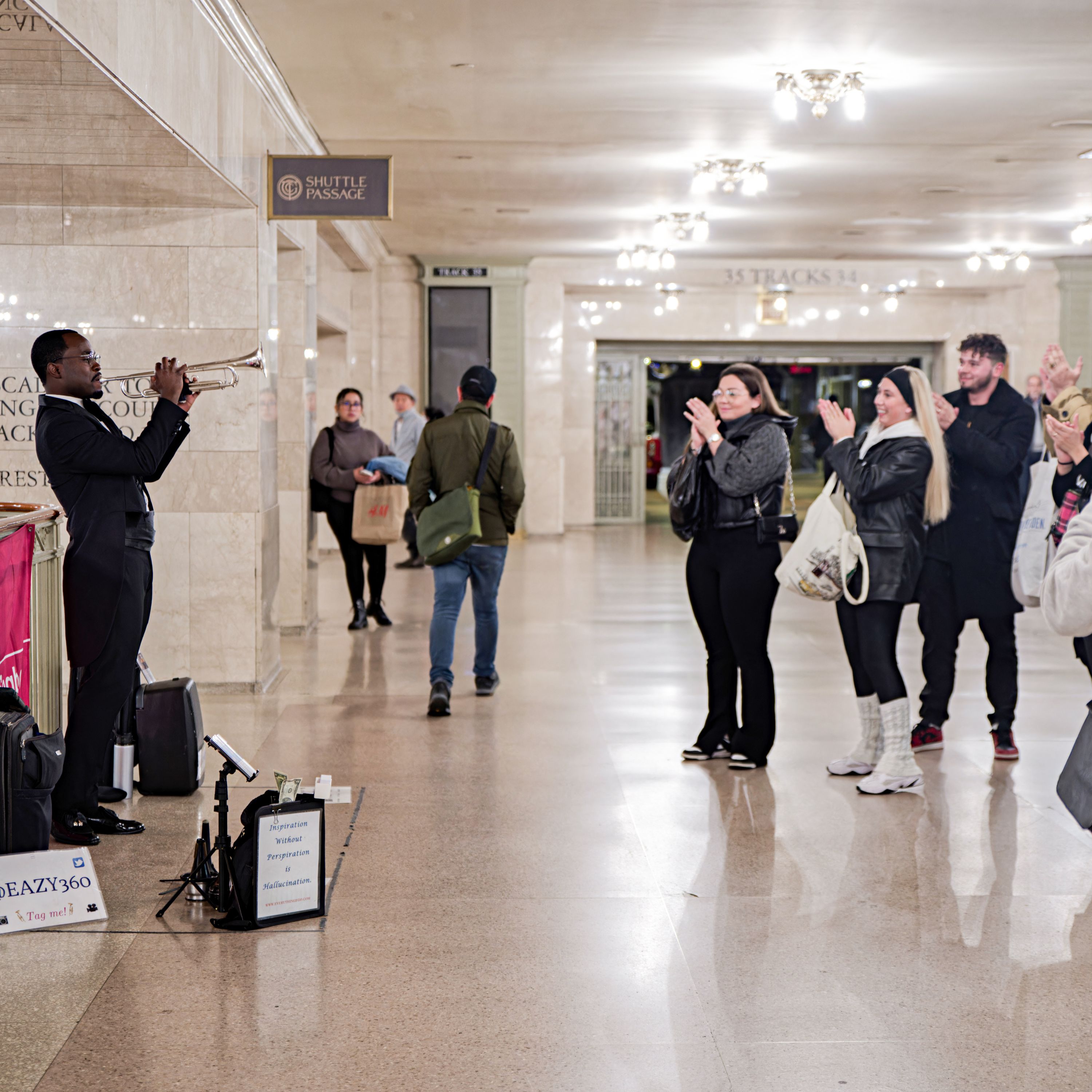
This is all of it on wnyc. I'm Alison Stewart. The MTA operates more than trains and buses. For many years, it has also operated the MTA's music under new York program, which brings thousands of live performers to the transit system each year. This year, the program is undergoing some changes, so we wanted to talk about it and also bring some of the music out of the subway and into the WNYC studios. In just a few minutes, we'll speak with one one of the MTA's featured performers, Trumpet player Eganam Sabethia. He'll also play some music for us. Hi, Ego.
- [02:00]
Ego Sabefia
Hi. Thank you for having me.
- [02:01]
Alison Stewart
But first, we'll hear from tina Vaz, the MTA's art and design program, the head of the MTA's art and design program. Hi, Tina. Hi. Why is it important for there to be music in the transit system?
- [02:13]
Tina Vaz
The transit system is not just a way to get from point A to point B. It's really the backdrop against which life plays out in its rich tapestry, especially in a place like New York. And so, as we do with all of our programming in arts and design, which includes visual art, graphic art, poetry and music, we want to be part of elevating that journey.
- [02:36]
Alison Stewart
What does it do for commuters?
- [02:39]
Tina Vaz
It does a lot of things. It really depends on what that person may be experiencing that day. For some people, it's a drop shoulder moment for some people. Maybe it gives them a spring in their steps. I think we really want to aim to create those interior moments for people that are so hard to find these days.
- [02:59]
Alison Stewart
How is the MTA's music programming changing this year?
- [03:02]
Tina Vaz
Well, for starters, we have rebranded as MTA Music, which replaces the music under New York name. We are celebrating our 40th year as a program collectively and music has been a part of the program since its very beginning. One of the things we are doing that's new this year is we've just introduced a new monthly station series which is focused on organized performances in celebration of cultural moments at stations, five stations across the five boroughs. And in fact, Alison, as we speak we are doing our Women's History Month celebration which is ongoing from 12 to 6pm today.
- [03:44]
Alison Stewart
I understand that you're going to be doing different months based on different celebrations. It's going to be September is Classical Music Appreciation Month, April is Jazz Appreciation Month.
- [03:54]
Tina Vaz
What will happen then? Well, we have ensembles scheduled for the five stations across the boroughs and that will be happening on April 23rd.
- [04:05]
Alison Stewart
How will you choose your performers, Tina?
- [04:07]
Tina Vaz
Well, historically we've had live auditions. Performers audition to enter the program and then when they join the program they go through an orientation so they understand the specifics about performing in the system. This year we are looking at ways to really more deeply engage the more than 150 performers we have on our roster who are already responsible for about 8,500 performances a year. So we really want to engage them and the Station series is just one of the ways that we are working to do that.
- [04:44]
Alison Stewart
What does the program do for the musicians?
- [04:47]
Tina Vaz
For the musicians? You know, I think these are musicians who have active careers outside of the time they spend in the subway. For some, a way of getting additional practice. For others, it's almost, you know, we have performers who have been with us for 20 years. It's just really a part of their practice. It's about connecting with people. It's about being part of the energy that moves New York.
- [05:16]
Alison Stewart
If someone wants a schedule to find out where they can see musicians, where should they go?
- [05:21]
Tina Vaz
They should follow us on Instagram taartsdesign or go to our website mta.infomusic and sign up for our newsletter.
- [05:30]
Alison Stewart
That's Tina, the director of the MTA Arts and Designs. We've been talking about musicians in the subway. Let's talk to one. This is Ego Sbefia. He's a trumpet player who's been performing in the Subway for years. How did you get hooked up with MTA music?
- [05:48]
Ego Sabefia
First and foremost? Thank you so much for having me. Of course, I got hooked up with MTA music because I was at school in South Carolina State University at the time, and New York's music scene was very small, and a friend of mine said, why don't you go on the subway and play? You never know who you'll meet. And I was adverse to it at first. And I went out and I played. And the first day I played, I made $8, 45 minutes. And I said, well, it's kind of like minimum wage when I'm, you know, at the work I was doing at the time. He said, go back and play again. So that same day, I went back and played. I made $45 in 35 minutes. And I said, well, that's the benchmark. And that was June 5, 2013, and I'm 13 years in it. And I've been blessed to say that I've made a little bit more than $45.
- [06:25]
Alison Stewart
All right, I'm glad to hear it. Could we hear a little music from you?
- [06:28]
Ego Sabefia
Absolutely.
- [06:28]
Alison Stewart
What are we gonna hear?
- [06:30]
Ego Sabefia
We're gonna hear Friend Like Me from Aladdin.
- [06:32]
Alison Stewart
All right, this is Ego Sabefia playing Trump. That was trumpet player Ego Sbefia performing Friend Like Me. So, Ego, how did you start get started playing the trumpet?
- [08:54]
Ego Sabefia
I started playing the trumpet in the fifth grade, about seven months after I moved to New York City from Lagos, Nigeria. My mom won the visa lottery, and so we migrated here.
- [09:06]
Alison Stewart
What do you like about the trumpet?
- [09:08]
Ego Sabefia
I love that the trumpet, the bell, and your eyes and your face have to face the same way in order to play. So whenever the sound comes out and you look at someone, your head is still in them. It's the one instrument that it's face forward. So you have to mean what you say, and you have to say what you mean. And that responsibility is something, you know, because a lot of the times, you know, we may say things. So that's one of the things I love about the trumpet.
- [09:35]
Alison Stewart
After you moved to New York, you lived in the Bronx, right?
- [09:38]
Ego Sabefia
Yes, please.
- [09:38]
Alison Stewart
All right. So what experience did you have with subway musicians before you became a subway musician?
- [09:44]
Ego Sabefia
So the experience I'd had with them was like, I almost looked down on them, you know, unfortunately, that was my ignorant way of looking at things until I was in that same footstep. And then I was like, wait. Oh, you gotta have. You really gotta be able to put yourself out there and be bold and take whatever comes with that. And now I have the utmost respect for musicians. Every musician I meet, I tell them, you gotta play in the subway and earn that.
- [10:10]
Alison Stewart
What do you learn by playing in the subway?
- [10:12]
Ego Sabefia
You learn everything, But I base it down to two things. Every day you gotta show up with a good attitude and a strong work ethic. That's the authenticity. That's the bedrock of authenticity. One cannot be without the other. And everything else will fall into place when it's supposed to fall into place.
- [10:28]
Alison Stewart
Are you up for another song?
- [10:29]
Ego Sabefia
Absolutely.
- [10:30]
Alison Stewart
Okay. What are we gonna hear next?
- [10:31]
Ego Sabefia
We're gonna hear you Got a Friend in Me from Toy Story. That's my jam.
- [10:34]
Alison Stewart
All right. Let's do it.
- [10:35]
Ego Sabefia
Yeah.
- [12:55]
Alison Stewart
We are bringing subway musicians out of the Station and into WNYC Studio 5. I'm speaking with trumpet player Ego Sibefia. You can catch him a few times a week playing at Grand Central Terminal as well as some other venues. But he joins me in studio now. What makes a good song to play in the subway?
- [13:13]
Ego Sabefia
How people react to it. A musician is a serviceman or service woman to society. You gotta play especially in the subway. In New York City, people are from everywhere. And so the music has to be a shuffle. It has to be a gumbo of that. You know, it's gotta be in that. I studied classical music, and I found very quickly New Yorkers will tell you what they wanna hear and how they wanna hear it. So that's how I choose. What songs in the subway.
- [13:43]
Alison Stewart
You primarily perform in Grand Central Terminal. What do you like about playing there?
- [13:48]
Ego Sabefia
First and foremost, it sounds like I'm in a cathedral when I play classical music. And there are times, especially when it's not as busy, where the sound can reverberate through. Another thing is there are four police agencies there. So safety is very important, you know, because people are putting tips in there. And so you can become a target really quickly. The third thing also is the foot traffic, the people. New York City is the executive capital of the world. And so most of the executives come from Westchester or come from Long Island. Now that Long island is connected to Grand Central. You know, there's a saying, you hang around a barbershop long enough, you get a free haircut. So there's a birthday celebrated every day of this year. And so if you're there and you're playing songs like friend like me, oh, I got my son. He's turning two years this year. Are you available? Yes, I am.
- [14:35]
Alison Stewart
I have to say that you look quite fashionable.
- [14:38]
Ego Sabefia
Thank you.
- [14:39]
Alison Stewart
That's very important. Why is it important how you look?
- [14:41]
Ego Sabefia
They say never judge a book by its cover. But appearances, everything. Also, it's a live audition every day, every time I'm out there. So if someone sees me in a tuxedo, the first thing they see is he's serious about what he used to. He's playing. And then also when I tried it as an experiment, it changed, literally, the way people spoke to me. When people come up to me, they come with you with respect. Also, you never see a police officer who's on duty without his uniform on. Same thing with the nurse, same thing with the firefighter. And in classical music, whenever you go see musicians on stage, they're always in a tuxedo. So if I'm gonna bring that experience, I have to honor that, and I have to make sure that I uphold that responsibility.
- [15:19]
Alison Stewart
Let's hear another song. What are we gonna hear?
- [15:21]
Ego Sabefia
We're gonna hear Bumble Boogie. And Bumble Boogie is the jam that I play usually during rush hour because people look like bees in a colony. And so sometimes the bumble. The bee has all four wings running. Sometimes people are limping. So he's going, let's do it.
- [15:36]
Alison Stewart
Let's do it. This is Ego Sibefia with Bumble Boogie. We are bringing subway musicians out of the Station and into WNYC Studio 5. I've been speaking with trumpet player Ego Sabefia. Do you have your favorite subway musicians you like to hear?
- [17:44]
Ego Sabefia
Oh, he put me on the spot.
- [17:46]
Alison Stewart
Next question.
- [17:47]
Ego Sabefia
I got a few. I got a few. But the first one is Gabriel Aldor, also known as Galdor Gumbo. And he was the first musician who came and spent time and listened to me. And he said, wow, I love your music. But also gave me some pointers. I love when people can be honest and be graceful and be honest and give you honest critique. And so I love that. I love his spirit. And I can see when he's playing, he touches people.
- [18:11]
Alison Stewart
Do you have connections with commuters?
- [18:12]
Odoo Sponsor
Do you have regulars?
- [18:13]
Ego Sabefia
Oh, my goodness, I've lost count. You know. I'll tell you a brief story. So I've been playing at the shuttle train station before the construction, and I was at Manhattan School of Music. I was taking 18 credits. So I'd play from 6am to 9am in the mornings, Monday through Friday. Then I'd go to school, and it was time for my master's recital. And I put a sign out there. It was three by four, just like I would do with my MTA music sign. And when I walked out on the stage at Manhattan School of Music for my master's recital. It was standing room only and it was to the point where people had to leave during intermission and more people came in. And it was something that really opened my eyes to understanding how I was connecting with people in such a short instance of time. Because people are running back and forth going, but they see like, oh, wow, I gotta support him.
- [19:04]
Tina Vaz
Him.
- [19:04]
Ego Sabefia
And they come and they show up. And as a musician, you're standing in one spot and you're seeing people going, and it's very easy for you to see and say, oh, well, maybe no one's listening. Maybe no one's, you know, because their days, every day is different. You're not going to make the same amount of money every single day and you don't know what tomorrow brings. But that was the one reason. So regulars, there's so many. And then during the holiday season, people have brought me cards, people who I don't even think I know, they put a card in and then I open it and it says, oh, wow, I love seeing you here every day. And. And you know, there were times where I didn't want to go to work, but I'd see here at six in the morning and I'd say, well, if he's able to come to work without no expectation, I should be able to come to work as well.
- [19:41]
Alison Stewart
Will you play us out? What's our last song?
- [19:43]
Ego Sabefia
We're going to hear Someone to Watch Over Me, that song because I believe that God is watching over us and that's. I'm a very religious person. I'm a Christian and it's not a Christian song, but Someone to Watch over Me, that's my connection to it.
- [19:57]
Alison Stewart
This is Ego Sabefia playing Someone to Watch Over Me. Sa.
- [23:22]
Odoo Sponsor
WNYC Studios is supported by Odoo. When you buy business software from lots of vendors, the costs add up and it gets complicated and confusing. Odoo solves this. It's a single company that sells a suite of enterprise apps that handles everything from accounting to inventory to sales. Odoo is all connected on a single platform in a simple and affordable way. You can save money without missing out on the features you need. Check out odoo@O-O-O.com. that's O D O O dot com.
- [23:53]
McDonald's Sponsor
Our HBCUs have a legacy that's straight up golden, and McDonald's is proud to help keep it that way. Since 2021, the Golden Arches has connected with the Thurgood Marshall Colle fund to provide $1 million in scholarships for students headed to our HBCUs. That kind of cash helps keep bright minds on the yard dreams within reach and the future golden. Learn more about McDonald's black and positively Golden Scholarships at mcdblackscholars. Com.