Loading summary
Transcript44 lines
- [00:00]
WNYC Studios Announcer
WNYC Studios is supported by Odoo. When you buy business software from lots of vendors, the costs add up and it gets complicated and confusing. Odoo solves this. It's a single company that sells a suite of enterprise apps that handles everything from accounting to inventory to sales. Odoo is all connected on a single platform in a simple and affordable way. You can save money without missing out on the features you need. Check out Odoo at o d o o.com that's o d o o.com.
- [00:38]
Alison Stewart
This is all of it. I'm Alison Stewart live from the WNYC Studios in soho. Thank you for spending part of your day with us. I'm grateful you are here. On today's show, a film series at Lincoln center celebrates the career of Diane Keaton. And we want to hear your favorite Diane Keaton performance. Then the Oscar nominated cinematographer behind gorgeous film Train Dreams breaks down his craft. And we'll be talking about all those sports betting ads and how they're changing the game itself. But we wanted to give you a quick reminder about our February get lit with all of it book club selection. We are reading the Wilderness by Angela Flournoy. The story follows a group of black women and their friendship through good times and bad in New York City and Los Angeles. It's about chosen family, social justice and navigating the challenging wilderness of young adulthood. Angela Flournoy will be with us at the Stavros Niarchos Foundation Library for a Get lit event on Monday, February 23rd. Tickets are free, but they are first come, first serve. And we have an exciting update. Our February musical guest hand picked by Angela Flournoy will be jazz musician Emmanuel Wilkins. Wilkins was a nominee for Best Alternative Jazz Album at the Grammys just last weekend. That's a live recording from our studio of Wilkins playing the song Motion from that album. And on February 23rd, you'll get to see him live at the Stavros Niarchos Foundation Library. Head to wnyck. Org get lit to get your tickets now. And to find out how to borrow your copy of the book from the New York Public Library. That's in the future. Let's get to now. We let's get to now. You know what I'm thinking about?
- [02:48]
WNYC Studios Announcer
I'm thinking about No.
- [03:33]
Alison Stewart
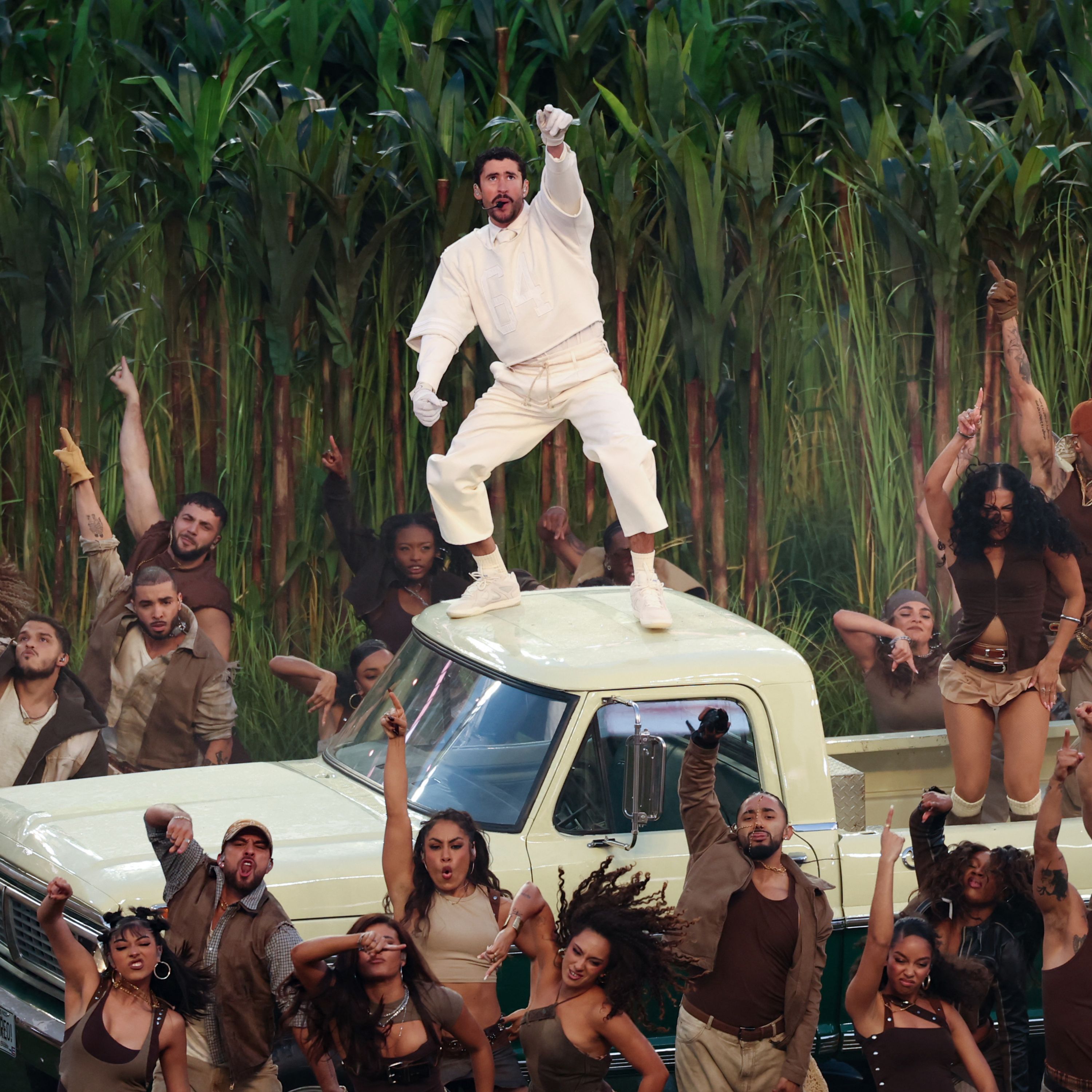
I hope that Benito Antonio Martinez Ocasio, AKA Bad Bunny, got a good night's sleep last night after giving a joyful and emotional super bowl halftime show performance. Fresh off the heels of his historic Album of the Year Grammy win, the first Time, a Spanish language album won. The show took place inside the Levi Stadium at Santa Clara, California. It opened with the artist inside of a field performing his hit song Titi me Procunto with Ibaros farmers harvesting sugar cane. Later, he made his way to the bright pink casita, a fixture which has become a staple of his recent tour. Bad Bunny performed a career spanning set of 14 songs in 13 minutes. He also featured surprise guests such as Ricky Martin and Lady Gaga. Those are just two of the cameos. Others included New York City's Caribbean Social club owner Tonita Actro, Pedro Pascal, Bronx raised rapper Cardi B. It was her song I like it like that. That many in the American mainstream first heard of Bad Bunny. Joining me to talk about the 2026 Super bowl halftime show is NPR's alt Latino and tiny desk producer, an Maria Sare. Hi, Anna Maria.
- [04:45]
Ana Maria Serra
Hey, how's it going?
- [04:46]
Alison Stewart
It's going forward. Thanks for joining us. Hey listeners, we want to hear from you. What did you think of Bad Bunny's halftime show? Which moments or themes are living rent free in your head? Did the performance hit differently for you culturally, politically, emotionally? What do you think he was trying to say? And did it land our phone lines? They are wide open. Our number is 2124-3396-9221-2433 wnyc. You can call and join us on air or you can text to us as well. All right. What are the three words you would use to describe your reaction to Bad Bunny's super bowl halftime show? Anna MARIA.
- [05:28]
Ana Maria Serra
Wow. Three words. There was about an essay and a book of references packed in there, but I would say thoughtful, inclusive and loving. Loving.
- [05:43]
Alison Stewart
What is the musical moment that has, that struck you as being spot on? And what is a cultural moment that has stayed with you?
- [05:54]
Ana Maria Serra
I mean, talking about musical and cultural moments, when talking about Benito, they're, they're so intrinsically linked, it's, it's kind of impossible to separate them. So I would say one that felt really significant to me that I think is at this point, at least within the Latino community, a little bit controversial. Controversial is the use of Lady Gaga, actually, and that particular song, you know, die with a Smile, which is one of her latest, biggest hits, I think. You know, I heard a number of people reacting after the show saying that that was kind of him pandering maybe to an American audience, a white audience or to say a United States pop audience. And I actually think that there was something really significant about using, you know, a widely popular mainstream pop US Song Although most of his music is arguably mainstream pop now and doing a salsa arrangement, I think there's something really significant about including her, especially in such a rich and important cultural moment. Like what that scene he had of the wedding, which is such a key, you know, tenet of Latino life. I think that there's this sense of the fleetingness of life in a lot of Latin America, the importance of surrounding yourself as much as possible with family, with the people you love, and to dance and to enjoy life, because you really just don't know how much of it you have or how long you have it for. And so I think to include Lady Gaga not only doing salsa, but singing a song that thematically feels fits quite perfectly into a very Latino way of living, to say, hey, I just want to have you with you as long as. With me as long as I can. I think that felt really beautiful. It felt really human. It felt really like we all feel that way, that we want to love life and love the people around us, and that life can feel fleeting. And so that felt really important to me also, obviously a nod in many ways to the queer community, to a consistent love I think he's had of Lady Gaga. And then musically, I mean, Ella Pagon felt so important and incredible to me. The moment where he stands on top of those Luma energy light, light posts and he sings with his full chest. You know, everyone in the world wants to be Latino, but they. They lack, as he says, the. The seasoning, the. The drums and reggaeton. And I think, you know, when he originally released that song, it was this really incredible mixture of protest and party, right? Like, it's one of his most pointed protest tracks where he talks about all of the things that are hard about life in Puerto Rico, and then he goes on to celebrate it, right? Like he says, but it's. It's amazing to be Puerto Rican. It's amazing. Puerto Rico is amazing. That's the chorus of that song. And I think over the years, that line specifically about everyone wanting to be Latino, I mean, it's one of the things. You go to the club in Latin America and everyone has to stop and sing that line with their full chest because there's so much universal pride around it. And so I think for him to choose to mount, not a pedestal, a castle, some grand podium to sing that line, but to mount this symbol of frail infrastructure in Puerto Rico, one of the things that makes life in Puerto Rico so hard and to sing about what makes being Latino so amazing. I mean, there's something really Striking about that moment musically and culturally.
- [09:30]
Alison Stewart
Yeah. Raphael online, too, is calling in from a story with that exact point. Hey, Rafael, thank you so much for making the time to call all of it.
- [09:37]
Rafael
Oh, thank you. Yes, I agree with what she just said about Elapagon. You know, I'm a New Yorkan, which is, you know, born in New York and raised by Puerto Rican parents, you know, raised on the culture. But I thought it was brilliant because he not only pushed back on that the corruption and the collusion between corrupt Puerto Rican officials in the United States of fleecing the people of light and energy for life, but they weren't men. The people on the polls were women. So it's like a double whammy, a double statement of feminism, and also push him back, you know, with this protest, while at the same time celebrating all the good stuff when he crashes through the roof of a wonderful, humble, you know, Puerto Rican home. You know, very typical, the wedding. You know, I understood this morning that that was a live wedding, family value, you know, and the set was just fantastic, you know, so it was brilliant. You know, it makes me very, very proud of, you know, being a Puerto Rican.
- [10:45]
Alison Stewart
Thanks, Rafael. Let's talk to Mary, who's calling from White Plains. Hi, Mary, thanks for taking the time to call, all of it. What did you think of the halftime show?
- [10:54]
Mary
Oh, my gosh. I think we all, like, woke up so beautifully. And you know what? He did a great job. He held his own like he of course would. And I do agree with the last caller as well as the one previous to that, because I did catch the Luma reference because I was trying to figure out the whole length, but that even with all its challenges, Hurricane Maria, the apagones, and the economic, social challenges that we have, that we still rise, that this island continues to grow and it's a home for everyone and anyone. And you know what? The United States is the only place that we do not accept multi languages. And how important is that we can rise to the occasion if we allow people to speak what they speak and not penalize them. So it was definitely a moment of protest. It was a moment of pride. It was a moment of sheer, like, this is who we are as a people, but also globally, that it doesn't have to be one or the other.
- [12:08]
Alison Stewart
Thank you so much for calling in. Marie Anna. Marie, I want you to listen to this text. It says, I did not expect to tear up on the Super Bowl. Hearing all the countries named out loud, Brazil included, hit me in a way that I didn't Expect feeling so proud. Us Latinos really needed this. Obrigado, Benito. And you know, what was always interesting about the show is it was sweet. And I mean that in the best sense of the word. There was a marriage on stage. We'll get to that. There were callbacks to the elders. There were lots of little kids, a lot of body diversity. What do you think Bad Bunny was trying to convey about identity and belonging?
- [12:48]
Ana Maria Serra
You know, it's really not out of place. Everything you just described, which I think you're 100% correct about it being very sweet and cute. This might be a niche reference, but I said last night, I was like, it kind of reminds me of in 13 going on 30, when she kind of like succeeds at fixing her newspaper by going back to the things that we all recognize, right? Like to childhood and sweet moments and. And these very, like, family oriented things. And this is something he's been doing. I mean, Benito, over the course of his career, has been a master in nostalgia. All of his songs are like, they're love songs that are actually, I'm heartbroken already remembering you. I mean, that is literally his craft, his strength. And what he did in this last record is he took that and he made it about Puerto Rico, about home, about family. Family love, mutual support is so Puerto Rican. It just culturally is. And so, you know, really, he just took that to another level on a bigger stage. I mean, doing things that, like, the image of the kids sleeping on the chairs is one of the most probably universally Latino images he could have invoked. It's like, you want your Latino card. You fell asleep on the chairs at the party. That's what that is. And so he took those things and it fit right into this larger message which he posted in huge letters at the end of the show, which he said in his Gramm speech last week, notably both times in English, he said, love is bigger than hate. Love is more powerful than hate. And I think, you know, tapping into family, tapping into childhood, tapping into the things that make us fundamentally us is. Is the easiest way to communicate that and also the easiest way to. To show that we, you know, we all were young once, we all have loved. And. And those are things that I think are really powerful sentiments to. To pull on.
- [14:40]
Alison Stewart
We're talking about Bad Bunny performing at the 2026 Super bowl halftime show. Reflecting on his performance with NPR's Alt Latino and tiny desk producer, Ana Maria Serra. Listeners, we want to hear from you. What did you think of Bad Bunny's halftime show? Which moments or themes are living Rent free in your head. Did the performance hit differently for you? Culturally, politically, emotionally? Our number is 212-433-969-2212-4333. WNYC. This is a really interesting text, Anna Maria. It says I really love the performance and as a non Spanish speaker, appreciated the realization of how much entertainment is centered around English speakers and the sense of exclusion one might feel if they don't speak or understand much English. Having that flipped was really interesting to me. And despite that, it felt specially specifically and intentionally non exclusionary.
- [15:39]
Ana Maria Serra
Yeah, I love that. I think that is such a key tenet of what Bad Bunny does. I mean, the whole performance, right, was this reimagining of what American means to say that America is two continents that includes everyone in those two continents. And I think the point, his point in doing that is oftentimes as he does to decenter the United States. And you know, that is a very real thing that most people in other parts of the world, I wouldn't even say just Latin America, they are accustomed to having to conform to watching English speaking media, to watching, you know, media that's dubbed, to consuming a lot of things that are not intentionally made or translated for them. That's not a feeling of discomfort that most people in the United States have to, to experience. And so what Bad Bunny is doing is not saying, hey, Spanish is, is the only way or the supreme way, he's saying, but it is a way and it's. And it's an equally valid way. And, and it's, it's something that deserves to exist in its original form without any translation. And that shouldn't be a problem.
- [16:47]
Alison Stewart
Let me ask you about the music. 14 songs. What are your thoughts on the songs he chose to perform?
- [16:54]
Ana Maria Serra
Oh my goodness. It was, it was all. It was so much of the greatest hits, right? It was. He's this master. He really is a master in making people dance. I mean, no matter who you are, where you're from, I get asked all the time, they're like, why? What makes Benito so infectious for people who can't understand it, I'm like, well, I'm not quite the right person to answer that, but I think it's just that you can't not move. And there's something really powerful and magnetic about that. And so he made sure you know, to keep, keep all of the energy up, to keep all of the songs super danceable. But they were also songs that are meaningful. You know, Cafe Conran, El Apadon Lo que Le Paso Hawaii. And you know, all of these songs are. Yes, they're even Nueva Yol. Right. Like that is a super upbeat, amazing, fun song. And it's also, you know, it's meaningful because it's speaking to, it's reaching out to. It's including a New York Puerto Rican diaspora that you. That isn't always included in conversations about Puerto Rican culture.
- [17:55]
Alison Stewart
This text says part of the beauty was how he made it not about himself, but about all of us. Let's talk to Julie from the Bronx. Hey, Julie, thanks for calling in.
- [18:06]
Ana Maria Serra
Hi. Thanks for this really great show. It was a very exciting moment. I think you're correct that this show is going to spurn a cottage industry and PhD theses about the references to. And our family was discussing many of the incredibly brilliant references that were integrated into the performance. And one of the things that we'd been discussing was when, and I think they were women who were climbing the Luma power plant poles at the end. We felt that that might have been like a reference to Taino culture where people were known to climb trees in quite sophisticated manners.
- [18:43]
Alison Stewart
That's an interesting point. Thank you, Julie, for pointing that out. Let's talk to Peter in Florida. Hi, Peter, thanks for calling, all of it.
- [18:51]
Ana Maria Serra
Hi.
- [18:52]
Rafael
A first time caller, longtime listener.
- [18:55]
Ana Maria Serra
I really love the show as a Bronx native and queer New Yorker. But I think what stood out to me most palpably is, you know, so much of the national conversation in the media these days is directly tied to.
- [19:08]
Rafael
Trump, Trump's name, what Trump's doing, and.
- [19:12]
Ana Maria Serra
Just the fear mongering that this administration is known for. And I saw Bad Bunny's entire performance as a counterbalance to that. Just really such a celebration of Latino culture, but also a celebration of community, a celebration of life, a celebration of the beauty that can happen when we all come together. So I really enjoyed it for that.
- [19:36]
Alison Stewart
Thank you so much, Peter. Yeah, it's interesting, Anna Maria. It was the most un Trump like thing I've seen in years.
- [19:45]
Ana Maria Serra
Yeah, I would agree with that. And you know, he had something to say about that too after the performance. But I think that the, you know, Bad Bunny focus is not particularly ever on his adversaries. It's always on love. It's always on. On, you know, talking about what makes Puerto Rico and by extension Latin America so amazing. He doesn't really focus in his imagination. There is no, no, there is really no adversary besides the limits of what he can dream up. And I think that that was really communicated in the performance.
- [20:21]
Alison Stewart
I wanted to ask about his inclusion of Ricky Martin, in the performance, he sang Loke La Opasia Hawaii. It's a song that reflects. Thank you. It reflects on the similarities between Hawaii and Puerto Rico. And there are political undertones to this song choice. Why do you think he wanted to include it? And why do you think he wanted to include specifically Ricky Martin?
- [20:47]
Ana Maria Serra
You know, I think Ricky Martin was a really beautiful selection for that song. It's important to note that that is a song that he sang every single night of his 31 show residency in Puerto Rico over the summer. And he always, pretty much always takes a different artist to sing that song. And I think, you know, in many ways I've kind of thought of that as his way of being like, this song is for everyone. It includes everyone. It's a very explicitly political song that essentially warns Puerto Ricans that he doesn't want Puerto Rico to end up like Hawaii, which would be statehood primarily, and would also be what I think he sees as cultural erasure or cultural reduction. And so, you know, choosing different artists from different places, I think that's really his way of being like, this is a universal story. It's an important story. Ricky Martin specifically, I mean, he's a legend. He's a legend from Puerto Rico. He represents Puerto Rico well. He actually published an op ed last week congratulating Benito for his Grammy win. And he said something to the effect when. When it's important that you remind us basically that when. When Puerto Rico wins, when someone from Puerto Rico wins, we. We all win. And so I think that that was something, you know, that including him on that stage felt this, like this really nice closing of the circle, some of the values of Puerto Rican artists and culture and life. And that there's this really, this sense of mutual support and. And like many people say, you know, when they see Bad Bunny succeed. A lot of my Puerto Rican friends have told me that they're like, it's like watching a primo succeed. And so I think that, like, that stamp from Ricky Martin on that stage and also that that mutual love back from Benito.
- [22:41]
Alison Stewart
What did you make of his storytelling ability through this, these 13 songs, 14 songs.
- [22:50]
Ana Maria Serra
Oh, I mean, the one thing that I expected leading up to this was that what we would see was a complex Puerto Rico. One, a complex Puerto Rico, and two, a Puerto Rico really in his image. Puerto Rico is tough. Life is hard. There's a lot about it that's hard. And I think that Benito has never been afraid of representing that, talking about that, and then by extension, and through his art, showing why Regardless, Puerto Rico is magic. It's resistance, it's resilience. And so I think what he really focused on doing there was saying, this is every single part of what we are. And look at how colorful and danceable and energetic and beautiful this is. So that's what it really was to me. The story he told there was one of Puerto Rican love and supremacy, perhaps, and also one that included a New York and larger global diaspora. And then beyond all of that, you know, it was this, this reminder that, you know, America is America and Puerto Rico as this place that has long been kind of outside of both the US and Latin America, not quite fitting within either. It became this perfect vessel to unite those two things, to make Latin America feel at home on an all American stage.
- [24:20]
Alison Stewart
This text says it was a beautiful show that made me really emotional as a non Latinx woman. I loved his refusal to translate himself. You know, what I wanted to bring up was that was a real wedding on stage.
- [24:35]
Ana Maria Serra
It was. It was so great. There was a couple. Yeah, it was amazing there. And it's so, I mean, by. Is so endlessly creative and silly and kind of like a forget all the rules kind of person. And basically that couple had reached out to him, being like, hey, do you want to come to our wedding? And Benito said, how about you come and get married at my super bowl halftime show? Which I think is just excellent. And so, I mean, he never takes anything too seriously. And he's always willing to kind of play and, and try new things and do the unexpected and not in a, you know, how big can my lights be and how, how flashy can my performance be? But hey, what if I just did something authentic on stage?
- [25:21]
Alison Stewart
I have to ask you, what was the 64 he was wearing when he on his jersey?
- [25:25]
Ana Maria Serra
You know, there's a lot of speculation about that. It's unclear. Some people are suggesting that it's referring to the. The initial confirmed deaths after Hurricane Maria. Some people say there's an association with his grandpa. I think actually that the more notable and exciting and sweet thing to me was the Ocasio on the back of that jersey, which was choosing to use his mother's name. And that's something. I mean, we saw him literally two days before the super bowl crying on stage about his mother, saying that he never would have gotten to where he is if it weren't for. Not the way that she believed in his greatness as an artist, but his greatness as a person. And I think that who he was as a person was in every detail last night on stage.
- [26:13]
Alison Stewart
Let's take one more call. Gabriella is calling in from Rye. Hey, Gabriela, thanks for calling all of it.
- [26:20]
Ana Maria Serra
Hi, I, I'm, I'm calling because this discussion about all the Spanish made me think about English speakers and how they're just used to everything being understood by them and being translated into English. And when you go to foreign countries, people speak English to you. And I really think that if you only listen to music that you understand all the words, you may be limiting yourself. Like, I really love and I don't understand half of it because I don't speak all those languages and. But I still love it. And I can't imagine what my musical life would be if I limited myself to only music I could understand the words of.
- [26:56]
Alison Stewart
Thanks for calling in. Ana Maria. Anything else you want to say about last night's show?
- [27:02]
Ana Maria Serra
I think we'll all be talking about it for a really long time and I, and I also think there that we may be unlocked a new Bad Bunny era. I think. You know, he wiped his Instagram last night right after the show. And, and I think the note, the final message was, I'm now not just speaking to Puerto Rico. I'm not just speaking to Latin America. I am speaking to America, period. And I think that that might create some really interesting messaging and music to come soon.
- [27:29]
Alison Stewart
I've been talking about Bad Bunny super bowl halftime show with NPR's All Latino and Tiny Desk producer Anna Maria Ser. Thanks for making the time today.
- [27:39]
Ana Maria Serra
Thank you.
- [27:40]
WNYC Studios Announcer
WNYC Studios is supported by Odoo. When you buy business software from lots of vendors, the costs add up and it gets complicated and confusing. Odoo solves this. It's a single company that sells a suite of enterprise apps that handles everything from accounting to inventory to sales. Odoo is all connected on a single platform. In a simple and affordable way. You can save money without missing out on the features you need. Check out Odoo at o d o o.com that's o d o o.com finding ways to be financially savvy is a smart move. And knowing you could be saving money for the things you really want, like that dream home or new ride is a great feeling. That's why the State Farm personal price plan can help you save when you choose to bundle home in auto bundling. Just another way to save with the personal Personal price plan. Prices are based on rating plans that vary by state. Coverage options are selected by the customer. Availability, amount of discounts and savings and eligibility vary by state.