Loading summary
Transcript112 lines
- [00:00]
A
Foreign.
- [00:08]
B
This is all of it. I'm Alison Stewart live from the WNYC studios in soho. Thank you for sharing part of your day with us. I'm really grateful that you're here. On today's show, New York Times award show columnist Kyle Buchanan joins us to talk about the recent golden globe nominations. Musician JSAM performs live in Studio 5. The band is over there. There are so many of them and they sound. And we'll hear about the new podcast, David Green is obsessed from the host himself. That's the plan. So let's get this started with Wake Up Dead Man, a Knives out mystery.
- [00:54]
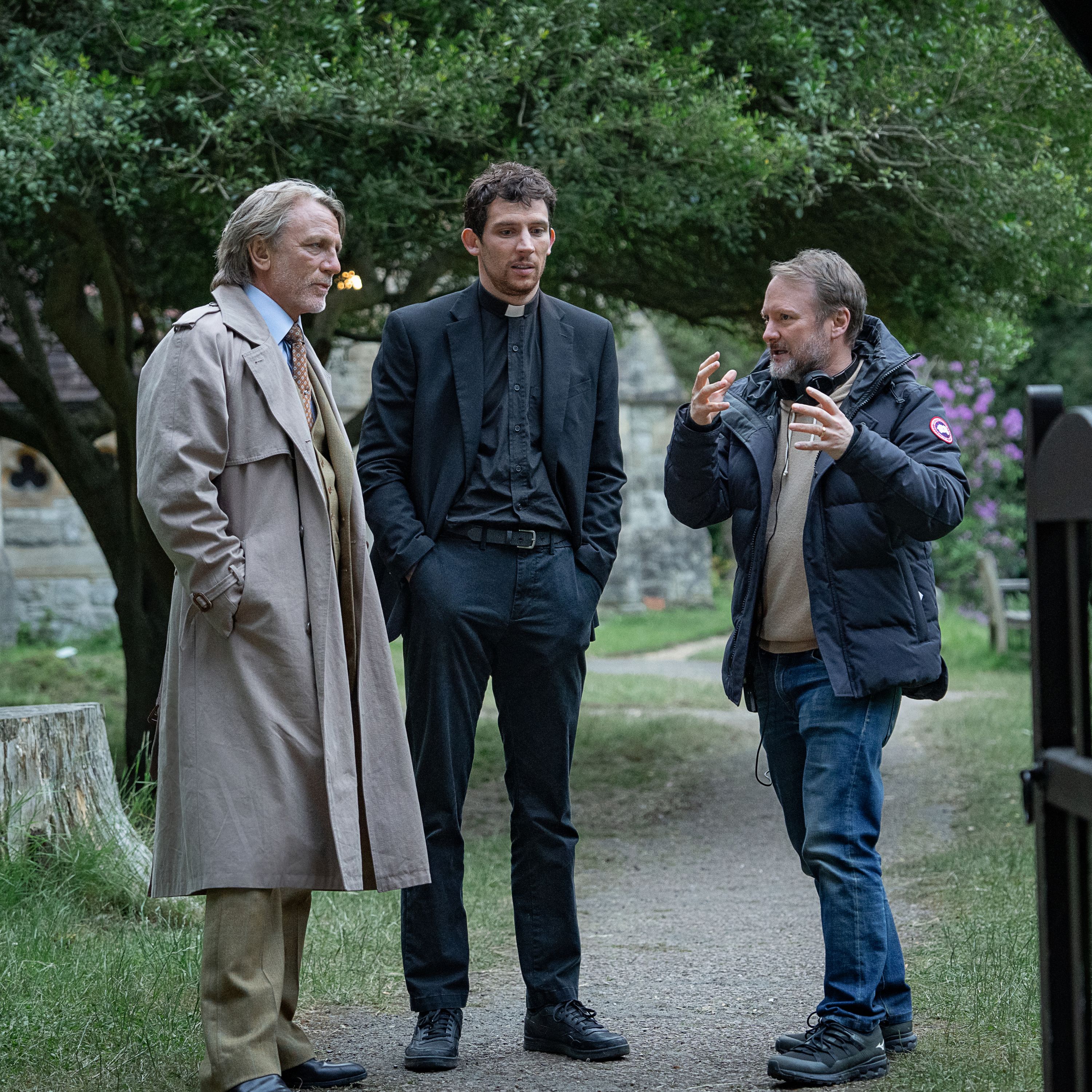
After New England mansions and Greek islands, Knives out has headed to church. The third film of the series brings together a new group embroiled in a fresh murder mystery. But many are also reckoning with their faiths. Josh o' Connor plays a young priest, Father Judd, who has had a troubled past that led him to God. But he still can't shake his violent past as a boxer. To help, he's been sent to church in upstate New York led by Monsignor Jefferson Wicks, played by Josh Brolin. Right away, there is tension between Judd and Wicks. Judd prefers a gentler approach to priesthood, but Wicks maintains a cult of personality over his flock. He's controlling and embraces a warrior like mentality of what it means to be a priest. And he has a great head of hair. Wicks also has his own secrets and desires, all of which results in a murder mystery now familiar to Knives out viewers and perfected by writer and director Rian Johnson. Of course, the ensuing whodunit investigation is led by everybody's favorite dapper detective with a deep Southern drawl, Benoit Blanc, portrayed by Daniel Craig. The film is called Wake Up Dead Man, a Knives Out Mystery. It's out on Netflix this Friday. Written and directed by Rian Johnson, who is sitting across from me in studio. Hi, Ryan.
- [02:14]
A
Hey, Alison. How are you?
- [02:15]
B
I'm doing okay. I wanted to ask you about the pronunciation of the film. Is the stress on man like wake up, dead man or is it Wake up, dead man?
- [02:24]
A
Well, you can also, by putting a comma, you can different places, you can mess with it. Wake up, dead man. Wake up, dead man. I don't. You can. It's a command. Wake up, dead men.
- [02:35]
B
Wake up, dead man.
- [02:36]
A
All right, let's do it. Let's wake up.
- [02:38]
B
I wanted to get that out. Okay. So the story takes place in a church and previously you were in New England and you were on the Greek islands. How did you decide for the premise and the setting of the third movie in this trilogy.
- [02:51]
A
Well, I, I, I really want each of these movies, each time we do them, to give the audience something very different. And it's kind of modeled after the inspiration for all of this, Agatha Christie. And she tried something incredibly different with each one of her books. And so with this one, I wanted to ground it a little more. And I thought it'd be fun to take it to sort of more of a gothic kind of tone. So that led to the church. But there's also a big reason it also takes place in a church and has to do with faith, is because I wanted to also make it personal. I grew up very Christian.
- [03:28]
I was devoutly Christian up through my early 20s. And I'm not a believer anymore. And so it's something I have a lot of personal feelings about. So trying to see if I could have a generous multifaceted conversation about that topic in a big fun Benoit Blanc mystery seemed like an interesting challenge.
- [03:48]
B
How would you describe your faith at the moment?
- [03:53]
A
Well, how much time have you got?
- [03:56]
B
Public radio? We have a lot of time.
- [03:57]
A
I mean, look, like I said, up through my early 20s, I wasn't Catholic, I was evangelical Protestant, I was a youth group kid. But I was deeply, personally Christian. And my relationship with Christ was what I framed the entire world through. So today I don't consider myself a Christian. I'm not like a hardcore atheist, but I don't really have an active belief in God. But still, I mean, that's such a foundational time in your life. And as anyone who grew up with faith will tell you, the shape of that never quite leaves you. And it's something you're in dialogue with for the rest of your life, I think.
- [04:36]
B
How did it help you write this script?
- [04:38]
A
It was essential. I mean, first of all, I don't think I would have attempted the topic if I didn't grow up in it and have personal experience with it. Because as a Christian, when I was younger, I also remember being so acutely aware of feelings of when Christians are portrayed in pop culture, culture things, and how they can sometimes just be sort of dumb or cruel caricatures, I guess. But also because the only way to write honestly about the topic, I think, is to come from a place of personal experience with it. So the movies, I mean, it's not a faith based movie. It's very honest. It's very, you know, very multifaceted. But I hope it is honest in the best way.
- [05:19]
B
Where did you shoot it?
- [05:20]
A
We shot it in London. It's set in upstate New York, but it's set in kind of an old stone church in the middle of the woods.
- [05:28]
B
It's a real church.
- [05:29]
A
It's a real church. They have a lot more of those in London. And actually, if you look at the outside of the church, I'm sure people know about this stuff. The church is a couple hundred two years old, a couple hundred years too old for upstate New York. The interior of the church, though, if you watch the movie, is a beautiful set that our production designer, Rick Heinrich built.
- [05:50]
B
What did you know that you wanted to have on that set?
- [05:54]
A
Well, so the set is. I mean, you mentioned Josh Brolin's character. Monsignor Wicks is kind of the ruler of the church when Jud first arrives. And so the set had to reflect Wicks's church. And so it's kind of spare. It's kind of scary feeling. It's kind of. There's a. The centerpiece, which is supposed to be the crucifix on the wall. It's not there. And there's just like the shape of it. And that's kind of indicative of what's wrong with Wicks's church.
- [06:25]
B
And also there's a high, low dynamic. He's up, like, way high in the pulpit, way sort of ruling over the people.
- [06:33]
A
There's a big, beautiful ambo, which is the pulpit, and it's. I talked to our production designer about Moby Dick and about that great Jonah sermon. And so that's why it's the prow of a ship. It's a Moby Dick thing. Yeah. But he towers above the congregation in more ways than one.
- [06:52]
B
My guest is writer, director Rian Johnson. We're talking about his new movie, Wake Up Dead Man, a Knives out mystery. It's out on Netflix on December 12th. So the film introduces us to Father Judd, played by Josh o'. Connor. And I just wanna glaze Josh o' Connor for just a minute.
- [07:09]
A
Let's do it. Come on.
- [07:10]
B
Cause we had him on the show for the mastermind, Right. And Kelly Reichart was there and he was on Zoom. And it was like having a convers with three people going out to coffee. Like, he had a million questions. Like, I had a hard time getting a question out. He had a million questions for me, he had a million questions for Kelly. And it was just this sort of. It caught me off guard. It's like this is really a genuine person who's interested in the world around him.
- [07:34]
A
Yeah.
- [07:36]
B
How did you meet him?
- [07:38]
A
I met him through Daniel Craig, as I meet most wonderful people in my life. No, Daniel knew him through Luca, who directed Challengers and Queer that Daniel was in. And so Daniel connected me with him, and I watched Challengers, and then I watched a film he did called La Chimera, and I was just like, who is this person?
- [08:00]
And then when he started to work on the movie, I mean, exactly what you described. Because I didn't grow up Catholic, one of the first things I did when I was writing, I connected with my aunt and uncle, who I'm very close to in Denver, who are very Catholic, and they connected me with their priest, Father Scott, and he was very helpful. And Josh got on a zoom with him. I think he did several zooms with him, and they talked for, like, several hours and kind of had these deep conversations about what life was like as a priest. And I have a feeling it was probably similar to your interview. He's just. He's a genuinely wonderful, like, spirited person who is curious about life. And I think you can see that in the breadth of amazing performances he's given this year.
- [08:47]
B
He's gonna be on Saturday Night Live this weekend.
- [08:49]
A
I'm going for the first time. This is gonna be my first time going to a taping. I'm really excited.
- [08:53]
B
Oh, it's really fun.
- [08:54]
A
I can't wait.
- [08:55]
B
It's really fun. When you thought about Josh, when you assumed that he would be this role of Father Judd, what did you think that he was going to be able to do with the role that another actor couldn't?
- [09:07]
A
Well, I think I felt the same instinctive thing you felt from him, which is he has just a level of human empathy to the role. And each of these movies, kind of one of the tricks of them is that Benoit Blanc, the detective, is not the main character. There's always somebody who's kind of the main character, and that character, the audience, has to be on their side. So in the first movie, it was Ana De Armas character. In the second movie, Janelle Monae. In this one, it's Josh o'. Connor. And so somebody who can earn the audience's empathy without asking for it, I guess, is sort of the big ingredient of the protagonist of one of these films. And Josh has just so much sincerity and, I mean, complexity to him. So, yeah, I don't know. I just. I felt so lucky every single day that he was in that part.
- [09:57]
B
And when you think about Josh Brolin playing his sort of antagonist, Jefferson Wicks, what did you want Josh to bring to that character?
- [10:08]
A
Well, Wicks has, like, you said he's on war footing constantly. He phrases spirituality in terms of warfare and kind of binds his flock closer to him through making them afraid of the outside world. It's a very us against them mentality, which Father Judd kind of represents the opposite of, but what I loved. I mean, Brolin's somebody that I had wanted to work with a long time. And he's got. He can be scary and he can be powerful and big. He's also incredibly funny, which is another essential thing to me. I think he. I don't know, I think he's a very funny actor. And that was another essential part of it is he couldn't just be a one dimensional bad guy. You had to also kind of see why this flock kind of is drawn to his cult of personality. I would maybe follow Brolin into.
- [11:03]
Yeah. As a monsignor. I don't know.
- [11:06]
B
It makes you wonder, like the role of the priest as a leader, it can be good or it can be bad.
- [11:13]
A
Yeah. Like any position of leadership, it can be used in different ways. And that's the other thing. I feel like the two different modes that this movie presents in terms of operating within the Church, to me, it also, it's incredibly applicable to any, you know, to any kind of micro society outside of that. Especially today in 2025. I feel like it's not just the church that is fighting this, us against them, let's all get in our camps and put up the walls mentality. I feel like no matter what social group you're in these days or wherever, that's a common thread.
- [11:52]
B
One more Josh o' Connor question.
- [11:54]
A
Come on, let's do it.
- [11:56]
B
Where did the accent come from?
- [11:58]
A
So he actually, I mean, Josh is British, obviously, and I guess not obviously because so many of the roles he's done, he's got an American accent, so people might be shocked to hear his name.
- [12:08]
B
He's very British.
- [12:09]
A
He's incred. Incredibly British.
- [12:12]
B
Portrayed Prince Charles, actually.
- [12:13]
A
Yes, yes. You don't get more British than that.
- [12:17]
So it's a fairly neutral accent he had tested out doing. He had an idea because the guy was a boxer of maybe having a slight Boston accent. Okay. And we pulled the plug on that pretty early.
- [12:29]
B
That can go wrong.
- [12:30]
A
That can go wrong. That could go south pretty quick. So it ended up being a fairly neutral accent, but he's very good at it.
- [12:40]
B
My guest is writer director Rian Johnson. His new movie is Wake Up Dead Man, A Knives Out Mystery. When did it become clear to you that you could pull off this sort of humorous murder mystery. It's weird to say that, but it is humorous. While also wrestling with these larger issues of faith.
- [12:59]
A
I mean, I tend to think that, I mean, all of my favorite movies, including kind of the heaviest films, all have humor in them. And I also having, having grown up in the church as a teenager, as a youth group kid, I think from the outside, people who didn't grow up in the church sometimes see it as it's probably sanctimonious or they take it very seriously. The reality is, especially if you're a young person in the church, it's your life. And that means it's also funny. That means there's a lot of. We had a lot of farting and church humor.
- [13:36]
But the thing is, it's a bit like I remember in Was it the King's Speech, that movie where they have the ceremony and there's the crown for the king. And then after the ceremony is over, backstage, you see the servants kind of tossing the crown around and just putting it. That's a little bit kind of like when you actually are living in the world of faith. It's a real day to day thing that you're not handling with kid gloves. So the idea of applying humor to it, I don't know, I didn't really blink twice at that. But because that was part of my experience.
- [14:06]
B
The introduction of Belmont Blanc. How did you know, in terms of the pacing, when to introduce him into this story?
- [14:12]
A
He comes in a little later than he does in this one. This one has more of a traditional murder mystery structure where the first act we kind of meet all the suspects, you get an idea of who's gonna get killed, they get killed and then the detective enters. But it also, it made sense to me to hold off his entering the story because I think that first act, because of the complexity of the theme of it and everything, just giving the two Joshes, o' Connor and Brolin, that first act to really establish that conflict and for you to get a real sense of what Jud wants and what he's up against. Because once Benoit Blanc enters, there's a whole other gravitational force at play. And so it felt like the right place for him to come in. And it's. I mean, when you have Josh o' Connor in the movie, I haven't had anyone who's said they were frustrated because Daniel Craig enters so late because we were having such a good time with Josh for that first act.
- [15:13]
B
Blanc says it's an impossible crime when he learns the details. What about this feels Unsolvable to him at first?
- [15:22]
A
Well, this is. There is a very specific subset of the mystery genre, which is the impossible crime or the locked door mystery.
- [15:33]
I name check an author in this movie, John Dixon Carr, who was a very big influence on this film. And Carr, he was American, actually, he's one of ours, but he mostly worked in England. He was a contemporary of Agatha Christie's. He was part of the golden age of detective fiction. And I've only discovered him within the past few years, and he's become one of my favorite mystery writers. And he specialized in these little locked door mysteries, which. It's always a thing where it's impossible for the murder to have happened. Like it's somebody in a locked room with no windows. They've locked it from the inside. They walk in alone.
- [16:08]
B
How did they die?
- [16:09]
A
Yeah. Scream, they break down the door. They've been stabbed in the back. How is it possible? And they're like little chess puzzles, basically. But the other thing that Carr did, he was a great writer and he wrote in sort of a gothic horror, almost Edgar Allan Poe like tone. That's really delicious. That also informed the movie. But. So anyway, but this. In this one, we try and do a proper impossible crime puzzle. And, yeah, I think it was a real challenge to write for the screen because there are more limitations than when you're writing a book. But I don't know, I think it's a fun challenge.
- [16:45]
B
You said that this was one of the harder movies that you had to write.
- [16:49]
A
Yeah, the hardest. Well, I mean that specifically the impossible crime thing is no Walk in the park. But that wasn't the difficult part, honestly, was more the fact that it was about religion and the fact that that meant a lot to me and the fact that that's such a complicated thing. And I wanted the movie to be balancing many things. I wanted it to essentially have a generous spirit. I also, though, didn't want it to just feel like it was tiptoeing around and trying not to offend anyone. I wanted it to be an honest conversation about all.
- [17:26]
And so all of that just took. Doing that in the context of a big mystery.
- [17:32]
Took a lot of rewriting, took a lot of balancing.
- [17:34]
B
You did have to do a lot of reading and writing on this.
- [17:36]
A
Yeah, a lot of rewriting. I mean, you always do. But this one in particular, I really, really worked and reworked and reworked. I just really wanted to get it right.
- [17:46]
B
Does someone read your drafts in between?
- [17:49]
A
I have several friends on this movie in particular to very dear friends of mine, Dan And Stacy Sheridan, who are a husband and wife writing team I've just been good friends with since college. They were invaluable in just giving me feedback. And I would actually pass them 30 pages after I wrote them. And they would say, this isn't working right. And they'd lovingly say, no, it's not. And Dan is actually in the movie. He plays one of the cops who's like reviewing security footage. He's also.
- [18:18]
B
Oh, he's a beard.
- [18:19]
A
He was with the beard. The other person who cast Dan in movies is Paul Thomas Anderson. And Dan is Comrade Josh in one battle after the another, who's on the phone with Leo, who won't give him the location. So it's me and Paul putting Dan Sheridan to work. I like it.
- [18:38]
B
The name of the film is Wake Up Dead, A Knives Out Mystery. I'm speaking with its writer and director, Rian Johnson. So I read somewhere that you write your scripts by hand in Moleskine notebooks.
- [18:52]
A
Well, I start, yeah, I do the first 80% of the process in little pocket sized Moleskin notebooks you just made.
- [18:58]
B
Public radio listeners love you.
- [19:00]
A
No, by saying that with a fountain pen. Is that a step too far? Is that a step too twee? Yeah, yeah, I do. If I work for a script on the year, the first 10 months are in little Moleskine notebooks. And for me, it's very, very useful, especially for these movies, because in a genre that contends very easily towards the complex, it's important for me to keep in my field of view the simple thing that's driving the story. And so when I am working, I do everything. I do dialogue, I write ideas, all that. But also I'm doing diagrams of the movie. I worked very structurally. So on one little, you know, 3 inch by 5 inch page, I will draw a line and do little cross hatches and lay out the whole film for myself. And being able, in one visual gulp, to see what the journey of the film is from the start to the end for the protagonist, for Father Judd. In this case, it lets me just remember what that simple arc of, you know, you throw a stone at the beginning of the movie and where it lands at the end is where it's going to give you that emotional impact. So for me, it's tremendously helpful to work in that place as long as possible before you get lost in the woods. Yeah. Final draft. Yeah.
- [20:23]
B
Do you ever show people the originals in the Moleskins?
- [20:26]
A
Just as a curiosity, because the reality is it's indecipherable. It's like the notebooks at the beginning of seven. It's indecipherable. It doesn't mean much to anyone. But my producer used to be worried that I would lose one of these notebooks when I was writing. I'm like, if I do, good luck to the person who. They'll just think it's the rantings of a crazy person.
- [20:45]
B
How do you manage hand cramps?
- [20:48]
A
I don't know. I also though, it's, it's, it's. I can't say I'm a disciplined enough writer for that to become a problem.
- [20:55]
B
This movie, Wake Up Dead man, it includes an incredible cast. Jeffrey Wright, Kerry Washington, Glenn Close, Andrew Scott, Jeremy Renner, Millie Kunis, Dale McCormack and more. What did you like about working with a specific group of actors? Because they are. They are often on set together.
- [21:14]
A
Well, that's the key to it. And that's kind of the unique thing about these movies is we're building an ensemble out of movie stars. The people who are usually number one on the call sheet.
- [21:25]
B
Yes, definitely.
- [21:26]
A
I mean, to me, the inspiration for that. I grew up not just loving Agatha Christie's books, but really the big inspiration for these movies are the late 70s, early 80s adaptations like Death on the Nile with Peter Ustinov and Evil under the sun and Murder on the Orient Express. I was like the perfect age for those. And that was just. If you think about it, that's the model for these movies. An all star cast, a beautiful location, a really fun mystery that has all the great kind of little mystery things about it, but is still a blast to watch. So anyway. But I think there is something to casting movie stars and having them come and be part of an ensemble. Cause I don't know, I've never had to deal with a movie star ego on set from any of the three casts we've had. Everyone's just shown up. And I think the reason is there's no reason for them to say yes to this unless they want to have that ensemble experience. And so everybody shows up not wanting to go back to their trailer and just wanting to hang out with all their fellow actors and wanting to have that kind of summer stock theater experience. You can see them showing up hungry for it and it's. I don't know. For me, that's a joy.
- [22:44]
B
Benoit Blanc, he looks a little different this time. His hair's a little bit longer. What evolution has happened to him in your head when you're thinking about, like, when we meet him? What has happened in his life.
- [22:56]
A
I think he's going through some stuff, man.
- [22:58]
B
Yeah.
- [22:58]
A
I think he's in a place right now. He's wearing the Yves. Yves Saint Laurent suits kind of, and he's got his hair grown out and.
- [23:06]
B
Little heels on his boots.
- [23:07]
A
Little heels on his boots. He's feeling his. You know, he's feeling. Feeling his. Feeling his oats. Yeah. It's funny because I don't kind of write a proper backstory, really, for Blanc. Daniel and I talk about it a little bit, and I think we had a line in the movie at some point that I cut where Blanc mentions, like, how, you know, when he heard about this mystery, he left the ashram and picked up his car, and it was like, okay, he was on ashram. He's figuring some stuff out. But for me, I like that it's kind of that you're wondering where he's just been and where he's at. I would never, I think, want to burden the audience with a flashback of why Blanc became a detective or a big backstory of where he's at in life. To me, what's. The great detectives, they reveal their character and they reveal themselves through detecting, through solving these crimes. And so I always want to learn more about Blanc, but I always wanted to do it in the context of him trying to solve the case.
- [24:09]
B
I want to ask you two more questions. Poker Face, starring Natasha Leone was not renewed for a third season by Peacock. Boo. But you're shopping it around.
- [24:17]
A
Yeah, we're trying.
- [24:18]
B
With Peter Dinglage.
- [24:20]
A
Yeah, with Peter. Yeah. If we can get this new version of it going, I'd be really happy, but. But still in progress. Still in progress. Yeah, we'll see.
- [24:26]
B
All right, fingers crossed. And finally, the Netflix news. Time for the merger question.
- [24:33]
Netflix's merger with Warner Brothers could mean fewer movies in the theaters. You know, you have to walk that line when you're dealing with Netflix. As a director, how are you thinking about the potential future of movie mergers?
- [24:48]
A
Boy, you saved a big one for the last question. I see. But, I mean, look, I'm in the same waters as everybody in this industry. I'm just trying to swim. I'm just kind of trying to figure out. I think all of us are. I mean, the reality is this is such a monumental kind of shifting of, you know, shifting of plates that we'll see where we just have to kind of see what happens, where it all ends up.
- [25:17]
I have had a great. I. I truly love the people in Netflix. I've had a great experience with them. I also truly value and love seeing movies in theaters and more than that because I think that just, you know, middle aged people like me wagging our fingers and preaching the theatrical experience is valuable. That carries no weight at all. The thing though, that I see, I see young people specifically coming out to see movies and I see them excited about going to the movies and I see them going to revival stuff and seeing older movies. I see them showing up new movies. It is a young audiences driving that move to the theater. And that means it's not just a relic of how things used to be, it is the way that human beings want to experience movies and entertainment going forward. So I think that's very, very important.
- [26:08]
B
The name of the film is Wake Up Dead, A Knives Out Mystery. It's out on Netflix on December 12th. Ryan, thank you so much for being with us.
- [26:16]
A
Allison, it's always a pleasure. Thank you.
- [26:20]
Life is full of exciting moments.
- [26:22]
B
Whether you're buying a new home, opening.
- [26:24]
A
An account as you welcome a new family member, or planning for retirement, you.
- [26:28]
B
Need a bank that's there when it matters.
- [26:31]
A
At Atlantic Union bank, you'll find helpful people and digital tools to make banking for all of life's moments a little easier.
- [26:38]
B
Because you deserve a financial partner who.
- [26:40]
A
Cares as much as you do. Call Visit us online or drop by.
- [26:44]
B
A branch to learn more.
- [26:45]
A
Atlantic Union Bank Any way you bank.
- [26:49]
The holidays mean more travel, more shopping, more time online and more personal info in more places that could expose you more to identity theft. But LifeLock monitors millions of data points per second. If your identity is stolen, our US Based restoration specialists will fix it, guaranteed your money back. Don't face drained accounts, fraudulent loans or financial losses alone. Get more holiday fun and less holiday worry with LifeLock, save up to 40% your first year. Visit LifeLock.com SpecialOffer Terms apply.