Loading summary
Transcript113 lines
- [00:00]
Progressive Insurance Announcer
All of it is supported by Progressive Insurance.
- [00:03]
Host (possibly Brian or Bob)
Do you ever think about switching insurance.
- [00:05]
Progressive Insurance Announcer
Companies to see if you could save some cash? Progressive makes it easy to see if you could save when you bundle your home and auto policies. Try it@progressive.com Progressive Casualty Insurance Company and affiliates.
- [00:17]
Host (possibly Brian or Bob)
Potential savings will vary.
- [00:18]
Progressive Insurance Announcer
Not available in all states.
- [00:28]
Alison Stewart
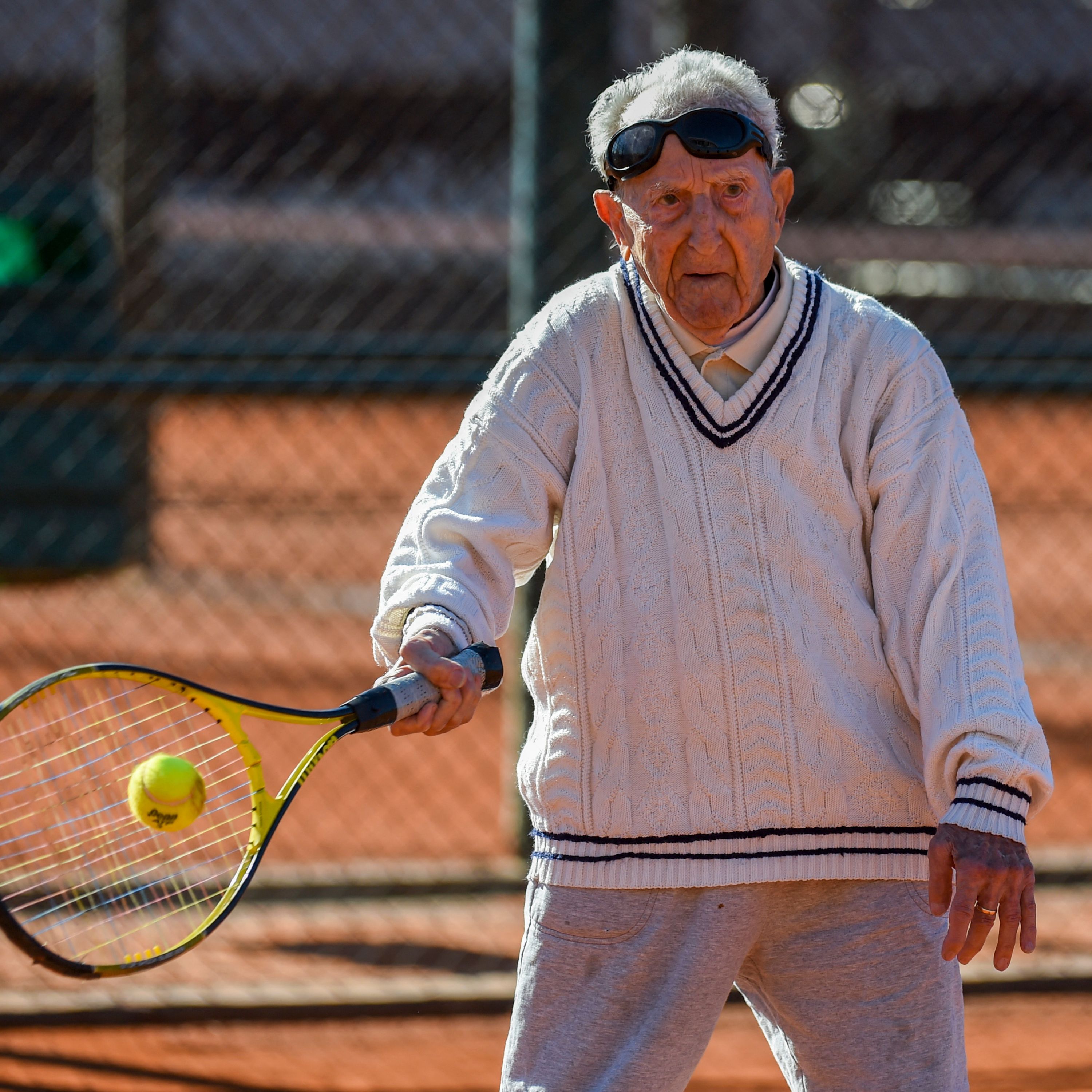
This is all of it. I'm Alison Stewart live from the WNYC studios in soho. Thank you for spending part of your day with us. I'm really grateful that you're here. On today's show, we're talking with a woman who is documenting her journey to visit every single museum in New York City. Her name is Jane August and she joins us to share some of her favorites. And we want to hear yours. We'll also talk about a new documentary, mel Brooks, the 99 Year Old Man. It explores his life as this Brooklyn legend. Its co director is Michael Bonfiglio and he will be my guest. Plus, we'll preview an event at Lincoln center this weekend that celebrates the 40th anniversary of a Philip Glass album. And there will be live singing happening right in this studio. That's the plan. So let's get this started with exercise. Okay? Move over paddleball. Tennis has a new reason to feel superior. Research suggests tennis is the leading sport for longevity. Of course, all forms of exercise help you live longer. But something about tennis, the physical requirements of the game, the cognitive and social skills, gives tennis the edge above other sports. But maintaining a consistent habit of working out no matter what it is is important for a healthy and especially long life. Simra Bajaj is a reporting fellow for the New York Times who covers health and wellness. He recently wrote an article called the Best Sports for Longevity. And he's here with me now in studio to discuss his reporting. Hi Simra.
- [02:14]
Simra Bajaj
Hi Alison.
- [02:15]
Alison Stewart
Listeners, we want to know, how do you stay active? Do you go for walks? Do you still participate in certain sports like tennis, swimming or cycling? Did you join a gym or a social fitness group? What advice do you have for a younger person about how they should exercise to prepare for being older? What? What do you wish someone had told you? Our number is 2124-3396-9221-2433 W NYC. Let's start with the big picture. What is the recommended amount of exercise that we should be striving for each week and is it different in different stages of Life?
- [02:53]
Simra Bajaj
So the CDC recommends having about 150 minutes of moderate intensity aerobic exercise. I'll explain what I mean about that in a second. But they recommend 150 minutes of that and then two days of strength training. So what does a moderate intensity aerobic exercise mean? That's like walking fast. That's like riding your bike on, like, level ground. Maybe not so fast. That's like pushing a lawnmower. Something that gets your heart rate up a little, gets your breathing faster a little, but nothing too crazy. You can do that. Or 75 minutes of vigorous intensity exercise where that's like more like running or.
- [03:25]
Alison Stewart
So running is vigorous. Walking so you can kind of speak to somebody is moderate to intense. But we New Yorkers, we walk a lot, right? So how should we be thinking about walking if we're walking for exercise?
- [03:40]
Simra Bajaj
So I think there's. It's always great to walk, right? When you're walking between your apartment or your subway, that's great. But walking for exercise, that's a little bit more intentional. Maybe you're walking a little bit faster. Maybe you're walking around Central park or something that sort of. You want to get your heart rate a little bit up. Because sometimes when you're walking, right? It can be gentle, and that's good, too. But how do you turn walking into exercise?
- [03:59]
Host (possibly Brian or Bob)
Yeah, you shouldn't be strolling.
- [04:01]
Alison Stewart
That's what you're telling me.
- [04:02]
Simra Bajaj
Well, I mean, it's fine to stroll. It's better to walk faster.
- [04:05]
Alison Stewart
There's a difference between exercising and then playing a sport for exercise. What are the potential added benefits of a sport when it comes to longevity?
- [04:16]
Simra Bajaj
So what researchers say is that what sports add is sort of this social component, right? You're meeting someone else, you're playing against another person. So there's that. There's also the added cognitive demands, right? When you think about something like tennis, how you're acting and reacting, right? But this is true of all sports, right? You're thinking about how do you win the next point, how do you structure this play? So those two things, the social and cognitive demands, they can be a little bit above and beyond what might be sort of a solo walk or a solo gym routine.
- [04:42]
Alison Stewart
Let's talk to Bob from Queens. Hi, Bob. Thank you for making the time to call, all of it.
- [04:49]
Caller (Bob/George)
Thanks, Allison. Love your show. You do great work. I retired last year. I've been playing tennis three times a week, about an hour and a half each time. And your guest is absolutely right. There's strategy, there's socialization, there's aerobics. It's a phenomenal sport. It's just so much fun. TV doesn't do it justice. You got to get out there and play.
- [05:11]
Host (possibly Brian or Bob)
Thank you so much for calling in. Yeah, let's dive into tennis. Why not? Since you brought it up, what is it about the game that gives it a unique edge when compared to other activities?
- [05:24]
Simra Bajaj
So it's one of those things researchers don't know for sure, but some of the reasons they think is that it's a full body workout. You're swinging your arms, you're moving left, right, forward, back. And those quick changes in direction that you have in tennis, they can be helpful for balance and coordination. So when we age, one of the big risks are falling down and having some fractures. So if you can handle yourself on a tennis court, it means that you might be more likely to handle yourself around obstacles at home and less likely to fall and break something.
- [05:51]
Host (possibly Brian or Bob)
What about hand eye coordination? Does that fit in?
- [05:54]
Simra Bajaj
That's a big one, too. It goes back to the balance and coordination, right. Think about a tennis ball. It's not that big and you have to hit it, right? So it's one of like it's also not just tennis, but also a lot of racket sports. Right? You can think about badminton, you can think about even pickleball. Right. They offer that same kind of hand eye coordination.
- [06:07]
Host (possibly Brian or Bob)
Listeners, especially our older listeners, we want to hear from you. How do you like to stay active? Do you go for walks? Do you strength train? Do you participate in certain sports? Give us a call or text us now at 212-433-WNYC 212-433-9692. How do you find time for exercise in your routine? Do you go to a gym or a social fitness group? Do you do it on your own? 2124-3396-9221-2433-WNYC. We got a text that says bird watching. I end up walking about 15 miles a week, just doing that. Good on you. This one says three days a week, seven minute workout app plus half an hour of free weights. This brings me to muscle training. How important is muscle training?
- [06:55]
Simra Bajaj
It's super important. I think that and muscle training can be a lot of different things. It can be with sort of free weights, it can be with resistance bands, it can be with your own body weight. Something like push ups or burpees. And the evidence.
- [07:06]
Host (possibly Brian or Bob)
Burpees made me shake when you say that.
- [07:10]
Simra Bajaj
Just really love burpees. But it's one of those things where the research finds that people who do cardio and resistance training, they tend to have the longest lives. It tends to be best for longevity to do Both. You don't want to choose one or the other.
- [07:22]
Host (possibly Brian or Bob)
Yeah. You cite one analysis that finds that an hour a week can lower a person's risk of dying by 25%. That risk of dying is an interesting phrase because this could mean your balance.
- [07:35]
Alison Stewart
Right.
- [07:36]
Host (possibly Brian or Bob)
It could mean you are better with your nutrition because you are strength training. It's not just the strength training, definitely.
- [07:44]
Simra Bajaj
It's a multitude of things that may come with strength training. But one of the benefits of strength training is that you might be able to preserve and build muscle mass. As we age, we tend to lose muscle mass and that's not great for those same fall and fracture risk that we're worried about. Right. The muscle helps us stay a little bit more balanced and coordination and have better coordination.
- [08:02]
Host (possibly Brian or Bob)
You cite a few studies in the piece. One is from Denmark that says tennis players live almost 10 years longer than.
- [08:07]
Simra Bajaj
Their peers, sedentary peers.
- [08:09]
Host (possibly Brian or Bob)
Oh, my gosh. One research from Britain and the US found racket sports were linked to lower risk of death than any others. When we're talking about these risks, how is longevity measured in these kind of studies?
- [08:22]
Simra Bajaj
Right. So they're following people for like 10 to 25 years. They're seeing sort of what sport do you play? And let's just track you over time. None of this means that sort of tennis proves or tennis causes you to live longer. Right. These are all sort of more correlational studies. It just suggests there's this interesting link between playing tennis, staying active in this way, and having sort of a little longer life.
- [08:46]
Host (possibly Brian or Bob)
We got a text here that says gardening for muscle training and flexibility. It works for me.
- [08:51]
Simra Bajaj
That's great. And I think that's sort of the main message of the piece. You don't need to pick up tennis. However you like to stay active. That's what experts want you to do. Nobody should be switching to tennis just because. But if you want to pick up a new sport, it's a new year. Tennis is a good option. There are lots of other good options. Choose something you'll enjoy.
- [09:06]
Host (possibly Brian or Bob)
What does the research tell us about swimming?
- [09:09]
Simra Bajaj
Yeah, so swimming is another great sport. It's really helpful in terms of building your lung capacity. In particular, you tend to see a lot of swimmers have, for us, obviously, better lung capacity. The thing about swimming is that it's also a good full body workout, but it isn't necessarily weight bearing. What does weight bearing meaning? That means you're working against gravity. And that's sort of important for when we're talking about bone density and we want to keep Sort of our bones strong as we age as well.
- [09:33]
Alison Stewart
Let's talk to George on line one. Hi George, thanks for taking the time to call all of it.
- [09:39]
Caller (Bob/George)
Hey, Alison, I'm a huge fan and originally from Glen Ridge, New Jersey, so shout out.
- [09:43]
Alison Stewart
All right.
- [09:46]
Caller (Bob/George)
I want to advocate for the sport of rowing. It has many of the best attributes that the guest is talking about, including weight bearing activity. It is social. It's also a highly technical sport. I do sculling up in Piermont, New York, but there are numerous places in the New York area that offer different kinds of rowing and I've been doing it for 15 years. I'm 60 years old and I feel like I'm 40. Thanks to rowing, in my opinion.
- [10:12]
Alison Stewart
Thanks, George. Appreciate you calling in. This one says, hi, my name's Steve. In the winter, I snowboard three to five days a week for two plus hours. In the summer, I downhill mountain bike and I play the drums. He's got to cover those traffic. Let's talk to Kate in Harlem. Hi, Kate, thanks for calling all of us.
- [10:32]
Progressive Insurance Announcer
Hi, thanks for taking my call. I was just wondering, tennis and racket sports are usually kind of more of a like they're, they're kind of expensive to participate in. Did the research use any controls because people that can participate in tennis are more likely to have access to better health care?
- [10:51]
Simra Bajaj
It's a really important question. And yeah, one of the risks in these kinds of correlational studies is that maybe tennis players are healthier and wealthier to begin with. So the researchers try to control for that. They tried to adjust for things like education status or income. Doesn't mean they did a perfect job, but it is something that they were trying to take into account for because that could obviously bias the results.
- [11:13]
Alison Stewart
As a reporter, when you read a study like that and it makes claims like the ones we're discussing, what questions do you have when you're trying to understand the studies? Questions like our guest just had.
- [11:24]
Simra Bajaj
Right. I'm trying to understand, right. Is this real? Right. I mean, anybody can sort of find a link between two things, but what did they adjust for? Were they trying to answers and preemptively address some of these questions that I have? The same question as the caller.
- [11:40]
Host (possibly Brian or Bob)
Right.
- [11:40]
Simra Bajaj
Maybe it's just tennis players are just wealthier to begin with. So I'm looking into that. I'm asking researchers, what do you think the biggest weaknesses of your study are? I'm trying to see how open they are about admitting the limitations and putting it in context. This is not just about one study, but about three studies that found that interesting link. That doesn't mean it's true, but it means sort of there's something seems to be there. When you're looking at Denmark, us, uk, it's at least interesting and worth looking into.
- [12:04]
Alison Stewart
My guest is Simer Bajaj, a reporting fellow for the well section of the New York Times. He wrote a recent article called the Best Sports for Longevity. We are also hearing from you. Let's talk to Santos in Park Slope. Hi, Santos. How are you doing?
- [12:19]
Caller (Santos)
I'm doing really well, other than a cold, but I'm great. Listen, cycling is my sport. I've been cyclists almost my entire life. Learned to ride when I was four, but I was competitive in the 70s all through and I rode my last race at the age of 55. I'm 75 now and I ride two to three times a week, two and a half to three hours each time. Hills and flats. It could be a solitary sport, which in case, in that case, it's meditation in motion or you can ride with others. There are many clubs in this city and it's a sport. It's either really gentle on your body or very hard if you go down. But it's a whole other thing.
- [13:00]
Alison Stewart
Thank you.
- [13:01]
Caller (Santos)
Anyway, so that, that's my bit.
- [13:03]
Alison Stewart
Thank you so much for calling in Santos.
- [13:05]
Host (possibly Brian or Bob)
I want to ask a question because he said he has been cycling since he was 4. If you're someone who wants to take up a sport at my age, and.
- [13:13]
Alison Stewart
I say, gee, I'd like to learn to play tennis is.
- [13:17]
Host (possibly Brian or Bob)
Does that have an advantage? Because I'm going to be starting from zero.
- [13:22]
Simra Bajaj
Right. It's one of those things where, like, it's always good to try to pick up new skills to keep your brain active. Right. So it doesn't have to be tennis, but if you want to pick up a sport, that's great. I really encourage it. And the biggest thing, I think what Santos was saying is that, right, staying active over a lifetime, that's the most important thing when it comes to longevity, it's not about playing tennis for a year and then stopping forever.
- [13:42]
Host (possibly Brian or Bob)
Yeah. You're talking about. You aim for consistency with something that was big in your article.
- [13:47]
Simra Bajaj
Exactly. That's the key to just living longer and getting the benefits of exercise. Right. The benefits of exercise, they build over time. And you can't just do it in small bursts. You want to keep it consistent.
- [13:57]
Host (possibly Brian or Bob)
Can I ask what consistency means when it comes to exercise?
- [14:01]
Simra Bajaj
Yeah, I mean, I think it varies for everyone. Right. People will be in busy periods of their time. I think if you can aim for some of those like targets we talked about earlier, about maybe 75 minutes a week of playing tennis, 150 minutes a week of walking. Those are good targets that the CDC recommends, sort of across all age groups.
- [14:17]
Host (possibly Brian or Bob)
Let's talk to Sherry from Manhattan.
- [14:19]
Alison Stewart
Hi, Sherry.
- [14:20]
Host (possibly Brian or Bob)
Thank you so much for calling all of it.
- [14:23]
Caller (Carol/Sherry/Polly)
Hi, I'm a member of a dance group for seniors 60 and over where they're pacemakers. Learning choreography is so good for the brain and, of course, the body. We learn pretty complicated routines and we.
- [14:42]
Caller (Chitra)
Perform all around the city.
- [14:44]
Caller (Carol/Sherry/Polly)
We're going to be at the Westchester Mix very soon, and we're going to have three days at the New York City Museum of the City of New York as part of their Urban Stomp exhibit. It's we, we meet weekly, we rehearse for two and a half hours, and then we also have optional rehearsals. Yep, everybody's pretty fit.
- [15:06]
Host (possibly Brian or Bob)
Thanks for calling, Sherry. This one says get a dog. I've always been active, but since I got my pup, I walk at least 5 die 5 miles a day more than before, including running to keep up with her and throwing balls. Talking to other dog people provides the social component, which is so important as we get older. And you mentioned this in the piece, make it social. It's really, really important. The social part. Why can socialization and exercise improve your health?
- [15:36]
Simra Bajaj
So socialization is really important because it can help buffer against things like loneliness. It can buffer against things like sort of some mental health conditions. It's just about sort of keeping up with a group of people right now. Maybe that's the people in your tennis club. Maybe that's the people in the dog park. It doesn't really matter how. And if you like doing exercise alone, that's fine, too. Find ways to increase your social activity in other aspects of your life.
- [15:58]
Host (possibly Brian or Bob)
Then this one says, for exercise, I golf once or twice a week. It doesn't seem strenuous, but I walk 18 holes while carrying my golf bag. Add to that I'm absolutely horrible at golf. So I'm never walking a straight line, which adds distance to most of my day. And you had golf down as one of your one of your sports that we should think about because, you know, sometimes I think about golf. I think about guys smoking cigars. Not the way to be healthy, but it can be a good activity.
- [16:26]
Simra Bajaj
I think it comes back to sort of some of those, like fine motor control. Right. It's not really necessarily easy to eat a hit a small golf ball with like this with this club. So it comes down to some of that. It comes down to some of the balance and the rotational motion that goes on a golf swing. Now this is all just sort of experts thinking out loud. Nobody knows precisely why any sport is good. We just know staying active is great for your health.
- [16:48]
Host (possibly Brian or Bob)
They also mentioned in the piece that you need to exercise your whole body. Can you explain that a little bit more?
- [16:55]
Simra Bajaj
You want to use all your muscle groups, right? You don't want to just focus on. I'm just going to focus on my legs. And nobody says do leg day every single day at the gym. So it's about exercising your whole body, right? So if you're doing something like running, make sure you're also doing strength training for upper body workout. That's the way to keep your whole body healthy.
- [17:14]
Host (possibly Brian or Bob)
Let's talk to Chitra in Morristown. Chitra, thanks for calling all of it.
- [17:19]
Caller (Chitra)
Hi, can you hear me?
- [17:21]
Host (possibly Brian or Bob)
Yeah, I can.
- [17:22]
Alison Stewart
Yeah.
- [17:23]
Caller (Chitra)
Well, I am going to talk about table tennis. You know, people call it ping pong, but those of us who play table tennis, seriously, we are offended. Recently you had a full program on the producer of the movie on Marty Reisman. Actually, I think I heard it in NPR for the first time. I personally have seen him before. And also, by the way, your puzzle master, Will Schwartz is a fantastic table tennis player. He owns a club with I think at least 35 to 40 tables in upstate New York. I think table tennis goes all the way to grave in your 100 plus. As a matter of fact, there is an international World Championship for 80 and over and that is the most hilarious tournament to watch they ever broadcast that. New Jersey used to have, for example, one club in 1981 when I first got to New Jersey. Now they have anywhere from 20 to 25 clubs in all of New Jersey. That's how popular the sport has become. A lot of people don't know a few things about. I just touch on a couple of things. One is the paddle surface is over several thousands unlike what you're used to, you go to the sporting goods store and buy a ping pong paddle. Now, the paddle surface has rubbers that are the greatest technology. There's probably several thousand of them that you can choose from and it'll make your game unique and different.
- [19:01]
Caller (Bob/George)
Right?
- [19:03]
Caller (Chitra)
And then the last point that I want to make is ping pong for Parkinson's is a huge medical proven activity. They have been showing that the Parkinson's people playing ping pong, you know, definitely get a lot of benefit in their motor Use motor control or something like that.
- [19:21]
Alison Stewart
Simra, I think she just gave you your next story.
- [19:24]
Simra Bajaj
I'll have to look into it.
- [19:25]
Alison Stewart
We're talking to Simer Bajaj, a reporting fellow for the Wells section of the New York Times. He wrote a piece called the Best Sports for Longevity. We'd like to hear from you. We'll hear more from you. Our phone lines are full. We'll get to them after a quick break. You're listening to all of it on wnyc. I'm Alison Stewart. I'm speaking with her. Simer Bajaj, a reporting fellow for the Wells section of the New York Times. He wrote a piece called the Best Sports for Longevity. And we are hearing from you as well. We'll get to more calls. But I did want to ask you about this one part of the story where you said, you know, you've heard our callers, they're very active. Your next step is to keep challenging yourself. What does that mean when you're exercising?
- [20:18]
Simra Bajaj
So it means a couple of things, right? I think you want to engage your brain, right? So how might you do that? Right? Increase the novelty? Maybe you're trying a different gym routine. Maybe you're going on a different walking path. So that's one part of it, right? How do you engage your brain as a novelty? The second part is to set some short term goals. So are you going to increase the weight next time you do a set? Are you going to try to increase your walking time? These are ways to try to just build some intrigue into your sort of exercise routine.
- [20:46]
Alison Stewart
All right, let's think about the opposite end. You have never exercised. You work at a desk. You, you're tied to your computer. What is one movement we can do daily at our desks that will be helpful?
- [21:01]
Simra Bajaj
I think it's a good question. I think like maybe walking around the office can be helpful. But if you're at your desk, I think other thing is just sort of like stretching a little bit, touching your toes, sort of doing anything that sort of. I think ultimately you only try to get your heart a little bit active. It can be a little bit harder than desk. But maybe for lunch you go or walk around the block.
- [21:19]
Alison Stewart
Let's take some more calls. Carol is calling in from Brooklyn. Hi Carol, nice to speak with you.
- [21:26]
Caller (Carol/Sherry/Polly)
Hi, good to speak with you too. I love this segment because I am a belly dance teacher and I started belly dancing actually to recover from a very serious abdominal injury. I had like massive surgery, herniated three discs in my lower back and you know, Yoga, Pilates, nothing worked. And then I started belly dancing and it just, it changed everything. And I started when I was 34. I'm 56 now, and I'm in better shape now than I was in my 20s. And I really found that belly dance, first of all, gave me a lot of strength and awareness in my core. And though it's really an all over body dance, you know, because you're constantly moving around snake arms, that you can do your snake arms in your chair, by the way, at your desk. You can do your chest lifts in your chair at the desk. And I have people in their teens and in their 70s and 80s in my classes. So it's something that ages really, really well. It's very focused. And it's also great for your head because like you were just saying, there's always novelty, we're always learning something new or always different ways to put things together. And people really love it. And, you know, it's, it can change your life.
- [22:36]
Alison Stewart
I like the last part of that.
- [22:38]
Host (possibly Brian or Bob)
Thank you so much for calling. Carol.
- [22:40]
Alison Stewart
Polly is calling from Asbury Park, New Jersey. Hi, Polly.
- [22:44]
Host (possibly Brian or Bob)
Hi.
- [22:44]
Caller (Carol/Sherry/Polly)
Hi.
- [22:45]
Progressive Insurance Announcer
Can you hear me okay?
- [22:45]
Alison Stewart
Hear you.
- [22:46]
Host (possibly Brian or Bob)
Great.
- [22:48]
Progressive Insurance Announcer
Oh, good. Thank you for taking my call. I was so excited to hear the subject of this segment and then hearing that George advocated for rowing. And I am a strength coach, mostly for women, and a certified indoor rowing coach. And I'm also a long distance cyclist over the years riding century rides, you know, 100 mile rides. And, and I coach people cycling. And as a strength training coach, I advocate for strength, for mental acuity, so especially for women in midlife and beyond. And I will say I'm 72 years old and I have six kids and 15 grandkids. And I am also stronger now than I was in my 30s, which is pretty amazing to, you know, using myself as a guinea pig. I didn't really start strength training until I was 50 and I began getting certified in one certification, Pilates and personal training and Parkinson's, which is another topic I wanted to hit on for you. Parkinson's strength training for mental acuity. For my client, I have one particular strength training client who is very advanced in Parkinson's. When he falls, he has so well controlled his strength in the eccentric, which is the downward phase in the movement, and that he doesn't get hurt. And he's. It's just unbelievable to see over the 10 years that I've been training him how this man, he's cycling, he's indoor rowing, indoor, he's indoor cycling, and it's it's just the biggest, the best testimonial for the. The advantages of strength, cycling, rowing and all of the stuff that you're talking about. Ping pong, you know, every belly dancing, all of it. And there shouldn't have to be like, you know, this is the best one. There shouldn't be. This is the only one. All of the things that people like to do for their lifespan, for longevity, for joy span and health span is what it's about. And especially advocating for women, midlife and beyond.
- [24:45]
Host (possibly Brian or Bob)
Thank you so much for calling. This says I have been doing Taekwondo once or twice a week for the past 10 years. I was intimidated at first, but my fellow classmates and master were very welcoming. It has really helped my strength, fitness, coordination and confidence. I am a second degree black belt now are which is amazing. This is interesting. Like I've heard Parkinson's twice. I think there's a story you should do.
- [25:09]
Simra Bajaj
I should look into it.
- [25:09]
Host (possibly Brian or Bob)
The other story I would love for you to do because I find it interesting when I go on Instagram, it's sort of the postmodern version of Tai chi about everybody's doing tai chi as their warm ups. Have you seen this at all?
- [25:23]
Simra Bajaj
I have not seen this. Oh, okay. So now here's our phone.
- [25:26]
Host (possibly Brian or Bob)
We'll say tai chi, warm up and it'll end up on your Instagram. Instagram. But as I was watching the people do it, these young people do it, I'm like, that's what I see in Chinatown and Baxter park every time I go by. And I was wondering about the East Western medicine. I don't know, there's something about it that struck an interest in me.
- [25:47]
Simra Bajaj
Yeah, I mean, I think it's one of those things. It's like whatever you enjoy, Right. If Tai chi is what you enjoy, I'm so happy for you. I think we've heard from callers that they just enjoy, they enjoy rowing, they enjoy belly dancing. That's what I think is so important. Because if you enjoy something, you'll stick with it. Right now, if I started playing tennis and I hated it, I would just not play and then I wouldn't get any of the benefits of any physical activity.
- [26:08]
Host (possibly Brian or Bob)
It is cold out now and we're expecting snow. How can we keep up the exercise routine and the motivations that we've heard about when all you really want to do is cuddle up?
- [26:18]
Simra Bajaj
Yeah. It's difficult and you want to be careful also when doing. If you're going outside exercising in the cold because it can be icy and Slushy. You don't want to fall. You don't want to put yourself at risk. But I think something like sports or just making it social can be helpful, right? When I'm so tired in the morning and I don't want to go on a run, right? But I have a sort of a tennis partner that's waiting for me. It's a little bit harder to cancel. So I think that's sort of good for accountability. That can be good for just keeping a little bit active, even when you might not want to go out.
- [26:46]
Alison Stewart
It's very interesting. You're a young reporter and one of our young people who answers the phone just said, all of our listeners are making me feel shameful. But think about from a young person's point of view, when you're reporting on this, why should young people think about exercising with longevity in mind, even if that is 20, 30, 40 years down the road?
- [27:15]
Simra Bajaj
It's a couple of things. One is that some of these risks that we're trying to avert, right? Like when it comes to heart disease, when it comes to falls or fractures, these benefits accrue over time, right? It's never too late to start. And I don't want anyone to feel that I can't start now because I'm 50 years old or whatnot. You can always start. But the earlier you start, the better, the more consistent you are, the better because you get stronger. You're able to, for example, the more muscle you build, sort of when you're young, just starting from a higher point. When with age, people tend to lose muscle.
- [27:47]
Alison Stewart
You definitely see that with people who are athletes when they were young, for sure. Anything that I didn't cover that you want to tell our audience about?
- [27:55]
Simra Bajaj
I think the biggest thing is that again, it doesn't. I don't want anyone to say I have to quit what I love and start playing tennis, right? That doesn't matter. What matters is to stay active however you love, however you enjoy. So many people, so many readers wrote in to this article saying you missed ice hockey, you missed croquet, you missed xyz. And it's true. These studies don't study every single sport. That doesn't mean those sports are bad. That doesn't mean they're sort of either. Or here, it's simply that stay active any way you love, any way you know how. And if you aren't active, if you want to get more active, start small, right? Start small with walking. Go to local parks center or your rec center. See if you can join a sports league. Right? That can be a good way to sort of build that into your schedule. Write something on your calendar. You have to go because there's a class here every sort of Monday at 5.
- [28:46]
Alison Stewart
Thanks to all of our callers who called in. And thanks so much to Simer Bajaj. He's a reporting fellow for the well section of the New York Times. You can read his piece the Best Sports for Longevity. Thanks for coming to the studio.
- [28:58]
Simra Bajaj
Thanks so much. Glad to be here.
- [29:00]
LifeLock Announcer
The new year brings new health goals and wealth goals. Protecting your identity is an important step. Your info is in endless places that could expose you to identity theft leading to lost funds. LifeLock monitors millions of data points per second. If your identity is stolen, our restoration specialists will fix it, guaranteed, or your money back. Resolve to make identity, health and wealth part of your New year's goals with LifeLock, save up to 40% your first year. Visit LifeLock. Com SpecialOffer Terms apply.