← All Of It with Alison Stewart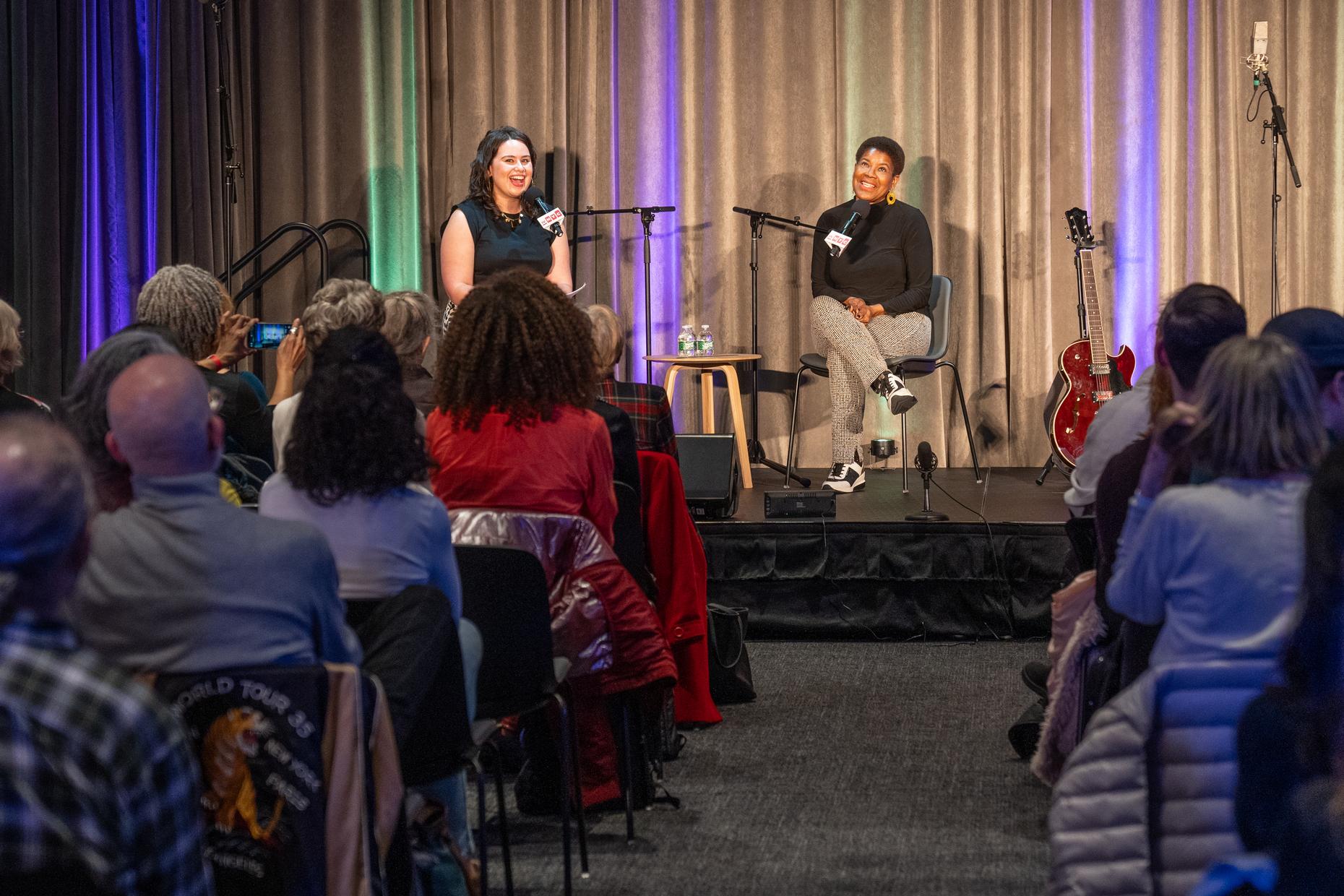
All Of It with Alison Stewart
Tananarive Due on 'The Reformatory' (Get Lit)
00:23:06
February Get Lit with Tananarive Due author of The Reformatory
Loading summary
Transcript35 lines
- [00:04]
A
Listener support WNYC Studios.
- [00:16]
B
This is all of it. I'm Matt Katz in for Alison Stewart. Thanks for listening. The latest novel from acclaimed author Tananarive Due is a heartbreaking tal based on a true story. Tananarive's great uncle Robert Stevens was sent to the now infamous Dozier Stor School for boys in Mariana, Florida and died there at age 15. Tananarive took that story as inspiration for her novel the Reformatory. It follows a young black boy, also named Robert Stevens, who is sent to the abusive segregated Graystown reformatory. Robert is sentenced to a couple of months in Graystown after he kicked a white boy who is making advances on his sister Gloria. Gloria does everything she can on the outside to help get her brother out. While on the inside, Robert. Robert learns something disturbing. There are ghosts on the grounds of Graystown known as haints. They are the spirits of the boys who were killed at the school. The terrifying superintendent, a violent man named Haddock, wants Robert to help catch these haints. But one stubborn ghost named Blue wants Robert to help him get revenge on Haddock at great risk to his own life. The reformatory was the February get lit with all of it book club selection and author Tananarive Due joined us on Wednesday for a live event at the Stavros Niarchos foundation library. Here are some highlights from that interview, which was conducted by get lit book producer Jordan Loff.
- [01:48]
C
So I wanted to begin this conversation with where your novel begins with a dedication. So here's your dedication for Robert Stevens, my great uncle who died at the Dozier School for Boys in Marianna, Florida in 1937. He was 15 years old. When did you first learn your great uncle's story?
- [02:06]
A
Really, it came at a time of grief for me. My late mother, Patricia Stevens dhu, was a civil rights activist. In fact, Carol is here, worked with my mother in the 60s and with Judy Beniger Brown, my godmother. And she was such a huge force not only in history, but in our lives. So losing her was a big hole in in the family and during the aftermath. Right after she died in early 2013, I got a call from the Florida State Attorney's office to let us know that I might have a relative buried on the grounds of the Dozier School for Boys in Marianna, Florida, which I had never heard of. And I had never heard of Robert Stevens. I really thought it was a call about another relative on my grandmother's side. Another juvenile who died was put to death by the state. So my dad and I My father, John Dorsey Dhu Jr. If you've read the book, you know I named Don Dorsey after him. We went to the school. We met survivors, heard their stories. And given that I had had a relative who passed away there, even though I never knew his name, or maybe because I never knew his name, I decided almost immediately that I had to write a book.
- [03:25]
C
And was it immediate that the character was going to share the exact same name as your great uncle?
- [03:30]
A
Absolutely. I wanted to honor his memory. I never knew about him. I don't think my mother ever knew about him. I've since met another relative who is actually a namesake who never knew for whom he was named. And I think what just happened is that the trauma was so great for any family where you lose a child that they just kind of cemented over it. And I didn't want that for him. And also I wanted a better ending. I mean, I don't want to spoil anything, but I wanted a better. You can spoil it. It's a book club. I wanted a way better ending for him. I wanted to write a story that could be inspirational rather than just depressing. And it's not dishonest because most of the boys who were there didn't die there. There were several who did, and he was one of the unlucky ones. But I really wanted the reformatory. Not just about Robert Stevens, but about other children who were there. The fact that this institution existed, Jim Crow, as the monster of the story. I wanted it to be about our current mass incarceration system and parents who were to this day dealing with juvenile justice, where, in fact, I think children are more criminalized now for schoolyard fights, for example, than they would have been even in 1950.
- [04:48]
C
Yeah, the school to prison pipeline.
- [04:50]
A
Oh, my gosh. Absolutely.
- [04:52]
C
So you mentioned being able to talk with survivors and people who attended the school. What's. Or attended is a strong word. Who were sent there.
- [05:00]
A
Who were sent there. Yeah.
- [05:01]
C
What's something you learned from those conversations? A detail that emerged that you knew you wanted to include in this novel?
- [05:08]
A
Well. And most of you have read it, Right. Because you're a book club. That's so great. That's so great. Not to have to hide things. So one of the things that I. A firsthand account I heard from one of the white survivors actually, was that he was taken to the whipping shed, which in real life was called the White House, not the Fun House. I just gave it an even worse name in my book. But he said that he had to cancel visiting day with his Parents. Because the physician literally had to remove fabric from the wounds in his back. That's how deeply they were cutting their skin with these beatings in this shed. And this was during a time when flogging had been out for adult prisoners in Florida. But somehow children were being subjected to this kind of torture. And that story really just stuck with me. I couldn't wrap my mind around it.
- [05:58]
C
And I'm interested you said that. Because something that really stuck with me in reading this book is that you don't shy away from those really graphic details. The scenes in the funhouse don't fade to black. You really take us there, and you take us into the violence. Why was it important to you to give us those details?
- [06:18]
A
I apologize, first of all, for those details, because it was difficult to write up to that scene. I knew I wanted it to happen. I knew I wanted it to be on his first night. It was a very difficult scene to write up to. I actually excerpted that scene years ago in the Boston Review as a standalone short story. Because to me, it's sort of the crux of the matter in terms of how I'm going to take the reader, the realm of the real, into the fantasy realm. And it's during that scene that Robert is in such a horrific situation, being lashed in the real, that he first realizes that these Haints are here. And he can really feel their presence. And he was afraid of them up to that point. That was the scary part of being sent to the reformatory. But in reality, they are not the scariest thing about the reformatory. And in fact, there's something special about the bond. Not only that he can create with at least one of the Haints, but also, as I said in that chapter, knowing there is more than this, there is more than this moment. He uses it in his awareness of the ghost as a way to sort of elevate himself out of a horrific moment and find even in that moment, something hopeful, something to hang on to, some piece of himself, like feeling his mother and all these other spirits. Something he can hang onto so he won't lose himself in that place.
- [07:49]
C
So let's talk about our protagonist, Robert. Although when we first meet him, he's known as Robbie. He's known as Robbie to his friends and his family. But once he gets to Gracetown, he says sort of immediately, I'm gonna be Robert here. I can't be Robbie here. Why that distinction between Robbie and Robert? Why does he make that distinction?
- [08:07]
A
That is a great question. And in his mind, he was crossing A threshold, Right. He's crossing. He did not want to be perceived as weak, first of all, because he was afraid he would be a target. He figured, all these boys are going to be tough. And he, you know, Robbie, that's. That's not a good street name. And like Blue says, we'll get you a better nickname than Robert, but okay, that's something to work with. But I think in his mind, I think he understood he was going to have to grow up. He was going to have to grow up at this place. He could not be a child anymore. My husband and I crowdfunded and co wrote a short film called Danger Word, which has a similar theme about a young girl who in the zombie apocalypse. And Frankie Faison plays her grandfather, saying, you've got to grow up now. Stop being small. And I think that's what Robert was feeling.
- [08:59]
C
What really struck me in reading it is that there's an interesting pacing choice that he makes. So the beginning happens sort of rapidly. You've got the incident with Lyle. He goes to court, he gets sentenced to the reformatory. And then we really slow down, and the next 100 pages or so are just following Robert in this first day at Gracetown. You really follow him moment by moment. All the people he meets, all of the places he goes. Why did you want to really linger in that first day?
- [09:26]
A
I wanted it to feel immersive. I wanted the reader to feel like they were there with him, experiencing it as he was experiencing it. And I think also as the writer I was learning, like that was the part that was the most intimidating to me was to try to depict the reformatory itself. I've never been a little boy. I've never been a little boy who was put in a reformatory. So everything about it, like the social relationships, the hierarchies, the duties, they were very informed by photographs that you can actually look at at the Florida archives or online. It's called the Florida Memory Project. It's a lot of. There are a lot of digitized photos of the. The Dozier School. And I literally was writing from like, this was what the kitchen looked like. This is what. That big freezer. That was a real freezer. That's what it looked like. And I think that was me as the author immersing myself because I wanted the reader to feel immersed.
- [10:19]
C
Were ghosts always going to be a part of the story? When did they come in for you?
- [10:23]
A
Ghosts were absolutely always going to be a part of the story. But there's a funny story about that. I had written maybe 250 pages. I had written beyond the first night when Boone comes in and wakes all the boys up and takes them to the funhouse. I'd written beyond that when my agent, Donald Moss, said to me, you know, I think you might want to make Blue a ghost. Now, it may seem a little surprising to you that that was not what the case was. In the beginning, when I first wrote Blue and Red Bone, I was really just trying to create friends for Robert. And when he gave me that thought, I said, well, let me see how many changes I would have to make for that to be true. And it turned out not that many, because he was sneaking around in the kitchen and nobody saw him. He said to Boone, can I go back to bed? Boone didn't even acknowledge him. You know, it was as if I knew on one level that Blue was supposed to be a ghost, but I hadn't discovered it yet. And that's what a good agent will do, you know, tell you things about your book that you don't even know yourself. So that, to me, I think, was a pivotal moment because it took the ghost out of the realm of kind of like, spirits floating around over his head to, frankly, what I've heard an account from the former curator, now deceased, of the Scott Joplin house. And the whole reason I wrote the book, Joplin's ghost, was because he told me about the time he thought he had seen a ghost in Scott Joplin's parlor. And I said, was he shimmery? Was he transparent? He's like, no, he looked just like any other man. And that always stuck with me. So I decided in creating the ghost, that they can take that form where Blue has the power to just look like any other kid if someone is sensitive enough to see him.
- [12:03]
C
Why do you think the children are the ones who are able to sense these Hanes? The adults, like, sort of know that they're around, but they're not seeing them in the way that Robert and the other kids at the school can see them.
- [12:14]
A
The reformatory is set in a fictitious town called Gracetown that I started writing about in short stories maybe, like, 10, 15 years ago. And my whole idea, some people compare it to, like, Stephen King's Castle Rock, but in reality, I was thinking of William Faulkner in County, going back to my college English literature days. Like, I wanted to create a fictitious county, but being a horror writer and my fictitious county, I wanted it to have a special impact on children. And I don't think I have done ghost stories set in Graystown, one of Them is Ghost Summer, which was the the title of my last short story collection or my first rather short story collection. But the point of them being children is because I have very vivid memories of that line of demarcation between being a child who was 12 and preoccupied with childish things and then like a page turning when my perceptions deepened and the world became a little darker and scarier. And this notion that if there's some mistakes you don't come back from. And all this was very much in my mind and also a strong sense of mortality. So I wanted to create a county where younger children are still sort of in touch with their spirit selves in a slightly different way. They. And to me, I guess the comparison would be the way as children we like to draw. You know, there's almost no kid who doesn't love to draw and there's almost no adult who hasn't, who hasn't stopped drawing. You know, like, so what happens to that? What happens to that part of us that used to like to draw? Right. Or who would indulge our creative side? I'm so lucky as a writer. I feel like I'm living in my child self all the time. But a lot of us let go of that. And so I wanted that to be kind of a parallel. Like while you have that childish sense of wonder and openness and you're hearing noises under the bed and you still believe in monsters. I wanted to capture that, but in a literal way.
- [14:21]
B
We'll have more highlights from our February Get Lit with all of it event with author Tananarive due in just a bit. You're listening to all of it. I'm Matt Katz in for Alison Stewart. Today we continue airing highlights of our February Get Lit with all of it events with author Tanonaru Tananarive due. Excuse me. We spent the month reading her new novel the Reformatory. The interview was moderated by Get Lit with all of it producer Jordan Loff. Here's more of her conversation with Tananarive due.
- [15:07]
C
So we've talked about Robert, we've talked about the reformatory, but there's also Gloria, who's on the outside and doing everything she can to get her brother out. Was this always going to be a sibling duo for you? When did Gloria enter the story?
- [15:19]
A
Absolutely. I think maybe in part it was because it was my mother's uncle and we were mourning my mother when I started writing the book that I felt like she needed to be in the story. Her middle name was Gloria and she was my North Star in Terms of. I mean, this woman was absolutely fearless. She was lying down in front of sanitation trucks in 1968 during the sanitation workers strikes, and she was tear gassed by police. Wore dark glasses her entire adult life after the age of 20, pretty much all the time, 80% of the time, because of sensitivity to light after being tear gassed. So she was the first superhero. My parents were both the first superheroes in my life. And I knew I didn't want to just contain the story to Robert's experience with incarceration in part because that wasn't a world idea. You know, I didn't want to be there all the time either. Right, right. But also as I was writing, I realized it's not just a story about one child. It's not just a story about one facility. This is a story where the monster itself is the era. It's the Jim Crow era. It's the uncertainty, it's the lack of stability, the oppression, all of the barriers, the stifling. Like. The reason my mother became a civil rights activist when she was in college was when they saw a way to fight the system through non violent direct action. Finally there was a plan, a large scale plan. And she always felt like, I'm dead anyway if I don't have these rights in the way that young people have that, that clear view. They don't have the conflicts of a mortgage, you know, and a job, by the way, that they're afraid of getting fired from very often. So it's just like, this is wrong and I'm going to speak up. And that is what young people do. And I wanted Robert to have that advocate. He wasn't going to be able to count on a system to help him, but he could count on his sister.
- [17:17]
C
Let's talk about Superintendent Haddock. Was, was he based on anyone in particular you learned about in your research.
- [17:22]
A
Or even if he had been, I would not say so for legal reasons. Okay. But actually, no. I mean, in that sense, I mean, I did read a little bit about the real superintendents, and there were superintendents who did take place, take part rather in the whippings and whatnot. But I wanted Haddock to be a composite. Not just really for all the wardens, but like sort of a central figure of the evil, even though I didn't want to let it off the hook. I mean, that had the possibility that people would think, oh, well, he was the problem. And hopefully readers don't feel like he was the only problem. He was not the only problem, but he was someone who, like you know, apparently is common not just at the Doer School for Boys, but the Alabama Industrial School for Negro Boys. There's a whole podcast about that. The indigenous schools in Canada, the schools for unwed mothers in Ireland. Like, there's this thing where the powerless are preyed upon when, when they're incarcerated. And it's, it's terror. And it doesn't matter if you're a child. It doesn't. I mean, the weaker you are, the more you're preyed upon. So I wanted to show what kind of dominion someone with that kind of sociopathic, psychopathic, I'm not sure, I'm not a shrink. He's got something wrong with him. When someone with that kind of murderous mindset has that power that he can exercise with impunity, that's what happens. And the entire town is just accepting this and just covering it all up.
- [18:52]
C
But it's not just Superintendent Haddock who gets sort of caught in this. There are some people who come into the school and maybe they're well meaning or maybe they, you know, whatever motives they have for working there. But there's something about that place that can transform people. And I wanted to read this quote from Ms. Lottie who talks about Junior when he worked at the reformatory. And she says that place changed him, Gloria. Worse than the war. Day by day, he wasn't the sweet boy who'd gone to work there. Day by day you could see something growing behind his eyes that wasn't him anymore. So what do you think it is about this place that can change people even while meeting people?
- [19:25]
A
Well, for the purposes of fiction, it would be as if there's sort of some kind of a curse on those grounds where people who work there get, you know, like no one stays. Nice redbones and blue say that as you work there, it kind of begins to overtake you. Haddock talks about, I think, dreams that he had. But really it's just the mindset, us and them, that emerges in these kind of power differential situations and the dehumanization of people that society has deemed are less than for whatever reason. And I wanted this book to be in conversation with the present because we still have a lot of vestiges of this era that we're still dealing with as people of color. For whites, it's mostly the mentally ill who have the kinds of experiences with police that black people talk about. And it's just so heartbreaking on social media. When I see people posting, though my son was having an episode and I called police as if the police were going to help their son with their episode when I could say, do not call the police. They are not good with the episodes. If your son picks up a. Not even a steak knife off the table. I mean, I've read a story about a naked white man shot because he was having a mental. Who exactly was he threatening? But it's the dehumanization. You have been othered. And when people are othered, I mean, who knows? The sky's the limit in terms of the kind of things that can happen to them.
- [20:57]
C
Yeah. You've been out on book tour for a couple months now. It's been out in the world. Have you interacted with anyone who went to Dozier, who read the book and what have those experiences been like?
- [21:07]
A
As a matter of fact, yes, quite by accidentally, at a gathering much like this one, there was a signing line and a white young man I would say was in his late 30s, maybe early 40s, was last in line. And he said, as he posed for a photo, he said, I'm shaking. And I was like, oh, are you a big reader of my work? He's like, no, I've never read any of your other works. I was at Dozier in the 90s and he thanked me for writing the book, which I'm so grateful for, because I would have been heartbroken if he had had critiques, like serious critiques, like, why are you writing this book? That same morning, that same morning, I had spoken to an 89, 88 year old black man who was at Dozier in 1950 when he was 12, and his name was Robert, when he was there, who wrote his own memoir that I added at the last minute in my acknowledgments page. And I put him on the phone with my dad and he too, he started just telling all these terrible stories. So I spoken to two survivors, one who had read the book and one who had not read the book, but was glad that I had included his book in my acknowledgments. And the experiences in both cases were heart shattering. It was like going back in time to that very first meeting. Because I wasn't expecting to meet survivors. I had not kind of girded myself up for that emotionally. And each time, like in the morning, the phone call with the older man, I was devastated, told the audience how devastated I was. That same night, in that same audience was another survivor who. Who, even though he thanked me in the drive home, I was again devastated. I was devastated that I had met two men generations apart, one black, one White, both of whom felt seen by the fact that this book had been written and just the evil of the multi generational terror against children just was overwhelming. Again, that's why it took seven years.
- [23:04]
B
That was author Tananarive due in conversation with get lit with all of it book producer Jordan Lough. Her new novel the Reformatory was the February get lit selection.
- [23:15]
C
At Capella University, we believe accessible education can make a difference in people's lives. That's why we offer scholarship opportunities to all eligible students. Whether you're considering a bachelor's, master's, or doctoral degree, our teams will walk you through the process and help you get the savings you are eligible for. Furthering your education is an investment in yourself. Entonces de lo que cres con Capella University. Learn more at capella.edu A BetterHelp ad Louis Capaldi partnered with BetterHelp to get word out about how important therapy can be.
- [23:54]
B
I struggle most weeks to get myself up and ready and go to therapy or whatever. Even opening the laptop to talk to my therapist sometimes can be really difficult. But I do it because I realize how important it is for me to continue to feel good. I felt the best I felt in a long time through therapy.
- [24:12]
C
Learn more about online therapy at betterhelp. Com.