← All Of It with Alison Stewart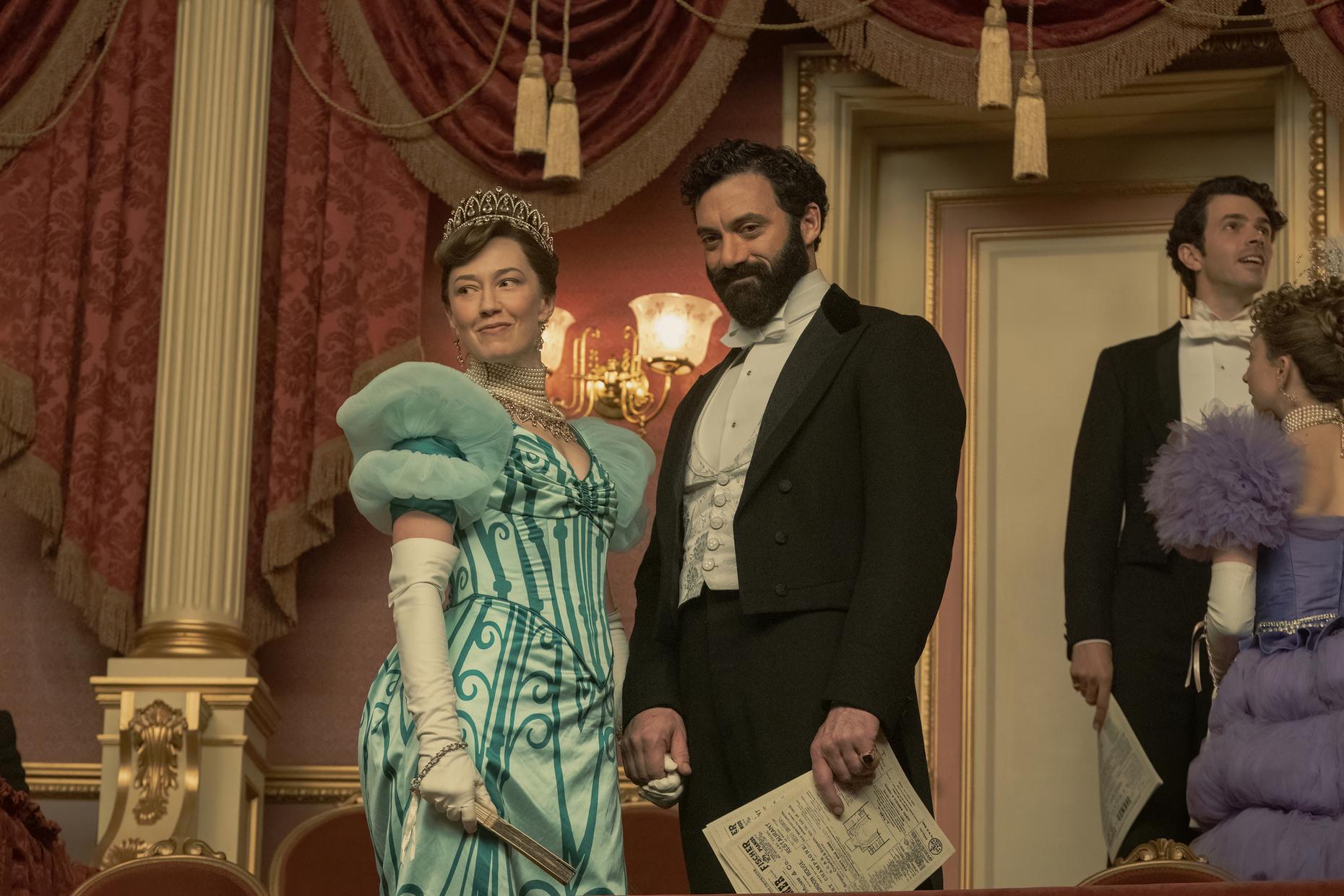
All Of It with Alison Stewart
'The Gilded Age' with Carrie Coon (Watch Party)
00:28:59
Actor Carrie Coon on the second season of 'The Gilded Age'
Loading summary
Transcript95 lines
- [00:00]
Caller/Listener
I' ma put you on, nephew. All right, unc.
- [00:02]
Carrie Coon
Welcome to McDonald's.
- [00:03]
Alison Stewart
Can I take your order, miss?
- [00:04]
Caller/Listener
I've been hitting up McDonald's for years. Now it's back. We need snack wraps. What's a snack wrap? It's the return of something great. Snack wrap is back.
- [00:15]
Old Navy Advertiser
Some days call for sleek and straight, others for slouchy and relaxed. Whatever your vibe, Old Navy has the denim fits to match from extra high rise to barrel. It's not just a mood, it's a whole style range. And with jeans Starting at just $22, you can collect them all. Snatched waist go extra high rise straight lived in staple vintage slim, low slung and laid back, slouchy, wide. You've got range. Your denim drawer should too. Premium fabric deluxe details your perfect pair or weights. Shop in store or online@oldnavy.com.
- [00:53]
Alison Stewart
This is all of it. I'm Alison Stewart live from the WNYC studios in soho. Thank you for spending part of your day with us. I'm really grateful you're here. On today's show, we kick off this month's full bio. It's our book series where we dig into a big biography over the course of a week. Today we'll begin discussing the book Lou the King of New York about the musician, poet, photographer and New Yorker Lewis Allan Reed. Kirk has called the book an engrossing, fully dimensional portrait of an influential yet elusive performer. Also this week, we're getting into the holiday spirit every day. So today we're gonna hear from the director of the new hit film Candy Cane Lane. And that is our plan. So let's get this started with the season finale of a show about the drama, intrigue and romance of New York in the 1880s. That is the theme song from the series the Gilded Age, a prestige period drama that one reviewer said, quote, proves it deserves its place in HBO's Sunday night lineup. That's high praise considering alumni include Game of Thrones, the Wire and Succession. The Gilded Age shares similar themes with those shows. Power plays, scheming family dynamics, and it does it all with horse and buggies, calling cards, top hats and corsets. The story follows new money versus old money in New York City in the 1880s. My next guest plays the freshly rich, very nervy and smart social schemer Bertha Russell, wife of a robber baron who has arrived in New York City herself. A Versailles like mansion on Fifth Avenue and 61st street, right across from one of the old money families in town. As Bertha tries to climb the social ladder, the old guard attempt to pull the rungs out from beneath her. But Bertha and her husband will not be denied. Here's a scene from season one. Bertha Russell has been shut out of hosting a hoity toity charity bazaar in her palatial home. The old crowd is sending her a message. So when Bertha and her husband arrive at a small venue where the bazaar is being held instead of their huge home, he decides to shut it down by buying out every vendor in sight to avenge the dishonor of his wife. The first voice you will hear is George Russell calling out two old money matrons.
- [03:10]
George Russell (Character)
You must be Mrs. Fane.
- [03:12]
Carrie Coon
Yes, Mr. Russell, I am Aurora Fane.
- [03:14]
George Russell (Character)
So the pair of you decided my wife's ballroom was not good enough to raise money for your charity.
- [03:20]
Carrie Coon
Mr. Russell, there's no need.
- [03:22]
George Russell (Character)
How much money do you hope to raise over the next three days?
- [03:26]
Carrie Coon
I suppose I'm hoping for 30 or even $40.
- [03:29]
George Russell (Character)
There's $100. On one condition.
- [03:32]
Carrie Coon
What?
- [03:33]
George Russell (Character)
That everything on the stall is delivered to my house on fifth Avenue within the hour. This is my card. Can you do it?
- [03:39]
Carrie Coon
Yes, I suppose we can. It is why we are here, isn't it? I mean, that is the point, of course.
- [03:47]
George Russell (Character)
So you'll take it?
- [03:49]
Carrie Coon
Thank you. Very generous.
- [03:51]
George Russell (Character)
You will also close and dismantle your stall. This is my address on Fifth Avenue.
- [03:58]
Alison Stewart
I see.
- [03:58]
George Russell (Character)
$100. I'm buying everything. But it must be delivered within the hour. And the stall will be closed and taken down at once.
- [04:04]
Carrie Coon
As you wish.
- [04:07]
George Russell (Character)
I will buy everything on your stall.
- [04:09]
Carrie Coon
For a hundred dollars.
- [04:10]
Caller/Listener
Please.
- [04:10]
George Russell (Character)
Wrap it up. What happened here? I will take all.
- [04:17]
Carrie Coon
Mrs. Russell. Can't you stop this? The bazaar will be the most successful of the season. Madam.
- [04:24]
George Russell (Character)
$100.
- [04:25]
Carrie Coon
We won't help you. You know this sort of stunt does not impress the people you want to win over, Mrs. McMorris. This sort of stunt impresses everyone.
- [04:32]
Alison Stewart
That last voice you hear is my next guest, Carrie Coon as Bertha Russell. And as a reviewer described her performance, quote, bertha's ascendancy is endlessly fun to watch, in part because Coon imbues this character with delicious confidence and a ruthless streak. The Emmy nominated actress also makes wearing the corseted dresses, bedazzled jewels and enormous headwear look easy. Joining us today is Carrie Coon. Carrie, nice to see you.
- [04:56]
Carrie Coon
Good morning, Allison. Thanks for having me.
- [04:58]
Alison Stewart
And listeners, two things. I promise you I will give you a huge heads up when we get into any spoiler territory. If you haven't had a chance to watch the finale yet. But fans, you can call in with your comments or questions for Carrie Coon. What's your favorite part of the Gilded Age? Do you have questions about the costumes, Bertha's motivations? What the actors do in downtime when they're all corseted up? Our Phone lines are open. 2124-3396-9221-2433. WNYC. You can call in, join us on air. You can also text to us at that number. And our social media is available as well at all of it. Wnyc. We're talking gilded age today. What adjectives do you use to describe Bertha?
- [05:36]
Carrie Coon
Carrie? Oh, gosh, there are so many good ones people keep putting out there. Feisty, tenacious, determined, myopic. Relentless. Charming.
- [05:48]
Alison Stewart
She is charming. She does have a charm about her.
- [05:51]
Carrie Coon
Yeah.
- [05:52]
Alison Stewart
What does Bertha want most from life?
- [05:55]
Carrie Coon
Oh, well, she's. I mean, she is rabidly ambitious. I think if she were born in another time, she would have been a CEO or a senator or president. But those avenues are not open to her. And so therefore, the social sphere is her purview. And she plans to dominate, as you can see. But really, she's taking care of her kids.
- [06:18]
Alison Stewart
Yeah, we'll get to that. She has her way.
- [06:21]
Carrie Coon
Yeah, in her way.
- [06:23]
Alison Stewart
As you started to construct this character, what was something in your mind that was important to know about Bertha before we even meet her in New York? Something that either you've talked to the writers about creating her past, maybe something you've created about her past that's important to know.
- [06:38]
Carrie Coon
That's an interesting question. I think one of the things that was always in the back of my mind was that she had been decidedly middle class, really borderline. And that she had come, of course, from probably Irish immigrants, potato diggers. I always laughed because the woman who plays Turner, Kelly Curran, she has the most beautiful hands. And so I would always watch her hands whenever she was putting a necklace on me or a tiara because her hands are so much more elegant than mine. And I personally am, you know, come from a working class family, so I always. That always made me feel appropriately out of place. Place in my own house.
- [07:17]
Alison Stewart
That's interesting.
- [07:18]
Carrie Coon
So you.
- [07:18]
Alison Stewart
You coming from a workingclass family, what were you able to. What do you understand about Bertha?
- [07:25]
Carrie Coon
Well, I understand that Bertha, what I. What I love and respect about Bera is that she thinks she's living in a meritocracy. She believes that if you work hard and you have some ability, you should be able to work your way to the top. And then the door should be thrown open for you. And she thinks that the world works like that for everyone, Though she's not really thinking about everyone. Of course, she's a product of time. She's not thinking about the laborers and immigrants and black people in America. She's really just thinking about the other women she has to dispatch with to get to the top. But I think she really, she. She has a talent for cutting through some of the BS that she sees. Some of the stuff she realizes is just constructed to catch people out. She thinks it's disingenuous. And I love that she's not. She's not unwilling to have that conversation. She's not unwilling to just go right under the surface and cut to the heart of the matter. And I really appreciate that about her.
- [08:17]
Alison Stewart
I read somewhere that you played college sports and you described yourself as competitive. And I thought about that and I thought about Bertha, and I think there's connective tissue.
- [08:27]
Carrie Coon
Yeah, definitely. I mean, I think athletics are a good. A good foreground for. A good starting point for being an actor anyway, because it's a similar kind of presence. But, yes, I was very competitive. My track team in high school lost two meets in 26 years. And I hated running. But I loved winning, and we won all the time. I loved it. But I'm not a sore loser at all. I totally accept, you know, when we haven't. When someone beats me fair and square, I'll accept it.
- [08:57]
Alison Stewart
Let's take some calls. Willa Mae is calling in from Brooklyn. Hi, Willa Mae. Thanks for calling, all of it. You're on the air.
- [09:04]
Caller/Listener
Yes, good morning. I'm going to talk real fast because there's a lot of calls waiting your guest. I give you the honor. I mean, you make that series. You make it, you make it. You just make it. And it's. And it's just done so professionally, you know. And thank you.
- [09:27]
Carrie Coon
Thank you for saying that, Willa Mae. I think a lot of women really respond to Bertha. I have found women of a certain age, I think, who've had to fight their way in particular.
- [09:36]
Alison Stewart
Yeah.
- [09:36]
Carrie Coon
Really seem to admire her relentless ambition. And she's having a good time. She relishes her victories. But thank you for that, Willa Mae. I so appreciate it.
- [09:46]
Alison Stewart
Let's talk to Eileen calling in from Weehawk in New Jersey. Hi, Eileen.
- [09:50]
Caller/Listener
Hi, both of you. And everybody. Carrie. I worked background on season two when we were based in Troy, although I live in New York, but I worked as local and.
- [10:03]
Carrie Coon
Wow.
- [10:03]
Caller/Listener
So I have a. Have a taste of. Yeah, it's on me. But I, I got a month's worth of days, which was awesome. Anyway, it's been fascinating to see how the pieces that, you know, I see, you know, when you work background you, you know, you work on certain scenes, you're not necessarily ending up in any of them, but just to see the puzzle pieces of the pot unfolding. And this is of course always the case, but also to have had some observing. I was right behind you. The only time I saw someone noticed me behind you in the Easter Parade, like, there he is. But just to be up there and it was sweltering. You can probably speak to the discomfort or adapting to bustles and courses, but learning how to sit in a freaking seat with a foot behind you in the Academy of Music. And also finally, I'm from Philly. I grew up there. And when we shot there, that was in a place that I had grown up listening to the Philadelphia Orchestra. So it's interesting to see it as a New York venue. And hair, makeup and wardrobe were where I had my senior prom in Philly. So that was just weird and cool.
- [11:17]
Carrie Coon
You've had a whole venues left that, that is from the Gilded Age that resemble the op, the Academy, that was a great place for us to shoot. And you're right, the church for the Easter parade, it was 130 degrees in there the night before we shot. And they had spend all night rigging air conditioning so we didn't all pass out when we got in there. So kudos to you. It's you. As you understand, it can be very repetitive work when you're repeating the same pattern over and over again. People think it's very glamorous, but in fact it can be really, there can be a lot of repetition in a day. And most of the time women didn't wear those dresses for 14 hours straight. But we do, don't we?
- [11:55]
Alison Stewart
My guest is Carrie Coon. We are talking about the Gildage age. The season two finale was last night. Super fans of the show. If you want to call in and join this conversation with your questions or your comments for Carrie, our phone number's open. Phone lines are open. 2124-3396-9221-2433. WNYC. You can call in and join us on air or you can text to us as well. When you first got the part, Carrie, what kind of research did you do? Where did you dive in?
- [12:27]
Carrie Coon
Well, they had assembled our assistant director, Luke Harlan had assembled a wonderful research packet along with Erica Dunbar, who's A magnificent historian who worked on the piece, particularly the African American diaspora there in New York. And they handed me a list of books and both fiction and nonfiction. And I've always been a very cerebral actor as well as a good student, and so I jumped right in. But also, Portrait of a Lady is my favorite book. I reread it every few years. I was a big. I think I dressed up as Edith Wharton in, I don't know, fourth or fifth grade for a book report. So I'm a real nerd of the time period anyway. And it was just a delight to get to dive back into those worlds, being that I loved them so well and they really did prepare. We also always had a consultant on set for any kind of the etiquette. And of course, you would hear from Julian, too, even if he was in England. He would call in on the bat phone and say he can't touch her on the street or more flowers in the foyer. He was always watching. You never knew when you'd hear from.
- [13:30]
Alison Stewart
Him talking about Julian Fellowes. Let's talk to Harry from Brooklyn, since you brought up Erica Dunbar. Hi, Harry. Thanks for calling, all of it.
- [13:38]
Caller/Listener
Yeah. Hi, good afternoon. Hi, Carrie. Great acting. Thank you. I wasn't a fan of you at first, but as I see as you transition into different parts, I kind of like your. Your. Your character. But one of the things that I'm taking away from it is the resilience of women back in those days and the power and the struggle, but also in particular as a person of African descent is the portrayal of African American history as a contribution towards that time period. And I think that was very powerful. And I think that's what captivated me, that I didn't realize that back then African Americans usually exist and live amongst in a progressive way. Back then, I was a progressive. Was. But understand, your part is really. I'm kind of like, lacking your character. But I think the message is very powerful.
- [14:24]
Carrie Coon
I agree, Harry. It's my favorite part of the show. I think we rarely see the African American diaspora depicted in this time period as particularly as middle or upper class. We just don't have access. And, of course, there was a thriving community, economically viable community in New York. Some of them, of course, were, you know, raised to make Central Park. So it's not without its really challenging history. But it's a shame that this is one of the first times we've ever seen that depicted. And I have to give Danae Benton and Erica Dunbar credit. And of course, Sonia Warfield, who's Our co writer with Julian for really being rigorous about making sure that felt truthful and really being attentive to those storylines and the dialogue and making sure that Danae was feeling like she was playing a whole person. But also just, you know, to have a night like that Brooklyn Bridge party and just to see all those beautiful young people dressed up that way. I mean, I know from my friends growing up always had to imagine themselves in the stories that were dominated by, you know, white writers and white actors. And I think it's really. I'm really moved that a young woman might look at our show and see herself in it in a way that maybe a black girl hasn't had that opportunity in the past. Danae, of course, is also just stunning and luminous and a marvelous actor and a Broadway legend. And so to have she and Audra and John Douglas Thompson and all those marvelous actors there, it's my favorite part of the show. Not to mention the romance is very sexy between Fortune and Peggy. I love that.
- [15:54]
Alison Stewart
It's interesting, we've gotten a couple of texts there talking about how much they like Bertha Moore this season.
- [16:00]
Carrie Coon
I think she's been made more vulnerable this season. I think putting in the complication of Turner complicating the marriage she has with George. You know, he's the only person she feels comfortable being vulnerable with. And I feel like they gave us more. More moments of that this year when she's feeling insecure. And that always complicates a character, especially when you're playing someone who is ostensibly an antagonist or a villain. Vulnerability will always make that person feel more rounded and more human, as well as some grace notes like giving the tickets to her housekeeper for the opera. I mean, they made her seem maybe less heartless this year.
- [16:37]
Alison Stewart
Let's go to Rita online for calling in from Santa Fe, New Mexico. Hi, Rita, you're on the air.
- [16:44]
Caller/Listener
Hi. I had wanted to ask Carrie how she felt about having to speak in that very hoity toity way. She's got such a lovely voice. This is the first time I'm really hearing her speak in her normal voice. And was it difficult to maintain that? How did you get coached for it? I can't believe that people actually spoke that way back in the day.
- [17:07]
Carrie Coon
Well, you know, we don't have a lot of recordings. You know, you watch those old movies and they're all speaking in that mid Atlantic dialect, which was a real Hollywood standard and was always taught in acting schools. It's called the Edith Skinner method or a good speech for classic plays. So Those of us who've been through those programs probably were put. Put through that training, though. I feel like it's getting less and less common for students to get that kind of background. But we had a coach, Howard Samuelson. He was there every single day to notice any T or any strange Midwestern A that was creeping in. And I would say it felt awkward at the beginning, certainly, because the language has a certain size. You can't just play it. You can't just mumble through it like you're doing a contemporary television show. It does require a bit of theatricality, and finding the balance between making that feel truthful is really challenging. And I'm not sure that I think there are days when I felt more successful than others. I wish I could say that I felt I was consistent throughout. I don't think that's true. I. I do feel like I settled in in the second season a little bit more. I just had a little bit more fluidity with it. But it is specific, and it is hard when you go away, you know, when they're shooting in the other house. I might have five or six weeks off. And then to come back into production, it does take a few days of warming up where you don't necessarily feel entirely human.
- [18:34]
Alison Stewart
Let's talk to Suzanne from Manhattan. Hi, Suzanne. Thanks for calling. You're on with Kerry.
- [18:41]
Caller/Listener
Thank you. Thanks very much. Carrie. Love the show. I have to. I love both shows. I wanted to ask you, you just spoke of truthfulness and my favorite. I love the show. I love your role in the show. Obviously, that's why I've called. And the honesty and the depth of your relationship with the actor who plays your spouse, your husband is probably my favorite part of my time with you and your character in the context of the show because she puts her guard down. But the honesty of. And there's such. It seems to have such deep roots. How did you engender that with this actor? Because it is so delicious and it is so fun to watch.
- [19:22]
Alison Stewart
You and Morgan Spector are quite a team.
- [19:24]
Carrie Coon
Yeah. Thank you. Well, it'll be no surprise then to hear that. I really adore Morgan personally. Morgan and I actually met years before doing an avant garde short film called Great Choice, in which a woman is trapped in a Red Lobster commercial from the 90s. It's really absurd. It's really funny. I cut out his tongue with a butter knife, and we, you know, and splash hot butter on his face. I mean, it's really ridiculous. And we. So we were thrown into this funny Little production for 48 hours and got to know each other really well. And our spouses, the great Rebecca hall and Tracy Letts, had just made the movie Christine together with Antonio Campos. And so they had been social. And then Rebecca and I got pregnant at the same time. So our kids are the exact same age, Their daughter and my son. And so we just became really good friends in the world before gilded age came along. And so it was such a delight to know that it was Morgan. It was one of the reasons I took the job. And so, yes, you're right. That. That history that we have does inform those moments. It's always helpful when you have a level of intimacy with another actor before you have that kind of work with them. And there. And we just have a real deep love and respect for each other in real life, and that certainly doesn't hurt. And he's a great feminist and basically a Marxist. I mean, politics couldn't be further from a robber baron. But it is. It is fun to engage with him on those subjects because he's. He's got some strong opinions, but he's a great actor, and he's incredibly attractive, which doesn't hurt either. But it's also in the writing. You know, Julian's written a really egalitarian and very modern feeling marriage. And unfortunately, in the world we're living in right now, respect has become really elusive and sexy. So here we are.
- [20:59]
Alison Stewart
They're in lockstep most of the time. The one thing they do seem to differ on is what they want for their children in their married life, which becomes apparent this season. We're gonna get close to the spoiler. Not yet. George would like a love match for their daughter. Bertha want a status match for her children, specifically early in this season with her son, who's taken up with a slightly older widow named Susan Bland Blaine. Excuse me. Played by Laura Benanti. Let's take a listen to Bertha laying down the law. This is from the gilded age.
- [21:32]
Carrie Coon
Did you see the article about you and Larry? How can you be so sure? It gave no names. Don't think I care what they write about you. But I do not want them to connect you with my son. Larry is working for me. You've had your fun. Isn't it time to end it? What are you talking about? What is it that you want from him? You can't give him an heir. In 20 years, when he is in his prime, you'll be walking with a stick. Even if he feels too guilty to leave, part of him will be waiting for you. To die. You must remember what that was like when you were married to your husband. How dare you say such things? I dare because they're true. I'm the leaving.
- [22:09]
Alison Stewart
Why? What makes her so direct? What makes Bertha so direct? She's waiting for you to die.
- [22:14]
Carrie Coon
She. I mean, you know, it's the truth.
- [22:17]
Alison Stewart
It's the truth.
- [22:18]
Carrie Coon
Bera believes that the truth is powerful when convenient. And it's. She's. I mean, she knows that Susan Blaine was married to an older man, and so she's really holding the mirror up and say, this is, you know, wasn't your life stifling in this particular way? And is. That's not something I want for my son. And it's not something that's going to make you feel good putting him in that position. She really. I think she absolutely believes those things. And she also knows that the world is set up for Larry. Larry's a rich, young white man. He's going to be fine. But she will not let him make a match that will. That will put a stain on the family name. And that was socially unacceptable in their day, was to be with a divorcee. In fact, you know, prostitution was more acceptable than being with a divorced woman because everyone knew the men were doing it. They just didn't talk about it. So you have that scene earlier where she kind of suggests that might be a way for him to take care of his needs. But. But, you know, ultimately, she. She thinks that Gladys and George are naive about what Gladys needs from the world because the world is not set up for her.
- [23:20]
Alison Stewart
My guest, Carrie Coon. We are talking about the Gilded Age. She plays Bertha Russell. So we're going to get to the spoiler in just a moment, but I do have this text which is. Puts it in the best way. Does she just not. Does she not just gag when she sees her costumes? Carrie, it means you, Carrie. She always takes my breath away in them, and I just feel giddy for her. She's a luminescent actor as it is, but wow.
- [23:45]
Carrie Coon
Yeah, the fittings are really shocking. I mean, you come in and Kasia, our designer, always has these boards that she's made, and always there is some historical inspiration. There's fabric swatches, and there's her sketch, which sometimes pulls in images from contemporary couture or, you know, catwalk design right now. And so every choice she makes is justifiable in the historical record, even though there are times when she is, in fact, pushing the period. But she's doing that so intentionally because she wants the audience to Feel which characters are modern. We've seen this time period depicted before, and we have a sense for it. And so you have to push the viewer's eye a little bit so they can differentiate between which characters are pushing those boundaries. So, yes, of course, it's astonishing. You go in there and then suddenly she's taking a giant black pouf and putting it on your shoulder and adding more jewels. More. It's always. With Bertha, it's always more. I mean, there are certainly characters where it's less and she's taking things away, but for me, I feel like she's always adding things every time I go in. And also, unusually, I have three or four different dressmakers. Most of the characters have one dressmaker, but my address is actually run the gamut of our. Of our makers, because they all have a different sort of personality and purpose. And they're not as consistent as some of the other characters, though, always, you know, stunners, as you say.
- [25:06]
Alison Stewart
Here we go. We're in spoiler territory. Just saying this out loud. Hug your ears if you haven't watched it yet. Well, one part of it is pretty obvious, because the Metropolitan Opera still exists.
- [25:17]
Carrie Coon
True.
- [25:18]
Alison Stewart
So Bertha ends up winning the opera wars, ultimately. But how she goes about winning it is quite something, and it's what we touched on earlier. It seems that Bertha may have promised her daughter to the duke in exchange for coming to the opening of the Met.
- [25:38]
Carrie Coon
I mean, he wasn't the only Englishman fishing around for a family fortune. Those families were famously bankrupt in that time period. That old money was disappearing really rapidly. And there were many, many young women from the new class in America going abroad to meet these men and to make these marriages a convenience. And anyone who knows the history of Alva Vanderbilt knows that she did that, famously with her daughter Consuelo, and married him her, after the Duke of Marlborough. A very unhappy marriage, and one, I think, that Alva did, in fact, come to regret, which I think would be interesting territory for Bertha and Gladys to traverse. And, of course, yes, George doesn't approve of this arrangement. You get a little glimpse of that at the end of the show that George is really onto Bertha and what the personal cost will be. So while we know that the Metropolitan exists, we don't always know exactly what the personal stakes will be for the characters in the show. And I think that's where that tension comes from, ultimately. Yeah, Gladys is being sold across the ocean.
- [26:36]
Alison Stewart
I think we've gotten so many texts about some of your other work as well. I'll just read one. Please tell Ms. Kuhn that in one of TV lovers opinion, her performance in the Leftovers is one of the all time greatest acting performances. Thank you so much. Several fans of the Leftovers have.
- [26:52]
Carrie Coon
Well, they're the only people who recognize me in my entire career. It, it will always be a Leftovers fan. I've been recognized maybe twice for the Gilded Age and never for anything else but Gil. But every now and then a Leftovers fan will hear my voice or see me and they'll, and they'll know who I am. And those exchanges are never trivial because people who are connected to that show have a very strong and powerful usually experience that binds them to it. And so it's, it's always a pleasure for me to get to meet those people. So thank you so much. It's very special to me. I'm afraid I may have peaked early and it's all downhill from here.
- [27:25]
Alison Stewart
Don't think so. Another text. So many Broadway stars. That is one of the fun things to do in the show is spot the Broadway star. Whether it's Patrick page or Audra McDonald or Cynthia Nixon or Kelli O'. Hara. You've obviously you're a Tony nominated actor. Any chance you're gonna do any stage work soon?
- [27:44]
Carrie Coon
Boy, I hope so. The system in Broadway is really challenging. It's very hard to get a straight play. That's what we call, of course, plays that are not musicals up on Broadway right now. They don't tend to make a lot of money and you really need to have big names in them these days to get them produced. And so it's unfortunately very challenging. There's a production of Bug that my husband's play that we did in Chicago, marvelous actor named Amir Smallwood, directed by David Cromer. We'd love to bring that to New York, but so far that's proven to be very difficult. Also, August Osage county is ripe for a revival. And that's something we'd also like to see. It's been, I think over maybe 15 years since the, since that show took over Broadway. And it's really a period piece now, but it's very shocking to hear the language about America in that piece. And so I would love, love, love to be back on stage. I guess we have to start a letter writing campaign or a GoFundMe or something. Make that happen.
- [28:34]
Alison Stewart
Well, we've just put it out into the universe.
- [28:36]
Carrie Coon
Excellent. Let's see what happens.
- [28:38]
Alison Stewart
And everybody wants to know, is there a season 3?
- [28:41]
Carrie Coon
I would love to know. I do not have the answer. Your. Your guess is as good as mine, but we'll probably all hear the news at the same time. I'll probably read about it in Deadline if there's going to be another one, but I hope so. I sure love that group of people. As you point out, those, those theater actors are. They're great company. Everyone's really grateful to have a job. They're all ensemble players and so those big group scenes really are just nerdy theater camp for all of us. I just so adore those people and I would love, love to get to work with them again. Not to mention our crew. It's one of the best crews in New York. That work is very hard. The dresses they're making and dressing, the hair and makeup, all of the wigs they're maintaining, the long, long hours, the long hours they did during COVID essentially dressed as surgeons. You know, they had all the PPE on when we started and they're just the most hard working and and least complaining people I've ever known. And I just adore them.
- [29:34]
Alison Stewart
Carrie Coon. She plays Bertha Russell in the Gilded Age. The season two finale was last night. Fingers crossed for season three. Carrie, thanks for making time today.
- [29:43]
Carrie Coon
Thank you for having me. See you soon.
- [29:45]
Old Navy Advertiser
Some days call for sleek and straight, others for slouchy and relaxed. Whatever your vibe, Old Navy has the denim fits to match. From extra high rise to barrel. It's not just a mood, it's a whole style range. And with jeans Starting at just $22, you can collect them all. Snatched waist go extra high rise, straight lived in staple vintage slim, low slung and laid back, slouchy wide. You've got range. Your denim drawer should too. Premium fabric deluxe details your perfect pair or weights. Shop in store or online@oldnavy.com at Capella University.
- [30:16]
Capella University Advertiser
We believe accessible education can make a difference in people's lives. That's why we offer scholarship opportunities to all eligible students. Whether you're considering a bachelor's, master's or doctoral degree, our teams will walk you through the process and help you get the savings you are eligible for. Furthering your education is an investment in yourself. Entonces quistas esperando un futuro di ferente estam masser ca de loca cres con Capella University. Learn more at capella.edu.