← All Of It with Alison Stewart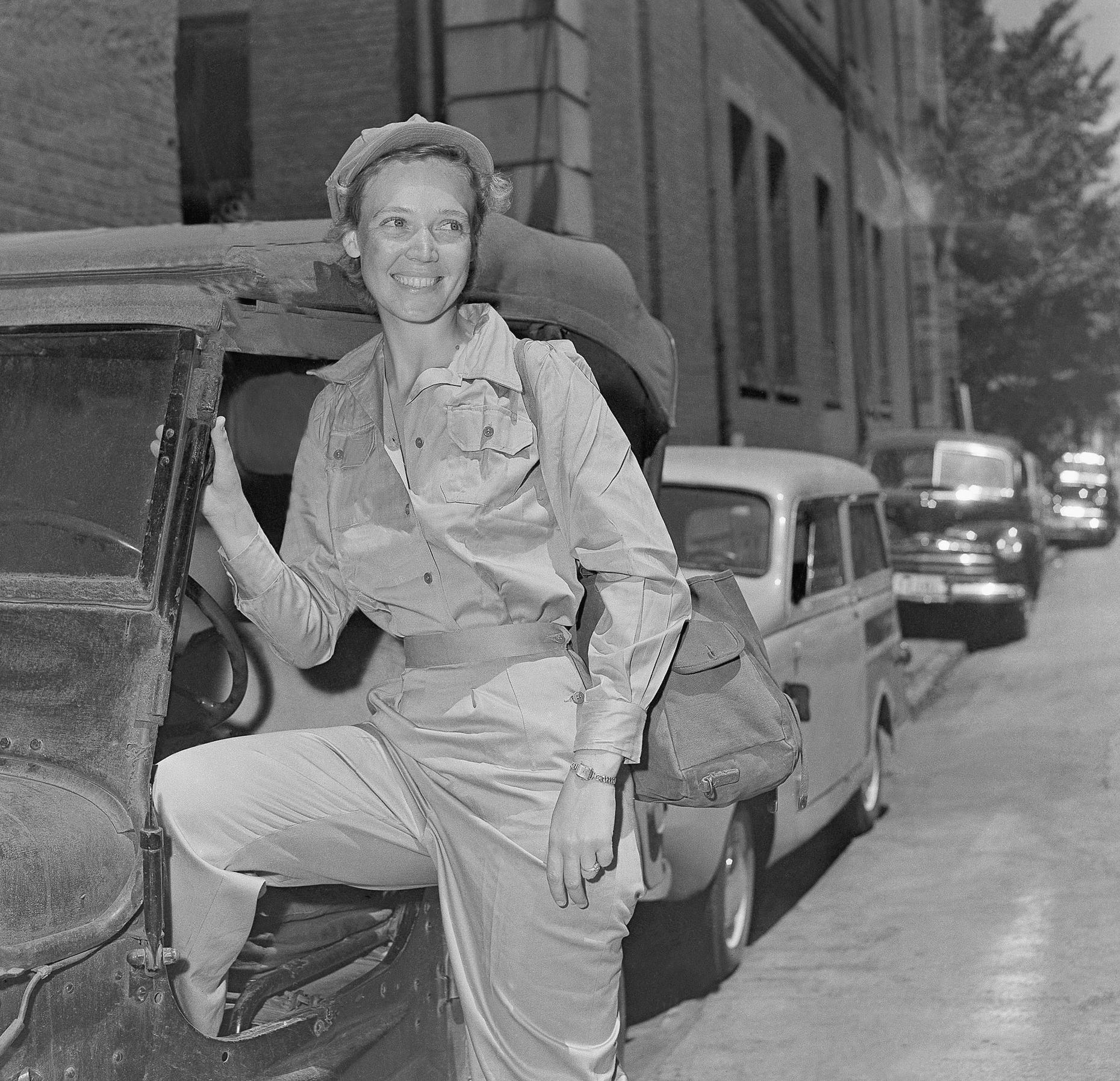
All Of It with Alison Stewart
The Life of Groundbreaking War Correspondent Maggie Higgins
00:28:39
Author Jennet Conant joins us to discuss her new book, Fierce Ambition: The Life and Legend of War Correspondent Maggie Higgins.
Loading summary
Transcript61 lines
- [00:00]
McDonald's Customer
I' ma put you on, nephew. All right, Unc.
- [00:02]
Alison Stewart
Welcome to McDonald's. Can I take your order, miss?
- [00:04]
McDonald's Customer
I've been hitting up McDonald's for years. Now it's back. We need snack wraps. What's a snack wrap? It's the return of something great. Snack wrap is back.
- [00:15]
Regain Couples Therapy Announcer
This is an ad by Regain Couples Therapy. Let's be honest, loving your partner doesn't mean you always like them. And guess what? That's normal. Regain, powered by BetterHelp, offers couples therapy that's flexible, affordable, and 100% online. Whether you're reconnecting or working through conflict, Regain is here to support you both. See why people wish they'd tried couples therapy sooner? Visit regain.com couplespod to get 10% off your first month. That's regain.com couplespod.
- [00:49]
McDonald's Customer
Listener support WNYC Studios.
- [01:02]
Alison Stewart
This is all of. I'm Alison Stewart, live from the WMYC studios in soho. Thank you for sharing part of your day with us on tomorrow's show. The Muscogee nation used to be one of only a handful of federally recognized tribes with an independent press. But that changed in 2018 when the tribal council voted to put the press under tribal government control. The Sundance Award winning documentary Bad Press details the fight to claw back those freedoms. We'll speak with its directors. That's in our future. But this hour, we're going to talk about the journalists who cover war. And then. And now, coming up, we'll speak with the director of the documentary 20 Days in Mariupol, who documented the Russian attack on that city. He and his team were the only journalists there at the time. But we begin with a war correspondent from the past who defied expectation. War correspondent Maggie Higgins spent her life defying expectations as a woman, and a very beautiful woman at that. Fellow journalists initially underestimated her ability to cope with the dangers of combat reporting. Maggie proved them wrong time and again, using brave and competitive tactics to beat everyone else to the story. As one fellow reporter once put it, quote, she's as innocent as a cobra. Higgins made a name for herself covering the most important conflicts of the 20th century for the New York Herald Tribune, from the final days of World War II to the outbreak of war in Vietnam. She was there when the allied forces liberated Dachau and was with American forces during some of the most violent days of the Korean War. She learned to shoot a gun. She slept in trenches. She went toe to toe with military. Maggie Higgins was the first woman to win a Pulitzer Prize work for Frontline reporting, an honor she received for her work in Korea. Despite the accolades, throughout her career, Maggie Higgins had to contend with accusations that she was frankly sleeping around to get the story. She had to fight to be allowed on the front lines alongside male reporters. And later years, in the later years of her career, she had to fight accusations from younger journalists that her anti communist politics were affecting her reporting. A new biography takes you through the fascinating life and career of Maggie Higgins. It's titled Fierce Ambition the Life and Legend of War correspondent Maggie Higgins. It's written by author Janet Conant, and she joins us now. Welcome to the studio.
- [03:15]
Janet Conant
Thanks for having me.
- [03:16]
Alison Stewart
When did you first hear about Maggie Higgins?
- [03:18]
Janet Conant
I first heard about her through a friend of mine, Nora Ephron, who spent two decades trying to get a movie made about Maggie Higgins. And she never succeeded. She was still working on it at the time of her death in 2012. And she used to joke that it was easier for Hollywood to make a movie about a man with a hangnail than a woman who'd won a Pulitzer.
- [03:39]
Alison Stewart
So that's such a good Nora F. Online right there.
- [03:42]
Janet Conant
Right. So I became intrigued that I had never heard of her. And I thought that was amazing. I'm a World War II author. I've spent my life, you know, reading dispatches from World War II correspondence. And I thought it was amazing that I hadn't heard of Maggie Higgins. And so I started reading up on her and I just thought she was an amazing story and should be better known.
- [04:02]
Alison Stewart
You note in the afterword of your book, this was possible because of a woman named Kathleen Kearney Keeshan, not a journalist, but a fellow Maggie Higgins. Obsessive. I think you used the word obsessive. What resources did she share that were useful and a little bit about her? Cause it's kind of interesting how she came to Maggie.
- [04:19]
Janet Conant
It's an amazing story, really. And it was one of those great gifts you get as a reporter. I started the book during COVID so all of the archives that I needed to use were closed. So I just did that thing of anything I could get on the Internet. Any reference to her, I bought. I bought some of the most obscure things. I even bought a shower curtain with Maggie Higgins image on it. I mean, if it was there. I got it and I unearthed this dissertation. It was only in print. I had to order it from, I think, some Kansas City library, I can't remember. And it came and I read it. And it was amazing, frankly. And it was a PhD dissertation. It was dated in its way. It was written by someone who was clearly not a journalist, but a student. That said it was full of quotes from Maggie's colleagues and peers during the 40s, 50s and 60s that appeared nowhere else. And so I was amazed this student had accomplished this. I tracked her down. It wasn't easy. She had moved many times, and I found her in a retirement home in California. First contacted her son, who put me in touch with her. I won't tell you her age because she's phenomenal, but Kay Keeshan immediately responded. And it turned out that she had gone into this retirement home and decades of research on Mag Hickens was sitting in some container and she didn't want to pay the rental fee anymore, and she couldn't take it with her. So she asked me if I wanted it, and I said sure. And So I paid $2,000 to have it trucked across country, and it arrived in my driveway. I have the photographs of this giant wooden crate. Anyway, during COVID this was a huge gift.
- [06:04]
Alison Stewart
Oh, my gosh.
- [06:05]
Janet Conant
But Kay spent. She worked for IBM. She was perennially being passed for promotion. Every time she did, she went to management and said she was going to get another degree. The woman has so many degrees. She has several masters, but she got a master's and a PhD where she wrote about Maggie. And in the course of a decade or more, she interviewed all kinds of people that are now dead. And she gifted me these incredible interviews, and they're most of them in correspondence form. So she wrote questions to the journalists and they wrote their replies. So it's not secondhand, and it's an incredible resource. It's invaluable. Plus, she became a great friend and we talked all the time. And she was a Maggie obsessive. So during COVID I had a partner in crime and we had a great time together.
- [06:52]
Alison Stewart
My guest is Janet Conant. The name of the book is Fierce Ambition, the Life and Legend of war correspondent Maggie Higgins. What's an example? We're going to get into some details, but what's an example of a quote you read about her or something from the people who knew her that didn't make it into the book, but really gave you a sense of who she was and a sense of what to make of her career? You know, sometimes you read a detail about your someone, you're like, ah, I know who this person is now from.
- [07:22]
Janet Conant
That detail I did. I read a quote about her that explained a lot to me, and it said, I think it's in the book. But the quote was, nobody was ambivalent about Maggie, they either loved her or loathed her, but nobody was indifferent. And that was the thing about her. She was an incredibly strident personality. She pissed off the chauvinists and the feminists because she just played by her own rules the entire time. And I think that partly explains why she's not better known. Because she was not beloved by the sisterhood and perhaps revered the same way. Because she was a prickly customer.
- [08:02]
Alison Stewart
Yeah. She would not say she was a feminist.
- [08:03]
Janet Conant
No, not in her day. But to be fair, not that many women did professionally at that time. I mean, when I say professionally, there were no women war correspondents when she started out to be a woman war correspondent. And there were really almost no women in the City room of the New York Herald Tribune or any metropolitan newspaper. And the few women that were there covered women's issues. You know, society, fashion, you know, widows and orphans. Nothing that she wanted to do. She wanted to be where the boys were. So, you know, she set out to do something that was not acceptable in her era. And she pulled all kinds of crazy stunts and dirty tricks to get there. Because, you know, if she didn't break the rules, she couldn't have done it. Because the rules were women didn't belong in the City room, let alone at the battlefront.
- [08:52]
Alison Stewart
So what's the rule she broke?
- [08:55]
Janet Conant
You know, she broke every rule. You know, she wasn't. She didn't play by the sort of pain, papers accepted, idea of a team player. You know, you were supposed to cover something together and share credit. If Maggie got there first, she hogged all the credit. Not only did she hog all the credit, but she was accused of hogging the telephone booth so nobody else could file their copy. She felt that she needed not only to go an extra mile to get ahead of the men that she was competing against, but every day, in every way, she would try, in some sense, to undercut them because she felt that she was being undercut, cut every day. She never got a fair shake. She never got an equal opportunity. Women weren't welcome. Remember when she started, Women weren't welcome. Not only in the men's clubs, they weren't admitted in most bars in New York. She couldn't even go to the Oak Room at the Plaza, where businessmen met for lunch because it was thought that women distracted from the deal making. The army barred women from the front completely. And she wanted to be a war correspondent. So if she wasn't outrageous, if she wasn't irritating, if she didn't raise her voice and cause a ruckus and generally be a pain in the ass. She wouldn't have done anything.
- [10:14]
Alison Stewart
She was born in 1920. The family spent a few early years in Hong Kong before moving back to California. She ended up spending some time living with relatives in France and being educated there before coming back to the States. And it led her to not feeling fully comfortable with speaking or writing English for many years. She wrote, Maggie was conscious. You wrote. Maggie was conscious of her bizarre background, what she took to calling her Irish, French, Hong Kong heritage. How did this affect her career going forward? How did it affect her journalism if she wasn't necessarily the strongest writer?
- [10:47]
Janet Conant
Well, she spoke a couple of languages, and she had a great facility for language. So she started out as bilingual. She studied German from an early age because she wanted to be a war correspondent. She could pick up languages, Russian, very quickly. So she knew that was an advantage. And she kept that up knowing that that was an advantage. And that is how she sent abroad at a very young age to cover World War II at the age of 23. She was an outsider. And that chip on her shoulder of being an outsider. She came from a poor background. She was a scholarship kid all through high school and college. She was a gifted athlete. That kept her there. She was a gifted student. But that sense that she had to work harder, go the extra mile, that nothing would be given to her, was just a fundamental part of her personality and also, I think, an underlying insecurity. The sense that she had to constantly prove herself, prove herself worthy.
- [11:50]
Alison Stewart
That is what drove her in terms of her competitiveness. What was an instance when her competitiveness worked to her advantage, and what's an instance when it probably hurt her?
- [12:00]
Janet Conant
Well, her competitiveness helped her in the sense that, in that women weren't allowed, she was so competitive that she completely ignored the women of her generation, set her sights on the men and the best of the male journalists, and she wanted to go toe to toe with them. And because she was so competitive, she was willing to work harder, longer hours. She was absolutely tireless. And she was reckless in the sense that she would take risks that they wouldn't to get stories to beat them. But she carried everything in her life a little bit too far. And the extreme of her competitiveness, a certain lack of generosity, I think, with her colleagues. In the end, a colleague said she had a genius for bad publicity. If people tried to congratulate her or be kind to her, she could just be too tough, too mean, too unrelenting, because she just felt she had to constantly, constantly prove herself do you think.
- [13:05]
Alison Stewart
She was too tough, too mean, unrelenting, or she was just being a reporter?
- [13:09]
Janet Conant
Well, that's the other thing. You know, there were such a double standard at the time for female behavior. My contention, I think, throughout the book. And obviously people will make up their minds what they think of her. I think she was judged constantly by how women were supposed to be perceived. In the 40s and the 50s and the 60s. You know, they all said she advanced on her back, that she slept around. She slept around, but with colleagues, male colleagues. My God, the male journalists of that day were all married. And they all had a girl at every port. You know, all the war correspondence. She didn't behave any differently than the men. But because she was a woman, she was branded as a hussy in those days or worse. And I think it was a phenomenal double standard. But what's interesting to me is that it carried over even decades later into the journalism and the biographies written of her. Even by women who kept quoting the men saying that she was sort of slutty in her behavior. And I just thought it was so interesting how it's taken a long time for this generation of women to understand that their heroines are allowed to be people and complicated, just as the men are always allowed to be.
- [14:18]
Alison Stewart
I want to read a letter from the book. This is later in her life. She wrote to her editor about her marriage to an Air Force general, William Hall. Which you happened, right? It happened practically like the ink was dry on her last divorce. So she writes a letter and says, since I consider the Herald Tribune to be kind of family, I wanted to be sure to inform you before the columnist did. I am marrying General Hall. I also want to tell you the marriage will not, so far as we are concerned, affect my plans for resuming my work with the Herald Tribune very shortly. I see no point in being coy about our problems. Briefly, they stem from the fact that Bill alimony leaves him less per month than I used to earn per week. So even if I wanted to stop being a reporter, which I don't, I couldn't. Despite all the manifold difficulties, we decided to go ahead with our marriage on the theory that it was better to face the difficulties as a team than apart. I look forward being back in New York. I detest California, but I have to admit the weather has been wonderful. And at last I appear to be completely cured of all my ills, including the sinus. This bout with the bugs has been quite exhausting. One and I'm glad to this particular battle is over. There's a lot we learned about her life. First of all, how did she manage to get hired at the New York Herald Tribune in the first place?
- [15:32]
Janet Conant
Well, she went straight out of college. She arrived in New York, as the story goes, with $7 in her pocket and her fierce ambition. She went straight to the New York Herald Tribune because when she got out of Penn Station, she asked for the nearest newspaper and the paper boy directed her to the building up the block. So it was pure luck that she walked into that building first and she into the city room and she asked for a job. And she was pretty much laughed out of there, except the city editor sort of complained under his breath that with the draft taking so many of the men from the paper, he might be forced to eventually hire a woman. On that sort of slender read of hope. She was determined to stay in the city, and she got herself into the Columbia Journalism School, which in those days had a quota on the number of women allowed, and that was 11. But at the last minute, one woman cancelled, didn't make it, and Maggie squeezed in literally five days before school started. And while she was there, she managed to get herself hired as the campus correspondent for the Herald tribute. And then once she had her foot in the door, she would not be dislodged.
- [16:45]
Alison Stewart
She makes reference in needing money there, even after the Pulitzer. She describes her own words, she was broke.
- [16:51]
Janet Conant
She was broke. I mean, newspaper reporting never paid much and it certainly paid nothing in those days. Also, you know, she had no money to fall back on. She was frequently ill from all of the parasites that she picked up in these war zones where she reported from. And also, as the letter indicates, she married a man who was divorced, who had children, support. So she was essentially the sole earner of her household. And unlike most of her colleagues, war reporting was not an inducement to a happy family life. She managed to have two children and she had to pay for their education. She had to pay for their childcare. So she had to work twice as hard to keep everything going. And she was way ahead of her time in taking all that on.
- [17:45]
Alison Stewart
My guest, Janet Conant. The name of her book is Fierce the Life and Legend of War Correspondent Maggie Higgins. We'll have more after after a quick break. This is all of it. You are listening to all of IT on wnyc. I'm Alison Stewart. My guest this hour is Jeanette Conant. The name of her book is Fierce the Life and Legend of War Correspondent Maggie Higgins. Jeanette, you begin the book with a description of Maggie's experience covering the liberation of Dachau concentration camp. Why did you want to begin the book this way?
- [18:23]
Janet Conant
Because it was an incredible scoop. It was one of the most famous dispatches in the, you know, the annals of World War II. And she was incredibly young, and so opening the book, showing how she was told that she couldn't go there. It was across enemy lines. She asked for permission for the army to take her in a. In a small spotter plane. The general told her it was a good way to get killed. So she promptly went off and found a young Stars and Stripes correspondent who had his own jeep and convinced him to take her. And so they dashed across occupied territory ahead of the American forces because she wanted to get there first. And that pretty much encapsulates Maggie Higgins entire mo.
- [19:07]
Alison Stewart
What did she learn from her experience covering World War II and the aftermath in Berlin that she took forward with her to covering Korea, which was really a violent, violent war. I think sometimes people forget that.
- [19:21]
Janet Conant
Well, Peter Fursch, the young journalist that she teamed up with to cover Dachau, they did indeed get there first, and they opened the gates of Dachau, and they had a liberation story that was just momentous and moving, and it made her star overnight. And then over the weeks that followed, and as Europe. Europe just fell and they saw all kinds of atrocities and more concentration camps and the arrest of all of the Nazi leaders, she Furst took chance after chance. They broke the rules. They raced ahead of the American forces. They went with expeditionary teams, and they got all kinds of exclusives. And she made headlines, and that would just inaugurate her style, and she would carry that. That forward. And so she would always be in search of a fearless male correspondent, a jeep and a way to travel ahead of the forces. And that's what she did in Korea, and it won her a Pulitzer. And the guy that she traveled with, a fabulous Chicago Daily News reporter named Kai's Beach.
- [20:29]
Alison Stewart
There's a quote from one of her own recollections of her time going to Korea in your book. And she writes, for me, getting to Korea is more than just a story. It was a personal crusade. I felt that my position as a correspondent was at stake here. I represented one of the world's most noted newspapers as its correspondent in the area. I could not let the fact that I was a woman jeopardize my newspaper's coverage of the war. Failure to reach the front when undermined all my arguments that I was entitled to the same breaks as any man. They wanted to keep her off the front line.
- [21:03]
Janet Conant
Not only did they want to keep her off the front lines, but even after she was one of the first four correspondents into Korea and covered the fall of Seoul and walked 14 miles back alone through rice paddies and mountain paths to file her story, which was a huge exclusive for the Herald Tribune, which was then picked up by the Washington Post. And she would file for both papers throughout the war. Even after all of that, she was thrown out of Korea by a general who said it was no place for a woman. And his reason was that there were no facilities for ladies, which, you know, absolutely infuriated Maggie because, you know, the nearest facility was the nearest bush. And the idea that they would throw her out for that reason. And she appealed to General MacArthur and he had her reinstated. And the headline which was his cable saying we hold Marguerite Higgins in the highest esteem and she was reinstated to the battlefront really made her probably one of the most famous war correspondents of her day.
- [22:05]
Alison Stewart
The Tribune sent another reporter to cover the war alongside her, a veteran correspondent, Homer Biggert. And they ended up winning this Pulitzer together for the coverage of the war. They seem to pretty much hate each other. What was the source of the animosity? I don't know if hate's too strong a word, but. But certainly there was animosity.
- [22:21]
Janet Conant
There was tremendous animosity. Halbert Biggert was more than a decade older. He was a very seasoned World War II correspondent who'd flown umpteen combat missions and already won a Pulitzer for that. And then they brought him into Korea, but she was already there and he was a bachelor, unmarried, as I said, you know, really a hard bitten news correspondent. And he ordered her home and he was going to take over and she wouldn't leave. She felt that she had earned the right to be there. She had covered, as I said, the fall of Seoul and all of the early battles which were not only incredibly bloody but incredibly depressing because the South Korean army and the few support troops that were there that were American were very undermanned and under trained and overwhelmed. And it was retreat after retreat with all kinds of young soldiers dying because of inexperience and lack of equipment. And she had done a very good job of covering that. And she wouldn't leave. So they fought terribly. And then all of a sudden that started being covered in all the magazines. Time and Newsweek started covering this intrepid young female correspondent that wouldn't leave the front and was so brave. And that drove Homer Biggert crazy that she got coverage for being A woman. I don't think Maggie Higgins wanted coverage for being a woman, but she would take it if it meant she could stay, wouldn't turn it down, and so she stayed. And they just covered opposite ends of the war. And the Herald Tribune quickly realized that having two star correspondence gave them the best coverage, and it did. And they won all of the prizes for the Korean War because the two of them were determined to outdo each other.
- [24:03]
Alison Stewart
So I guess the idea was, if being a woman is going to be a problem, I'm going to take it when it's an advantage.
- [24:08]
Janet Conant
And it actually got scarier than that because in her determination to beat Homer Biggert, who was a legendary war correspondent and idolized by all the male correspondents, she took incredible risks. And, you know, it became a joke that she was going to get Homer Biggert and all the men killed because she kept going to the front with the troops to get exclusives while they were back in the bureau. And while the newspaper loved it because it made headlines, I think the competition did drive her to take very, very dangerous risks.
- [24:42]
Alison Stewart
You know, there's people often refer to, we say of war correspondents that they're adrenaline junkies.
- [24:47]
Janet Conant
Yes. And for sure she was.
- [24:49]
Alison Stewart
Yeah. We got a question. Somebody texted in, who's been listening, says, thank you for sharing this pioneering story. Did Maggie also interact with Martha Gellhorn?
- [24:59]
Janet Conant
She did. Gellhorn, you know, was also a pioneering correspondent. I think that Gellhorn tried to cover the war. She smuggled herself on a ship, hospital ship, to be there at Normandy. When they caught her, they barred her from the front because women weren't allowed on those ships at the time. And so she ended up having to cover the war from the sidelines. And Maggie was younger by quite a bit and came in just sort of behind Gellhorn and then almost took advantage of the situation and then, you know, was at the front all the time. So while they crossed paths a few times, Gellhorn was. Had been thrown out, essentially, and Maggie stayed. So Maggie was there at the tail end of World War II.
- [25:47]
Alison Stewart
What changed about the perception of Maggie Higgins during the Vietnam War, when she wasn't the upstart, when she wasn't the young gal reporter.
- [25:56]
Janet Conant
There was a huge generational shift at Vietnam. You have to understand that Maggie started covering Vietnam after the fall of Europe. She'd seen the Russians march into Poland and Czechoslovakia, take over those fledgling democratic governments, kill the leaders, oppress the young democratic movements in those countries, arrest and brutalize, essentially the population there. So she had an absolutely passionate, abiding hatred of communism, of totalitarianism. And she carried that forward into her coverage of the Korean War. And she hated the communists that were funded by the North Koreans, which were supplied by the Russians and the Chinese, and so she hated the communists there. And then she started covering Vietnam in 54 as an extension, really, of the Korean War. And she carried that Cold War mentality forward. But by the early 60s, a new generation was coming in, and they didn't view the battle against communism with the same abiding hatred that she did. So she wanted to wipe out the communist insurgents in North Vietnam, and she wanted to protect this little fledgling South Vietnamese government. As corrupt and terrible as the Diem regime was, she felt that we had promised to protect it as America and that it was the only outpost of democracy there. But it was a very corrupt regime. She rightly predicted that what followed would be worse. But it was a big generational change. And the younger reporters, and I will say that David Halverson sort of led the pack.
- [27:44]
Alison Stewart
The rover boys.
- [27:45]
Janet Conant
The Rover boys, as she condescendingly dubbed this younger generation of males reporters. He felt that the war was doomed and had a very different look. And it was a real generational switch. It was also, oddly enough, yet another massive feud with another male New York Times reporter. He replaced Homer Biggert for the New York Times. So it was an extension of Maggie's battle of the sexes.
- [28:15]
Alison Stewart
So she died young, 45, in 1966, of a disease she contracted during her time in Vietnam. What do we know about her final days, her final weeks?
- [28:25]
Janet Conant
Well, she probably could have lived had she not been so stubborn, but she had been incredibly resilient in the past. She contracted every known disease, you know, from all the different war fronts and the Congo and India. And she'd always managed to bounce back. But she had a raging fever, and she looked near death when a colleague called her boss at the then Newsday and said, you've got to order her home. And by the time she reached Washington, she had a fever of 105 and she wouldn't go to the hospital. She went home and she kept filing. She was so determined to keep up her three times a week column, and she wanted to complete all of the series of articles she'd done on Vietnam. So by the time they got her in Walter Reed Hospital, she lost one kidney and her organs began to fail. And even then, they. I think nobody could believe that someone so young would die, but they couldn't save her.
- [29:23]
Alison Stewart
The name of the book is Fierce ambition, the life and legend of war correspondent Maggie Higgins. I've been speaking with its author, Jeanette Conant. Jeanette, thank you for coming to the studio.
- [29:31]
Janet Conant
Oh, thank you for having me.
- [29:33]
McDonald's Customer
I'mma put you on, nephew.
- [29:35]
Alison Stewart
All right, unc. Welcome to McDonald's. Can I take your order, miss?
- [29:38]
McDonald's Customer
I've been hitting up McDonald's for years. Now it's back. We need snack wraps. What's a snack wrap? It's the return of something great. Snack wrap is back.
- [29:48]
Regain Couples Therapy Announcer
This is an ad by Regain Couples Therapy and features real testimonials.
- [29:54]
Alison Stewart
This was our first time trying therapy, and honestly, it was long overdue. Looking back, we just wish we had started sooner.
- [30:01]
Regain Couples Therapy Announcer
Regain's qualified therapists help couples when they can't get there on their own.
- [30:06]
Janet Conant
We thought it was intimacy issues, but Andrea helped us uncover a deeper root cause we hadn't even realized was there.
- [30:12]
Regain Couples Therapy Announcer
Visit regain.com couplespod to get 10% off your first month. Regain. Powered by BetterHelp.