Loading summary
Transcript94 lines
- [00:00]
Anne Gridley
All of it is supported by Progressive Insurance. Do you ever think about switching insurance companies to see if you could save some cash? Progressive makes it easy to see if you could save when you bundle your home and auto policies. Try it@progressive.com Progressive Casualty Insurance Company and affiliates. Potential savings will vary. Not available in all states.
- [00:28]
Alison Stewart
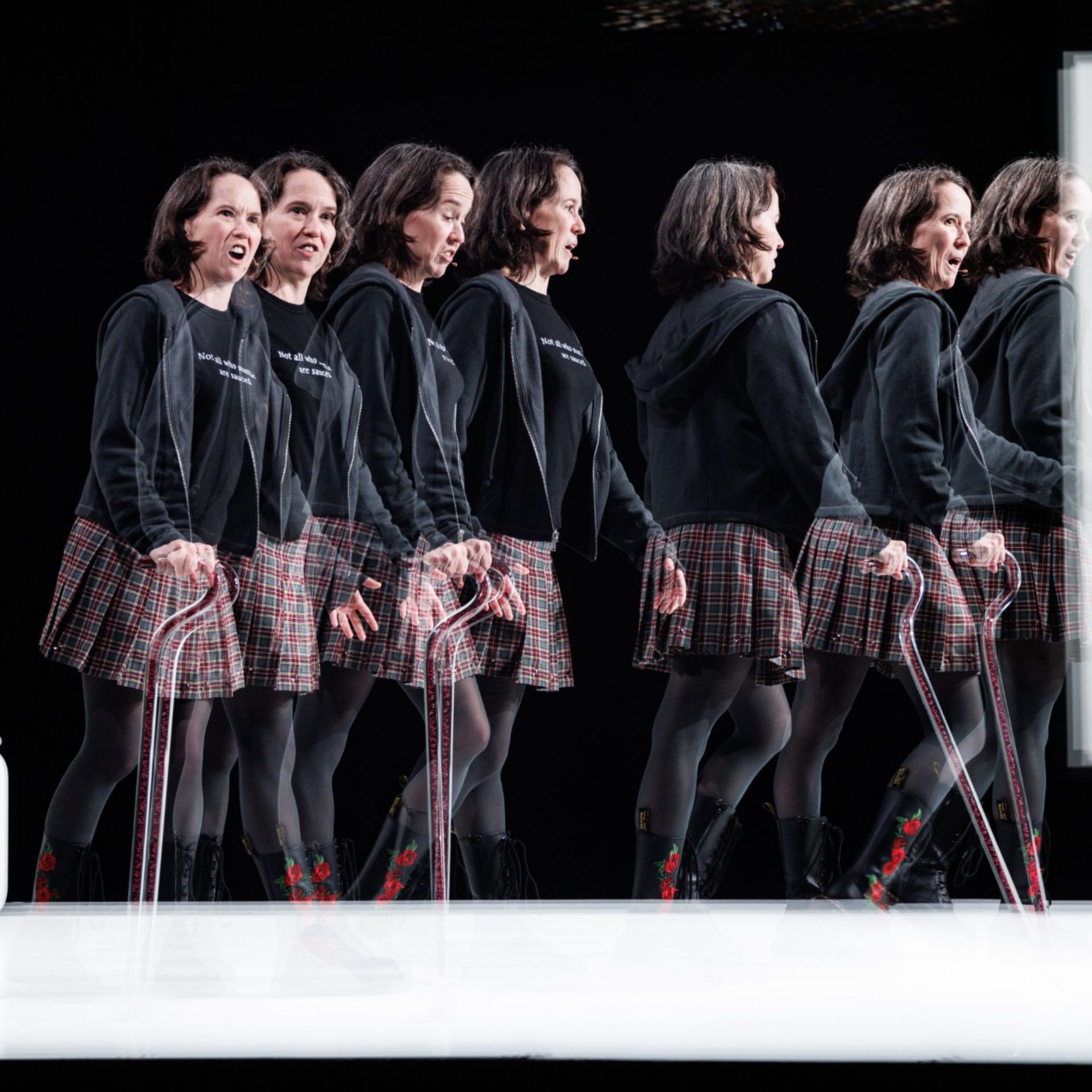
This is all of it. I'm Alison Stewart live from the WNYC studios in soho. Thank you for sharing part of your day with us. I'm really grateful that you're here. On today's show. We have two Broadway stars in studio to talk about their performances. Mark Strong joins us to talk about starring in the new version of Oedipus. And Namir Smallwood is here to talk about his role in the revival of Tracy. Let's bug. That's the plan. So let's get this started with an under the radar festival entre. Watch Me Walk. Two time Obie Award winner Anne Gridley is a longtime performer, a regular on the downtown scene. Twenty years ago, it was likely that she would not have expected to be the subject of a one person show. least this one, the one where she speaks candidly about her disability. It was a midlife onset of hereditary spastic paraplegia. She didn't know she had it first. Sometimes she lost her balance or maybe she thought it was the aftermath of drinking too much. But as she learned more about why her walk was off, she put the dots together and she realized her mother and grandmother had it too. Her show, Watch Me Walk is both funny and a gut punch at the same time. And there's dancing and singing too. And it's directed by Obie Award winning director Eric Tang. As Hilton Als wrote about the show in the New Yorker. Gridley's script and the incredible performer who means to tell us her story without sentiment remains a prime example of what we get when autobiographical theater works. Intelligence and the ability to laugh at oneself with one's heart. As always in both the wrong and the right place. Watch Me Walk is playing as part of the under the Radar Festival. It can be seen at Playwright Horizons until February 8th. Anne Gridley, welcome to the studio.
- [02:27]
Anne Gridley
Thank you so much.
- [02:28]
Alison Stewart
And Eric, it's really nice to meet you as well.
- [02:29]
Eric Ting
Yes, thank you.
- [02:30]
Alison Stewart
So Ann, when did you know you were going to be a performer?
- [02:34]
Anne Gridley
Oh, well, I sort of fell in love with it when I was in middle school. Yeah, that's really when I started. Before that I wanted to be a veterinarian.
- [02:48]
Alison Stewart
What changed for you?
- [02:51]
Anne Gridley
I just saved me the theater, you know, with this Group of people all coming together toward a common goal that was so beautiful and moving and fun, you know, that I just started it and I stayed with it.
- [03:11]
Alison Stewart
Eric, how did you get into directing?
- [03:13]
Eric Ting
Oh, my goodness. A very circuitous route. I started in puppetry, which is the thing that I recommend to any megalomaniac because you control all things. But I think directing is really just. I think, as Ann is saying, it's all about collaborating with people.
- [03:30]
Alison Stewart
Now, how did the two of you meet?
- [03:34]
Anne Gridley
Well, well, through your wife.
- [03:36]
Eric Ting
Through my wife. And Anne and my wife Mei in went to grad school together and we met each other sort of like early in my relationship with me and Ann, I was a huge fan of Ann's work as part of Nature Theater of Oklahoma. It was definitely one of those kind of cornerstone Keystone theatrical companies in my career as an artist and a lover of art. And Ann was always the most captivating part of it for me. There was just something about the way Anne took the stage that kind of grabbed you by the throat and never let go.
- [04:16]
Alison Stewart
Anne, before this show, how did you feel about one person shows? People have very different feelings about them.
- [04:23]
Anne Gridley
Oh, yeah, they're so easy to make fun of or to like, hate. And I admit I was more in that camp of like, sort of like, oh, no, it's a one person show.
- [04:36]
Alison Stewart
I have a friend who's like that. He's like, don't invite me, don't invite me to go with you.
- [04:39]
Anne Gridley
Yeah, yeah. It's like, oh, do you want to come to my improv show? No, thank you. But improv can be great and so can one person shows. And I think, I think I've said this before, but I think part of what I disliked about it is the fact that I was afraid, Like, I didn't know if I could do that. You know, that was the little kernel of truth at the bottom of it is that I didn't think that I could actually do it. And so everybody else is ridiculous for even trying, you know. Yeah, but. And it's a 1 ish person show. Watch me walk. So I think I kind of cheated the system a little bit.
- [05:23]
Eric Ting
Anne early on was sort of like, you know, we were asking Anne, what would you want if you could do a one person show? And she would like, she was like, not be a one person show. And so she asked if she could cast two adonises. So that's Alex Gibson and Keith Johnson, who kind of came on board and brought their own special gifts to the piece.
- [05:40]
Alison Stewart
Eric, when you decided to direct Anne, in this show, what did you learn from watching previous one person shows that you thought, I'm not gonna do that, or, oh, that's a good idea. Put that in the back of my head.
- [05:53]
Eric Ting
So one person shows, I find, are work that is autobiographical in nature, which often shows up as solo work. But, like, again, we're trying to do something a little different with this. But that kind of autobiographical work is always about a story. And what you're trying to do is you're trying to find the story and, like, build the story and understand what are the ways within which that story connects back to. So one of the great things about Watch Me Walk and Anne Gridley in particular, is that. So I'm also the director, one of the three directors of soho Repertory Theater, which is producing the world premiere of this play. And one of the great things about this piece was that when we found out Ann was doing it. There are two recordings featured in the work, and they're recordings of Ann's mother. And those recordings come from a Nature Theater of Oklahoma production called no Dice, which was actually commissioned by soho Rep almost a decade ago. It's kind of like a full circle moment, right, for us, where it's sort of like, in the same way that Anne's journey kind of helps us understand the passage of time, that's also been kind of what's been exciting about working on this piece.
- [06:57]
Alison Stewart
We're talking to Anne Gridley and Eric Ting. We're talking about Watch Me Walk. It's part of the under the Radar Festival. It's running at Playwright Horizons until February 8th. So, Anne, for the first part of the show, we watch you walk. We go back and forth across the stage for five minutes. It's a long time, right?
- [07:15]
Anne Gridley
Yes.
- [07:17]
Alison Stewart
Why did you want to spend that much time having the audience watch you walk?
- [07:22]
Anne Gridley
I think it's important to, like, let people settle into my way of moving, because if you just catch it at a glance or something, you might get nervous. Is she gonna fall? Is she gonna. Oh, what's that? What's that? That's weird. Why does her knee do that? Why is her ankle flopping around? So to let the audience have those feelings and go through those feelings until it becomes normal. Normal, Quote, unquote. I don't care for that word. But until they're like, oh, okay, well, this is the way that this person moves. And now I know that. And okay. And it takes the time that it needs to take. We experimented with, like, you know, I joked about, okay, and then they're Going to watch me walk for 40 minutes, you know, and then we tried two minutes, but that wasn't long enough. So now it's. Now it's, I think around three minutes where there's. You get what the title of the show is.
- [08:26]
Alison Stewart
What was your guidance as the director for this part of the show where we watch Anne walk?
- [08:33]
Eric Ting
Yeah, I think, you know, there's a really. Anne gives a glossary of words at one time. And one of the words that she mentions the phrases is crip time. And it's this notion that for someone with a disability, time is. And their relationship to time is different. So, you know, there's a fascinating thing. There was a patron of ours came to see the show and wrote me afterwards and was like, it was really amazing to sit in that audience and actually watch this person walk for so long. Because what she was saying was that we are taught not to. Like, we're taught when we're very little that it's like not good manners to stare, not good manners to watch. And I think what's been very special about this is for us, it's like, okay, we want to both, right. Give us as an audience an opportunity to kind of like sit in and get accustomed to Ann and Ann's mobility. But also at the same time, we want to actually invite an audience to step into Ann's relationship with time.
- [09:33]
Alison Stewart
Anne, are you ever fearful that you're going to fall?
- [09:37]
Anne Gridley
I mean, it's just something that happens in my life. So, no.
- [09:46]
Alison Stewart
Let'S get back up.
- [09:47]
Anne Gridley
I just get back up. I just get back up. And it's much easier when it happens in the theater than when it happens when I'm like walking to go grocery shopping.
- [09:57]
Alison Stewart
Do you consider yourself, are you Anne or are you Anne as a character in the play?
- [10:02]
Anne Gridley
Oh, I consider myself Anne. I don't know how to play a character of myself.
- [10:08]
Alison Stewart
Which person do you direct? Do you direct Anne, your friend or Anne, the performer?
- [10:13]
Anne Gridley
Eric.
- [10:13]
Eric Ting
Oh my gosh. I mean, you. For a little while, it was a little like cross eyed because we would be in the room and I would be like talking to Anne and then also talking about Anne. And we got to the point where we were sort of like, when we talk about the character, we're saying Anne Gridley. And when we're talking to you, we're saying Anne.
- [10:29]
Alison Stewart
That's interesting.
- [10:29]
Eric Ting
And so it was like. Because it was helpful, I think, partly because the work is so personal. Like, it's an act of bravery, what Anne is doing for her in a way, because she's putting so much of her own self into this piece, which is not a thing that we necessarily have been invited into. And that kind of overlapping kind of relationship to the work. As an artist, what I found was that it was helpful actually to be able to give the writer an ability to dissociate from the character at the center of the piece so that, like, she could think, you know, from a clinical distance about the journey of the play.
- [11:03]
Alison Stewart
So what question did you have for Anne, Eric, when you read the script?
- [11:09]
Eric Ting
Well, you know, there was a really great question that. So one of the things that we do is we invite audiences to write questions for Anne in the lobby before the performance. And there's little cards that they can fill out, and those cards get selected by our stage manager, Lisa McGinn. And one of the questions that came up the other night was, oh, what was the question that was asked? I was totally going there. I'm forgetting right now. I will say this. What. One of the questions that I asked Ann early on was, you know, what is beyond just your experience of hereditary spastic paraplegia? And there is an element in the play which is that hereditary quality that you mentioned, right, where Anne shares that both her mother and her grandmother had it. And so for us, that was the portal to the kind of next kind of evolution of the work. The second half of the play is really rooted in this notion of that the things we inherit are not just, you know, physical health conditions, but we also inherit a point of view on the world. We also inherit, like, legacies and accountabilities.
- [12:19]
Alison Stewart
And when did you write the script? Who was your first reader of the script?
- [12:25]
Anne Gridley
It was two years ago, I think, for the Prelude Festival at cuny. I sort of. I'd always. I had the idea for the title of the piece for years, and I had written nothing. I was just like, this is a really great title. Isn't it funny? And people said, yes, and it's very funny. And. And then Annie B. Parson from Big Dance told Frank. What's his name?
- [12:54]
Eric Ting
Hensker.
- [12:55]
Anne Gridley
Hencher. Thank you. Frank Hencher at cuny, like, oh, you know, Ann has a work in progress that you could show at Prelude. I had nothing. So, title. Yeah, I had a title. That was it. So. So then I sort of had to mad dash write something. And it started with the doctor's notes from my chart as like a jumping off point. And it was about a 20 minute presentation that I did for Prelude Festival. And Eric saw that. And then people called me on my Bluff, I guess.
- [13:29]
Alison Stewart
You know, after you wrote the script and you read through it, what did you realize that you hadn't paid attention to before?
- [13:42]
Anne Gridley
Whoa. Whoa. I don't. I mean, I think it. It's funny because it. It's in the name of this disease, hereditary spastic paraplegia. But, like, I think I didn't quite realize how much my mother was involved. And, and the audio recordings that Eric talked about earlier, we didn't get until late spring of this year. We didn't have them. And then once we had them, it was like, ah, this is the. The golden ticket that's really going to crack open and sort of bookend the piece. But I thought I was just going to yammer on about this particular disability and maybe disability in general, and the connection with these women in my family is much stronger than I think I thought it would be when I first sat down and started my silly little writing.
- [14:48]
Alison Stewart
We're talking about Watch Me Walk. It's part of the under the Radar Festival. It's running at Playwright Horizons until February 8th. We'll have more with Anne Gridley and Eric Ting after a quick break. This is all of It. You're listening to all of it on wnyc. I'm Alison Stewart. In studio with me is performer Anne Gridley and director Eric Ting. We're talking about their performance of Watch Me Walk. It's part of the under the Radar Festival. It's running at Playwright, playwright Horizons until February 8th. And so for people who are just joining us and want to get up to speed, would you describe your disease for us?
- [15:36]
Anne Gridley
Sure. Hereditary spastic paraplegia is a rare disease that affects the upper motor neurons. And the upper motor neurons control your leg movement, so it's progressive. And the upper motor neuron degenerates. And that affects, like, the way that your brain communicates with your legs. So. So I always say, like, oh, those signals get lost in translation. So either they never get the message at all or they get it late. So it affects balance, it affects agility, and. And it can affect strength as well.
- [16:20]
Alison Stewart
Eric, did you do research into her disease before starting this show?
- [16:26]
Eric Ting
Definitely. I mean, I think a lot of what I've learned, I've allowed Ann to lead because it's been helpful to kind of, like, take that process. Soho Rep has a kind of long history of doing work that kind of challenges how we see things in the world and the assumptions that we make. And so, like, for us, it felt really important to both have a foundation, but also to recognize. Right. That the foundations of the information that we gather is always told with a point of view and that what we want to do first and foremost is center the point of view of our artists. And so that's been a big part of this from the very beginning.
- [17:06]
Alison Stewart
And in the show, you talk about your boots. It's on the show's promo material.
- [17:11]
Anne Gridley
Yes.
- [17:11]
Alison Stewart
What's special about your boots?
- [17:14]
Anne Gridley
About my Doc Marten boots.
- [17:17]
Eric Ting
Product placement.
- [17:18]
Anne Gridley
Yeah, product placement. Well, they are supportive. They come to, like, mid calf. So they sort of function in a way that my much despised AFOs. That stands for ankle foot orthotics, or like a leg brace. They function in a similar way, but the boots have more flexibility and give to them. I love that they zip on the side so you don't have to deal with, like, miles of shoelaces. But they're. They're really supportive. I just feel very supported in them. And they look very cool.
- [17:57]
Alison Stewart
They do look cool. I have to say, there are moments in this show where things get wacky. There's a whole section involving Anne being part of the body, costumes included. Why did you want the audience to experience that moment?
- [18:16]
Anne Gridley
Well, I thought it would be a fun way to sort of get into the science of it, which is often confusing for. For me and as a non scientist. So it's. And it's like theatrical fun. You know, I love, quote, unquote, like, dumb theater tricks. So, like, yeah, put on this weird upper motor neuron mascot outfit.
- [18:48]
Eric Ting
One of the great things that the costume does, and the costumes were designed by Lux Hawk, is that the. The costumes actually become a metaphor for Anne's own relationship to her body. Right. So there's something about the. That whole wackadoo section happens after the diagnosis in the play when Ann shares what she has with us. And so, like, for us, a little bit, the exploration was about what happens when you get a diagnosis that is life changing. How does it change your understanding of your own body? How do you stop feeling like yourself in your body anymore? And so it felt like it was a moment when, like, the rules of the world should turn upside down as well.
- [19:23]
Alison Stewart
I saw the performance on Sunday night, and you're very cute, Eric. You came to the front. Like, we added a whole bunch of stuff. Let's see how it goes. What did you add to the show? How did it work out? What do you think?
- [19:38]
Anne Gridley
I don't even remember what we added on Sunday.
- [19:40]
Eric Ting
I'm sure it was in the science section.
- [19:41]
Anne Gridley
It worked out. Yes, it was in the science section. And it Worked out.
- [19:45]
Eric Ting
Oh, we added a deep thought section. It was sort of like just, oh, yeah, you know, there's like sketch comedy kind of is a kind of aesthetic choice in that section that you were talking about. And there's a moment when we kind of reference an old SNL sketch. Right. Deep thoughts with Jack Handy. And I think what Ann does in that moment is she tries to encapsulate kind of the anxieties that have transpired and led her to this doctor's office for this diagnosis.
- [20:14]
Alison Stewart
You said it's a one person, ish show. Yes. There are two other folks on stage, Alex Gibson and Keith Johnson. What kind of audition process did you go through to find these two big old boys?
- [20:30]
Anne Gridley
It was very exciting. It was the greatest audition process I've ever been a part of. Just hours of handsome men coming in. But, yeah, we had them come in and the text that they had to bring in was the history of disability text. Alex came in and had set it to music and encouraged us to sing along with it. And I turned to Eric at the end and said, like, well, we. I think we just looked at each other and said, we need that in the show. That song actually needs to be in it. There was another audience participation song at one point, but we. We just gave it all to Alex because it was so incredible what he came in with. And Keith came in with baton twirling as a special skill. And he.
- [21:27]
Alison Stewart
He can really. He can really.
- [21:28]
Anne Gridley
It's on his wrestling. Yes.
- [21:31]
Eric Ting
Under special skills.
- [21:32]
Anne Gridley
Actors are amazing under special skills. So he brought in a baton and did a routine to Michael Jackson. And I said, can you do that with a walking stick? And he said, sure.
- [21:42]
Eric Ting
It's a beautiful story. I think Keith. I hope Keith is okay with my sharing a little bit of this. But, like, I think Keith's father was the person that encouraged him to kind of take up baton hurling as a way to improve ball handling as a basketball player, which is what Keith had quite a bit of success in. And it was really amazing because I think one of the things that Keith shared with us was, was that sort of like in the practice of bringing that skill into the room, it was the first time that that skill was anything more than just a way of preparing for a different thing.
- [22:09]
Anne Gridley
Yeah, you said, oh, nobody's ever really celebrated that I have this special skill. And I was like, we will celebrate you.
- [22:19]
Alison Stewart
What do you see as Alex and Keith's role in supporting Ann? Ann Gridley?
- [22:25]
Eric Ting
Oh, gosh. I mean, I think if there's a thing that I would love people to. To kind of like, think about as they're coming to see this show is so much of what we do in the theater, we make work under these kinds of assumptions about how work is made. And I think the gift of being in this process with Anne is that a lot of those assumptions we've had to question. And like, all along the way, there's been a part of this work that has been about how do we care for each other. Like, that is always there in the theater. Like, people are always asking that and thinking about that. But it was like, particularly surfaced in this process, Right. That like, Ann's body sometimes is different from day to day. And we have to make sure that in this show there is the elasticity built into it to allow for and adapt to Anne's needs on any one day. And so it was really important to us to cast two co cast members, these two Adonis', to cast people with a spirit that was like a spirit of care. People that we knew would come into this space and would be able to. Would be sensitive to Anne's needs as a performer. Not just day to day, but moment to moment. And that has been the kind of most extraordinary discovery of this process.
- [23:36]
Alison Stewart
Now, this is part of the under the Radar festival. It's a SoHo rep show. Yes, but it is playing at Playwrights Horizons on West 42nd Street.
- [23:43]
Eric Ting
Correct.
- [23:44]
Alison Stewart
There we go. Got everything in there.
- [23:45]
Eric Ting
Go to www.sohorep.org for tickets.
- [23:50]
Alison Stewart
Under the Radar is known for its experimental theater. Why does this show, Anne, feel like it belongs under the Radar? Well, as a theme, not like under the Radar, but just like under the Radar Festival. Yeah.
- [24:03]
Anne Gridley
Well, I've been fortunate to perform for under the Radar Festival several times in years past. I mean, for me, it's experimental because I've never written a show before. I think it belongs under the radar because stories of folks with disabilities are not as out there as they could or should be, I think. So to be able to bring that voice to the public is something that I take very seriously.
- [24:38]
Alison Stewart
Is there a part of the show that's particularly hard for you every night?
- [24:44]
Anne Gridley
There's a part in the slideshow that my voice cracks every time.
- [24:49]
Alison Stewart
Yeah.
- [24:49]
Anne Gridley
Yeah.
- [24:51]
Alison Stewart
Why do you think this is a. A performance that should be under the Radar on the Under Radar Festival?
- [24:59]
Eric Ting
Well, I mean, I think there isn't a theater artist in New York City that hasn't been shaped by the under the Radar Festival. And like. And partly it's because the. The festival has this long history of exposing and introducing artists to not just like great art, but art that really challenges how we see and do and think of the very thing that we practice. What's been great about Anne's show, I think, is that like, again, I think it's challenging us both to think about time, but also to think about sort of like how we think about our own personal stories. I think of Anne's play as a play about reconciliation. So it's not just about the reconciliation of like getting a diagnosis, a life changing diagnosis, but it's about the reconciliation with a mother. It's about the reconciliation with a family history. It's about a reconciliation with sort of one's own self and one's own kind of like dark, dark moments. And how do we reconcile those dark moments with the light ones?
- [26:01]
Alison Stewart
What's the show about to you, Anne?
- [26:03]
Anne Gridley
I like everything that Eric just said.
- [26:08]
Alison Stewart
And that's why he's the director.
- [26:10]
Anne Gridley
That's right.
- [26:12]
Alison Stewart
The name of the show is Watch Me Walk. It's part of the under the Radar festival through Soho Rep. Tickets are available only at soho Rep. I've been speaking with performer Anne Gridley and director Eric Ting. Thank you so much for coming to the studio.
- [26:26]
Anne Gridley
Oh, thank you so much.
- [26:28]
Eric Ting
We're so grateful, Alison.
- [26:30]
Anne Gridley
Since WNYC's first broadcast in 1924, we've been dedicated to creating the kind of content we know the world needs. Since then, New York Public Radio's rigorous journalism has gone on to win a Peabody Award and a Dupont Columbia Award, among others. In addition to this award winning reporting, your sponsorship also supports inspiring storytelling and extraordinary music that is free and accessible to all. To get in touch and find out more, visit sponsorship.wnyc.org.