Loading summary
Transcript61 lines
- [00:00]
Chris Jennings
Foreign.
- [00:09]
Alison Stewart
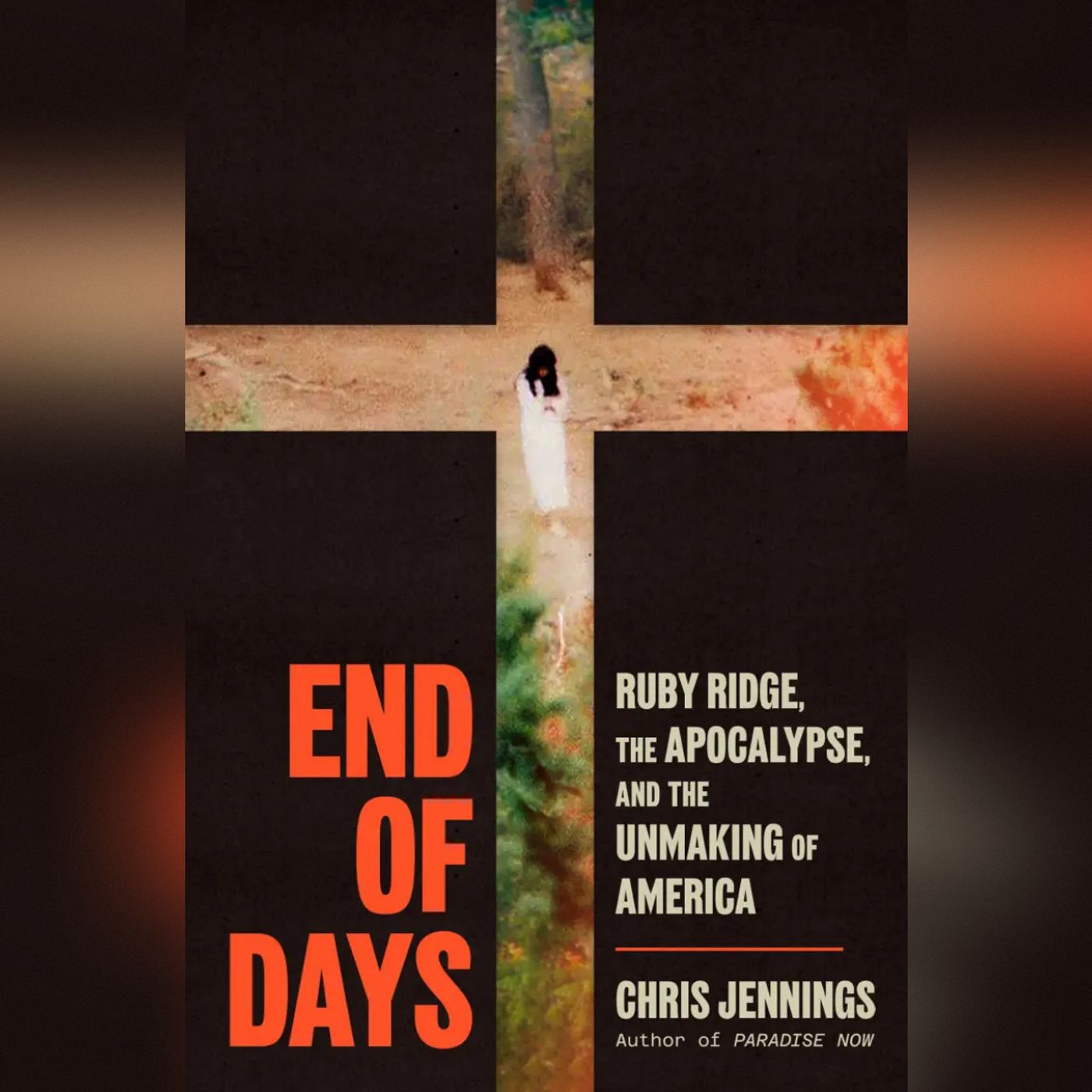
This is all of it on wnyc. I'm Alison Stewart. Most people think of the Ruby Ridge standoff that left three people dead as a flashpoint for overzealous government versus extreme separatists. On paper, it looks like Vicki and Randy Weaver moved their family to remote Idaho, lived off the grid, were into fringe groups and selling illegal firearms. But when you add in the Weaver's belief in the apocalypse, you get a more nuanced story that led to the 11 day standoff with the FBI. A new book by former New York editor Chris Jennings says the Weavers had been preparing for the end of the world at least a decade before moving to Ruby Ridge. And they weren't alone. Fundamentalism has permeated a certain part of American culture from Amway to televised church service. The book follows the Weavers from normal kids to conspiracy theorists. It's called End of Days, Ruby Ridge, the Apocalypse and the Unmit America. A Harper's review says Jennings offers not just a searing account of the standoff, but a definitive intellectual history. Chris Jennings will be at McNally Jackson tonight with Tara Westover at 7pm and he joins us now in studio. It's really nice to speak with you.
- [01:20]
Chris Jennings
Thanks so much for having me, Allison.
- [01:22]
Alison Stewart
So this book is a lot of the background of why Ruby Ridge happened. When did you realize faith was gonna be a key component to, to what you were going to write about?
- [01:34]
Chris Jennings
Pretty early on, I actually came to the story sort of through the religion. I was interested in the rise of apocalyptic theology in the US I'd written a book about utopian communities which was all about how people behave when they think the world is on the brink of perfection. I became interested in how people behave when they think the world is about to end. And over the course of the 20th century, that really became the driving belief of a lot of American Protestants. So that's what led me to the Weavers, not the other way around.
- [02:03]
Alison Stewart
If you have a question for Chris Jennings about Ruby Ridge fundamentalism, you can text us or call us now at 2124-3396-9221-2433.
- [02:13]
Interviewer/Producer
WNYC.
- [02:16]
Alison Stewart
Let's go back to the Weavers before this all started. How would you have described Randy Weaver to somebody?
- [02:23]
Chris Jennings
A pretty regular American? I mean, he and his wife both grew up in Iowa. Families that had been in Iowa for a he was in the army. She grew up on a farm. His dad was a salesman, but he grew up around farms. And their faith was kind of standard issue evangelical. And only once they Got together. Did they get deeply into fundamentalism and particularly this emphasis on prophecy that was on the rise in the early 70s?
- [02:51]
Interviewer/Producer
How did the army affect Randy Weaver, if at all?
- [02:55]
Chris Jennings
It certainly affected him. It certainly affected the way he was perceived subsequently. Both by his supporters who regarded him as a sort of warrior hero, and by the government who had created a sort of Rambo like character out of him because he was a Green Beret, even though he had actually never gone to Vietnam. So it had a big effect in that sense. I think he was someone inclined to not enjoy the government or not like the government very much. And his time in the army didn't change that, certainly.
- [03:20]
Interviewer/Producer
So they were coming of age in the early 70s. They got married in 71. You write they were energetic farm kids in a perfect world. What would they have gone on to do with their lives?
- [03:32]
Chris Jennings
I mean, there's really no telling. I think that they both.
- [03:34]
Interviewer/Producer
I'm just gonna pull the microphone up. Cause you're tall.
- [03:36]
Chris Jennings
Sure, sure. No problem. I am. There you go. Thanks. Sorry. Is that good?
- [03:40]
Alison Stewart
That's good.
- [03:41]
Chris Jennings
Okay. So, you know, they were. Vicki in particular, was an incredibly smart, incredibly hardworking woman. Randy, I think, was. Didn't love working, some people have said. But he. I mean, they ended up homesteading, which is very hard work. So he just didn't like working for other people. His main job and career was at John Deere before they left Iowa, was working on a factory, building tractors. So I think they could have had a pretty idyllic life. They owned their home. They had three kids. The fourth was born in Idaho, and they were close with their families. So I think had this turn towards obsession with prophetic belief not to come over them. They might have gone on to live a rather happy life.
- [04:25]
Interviewer/Producer
You make a point that they were kind of looking for something else in their life. What is it that they were looking for?
- [04:31]
Chris Jennings
Yeah, I mean, I think like a lot of people of their generation, they were seekers, but they couldn't have been more at odds with the sort of prevailing counterculture of the late 60s and early 70s. But they were looking for transcendence and for something more. The terms in which they described the life they left behind was a lot like you would expect from some Back to the Landers hippie types. They wanted to get out of the rat race, didn't want to be punching the clock, wanted freedom. You know, a lot of sort of common stuff. In their case, because of the way they were brought up. It was in church where they first went looking for transcendence. And prophecy in particular fascinated them very early on.
- [05:10]
Interviewer/Producer
We are discussing the book End of Ruby Ridge, the Apocalypse and the Unmaking of America. My guest is its author, Chris Jennings. Okay, so we're going to go on. We're going to leave the Weavers for the moment and talk about the history of fundamentalism. Because you talk about it a lot in the book. It's really interesting. And then we'll talk about how the Weavers found it. I'd like to talk about John Nelson Darby. Tell us who John Nelson Darby is.
- [05:34]
Chris Jennings
Sure. He's a character who ought to be pretty obscure, except for the fact that his ideas have ended up having an enormous influence, in particular in the United States. He is an Anglo Irishman who became obsessed with a particular reading of the parts of the Bible devoted to prophecy, especially the end times. He is basically the creator of what came to be known as dispensational premillennialism, which is a long way of saying a particular account of how to read the Bible in light of current events and what is coming with the end of the world. His ideas kind of petered out in Europe, but they really took off in the US and helped seed what came to be known as sort of the fundamentalist awakening, which peaked or came into wide public view in the 1920s when a lot of churches were split and prophecy was the dividing line. Whether people thought the earth was on the brink of apocalypse and Armageddon, or whether they thought that the world was part of this long, slow march of progress that had previously been the dominant Protestant story.
- [06:39]
Alison Stewart
It's interesting, you said the first. He had two notions. The first was the notion that divine history is divided into two distinct eras or dispensations.
- [06:47]
Chris Jennings
Yeah, seven. Seven.
- [06:48]
Alison Stewart
Yeah. And here they. Creation through the apple, the fall until the flood, the rainbow covenant with Abraham, the era of God's special covenant with Abraham and Israel. Moses receiving the law until the crucifixion, the resurrection until Armageddon. You were here. And Christ's millennial reign on earth. And his second big idea was the scripture, when read properly, foretells a dramatic supernatural event. What is that event?
- [07:18]
Chris Jennings
That event is what's commonly known as the Rapture. And it's worth adding that part of what made the weavers, the weavers and their experience, what it was, is they took a lot of this stuff, and I don't think they would have known they were getting it from John Nelson Darby by the time they came along and had pervaded American churches. But they were not believers in the Rapture. So they, like John Nelson Darby, thought that there was going to be a period of tribulation followed by Armageddon, a global war which would precede the earthly reign of Christ. But not believing in the Rapture, they began thinking about material ways to survive the period of tribulation. For instance, arming themselves, moving to a remote area.
- [07:55]
Alison Stewart
Well, you notice that the Rapture isn't in the Bible.
- [07:58]
Chris Jennings
No, it's not. I mean, well, we could have someone sitting here who would disagree with you.
- [08:03]
Alison Stewart
Explain that to me.
- [08:04]
Chris Jennings
Well, I'm not an expert on the Rapture, but there are the people who believe in the Rapture, and Darby is largely attributed as the guy who really launched it into mainstream theology. Find little scraps of text that seem to point to the notion of the church meeting Christ in the air. But yes, the word rapture certainly is not in any translation of the Bible, or maybe there is one now that uses the word rapture, but it's certainly not in the King James Version. And yeah, it was a pretty novel idea. I think American fundamentalists largely think it's plainly scriptural and has been with us all along. But until the middle 19th century, people didn't talk about Christ returning twice, which is what the Rapture entails. Once to remove the church, meaning all true Christians, a second time to preside over the events of Armageddon and then rule for a thousand millennial years of, you know, a golden age.
- [08:57]
Alison Stewart
I wanted to ask something else I thought was interesting was that the Civil War plays a role and people chasing this kind of faith. Would you explain how the Civil War plays a role?
- [09:11]
Chris Jennings
Sure. I mean, it's a sort of general role, which is that prior to the Civil War, in fact, in the decades right up to the Civil War was a sort of heyday and peak of what we would now call post millennial philosophy theology, which is the idea that Christians, through the spread of the gospel and through material work and good works, will build up the kingdom of God on earth. So this sort of, like, long, inexorable march towards earthly perfection, that. And that was the sort of prevailing belief among American Protestants in the decades before the Civil War, all the way back to the Revolution. That was a harder notion to stomach after the country had just endured years of, you know, mass bloodletting. The idea that we were on the sort of glide path to perfection didn't make sense. So it was in the wake of the Civil War that a lot of people took up with this more, I would say, cynical or less hopeful view of God's. Plan that in fact, earthly conditions are supposed to be getting worse. Things are going to get worse and worse until Christ's return. And only Christ's return will make life on Earth better.
- [10:20]
Interviewer/Producer
So how did. Now we're going back to the Weavers. How did Vicki and Randy Weaver become exposed to this?
- [10:30]
Chris Jennings
Well, everyone was. Everyone who, you know, every church going America of the 1970s was probably getting some of this, especially if you were not in a very mainline Protestant denomination. Catholics and Mormons and other people are operating on their own separate paths here for the sake of this conversation. But. But the Weavers got really into pop prophecy, which was huge. Vicki read a lot of this stuff in particular, there was a book called the Late Great Planet Earth, which was published in 1970 by a guy named Hal Lindsey, which, it's worth noting, was the hands down best selling nonfiction book of the entire decade. A lot of Americans were reading this. It was sold in airports and grocery stores. It brought prophecy out of what had been kind of a. I don't know if fringe is the right word, but certainly only people who were regular churchgoers would be exposed to it. And everybody read Hal Lindsay's book. And it took the prophetic parts of the Bible, the Book of Daniel, Ezekiel and the Book of Revelation in particular, and applied them to the politics of the 1970s. What was happening in the Middle east, what was happening with the Soviet Union, really saw it all kind of through a Cold War lens. And it was explosively popular and convinced a lot of people they were living in the latter days, Vicki among them.
- [11:51]
Interviewer/Producer
You also bring up the idea of Amway and how Amway sort of introduced them to sort of what was introduced a conservative faith to this mlm.
- [12:04]
Chris Jennings
Yeah, the original mlm.
- [12:07]
Interviewer/Producer
The original lmm. How did selling soap or not selling soap, how does it have tenants with fundamentalist ideals?
- [12:15]
Chris Jennings
I think, you know, again, it's rather general. There's a literal way in that a lot of Amway sellers just happen to be evangelicals. And now to this day, MLMs, if I'm using that right, are popular, especially among Mormons or Latter Day Saints and evangelicals. They tend to make up a large portion of Amway sellers. But the organization was founded by a guy, Richard DeVos, who then ended up using his. We're all now familiar with his daughter Betsy DeVos, but he bankrolled a lot of the New Right and was himself a fundamentalist. And the language of early Amway had a lot of overlap with evangelical preaching. And the sort of business model was faith Based, for lack of a better term. It was if you believe and if you try, they would say, you can get free, meaning, make your living outside of the American economy and be your own boss and all that stuff. It was a very hopeful message, and that's what sold.
- [13:17]
Interviewer/Producer
I am talking to Chris Jennings. His book is called End of Days, Ruby Ridge, the Apocalypse and the Unmaking of America. For the rest of the conversation, we're going to be talking about the Weavers. They made their home in Iowa. There's holding these sort of, it's radical, fair to say, meetings in their home, church meetings in their home, Bible meetings in their home. As they're developing this idea of fundamentalism and what it means to their life. What was being discussed in those meetings and how did people in the community feel about it?
- [13:49]
Chris Jennings
Sure. Well, when they were in Iowa, before they ended up moving to this very remote place in Idaho, they, as you were saying, hosted these meetings that were very concerned with prophecy and with trying to read the Bible in what they saw as a sort of like totally deeply literal scriptural way. But it got to the point where they withdrew from their Baptist church they had been attending and felt like they had to be sort of a denomination unto themselves. And the main preoccupation was with prophecy, with applying the Bible to contemporary events and saying, well, clearly the Soviet Union represents the Gog mentioned in the Book of Revelation. And clearly this little bit of scripture is about the American army and, you know, so sort of making their own patchwork out of Scripture to apply to the world around them.
- [14:41]
Alison Stewart
And they found people who thought the same way.
- [14:43]
Chris Jennings
Yeah, I think that they were both very compelling people, very charismatic people. In real life, they had different charismas, if that's a word. Vicki. Different kinds of charisma. Vicki was extremely well versed in Scripture and could cite chapter and verse in a way that really impressed people. Randy was very, I think, excitable. And, you know, his dad had been a car salesman. He was a bit of a salesman. He liked making the pitch. That was true. When they did Amway, Vicki was the one who was an expert in all the products. Randy was the one who would get people to buy. Not that they ever did particularly well with it, but they were at the center of this Bible study, which was theoretically a community, but they were clearly the hub. And the meetings were in their home. And it drifted at some point into to what was then called, and still some people call Christian survivalism, which is they started buying guns, they started learning how to prepare food, finding material Solutions to what they regarded as the coming tribulation.
- [15:40]
Alison Stewart
In chapter five, you write about going into conspiracy theory that you don't. If you're like. Of their mind, it's not like you're going down a rabbit hole of conspiracy theory, but you're seeking a higher ground. You're going up. You're seeking a higher truth. What did they see as the truth?
- [15:57]
Chris Jennings
I mean, what they saw. The most important truth to people who are deeply engaged in conspiracy theories is that everything else is a lie. So that's the leading truth. All of our metaphors about conspiracy theories are about dissent. And I think to people who truly hold them, the belief is ascending up into a clear light, getting seen clearly for the first time. So their truth was that everything the government says is a lie, Everything the media says is a lie. Everything their local preacher is saying is a lie. The one truth is the truth that they themselves can kind of pry out of the Bible through prayer and hard work, hard reading, which is a big idea in the fundamentalist movement. You sort of leave the right thinking Christian alone with his bible or her Bible, and that's the closest communion between the believer and God. Not a church with a hierarchy and all that stuff.
- [16:51]
Interviewer/Producer
They decide to move to Idaho. You describe Idaho at the time as having idiosyncratic politics.
- [16:57]
Alison Stewart
What does that mean?
- [16:58]
Chris Jennings
Well, I mean, Idaho became Later, in the 80s and 90s, deeply associated with the far right. And at the time, Idaho did have a lot of far right organizing in it. And by far right, I mean literally far right, Like Aryan nations and the Klan and the John Birch Society and stuff like that. But before that, Idaho's native politics were idiosyncratic in that there was a lot of split ticket voting, a lot of registered independents. It wasn't neatly blue or red in the way we currently think about states. Idaho now is obviously one of the most conservative and consistently Republican voting states in the country. But at the time, it was kind of all over the place.
- [17:39]
Interviewer/Producer
So they go there, they build this cabin themselves. They're off the grid. They don't want to be involved with. With anybody really.
- [17:49]
Alison Stewart
What did they do?
- [17:49]
Interviewer/Producer
They just wanted to live their life and wait for what?
- [17:52]
Chris Jennings
Wait for the end. I mean, they. It's a little bit wrong to say that they didn't want to be involved with anyone. And it's the thing people always say to sort of indict the government for what eventually happened to them because they were involved. They did go to meetings. Randy ran for public office. He ran to be sheriff. So they were involving themselves in their community in a sort of activist role. But they wanted to separate from what they saw as the corrupt civilization of the United States.
- [18:20]
Alison Stewart
So that's what they wanted to be separate from, right?
- [18:22]
Chris Jennings
Exactly.
- [18:23]
Alison Stewart
So In August of 1992, what happened that we can relate directly to their quote unquote faith.
- [18:35]
Chris Jennings
I mean, it's almost shocking the extent to which all of their prophecies were vindicated. And it's why the Weavers became such icons. Icons, especially on the American right. But in general, you know, they went from being conspiracy theorists, watching for the big conspiracy and gathering evidence of it to really becoming evidence of it. And in short, what happened was there was a spate of terror activity, white power terror in the Northwest, which brought a lot of federal attention to the Aryan nations, where Randy and the rest of his family made a habit of visiting every summer or for several consecutive summers. Randy got mixed up with a guy who turned out to be an ATF informant. He sold him some illegally modified shotguns. The government thought they could turn Randy into an informant because on paper he seemed like a good candidate. He'd run for sheriff, he'd been in the army. He was not a true believer. He didn't want to start war with zog, as they called the federal government. He wanted to just live his life and wait out the end. And when the government tried to turn him into an informant with this legal hazard hanging over his head, which was a pretty minor charge, he refused and didn't come to court.
- [19:53]
Alison Stewart
And that is what led to almost an 11 day standoff.
- [19:57]
Chris Jennings
That's right.
- [20:00]
Alison Stewart
Do you see this kind of belief system in 2026?
- [20:03]
Chris Jennings
I do. I mean, what is most notable to me is that the beliefs that were so fringe in the early 90s had become have now moved more into the mainstream.
- [20:13]
Alison Stewart
You can read all about it in the book End of Ruby, the Apocalypse and the Unmaking of America. It's by my guest Chris Jennings. He has an event tonight at McNally Jackson at 7pm thank you for joining us.
- [20:29]
Chris Jennings
Thank you so much.
- [20:31]
Ira Flatow
I'm Ira Plato, host of Science Friday. For over 30 years, our team has been reporting high quality news about science, technology and medicine. News you won't get anywhere else. And now that political news is 24 7, our audience is turning to us to know about the really important stuff in their lives. Cancer, climate change, genetic engineering, childhood diseases. Our sponsors know the value of science and health news. For more sponsorship information, visit sponsorship.wnyc.org.