Loading summary
Transcript103 lines
- [00:02]
Rob Lowe
Three years after my brother died by suicide, I started going to wars. A friend made a phony press pass for me. I borrowed a video camera, bought some wireless microphones, and snuck into Myanmar to shoot a story about young people fighting the Burmese government. Months later, I went to Somalia to report on a famine and civil war. I'd never seen suffering and death on that scale. I was in a town called Baidoa, where about 100 people were dying every day. As dusk fell, I watched a man and his wife, in a hut made of twigs, fill a kettle with what little water they had. Between them lay their young son, who just died. His body was covered in a dirty cloth. The man held the boy's head in his left hand. The woman poured the water over her son to wash him. They'd already watched their three other boys die. This was their last. He was five years old. It was in Somalia, on that trip, 32 years ago, that I knew I'd found my calling. I couldn't stop the starvation. I couldn't save people's lives. But I could bear witness to their struggles. I could tell their stories. I'm not sure if it's been healthy for me to do this, year after year, decade after decade. But I do think, in a way, it saved me. Seeing what others had been through. Telling their stories. It's put my own pain into perspective. It's helped me survive.
- [01:30]
Irene Weiss
My dad works in B2B marketing.
- [01:33]
Podcast Announcer
He came by my school for career.
- [01:34]
Irene Weiss
Day and said he was a big roas man. Then he told everyone how much he loved calculating his return on ad spend. My friends still laugh at me to this day.
- [01:45]
Podcast Announcer
Not everyone gets B2B, but with LinkedIn, you'll be able to reach people who do. Get $100 credit on your next ad campaign. Go to LinkedIn.com campaign to claim your credit. That's LinkedIn.com campaign. Terms and conditions apply. LinkedIn, the place to be. To be.
- [02:01]
Rob Lowe
Hey, everybody, it's Rob Lowe here. If you haven't heard, I have a podcast that's called Literally with Rob Lowe. And basically it's conversations I've had that really make you feel like you're pulling up a chair at an intimate dinner between myself and people that I admire, like Aaron Sorkin or Tiffany Haddish, Demi Moore, Chris Pratt, Michael J. Fox. There are new episodes out every Thursday, so subscribe, please, and listen wherever you get your podcasts. My guest today is Irene Weiss. During World War II, she was a child living in a village in what was then Hungary. When the Germans Occupied Hungary in the final year of the war, they deported nearly half a million Hungarian Jews to extermination camps, mainly Auschwitz and Poland. When they got there, 80% of those people, mostly children and their mothers and the elderly, were killed immediately in gas chambers. The rest were forced into slave labor or used for medical experiments. This interview was conducted originally for CBS's 60 Minutes. We only had time to use a few things irene said. So 60 Minutes kindly allowed me to use the full interview for this podcast. You can watch a video version of it online and see pictures of Irene and her family@cnn.com all there is online. Irene Weiss was 13 when she arrived in Auschwitz, along with her parents, Mayer and Leah Fogel, her sisters, 17 year old Serena and 12 year old Edith, as well as her three brothers, 16 year old Moshe, 10 year old Reven and Gershon, who was 8.
- [03:47]
Irene Weiss
What happened in our little town? There was actually a town crier with a drum. He went up and down the street, which sounds very quaint, and he would hear ye, hear ye. And he'd tell you, what is the news this day? The news was that all Jews in this town. Back your suitcase and report at the town hall tomorrow.
- [04:13]
Ariel
People came to your house and demanded any valuable possessions that your family had.
- [04:20]
Irene Weiss
Yes, yes.
- [04:20]
Ariel
Before you would be shipped away. These were people you knew?
- [04:23]
Irene Weiss
Oh, absolutely. They knew my father. It was the principal of the school that we attended.
- [04:29]
Rob Lowe
Your school principal came to your door?
- [04:31]
Irene Weiss
Yes, because he wasn't Jewish. They came and said to my father, give us all your money and valuables. And my father began to give them something and they demanded more. Suddenly you became a non person, a non citizen. What you owned wasn't yours. The civilization that we lived in turned upside down.
- [04:55]
Ariel
Somebody I knew, General Michael Hayden, talks about the thin veneer of civilization.
- [05:00]
Irene Weiss
Very, very thin.
- [05:02]
Ariel
That we all think that the society we live in, there are rules, there are laws. You have seen how thin that veneer of civilization is.
- [05:11]
Irene Weiss
Well, the most dangerous animal in the world is man. Other animals will hurt you if they're hungry. But man can turn into an animal in no time, in minutes. The instinct to kill is so strong in man, all he needs is permission from the society. And as soon as he's given permission, he's the most dangerous animal.
- [05:44]
Ariel
I can't imagine as you as children looking to your parents for answers.
- [05:50]
Irene Weiss
That's right. Parents couldn't protect their children and yet we were looking towards them. You can't describe it from family life to sitting on the floor of a cattle train with 100 people in there and a bucket for toilet. I can't explain it, but I do remember.
- [06:16]
Ariel
Was there talk? Was there silence?
- [06:19]
Irene Weiss
Total silence at this point? Yes. Even the children didn't cry. Children didn't make any noises because there was this heavy air trapped. You know, when the trains opened, there were screaming and yelling orders to get out and leave everything behind. The men were told to go to one side. So my father and 16 year old brother lined up there. Women and children and older people line up. Here. We are in front and all of a sudden the crowd is moving and There are about 10 Nazi soldiers. I remember walking towards this man who is motioning people to go this way or that way. This one man held a stick. He held life and death with that stick.
- [07:13]
Rob Lowe
Irene says the Nazi with The stick was Dr. Josef Mengele, who was known in Auschwitz as the angel of Death. In addition to selecting who would die in gas chambers and who would be sent to slave labor, Mengele also conducted experiments on prisoners, many of them children. He had particular interest in twins.
- [07:32]
Irene Weiss
If you were a child in Auschwitz, you had to die. They had to kill the children so there will not be a new generation. And they discovered that if they also killed the mothers, then they didn't have to worry about the chaos that that would create separating.
- [07:52]
Ariel
The children wouldn't be upset by being.
- [07:54]
Irene Weiss
Separated and the mothers wouldn't be upset. So the mothers and children very calmly went to the side that they were shown to go, which went to the gas chambers. This had to be done very fast and they had to finish and clean up the platform for the next train.
- [08:15]
Ariel
Because there was another train waiting, waiting.
- [08:18]
Irene Weiss
It was train after train after train because they had a half a million more Jews to kill.
- [08:27]
Rob Lowe
Irene's sister Serena was selected for slave labor. Her mother and two younger brothers were immediately sent to the gas chambers. Irene approached Dr. Mengele holding her sister Edith's hand.
- [08:41]
Irene Weiss
And the stick came down between us. It's an instant and she was separated from me. Edith was sent towards where our mother went and he motioned me to where the young adults went. The terror hit me. Fright and terror and confusion.
- [09:03]
Rob Lowe
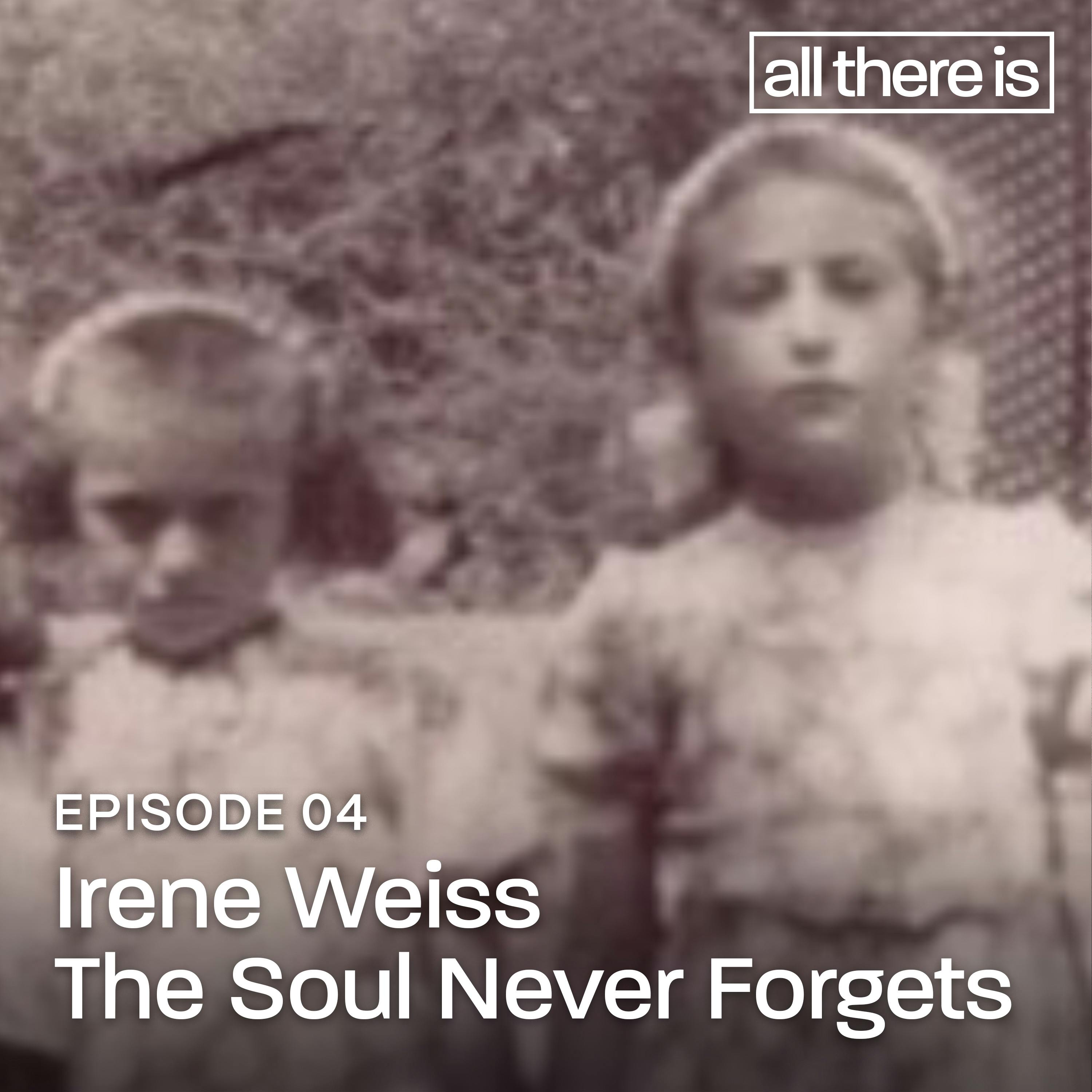
There are not many photos of prisoners in Auschwitz, but on this day a Nazi photographer was on the platform and took a picture seconds after Irene had to let go of Edith's hand. She's looking off camera trying to see if Edith will be able to catch up with her mother and brothers.
- [09:20]
Irene Weiss
This was just more than I could bear. That was my original grief and shock that she was taken away from me. I felt Like I had should have held on tighter. I should have said something. I should have. You know, that really was terrible. After we were processed, we didn't have to wait very long to find out where our families went, the women and children. Because we met the people who had come before us. And the very first thing we asked them, when is the reunion with the families? And they looked at us that we were crazy. And they told us where our families went. They pointed to chimneys belching smoke and fire.
- [10:16]
Ariel
They showed you the gas chamber?
- [10:17]
Irene Weiss
They showed us, they told us. But where is this place? Where is this universe? Who is in charge? Who is doing the killing? Why is the killing going on?
- [10:28]
Ariel
None of it made sense.
- [10:29]
Irene Weiss
No, no, you can't, you can't. And it's very interesting how you can block it out.
- [10:37]
Ariel
And that began right away.
- [10:38]
Irene Weiss
Blocking it out more right away than after. The denial was your brain didn't allow it. It just didn't allow it. You don't vision thousands of people getting off a train and walking into a gas chamber. And within an hour of arrival, everybody's dead, especially women and children. You see it, but you don't believe it. I thought that it'll be over and when I go home, everybody will be there, just like before. When I was 13, I could easily daydream and reject it. But the adults were also rejecting it. Because the suddenness, the strange other worldliness. You entered a closed world of killing, oppression and lack of human feeling.
- [11:44]
Ariel
What happened to your father?
- [11:46]
Irene Weiss
My father? He was taken to work in the gas chambers, pulling the bodies out, getting it into the crematorium. Very strenuous, constant work. My father didn't live very long there. Which if I live to be 200 years and the pain will never go away, or the horror that a gentle person, father of six children, he should come out of a train and witness what was going on to his people and his family and everybody. It's incomprehensible. I can't go there. However, my 16 year old brother, we have absolutely no idea what happened to him. He most likely got ground up in the system. He was a young 16 year old boy.
- [12:36]
Ariel
You talked about the silence on the cattle cars to Auschwitz and the shock of being there. Did you cry when you were there? Did other people cry?
- [12:47]
Irene Weiss
No. And that's a really interesting question on your part. Because we by accident ran into my mother's two sisters who were in their twenties, my aunt Rose and Pearl. They came from a different town, a different train. My sister and I, we survived. I survived because of them. They saved me, and they saved her because they did protect me emotionally in so many ways. And I could put away that terror. And I began to grow up a little bit, too. And I. These guards, they did look at us as subhuman. And I don't think I can explain it to normal people, because to be considered subhuman, it's a devastating feeling. And if you fall for that, that they're superior and I am inferior, then you're going to be lost. I all of a sudden, wait a minute. I am not a subhuman. There is a reverse thing here. These German guards, they were doing things because they were actually subhuman people. And that helped you enormously. It really helped me. Because to be considered subhuman, I don't think I can explain it to normal people. It's a devastating feeling.
- [14:22]
Ariel
You mentioned you were grieving. Did you feel. Were you able to grieve while you were there?
- [14:30]
Irene Weiss
A mixture of denial and grieving. Denial and grieving. See, there were stages. When I first got in there, we couldn't absorb it. But then, my sister and I and my two aunts and a thousand women, we were assigned to work day and night for eight months next door to a crematorium and gas chamber. Just an electrified fence separated us from gas Chamber Number 4. And the belongings that came out of the train by the thousands and thousands were brought to this place to be repackaged, to send back to Germany for the German population. Our job was separating, taking off labels and so on. But we saw these columns of women, mothers and children going into the door there. And they would walk by and speak to us in Hungary and Yiddish. And they're told they're walking into a bathhouse. You know, they asking questions, where are you from? And how long have you been here? So we talking to them, and a half hour later, the chimney is belching fire, and we just talk to them. And that went on day after day and night after night. But that doesn't explain the feelings. Seeing and absorbing and understanding and wondering where you are. I had many feelings of being on a different planet, actually, because I thought, well, if anybody knows this, they wouldn't allow it. And if nobody knows this, then it's not on this planet.
- [16:29]
Ariel
So in terms of grieving, yes.
- [16:32]
Irene Weiss
You deny. You deny, but I know my parents, my mother went the same route. Or you asked about crying. I didn't answer your question. I was told by my sister later that the first night when we were in the barrack, where we slept in layers and Everybody was cold and unhappy and that I was crying a lot and I said, no, no, I was never crying. Yes, yes, you were crying that first night.
- [17:03]
Ariel
That's what your sister told her.
- [17:04]
Irene Weiss
Yes. So she must have been right because it was a terrible change of life. But after that, seeing the thousands of women walking in and having spoken to them and ah, we couldn't cry. Not only I, who was young, my aunts and others, crying was not helping. The tears are for normal pain. This is beyond crying. This is beyond comprehension. We didn't cry and talked about not crying.
- [17:45]
Rob Lowe
We'll be back with more of my conversation with Irene Weiss.
- [17:57]
Podcast Announcer
This episode is brought to you by Skinnypop. Popcorn. Perfectly popped, endlessly delicious. Oh, so light and crunchy. Skinny Pop original Popcorn is the snack you've been searching for. Made with just three simple ingredients. Popcorn kernel, sunflower oil and salt. Snacking never felt or tasted so good. Perfectly popped, endlessly delicious. Give yourself permission to snack and pick up Skinny Pop original popcorn.
- [18:24]
Irene Weiss
Today.
- [18:27]
Rob Lowe
We'Re back with Irene Weiss. 1.1 million people are estimated to have been killed in Auschwitz. When Soviet forces finally liberated the camp on January 27, 1945, they found only about 7,000 prisoners left. Irene was not one of them. She, her sister and two aunts were among an estimated 60,000 prisoners who'd been forced to evacuate by the Nazis as Soviet forces closed in.
- [18:56]
Irene Weiss
They took us into Germany from Poland, walking, walking. But it doesn't really make sense because they abused us on the road. It was winter and very, very cold. They didn't feed us, we were starving. They shot people who sat down. People just died left and right there. It literally was a death march. We ended up near Hamburg in another concentration camp. For five more months, this camp didn't have a gas chamber. But they never stopped selecting people for killing. Every day they lined up, they selected people out and a truck would come to pick the ones that were selected to a nearby camp that had a gas chamber. My two aunts were still with us. One of them got typhus. And one day my aunt was selected and we watched her being walked up onto the ramp to the truck.
- [19:58]
Ariel
Were you able to say goodbye?
- [20:00]
Irene Weiss
No, no, no. The next selection, they picked my sister out because she was skin and bones. I was too. But somehow she was first. And so then my other aunt was desperately ill. She had pneumonia. She was lying on the floor and I knew that she would be next. But here my sister is being picked out and I thought, I can't stay alone. I can't survive alone. I Volunteered to go. I said, I'm her sister, and said, you can go too.
- [20:36]
Ariel
You said that knowing what that meant?
- [20:39]
Irene Weiss
Absolutely. I just remember thinking, who. Who will I belong to? It's exactly the words I was telling to myself. One of my aunts is gone. The other one is desperately ill. Who.
- [20:54]
Ariel
Will I belong to?
- [20:55]
Irene Weiss
Who will I belong to? I can't do it.
- [20:58]
Ariel
And you were okay with dying in that?
- [21:03]
Irene Weiss
Yes, well, part of it was that the extreme starvation. You really can't take it anymore. It's very, very painful. It seemed right. I really didn't know how to be alone. And they locked us in a room with others that were selected, waiting to be taken when the truck comes.
- [21:26]
Ariel
How was it that you finally got away?
- [21:29]
Irene Weiss
My sister and I both survived because the truck didn't come that day. The Russian army was very close, and they were on the highways. And that day the truck didn't come. That was it. The door opened, we went back to our places. And after that, the truck never came again. The Russian army came so close that the Germans fled and the camp was abandoned.
- [21:58]
Rob Lowe
Soviet troops, fearful of catching diseases from prisoners, did little to help Irene. Her sister Serena and her aunt walked and hitched rides, eventually getting to Vienna, where they met up with a few surviving members of their extended family. It was then she learned just how many relatives of hers had been killed.
- [22:17]
Irene Weiss
In my family, there were six children. Parents and two children survived. My sister and I. My mother's sisters who were married, all of them died. My mother had two brothers who were married. Each had two children. Their wife died. Grandparents were killed. My father's sister, something like 13 cousins were killed. I mean, everybody was killed. And in my hometown, out of something like 30 children, out of the 10 Jewish families, there were no children left. My sister and I were the only two who came back.
- [23:06]
Ariel
You ultimately went back to your house in the village?
- [23:11]
Irene Weiss
Yes, I went back.
- [23:12]
Ariel
There was a family living in your home?
- [23:14]
Irene Weiss
Oh, yes, sure. Somebody was living in every Jewish home that was empty.
- [23:20]
Ariel
Did you say anything to them?
- [23:23]
Irene Weiss
No. There was a woman there with children. When I walked in, I didn't have to introduce myself, although we never met before. She took her children and went over to the side and just stood there.
- [23:36]
Ariel
She knew who you were?
- [23:37]
Irene Weiss
Oh, yeah. This is very interesting. She just went to the side and I went through the house. Sounds strange, right? I went to every room. There was nothing. Hours at all, that I remember. But I went down to the very big garden in the back. We had fruit trees and there was fruit all over on the trees and ready to be picked. And it's the first time I cried. I just, I saw, I thought here is all the fruit. No one to pick it. Not my family. It was very strange that I finally broke down because again the pain was too big for crying. There was some other way it had to be handled because crying tears didn't help.
- [24:33]
Ariel
It had 15 months since you had left that house.
- [24:36]
Irene Weiss
Yeah, yeah.
- [24:37]
Ariel
Did it ever occur to you prior to that how one's life could change so drastically and 15 months?
- [24:44]
Irene Weiss
No. You know there's a lot written about Auschwitz and it can never be fully described. There is no way to get the feel of a sub human prisoner in Auschwitz.
- [25:01]
Ariel
It's impossible to explain.
- [25:03]
Irene Weiss
It's impossible to explain Auschwitz. It is. Somebody labeled it a metropolis of death and that's what it was. It was a metropolis of death. It worked like an assembly line factory and it just ground up people. Mainly families, mainly children. That's what bothers me. I think the most smart people planned this. Architects and scientists. This was designed and kept secret. And then they filled the Jewish children of Europe into it systematically.
- [25:52]
Rob Lowe
Irene came to New York in 1947 with her sister Serena. That's where she met and married her husband Martin. Two years later she had three children, studied often at night to get a college degree and became a teacher. Now 93, she has six grandchildren, three great grandchildren and is a survivor volunteer at the United States Holocaust Memorial Museum.
- [26:17]
Ariel
How do you, how do you live with this?
- [26:21]
Irene Weiss
Well, I am 93. There hasn't been a day that I have not lived with it. It's very difficult. I was a teenager and then I got married and I had children. I had new responsibilities. Life makes you do that job because that's important. But there is something about what this kind of experience, the relationship with mankind to reconcile that that man can be so cruel. So like an animal really changes your way of thinking of mankind and life daily. Because I know that people can turn on you, can turn on you because of a label is very frightening. And there is this huge disappointment in that aspect. That veneer that you're talking about of civilization is extremely thin.
- [27:37]
Ariel
Have you been able to cry in subsequent years?
- [27:43]
Irene Weiss
Still not. Still not. But that kind of brutality from fellow mankind is so deep that you know, people say broken heart, the heart keeps working but the soul never forgets. There is a soul that does not forget any of it. It's imprinted on the soul. That keeps the memory, the pain, the grief, it's just always there.
- [28:22]
Ariel
The 13 year old girl that you were. Do you still feel that little girl at times or did you bury her early on in the story?
- [28:31]
Irene Weiss
No, that's a good question. That's really a very good question. I am stuck there, Ariel. I'm really stuck there. That's really the biggest fight because I attempt to. I've read a lot, I analyzed this many years, but I'm really stuck there. And that's where all the grief is. How could that have happened? A quiet, devoted, lovely family. Somebody comes along and tears it apart in a matter of days. How could that have happened to my family? They were not guilty of anything. They never did anything. Why? Why? Why? Why? You know, definitely your question is deep in. I am stuck there. But I can't be stuck there because I have grown up responsibilities.
- [29:37]
Ariel
I ask that because my dad died when I was 10 and in my little world it was. My voice even cracks now talking about it. I realized I'm stuck there at that age.
- [29:52]
Irene Weiss
So you know that, you know that can happen.
- [29:55]
Ariel
But I can't even imagine, I mean, what you went through, is that multiplied by.
- [30:02]
Irene Weiss
Well, it's definitely stuck there. And it's what that 13 year old experience that can never be rectified. The pain can never go away, the questions can never go away. And so look, it does result in a kind of depression that's constantly there, but I can't let it go too far, control it. There is a lack of full life.
- [30:40]
Ariel
Psychologists say, because I've been reading about this in my own case, that if as a child you've experienced a traumatic loss and you're not able to grieve it as a child, that you live your whole life with a sort of melancholy that you can't quite put your finger on. Like I don't allow myself to experience great sadness, but I also, in doing that, have not allowed myself to experience exuberant joy. And I sort of find myself in this middle ground.
- [31:19]
Irene Weiss
Well, shake hands with me. It's a melancholy. It's not the depression that you could read about in books. It's a pain and it's a melancholy and you can't experience. And I'm different. People tell me, oh, but you're so normal. After I say I'm different normal. I'm not normal normal. I'm holding on. And yes, I'm 13 years old most of the time, very difficult. I can see I'm strange among other women or friends. I think I probably am misunderstood too, that I'm reserved or not friendly or something like that. Very hard to I see another side all the time. Not fair. Not fair. Things like that shouldn't happen to 13 year olds. But you have responsibilities. I have responsibilities. I can't give in to all that because I gotta raise normal children. And if I let go, then I'll have to be treated for depression and all that. It's a. It's a struggle. I'm willing. I raised normal children and I've done right by them. I've done it. But the toll, I even hiding the toll. It's hard. It's been very hard.
- [32:59]
Ariel
Your family would be very proud of you.
- [33:04]
Irene Weiss
Well, I don't know how to look at that. It's been rough, that's all. It's been very hard. How would any experience like that ever leave you?
- [33:22]
Ariel
It's impossible.
- [33:23]
Irene Weiss
Impossible. And where would you put it? And how would you modify it? And what would take it away?
- [33:31]
Ariel
One thing I take away from you is that it is possible to get through. It is possible to build a life. And it's possible to have a life.
- [33:42]
Irene Weiss
Yes, because life pushes you, pulls you. Somehow it pulls you along. If you don't grow up and live an adult life, then you end up in an insane asylum somehow. But you're really hitting things that are very important. You have to juggle both and it saps your energy. I have to juggle the fact that I'm a grown up in charge. And there is that other thing that I can't share. I don't want my children to feel the way I feel. Definitely I decided that long ago. They cannot be made sad. And a mother is not quite right. The struggle is always there. Some survivors will say, you, for example, you eat that food. You should know what that food means. But how hungry I was. I'm starving. Don't go there. Don't make them think every minute that they're hurting you by their behavior. So there is that normal and then there is that private one. It's a struggle. It really is. You say you can overcome. I think my own family don't know how much I overcome to make sure that everybody gets normal treatment.
- [35:17]
Ariel
Having seen those things and knowing what man is capable of, even on a beautiful almost spring day like today in this nice quiet neighborhood. Do you still see everything through that lens?
- [35:34]
Irene Weiss
Yes.
- [35:36]
Ariel
That all of this can change very quickly.
- [35:40]
Irene Weiss
Well, it's subtly and even not so subtly changing as we watch it in this country. Who is the enemy? Who is to be hated? Who is to be excluded? It's happening all the time. As soon as permission is given from higher ups from government. It accelerates. Permission is very important, even a hint of permission that it's okay to attack this group or exclude this group or shame that group. It's it's happening. It's never stopped.
- [36:23]
Rob Lowe
I want to thank Irene Wise for her willingness to talk with me. You can watch a video of the interview@cnn.com all there is online. That's our new online grief community, where you can also connect with other podcast listeners and hear voicemails from some of them as well about their grief experiences. Next week we'll be taking a break from this podcast because of the election, but we'll be back the following week with an all new episode. I want to thank the executive producer of 60 Minutes for allowing us to use this interview with Irene Weiss, which was originally recorded for 60 Minutes. Bill Owens is the executive producer. Nicole Marks was the producer on the story, John Gallon the associate producer, Grace Conley, the broadcast associate. The 60 Minutes piece was edited by April Wilson. The camera operators were Chris Albert and Sean Healy. Sound operators were Tim Camerota and Eric Kershner. All there is is a production of CNN Audio. The show is produced by Grace Walker and Dan Bloom. Our senior producer is Hayley Thomas. Dan Dezzulla is our technical director and Steve Lichtai is our executive producer. Support from Nick Godsell, Ben Evans, Chuck Haddad, Charlie Moore, Carrie Rubin, Carrie Pritchard, Shimri Chet, Ronald Bettis, Alex Manaseri, Robert Mathers, John Deonora, Laney Steinhardt, Jamis Andrest, Nicole Pesaru and Lisa Namorow. Special thanks to Wendy Brundage.
- [38:00]
Podcast Announcer
There's a reason the Sleep Number Smart Bed is the number one best bed for couples. It's because you can each choose what's right for you whenever you like. Firmer or softer on either side. Sleep Number does that. One side cooler and the other side warmer. Sleep Number does that too. You have to feel it to believe it. Sleep better together. And now, during Sleep Number's Black Friday sale, save 50% on the Sleep Number Limited Edition Smart Bed plus special financing for a limited time. Find Sleep Number Smart Beds at every price point only at a Sleep number store or sleepnumber.com.