Loading summary
Transcript92 lines
- [00:01]
Advertiser
There's a reason the Sleep Number Smart Bed is the number one best bed for couples. It's because you can each choose what's right for you whenever you like. Firmer or softer on either side. Sleep Number does that. One side cooler and the other side warmer. Sleep Number does that too. You have to feel it to believe it. Sleep better together. And now, during Sleep Number's Black Friday sale, save 50% on the Sleep Number Limited Edition Smart Bed plus special financing for a limited time. Find Sleep Number Smart Beds at every price point only at a Sleep Number Store or sleepnumber.com Apple.
- [00:37]
Nicole Chung
Apple. Apple. Apple.
- [00:40]
Anderson Cooper
My son Sebastian has started to talk. Banana was his first word, and just the other day he started saying, apple.
- [00:46]
Nicole Chung
I'm so proud of you, Apple.
- [00:49]
Anderson Cooper
What's your second word? Apple. I feel like he's going to be speaking sentences in no time, and it's incredible to witness the progress that he makes every day. I wish I could say the same for myself. The last couple of weeks, I've been feeling stuck, like I haven't made enough progress dealing with the grief that I've been running from for so long. When I started this season of the podcast, I'd had this revelation that I'd never grieved, that I'd buried the sadness and fear I felt as a little boy when my dad died and then again when my brother killed himself. I realized that sad and angry little boy is still very much alive inside me. When I interviewed Francis Weller in the first episode of the season's podcast, I asked him what I should try to do to begin to face all that buried grief. What is the next step? I feel like a well, an ocean of tears just below the surface. For the last two months, I've just felt it constantly there and it bubbles up all the time now.
- [01:52]
Nicole Chung
Yeah, you have to make a slow titration into that territory. I don't think we dive headfirst into it. We have to build some faith that the grief itself won't swallow me. So you can do little writing practices.
- [02:07]
Anderson Cooper
To begin to know that I can touch into that space and step back.
- [02:10]
Nicole Chung
Out, touch into it, step back out. Begin to see that when you're there and when you return.
- [02:17]
Anderson Cooper
I'm not going to drown.
- [02:19]
Nicole Chung
This grief belongs here. It'll actually help me to become more human.
- [02:25]
Anderson Cooper
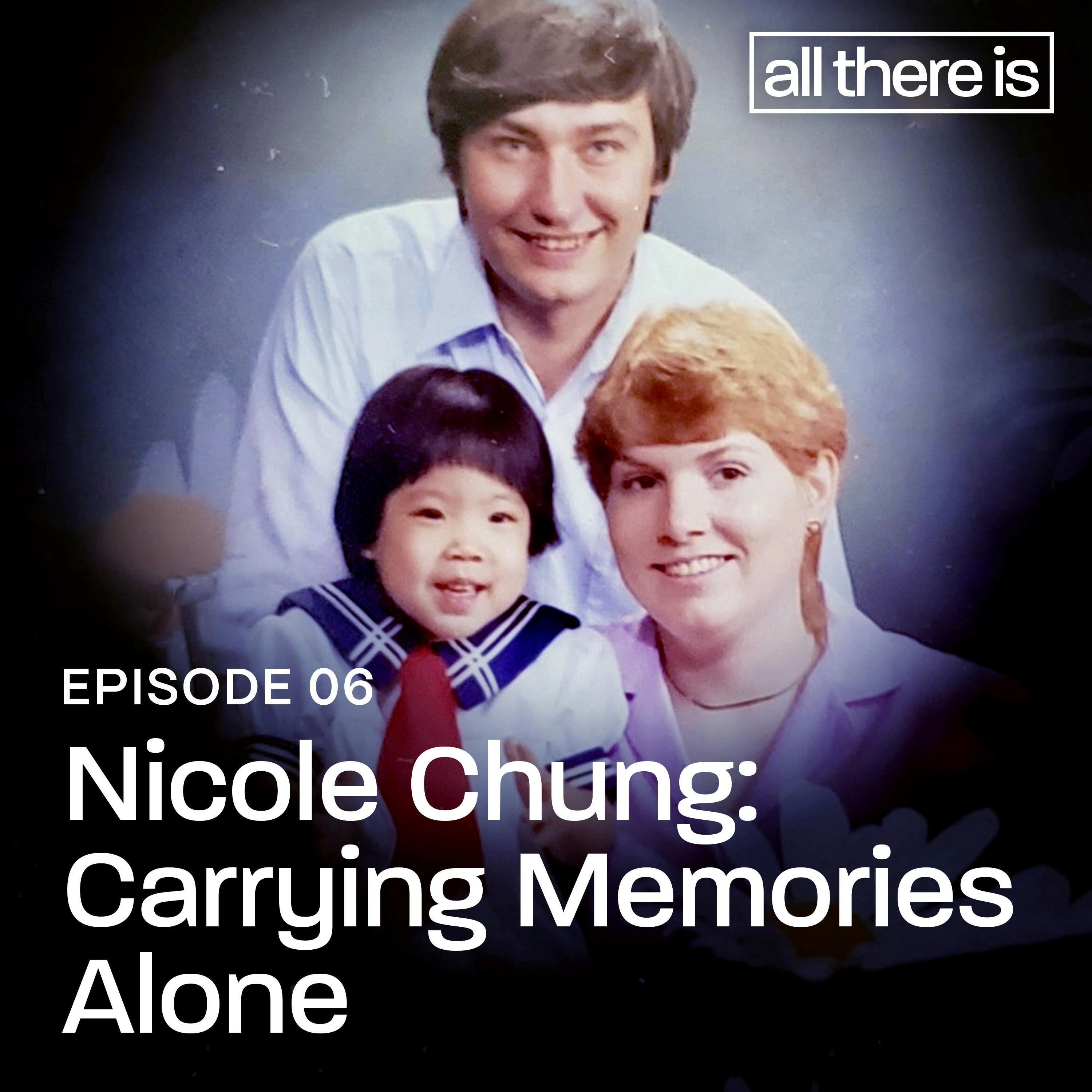
Francis has some writing exercises in his book the Wild Edge of Sorrow that I've been doing, and they've helped. I am now at least more aware of the little boy I was, and there are moments when I can allow myself to feel him still. When I do that, that's when the tears come. He I can't believe that they're all gone, my dad and my mom, my brother and May, the nanny who raised me. I can't believe that I'm the only one left. And sometimes I wonder why was I left behind. I think I fear that if I somehow face my sadness and make progress, whatever that means, then I'll have to kind of let them go. And I don't want to do that because I don't want to be alone. This is all there is My guest today is Nicole Chung. In 2018, she published her first bestselling memoir, all youl Can Ever Know. Nicole was given up for adoption as an infant by her Korean parents and raised by a white couple in Oregon. The book chronicles her search for her birth family. In 2023, she published another bestselling memoir, A Living Remedy, about the death of her adoptive parents. I began the interview by asking Nicole about a poem that she references in A Living Remedy. The poem by Marie Howe is called what the Living Do. Howe wrote it originally as a letter to her brother John, who died of complications from AIDS in 1989. I'm going to read you some of Marie Howe's poem and then ask Nicole about it. For weeks now, driving or dropping a bag of groceries in the street, the bag breaking, I've been thinking, this is what the living do. And yesterday, hurrying along those wobbly bricks in the Cambridge sidewalk, spilling my coffee down my wrist and sleeve, I thought it again and again later, when buying a hairbrush, this is it. Parking, slamming the car door shut in the cold. What you called that yearning, what you finally gave up. We want the spring to come and the winter to pass. We want whoever to call or not call a letter a kiss. We want more and more and then more of it. But there are moments, walking, when I catch a glimpse of myself in the window glass, say, the window of the corner video store, and I'm gripped by a cherishing so deep from my own blowing hair, chapped face and unbuttoned coat that I'm speechless. I am living. I remember you. I asked Nicole why this poem is important to her.
- [05:18]
Nicole Chung
I've loved poetry for so long, and this poem came to me like on a National Poetry Month listserv in my very early 20s, and I had not at that point lost a parent. But it resonated so much I like filed it away. Lines from it kept coming back to me after my father's death and after My mother's, because it is about grief, but it's also so much about survival. And I experienced moments after my dad died and also in the midst of my mother's illness, dealing with that sort of anticipatory grief when I was just so terrified of what life on the other side of these losses would look like. And honestly, there were times and there were days when I didn't know if I wanted to survive it. I just was so afraid of that. And this poem was one thing that allowed me to begin to imagine, you know, what that could be like and how living after them, as hard and as terrible as it sounded sometimes, was also going to be living with their memories and trying to keep them alive. In a sense, with me, just the idea that living is how we remember it was such a comfort to me because there were days after when all I could do was just live. It wasn't even necessarily that I wanted to, honestly. It was just that I was. And in doing that, to live is to remember the people that we've lost.
- [06:43]
Anderson Cooper
Do you think about your parents all the time?
- [06:46]
Nicole Chung
Oh, yes, definitely. My book came out in April, and ever since I've been traveling, I've been lucky enough to have events and to meet and talk with readers. And I'm constantly talking about them and our life together and about grief and hearing other people's stories about people they miss. So, yes, but I think even without all that, I think I would. I would hear my mother's voice in my head every day. It kind of surprises me still. So, yes, they are always on my.
- [07:14]
Anderson Cooper
Mind for you now, the month of May is really hard.
- [07:17]
Nicole Chung
May has always been my favorite month. It's nice you're coming out of winter. Things are blooming. The weather's nice, but not too hot. I've always thought of it as kind of an ideal month. But that year, spring, the whole season of spring just sort of feels different to me now. And I think it's because. I don't know if you experienced this too, but smells and sights and sounds like that remind me of my mom. Yes. But also that spring where she was dying and, like, she was dying during the early weeks of the pandemic. And I couldn't get to her. I remember being outside so much because there was nothing else to do. Everything had been canceled. We were all working from home. The only place I ever went was, like, the grocery store and walking around, just walking. And every spring, when everything's in blossom, like, it just reminds me of all those walks. And quite often I'd be trying to talk to my mom or her caregivers on the phone during those walks. And the world's beautiful. It's blooming. There's new life everywhere. And it just feels sometimes like a mockery because I go outside and it's spring, and I'm like. My body is like, right back in spring 2020. It's interesting, too, because I know even at the time I knew, I was like, you are not the only person experiencing this unbearable separation or just missing people or being devastated because you wanted to see someone that you can't see. Not the only person who had to talk with my mother as she was dying over Skype or livestream her funeral. And so I know these memories, which are really. They're so. They're so immediate. Like, I can feel them now as I'm telling you about them. I know a lot of people listening probably won't have to reach very far to remember what those days were like for them either. I think it must have been a very common thing for so many who were separated from loved ones and from sickness and dying loved ones, especially in that spring. But, yeah, May is really, really hard. And like birthdays. My mother's birthday was last week.
- [09:10]
Anderson Cooper
And what do you do on that day?
- [09:13]
Nicole Chung
Oh, gosh, I've never really figured out exactly what field. Right. The first year, I ordered her flowers to be placed at her grave, and I tried to get a meal or make a meal that she would have liked. Sometimes I write her letters. I actually. One thing that hurt so much was seeing something I would have gotten her as a gift for a birthday or holiday and being like, she would have loved that, and I would have loved to give it to her, and I can't. So I have sometimes allowed myself to just buy the things, and sometimes I keep them as a reminder to myself, and other times I give them to friends or like, I've given a couple to my children.
- [09:57]
Anderson Cooper
One of our listeners last season called in and told me that she. Her mother was very thrifty and loved a good sale, but also would return a lot of stuff. So that what she says to honor her mother on her birthday, the day before her birthday, she goes to a place and buys something, and then the next day she returns it. And she just gets a kick out of. She thinks her mother would get a kick out of her doing that. And so it sort of. Which I love that.
- [10:25]
Nicole Chung
That's hilarious. I love that, too.
- [10:28]
Anderson Cooper
You wrote about the last time that you were with your mom before her death. You Couldn't be there, as you said during COVID when she actually died. But you asked her to forgive you for all your failures as a daughter. Could you read that paragraph?
- [10:47]
Nicole Chung
I hope you can forgive me for all my failures as a daughter. I say forgive you? She shakes her head. There's nothing to forgive from where I am. But I forgive you everything. You did everything you could. You walked your path. You stayed faithful in your own way. That's all I can ask. And who knows, she adds, maybe after I'm gone, we'll meet in prayer from time to time, like the saints did. Reading that, I can hear her voice so clearly. And that's a really treasured moment for me. Even though I didn't share my mother's faith tradition, it's still. I'm really thankful that that was part of our last. The last day we spent together.
- [11:32]
Anderson Cooper
I love what she says. Who knows, maybe after I'm gone, we'll meet in prayer from time to time, like the saints did. I've never thought of that idea that people can meet in prayer.
- [11:46]
Nicole Chung
Yeah, that's actually the part of the faith I was raised with. And I think why it can be such a comfort to people is this idea that even in death you meet the people you love. There is still this communion that that doesn't end. An idea, I think, that anyone can take and believe in if they want to. I don't think it necessarily has to have religious connotation. You can just think about, like, how powerful the love we have for each other is and how much we impact one another by living together and loving each other for our whole lives. It makes sense that that wouldn't end, that wouldn't go away. The relationship doesn't end with death. You know, whether or not your view of that is spiritual or just a matter of love.
- [12:27]
Anderson Cooper
You also wrote, and I just want to read this because I just think it's so. It just stunned me, this paragraph you said. How do you learn to cherish your life when grief has made it unrecognizable? I'm starting to feel that we do so not by trying to fill a void that can never be filled, but by living as best as we can in this strange, yawning terrain our loved ones have left behind, exploring its jagged boundaries and learning to see it as something new. I believe this because I feel that I am becoming someone new, someone who can remember and mourn and live without punishing herself. That's so beautiful.
- [13:08]
Nicole Chung
Thank you. I mean, earlier when you mentioned not being sure how to grieve or not. Not being sure that you'd really even allowed yourself. I was thinking about all the things I personally did that I thought was grief. You know, grieving that in fact was like self recrimination or was just trying to punish myself and keep myself in as much pain as possible because I thought that's what grief was or that was what I deserved.
- [13:34]
Anderson Cooper
Even this idea of you feel like you're becoming someone new, someone who can remember and mourn and live without punishing yourself is really interesting to me. And we had a guest early on in the podcast this season, Frances Weller, who talked about that one is changed through grief and that it is this. You are no longer the same person. And it's meant to be. This experience that brings you to your core and brings you to the very deepest part of who you're meant to be. When I read what you had written, this idea that I'm becoming someone new, I thought that's exactly how I feel. I feel like I don't know what I'm going to end up. I may end up like a complete wreck on the other side of this, and I don't know. But I definitely feel like something fundamental is shifting.
- [14:23]
Nicole Chung
It just kind of lays you bare and. Yeah, part of the reason I was so afraid of just life after my mother dying, I just couldn't even imagine that world or, like, who I would be. It was terrifying thought, and sometimes still is. I had this experience with both of them in different ways. I didn't really know myself before. Before they were gone in a way you don't have to.
- [14:48]
Anderson Cooper
That's interesting. You didn't know yourself before they were gone.
- [14:51]
Nicole Chung
There was just so much that I didn't really see. I think both.
- [14:54]
Anderson Cooper
So it's only in grief that you have come to see yourself.
- [14:57]
Nicole Chung
I'm not sure I have the words to describe it, but there's this way that your family sees you that forms this sort of bedrock of your life that has this effect on you, whether or not you even agree with it in many ways. And it's hard to get out of that pattern of defining yourself according to or against how they see you and how they raise you. There's something about standing on your own two feet without your parents in this world anymore. I felt like newly vulnerable. I felt like I was seeing things about myself I'd never had to see before. And I really didn't know it would be on the other side. It was really frightening to think about. And doing that without a guide.
- [15:40]
Anderson Cooper
We'll have more with Nicole in a moment.
- [15:46]
Nicole Chung
Want to Shop Walmart Black Friday Deals.
- [15:48]
Anderson Cooper
First Walmart plus members get early access to our hottest deals. Join now and get 50% off a.
- [15:54]
Nicole Chung
One year annual membership.
- [15:56]
Anderson Cooper
Shop Black Friday deals first with Walmart plus see terms@walmartplus.com hey everybody, it's Rob Lowe here, if you haven't heard. I have a podcast that's called Literally with Rob Lowe. And basically it's conversations I've had that really make you feel like you're pulling up a chair at an intimate dinner between myself and people that I admire, like Aaron Sorkin or Tiffany Haddish, Demi Moore, Chris Pratt, Michael J. Fox. There are new episodes out every Thursday, so subscribe please and listen wherever you get your podcasts. Welcome back to all There is.
- [16:44]
Nicole Chung
In.
- [16:44]
Anderson Cooper
Your first book you write about being adopted.
- [16:47]
Nicole Chung
The loss of my first family, like my birth family, that initial separation, and I speak only for myself here as an individual adoptee, but that is literally the original, defining loss of my life. It's the one from which everything else and all of my many gains, you know, everything that I've, I've also gained. But it came from this initial loss. I mean, that's something that I just have to grapple with and that many other adopted people also grapple with.
- [17:17]
Anderson Cooper
But that feels like a loss. That is a loss that you grieve or have bereavement of.
- [17:22]
Nicole Chung
Absolutely. Even since before I had words for it. I mean, there's a reason that I eventually, when I got older, decided to search for my birth family. And it was because this loss of them and of just not knowing and not having any answers about my origins, about who made me, about why I was placed for adoption.
- [17:42]
Anderson Cooper
Your parents had told you from an early age that you had been adopted. What had you been told growing up?
- [17:49]
Nicole Chung
A very simple story. I don't want to call it a fairy tale. It was a completely closed adoption. My adoptive parents really didn't have answers when I came to them with questions, they couldn't tell me their names or what they looked like or like even for sure, they weren't positive what they did for a living. They weren't positive whether they had other children at home. So there was a lot of space for, like my imagination to fill in the gaps. But as for what I was told, it was, it was just that it was what I told you. They came here, they didn't have much money. They thought that you'd have a better life if they gave you up. And as part of that I'd been born severely premature. So I weighed two pounds at birth, and I had and was projected to have a lot of medical problems. And so they also said they thought my birth parents had been, like, scared by that and by what the doctors had told them about my chances of survival and the. The great chance that I would have debilitating lifelong disabilities. And that was really kind of all that I had growing up. And I think a lot of those questions and that yearning to know more and to ask, even when I knew they didn't have new answers to share, that grew out of this, like, loss. I. I've, like, my whole life resisted, like, being dramatic about it. Like, obviously, this loss happened when I was too young to remember, but the impacts are lifelong. And I just. I grew up just not knowing and wanting to know. And the reason I finally searched is because, you know, I knew they might not want to talk to me, they might not want to share information, but I just couldn't go any longer without trying. Like, I had to be able to tell myself I tried. I tried to step into that gap and fill it with something. And, yeah, so I definitely do identify adoption as starting. Starting with a loss, because before you are found or adopted or, like, brought into. Made part of this new family, the first thing you do is lose everything and everyone that you were attached to before. So I think I've always kind of been aware of that, even as a young child, in a instinctual way, and then started to kind of find language for it as I got older.
- [19:59]
Anderson Cooper
You also described once your mother died as sort of being unadopted.
- [20:05]
Nicole Chung
Yes. Yes.
- [20:06]
Anderson Cooper
Because your dad was gone and your mom.
- [20:09]
Nicole Chung
It felt like this unraveling of our family to be the only one left and to have no one I could. I could really call and talk to and be like, remember when this happened? I'm carrying my mom's and my dad's and my grandma's memories, and it's just me. And no one else remembers what I was like as a little girl. Nobody else remembers what my parents were like when they were young. Like, trying to think about. I guess I was thinking, like, what does it mean to be an adoptee whose adoptive parents are gone? This relationship I've defined my life and a part of my identity, like, a real part of my identity with. Is gone. I wouldn't use the term unadopted now. And it's one of those things where you write. And it was true. Like, it was emotionally true when I said it, and it was. It Was important, I think, to record. I don't know that I would say that's how I feel now, but it was very much how I felt in the days after she died. Just like I'm. I'm alone and. I don't know, it just felt like. Like my family had unraveled, like these bonds were gone all of a sudden. I mean, I know now that it's not like that, but it just. It very much felt like it. In those first.
- [21:29]
Anderson Cooper
Those first days after you wrote, I had not considered how my experiences as an adoptee would tint the edges of my grief when I began to lose them. Talking about your adoptive parents, it would.
- [21:40]
Nicole Chung
Be something so little. Like, people who didn't know I was adopted, who heard about my dad's death, saying things like, you'll always see him when you look at yourself or you look at your children, not knowing that. That's, of course, not my experience. I wasn't offended. But those things still stung in ways that I hadn't anticipated. It hadn't really mattered to me on an emotional level, that I didn't look anything like my adoptive parents. But, you know, when my dad was gone and I don't see traces of him in me or my kids, and it's the same with my mom, and I didn't know that would hurt.
- [22:16]
Anderson Cooper
That's hard.
- [22:17]
Nicole Chung
But it's just one more reinforcement, I guess, of being alone and carrying these memories alone.
- [22:24]
Anderson Cooper
I find it so strange that, you know, all these memories that I have of the life my parents had and my brother had and the life that we all had and all the people that we knew and the people who had come into the house and the things my parents were doing. All of that. I'm the only one who remembers.
- [22:46]
Nicole Chung
Yeah. I mean, I think about that every day, too. Nobody was really going to see or understand or miss them, at least in the exact same way I did, because I was their only child. I was not the only person mourning them, but I was their only child. And it was so hard. And I don't know if it's been hard for you, but, like, sometimes I have the energy to really share those memories and try to make them come alive and try to help people see them and hear their voices, which is obviously a big part of, like, writing, but sometimes I can't. And in those moments, I just feel, like, really alone still.
- [23:22]
Anderson Cooper
Yeah.
- [23:22]
Nicole Chung
Like, I'm holding onto this memory, like, I'm carrying it, and it's still real, but it's. It's just mine.
- [23:29]
Anderson Cooper
You Started researching your birth family the month your first child was born, like.
- [23:34]
Nicole Chung
The months leading up to. But I heard from them all for the first time, like, that same month.
- [23:39]
Anderson Cooper
Wow, that's quite a month.
- [23:41]
Nicole Chung
Yes. The first time I heard from my birth father, like, in an email, he emailed me. I was literally in labor with my first child. Are you kidding? No, no. I remember thinking as I was writing it in the first book that, like, if this were a novel, nobody would believe it. They would just be like, this is too on the nose, but it's reality. That's what happened. And I had to basically tell him.
- [23:59]
Anderson Cooper
It'S like a Francis Ford Coppola movie where, like, all it all culminates in, like, the baptism scene and, like, all the threads come.
- [24:07]
Nicole Chung
Yeah, I mean, I started searching for my birth family in part because I was expecting my first child. And, I mean, I wanted medical history. I wanted. I wanted, again, back to the idea of legacy and history. I wanted to be able to, like, answer their questions that I knew they'd probably have someday. It just gave me, like, one more reason I felt like I was searching for my child and not just for me. I underestimated, like, the bureaucracy and how long it would take, so I didn't expect I would be hearing from them while giving birth. But the. That is what happened.
- [24:40]
Anderson Cooper
What was that like?
- [24:42]
Nicole Chung
Even at the time, I remember thinking, my family's expanding in. In more ways than I could have imagined. I'd always felt like I was sort of on this island of my own as an adoptee. And then there was my daughter, and she was the first person I'd ever seen who looked anything like me. You know, that my first biological relative I actually met was my child. My sister, not long after that, but my daughter first. And, like, just the ability to look into a face and see traces of myself. I hadn't realized how much that might mean to me until it happened. I don't know. And then, not even a year later, a full year later, to finally meet my sister, you know, who looks. We look very different, but you can tell we're sisters. But I'm, like, so thankful for the way things worked out. It hasn't been easy or uncomplicated, but to have that part of my family back. And also while grieving, my adoptive parents, who also got to know my sister, to have her with me, to still have family sort of anchoring me even though my adoptive parents are gone. I mean, I think a lot about how I'd be alone. I wouldn't have I wouldn't really have family of my own that I'm really close to outside of, you know, my nuclear family, if not for that reunion.
- [26:02]
Anderson Cooper
You talked about sort of this, the original loss that you felt of the knowledge you were adopted. Did meeting your birth family, did that heal some of that feeling of loss?
- [26:15]
Nicole Chung
I mean, I'll always feel that in a way. I never feel like the separation from my Korean culture more clearly than when I'm with my birth family. They just have this knowledge and, like, awareness. They speak the language. They have this. It is part of them in a way that it's not part of me in the same way. Okay. It's very easy with my sister. Like, it's always been so easy. I'm really lucky to have that. But it's definitely more complicated with other people in the family. Most of my Korean family doesn't know I'm alive. They were told I died at birth, and it's still what they think. It's kind of an interesting thing in the context of this discussion. I had never thought about it before, but my birth parents told everyone I died at birth. It's also what they told my sister. So my sister grieved me, like when she was six years old and they came home without a baby and told her her sister died.
- [27:08]
Anderson Cooper
And that's what they told your sister you had died?
- [27:11]
Nicole Chung
Yes, and they stuck to that until I came out of the woodwork decades later.
- [27:15]
Anderson Cooper
Wow.
- [27:16]
Nicole Chung
I mean, to have been alive all that time, to be sort of dealing with. To living with the reality of adoption loss and to have been grieved myself without knowing it, you know, I don't know. It's just sort of a layer that I hadn't really thought about before this conversation.
- [27:32]
Anderson Cooper
You know, often what people say about grief is. It's. I mean, I've said this about grief, that it. That it is the most universal of human experiences. That is something we all go through. But you made me think of it in a more nuanced and complex way. You wrote, sickness and grief throw wealthy and poor families alike into upheaval. But they do not transcend the gulfs between us, as some claim. If anything, they often magnify them. Who has the ability to make choices that others lack? Who is left to scramble for piecemeal solutions in an emergency? You say, in this country, unless you attain extraordinary wealth, you will likely be unable to help your loved ones in all the ways you'd hoped. You will learn to live with the specific hollow guilt of those who leave hardship behind. Yet are unable to bring anyone else with them. Your parents lived not paycheck to paycheck, but emergency to emergency.
- [28:29]
Nicole Chung
Yeah. And it was a situation that just got a lot more dire as they got older and sicker. But like, looking back, I can see the beginnings of it when I was in high school and my mother's first bout with cancer, which is where a lot of insurmountable medical debt came from because we were uninsured. The stability I always thought we had when I was quite young was really based on everything going right all the time. And as soon as something went wrong, we were like so many families one crisis away, you know, from that ragged edge. And then when my dad got sick, they just did not have enough to like, meet that moment. And I was at a stage in life when I didn't have enough to carry or like, pay for medical care. But his death really was sped by lack of healthcare. And it's interesting because, like, I really grew up thinking of my parents care and like, future needs as my responsibility. Right. As their only child, their only daughter, that's part of what like, I owe them. And I think a lot of people feel this way. There's such a focus on like personal obligation or responsibility, but it doesn't really acknowledge the reality that alone, we can't really do that for our families. We may want to, but the need is eventually going to outstrip our capacity. And you know, with my parents, that was definitely the case. There just. There wasn't enough. It was like, do we pay for insulin or do we buy food? It was just. It was an impossible situation and one that's far too common.
- [29:58]
Anderson Cooper
Your mom was selling her plasma for a time.
- [30:01]
Nicole Chung
Yes. Which I hated and begged her to stop. But I remember her saying, well, where is that money going to come from? And I mean, it's true, but it's devastating, but it's true. Like, there was no other replacement. There were times when that was what allowed them to pay their rent or to buy groceries or to buy insulin.
- [30:20]
Anderson Cooper
And which should be said, your parents worked constantly and were constantly looking for work if they were out of work. Your dad worked in restaurants that would suddenly shut down, as restaurants do, and he would have to find something else. And your mom was. Would have a bookkeeping job, and then suddenly that job didn't exist anymore.
- [30:41]
Nicole Chung
Yeah, I mean, my parents hated what they referred to as handouts. And I remember researching different types of public assistance when it was clear dad was sick, we didn't know what was wrong. Neither one of them were Working. And it was just so hard to get my father to even apply for disability. And I guess you could say in the end, he did access part of the safety net. It was a federally qualified health clinic. He got off the waitlist there, and being seen by those doctors saved his life, but so much damage had already been done at that point.
- [31:15]
Anderson Cooper
You described yourself at one point as an expert at grieving under capitalism.
- [31:21]
Nicole Chung
I think in the book specifically, I was thinking about, like, the rush to go back to work, the fact I had no real bereavement leave. I felt like I was just going through the motions, but I still had to work and earn a paycheck and take care of my family, even though most days I didn't want to get up out of bed.
- [31:38]
Anderson Cooper
After your dad died, I mean, you. You got severely depressed.
- [31:42]
Nicole Chung
Yeah. Yeah. I think a lot of it was, like, avoidance of grief. The pain was just too much, and I was trying to not see it and not feel it. And I think some of that is what led to just this hopelessness or this despair. I think I wasn't really letting myself grieve at all.
- [32:04]
Anderson Cooper
You wrote, I know this is not pain without aim or form, even if it is pain without end. What do you mean?
- [32:12]
Nicole Chung
I mean, if it is love for someone we've lost, then it's not without aim, because it's love for them. It has a destination. You know where the water in that channel is going. You know where that love is going. It's not without.
- [32:26]
Anderson Cooper
Without purpose, but it is pain without end.
- [32:30]
Nicole Chung
I don't think it's ever really going to. I mean, I would love to be wrong about that, but I think now, like, several years in, I expect it will always be with me. And it feels so close beneath the surface still. I can go from, like, perfectly fine to suddenly, like, very weepy very quickly. Tell me about it. Never, which never used to happen to me before. It just feels like it's always there. Like, it's still exposed. Like, I can feel it in my chest, in my body, and all I have to do is, if I even give it a little bit more attention in the middle of a busy day, like, it'll take over.
- [33:05]
Anderson Cooper
I had a book event last night, and I could not speak without crying. But that feeling of it being just right below the surface is really. It's unsettling for me, given the control I've had over myself my entire life and the degree to which I push this down.
- [33:27]
Nicole Chung
I'm also really big on control. But then, like, isn't Every, like, important experience in life, like parenting, is nothing but a constant reminder of how little control you actually had. And I think grief is the same in that way. If you think about it, you wouldn't judge anybody else, right, who was just consumed by grief and in that moment couldn't stop crying. Right. Or couldn't speak publicly. But it's like, what you expect of yourself is so much different. If anything, if I saw that I would, like, appreciate a person's humanity.
- [33:59]
Anderson Cooper
It's a question I've asked. I ask everybody at some point on the podcast. Is there something you have learned in your grief, through your grief, that you think would be helpful to others?
- [34:11]
Nicole Chung
Sharing stories can help us just reconsider our lives and also these larger issues, problems we just don't know how to confront. It's helpful to me to, like, hear from other people who are grieving and to know I'm not alone. And I guess letting them know they're not alone, that their grief can be acknowledged and seen, because I think it's so hard when it's not such a big. Part of grieving for me has been learning to forgive myself and recognize I don't have control. There were things I wanted to control and I wanted to make better for my parents that I, in the end, could not like. I could not do enough. I couldn't save my dad. I couldn't be in there in exactly the way I wanted from my mom. I could continue to punish myself for that. I could continue to beat myself up and tell myself, all this pain, this is just what you deserve because you weren't there when they needed you. But I know that's not what they would have wanted. I don't think anybody we've lost wants us to heap more suffering on top of suffering in that way. So I don't try to tell anybody else how to grieve. But I do hope people can learn to be gentle with themselves and let themselves actually grieve. I know the pain is no one would seek it out, but I think it's necessary. I think it's necessary because if we don't grieve, it turns into another way of punishing ourselves.
- [35:34]
Anderson Cooper
Well, thank you for talking.
- [35:36]
Nicole Chung
Thank you so much, Anderson.
- [35:40]
Anderson Cooper
I hope you like this episode of All There Is. I want to let you know that we've set up a phone line for you to call, like we did in the first season of the podcast. If you want to leave a message in our voice mailbox. In particular, I'd love to hear if there's something that you've learned in your grief that might help others. I can't guarantee we're going to use your message in an upcoming episode of All There Is, but I will listen to all the messages. If you want to leave your name and your phone number, you can, but you don't have to. Please don't feel like you need to praise the podcast in your message. While I certainly appreciate the kind words, I don't want you to take time out of your message that you could use in other ways. The number to call is 1-917-727-6818. That's 1-917-727- 6818. It'll be up for the next few weeks. Thanks for listening. There'll be an all new episode of All There Is next week. All There Is is a production of CNN Audio. The show is produced by Grace Walker and Dan Bloom. Our senior producers are Hayley Thomas and Felicia Patinkin. Dan Dazula is our Technical Director and Steve Lichtai is the Executive producer of CNN Audio. Support from Charlie Moore, Carrie Rubin, Shimrit Sheetrit, Ronnie Bettis, Alex Manaseri, Robert Mathers, John Deonora, Lainey Steinhardt, Jamis Andres, Nicole Pesaru and Lisa Namro. Special thanks to Katie Hinman.
- [37:14]
Advertiser
There's a reason the Sleep Number Smart Bed is the number one best bed for couples. It's because you can each choose what's right for you whenever you like. Firmer or softer on either side. Sleep Number does that one side cooler and the other side warmer. Sleep Number does that too. You have to feel it to believe it. Sleep better together. And now, during Sleep Number's Black Friday sale, save 50% on the Sleep Number Limited Edition Smart Bed plus special financing for a limited time. Find Sleep Number Smart Beds at every price point only at a Sleep number store or sleepnumber.com.