Loading summary
Transcript97 lines
- [00:01]
Andy Slavitt
This past Monday was the anniversary of my dad's death. January 5th. It's one of those dates on the calendar that I've always dreaded. I'm guessing you have them, too. Death days, birthdays, holidays where the ache of loss is especially deep. I mentioned that dread on the New Year's Eve broadcast we did from Times Square a couple days ago, and I was stunned and moved by the response. Here's what I said that night.
- [00:26]
Andy Slavitt (New Year's Eve Broadcast)
I started volunteering to work on New Year's Eve 20 something years ago because since I was a kid, I've actually dreaded this night. And I think a lot of you may be out there watching or watching it through different eyes than some of the people in this crowd. December 31, 1977. I watched this ball drop at home with my brother Carter. I was 10. My dad was in the hospital. We knew it was bad, but not how bad. I remember this night all those years ago, watching Dick Clark and all the shots of the crowd that you're seeing right now, now, all the merriment and the people together. And I never felt so alone. My dad died five nights later and my brother ten years after that. And I mention this tonight because some of you watching right now, maybe a lot of you watching tonight, may see all these crowds and the merriment and feel alone, even if there are others around you. Maybe someone you love is sick or they've already crossed that mysterious threshold we know virtually nothing about. And you long to see them or hear them or feel them again. And maybe it's your dad who's died, or your sibling or your mom or your spouse or your partner or your child. Perhaps it's a beloved animal. Maybe it's your job, your health, your hope that's gone. I just want you to know that in the midst of all of this, which is not really real, what you are feeling is. And you are not the only one. You may feel alone tonight, but you are not alone. Mary Laikainen is watching tonight, right now, maybe in her son Ian's room. He died of glioblastoma. Ian, I've got you, she told him, and she did every day of her life, and his and his. Ian died in her arms. And I'm thinking about you, Mary, and Ian, tonight. And Susan Heim is watching right now. And this is her son, Charlie. And this is Charlie a couple years ago, watching this very broadcast, watching Andy and me. And I love these pictures because Charlie, with us in the background, is laughing and he's smiling and he had special needs. And Susan cared for him every day of his life for 17 years. And Charlie died this summer in her arms as well. Susan told me she doesn't want this year to end because it's the last year that Charlie was alive. Susan, I'm thinking of you and Charlie tonight, and I'm thinking of all of you watching with perhaps the same fear or sadness that I watched with all those years ago and still feel on this night, even right now. I'm thinking of Marika o' Meara and Chrissy K and Janice Allen and so many more. So wherever you are in the world or in your grief, you are not alone. You are here with us, and I am grateful that we are together.
- [03:07]
Andy Slavitt
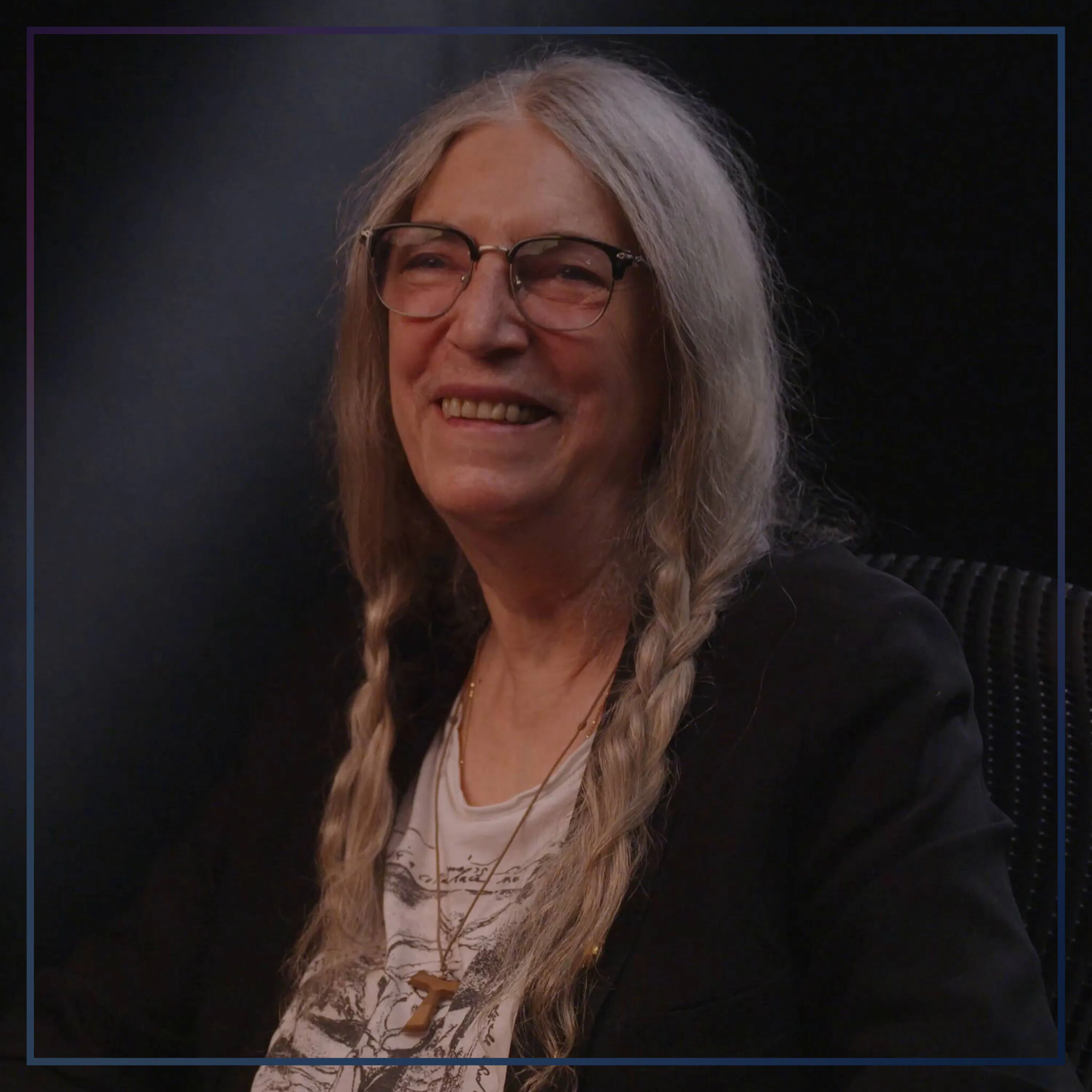
Millions of people watch that or have seen it now online. It's been reposted a lot, and I've received tens of thousands of direct messages and comments about it. So many of them are deeply personal and moving, and I wish I could respond to all of you who reached out. The response just affirms my conviction that none of us is alone in our sadness. It is a bond that connects us with unseen strands of longing and love. This is all there is. We'll be right back with my guest on the podcast today, singer, writer, poet and artist Patti Smith. Welcome back to all there is. My guest is legendary rock musician, writer, poet Patti Smith. She burst into the punk rock movement in the mid-1970s with her first album, horses. She's had such a remarkably creative career ever since, it's really impossible to catalog.
- [04:01]
Patti Smith
Because tonight belongs to lovers.
- [04:05]
Andy Slavitt
She's a member of the Rock and Roll hall of fame. Her 2010 memoir, Just Kids, about her relationship with artist and photographer Robert Mapplethorpe, won the National Book Aw. Her latest book out now is Bread of Angels, a memoir. I spoke to Patti one day after the anniversary of her husband, guitarist Fred Sonic Smith's death. He died in 1994 on Robert Mapplethorpe's birthday. Mapplethorpe died due to complications from AIDS in 1989, and Patti's brother, Todd Smith, died a month after her husband. Do you feel, do you feel grief now?
- [04:42]
Patti Smith
I feel, you know, it's a ride. I mean, I think it's something. Loss is something you have to navigate. It's not a thing where time heals all wounds. It's just in time, you learn to navigate it more because nothing really heals. They're sacred wounds. They're not going to heal.
- [05:03]
Andy Slavitt
They're sacred wounds.
- [05:04]
Patti Smith
Yeah, you just, you learn to live with them. This time of the year has always been Difficult. My husband. Yesterday was his passing day. It's Robert Mapplethorpe's birthday. So it's a. The date is fraught for me. And some years, it's extremely painful. This year, I don't know, I just felt happiness that I knew them both. I was just happy. A couple years ago, I had such a terrible. Of, like, almost horror that these people are gone, that my husband is never coming back, that I could almost. Couldn't get out of bed. So I just accept that some years the wound is, you know, vibrating. And other years were fine.
- [05:53]
Andy Slavitt
Robert Mapplethorpe died 1989. He was 42 years old. And then your husband.
- [06:00]
Patti Smith
Fred. Fred.
- [06:00]
Andy Slavitt
And then my brother Fred died in 1994. He was 44. And your brother was a month later at 42 years old.
- [06:07]
Patti Smith
Yeah, Fred had just died. And my brother and I decided I was gonna leave Michigan, live. Stay with him with the kids, and he would help me raise the kids and just we would, you know, live our life. And then a month later, he just died. And it was completely out of the blue. He was only 42, and he had a massive heart attack.
- [06:33]
Andy Slavitt
He was wrapping a present for his.
- [06:35]
Patti Smith
Business, presents for his daughter, and he was alone. And that. That still is so hard for me. And I miss him so much. And in that period of my life, I also had another child. So it was a period of both birth and loss. And it was just. It was a difficult. More than difficult, but I'm just. The fact that now when I look at my life, that I knew these people and they were such an important part of my life, that they loved me is. It's a beautiful thing. I think also, being, you know, I'll be 79, and we evolve, you know, we go through so much or so much pain or so much loss that it almost becomes a philosophic part of existence. It's different.
- [07:26]
Andy Slavitt
Your perspective now, the age you are, is different than it was even 10 years ago.
- [07:31]
Patti Smith
Yeah. And also the amount of the pain isn't so hard to bear. It's just almost like I can, like, sit back and watch it.
- [07:44]
Andy Slavitt
It's not that it's not there, but you have either a distance or a perspective on it that allows you to.
- [07:50]
Patti Smith
See it, I think. And also my father was much like that. My father was very philosophical, and I feel more and more like him as I get older. And I can look at things, and I don't take things personally. And people would say to me, all these bad things happened to you? And I said, no, they didn't Happen to me. They happened to others. But they're in my realm. But I just still feel I'm grateful to be here.
- [08:18]
Andy Slavitt
I heard you say something. You said, it isn't that the dead don't speak. It's that we forget how to listen. Which is a quote from Pasolini, the Italian filmmaker. I love that I hadn't heard that before.
- [08:29]
Patti Smith
I think of that all the time. I think of that constantly.
- [08:33]
Andy Slavitt
What does that mean to you? It isn't that the dead don't speak. It's that we forget how to listen.
- [08:37]
Patti Smith
Well, we have the ability to channel things. You know, some people think that channeling is a very mystical thing or shamanistic thing. And perhaps it is. But I found it's a part of my own existence. But you have to let things come into you. You can't clutter it up with your own thoughts. I'm not a meditator or any, but I can sort of, like, empty myself and allow things to come to me. When I first came back to New York after I lost my husband and brother and I had to go back to work to make a living one day, I was walking, and I can remember this so much. I was walking and I felt so bad. Sorry. I can tell you I just felt as low and as just. It was just the most terrible thing because I'm not subject to depression, but as much as that could be. And I was walking, and all of a sudden I felt this warmth in my heart. It was so warm and so I could almost see a red glow. And it scared me at first. Like, I thought, am I having a heart attack? And at first I resisted it, and then I relaxed. And then it sort of spread through me, and I felt so much love. And I almost started. I felt just happy. And I remember stopping, and I thought, it's Toddy. It was my brother. I could feel him. It was the sense of him. That's the way he was. He was my knight always. He believed in me. And I could feel him. And I just remember standing there smiling, just by myself, standing there, smile. And I knew it was him.
- [10:37]
Andy Slavitt
Was that the first time you had felt him since he died?
- [10:40]
Patti Smith
I mean, I could sense him or I would, you know, dream about him. Yeah, that was first.
- [10:44]
Andy Slavitt
But actually feel.
- [10:46]
Patti Smith
That was. And it was probably like a year after he died, but it was. So I just said it out loud. It's Toddy. I knew it was him.
- [10:57]
Andy Slavitt
Now that I have started to, you know, turn toward what I've been running from my entire life, I feel my dad for the first time. And it's incredible. Like I feel him and I feel like you can still have a relationship with somebody who's died.
- [11:14]
Patti Smith
Absolutely. I believe that.
- [11:16]
Andy Slavitt
To me that is one of the greatest gifts I've gotten, is this knowledge. You can have a relationship with somebody who has died and your relationship can grow and change even though they're gone.
- [11:28]
Patti Smith
Absolutely. I totally believe that. I mean, I think of Fred. My kids were 7 and 12 and we have kept him with us in every way. Humorously sad, angry, everything we talk about him. We know he would hate the Internet. He was a very private person. We think, well, glad dad wasn't around to see that. And oh, we'd love that car. Whatever it is, we talk about him. He's part of our daily conversation. And it's also like with my mother. My mother and I have improved our relationship since she was gone.
- [12:07]
Andy Slavitt
Really especially.
- [12:08]
Patti Smith
Yeah, all the things. As I get older, I appreciate her more and more.
- [12:13]
Andy Slavitt
Do you still talk to your mom? To your.
- [12:17]
Patti Smith
Well, my mom talks to me, that's for sure.
- [12:20]
Andy Slavitt (New Year's Eve Broadcast)
What does she say?
- [12:22]
Patti Smith
You know, telling me I should get my hair cut or would it be nicer? Or she's excited about something or she'll want to know how Richard Gere is and she was very fond of him. And there's just funny things, nothing deeply serious, sometimes just comforting me. The more I go through in life, see what it's like to have children, to see your children leave, your children grow. I understand her so much more, admire her so much more and tell her about it. It's almost like we still have coffee together.
- [12:59]
Andy Slavitt
Yeah, I understand my dad more because I now have two little kids and I know, I know what he was thinking when he looked at my brother. And I just as what I'm thinking, it's the same I'm thinking when I look at my sons. Yeah, it's lovely.
- [13:15]
Patti Smith
Yeah. It's just also you had things to process that I had terrible things and terrible losses, but nothing. I mean what your mother had to process and the way you lost your brother and also from a 10 year old boy. My son was 12. And I know being stoic is part of being a boy. It's completely natural that you wouldn't feel what you would feel later in life because first of all, you have to protect yourself. As a child, I had two childhood friends who died, all before I was seven. I didn't cry for any of them. I saw my dog killed right in front of me at 11 years old. Never had another dog. I still love that dog. But I don't remember even crying. Because you were a soldier, in a way, you know.
- [14:11]
Andy Slavitt
Do you remember when you first did cry?
- [14:16]
Patti Smith
No, actually. That's an interesting question. I cried when I read books. I remember crying with, reading the Prince and the Pauper. What I learned to do was develop a realm where these disappeared people would dwell.
- [14:35]
Andy Slavitt
Like a fantasy realm.
- [14:36]
Patti Smith
Yeah, it was like a heaven that wasn't that high up so you could sort of live with them. And that way of thinking really has carried me through life because I still sort of have that. I have that realm where my people are. I feel them close to me, and I can walk with them or sometimes almost ask them to help me with something.
- [15:03]
Andy Slavitt
You said once, if we keep ourselves open, they will come. Can you explain?
- [15:08]
Patti Smith
Well, it's like everything. Like the muse or with God. It's like we imagine prayer is like talking at God. Talking, talking, talking, petitioning, asking. But if you just, you know, think of it the other way and just sort of open yourself, why shouldn't God or the angels talk to you? Why? If we keep talking, we're not listening. We're not opening ourselves to feel them. Like that day I felt my brother. I feel that we could feel anything. Elves and fairies and. I'll take it. I'm still open. And have they come? Well, I mean, I've had a few visitations, like writing, you know, you have a terrible bout where nothing. It's like almost like your brain shuts down and all your cells shut down. Like, I'm having a rough patch right now. I haven't written, like, in three months or something. But instead of being, like, tortured about it, like when I was younger, I just think, okay, it'll happen. Just cool out.
- [16:15]
Andy Slavitt
When your brother died, you went to the funeral home, I think, with your sister.
- [16:20]
Patti Smith
Well, he arrived in a body bag, and we were at the funeral home, and they had laid him out, and there was a cloth over him, and we were sitting with him, and we were, like, could hardly even speak. We were so, you know, brokenhearted. But the way they had him, his hands must have been folded over his private parts. And the sheet was sort of sticking out there. And at the same moment, we both noticed it. And I said, I'm hoping that's his hands. And we both started laughing. But to understand this, Linda Toddi and I, what we were punished the most for was, like, uncontrollable triple laughter. We would all start laughing and wouldn't be able to stop. And my mother would yell at us and tell us to stop laughing. We could not. And then we could be punished. And I was distraught over Fred. I could hardly bear to smile and leave it to my brother. We could not stop laughing. And the guy and the funeral home guy thought we were, like moaning and crying out. And he said, are you two all right? And we're going, yep, we're all right. We were just laughing so much. But it was like I could imagine that people would think that was terrible, that we're sitting with our dead brother laughing. But for us, it just showed that we still had it. We still had the ability to get into that totty Linda and Patty frame of mind where, you know, we could laugh enough, enough to get punished. Then I always say to people, grief does not mean crying and sobbing. That's part of it. It could be wailing. I mean, I feel like I've done it all, but it's not required. Nothing is required because grief isn't just like the person dies and you grieve and you go to the funeral and then it's over. It's going to last your whole lifetime. It's going to come and go in waves.
- [18:30]
Andy Slavitt
I just talked to Ken Burns, the documentary filmmaker, and he said the half life of grief is endless.
- [18:36]
Patti Smith
That's beautiful. And I completely, I can comprehend that. And it is. The real thing is people should not feel that it's wrong to feel joy in the center of grief. We have to be able to go through the whole spectrum. It's part of being alive. We have to find a balance for all of that.
- [18:58]
Andy Slavitt
I've also come to the realization that I've muted my life by not allowing myself to feel grief and to feel a deep, deep sadness.
- [19:07]
Patti Smith
If you're muting one part of yourself, it's going to also mute somewhat of the other. You know, you're keeping in the safe zone, which some people might need to do because they experience deep depression, because they have clinical depression, because they can't allow themselves to enter certain realms. But if your mental health is good, I think it's important to feel everything. To feel guilt, to feel anger. It's important to know what all of these things taste like.
- [19:43]
Andy Slavitt
We're going to take a short break. A quick reminder. My new live interactive show, All There Is Live now, airs every other Thursday night on our grief community page, cnan.com you can join us there at 9:15pm next Thursday, January 15, for more conversations about grief with podcast listeners. We'll be right back with more from Patti Smith. Welcome back to my Conversation with Patti Smith. I spoke to Patti on the day after photographer Robert Mapplethorpe's 79th birthday. He died of complications from AIDS in 1989 at the age of 42. Patty and Mapplethorpe met in 1967, when both were 20 and still aspiring artists in New York City. They went on to become lifelong friends and artistic soulmates.
- [20:30]
Patti Smith
Robert was my first major, major loss in the string of losses that I was about to go through. Robert was the first. He was only 42. When I think of myself, what I've accomplished since 42, my greatest accomplishments were really in my late 50s and 60s as a writer at least. And Robert, he had so much work, so many visions, so much to do, so much capability. And what I mourn is like. I know what he wanted to do. I feel the pain of incompletion. I could imagine what he would have done.
- [21:14]
Andy Slavitt
The spark between you two, was it instantaneous?
- [21:22]
Patti Smith
It was always humanistic, like it wasn't a sexual thing or anything. There was something alchemical between us. Robert and I were like two artists who believed in one another. We were the same age. We were only two months apart. I met him when he was 20. I was trying to find a place to stay, and I was looking for some people. I went to their old apartment. They didn't live there anymore. And the guy that answered the door said, well, ask my roommate. He's in that room. He might know where they live. I open the door and there's this boy. He's lying on this little white iron bed, asleep with all these shepherd boy curls, and was just looking at him. And he. It's like he sensed that someone was there and opened his eyes and smiled and that it was like. It was like an instant welcoming. And our whole life was built on that smile. The last time I saw him alive, he was. Oh, my God, he was suffering. It was inhuman what he was suffering at the end of his life. And I spent a day with him, and he was able to calm. He didn't cough so much. We were alone. And he said, patty, I'm dying. I knew I was never going to see him again because I had to go back to Detroit. He was going to go to Boston for some new treatment. And he fell asleep. And I waited. And then I had to go. And I was almost to the elevator, and I just wanted to look at him one more time. And I went back and he was still sleeping. And I stood there, and I swear to you, he opened his eyes and smiled. So my first and last image Of Robert was that welcoming smile and everything else in between. And it was this symmetry. It was like a blessing, you know? Sorry.
- [23:33]
Andy Slavitt
No, it's lovely. I heard you say, I think it was after Robert's death that you went to the ocean. You went to the beach. And we had another guest on Andrew Garfield. His mother died of cancer, and when she was sick, he talked about going to the beach. I had read something he had said, and I read it to him, and then he talked about it. So I just want to play that for you. You said, as soon as my full body and head were submerged, it was like I got the medicine and my chest released and I let it all go. My interpretation of that moment was that it was the wisdom of nature, the wisdom of the earth, the wisdom of the ocean letting me know, hey, yeah, it's hard. It's horrible. I'm not taking away this unique pain you're feeling, but just so you know, us out here, us water molecules, we've been seeing this for millennia. And actually, this is the best case scenario for you to lose her rather than for her to lose you. This is a much better situation. And again, my ego was holding on. My ego thought I knew better. My ego said, no, this doesn't make sense. No, no, no, it should be this way, it should be that way. But actually, it took the ocean, the greater opponent, to just hold me under and say, it's really horrible. And sons have been.
- [24:42]
Andrew Garfield
Hmm, hmm.
- [24:49]
Andy Slavitt
And sons have been losing their mothers for thousands and thousands of years, and they will continue to. And you've just been initiated into that awareness and into that reality. Some illusion has been lifted. You're in a realer version of the world now, and it's painful.
- [25:05]
Andrew Garfield
Thank you for connecting with it, with your heart. And I know. I know that it's. I know that it's true. We have to ask to be helped in these moments. Otherwise we don't get any medicine, we don't get the help. We have to be in enough pain and enough longing to say, help me. And only with that. With collaborating in that way, with approaching the mystery in that way of. With all that vulnerability and with all that confusion and with all that lostness. Do we get any kind of answer? I think. And I think the answer is relative to the question and the willingness to ask the question and the willingness to not know the answer. So I think the only thing I can take credit for in. In terms of receiving that information was I allowed myself to feel broken. I just allowed myself to be in pain and I allowed my. I didn't run away from it. I ran towards it and I said, help me. And the ocean had a great. A great answer. A really tremendous answer.
- [26:19]
Patti Smith
Well, it answers the question about channeling too. Or like listening and opening himself. He heard what the sea had to say to him. Fred took me to the ocean because, I mean, Robert was such a part of my consciousness. I was seeing him everywhere. I dreamed of him constantly. I actually saw him like a hologram sitting in a chair while I was folding laundry. That's how much he was around. I didn't know even what it was. I mean, it's a form of grief, but it was also. I was like haunted, really. I couldn't get him out of my sight line. I couldn't get him out of my mind. And in going to the sea. The sea is so vast and it's pure and it's bigger than us. I like the way he said, sons have been losing their mothers. And it's been happening all through time. And the sea has seen it all. And it's philosophic, but empathetic and welcoming. But you could drown in it.
- [27:26]
Andy Slavitt
It's like grief.
- [27:27]
Patti Smith
Yeah, you can drown in it or be cleansed by it. That was very nice. Thank you for playing it for me.
- [27:34]
Andy Slavitt
The song you wrote for Fred, it's on the album Gone Again. It's called Farewell Reel. And I just want to play a little bit of that.
- [27:44]
Patti Smith
Okay. This little song is for Fred. It's G, C, D and D minor. Been a high time and when it rains it rains on me the sky just opens and women rains it pours I walk along a solid it's seems by tears from heaven and darling I can't help thinking those tears are yours. Our wild love came from above and wilder still is the wind that howls Like a voice that knows it's gone Cuz darling you died and will I cry But I get by salute I love and send you a smile and move on. Sorry.
- [29:38]
Andy Slavitt
It's beautiful.
- [29:40]
Patti Smith
I haven't heard it in years. I don't listen. I never. I rarely listen to myself.
- [29:44]
Andy Slavitt
So you don't have to say sorry. As Francis Weller says, those tears are holy.
- [29:55]
Patti Smith
So sad, but also optimistic.
- [30:02]
Andy Slavitt
It's stunningly sad.
- [30:05]
Patti Smith
Okay. Barbara Walder's Barbara Walder's moment. That's right. It was nice to hear it. It's just. It's heartbreak. Heartbreaking, really. Also my guitar playing. The last thing Fred, you know, at the end of his life, he taught me a few chords. Enough to write that song, you know, I'm not a musician at all, but I, you know, he was not well, and so he spent a lot of time teaching me these chords and that's what I did with them.
- [30:42]
Andy Slavitt
But I. I love it.
- [30:44]
Patti Smith
That song, I mean, that was a very raw record. And encompassed in that little song is the immediacy almost of what happened. It's also. I remember so much, you know, every line writing that. And they're all like, I don't know. I don't know how to express it. They're true. Every line in that is true.
- [31:09]
Andy Slavitt
There's a purity to it. That's the word I can hear.
- [31:11]
Patti Smith
Yeah, it's just true. It's just in the song, you know, what really happened is it's there. So it's not like it causes pain. It's just recognition, I guess, because it's a true song. And it was yesterday. Yesterday was his passing day. I didn't cry yesterday. So actually I'm happy to shed a few tears today. So that's nice.
- [31:35]
Andy Slavitt
You wrote something that really struck me. You wrote, everyone is dead, all is forgotten, echoes a voice I inventory those still with me I go no further than the face of my sister Innocent yet all knowing. So long as she is here, our memories are ensured. But what of the future when we are both gone? It's something I think about a lot. Being the last one left from the little family that I grew up in. I find great weight being the last one left and sort of the. The holder of these memories. And like, I'm like. My basement is still full of stuff that I'm trying to organize and photograph and trying to kind of make sense of it. But I also am sort of. I feel like I need to preserve it. Because if, you know, if I throw these things out or they disappear, then all of us or all of them disappear.
- [32:33]
Patti Smith
Well, that's why in the book I also talk about the shedding process. I have a lot of treasured things. Some of them are real treasures, like a letter of Emily Dickinson's. But then there's the other things. My father's favorite golf ball. The kid's baby teeth. And my books, which, you know, the books I had since I was 6 years old. I look at my copy of Pinocchio and I think, I've loved this book for over 70 years and I'm not gonna be buried with my copy of Pinocchio. I mean, what's gonna happen? But I know that I'm gonna have to say goodbye to it someday. I'm trying to train myself to start giving things away, sharing them, or just stepping back from my attachment with them, very hard for me. But I have to take deep breaths because I know that I'm going to get to a point where I can only choose a couple of them. Or maybe say to my daughter, can you bury me with my wedding ring and this little box? You know, it's all going to come down to that.
- [33:44]
Andy Slavitt
I ask everybody in the podcast, is there something you've learned in your grief that would be helpful for others?
- [33:51]
Patti Smith
Well, the main thing I would just tell people is allow yourself all the different things that you feel in losing somebody. You do crazy things when you lose somebody, like go shopping, like all of a sudden you just leave the house and buy something expensive or do something out of character. Don't judge yourself. Let yourself be angry or let yourself not feel anything. Don't feel guilty. Just allow all your cells and all of your being to go through its process. I mean, I cried more for Fred years after he died. It was like I was in such shock losing him. And I had so much responsibility and I had two young children and financially we were at an all time low. And then my brother died a month later. So a lot of the things that I felt, you know, were more intense years later.
- [35:05]
Andy Slavitt
And that's okay.
- [35:06]
Patti Smith
Yeah, there's no rules and there shouldn't be any rules. And there's all of these phrases like time heals all wounds. It doesn't don't look to be healed. You have a sacred wound, take care of it, don't let it get infected. But it's not necessarily going to heal. You just learn to live with it.
- [35:27]
Andy Slavitt
There's no rules in grief.
- [35:30]
Patti Smith
No, I don't think there should be. People expect people to cry when somebody dies. That's wrong. There's no telling how people, people even nervously laugh when somebody dies that they care about. They don't know why they do that. I don't judge anyone by their behavior. I've heard people judge children because they were playing. When we lost a little boy in our neighborhood, he was only four, I think I was six. And there was a wake in the house and he was in his little coffin and the cartoons came on and we put them on and we just rolled. It was a big TV that was on wheels and rolled it over so he could watch cartoons with us. We weren't sitting around crying. That's how we processed it. We watched cartoons with him. Did that mean we were heartless? I think that people just have to. They have to process things in their own way and they shouldn't be hard on themselves. It's hard enough to lose someone without judging how you're, you know, reacting to it.
- [36:41]
Andy Slavitt
Thank you for doing this. I really appreciate it.
- [36:44]
Patti Smith
I really feel grateful to have. Even though it was shedding tears, it's like the word shedding. It's not just crying, it's shedding. The tears are within us. You shed them and they'll. Ah, I feel like that was a good thing.
- [37:06]
Andy Slavitt
That was lovely. Thank you.
- [37:07]
Patti Smith
Thanks. Thank you.
- [37:09]
Andy Slavitt
Patti Smith's new book, Bread of A Memoir is out now. My guest on the next episode of the podcast is novelist Yiyun Lee. She's an extraordinary writer who's experienced the death of both of her sons, both of whom died by suicide. Her 16 year old son Vincent died in 2017 and her remaining child, James killed himself when he was 19 in 2024. You don't use the word grief. You talk about the abyss.
- [37:36]
Yiyun Lee
Yes, I use abyss as the precise word to describe how I feel about my life is I'm in an abyss.
- [37:45]
Andy Slavitt
You're in it right now.
- [37:46]
Yiyun Lee
Yes. And we will always be in this abyss because we'll always be parents who have lost two children and nothing in life is going to change that. So I don't want to say I want to get out of this abyss. What I want to do is to live in this abyss a little better so it doesn't feel abysmal. Each person lives in his or her own abyss. So yes, I am in the abyss and I never want to go out. I don't think it's possible to get.
- [38:19]
Andy Slavitt
Out, though it's painful.
- [38:22]
Yiyun Lee
It is painful. One wants to hold onto these memories, however painful they are. People always think pains are not good. There's nothing good or bad about pains. They're just facts. They're the facts in your life.
- [38:37]
Andy Slavitt (New Year's Eve Broadcast)
Pain is a fact.
- [38:38]
Yiyun Lee
Yeah. And I think what we do is how to live with that pain a little bit more wisely or better or cheerfully. My husband and I, we are in pain. We have the pain, but that doesn't stop us from laughing. I think that pain or that abyss is you coexist rather than getting rid of that.
- [39:02]
Andy Slavitt
Podcast will be released in two weeks, Thursday, January 22nd. We're changing the schedule for podcast releases and all there is live because we want to continue doing this work all year long. And in order to do that from now on, we'll be releasing a podcast every two weeks on Thursday evenings and on the other two Thursdays of the month, we'll have our live grief show, All There Is Live, which you can only see on CNN.com AllThere so next Thursday, January 15th, you can join us for an all new edition of All There Is Live, which you can watch at 9:15pm online. And the following Thursday will be the podcast with author Yiyun Lee. Thanks for listening. Wherever you are in the world and in your grief, you're not alone.
- [39:45]
Patti Smith
I'm CNN tech reporter Claire Duffy. This week on the podcast Terms of Service, what is the best way right now to get answers from the Internet? And can we be sure that the newest tools on the market are accurate? I have Robby Stein with me in the studio. He is the vice president of product at Google Search, where he's responsible for the core search experience as well as new AI offerings.
- [40:08]
Andy Slavitt
Yeah, we really designed AI Mode to really help you deal with a pretty complicated question. You're trying to figure out what kind of car you might want to buy or like backup power ideas for your apartment or your house. And there's like little power stations you can buy. There's kind of complicated things and you want to maybe compare them. You want to ask follow up questions. And so AI Mode's really awesome for those kinds of informational tasks.
- [40:30]
Patti Smith
Listen to CNN's terms of service. Wherever you get your podcasts.