Loading summary
Transcript120 lines
- [00:01]
Anderson Cooper
Why did no one tell us that to die is to be reincarnated in those we love while they're still alive? Poet Andrea Gibson, who died this summer, wrote those words. Tig Notaro was there when Andrea Gibson died, and we'll talk to her about what she witnessed and how it's made Tig rethink her own life. That's coming up on this episode of All There Is. This past week, I interviewed two people who also witnessed the deaths of their loved ones. Susan Heim's son Charlie died at 17. He died in her arms this summer around the same time Andrea Gibson died. Susan had cared for Charlie his whole life. He had down syndrome and cerebral palsy. Joe Sims cared for his son Jacob for 33 years. He also had special needs. Jacob died six years ago. And I want to play you some of what Joe said on All There Is Live, the companion show to this podcast.
- [01:00]
Joe Sims
One of the things that Jacob loved to do was go on road trips. He loved nature, he loved being outside. He loved. I loved putting his feet in a creek and let him feel the cool water. And I even took him near by one of the waterfalls and he felt the mist of the water. I think that was his best time when he was doing that. Even though he lived to only 33, he had a full life. And then it. It ends and you don't know what you're supposed to do. You lose yourself because your whole identity is wrapped around his every moment and you hit the wall. And then he passed away on a Tuesday, and my wife and I were lost on Wednesday. We wandered around for months trying to figure out our life without him. There's some days that I still feel the fog, and then there's other days I can see out of the fog. And I think that's what my son would want. I don't want to stop grieving, though. Honestly, Anderson, I don't want to stop grieving. I think the grieving is healthy. It keeps me in touch with them. I talk to him every day.
- [02:15]
Anderson Cooper
You feel him in your grief?
- [02:16]
Joe Sims
Oh, big time, sure. Yeah. Just like you do with your grief. And it's weird to say this, but I'm happy that I'm sad at times. I'm happy I still have your feeling. That's right. It's not supposed to go away. It just isn't. You're supposed to be able to live with it and still have a good life and a happy life and still have grief. There's. You can live with both.
- [02:39]
Anderson Cooper
Can you say Jacob's full name so that everybody listening hears it.
- [02:44]
Joe Sims
It's Jacob David Sims, born in Phoenix, Arizona, in 1986. January 17th. His birthday's coming up.
- [02:53]
Anderson Cooper
Maybe everybody at home who's watching could repeat the name just so that everybody tonight is speaking his name out there into the. Into the universe. Jacob David Sims.
- [03:07]
Joe Sims
I appreciate that. Thank you.
- [03:10]
Anderson Cooper
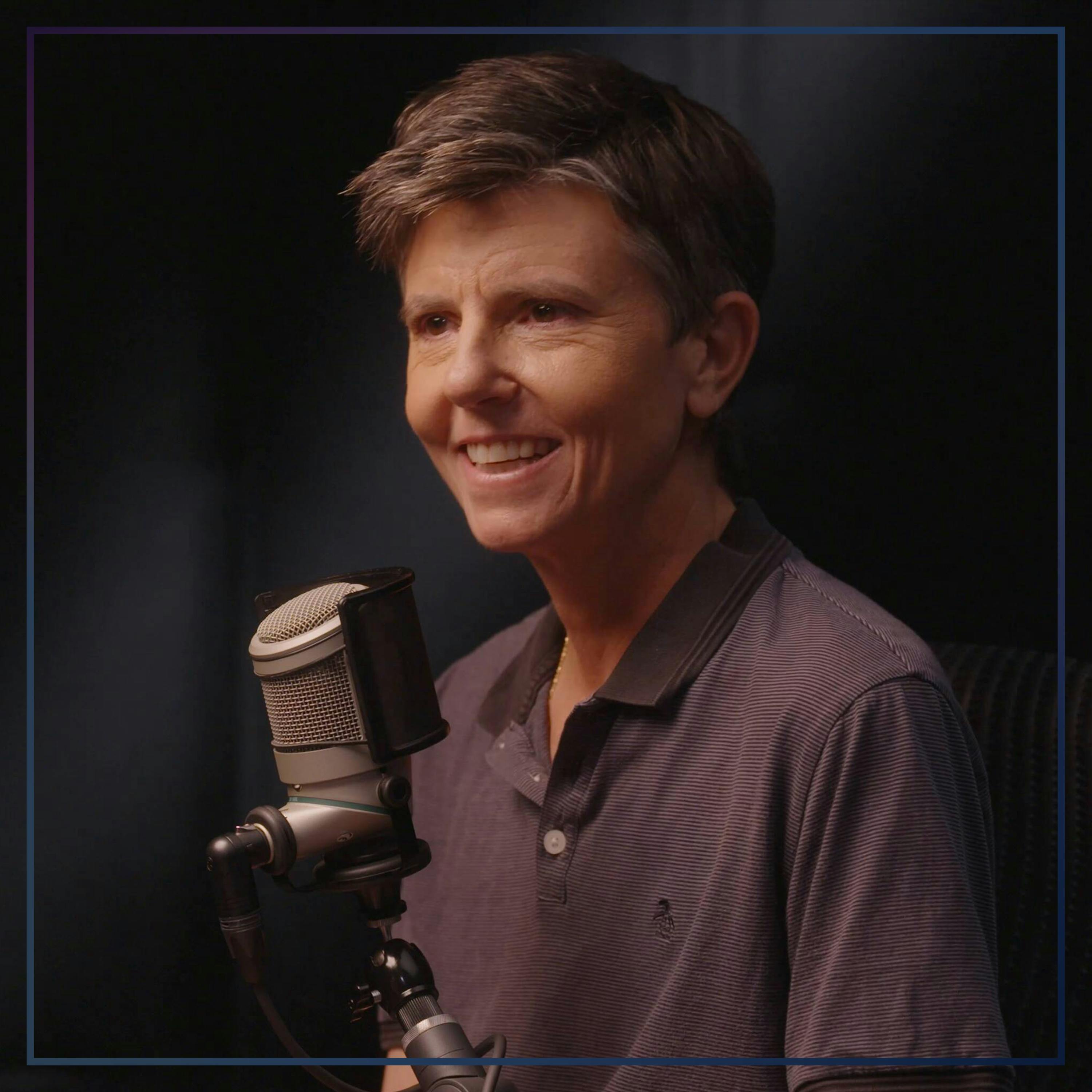
In a moment, my conversation with Tig Notaro. My guest today is comedian cancer survivor Tig Notaro. I spoke to Tig just days after she'd attended a memorial in celebration of life for her longtime friend, spoken word poet Andrea Gibson. Andrea died July 14th. They were 49 years old. Andrea, who used the pronouns they and them, was diagnosed four years ago with stage four ovarian cancer. When Andrea died, Tig was there in the home that Andrea shared with her wife, Megan Fowleigh. Tig is also a producer on an incredibly moving documentary that follows Andrea and Megan through Andrea's illness. The film is called Come See Me in the Good Light. And you can watch it streaming on Apple TV right now. I played part of the film with Tig when she sat down. And I want you to hear Andrea's words. I want you to meet Andrea Gibson.
- [04:08]
Andrea Gibson
I feel like I lived so much longer in these last years than I did all the years before.
- [04:19]
Joe Sims
Wow.
- [04:22]
Andrea Gibson
I.
- [04:26]
Joe Sims
Wow.
- [04:26]
Andrea Gibson
I got this life, and I know I'm not gonna die today. Like, I feel pretty certain. So, wow. I like, wow. I get tomorrow, too. So what happens next? I don't know. I want to live in the mystery, you know, I want my very last second to be like, damn, I wish I had a million more of these.
- [05:08]
Anderson Cooper
Do you feel like that is what Andrea's seconds were like?
- [05:12]
Tig Notaro
No doubt. Yeah. And, man, hearing Andrea's voice, it's tough.
- [05:26]
Anderson Cooper
I think it's still so recent, too.
- [05:29]
Tig Notaro
It's very recent, but hearing Andrea just now was. Yeah, it just. I can't stand that Andrea is gone.
- [05:46]
Anderson Cooper
Today is actually Andrea's birthday.
- [05:49]
Tig Notaro
Mm. Andrea Gibson turned 50 years old today. Yeah. Almost made it.
- [05:56]
Anderson Cooper
How did you meet Andrea?
- [05:57]
Tig Notaro
When I left Texas as a teenager, I dropped out of high school and moved to Colorado. And I met Andrea backstage at this theater called Old Bane.
- [06:07]
Anderson Cooper
Andrea was already doing spoken word poetry.
- [06:10]
Tig Notaro
Yep. Andrea looked like a rock star. Tattoos. Just to find out Andrea was a poet. It was not my world, and I was in comedy at the time, but a poet. I was like, okay, I'm listening. And then Andrea went on stage and leveled the place. I was stunned. I didn't know that was poetry. I didn't know poetry could look like that. But that's how Andrea's shows were. It was just, like, so intense, so you could be crying. And then Andrea was one of the funniest, most ridiculous people. And that's where I fully connected.
- [06:55]
Anderson Cooper
Meg said at one point that she didn't want to grieve while Andrea was alive. She was intentionally not going down that road. Do you feel like you have already been grieving Andrea before Andrea died?
- [07:14]
Tig Notaro
Yes. Yes, for sure. It was also very confusing. I feel like I'm very grounded, and then I find myself in these moments of life where I'm like, maybe Andrea's lying about having cancer. You know, like, you know, like some weird Netflix documentary. Yeah. You hear stories about people lying. And I was like, man, that would be the greatest ending to this story is just to find out my friend has deep trauma and lied about this. And let's dig in and figure that out. It didn't feel possible for Andrea to not be alive in this physical world.
- [08:06]
Anderson Cooper
Does it feel different than you expected it to be?
- [08:09]
Tig Notaro
I think it's definitely different. I didn't expect to feel Andrea so much.
- [08:15]
Anderson Cooper
Andrea's presence still?
- [08:16]
Tig Notaro
Yeah. Yeah. I mean, I've lost my mother, my father, my stepfather, my cousin. I've lost many friends and colleagues. I have to say, it's really the first time I've experienced a death in the way that I have, where I really feel Andrea, and I don't know what that is, but the grief I feel, you know how tricky it is. You go about your day and you're doing all right, and then all of a sudden, a truck parks itself on your chest and you can't do anything. It's so confusing that Andrea's gone. Like, I was just at their memorial in Denver a couple of nights ago, and it really just felt like we were at a party for Andrea. I mean, it was devastating. And poets from every corner of the globe came in to read Andrea's poetry, and it was a. This is going to sound crazy. A greatest hits night. I mean, God, they're hits. It's hit poetry. What am I saying? But it's true. It was just so beautiful.
- [09:26]
Anderson Cooper
As you said, you've experienced grief before your mom died, and then very shortly after that, you got cancer.
- [09:33]
Tig Notaro
Yes, yes. It was a four month, I think, period of time that I had pneumonia. Then I contracted this intestinal disease called C. Diff, and I had invasive cancer. My mother tripped, hit her head, and died, and my girlfriend and I split up. So that was an overload of grief. Grief about my body after surgeries. And.
- [10:04]
Anderson Cooper
Did I read correctly that you had to make the decision of removing.
- [10:07]
Tig Notaro
Life support from my mother? Yeah, yeah, yeah. And with my stepfather. I describe it to people like, you're watching your loved one drown, and you can't throw them any sort of safety net. You just have to let them drown as you hold their hand. And same with Andrea being dehydrated, and they desperately want any sort of hydration. And then after a certain point, you just have to let go. And it's every deathbed that I've been or end of life, it's so different. It's so different. And Andrea's was at home and really one of the most beautiful experiences of my life.
- [11:04]
Anderson Cooper
Beautiful in what way?
- [11:05]
Tig Notaro
That's not to say it wasn't utterly devastating and that feeling of unfairness, but there were just a lot of different people from different times in Andrea's life that traveled actual long distances, planes, trains, automobiles, and emotional journeys that people were on. And I remember after my diagnosis, that feeling when you know how precious something is, it's that sweet spot. But it oftentimes and sadly comes in the very last moment. A breakup or somebody's dying. You can see everything so clearly. Every grudge goes completely away, and everybody really holding each other through it for days, literally holding each other, no matter how well you did or didn't know the person next to you. One of the things was Andrea was highly medicated because when people are in that in the final moments, there's discomfort and pain.
- [12:19]
Anderson Cooper
And Andrea said something.
- [12:21]
Tig Notaro
One of the things was, I fucking loved my life. Yeah, I fucking loved my life. And we all just looked at each other. It was a gift. It was such a gift. To be able to hear Andrea say that and to be in the room when that happened was extraordinary.
- [12:43]
Anderson Cooper
You called it a transformative experience, being there.
- [12:46]
Tig Notaro
Yeah. I don't even know how to explain what I was just a part of and what I just witnessed. It really, really resonated on a very deep level of I don't want to get caught up in anything that's not real. And that was real. That was really real. What I witnessed, the love, the humanity was on overdrive.
- [13:15]
Anderson Cooper
It's beautiful.
- [13:15]
Tig Notaro
It was really beautiful. Really beautiful.
- [13:20]
Anderson Cooper
I mean, one can't ask for any other way to die, really.
- [13:23]
Tig Notaro
That's what I want.
- [13:26]
Anderson Cooper
More of my conversation with Tig Notaro in just a moment. If you want to listen or watch past episodes of this podcast, you can do that at Our community page, CNN.comAllThe that's where you can also watch our new weekly companion show called All There Is Live. It's Thursday nights at 9:15pm Eastern. We'll be right back with more from Tig. We're back with Tig Notaro. Do you feel like you have gone back to your regular life or do you still feel that transformative power?
- [14:00]
Tig Notaro
It's rippling on a very deep level that's making me feel tethered to really what matters. And I don't know how long that, you know, I'm human and you go in and out of that or I do, but I feel very tethered to, yeah, what matters and who matters. And it's really making me rethink a lot of things in my life.
- [14:29]
Anderson Cooper
Yet you don't want to go back to just normal life.
- [14:32]
Tig Notaro
I think I want a new normal, not holding on to anything that's not real. I was lucky enough to be in Colorado for the couple of weeks after Andrea passed and I couldn't sleep well. And I was getting up at four in the morning and I didn't know what to do with myself or what to do with this energy. And I was taking 6am walks and watching the sun come up and told my wife, Stephanie. I was like, I have so much energy that I don't know where to put it that I feel like I just want to walk back to Andrea's house. And she was like, what are you talking about? You can't. It's a four hour drive. And I was like, I'm up for it. She was like, okay, where are you going to sleep? I was like, I don't care. I'll sleep on the side of the road. I felt like I don't need any food or any water. I just have this crazy energy in me where I just, I felt so connected to that room where Andrea was and where Andrea's loved ones and closest people and exes and family, like it was this otherworldly experience. And it's a sweet spot that would be incredible to be able to live in, but it's sadly not realistic. I turned to Stephanie at one point and said, and can you believe at some point I'm going to have to exit the 101 onto Melrose and just head back into Hollywood. I could not comprehend such a thing.
- [16:10]
Anderson Cooper
That juxtaposition is so, it's interesting. I lived briefly in Los angeles, my early 20s, when I was first starting out as a reporter. And I was just going to war zones and conflict zones and I would be in these incredible, extraordinary places where horrific things were happening and it was life and death and the molecules of the air were charged with human emotion. And, I mean, it was just impossible to describe. And then to return to Los Angeles and be in a supermarket and there's like cool mist on the vegetables and.
- [16:42]
Tig Notaro
Go work out at Crunch. Yeah.
- [16:44]
Anderson Cooper
I mean, all I wanted to do was leave and go back.
- [16:47]
Tig Notaro
Yeah.
- [16:48]
Anderson Cooper
Even though when I was there, I was depressed and horrified by what I was seeing.
- [16:53]
Tig Notaro
Very similar. I was devastated. Devastated. But I was also very aware that this was the greatest in humanity. What was going on in Belgium. Yeah. Yeah, it was.
- [17:12]
Anderson Cooper
I think it's one of the reasons I started this podcast is cause just the weirdness that this is stuff people don't. And yet it is something that everybody may experience at some point in their life if they're lucky to be there when their loved one is leaving.
- [17:28]
Tig Notaro
Well, what I think I really realized through this experience is that death really is coming for us all. I don't know if it's right to, say, make friends with that idea of dying, but it really should be more in conversation. I don't want my death to sneak up on my kids, although I've had a lot of health issues, so I don't know if it's gonna sneak up on anyone. But I really have such a new. Not that I'm gonna abandon comedy and become a death doula, but.
- [17:58]
Anderson Cooper
Oh, my God, don't get me started on death doulas. I mean, I hear from so many of them. It's an extraordinary thing.
- [18:03]
Tig Notaro
It is extraordinary. And I get it.
- [18:06]
Anderson Cooper
I get it. I seriously consider giving up my job.
- [18:09]
Tig Notaro
Anderson and Tigg's death doula.
- [18:11]
Anderson Cooper
I would do it. I'll do it if you do it, sir.
- [18:14]
Tig Notaro
Let's do it. I mean, hospice nurses, death doulas.
- [18:22]
Anderson Cooper
Well, I'm so pale and white. People would think, like, they're already in the afterlife when I walk in. You get them laughing. And then I would walk in and freak everybody out.
- [18:30]
Tig Notaro
Yes.
- [18:30]
Anderson Cooper
Oh, my God.
- [18:31]
Tig Notaro
I think people would freak out if we were who showed up in their final moments of life.
- [18:36]
Anderson Cooper
Ding dong, T and A are here. Tna.
- [18:43]
Tig Notaro
Tna. Tig and. And. Oh, right, yeah.
- [18:45]
Anderson Cooper
Tig and Anderson.
- [18:46]
Tig Notaro
Yes. Okay.
- [18:46]
Anderson Cooper
No, I wasn't. I mean, it was a. I was making a reference to it, but I was not.
- [18:50]
Tig Notaro
Right.
- [18:51]
Anderson Cooper
No, I think that'll stay.
- [18:53]
Tig Notaro
We need to get business cards to make. But no, this experience with Andrea really made me understand the importance of really talking about death rather than live my life fearing death and trying to kick it away. At every possible move I'm making, to just really incorporate it into my thoughts and the way I go about things. Because it's coming.
- [19:22]
Anderson Cooper
Andrea wrote a poem, a letter from the afterlife. I just want to play part of it.
- [19:28]
Andrea Gibson
My love, I was so wrong. Dying is the opposite of leaving. When I left my body, I did not go away. That portal of light was not a portal to elsewhere, but a portal to here. I am more here than I ever was before. I am more with you than I ever could have imagined. So close you look past me when wondering where I am. It's okay. I know that to be human is to be farsighted. But feel me now, walking the chambers of your heart, pressing my palms to the soft walls of your living. Why did no one tell us that to die is to be reincarnated in those we love while they are still alive? Ask me the altitude of heaven, and I will answer, how tall are you?
- [20:22]
Anderson Cooper
It's pretty incredible, Andrew saying, why did no one tell us that to die is to be reincarnated in those we love while they are still alive? Ask me the altitude of heaven. I'll answer, how tall are you? I love that.
- [20:45]
Tig Notaro
Yeah. One of my favorite things Andrea ever said was, what kind of poet would I be if I could only make things beautiful on the page? And. Yeah, and Andrea wrote that. And Andrea spoke those words to Meg's face. I also love the line of, like, I'm so close that you look past me. You don't even know that I'm there. I feel that.
- [21:13]
Anderson Cooper
And the dying is the opposite of leaving. When I left my body, I did not go away. That portal of light was not a portal to elsewhere, but a portal to here. That idea, to me is so moving. I had never really grieved until a couple years ago. I never really allowed myself to. And I do think that if you allow yourself to feel grief, you can feel the person alive inside you.
- [21:35]
Tig Notaro
Maybe it's like I'm experiencing what you experienced two years ago of opening yourself up to something like that. Grief on whatever level.
- [21:45]
Anderson Cooper
By the way, I don't know why I'm the one who's always crying on this frigging podcast of mine. I don't know why it's supposed to be the guests who are crying. It's not supposed to be like, the host is very pathetic. Jesus, pull yourself together, Anderson. I was imagining. Are you thinking like, God, this guy's a wreck?
- [22:02]
Tig Notaro
No, I was thinking, this is disconcerting.
- [22:05]
Anderson Cooper
Nobody told me this guy was such an emotional basket kiss why didn't anyone.
- [22:10]
Tig Notaro
Mention what a loose cannon this man was? No, I think it's incredible and I think it's that space that I'm truly sitting here. And I've already said to you I adore you and I love your work and I felt like I knew you and I. But I am sitting here going, God, I would love to talk more with you. I would love to know more. I feel very much in this space.
- [22:37]
Anderson Cooper
It's okay if you want to ask me questions too. Don't worry. I'm egotistical enough that I will answer. But I do want to play something else that Andrea wrote and spoke in a letter from the afterlife.
- [22:50]
Andrea Gibson
My love, I want to sing it through the rafters of your bones. Dying is the opposite of leaving. I want to echo it through the corridor of your temples. I am more with you than I ever was before. Do you understand? It was me who beckoned the stranger who caught you in her arms when you forgot not to order for two at the coffee shop. It was me who was up all night gathering sunflowers into your chest the last day you feared you would never again wake up feeling light hearted. I know it's hard to believe, but I promise it's the truth. I promise one day you will say it too. I can't believe I ever thought I could lose you.
- [23:43]
Anderson Cooper
I really hope that's true.
- [23:45]
Tig Notaro
Yeah.
- [23:45]
Anderson Cooper
That dying is the opposite of leaving. Do you believe that?
- [23:50]
Tig Notaro
I think I. I'm like really trying to understand and make sense of my feelings because I haven't been somebody that has felt that. Really.
- [24:04]
Anderson Cooper
You don't strike me as the kind of person to push down your feelings.
- [24:07]
Tig Notaro
I'm so sarcastically.
- [24:09]
Anderson Cooper
Because I see myself in you and so I know it when I see it.
- [24:13]
Tig Notaro
Okay. Yeah. My wife is very into feeling. Well, no, I'm actually very sensitive. But as far as my belief in what's going on after this life I haven't really bought into. I'm kind of buying in. With Andrea, death inevitably brings up coulda, shoulda, woulda's. And with Andrea, I had this dream for years that I would go on tour with Andrea and for years I'd be like, ah, I'll do it later. I don't know if you experience that. Yeah, I mean, of course, shoulda, coulda, wouldas.
- [25:03]
Joe Sims
Absolutely.
- [25:04]
Tig Notaro
They're the toughest after a death.
- [25:07]
Anderson Cooper
I mean, I wish I'd interviewed Andrea two years ago about what they were going through.
- [25:16]
Tig Notaro
Well, and that's what's so incredible to see, like, how exciting that the world is finding out about Andrea Gibson. There's no world that I thought when I met that scrappy little rock star poet backstage at Old Main and Boulder, that they would become who they became. Stephanie was saying, andrea Gibson is now going to be one of very few poets people know by name. That is wild. What poet becomes famous, you know, then publishes eight books and Anderson Cooper is sitting here saying, I wish I had interviewed Andrea Gibson. It's really remarkable.
- [26:03]
Anderson Cooper
I asked a question to everybody on the podcast. Is there something you've learned in your grief that would help others?
- [26:08]
Tig Notaro
I think about those kind of hard moments that you don't want to face that seem impossible at the time. I have fear initially in a lot of those hard moments, like, how am I going to do this? When I was a kid in junior high school, I hung out with this guy John. He was a rocker and had the most incredible vinyl collection. And we'd hang out in his bedroom and listen to records. And one day he was like, oh, dude, my mom just got home. I'm not supposed to have anyone over. Can you jump out of my window? And I was like, what? And I was like on the ledge of his second floor window and I'm like, I can't let John get in trouble. So I just jumped and. And that moment that I just had to force myself to jump and just do it, I've taken with me my whole life. Because even though, and look, I don't recommend jumping, especially when you're like a knobby kneed seventh grader onto cement. But that moment that I just, I had to mind over matter, just go, just jump. And when I have to do something hard, I just, I go off and I. And I think that the lesson goes back to your question of what have I learned from my grief? And it is to not avoid it. And for a long time I've avoided grief and wasn't quite ready for it. And I feel it has opened me as a person tremendously to explore it and be also available to others in their grief.
- [28:04]
Anderson Cooper
Wait a minute, are you gonna start a grief podcast? Cause I'm the only one who has repressed my grief my entire life who gets to have a podcast about it.
- [28:13]
Tig Notaro
Well, if you're looking for co host funny and everything. Damn it. God.
- [28:18]
Anderson Cooper
That's the only thing I had going.
- [28:20]
Tig Notaro
And I'm taking this from you too. Yeah.
- [28:26]
Anderson Cooper
There can only be one person who's repressed their grief.
- [28:29]
Tig Notaro
Only one gay grief repressed with unprocessed or whatever you want to call it, connections To Mississippi.
- [28:38]
Anderson Cooper
That's right.
- [28:39]
Tig Notaro
With two sons.
- [28:41]
Anderson Cooper
Yeah. Two sons.
- [28:42]
Tig Notaro
Yeah.
- [28:45]
Anderson Cooper
Is there anything else you want to say?
- [28:50]
Tig Notaro
No, I just.
- [28:51]
Anderson Cooper
Do you regret walking into this? What, did your bookers tell you what to do? Thank you so much.
- [28:58]
Tig Notaro
Thank you so much. I really appreciate you having me.
- [29:03]
Anderson Cooper
I know the holidays can be tough, and I hope you know that you're not alone. If you have something that helps you get through these holidays, leave us a video message on our Instagram at allthereis or at our voicemail box 404-827-1805. All there is is going to be back with a new episode on December 2 with musician Nick Cave, who. Who's experienced the death of two sons, Arthur and Jethro.
- [29:28]
Audie Cornish
What I came to understand is that we are all sort of creatures of loss, that we are all part of the world and that we are all suffering in our own ways. The world is suffering from loss. It is the thing that holds us together.
- [29:45]
Anderson Cooper
There is an ocean of grief out there.
- [29:48]
Audie Cornish
Yeah. And I think that that's the sort of connective tissue that holds us all together. It's the thing that we can. We can look. I can look at you, you can look at me. And we understand that within our lives, whatever they may be, there is this sort of thread of. Of loss that runs through wherever you.
- [30:08]
Anderson Cooper
Are in your grief. I'm glad you're here. I'm glad we're together. You're not alone.
- [30:14]
Tig Notaro
Thanks for listening to All There Is with Anderson Cooper. Follow and listen to all There Is on Amazon Music. Or just ask Alexa, play the podcast All There Is on Amazon Music. Hey, friends, this is Audie Cornish, host of CNN this Morning and the Assignment. And guess what? Every story you care about, every angle you want unpacked is now streaming on cnn. So subscribe to CNN at cnn. Com Subscription.