
Podcast
All Things Policy
Hosted by Takshashila Institution · EN
Ever wondered how automation will change the world? Maybe you puzzle over what India could do to ease traffic congestion, or how China's aircraft carriers will transform Indian Ocean geopolitics? All Things Policy, a daily podcast brought to you by the Takshashila Institution, brings you all the answers. Every weekday, our researchers break down complex economic and geopolitical ideas through the lens of current events. For everyone from the busy executive to the curious student, All Things Policy is all you'll need to understand the world (and appreciate your breakfast) better.
117episodes
Episodes
Newest firstAll episodes
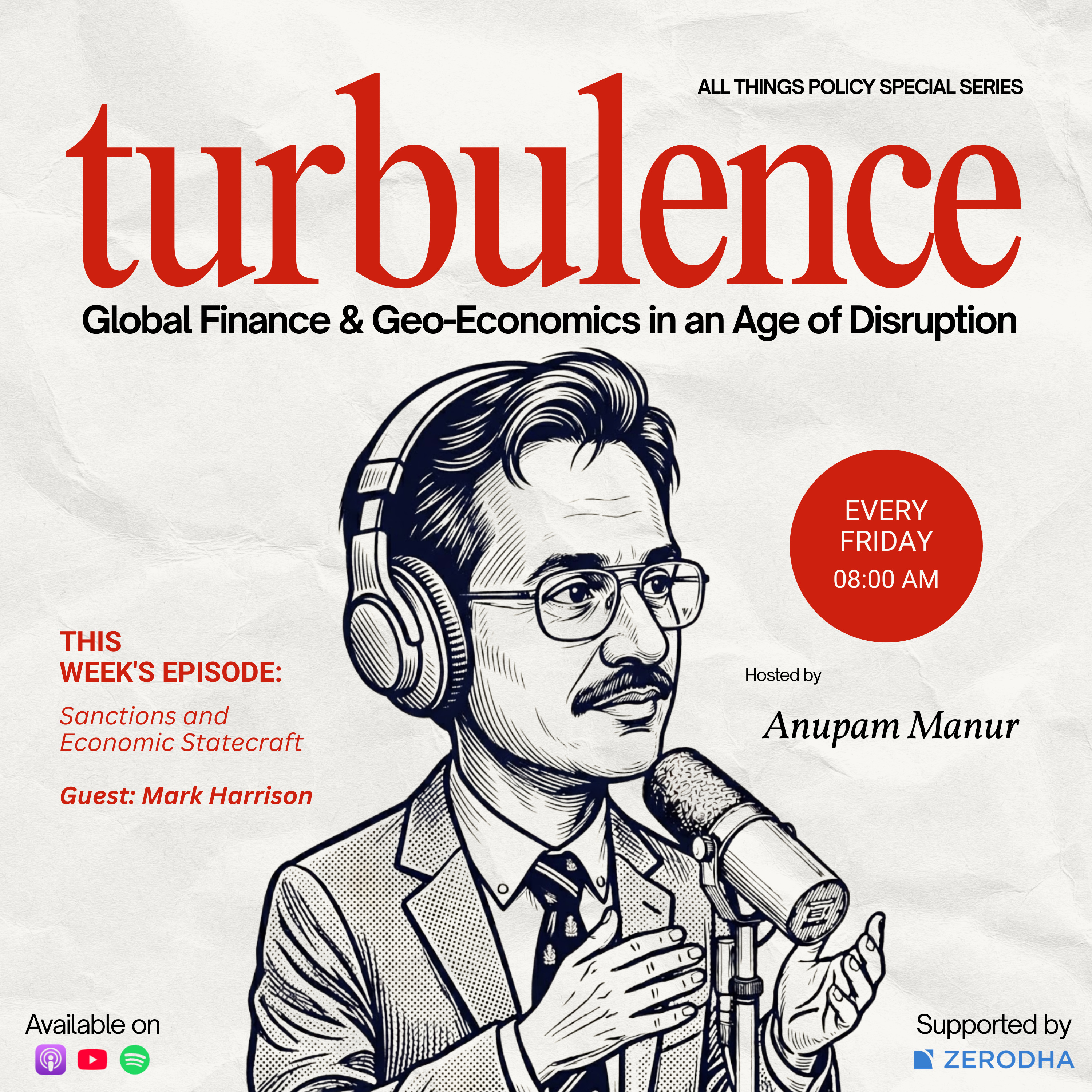
Sanctions and Economic Statecraft
4d ago01:23:38Tap to summarizeMore than a quarter of the world's countries now live under sanctions. They have become the West's instrument of choice—the thing governments reach for when war is unthinkable and doing nothing is unacceptable. Freeze the reserves, cut off the banks, choke the exports, and force a government to change course without firing a shot. The fashionable verdict, after Russia's economy failed to collapse, is that sanctions simply don't work. In this episode of Turbulence, Anupam Manur is joined by Mark Harrison, a Professor Emeritus at the University of Warwick, one of the world's foremost economic historians of war and coercion, and co-editor of Economic Warfare and Sanctions since 1688. Reading three centuries of evidence, Harrison finds an interesting pattern: economic pressure has worked only when backed by force or the credible threat of it, which is the one thing the modern sanctions regime was built to avoid. The conversation runs from Napoleon's blockades to the chip war, asks why targets adapt faster than senders expect, and turns on an uncomfortable question for a country like India, caught between the sanctioners and the sanctioned.All Things Policy is a daily podcast on public policy brought to you by the Takshashila Institution, Bengaluru.Find out more on our research and other work here: https://takshashila.org.in/research-areasCheck out our public policy courses here: https://school.takshashila.org.in
Transcribe →
China Gives India "Strategic Breadcrumbs"
5d ago00:41:47Tap to summarizeAs India and China navigate the paradoxes of their post-Galwan ties, stressors ranging from Delhi-Washington ties to a competition over influence in the Indo-Pacific continue to plague a strategic "reset." In this episode of 'All Things Policy', Anushka Saxena quizzes Saheb Singh Chadha on his latest research paper explaining China's India policy of "Strategic breadcrumbing." Saheb delves into the boundary question and the challenges posed by Beijing's sustained use of economic coercion, while arguing that the current thaw is nothing more than a pause before a new storm takes over the ties.Read his full paper, 'Threading The Needle', here: https://carnegieendowment.org/research/2026/07/threading-the-needle-indias-path-forward-with-china.All Things Policy is a daily podcast on public policy brought to you by the Takshashila Institution, Bengaluru.Find out more on our research and other work here: https://takshashila.org.in/research-areasCheck out our public policy courses here: https://school.takshashila.org.in
Transcribe →
Aboard Starship, The Largest Rocket Ever
6d ago00:28:37Tap to summarizeSpaceX, which has built the largest satellite internet constellation and has also made history with the largest IPO in the world is now testing the largest rocket ever developed. Recently, the Starship, as the rocket is being called, completed its 13th test flight. But what is Starship? What does its success mean for the space sector in the US and beyond? And, what does it mean for the space race? To unpack these questions, Takshashila's tech geopolitics researcher Lokendra Sharma is joined by Ashwin Prasad, Takshashila’s space researcher who closely follows SpaceX related developments. The Takshashila Institution runs a four-week Expert Capsule Course on Space Power, covering India's space reforms, the Outer Space Treaty, megaconstellations, and the military space strategies of India and China. Cohort 4 runs 5 September to 10 October 2026. Applications close 31 August. Apply here: https://takshashila.org.in/pages/policy-school/ecc-space-power.htmlIf you often think about space and India's foray into it, then we think you may like to take the Technopolitik survey designed by the Takshashila Institution. It aims to assess what people think about how India should navigate high-tech geopolitics. Take the survey here: tinyurl.com/technopolitikAll Things Policy is a daily podcast on public policy brought to you by the Takshashila Institution, Bengaluru.Find out more on our research and other work here: https://takshashila.org.in/research-areasCheck out our public policy courses here: https://school.takshashila.org.in
Transcribe →
Thorny Security Relations Between India and the US?
1w ago00:27:29Tap to summarizeU.S. Under Secretary of War for Policy, Elbridge Colby, recently critiqued what he called a "collective “middle powers” strategy". In this episode, Kripa Koshy (Staff Programme Manager) sits down with Brigadier Anil Raman (Retd) (Head, Defence Fellowship Programme) to analyse the U.S.' shift toward a more transactional, burden-sharing approach to global security and examine how India can navigate these evolving expectations.All Things Policy is a daily podcast on public policy brought to you by the Takshashila Institution, Bengaluru.Find out more on our research and other work here: https://takshashila.org.in/research-areasCheck out our public policy courses here: https://school.takshashila.org.in
Transcribe →
Can China's Open-Weight Models Help India's AI Sovereignty?
1w ago00:36:07Tap to summarizeLast month, China hosted the ninth iteration of its World AI Conference in Shanghai. Chinese President Xi Jinping addressed the event for the first time in nine years, and teasing out his speech beyond the rhetoric leaves some important takeaways. Meanwhile, companies around the world are turning to open-weight models from China that increasingly deliver near-frontier capability at a fraction of the cost. Join three researchers from the Takshashila Institution - Shobhankita Reddy, Amit Kumar and Bharath Reddy - as they make sense of what all this means for India. Read on - https://www.hindustantimes.com/opinion/lets-make-china-work-for-us-securely-building-indias-domestic-compute-keeping-good-terms-with-us-pax-silica-anthropic-101784679849823.html and https://eyeonchina.substack.com/p/the-symphony-of-global-ai All Things Policy is a daily podcast on public policy brought to you by the Takshashila Institution, Bengaluru.Find out more on our research and other work here: https://takshashila.org.in/research-areasCheck out our public policy courses here: https://school.takshashila.org.in
Transcribe →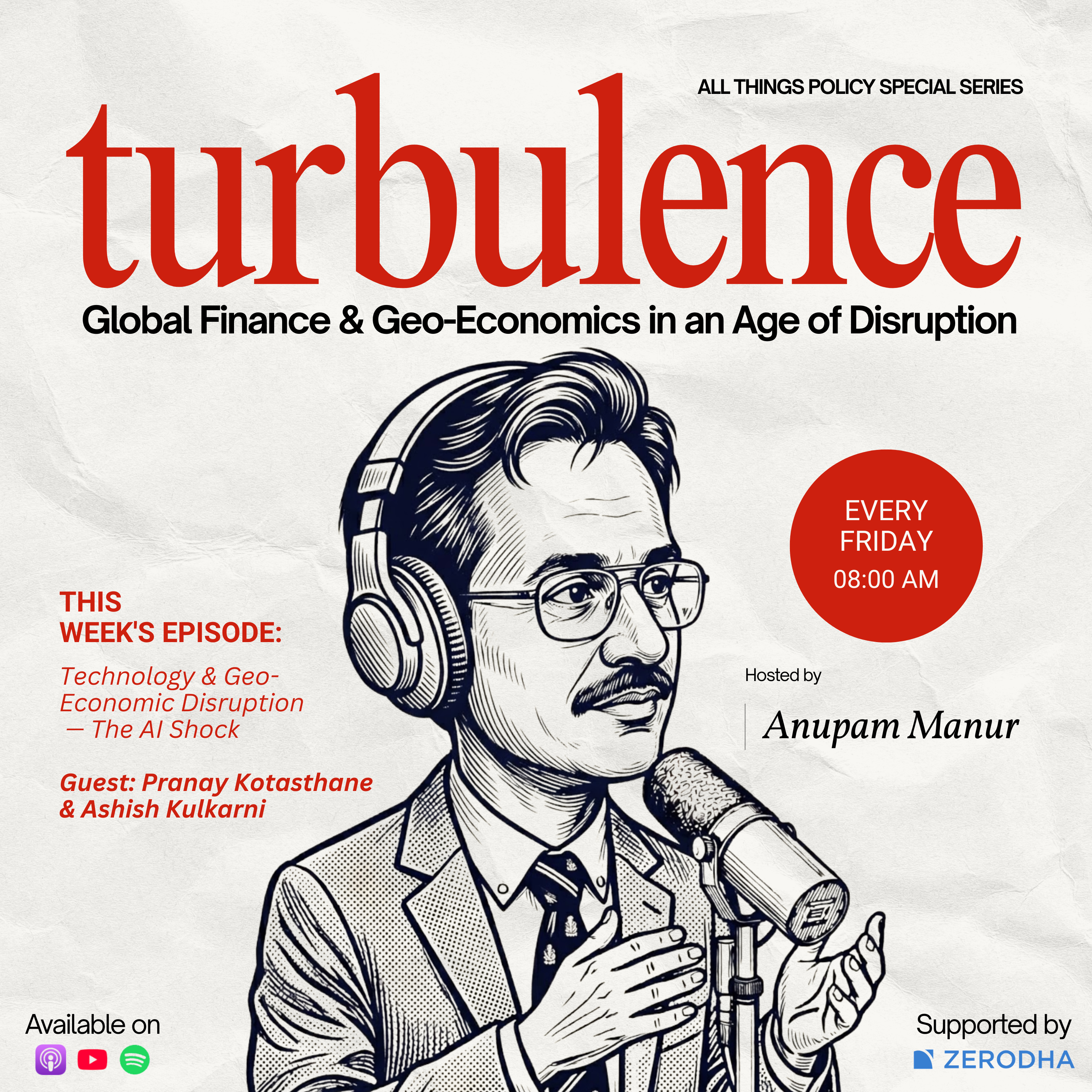
Technology & Geo-Economic Disruption — The AI Shock
2w ago01:26:59Tap to summarizeArtificial intelligence is being sold as the biggest economic shock in a generation, a productivity revolution that will decide which countries grow rich and which fall behind. The machinery of it has already become a contest of power: chips have become chokepoints, compute is rationed by export controls, and the routine coding and back-office work that lifted millions across the developing world is squarely in the crosshairs. In this episode of Turbulence, Anupam Manur is joined by two guides to the two halves of the story. Pranay Kotasthane maps the geopolitics of AI, including the chips, the compute, and the contest for power. Economist Ashish Kulkarni brings in the economics and answers whether the productivity boom is real or overhyped, and who actually captures the gains. Together, they work through the question that matters most for India: does AI offer the developing world a shortcut up the ladder, or kick it away? Also, whether export controls actually work, and whether India should build its own "sovereign AI" or simply buy it in.All Things Policy is a daily podcast on public policy brought to you by the Takshashila Institution, Bengaluru.Find out more on our research and other work here: https://takshashila.org.in/research-areasCheck out our public policy courses here: https://school.takshashila.org.in
Transcribe →
Whose Forest Is It Anyway?
2w ago00:41:37Tap to summarizeThe science of population biology and the coexistence debate with predators, how protected areas actually get expanded and monitored on the ground, and whose voices are heard in that process. This episode walks us through the science, the governance mechanics, and the on-the-ground reality of making any of this actually work.All Things Policy is a daily podcast on public policy brought to you by the Takshashila Institution, Bengaluru.Find out more on our research and other work here: https://takshashila.org.in/research-areasCheck out our public policy courses here: https://school.takshashila.org.in
Transcribe →
The Hidden Government Debt
2w ago00:29:42Tap to summarizeGovernments can make debt less visible, but they can't make it disappear. In this episode of All Things Policy, Kripa Koshy speaks with Sarthak Pradhan about off-budget borrowing - the incentives that drive it, its implications for public finances and democratic accountability. Drawing on examples from across India, they explore why these liabilities matter and discuss reforms that could bring hidden liabilities back into the public eye.Read more: https://fincomindia.nic.in/asset/doc/commission-reports/16th-FC/studies/commission/A%20Study%20of%20Off-Budget%20Borrowings%20in%20India%20by%20WB.pdfAll Things Policy is a daily podcast on public policy brought to you by the Takshashila Institution, Bengaluru.Find out more on our research and other work here: https://takshashila.org.in/research-areasCheck out our public policy courses here: https://school.takshashila.org.in
Transcribe →
India-UK Trade Deal
2w ago00:22:57Tap to summarizeIndia and the UK have signed a landmark trade agreement—but what does it really mean? In this episode, Anisree Suresh and Suman Joshi discuss the contours of the recently signed India-UK CETA. In addition to unpacking the key provisions of the India–UK CETA, who stands to gain, what was left out, we also try to understand the changing nature of FTAs and why issues like carbon border taxes and industrial policy may matter as much as tariff cuts.All Things Policy is a daily podcast on public policy brought to you by the Takshashila Institution, Bengaluru.Find out more on our research and other work here: https://takshashila.org.in/research-areasCheck out our public policy courses here: https://school.takshashila.org.in
Transcribe →
The New Phase of Conflict in West Asia
2w ago00:33:06Tap to summarizeIn this episode of All Things Policy, Aishwaria Sonavane speaks with Raja Karthikeya about the second phase of the US–Iran military conflict and its wider implications. The conversation examines India’s role, the opening of a new front involving the Houthis and Saudi Arabia, and the future of the US military presence in the Gulf.All Things Policy is a daily podcast on public policy brought to you by the Takshashila Institution, Bengaluru.Find out more on our research and other work here: https://takshashila.org.in/research-areasCheck out our public policy courses here: https://school.takshashila.org.in
Transcribe →