← American Scandal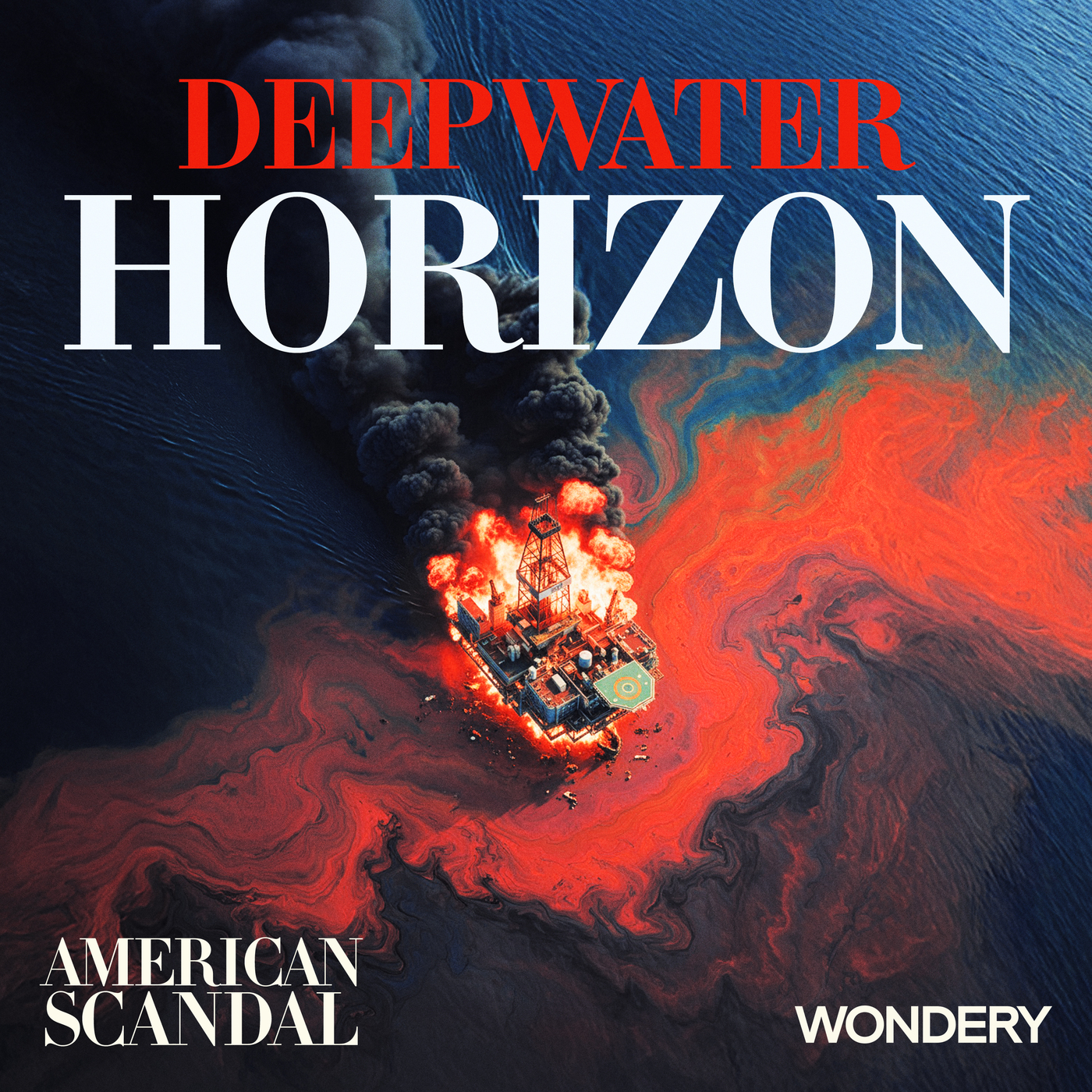
Loading summary
Transcript42 lines
- [00:01]
A
Want to get more from American Scandal? Subscribe to Wondery for early access to new episodes, ad free listening and exclusive content you can't find anywhere else. Join Wondery in the Wondery app or on Apple Podcasts. From wondery. Hi, I'm lindsey graham, and this is american scandal. In April of 2010, an explosion ripped through the Deepwater Horizon drilling rig in the Gulf of Mexico. Eleven workers were killed, and over the next 87 days, more than 100 million gallons of oil poured into the sea. The scale of the disaster was staggering. Millions of marine animals died, fishermen lost their livelihoods, and coastal communities struggled with the fallout. But given British Petroleum's history of cost cutting and deflecting blame, the disaster was predictable, perhaps even inevitable. Yet its executives emerged largely unscathed. Today, offshore drilling continues and oil companies remain enormously profitable. And all around the world, stories of corruption, coverups and violence continue to unfold on the front lines of the climate crisis. My guest today is Zach Goldbaum. He's the host of a new Wondery podcast, Lawless Planet. This show investigates crimes against our environment, from the BP oil spill to renewable energy fraud to activists murdered for protesting development. Our conversation is next. American Scandal is sponsored by AT&T. It's quite a relief in knowing things are handled. You know, like when a neighbor brings in your mail before it rains or a friend grabs your coat from the chair you left it on. Staying Connected matters. And that's why AT and T has connectivity you can depend on, or they'll proactively make it right. That's the AT&T guarantee. AT&T connecting changes everything. Terms and conditions apply, so Visit@&T.com guarantee for details.
- [02:24]
B
The WNBA playoffs are in full swing, and Tommy Alters the young man in the three brings you closer to the game. Get complete WNBA playoff coverage as Tommy sits down with the game's biggest stars and delivers unmatched analysis. The Young Men in the 3's WNBA playoff coverage is presented by Quest Nutrition. From irresistibly crunchy protein chips to rich chocolatey protein bars, these treats make giving in feel so good. Quest Big on protein, Low on sugar, Huge on flavor. Shop Quest on Amazon@Amazon.com quest nutrition and enjoy all the WNBA action on the young men and the three wherever you get your podcasts.
- [03:14]
A
Zach Goldbaum welcome to American Scandal.
- [03:17]
B
Thank you so much for having me. I'm such a fan of the show. I'm so happy my first appearance as a guest is not because I was involved in some sort of awful scandal.
- [03:25]
A
Well, aren't you involved in some sort of awful scandal. You are reporting on your podcast, Lawless Planet, perhaps the biggest scandals of them all. And you've done something interesting by framing these environmental crimes as true crime. Talk about your initial concept for this show. How did you come up with it?
- [03:43]
B
Yeah, that's right. We sort of use true crime as a Trojan horse to talk about big environmental and climate issues. But I come from the doc world and the TV world, and I'm a journalist as well. But I was working on a doc series for Comedy Central, of all places, and I was doing an episode about environmental activism. And we had gone down to Louisiana to this place called the Atchafalaya Basin, where kind of the tail end of the Dakota Access Pipeline was being built. It was something called the Bayou Bridge Pipeline. And I met this incredible activist named Sheree Foigland. And she actually, actually connects back to the Deepwater story. Her husband at the time was an oil rig worker, and Deepwater was what drove her to become an activist. And so Cherie was leading this group of protesters who were fighting the construction of this pipeline in the swamps of Louisiana. They were chaining themselves to pipeline infrastructure. They were putting their bodies on the line. Some of them called themselves kayaktivists because they would kayak out into the swamp in the middle of the night to prevent construction of the pipeline. Other ones I spoke to called themselves pipeline jumpers. They were moving from pipeline to pipeline to try to stop the construction of new fossil fuel infrastructure. And I kind of came up with the show because I thought we were on the cusp of seeing a resurgence of that sort of activism, that sort of direct action, sabotage. That, at its heart, was still. The story I wanted to tell was the sort of human story of the climate crisis. The climate crisis is really abstract. So I think people have a really difficult time kind of wrapping their head around it. And I think the best way for people to connect with it is by the crisis, having a human face. So understanding who the victims are, understanding who's fighting back, and really trying to connect with the human story at the center of the crisis.
- [05:29]
A
But you have a bit of a problem here. If the victims can be identified as individuals, oftentimes the villains are very much not individuals.
- [05:38]
B
That's true. I mean, I think that we have a really hard time as a society looking at corporate crime as crime at all. And I think oftentimes when we look at victims, like you said, they're individual people. And when we look at the villains in the story, they're large companies. And I think that's a failure of some of the storytelling around the climate crisis. For example, in the Deepwater story that we're talking about today, I went to look back at some of the early news articles about the spill, and people would call it the Gulf oil spill. We wouldn't be naming the perpetrator, we wouldn't be naming bp. Obviously, at Tony Hayward, the CEO started to come to the fore in the storytelling and the reporting. But we often describe these events as accidents and not choices made by people. And I think it's a broader problem in our culture. It's not strictly a journalism or a media or storytelling problem. I mean, we have a really hard time seeing corporate crime or white collar crime as a crime. But white collar crime may be less visible, but that doesn't mean they don't cause harm. I mean, you look at the financial crisis, you know, not a single top Wall street executive went to jail, but those are the people that perpetrated that crime. And the same is true of environmental crime. So I think it's important to name the villains in the story and name the bad guys and put a face to them just as much as it is to put a face to the victims.
- [07:04]
A
So in a sense, you're trying to remind us that corporations are people.
- [07:07]
B
Now you've cornered me here, but they are, they are people. And I don't think that corporations should have, you know, legal personhood, but if they do, they should be held to the same standard that people are held to. And in the BP disaster, there were two mid level employees that ended up being prosecuted, but the people who were really at the heart of it were not. And so we should start looking at corporate crime and environmental crime as something that is carried out by people.
- [07:34]
A
So returning to the formation of your show, the Germ of the Idea, when you came up with the concept, were there certain stories that you had to tell you had in mind that you wanted to cover?
- [07:45]
B
Absolutely. I mean, I think because the story and the show rather was born out of this experience I had watching climate activism. A lot of the early stories that I wanted to tell were about activists. It has never been more dangerous to be an environmental activist in the world. And there were a lot of stories that I was really interested in telling in the Amazon in Brazil, where activists were being killed. One of our first stories was the murder of Chico Mendez, who was a rubber tapper in the Amazon, who was killed by ranchers. And that story has repeated itself so many times since that happened in 1988. I mean, most recently, Dom Phillips and Bruno Pereira were killed in the Amazon. And so those stories are really interesting to me. And also stories about the limits of activism and the way we look at activism. So another story we told early on in the season was the story of these two young women, Jessica Reznicek and Ruby Montoya, who decided to sabotage pipeline infrastructure along the Dakota Access pipeline. And the lengths that both the government and the fossil fuel company Energy Transfer Partners went to investigate these two young women is really shocking. I mean, it reminds me of the green scare in the, in the 90s and 2000s where the FBI said that environmentalists are the biggest domestic terror threat in the United States. And this was happening right before 9 11, by the way. So it shows you where the focus was. But these two young women, they, they were sabotaging pipeline infrastructure. No one was injured, no one was hurt. They did, I think, set fire to a digger and use a blowtorch on the pipeline itself. The company hired this organization, this security firm, TigerSwan, and they used post 911 counterterrorism tactics to surveil and monitor these young women and the people that they worked with. And ultimately they were treated like terrorists. They got terrorism charges when they were ultimately sentenced. And there's a larger conversation that can be had about the efficacy of what they did and whether it was right or wrong. But the way that they were treated and the way that climate protest is being criminalized and penalized was a real early interest in the show. And I thought that sort of nexus of, you know, activism and crime was really interesting and something that we really wanted to explore early on.
- [09:58]
A
It seems like we're setting up a bit of a dichotomy in the way that different ecological criminals are being treated or viewed by the law. On one hand we have these pipeline activists who are pursued as if they were nine bombers. Right. But on the other hand, we have the corporate executives that seem to get off without even the slightest slap on the hand. How have you investigated this divide?
- [10:24]
B
Well, you know, it's funny. People love to talk about, you know, trickle down economics. Like the money's gonna, you know, go from the top to the bottom. But when it comes to crime prevention, it's like, ah, it'll trickle up. Like at some point, if we get these people down here, at some point corporate executives will start doing the right thing. And that obviously never happens. But how we've investigated it is, you know, in each of these episodes we try to name names and we try to really get into the details of what these people did and draw a real line between their actions and the crimes that we're talking about. And so what I mean by that is like, I think oftentimes we tell these stories. Like, again, it's. It's about how we cover these stories in the press. Oftentimes it's like East Palestine, the train derailment just happened. It was a. It was a tragic accident. The destruction of the rainforest has just been happening at pace, and it's just something that happens. But the truth is they are choices made by people. And I think in each of our stories, we really try to, you know, draw that clear connection between the actions of executives and the managers of these projects and the victims. And so, you know, sometimes that comes across super clearly. Like we tell a story about a woman, Berta Casseros, who's a Honduran environmental defense, who was killed essentially on orders of the project she was protesting, which was a hydroelectric dam in Honduras on the Guelkarque River. And through investigations, it became clear that that crime was ordered by the top executives from the company building the dam. And then other times, like in the case of BP and the lead up to the Deepwater Horizon, you have to start looking into the history and really realizing, well, these steps are how we got here. And each of these smaller incidents that led to this larger devastating incident, it starts to paint a picture of a crime. And it's like any crime storytelling. You want to start kind of tracing those clues and acting like a little bit of a detective.
- [12:26]
A
Now, it's likely not surprising to anyone that the oil industry shows up again and again in your series, but I'd like to hear from you. What is it about the petrochemical industry in particular that makes them such a perpetrator?
- [12:39]
B
There's this Steve Cole book called Private Empires, and I think that phrase really just epitomizes and embodies what the problem is. I mean, oil companies and fossil fuel giants are so powerful that they've been given free rein to do whatever they want. I mean, in the second quarter of 2022, Saudi Aramco made $48 billion, which is supposedly the largest quarterly profit ever posted by a company in. In global financial history. If you just think about what power that gives a fossil fuel company, it makes sense that they would then skirt rules and regulations and think that they can do whatever they want. And what that has ended up meaning is that fossil fuel companies, there are instances where they're essentially authoring legislation that impacts what they do. You know, it's a feast or famine industry, so it attracts gamblers and risk is rewarded and mistakes get a slap on the wrist. We told a story about Shell in Nigeria. They worked so closely with the authoritarian regime there that they were essentially calling the shots. And what that ended up leading to was nine activists. The Ogoni nine were executed in the early 90s for essentially for standing up to Shell, but they were framed for a murder that they didn't commit. It's that sort of power. When you become a private empire, you are given free reign to commit crimes. When there is no individual accountability and when the punishment is essentially a write off, there's really no reason for these fossil fuel giants to not engage in lawlessness and lawless behavior. But as long as we're empowering them to continue to act like this, these crimes will continue to happen.
- [14:33]
A
American scandal is supported by AT and T. There's a certain comfort in knowing someone's looking out for you before you even need it. A roommate who remembers to lock the door. A friend who shows up unasked with dinner when you're swamped. It's rare. But when it happens, you remember. Because staying connected matters. And that's why in the rare event of a network outage, AT and T will proactively credit you for a full day of service. That's the AT and T guarantee. So before today's over, take a second and reach out to someone. Those small check ins, they're the moments that matter. AT and T Connecting changes everything. Credit for fiber downtime lasting 20 minutes or more or for wireless downtime lasting 60 minutes or more caused by a single incident impacting 10 or more towers must be connected to impacted tower at onset of outage. Restrictions and exclusions apply, so see@&t.com guarantee for full details.
- [15:23]
B
Why choose a Sleep number Smart Bed.
- [15:25]
A
Can I make my sight softer?
- [15:26]
B
Can I make my site firmer? Can we sleep cooler? Sleep number does that cools up to eight times faster and lets you choose your ideal comfort on either side. Your Sleep Number setting. Enjoy personalized comfort for better sleep night after night. It's our Black Friday sale. Recharge this season with a bundle of cozy soothing comfort. Now only $17.99 for our C2 mattress and base plus free premium delivery price is higher in Alaska and Hawaii. Check it out at a Sleep number store or sleepnumber.com today.
- [16:00]
A
Now your show Lawless Planet recently came out with its own two part series on Deepwater Horizon and as we've explored it was a huge disaster. Most people have some Sort of memory of it. I certainly do. This daily race to try and seal the well. But once they did, it seemed like the event was over. And even in our series and our coverage, I personally felt that there need to be more telling of the story, but there just wasn't. Do you feel like it's something we fully reckoned with?
- [16:29]
B
I don't. I had the same experience with Deepwater and the BP spill that, that you're describing, where it became more than an environmental disaster, it became a cultural moment. I mean, I remember the spill cam, you know, it was in the bottom corner of every TV screen and this just gusher of oil for days on end. I remember, you know, the late night jokes and the constant coverage and just the devastating after. And at some point we just were like, case closed. And obviously for the people in the Gulf, that wasn't true. And the people closest to the story, that wasn't true. But what we wanted to do in our story and in covering it, we wanted to both tell the story of the disaster, but we also wanted to look at the lead up to it. And in doing so, we realized how inevitable this seemed in retrospect. But in terms, to answer your question, in terms of like, have we reckoned with it, I think the answer is no. Because a lot of the same behaviors that BP was exhibiting in the lead up to the disaster are happening right now. And not to spook you, but just to give you a couple examples, just in 2018, BP, you know, or it was rather a BP subsidiary was dumping illegal toxic waste in Patagonia. And BP also dumped, you know, illegal industrial waste into protected areas north of Scotland. Before the Deepwater disaster, BP was cutting costs and laying off workers. And right now BP is in the midst of a massive cost cutting operation. They're laying off thousands. I think they're trying to do 15% of their workforce by the end of the year and they're looking for other ways to trim the fat. And the lead up to the BP disaster was part of a trend within BP to drill in riskier and riskier places to go for oil where people hadn't tapped before. And right now, BP is again currently asking the federal government to approve a new rig in the Gulf of Mexico, which would be its first in the Gulf since Deepwater. So I think that another disaster is inevitable unless we curb that sort of behavior.
- [18:25]
A
One person you talked to for your series was Scott west, an EPA investigator and he called BP a serial environmental criminal. Tell us about Scott and whether his assessment you think is Correct.
- [18:37]
B
Yeah. Scott is. Scott's an amazing character. So to pull back for a moment, the EPA has this Criminal Investigation Division. They're like eco cops. They carry a badge and a gun, and because the EP's logo is a flower, the former director of the CID, the Criminal Investigation Division, we interviewed him for another episode, and he said they like to call themselves the power behind the flower. So you've got these, like, you know, gruff cops who also really love the environment. Scott just embodies that mission. He was the special agent in charge of the EPA Criminal Investigation Division in Seattle. And what he ultimately uncovers is a lot of risky behavior. A lot of whistleblowers were coming forward and telling him that there was going to be a problem at BP's operations in Alaska, in the North Slope, which is basically the northernmost point of Alaska. And at the time, they were led by a man named John Brown, otherwise known as Lord John Brown of Mattingly. But he's a really interesting character. He's not like the swaggering Texas oil man that you kind of think of. Brown's not a climate denier, which I think is also really interesting. Even back then, he was publicly recognizing the link between the oil industry and climate change in the early aughts, and he caught a lot of flack for it. And he oversaw this total rebrand of the company. They're no longer called British Petroleum under his watch. They're now called Beyond Petroleum. So they're like, we're an energy company. We're moving past oil. But the truth was, it was all kind of a mask for what they were really doing, which was looking for more oil in riskier places, including in Alaska's North Slope. And they even were lobbying to drill in this beautiful untapped wilderness of the Alaska National Wildlife Refuge. They didn't end up drilling there, but they were lobbying to do so. And these are places with caribou and polar bears and all manner of birds and. And some of the last great, untouched frontiers in America. And as Scott west starts looking into their operations in Alaska and whistleblowers start coming forward, he starts hearing that their operations are a mess, that there's no maintenance, that the pipeline is in disrepair, and basically getting the sense that a disaster was inevitable. And it started to confirm some of Scott West's worst fears about the company.
- [20:45]
A
I'd love to know what perhaps some of the more egregious things Scott uncovered as part of his investigation were what stuck out to you.
- [20:53]
B
Sure. I mean, there's a process for cleaning these Pipelines and for maintaining these pipelines called pigging. It's like pipeline integrity gauge, I think is what it's called. And that's supposed to happen every couple of years. And BP had basically never done it. Maybe they did it 14 years earlier in Alaska. And there was one anecdote that Wes told us that workers were told not to have keys, their pants, because if a piece of metal bumped the pipeline, it could rupture the pipe. It was that fragile. The pipe was that fragile. So people were coming forward and telling him that something really bad was happening. And as Scott west is looking into BP's behavior in the North Slope of Alaska, a different disaster happened in Texas City, Texas, where BP operated an oil refinery. And so what was uncovered in that investigation was that as early as 2002, three years earlier, the plant was known to be in disrepair. There had been a report commissioned, an internal study that suggested there were serious issues and that a major incident was essentially imminent. The plant needed urgent repairs, but BP was much more concerned with the plant's profitability. And so in March 2005, the inevitable ended up happening. This piece of aging equipment, which is called a blowdown drum, which is sort of like, it's basically a big cistern that catches gas and other debris from the for refining process. It wasn't working. And so instead of catching that gas, the gas is just seeping into the air, unbeknownst to all the workers at the refinery. And so March 23, 2005, this blowdown drum is failing, and nobody at the refinery knows. And all it takes is a worker to start a truck nearby that backfires and the entire refinery just explodes. And it's devastating. I mean, the whole town shakes. It's like an earthquake. And 15 people at the plant are killed. And those weren't the first deaths that took place at that refinery in Texas City. In the decade before the disaster, BP had reported more fatalities nationwide than any other US Refining company. You know, I think there were seven additional workers that died at BP refineries. Four in Texas City. There was an electrocution. Someone was crushed by a backhoe. Someone was hit by a train. You know, it's staggering. I mean, the death toll at this plant alone should have sent multiple executives to prison, in my opinion. But that's of course not what happens. And so these things are just adding up. And Scott is watching this happen as he investigates what's happening in Alaska. And so in 2006, a year after the Texas refinery fire, Scott's worst fears about what would happen in Alaska are realized. So there's a huge oil spill, but because the ground up there is frozen solid, the oil, it's just not as much of a crisis as the BP deepwater spill in the Gulf, but it's still pretty damaging. And Now Scott in 2006 has kind of all the information he needs to pursue BP criminally. And unfortunately, that's not what happens.
- [23:58]
A
He said to you, talking about his investigation of bp, that if I'd been allowed to pursue the case without interference, nobody would know the name Deepwater Horizon today. What was the interference?
- [24:10]
B
At the time, BP was charged with four criminal complaints. So they were pursuing felonies in Texas City. There was a misdemeanor Clean Water act in Alaska because the oil from that Alaska pipeline rupture had seeped into a lake. There's the illegal dumping charge that was from the 90s. And then there was an entire propane price fixing scandal that I won't even get into. So they're facing a series of pretty serious charges. And this is more than any other oil company at the time. And Scott is committed to assigning personal blame. And it's a little unclear about what happens next, but Scott is called to Alaska and essentially told by his superiors that they're going to settle with BP for all of these things. And so instead of there being any individual accountability, BP is basically able to pay these things out, which is exactly what they want. They were very pleased with this outcome. They wanted this case to be closed quickly. I think this was. The timing was extremely suspicious. It was right before some quarterly earnings report, so they could say, like, look, all this stuff is behind us and we're turning a new leaf. And why it happened is still a little unclear. You know, Scott claims that the order came from on high, that a deputy attorney general in Bush's DOJ wanted this case closed. And to me, that's not out of the realm of possibility. It's a very oil and gas friendly administration. It was also very possible that the EPA simply did not want to expend the resources fighting these cases for years and years, you know, sifting through 62 million pages of documents. And so ultimately there was pressure to end it. I think there's also kind of a bigger part of the story. And just like the way we don't really want to, we don't want to piss off oil companies, you know. So after the Alaska spill happened, BP was forced to shut down, like, half of their North Slope operations. Right. So they have to inspect and replace this long stretch of pipeline. That decision was costing the state of Alaska $3 million a day. So lawmakers also didn't like that the pipeline was shut down. And granted that there wasn't a direct one to one with the investigation, but, but there is this kind of larger ecosystem where the, you know, the government wants to see these operations continue and the government doesn't want to be be seen as getting in the way of private enterprise. So ultimately the case is shut down and BP pleads out to these charges and they settle. And Scott, his belief that the Deepwater Horizon disaster would not have happened had this case not been shut down is based on the fact that he thinks that individual accountability could have a chilling effect. You know, if a CEO knows that someone could come for their neck and that may make them rethink some of the decision making.
- [26:55]
A
Well, speaking about individual accountability or just accountability in general, let's turn our attention to the culpability of the government. Not only is the Department of Justice closing a case that perhaps they should have pursued, but the industry is supposedly a regulated one.
- [27:11]
B
Right? I mean, this is the thing, you know, there's a real cozy relationship between fossil fuel companies and the government. And these oil companies, truthfully, are the backbone of the economy. They provide energy. Energy. They fuel our military. The number one institutional emitter of greenhouse gases and the number one user of oil and petroleum products is the US Military. And so the government sees these oil companies as a critical part of our national security, as a critical part of our economy. And so there simply isn't the pressure to do more. I mean, the government gives out drilling licenses. It is up to the government to decide whether or not these companies have permission to drill, where they drill, and they more often than not get permission. And so we have a real responsibility if we want to curb emissions, if we want to meet any reasonable climate goal that would prevent catastrophic warming that we're already barreling towards. We can't have any new fossil fuel infrastructure. And yet the government continues to do it, and governments around the world continue to allow for massive fossil fuel projects. And so, yeah, I think a lot of blame is owed to the government for encouraging the type of behavior that we see in bp. And had Scott been able to pursue this case without the government that he worked for getting involved and preventing him from pursuing it, we might have had a very different outcome. In the Gulf.
- [28:44]
A
American scandal is sponsored by AT&T. There's a special kind of calm when, you know, things are taken care of, like when the trash bins are already at the curb before you remember it's pickup day. Or when a friend texts to say they've picked up your kid from practice because they know you're stuck in traffic. They're all little things, but they take a load off. Staying connected matters. And that's why, in the rare event of a network outage, AT and T will proactively credit you for a full day of Service. That's the AT&T guarantee. Because connection isn't just about big life events. It's hearing your best friends laugh on a random Tuesday. It's sending a thinking of you text and knowing it'll actually send. It's those quick in between moments that end up meaning the most AT and T connecting changes everything. Credit for fiber downtime lasting 20 minutes or more or for wireless downtime lasting 60 minutes or more caused by a single incident impacting 10 or more towers must be connected to impacted tower at onset of outage. Restrictions and exclusions apply, so see@&t.com guarantee for full details.
- [29:44]
B
This message comes from Capital One. The Capital One venturex business card has no preset spending limit, so the card's purchasing power can adapt to meet business needs. Plus, the card earns unlimited double miles on every purchase, so the more a business spends, the more miles earned. And when traveling, the VentureX business card grants access to over a thousand airport lounges. The venturex Business Card what's in your wallet? Terms and conditions apply. Find out more@capital1.com venturexbusiness.
- [30:21]
A
Given that your show makes the case that environmental destruction should be treated like a crime, I'm curious, if Deepwater Horizon were prosecuted that way, what charges would you bring and who would be on trial?
- [30:34]
B
Yeah, look, I'm not a lawyer, but I think ultimately executives like Tony Hayward and even John Brown should have stood trial for some of these incidents. John Brown was deposed in the aftermath of the Texas City disaster and you know, 15 people lost their lives and nothing happened to him. And he oversaw a 25% cost cutting campaign within BP and that is what directly led to that disaster. And so I think charges have to be brought against the people that make those decisions. You know, the buck should stop with the leaders of these companies. It shouldn't have just been a financial settlement. Tony Hayward came in. Tony Hayward was the CEO during the Deepwater Horizon disaster. And Tony Hayward was brought in to fix a lot of these problems. And ultimately what he did was a cosmetic fix and the cost cutting and risky behavior continued. There has to be a cost imposed on the people that are at the helm of these companies. And unless that happens, these sorts of disasters will continue to happen and the costs will be imposed on us.
- [31:42]
A
We've been focusing on the oil industry and BP in particular, for obvious reasons. But I want to remind everyone that renewable energy and related industries have their own problems too. And you've been covering some of it.
- [31:54]
B
Yeah. Like, to be clear, if we have any chance to avoid the worst effects of catastrophic climate change, we have no choice but to transition to renewable energy. That is, it has to be done. There cannot be any new fossil fuel extraction. But the truth is that renewable energy depends on electrification, which depends on mining, things like lithium and cobalt. That's not good for the natural world, that's not good for natural resources. And so some of the stories that we've looked at are about renewable energy as well and some of the pitfalls of the clean energy transition because it has to happen. And so we have to talk about how to do it right. And so, you know, we're working on a story now about cobalt extraction in the Congo. Cobalt, which is critically important to the clean energy transition, has allowed companies like Microsoft and Apple to become some of the world's most valuable companies. Companies, some of the most valuable companies in human history. And those companies are built on the backs of some of the worst labor practices happening in modern times. I mean, people are mining cobalt in the Congo under terrible circumstances. And so if we're not also addressing the system of extraction and the system that has built this fossil fuel economy, and if we're just sort of moving the same exact system from the fossil fuel economy over to the green economy, we're going to run into a lot of the same problems. Now, they're not going to be as devastating for the atmosphere. They're not going to warm the planet at the same pace, but they will poison rivers, they will kill the people who are forced to mine these minerals. They will destroy ecosystems. I mean, just recently, Trump approved a 211 mile Ambler road project through Gates of the Arctic National Park, I think is what it's called. And that's to win this AI arms race. And so we have to think about a better system. But ultimately we have. I don't see any other choice but to make that transition.
- [33:51]
A
I'm wondering, finally, how has working on Lawless Planet impacted the way you view climate change and our ability to fight it?
- [33:58]
B
I think I'm less pessimistic than I was. I'm not in the streets in the way these activists are in the streets. And I'm not putting my body on the line of the way they are. And the people that have the most to lose and the people that have invested the most in this fight seem to me to be surprisingly the most optimistic. I think the climate movement at large has been unsuccessful. I mean, we are where we're at. I think a lot of people in the movement would not disagree with that notion. And yet a lot of those people keep at it and they are continuing to find new ways to fight a problem that we have no choice but to fight. And so I think I came into this show feeling really pessimistic and really hopeless. Every time I talk to people who have spent their lives in this fight, who have endured a lot and who have sacrificed a lot, who have had a really, you know, the toll has been high for these people. They still find reasons to be hopeful. And I think that's really, really encouraging. And so I think as bleak as things may seem, sometimes I think that's worth remembering.
- [35:04]
A
Well, Zach, congratulations on the show and thank you so much for talking with me on American Scandal.
- [35:09]
B
Thank you so much for having me.
- [35:11]
A
That was my conversation with journalist and producer Zach Goldbaum. His new podcast Lawless Planet, including a two part series about Deepwater Horizon is out. Now. From wondering. This is the fifth and final episode of our series on the Deep Water Horizon Horizon for American Scandal. In our next series, in 1993, three eight year old boys were brutally murdered in the Arkansas town of West Memphis. As the local police struggled to solve the crime, rumors spread that the killings were the work of a satanic cult. Suspicion landed on three local teenagers. There was no real evidence linking them to the murders, but that would not protect them. Railroaded by the police and condemned by the public before they even set foot in a cross courtroom, the West Memphis three would face a decades long fight to prove their innocence and win their freedom. If you're enjoying American Scandal, you can unlock exclusive seasons on Wondery Binge new season first and listen completely ad free when you join Wondery in the Wondery app, Apple podcasts or Spotify. And before you go, tell us about yourself by filling out a survey@wondry.com survey. American Scandal is hosted, edited and executive produced by me, Lindsey Graham for Airship. Audio editing and sound design by Gabriel Gould. Music by Thrum this episode was produced by John Reed Managing producer Emily Burke development by Stephanie Jens senior producer Andy Beckerman. Executive producers are William Simpson for Airship and Jenny Lauer Beckman and Marshall Louie for Wondery.
- [36:53]
C
I'm Raza Jafre and In the latest season of the Spy who, we open the file on Morton Storm, the spy who lived inside Al Qaeda. Unfulfilled with his life in a notorious Danish biker gang, Morton Storm is lost. One afternoon he stumbles into a library looking for answers. He finds them in the form of a book about Islam. The towering ginger haired Dane doesn't know it yet, but that moment will hurl him into a world of radicalism and see him rise through the ranks of militant Islamist organization Al Qaeda, only to suffer a huge crisis of faith. He turns from devotee to spy tasked with rooting out some of Al Qaeda's most feared generals. The CIA and MI5 bid for his allegiance as he loses himself in a life of cash laden suitcases, double crosses and betrayal. Follow the Spy who on the Wondery app or wherever you listen to podcasts or you can binge the full season of the Spy who Lived Inside Al Qaeda early and ad free with Wondery plus.