← American Scandal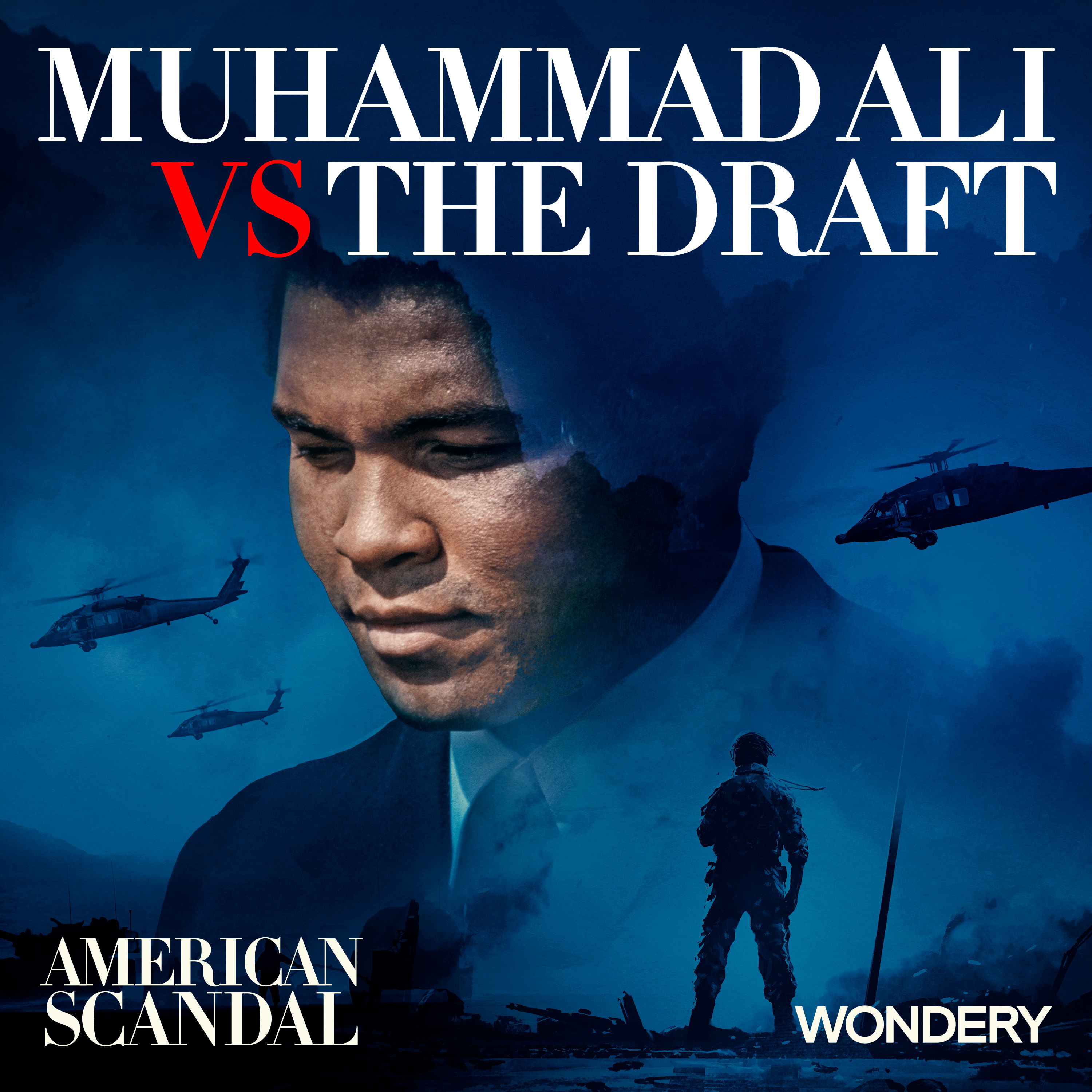
Loading summary
Transcript55 lines
- [00:00]
Lindsey Graham
Hi, this is Lindsey Graham, host of American Scandal. Our back catalog has moved behind a paywall. Recent episodes remain free, but older ones will require a Wondery plus subscription. With Wondery, you get access to the full American Scandal archive ad free, plus early access to new seasons and more. Join Wondery plus in the Wondery app or on Apple Podcasts.
- [00:26]
Howard Bryant
Foreign.
- [00:33]
Lindsey Graham
I'm Lindsey Graham and this is American Scandal. Muhammad Ali was not the first black athlete to risk his career, reputation and even his freedom to advance a cause he believed in. He stood on the shoulders of men like Jackie Robinson, who broke the color line as the first African American to play Major League Baseball, and Paul Robeson, who was most famous as a singer and actor but also played pro football before Ali. They used their fame to fight against the pervasive racism around them, and like Ali, they paid a price. Being a social activist and a famous sports figure is a risk, especially for black athletes. While some people celebrate sports figures who take political stands, others criticize them as ungrateful or unpatriotic. In recent years, we've seen these divisions play out over athletes who have taken a knee during the national anthem. Supporting the Black Lives Matter movement. Journalist Howard Bryant explores the history of this intersection between sports and black activism, including in his 2018 book the Black A Divided America and the Politics of Patriotism. Bryant is a senior writer for ESPN and head of Unscripted Development for Meadowlark Media. Our conversation is next. American Scandal is sponsored by Focus Features. Newest film Black Bag Starring Cate Blanchett, Michael Fassbender and directed by Steven Soderbergh, the director of Ocean's Eleven, Traffic and Magic, this electrifying movie brings together two legendary spies joined in a marriage of love and deception. When one suspects the other of betrayal not only of their country, but of their marriage, everything is threatened and thousands of lives will depend on the outcome. But who is the traitor? What is the truth? And who will survive? The answers will put loyalty to the ultimate test. Black Bag features an award winning cast including Cate Blanchett, Michael Fassbender, Reggae Jean Page, Marisa Abella, Naomi Harris, Tom Burke and Pierce Brosnan. Smart, sexy, surprising and seductive, Black Bag will keep you guessing until the very end. It's the most exciting film of the year. Black Bag Rated R under 17. Not admitted without parent or guardian. Only in theaters March 14 with special engagements in Dolby. American Scandal is sponsored by Squarespace, the all in one website platform for entrepreneurs who want to stand out and succeed online. But do you need a website? Of course you do I mean, if you own a business, have a hobby, write a book, blog, run an organization, create online, create irl, but show off your creations online. You need a website. In this day and age, your dog might need a website. So to help get you a website and a good one, Squarespace's new Design intelligence combines two decades of industry leading design expertise with cutting edge AI technology to unlock your strongest creative potential. Design Intelligence empowers you to build your own unique digital identity across your entire online presence. So no matter what you do on the web, write, create, sell, consult, coach, teach, you can do it better, faster and look more professional with Squarespace. Head to squarespace.com for a free trial. And when you're ready to Launch, go to squarespace.com scandal to save 10% off your first purchase of a website or domain. That's squarespace.com scandal to save 10% off your first purchase of a website or domain. Howard Bryant, welcome to American Scandal.
- [04:26]
Howard Bryant
It's good to be here. Thank you.
- [04:28]
Lindsey Graham
Our series focuses on Muhammad Ali, but as we mentioned in the introduction, he's part of a much bigger heritage, as you call it in your book. And this heritage started with earlier black athletes like Paul Robeson, who most people probably know as a singer and associate with the song Old Man River. But he was also a football player. Tell us about his athletic career.
- [04:49]
Howard Bryant
Well, Hol Robeson was one of the great athletes of the first part of the 20th century, in the same vein as Jim, Jim Thorpe, some of the great, great athletes to begin the century. He was a player in high school in Plainfield, New Jersey. He was a great football player, letterman, basketball, baseball, track. At Rutgers. He was part of the legendary Walter Camp, one of the godfathers of American football, his all America teams in 1917 and 1918. And he was a member of the new professional football league in 1920 that would soon be called the National Football League. Obviously, all of the things that Robeson did as an athlete began to become obscured when he showed even more talent on the Broadway stage and on the concert stage as a singer, actor, and then in Hollywood as well. Robeson played two years in the NFL and then chose to go on Broadway. But he was an athlete first. And it's just sort of fascinating when you think about somebody that had that much ability, sort of a true renaissance.
- [05:54]
Lindsey Graham
Man and a man of intense charisma. You'd have to be how did Paul Robeson use his celebrity for social justice? And I guess how did he get in trouble for doing so?
- [06:05]
Howard Bryant
The arc of Paul Robeson's career is very similar to the arc of a lot of black athletes in that he wasn't an activist at first. He was very much a believer in what we would call the American dream, very much a believer in being that representative of what possibilities could be if African Americans were given the chance to be part of the mainstream society. He was not a dissident as a player or even in the first several years on Broadway. He was a standard for progress. In fact, much of mainstream America, much like Jackie Robinson, would use him as proof that whatever racial dynamics existed in America, that opportunity still existed. It wasn't until the 1930s when he went to be on the stage in London, where his politics began to coalesce around social justice, around socialist policies. And that was where he began to get into trouble and then began to take a different look at America and began to realize that his position required of him a responsibility to uplift the races, he would say. And so by the mid to late 1930s, beginning of the 1940s, Robeson then began to recognize that his Hollywood roles that the industry was not willing to put him in, or any African American role in anything more than subservient positions. He began to recognize that he was much more of a social justice figure in terms of fighting against income inequality. All the things that we talk about now. In fact, Robeson, even in the 1930s and early 40s, would talk about the 1 percenters against the 99 percenters. So even that language dates back to him 100 years ago. Clearly, politically would refer to himself as a progressive New Dealer. And that would obviously put him in opposition to the anti New Dealers. And then, of course, as we get to the Cold War, people began to paint him in communist circles.
- [08:05]
Lindsey Graham
Yeah, let's talk about that era, because this is where he was probably most vociferously targeted. How did he get associated with communism in America?
- [08:15]
Howard Bryant
Well, I think it was his associations. It's hard to imagine today that there was ever in the United States a true opposition to capitalism. I think that Today, especially in 2025, I think there's been a complete surrender that this is our economic system, and there's no questioning that economic system. That was not the case in the 1920s and the 1930s. It's fascinating that there was, during Robeson's time, far more questioning of our economic systems. And so the time of the New Deal, the Great Depression, you take these economic forces and you combine them also with the Soviet Revolution in 1917. And so there is a feeling in the United States and around the world that workers rights were underrepresented and that Robeson found himself, as he would always say, on the side of the common man. That, of course, put him in opposition with the forces in the United States who were very much anti socialist, anti communist, very much anti New Deal.
- [09:20]
Lindsey Graham
And this period, it became very polarized in an almost cartoonish way. You are either pro American or you are against America. And Paul Robeson was forced to meet this opposition head on when he was called up to speak before the House UN American Activities Committee, or huac. At one point in his testimony, he's forced to defend his patriotism after mentioning that while in Russia, he felt no color prejudice like he felt in Mississippi. I was wondering if you could share the exchange that followed.
- [09:50]
Howard Bryant
It was Gordon Shearer, the committee chairman, who asked Robeson, why do you not stay in Russia? And he said, because my father was a slave and my people died to build this country, and I'm going to stay here and have a part of it just like you, and no fascist minded people will drive me from it. Is that clear?
- [10:09]
Lindsey Graham
So the passion there, his love of country, is clear. How did he perhaps reconcile his activism with his patriotism?
- [10:17]
Howard Bryant
There was no way to separate Robeson from the Cold War. I know we talk about the period of McCarthyism for Joseph McCarthy and for the Red Scare, but nobody paid a higher price for his activism, for his convictions, than Paul Robeson. You go back and think about what the Cold War was during those years, and you had the demand of loyalty oaths under the Truman administration. You had demands that the Attorney General had, lists of subversive organizations. And one of the things that Robeson saw far earlier than a lot of the black establishment that he clashed with was that in a lot of ways, the capitalistic system, in terms of raw dollars, in terms of who owned and who had opportunity to earn, was not going to work for black people. The gaps were simply too great.
- [11:06]
Lindsey Graham
Well, you talk about the costs of activism. In Paul Robeson's case, what was the result to his career?
- [11:12]
Howard Bryant
Well, Paul Robeson lost everything. He lost by refusing to sign the anti communist affidavit that he was asked to sign. Just prove to us that you're not a Communist. His response would always be that his politics were no one else's business. And in 1950, the United States Passport division revoked his passport, took away his opportunity to go abroad and earn a living, even though he was earning more than $100,000 a year traveling the world as a concert singer, as an actor, as a stage performer, and all of that was taken away. And he was not allowed to perform in the United States simply because he was associated with communism. And so he would be picketed whenever any sort of concert outlet would book him. He was radioactive inside the United States, was essentially under house arrest, was not allowed to travel abroad where people loved and respected him, around the globe. These convictions cost him everything. For eight years, he was not allowed to travel outside of the United States.
- [12:11]
Lindsey Graham
So Robeson might be characterized, I suppose, as an early standard bearer for what you call the heritage.
- [12:18]
Howard Bryant
Yeah, I think that one of the things that, when I think about this, when I think about what that term means and what it has always meant to me and why the book was titled that was this idea of a legacy of African American entertainers, athletes especially, who were using their positions to advocate for social justice, really not even social justice so much as for the rights of black people. And when you think about integration, you think about how the struggle for black rights, how it grew over the course of the 20th century. Integration did not take place through the doctors and the lawyers and politicians. It took place through athletes, and it took place through entertainment. You know, white America did not need Joe DiMaggio or Babe Ruth to speak for it, but black America looked to Jackie Robinson and Joe Louis and later Muhammad Ali and Bill Russell. And so, yes, Paul Robeson was certainly one of those major, major voices to speak on behalf of African Americans.
- [13:19]
Lindsey Graham
I'm glad you brought up baseball. That seems to be an early source of black activism. Why do you think that is?
- [13:26]
Howard Bryant
I think that the reason why baseball was so prominent in terms of the social movements was twofold. Number one, baseball was very quickly the first professional sport to really take hold in the United States. There were other professional sports. I mean, there was a time when cycling was more popular than baseball. There was a time when college football was more popular than baseball. But when you think about the modern 20th century, it's baseball. And as the national pastime, as it was called, as the appointment viewing, that was the World Series early on, it was the sport that really did carry the imagination of the country. And as a mirror image to that, you also had the Negro leagues, you had the black leagues as well, which were one of the major black businesses in the United States. And so baseball took on a place of importance that you wouldn't see in the other sports. And I think that, in addition, the way baseball looked physically was very jarring. It was very glaring because it was all white. It was clearly all white. And this is even when you have Jack Johnson as the heavyweight champion of the world, Baseball is still all white. Even when you have the 1936 Olympics with Jesse Owens and Jackie Robinson's brother, Mack Robinson, you have these great black athletes performing on behalf of the United States, you still look at the national pastime. In the national pastime, baseball has no black players. So baseball was symbolic. Baseball was the sport where you looked at it and you said, okay, well, if America belongs to everyone, why does this sport not have any black players? And so you have tons of opposition. As strategies are being mounted to take on Jim Crow and to take on segregation, Baseball was a main target.
- [15:08]
Lindsey Graham
Well, sticking with baseball, let's talk about Jackie Robinson and his activism. He at one point testified against Paul Robeson in front of the House UN American Activities Committee, but he was no less vociferous in his opinions.
- [15:21]
Howard Bryant
No, Jackie was very much like Robeson in that he was the type of person who believed in the American dream very much early on that, I'm an American and I am going to fight for it. As his wife, Rachel Robinson would always say when she would talk about him, she would say, well, that was Jack, my country, right or wrong. And in 1947, obviously, when Jackie Robinson comes in and integrates Major League Baseball, who better to represent progress in the United States or the potential of America than Jackie Robinson? And Robinson didn't really want to testify against Robeson, but he also did not feel like he had much of a say in the matter, considering that his boss with the Brooklyn Dodgers, Branch Rickey, asked him to do so. And so you had these two titans pitted against each other on Capitol Hill on July 18, 1949.
- [16:11]
Lindsey Graham
But even though they may have been artificial foils, Jackie Robinson was absolutely, well, almost militant in his activism. Certainly, he would cause controversy today because, for instance, he refused to stand for the national anthem.
- [16:25]
Howard Bryant
Well, by the end of his life, yes, but not when he was an active player. Jackie's disillusionment with the United States grew over time. All of the things that he fought for and all of the things that he sacrificed that the changes just weren't coming. So, yes, by the end of the 60s, he would say very clearly, not only did he not stand for the national anthem or did he not salute the flag, but he also gave an interview to the New York Times where he said, if I see car with an American flag bumper sticker on it, I'm assuming the guy behind the wheel is not my friend.
- [17:03]
Lindsey Graham
American scandal is sponsored by Noom, a leader in behavior change, weight loss. But now they Combine their proven weight loss program with affordable GLP1 medications so you can lose weight and keep it off. Because Noom doesn't just give you access to meds, it helps you build habits to keep the weight you lost lost. Noom's app features protein tracking so you can ensure you're getting the right nutrients, and fitness classes so you can keep muscle while losing fat. Noom GLP1 starts at $149 and is delivered to your door in seven days. So start your GLP1 journey today at Noom.com that's N-O-O-M.com Noom the Smart Way to Lose Weight not all customers will medically qualify for prescription medications. Compounded medications are not reviewed by the FDA for safety, efficacy or quality.
- [17:49]
Howard Bryant
Here's a tip for growing your business get the VentureX business card from Capital One and start earning unlimited double miles on every purchase. That's right, with unlimited double miles, the more your business spends, the more miles you earn. Plus, the venturex Business Card has no preset spending limit, so your purchasing power can adapt to meet your business needs. The VentureX business card also includes access to over a thousand airport lounges. Just imagine where the VentureX business card from Capital One can take your business Capital One. What's in your wallet? Terms and conditions apply. Find out more@capital1.com venturexbusiness.
- [18:37]
Lindsey Graham
Howard Bryant I'm wondering as a kid, which black athlete stood out to you as taking a stand for social causes? Who inspired you?
- [18:45]
Howard Bryant
One above everyone, it's Muhammad Ali. There's no question about that. He was the standard, he was our hero, he was the person that we all gravitated toward. And it's a good example as well of the power of boxing at that time and of course to the power of him as well. But certainly when as a young kid growing up in the 70s, and then of course then as a teenager in the 80s, it was Muhammad Ali and everybody else. But also as a Bostonian, there was Bill Russell and those two were friends. Those two together were the standards for what we felt an athlete's responsibility was to black people. And I think that what's really interesting about that when you go back and look at those years is it was so long ago and yet when you add up those two, you add up Robinson and Robeson and Joe Louis and you add them to the Bill Russells and the Muhammad Ali's. Even though their heydays were over a half century ago, that responsibility still lingers in today's athletes. Those players that came before. Their impact was so large that if you didn't follow them, people looked at you and wondered, why aren't you embracing this the way you're supposed to?
- [20:00]
Lindsey Graham
You consulted on and appeared in the PBS documentary series Muhammad Ali. Ali is, of course, remembered today as the greatest boxer of all time, but also a hero to many. He took on the establishment with a ferocity and style that is probably unmatched. But in his fight for civil rights, which was probably thrust upon him like many of these men, where do you think Ali looked for his inspiration? Where did he find the determination to do what he did?
- [20:28]
Howard Bryant
Well, I think it came from Malcolm X and it came from the Nation of Islam. It came from growing up in Louisville and realizing what is around you. He was a very aware man and very aware as a young man. It doesn't take much to look at your situation if you're paying even remote attention and feeling the need to change it. When you're black living in Kentucky, and when you're born in 1942, you've got segregation codified in the law. I mean, you still had de facto segregation in the north as well. But down there, it's literally against the law to sit where you wanted to sit or to sit in a restaurant or to be served or a drink out of a water fountain. So when I think about the Alis of the world, it feels more natural. It's not that he was doing something so remarkable. The only reason it was remarkable was because other people weren't doing it, even though the injustice was very clear.
- [21:19]
Lindsey Graham
Our series covers largely Ali's fight in the courts after his refusal to serve in the military and go to Vietnam. And we cover the harm it did to him and his family and his career. But he made a comeback, and it was in 1974 in Zaire that he fought the Rumble in the Jungle against George Foreman. I guess I'd like you to characterize this fight. What did it mean for Ali at the time?
- [21:43]
Howard Bryant
It meant everything. The Rumble in the Jungle is the most important fight, not only to Muhammad Ali's career in my mind, but also in the idea of Muhammad Ali as a person, as the person he would become, as the symbol that would outlive him, as the greatest, as the figure for social justice, as a humanitarian, as someone that America would eventually catch up to, even though he was once one of the most unpopular people in this country. And the reason why is, when you think about what took place during those years and when you think about what took place later with Colin Kaepernick who took a knee in 2016 and was blackballed from his career. You think about all of these athletes. You think about Tommie Smith and John Carlos, who gave the black fist salute at the 1968 Olympics. You think about Kurt Flood, who challenged baseball's reserve clause, that players were bound to one team for life. And he took that case to the Supreme Court and lost. And then eventually players got their freedom. And now you have ballplayers signing $800 million contracts. You think about all of these athletes and you think about the prices that they paid. This country broke them, Every single one of them. This country broke them. They lost something that they never got back. They were never quite the same. And this country did its very best to break. Muhammad Ali took three and a half years of his career. He comes back, he loses in his championship fight to Joe Frazier and he's not champion. And then he goes out and he loses to Kenny Norton. Norton breaks his jaw. And you look at Ali, and you look at The Ali of 1964, when he was beautiful and he weighed 214, 215 pounds, and danced around like he was a middleweight. He's heavyweight with that kind of movement and agility and youth, and it's all been taken away. Zaire is where he gets it back. He's the one they couldn't break. If he loses that fight, he's broken like everyone else. He's not the champion. And maybe he doesn't get another shot to win the championship or maybe he never wins it, but. But the fact that he won that fight as a massive underdog and did it in Zaire and did it in Africa, it's the kind of perfect storm that creates a legacy, that creates an entirely different history. And I think about that quite often, about how badly everyone needed that fight, and not just him, but also all of the people who fought for social justice and who felt like the idea of justice was getting away. This is also taking place. Vietnam is not over yet. So the idea of fighting against systems and beating systems and actually having something tangible that you can hold in your hand and say, we won, they weren't just moral victories. All of this is on Ali and is on his shoulders during that fight against Foreman in 74. And that's why we still talk about that fight, even though it was more than 50 years ago.
- [24:38]
Lindsey Graham
If we were to revisit that fight, watch it again now, would it be clear that this was not just for a championship, but for redemption? I mean, can you see it in.
- [24:46]
Howard Bryant
The ring, you can see it in the broadcast. And you watch that fight and hop on YouTube and watch it. Sure, you can see it. Because of the way they're talking. Ali is a huge underdog. The fight is taking place in Zaire. So instead of looking at a boxing match the way you usually do, where you look in the crowd and there are virtually all white faces except for the black celebrities that are in the crowd, this is historic. And so when you see all of those different things and you listen to what they're saying on the broadcast as well, about how much of an underdog he is, I mean, obviously people aren't putting this in that sort of immediate context, because it wasn't quite clear at the time. But by the time he wins that fight, it is clear, you know, even when you're watching the fight, and it's clear that the tide has turned and that Foreman has sort of punched himself out, and Ali is not gonna get demolished in the first round like everybody thought. Now you're starting to see a world figure on stage in his country. And the fact that you had two black men fighting in Africa, but the crowd and the people and the story and the narrative is only centered on one, and that person is Muhammad Ali. After all that had been done to him, it became very, very clear that this wasn't just another fight. This was something historic.
- [25:55]
Lindsey Graham
What heritage do you think Muhammad Ali has bequeathed to the athletes who came after him?
- [26:01]
Howard Bryant
I don't know that. I believed at one point that there was a clear line of responsibility. And there was one enemy to that line that I'm not sure was defeated. In fact, I'm sure it wasn't defeated. And that was money. Money and the capitalism that Paul Robeson fought against that. A lot of people fight against that. This idea that the athlete was this force for good. And so to see Ali and then to see nobody really follow him, by the time we get into the mid to late 70s and the 80s and the 90s, it becomes entertainment. Then there's the Dr. J's and the Michael Jordans and the rest of those players, and this idea of activism disappears. Of course, it disappears in a lot of ways from the country as well, because you get into a more conservative time in the 1980s and the 1990s. And so you don't really see a return of this sort of place of the athlete being vocal until you start getting into the 2010s, when Trayvon Martin is killed. Then you start to see this new generation of players. But it had been 40 years almost between the athletes being activists and being vocal in the 1960s to when they began to speak up again, they had lost their place in that heritage. They had broken with what was taking place from Jackie Robinson up to Ali. It's not necessarily a straight line, and it wouldn't be a straight line. It disappeared for quite some time, and which is why I think it made so much news when suddenly athletes were speaking up again. And so I don't think that when you look at these athletes, it's an automatic given that they're going to take on any sort of responsibility any more than any other citizen. I also think it's important to think about something else when we think about these time periods, and that is that the athletes are not leaders. The athletes are followers. And with the exception of Jackie Robinson, who was not necessarily politically active when he first was signed by the Dodgers, his presence gave him that responsibility because he was there. There was no way around it. He was the first black player in an all white game. You couldn't miss him. But when you see the other players, and it includes Ali and Bill Russell and the rest of them, they're part of the civil rights movement. They are also reacting. They're reacting to Emmett Till, they're reacting to Selma, they're reacting to Montgomery, they're reacting to Birmingham. And they're using their platforms and they're using their positions to amplify what has already taken place in the street. I think the athlete gets sometimes far too much dispensation. Now Ali, on the other hand, is different simply because he was willing to challenge the Vietnam War. That was a very distinct departure.
- [28:57]
Lindsey Graham
American Scandal is sponsored by Audible, who wants you to expand your life by listening. Explore over 1 million audiobooks, podcasts and exclusive Audible originals that will inspire and motivate you. Just open the app to find advice and insight from leading influencers, experts and professionals like the still resonant and relevant how to Win Friends and Influence People by Dale Carnegie. But whatever your interest, there's a listen for it on Audible. You'll find titles on fitness, nutrition, Relaxation, Relationships, Career, Finances, Making good decisions and building good habits. There's so much opportunity to imagine when you listen. Let Audible help you reach the goals you set for yourself. Start listening today when you sign up for a free 30 day trial at audible.com as Thumbtack presents the ins and.
- [29:43]
Howard Bryant
Outs of caring for your home out Procrastination Putting it off, Kicking the can down the road in plans and guides that make it easy to get home Project projects Done out carpet in the bathroom. Like, why? In knowing what to do, when to.
- [30:01]
Lindsey Graham
Do it and who to hire.
- [30:03]
Howard Bryant
Start caring for your home with confidence. Download thumbtack Today.
- [30:15]
Lindsey Graham
I'd like to dig into this a little more that these black activists are reactionary. It makes a lot of sense because the 60s and 70s were a tumultuous period in American history. You've already mentioned that there was a fallow period of activism in the 80s through almost the 2000s. What happened in this period that there were no Muhammad Ali's or Tommie Smith's or John Carlos'well?
- [30:39]
Howard Bryant
What would you do if you looked out and you saw a graveyard? Would you wanna join it or would you wanna avoid it? I think that in the middle of the 70s, which is why the fight in Zaire is so important, there's tangible evidence that you're going to lose everything if you voice your opinions. And I think that just as much as there's fear on the part of the athletes, there's also fatigue on the part of the country. By the time you get to the 70s, I mean, how long can you protest? People had been in the streets since the 1950s in terms of the civil rights movement. And so I think that coming out of the 1960s, and I think the King assassination had a lot to do with it as well. I think people were just broken. And I think that you moved into a new era where athletes were beginning to enjoy some of the same perks that the white athletes were getting. You had O.J. simpson, who was now making $100,000, $200,000 a year. Hank Aaron was making $240,000 a year. Kareem Abdul Jabbar signed a contract that was worth a million dollars. Then you have free agency. Reggie Jackson signs a multimillion dollar contract with the New York Yankees. And so now the money is replacing the activism. If you notice that it does parallel itself. As the activism in the street was reduced, so was the activism from the athletes, so were the ballplayers. And once it revived itself in the street, then the ballplayers followed.
- [31:56]
Lindsey Graham
Well, let's talk about the period in which it revived itself in the street. You've already mentioned the 2012 killing of Trayvon Martin as an inflection point. And certainly people took to the streets then and thereafter. You wrote in your book that LeBron James and other black athletes came out from behind the tinted glass of their Escalades. What kind of atmosphere do you think they were stepping into?
- [32:18]
Howard Bryant
They were stepping into an environment that was nearly as hostile to activism as the hostility of the 1950s. And that's because of 9 11. Try to go back and think about those first 10 years after 9 11. And then you've got the Boston Marathon bombing in 2013. There was not a lot of room for the sort of activism of the 1960s. You look out and you watch a ball game and there's an American flag across the 50 yard line across the whole football field. Now before the game, you've got the flags and the flyovers and you've got military appreciation night in every ballpark around the country. And so for the players to then suddenly decide that they were going to take a stand against police brutality. And let's not forget, you've got Trayvon, who was shot, but not by a police officer, but there was violence involved here from a citizen who acted as though he were law enforcement and George Zimmerman. And then you've got Michael Brown's killing in Ferguson in 2014. And suddenly you've got Sandra Bland in 2015. And you've got this social media viral movement where people are just sending video after video after video of some black person having a confrontation with the police. This is running specifically in opposition to the jingoism post 9 11. So now you have the sports leagues draping themselves in the American flag and you've got the players openly challenging law enforcement. So not only do you have the revival of the black athlete speaking up against injustice the way that Ali and Bill Russell and that old heritage did, but you also have a labor battle. You've got the workers making a stand against management. It's an incredibly volatile mix.
- [34:08]
Lindsey Graham
Colin Kaepernick began his protest in August of 2016, which was only a few months after Muhammad Ali died. Is that a coincidence or is there a connection?
- [34:21]
Howard Bryant
Maybe a little bit of both, but I think that. But certainly when Ali passed in the spring, early summer of 2016, there was a. Not just a reappraisal, but we were thinking about him more. He was fresh in our minds because even though he'd had Parkinson's and everything else, you just didn't think about Muhammad Ali dying. It was just so shocking, even though it wasn't shocking at all. But I think that for Kaepernick then to do what he did later on in August, it was an interesting through line. I don't know if the two were actually connected or not, but there was something. I don't know if poetic is the right word for it, but there was something interesting about that timeline.
- [35:00]
Lindsey Graham
It's interesting that you Used the phrase shocking about something that was shocking and not shocking at all, because that seems to be the case with Kaepernick's protest. At first, not too many people noticed. But I guess, remind us, when did the firestorm start?
- [35:14]
Howard Bryant
The firestorm started when he was actually noticed. He was sitting, I think it was before a preseason game in August of 2016. And once it became clear that he was protesting and then he came out and said it, and I believe he said something along the lines of, I'm not going to stand for a flag where you can commit murder and get free vacations. He's talking about police because of the number of shootings he had been activated by the Philando Castile shooting in Minneapolis. And I think that when he did that, it really did activate the latent feelings that people had had about athletes and athletes speaking up and about where we were. It wasn't just the fact that he was challenging law enforcement. Kaepernick was also challenging the direction of this country in a post 9 11America. It's no small thing.
- [36:05]
Lindsey Graham
In reflecting on this, having written your book, what were the latent feelings of athlete activism that Kaepernick was facing? How did things unfold for him after.
- [36:16]
Howard Bryant
The season, after the 2016 season where he protested and took a knee for the rest of the season, he never played another down of football again. That was the end of his career. And everybody saw that. And when I say everybody, I don't mean just the people on their couches eating nachos, watching the game. I mean the other players. This is what's gonna happen to me if I speak. And I think that it was really a flashpoint moment because of all of the discussion about athlete activism and player empowerment and how the players were now in control of things. And I took an opposite view of that. My feeling on that was, how much power do you have if you lose everything by opening your mouth? Power is being able to speak, not losing everything when you do. And so to me, what was going to be very interesting to watch was going to be two things during that time period. Was it a moment or was it a movement? And how would the players respond going forward because of the massive salaries that they were earning? What happens when the protester becomes the power? What happens to your heritage? What happens to your lineage when you are now so far removed from those environments that created the Muhammad Ali's and the Bill Russells and the Jim Browns of the world?
- [37:34]
Lindsey Graham
For this activism, Sports Illustrated gave Kaepernick the Muhammad Ali Legacy Award. I'm interested in your take on that. Is this something that Kaepernick deserved?
- [37:44]
Howard Bryant
Yes, of course he deserved it because he did something that Muhammad Ali did. He's actually one of the most deserving. Because if you go back and think about Ali and what he was, why was Ali the threat that he was. Because he advocated for black people specifically. Muhammad Ali was challenging the United States government and Colin Kaepernick was challenging American law enforcement, which is a national pastime unto itself. When you look at our popular culture, the years 2010, 2011 to 2022, when you add in the George Floyd protests as well, which really was the last moment of this era of athlete empowerment or athletes taking a political stand, getting involved, what took place next, I would say chilled me to the bone when it came to wondering if this heritage was dead. The players disappeared. There hasn't been a real moment since. It wasn't sustained. And then the players were using their money to distance themselves from the mainstream because they had the money to disappear and go to their private islands or go to their private gyms and everything else, and they were no longer part of it. LeBron James is a billionaire. Serena Williams is a venture capitalist. Alex Rodriguez has a percentage of the Minnesota basketball team. The athlete is now, because their wealth is so enormous, they have less in common now with the very people that they were supposedly aligned with. They're not like us anymore. The thing that made this period so interesting and gave the player so much social import was that they went to public school. Their kids went to the public school system. They were part of the everyday protest because the money wasn't as big back then. They were making four or five times what the average American was making. But now they make 200 times what the average American earns, 300 times. And I wonder what's going to happen or what is happening to this next stage in this journey.
- [39:42]
Lindsey Graham
Well, Howard Bryant, thank you so much for talking with me today on American Scandal.
- [39:46]
Howard Bryant
It's my pleasure. Thank you.
- [39:49]
Lindsey Graham
That was my conversation with journalist Howard. He's a senior writer for ESPN and head of unscripted development for Meadowlark Media. His book is the Heritage Black Athletes A Divided America and the Politics of Patriotism From Wondering. This is episode four of our series on Muhammad Ali in the next season. In the 1950s, quiz shows were big business for the relatively new medium of television. But to keep viewers tuning in and ensure the most popular contestants kept winning, some programs began rigging the results. And soon, one disgruntled former contestant would blow the whistle if you're enjoying American scandal, you can unlock exclusive seasons on Wondery. Binge new seasons first and listen completely ad free when you join Wonder plus in the Wondery app, Apple Podcasts or Spotify. And before you go, tell us about yourself by filling out A survey@wondry.com survey American Scandal is hosted, edited and executive produced by me, Lindsey Granford Airship this episode was produced by Polly Stryker. Our senior interview producer is Peter A.R. cooney. Sound design by Gabriel Gould music by Thrum produced by John Reed Managing Producer Joe Florentino. Senior producers are Andy Beckerman and Andy Herman Development by Stephanie Jens. Executive producers are Jenny Lauer, Beckman, Marsha Louie and Erin O'Flaherty for Wondery In 1920, American women won the right to vote, but it took over 70 years and three generations of activists to get there. Hi, I'm Lindsey Graham, the host of Wondry Show American Historytellers. We take you to the events, times and people that shaped America and Americans, our values, our struggles and our dreams. In our latest series, we trace the decades long struggle for women's voting rights and tell the stories of the visionary and often controversial suffragists who led the fight, including Susan B. Anthony, Elizabeth Cady Stanton, Alice Paul and Ida B. Wells. Follow American Historytellers on the Wondery app or wherever you get your podcasts. Experience all episodes ad free and be the first to binge the newest season only on Wondery. Join Wondery in the Wondery App, Apple Podcasts or Spotify. Start your free trial today.