Loading summary
Transcript134 lines
- [00:00]
John Archibald
Mint is still $15 a month for premium wireless. And if you haven't made the switch yet, here are 15 reasons why you should. One, it's $15 a month. Two, seriously, it's $15 a month. Three, no big contracts. Four, I use it. Five, my mom uses it. Are you, Are you playing me off? That's what's happening, right? Okay, give it a try.
- [00:20]
Becca Andrews
@Mintmobile.Com Switch upfront payment of $45 per three month plan. $15 per month equivalent required. New customer offer first three months only. Then full price plan options available, taxes and fees extra.
- [00:29]
John Hammetry
See mintmobile.com your burger is served. And this is our finest Pepsi Zero sugar. Its sweet profile perfectly balances the savory.
- [00:38]
John Archibald
Notes of your burger.
- [00:39]
Becca Andrews
That is one perfect combination. Burgers deserve Pepsi. This podcast contains some gruesome descriptions of violence. Listener discretion is advised.
- [00:56]
John Archibald
Up to my back door God was all that could have been Was not forgotten yet ignored and it's in the blood and in the mud where the light turns red in his head and it's in the blood and in the mud down in burning head Jermaine Hughes didn't know exactly why he chased that man up a mountain. Hell, he didn't even know what blew up. What I was thinking blew up was like some guy just blew up something trying to be funny, you know what I'm saying? Just something small like an outside commode being like construction site, something like that. I didn't think it was like nothing big.
- [01:49]
Becca Andrews
But it was big. The guy Hughes followed in 1998 was a bomber who, who killed police officer Sandy Sanderson and maimed nurse Emily Lyons. Then he walked away.
- [02:07]
John Archibald
It's remarkable how this college kid followed his gut, which told him to follow that man. He got some help from a guy named Jeff Tickle, and the two of them would give cops a break that would rattle this part of the world for a while. A tag number on a gray truck with North Carolina plates.
- [02:26]
Becca Andrews
Plates registered to a 32 year old army dropout, one Eric Robert Rudolph.
- [02:42]
John Archibald
The full weight of US law enforcement mobilized in a flash. FBI, ATF local cops began to sweep across North Carolina before Rudolph even made it home. They checked old addresses and searched utility records, but Rudolph was hard to find. I can attest.
- [03:03]
Becca Andrews
It was close to 7 o' clock on January 30, the day after the bombing, that a team arrived at Rudolph's trailer on Caney Creek Road in a town called Murphy.
- [03:15]
John Archibald
James Blanton, the Birmingham cop who had interviewed Hughes the day before, was caught up in that whirlwind, he found himself at the trailer, cold and uncomfortable and out of his element as federal agents went inside.
- [03:29]
James Blanton
And I remember when the feds were sending a robot and through the front door and I remember they took off running. And then I just took off running. The guy that was with me, he took. He said, why are we running? I said, dude, I don't need a run committee if they're running, it's time for me to go too. But when we finally were able to get in his house, it looked as if he had just walked out. It was still warm. I remember what stuck out to me the most. It was a map in his bedroom. I'd never seen a map like that. It had the terrain, like the mountains and each mountain height, how tall they were, and. And I was thinking because the visibility wasn't that good because it was overcast, like kind of cloudy, muggy. I said, that guy could be anywhere. And knowing his history, we could be walking into Booger Trap.
- [04:21]
Becca Andrews
They found oatmeal on the stove, drawers pulled open and clothes scattered across the floor, including outfits like those Hughes saw on the man he followed.
- [04:32]
John Archibald
But Rudolph was nowhere to be found. Why had he been tipped off?
- [04:40]
Doug Jones
We have issued the Warrant for a Mr. Eric Robert Rudolph.
- [04:46]
Becca Andrews
The U.S. attorney in Birmingham at the time, Doug Jones, later a US Senator, held a press conference to announce him as a person of interest in the.
- [04:54]
John Archibald
Birmingham bombing that would turn into something controversial. Jones held a press conference about 5pm on Friday, the day after the bombing, just as federal agents were planning their approach. Here's Jones.
- [05:09]
Doug Jones
We had a press conference and as fate would have it, it was within about two or three hours, maybe less of that press conference that the North Carolina officials were able to and FBI were able to find where he was actually living. If we had, if we had waited just a little bit later, we'd have probably captured him. But we scheduled it, we did it, we went public. It was publicized everywhere, especially here and in North Carolina. And he took off.
- [05:44]
Becca Andrews
Mike Wiseant was then an Assistant U.S. attorney in North Alabama. They called him Wizard. He drafted the warrant and went with Jones to get it signed by a judge. Wiz handled the case from beginning to end. He believes he knows where Rudolph was when the presser went live.
- [06:01]
Mike Wisenant
Later, we would learn that Rudolph had been at the Burger King at the time of the press conference. And he immediately left the Burger King and went to the Bi Lo grocery store right there by it. And he bought about 72 pounds of non perishable food items, very Quickly, and then apparently left there and went back to his trailer and then fled after that.
- [06:30]
John Archibald
Was it a bad move, holding that press conference? This is David namius, then the U.S. attorney in Atlanta, later chief justice of the Georgia Supreme Court.
- [06:42]
John Hammetry
I mean, it's hard to tell exactly. You know, maybe he would have heard him coming and gotten away, but. But it was close enough that, you know, there was still hot food. I mean, the stove was still warm, and, you know, the door was still open. He probably did get away just a few minutes in advance. So, you know, that's. That's very close.
- [07:02]
John Archibald
At Rudolph's home and his rented storage facility, cops found extremist literature with titles like Imperium, Besieged Patriot. The South Was Right, An All American Monster. They found the unauthorized biography of Oklahoma city bomber Timothy McVeigh. It was reported that they also found books about turning the tables on surveillance on methods of disguise, and a book called how to Build Bombs of Mass Destruction.
- [07:31]
Becca Andrews
He also had the Iliad and, of course, Jeff Foxworthy's you Might be a Redneck. If feds found a Bible with so many notes, it read like a diary. Rudolph had starred and underlined his copy in sometimes disturbing ways. For example, there was this passage out of. And there fell upon man a great hailstorm out of heaven. Every stone about the weight of a talent. And men blasphemed God because of the plague of the hail, for the plague thereof was exceedingly great. Next to that passage about hailstorms, Rudolph wrote bombs.
- [08:10]
John Archibald
They also found videotape of a newscast with a story about the anniversary of Atlanta's Centennial park bombing. Authorities said the device appeared to be a pipe bomb loaded with nails and screws designed to penetrate human flesh. So the world descended on tiny Murphy, and investigators began to piece together who this man was, what he might have done, and where the hell he might be.
- [08:42]
Mike Wisenant
We found traces of that dynamite in his vehicle a number of places, in his trailer, in numerous places, and even on a videotape that he had rented the day he came back from Birmingham and. And returned the next day to the video store. We found nitroglycerin traces on it as well.
- [09:04]
John Archibald
They knew they had found a cop killer. They wondered what else he might be.
- [09:18]
Becca Andrews
I'm Becca Andrews.
- [09:20]
John Archibald
I'm John Archibald. And this is American Shrapnel, the story of a serial bomber who became one of the most wanted and mythologized men in this country. A man who used religion and nationalism to justify the most heinous of crimes.
- [09:35]
Becca Andrews
It's a story of homegrown anger that would become a threat to the United.
- [09:40]
John Archibald
States, to democracy itself.
- [09:43]
Becca Andrews
Not just in 1998, but today.
- [09:46]
John Archibald
In the 90s and early 2000s, Rudolph's rhetoric was pretty widely condemned as extremely. Believe it or not, now we regularly hear it in courthouses and state houses, in the U.S. capitol, in the White House. But hold that thought.
- [10:01]
Becca Andrews
Our producer, John Hammondry, calls us a podcast 25 years in the making. Archibald, you are working the story as it happened. What do you remember?
- [10:10]
John Archibald
Wow. I was working at the Birmingham News on the morning of the bombing when that thing blew up. Everybody was working on it for the next few months. It was all hands on deck.
- [10:22]
Becca Andrews
So when Blyn's BOLO went out that morning, you heard it and you took off for North Carolina.
- [10:27]
John Archibald
Somebody heard it. In my memory. It was Carol, our cop reporter. She certainly got sources to identify the owner of the car. And our city editor, Randy Henderson, said, go, go, go. And I went with a pager and a paper map book and matchbox 20 playing on a CD.
- [10:46]
Becca Andrews
So this brings us to the moment I have personally been waiting for. Tell everybody about Rudolph's trailer.
- [10:53]
John Archibald
I have to tell you the story. I believed the story I'd been talking about for a quarter century. I got to Rudolph's house before the FBI. I stood there on the porch and banged on his door, and he didn't come out. My wife thanked God for that for 25 years.
- [11:09]
Becca Andrews
But that's not what happened, is it?
- [11:12]
John Archibald
No, it's not. When we started working on this podcast and got access to the reams of evidence, we saw photos of the search, the trailer inside and the trailer out. Scattered clothes and all of it. All I could think of was say it. I was at the wrong Damn House. For 25 years, I told myself I was on Rudolph's porch before the FBI. So a story about what a great reporter I was supposed to be turned into. Just the opposite. I was in the wrong place at the wrong time, which is deadly for a reporter.
- [11:51]
Becca Andrews
I mean, at least it turned out that he had lived there at some point. You know, that's something.
- [11:56]
John Archibald
Yeah, thanks. But it was sort of a good lesson, because as we look back over this whole story, one thing that's clear is that memories are fraught, unreliable things, especially after all this time. People tell themselves stories and imprint them forever as truth. Some of us who are there think of ourselves as the best witnesses. But we're unreliable, too. Prosecutors and cops and families and friends disagree on timelines and facts and details fade into other details. Rudolph himself is a Notoriously unreliable narrator.
- [12:33]
Becca Andrews
You're telling me. If the news is the first draft of history, it needs a hell of an editor. That makes a project like this tricky. Credible witnesses are convinced that Rudolph had help. Others are convinced that he absolutely acted alone. Digging through archives and interviews leads to dead ends, red herrings and contradictions. Memories fade.
- [12:55]
John Archibald
Yeah, you don't always know what you have or what you don't have. In the heat and adrenaline of breaking.
- [13:00]
Becca Andrews
News, it's fortunate we have court records, witness testimony from the time, and investigative files from the 90s to rely on. And we should put that investigation into some perspective. Because when the cops began to swarm into North Carolina, this would become the largest manhunt in United States history at the time.
- [13:19]
John Archibald
Here's how Peggy Sanford, then a reporter at the Birmingham News, remembers it.
- [13:24]
Peggy Sanford
And Murphy was this tiny little mountain retreat town. You know, I remember the drive up there was always so beautiful. You know, that whole mountain in Murphy was covered with cops. You know, it was state cops and federal cops and local cops and FBI atf.
- [13:47]
John Archibald
We're currently using every means available, including air support, electronic canine and sophisticated evidence.
- [13:55]
Mike Wisenant
Recovery technology techniques to assist us in.
- [13:57]
John Archibald
This 24 hour a day search packages by Expedia.
- [14:01]
John Hammetry
You were made to occasionally take the hard route to the top of the Eiffel Tower. We were made to easily bundle your trip Expedia made to travel flight inclusive packages are atoll protected.
- [14:15]
John Archibald
This podcast has a lot of talk about crazy stuff done in the name of religion. Two non preachy preachers I know, Clay Farrington and Ross Furio might explode at the thought. They talk about hard issues in an easy way, with understanding and without judgment on their podcast Armchair Theology. So if you want an alternative view to those who use the Bible as an excuse to kill, give them a listen. Find them@armchairtheo.com and wherever podcasts are found. It's really hard to imagine that era if you weren't there. Cell phones were limited. WI fi didn't exist. You had laptops, but you had to get a dial up connection. And in the North Carolina mountains that was not easy.
- [14:58]
Becca Andrews
Forget GPS or drones or tech that could spot somebody up there. It was a moment that couldn't be.
- [15:04]
John Archibald
Repeated now and Murphy was overrun.
- [15:07]
Peggy Sanford
Huge TV satellite trucks and all the reporters. You've also got this huge law enforcement presence, you know, and they've set up this fenced compound and they're up there with their dogs and, and they're just spread out all over the place.
- [15:22]
Becca Andrews
And cops were everywhere, finding what videos Rudolph liked to Watch where he ate, where he had lived, what he had written, who he had dated, how he made a living. Jeff Postel grew up nearby.
- [15:35]
John Archibald
I used the word circus very loosely.
- [15:36]
Mike Wisenant
But it was a circus.
- [15:37]
John Archibald
It was.
- [15:39]
Mike Wisenant
I'd never seen the amount of news, law enforcement and just people in general coming in to the area, wanting to have some part of was definitely something that you saw out of a script from a movie.
- [15:55]
Carol Robinson
I mean, they had tents, they called it. It was a tent city where agents were staying. You know, it was massive. I mean, they had brought in, you know, the full calm, everything they needed for communications. I really don't know how they coordinated it all as quickly as they did.
- [16:19]
John Archibald
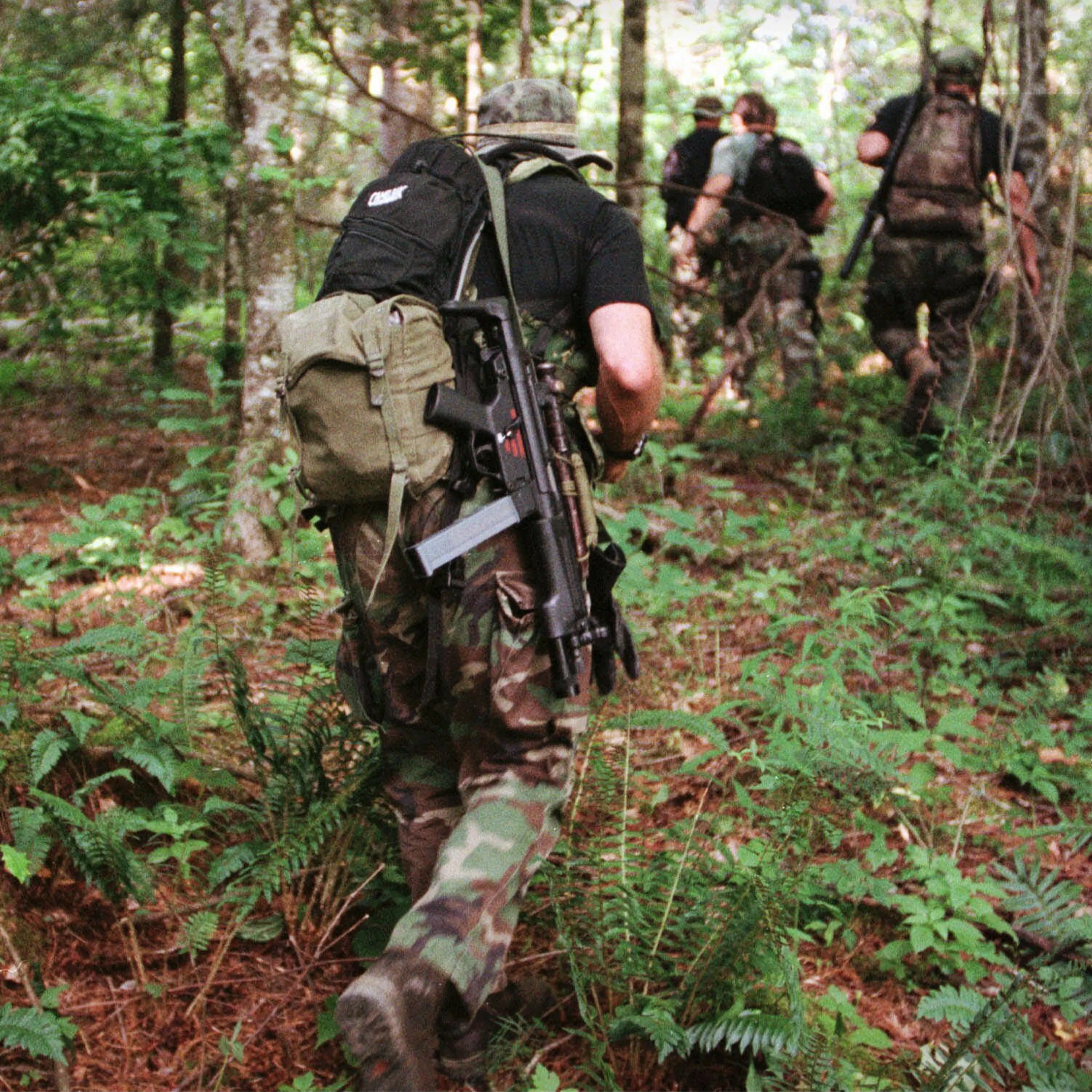
That's Carol Robinson, the cop reporter I mentioned earlier. The feds commandeered an old armory to use as a command center. They believed Rudolph was headed for the woods where they suspected he was comfortable. They believed he was squirreling away supplies in the forests and no agents. Flooded paths and passages in the dense Appalachian mountains. They were strangers in that strange land.
- [16:42]
Becca Andrews
Here's David Namius again.
- [16:44]
John Hammetry
One idea of how hard it is to find people if you've been up there or in any rhododendron forest. I can't remember when during the period, but an FBI agent's dad was flying down to visit him in a single engine Cessna or single engine plane. And, and the plane crashed and into the woods not far from. From Murphy. And you know, they knew a general area where a plane had crashed and did all kinds of searching for it and were unable to find it.
- [17:17]
John Archibald
Mike Wisenant, the Birmingham prosecutor, remembers the enormity of it.
- [17:22]
Mike Wisenant
When he fled, we felt like he was. Had fled into the Nantahala National Forest, which he was very familiar with. And it's hard to imagine that in this day and age that somebody could disappear in the United States like that and not be found. But when I got up there, the agent that was the lead FBI agent said, come with me. And he took me back out into the forest and we went up on a mountain up there. And he said, okay, look as far as you can see, I could count seven mountain ridgelines. And there was no sign of humankind anywhere. He said, There's 500,000 acres here. You know, we have to search all of it.
- [18:07]
Peggy Sanford
Anybody who knew that area and knew how basically to do survival stuff could stay hidden for that long because despite all the law enforcement, they had crawling all over there, you know, helicopters and all that. I mean, a helicopter can see anything through that growth. And so he, you know, he was able to work that and stay hidden for all those years.
- [18:31]
Becca Andrews
Paul Wolf teaches wilderness survival in those mountains and has studied the places he thinks Rudolph hid and lived.
- [18:38]
John Archibald
He talks here about how Rudolph chose his campsites with COVID and access to water and with lines of drift, as Rudolph called them. When you stand on top of Tarquiln Ridge and look down, down and walk naturally sheds you away from those rocky ridges because you're not going to try to make your life more difficult because of the extreme territory. So anybody who would be up there would be able to. Wouldn't just naturally drift upon them, they would drift to the left or right of them. The search was grueling and took its toll on everybody. Agents spent days on edge, tromping through brush so thick even in winter you couldn't see 10ft off the path. Snow still stood in higher elevations. Townspeople, not all, but some, began to tire the attention.
- [19:31]
Becca Andrews
Some folks began to sell mugs and T shirts that said run, Rudolph, run. Here's Carol Robinson again.
- [19:39]
Carol Robinson
Rudolph had such a contingent of supporters. He was in an area that he knew he was back home. And he was in a territory where a lot of people didn't trust the government. You know, these were his people. So, you know, it was. It was stuff that, like folklore is made of your. The setting could not have been more perfect for this kind of story. You're in the mountains, you know, where, where his people were like, run, Rudolph, run.
- [20:16]
Peggy Sanford
I just remember one of the things that struck me when I first got out there, got up there. They had these huge billboards, the anti abortion billboards. And of course they were very graphic. You know, they had like the picture of the fetus and full size billboards. So I mean, you kind of got a tenor of, you know, the climate of that. I mean, I do kind of feel sorry for those people in Burpee because can you imagine, I mean, after the first six months, you know, they're just sick to hell of it.
- [21:00]
Becca Andrews
Ashley Curry was an FBI agent at the time. He's now the mayor of Vestavia Hills, a posh Birmingham suburb.
- [21:06]
John Archibald
He worked the case mostly from Birmingham, but he went to Murphy on his own time.
- [21:11]
James Blanton
And we go in this little restaurant, nothing fancy by any stretch, but when I. When we go to pay it to register, there was one of the wanted posters. I just looked up at the poster and I told the cashier, I said, man, you think for 100,000 post he was up here? Somebody turn him in? And the guy just looked at me with that same kind of stare. I bet it Was like, well, a lot of us up here don't think what he did was wrong. And that was the end of that discussion.
- [21:49]
John Archibald
It was becoming downright hostile to Birmingham police officer James Blanton and his partner. It seemed like some people in Murphy preferred the myth of Eric Rudolph to the reality of two black Birmingham cops looking for him. Blanton said locals tried to stare him down at a cafe to show them they weren't welcome. One guy stared too long.
- [22:09]
James Blanton
I felt like the community really backed this young man because I remember one day I got tired of him just staring at me. And I went off, you know, the guy was standing, staring, I guess, trying to intimidate. They had the ZZ Top beard with the rubber bands. And I remember just losing it. And I was pissed because I'm tired of them trying to intimidate me. And I just let him know, you know, there's nothing between you and I, but ain't opportunity. If you feel like it, go for what you know. I wasn't gonna back down.
- [22:39]
John Archibald
But he didn't.
- [22:40]
James Blanton
Nothing. He just sat there, you know, my partner was like, man, you have to do that? I'm like, well that's, that's just my nature.
- [22:49]
Becca Andrews
He did regret it though. They ate the rest of their meals at Subway.
- [22:53]
James Blanton
I was just like, we can't let em cook us nothing now. Cause we don't, we don't know who's in whose back pocket. But yeah, either. Subway got old. I ain't. I did that.
- [23:03]
John Archibald
And it wasn't always just dirty looks.
- [23:05]
James Blanton
The part that really disturbed me the most was one night we were in our rooms and then all the power went out. When I tried to pick up the phone to call the guy, he rode up there with me. I couldn't get out. And I'm thinking, okay, all I got is this sig P228. I didn't even have an extra clip. I just piled everything up against the door and window. I said, well, if anything happens, they gonna know who got me because I'm gonna get as much lead down range as possible.
- [23:38]
Becca Andrews
And there was good reason to be wary. People did not want cops poking around. Here's David Namius.
- [23:46]
John Hammetry
Some ATF agents, as I recall from another city they bring in these groups were tromping around, they ran across a marijuana patch and they tore up all the marijuana and you know, destroyed it. And I think left a card. Well, a short time thereafter, somebody fired a couple shots from a high powered rifle into the command post and almost, almost actually hit somebody. And so then there was an investigation to try to figure out who'd done that. And they actually, as I recall, got a. Had an unrelated drug case and got a snitch who told them about the group of, you know, marijuana growers who had gotten mad. And so they'd fired some shots, really not trying to, I don't think, kill anyone, but just express their unhappiness.
- [24:46]
John Archibald
From the moment Jermaine Hughes and Jeff Tickle identified Rudolph's car, agents began to contact Rudolph's family members. They talked to teachers, ex girlfriends and army mates.
- [24:56]
Becca Andrews
But they weren't just asking about the Birmingham bombing. We know now from the questions they asked that from day one, they suspected Rudolph was also the Atlanta bomber.
- [25:06]
John Archibald
They wanted to prove he was the Blob Man. Agents interviewed Rudolph's sister Mara, the day after the Birmingham explosion. They didn't just ask her about his abortion views. They asked how he felt about gay people.
- [25:19]
Becca Andrews
They asked his brother Jamie, who is gay, the same question. Jamie said his brother was homophobic and had opinions so strong as a Rush Limbaugh fan that he didn't always want to keep talking to him. But Jamie told an agent he didn't think his brother would resort to violence.
- [25:36]
John Archibald
Agents questioned their brother Joel even before Eric's trailer was searched. Joel acknowledged hearing Eric use the word sodomites often. That's a term that struck a chord with investigators. It had been used in so called army of God letters mailed to take credit for earlier bombings.
- [25:54]
John Hammetry
You know, after the Sandy Springs bomb, we got the first army of God letter, which we spent a ton of time trying to figure out that there was a group called the army of God. They weren't. It wasn't really organized and. But had to look a lot at, you know, other people who've been involved in abortion clinic violence and. But his, you know, his code on those letters was 4 1993. It's the date of the Waco fire. And that was consistent with the idea that, you know, he was kind of anti government, anti. Particularly anti federal law enforcement.
- [26:40]
Becca Andrews
We'll get into this more later in the series. But on the day agents first talked to Rudolph's siblings, they couldn't know that another army of God letter was making its way through the mail. This one took credit for the Birmingham bomb.
- [26:54]
John Archibald
Evidence was piling up. So within weeks, they dropped the material witness pretense and named Rudolph a suspect in the murder of Sandy Sanderson.
- [27:03]
Becca Andrews
Pretty soon, the Justice Department merged all three investigations. Sand bomb sent bomb and twin bomb, as they were called, as the southeast bomb task force. That's sand bomb for Sanderson, scent bomb for Centennial park, and twin bomb for the other two Atlanta bombings.
- [27:21]
John Hammetry
It was actually like sent bomb C, E, n, T, b, o, M. No B. Yeah, twin bomb, also no B. That's because the FBI's like, naming system for cases at that point only could accommodate seven characters. And so the early bombings have no B.
- [27:44]
John Archibald
That inspires a lot of confidence.
- [27:46]
Becca Andrews
I know, hey, it was the 90s. But just like that, Rudolph climbed onto America's most wanted list, and the bounty on his head rose to a million bucks. Though he wouldn't be charged with the Atlanta crimes until later, the feds had.
- [28:00]
John Archibald
A lot more questions. They asked about a military backpack, an Alice pack, they called it an acronym for all purpose lightweight individual carrying equipment. Like the one used to hold a pipe bomb in a Olympic park. Joel told him, yes, Eric had one of those.
- [28:18]
Becca Andrews
A few days later, a soldier confirmed that Rudolph's unit had been taught to use a dowel like a broomstick to stabilize their Alice packs. It was an important clue.
- [28:29]
John Hammetry
Another thing we figured out was the ruck sack that Rudolph used had a sawed off piece of wood in it that was used kind of across the handles to help carry it. And that that was a pretty unusual practice. And the one place that we found that it had been used regularly was at Fort Campbell, and people had gone there. So again, some of these things, like when, when Rudolph was first identified and very quickly figured out he had been in the military and had been at Fort Campbell, the people who'd been working on the case from the start in were like, that's the guy. And then my recollection is in the storage unit, we found a. A broom or a mop handle that had been sawed off at the right place.
- [29:24]
John Archibald
Another soldier remembered being taught to use a metal plate to control the direction of the shrapnel, as the Atlanta and Birmingham bombs had done. And when investigators searched Rudolph's mini storage unit, they found four penny flooring nails with identical tool marks to the ones used as shrapnel in Sandy Springs. That was important, too.
- [29:43]
John Hammetry
We actually did a giant nail project to figure and were able to identify where these nails were made and did some research and figured out that the tool marks on the nails, the machines create tool marks and those in a fairly short order. I forget if it was a day or a few days, they have to re. They replace the cutting instruments. You get a new set of tool marks. So we had a pretty, pretty discreet set of nails that could have end the world. And we had some in the bomb and some in Rudolph's storage shed.
- [30:18]
John Archibald
Agents asked Rudolph's acquaintances if they recognized a voice on a tape. It was the Olympic Park 911 call. There is a bomb in Centennial park. You have 30 minutes.
- [30:34]
Becca Andrews
One of those asked was a man named John Glenn. This is what the agent wrote in.
- [30:39]
John Archibald
His report when asked on a scale of 10, how sure he thought the resemblance of Eric Rudolph's voice to that of the 911 caller Glenn rated at an 8.
- [30:49]
Becca Andrews
It wasn't just the evidence that was piling up. So was the weirdness.
- [30:54]
John Archibald
Eric's brother Daniel had talked to FBI and ATF agents a couple of times about how the Rudolph family had been active for a while in the Church of Israel, a white separatist group that believed white people were God's chosen people. He told them Eric had gone to Idaho in 1996 to visit other white supremacist groups and that his brother could easily make bombs. This is how the agent related Daniel's story. Let's have our producer John Hammetry read this one. Eric has a very good working knowledge of how to make bombs. Daniel Rudolph has seen Eric in possession of bomb making manuals that he had obtained while in the military. Daniel and Eric had talked in the past about making bombs. Daniel explained that their talk of making bombs was only out of curiosity and not in harming people or property.
- [31:42]
Becca Andrews
It's Wednesday. Adams, I see you're trying to distract.
- [31:46]
John Archibald
Yourself from your own banal thoughts.
- [31:48]
Becca Andrews
Let me help. Here's a recording thing made of my latest root canal. Wednesday Season two is now playing only on Netflix. This message is sponsored by Greenlight. With school out, summer is the perfect time to teach our kids real world money skills they'll use forever. Greenlight is a debit card in the number one family finance and safety app used by millions of families helping kids learn how to save, invest and spend wisely. Parents can send their kids money and track their spending and saving while kids build money, confidence and skills in fun ways. Start your risk free Greenlight trial today@greenlight.com Spotify that's greenlight.com Spotify. And then a few weeks later, there was this. I guess Doug Jones, the Birmingham U.S. attorney at the time. Sign sums up what happened with Daniel Rudolph about as bluntly as anybody.
- [32:55]
Doug Jones
The craziest thing that happened during that was his brother. Oh, my God. All I know, and I never watched it, I never saw it, all I know is they had interviewed him. They'd gone back to him several times and that he put up a video camera and he got a table saw and he said this is for the FBI or something like that. And just literally cut his hand with one quick swoop, just. And I'm thinking, okay, let's confirm that the whole family has screws loose somewhere, somehow, some way. I mean, my God. I mean, who does that? I don't even know what the symbolism for that was.
- [33:39]
John Archibald
Some say it's biblical. Matthew 5. 29. If your right hand causes you to sin, cut it off and cast it from you. For it is more profitable for you that one of your members perish than for your whole body to be cast into hell.
- [33:58]
Becca Andrews
Hubie Dodd, one of Rudolph's lawyers, one who became close to him, thinks it was something else.
- [34:05]
Hubie Dodd
After having seen that his brother had been targeted and was on the run, Eric's brother took a saw and cut off his own hand, immediately went back, went, took it to the emergency room, had it reattached. I've shaken that hand. It works well. He still does. Carpentry extraordinary. I think it was really an incredibly misguided attempt at an fu to the government to show just how deeply he believed in and the illegitimacy and the wrongful nature of the government and their actions. I think it was an ill conceived attempt at a grand gesture that was almost immediately regretted and reversed.
- [34:53]
John Archibald
Damien Rudolph, another brother, told the FBI that Eric's actions, the media frenzy and the FBI drove Daniel to do it. He was angry. Damien said that the FBI tried to contact Daniel twice at his job, that agents and media were following him.
- [35:12]
Becca Andrews
Things were getting surreal. A Vietnam vet named Bo Gritz brought a ragtag militia from around the country to the North Carolina mountains and claimed he could find Rudolph and bring him in from the cold.
- [35:23]
John Hammetry
I think he's very troubled emotionally and spiritually and physically. And I think maybe his tanks are just about dry and it's time for him to, to come in and get refueled. We're here for him.
- [35:34]
John Archibald
Grice was a guy who was once asked to be presidential running mate to Klansman David Duke. He was a darling of the militia movement and a popular speaker and radio host. Rudolph had even seen him speak when he was a teenager.
- [35:48]
Becca Andrews
If you believe his hype, and I don't think I do. He was the inspiration for Rambo.
- [35:53]
John Archibald
Greitz had acted as an unofficial mediator during federal sieges at Ruby Ridge, Idaho and, and with Montana. Freeman and Greitz thought he and Rudolph spoke the same language, but it didn't work and he went home. The feds worked hard to get a good dossier on Rudolph. They found him to be a lot of things. A watcher, a cold blooded killer, an enigma, a bomber in search of a.
- [36:23]
Becca Andrews
Target, a misogynist bomber who who looked for female targets. He had targeted women, written screeds against the women's rights movements and called women natural dependents of men.
- [36:37]
John Archibald
Rudolph was a chameleon. It was hard to get a clear picture of him. He was a dope dealer, at times a Nazi sympathizer, a bible thumper who could use the word of God to rationalize just about anything. He was was gone in the wind as the world tried to figure out.
- [36:56]
Becca Andrews
Just who the hell is Eric Robert Rudolph? Really? Join us on the next episode of American Shrapnel to find out.
- [37:18]
John Archibald
American Shrapnel is a production of Alabama Media Group. It was written and hosted by me.
- [37:23]
Becca Andrews
John Archibald and me, Becca Andrews. Our co creator and executive producer and voice actor for this episode is John Hammentry.
- [37:32]
John Archibald
This episode was engineered by Chris Hoff.
- [37:35]
Becca Andrews
Our field producer is Sarah Weitz Kodachek and our social media producer is Caroline Vincent and our logo and cover art were designed by Jack Browning.
- [37:43]
John Archibald
Challeng Stevens is our Editor in Chief. Consulting producers Dan Carson and Ashley Remkes provided valuable feedback. The song you're hearing right now is Birmingham by Beth Thornley and Rob Cairns. This episode also featured Beth and Rob's song Surrender.
- [37:59]
Becca Andrews
Special thanks to James Blanton, Doug Jones, Mike Wisenant, David Namias, Peggy Sanford, Carol Robinson, Jeff Pas, Paul Wolf, Ashley Curry and Hubie Dodd. Thanks also to Katherine Osay's Champion and the Birmingham Public Library.
- [38:16]
John Archibald
Shout out too to all our competitors and colleagues who covered these events decades ago, including but not limited to Jeff Hansen, Kent Falk, Greg Garrison, and the late great Randy Henderson.
- [38:27]
Becca Andrews
If you like our show, please leave us a rating and review and follow us on Apple Podcasts, YouTube or your favorite podcast app.
- [38:35]
John Archibald
Thanks for listening.