← Andy Beshear Podcast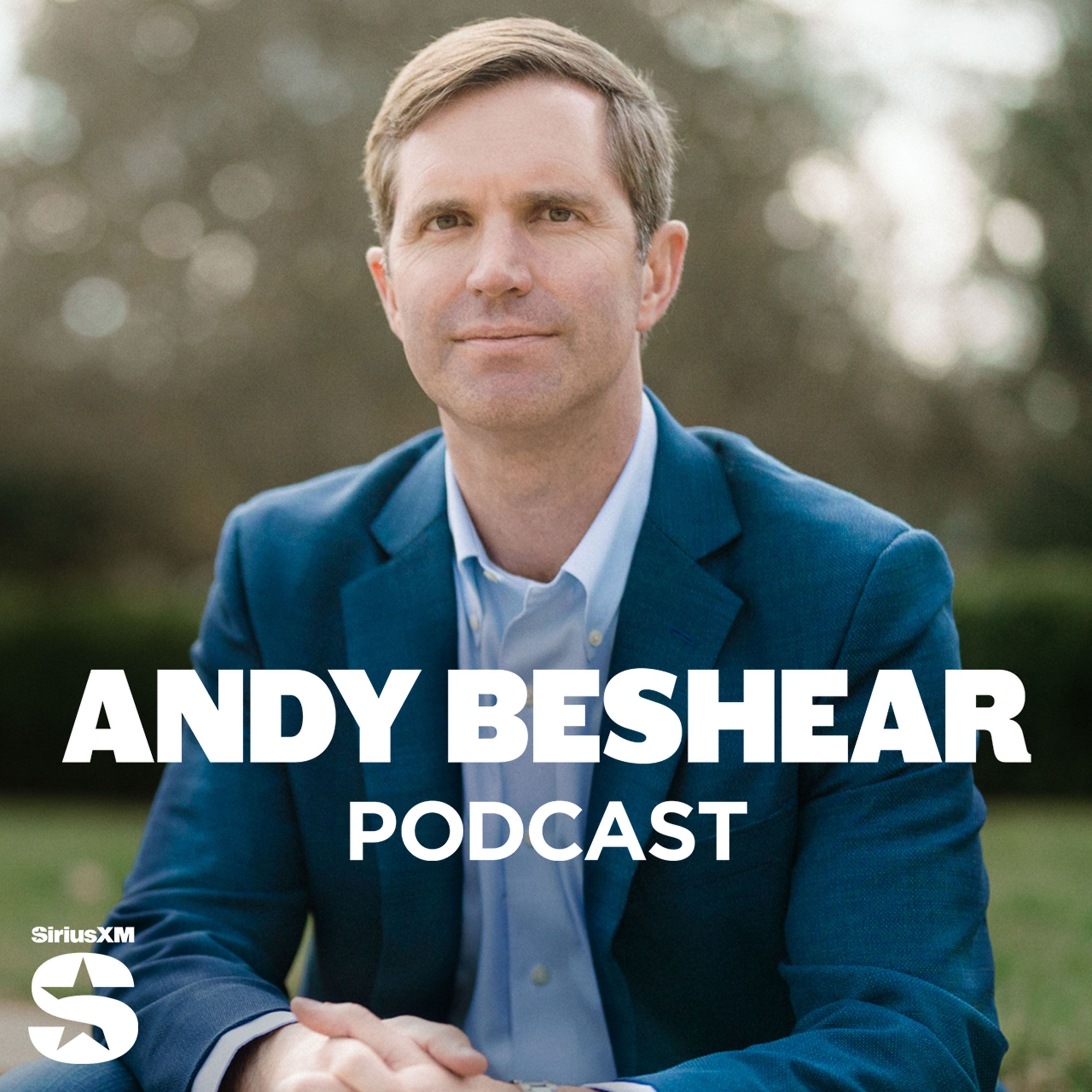
Andy Beshear Podcast
Episode 25: Katie Couric
00:49:39
Welcome back for Episode 25! In this episode, we're thrilled to bring you a special interview with legendary journalist Katie Couric.
Loading summary
Transcript127 lines
- [00:00]
Commercial Narrator
Next level pet people will do anything for their dogs. That means treating them with next level protection from parasites with Nexguard + a foxalaner, moxidectin and pyrantal chewable tablets. Nexguard + Chews provide one and done monthly protection against fleas, ticks, heartworm disease, roundworms and hookworms, all in a tasty beef flavored chew used with caution in dogs with a history of seizures or neurologic disorders. Dogs should be tested for existing heartworm infection prior to starting a preventive. Ask your vet about nexguard. Choose.
- [00:40]
Andy Beshear
Hello listeners and welcome to another edition of the Andy Beshear Podcast, a proud member of the Sirius XM Podcast Network. This week we continue to step up our game. We have news Titanicon Katie Couric as our main guest. She's going to talk through some of her most memorable moments, what she's seen in these last 40 years of covering the news and to connect some of the tough events and most meaningful events in the recent past to what we're seeing here today. Very excited to have her on. And then we're going to have a really important discussion about political violence, about how it's wrong every time, all the time, no matter who it's perpetrated against, full stop, period. That'll be a discussion with John Rabinowitz. And for John McConnell will be Louisville's mayor Craig Greenberg, who was a target of political violence himself. His story is very powerful and pretty personal to me. It's a great episode. I think it's a really important episode and I hope it's one that helps you process the tough news of last week, of the killing of Charlie Kirk, of these examples of political violence just happening over and over and over again to people on all levels of government and all political parties. Hopefully this will help us make a little bit of sense of it all and help you get ready for that next week in the midst of such difficult times. So that's a big agenda ahead of us. Let's get to it.
- [02:28]
Podcast Host/Interviewer
Our guest this week is award winning journalist who has anchored for NBC, abc, cbs, first woman to anchor an evening news segment. We have with us Katie Couric. Thanks for joining the podcast.
- [02:45]
Katie Couric
Hey Governor, nice to see you. How do you like doing a podcast?
- [02:49]
Andy Beshear
I've enjoyed it.
- [02:50]
Podcast Host/Interviewer
I actually get to ask the questions for once and that's not that bad.
- [02:53]
Katie Couric
Did you have any aspirations to become a journalist at any point in time?
- [02:58]
Podcast Host/Interviewer
Well, we'll see. Oh, I'm, I'm okay with my current day job, but Certainly the ability to talk to people directly, but then to tell stories for people, to get to know people is pretty exciting. I was reading that when you thought about three of your most important moments, it was post Columbine, it was being the anchor during 9 11, as well as the Sarah Palin interviews. And I just wanted to start there. When Columbine hit, we really hadn't experienced something like that before.
- [03:36]
Andy Beshear
It felt new and raw.
- [03:39]
Podcast Host/Interviewer
As a country, what was it like doing that interview at that heightened emotional moment with those family members?
- [03:47]
Katie Couric
Well, I think you're right. At that point in time, school shootings had not become the almost daily occurrence they've become in more recent years. And I remember being so shocked and stunned and I got a call from my office saying, you need to get on a plane and go to Colorado. You need to go to Littleton, Colorado and cover the shooting, this high school shooting. And you're so right. I mean, the level of carnage, the brutality of that day, the complete shock that this could happen at an American high school in a relatively small town in Colorado was almost unfathomable. And I think for me, you know, I have always tried to cover the personal side of stories, the real world human impact of events. And I think that interview has always been so memorable for me because I interviewed a father, Michael Scholz, who had lost his son Isaiah, who was hiding under a chair in the library, and Craig Scott, who had lost his sister Rachel, and who I recall had been, who knew Isaiah and was sitting near him in the library when he was shot and killed. And these two people coming together, united by this horrifying event and unimaginable shock and grief, was just a profound experience for me to witness.
- [05:33]
Podcast Host/Interviewer
Do you think the country missed an opportunity after Columbine in responding to, preventing, in making sure that these types of incidents don't happen because they happened time after time after time. Post Columbine, it happened in Paducah not very long after that.
- [05:55]
Katie Couric
I remember covering that story, Governor. I remember covering what happened in Paducah. And, you know, back then, these were anomalies. You know, they didn't really happen very often, and every time they did, they were shocking. And now it's become sadly, like a broken record. And, and people pay attention to it. They look at the death toll or how many people were injured, and then it seems as if they move on to the next thing. I can't tell you how many missed opportunities I've seen when it comes to school violence and our complete lack of effort in creating and supporting Sensible gun laws. You know, 74% of NRA members are actually in favor of stronger gun regulation. And yet this small, I think extreme movement within the gun rights community feel that it's a slippery slope. And you know, I also covered Sandy Hook where all those six and seven year old children were shot and killed. And I became friendly with some of those parents, Mark and Jackie Barden in particular. And their son Daniel was killed with a high powered automatic weapon. And, you know, they couldn't even identify his body because you couldn't recognize little Daniel's face. And if all these children were murdered by someone with a gun and nothing was done, despite the national outrage and shock of that situation, I gave up a lot of hope in our country when that didn't happen. So, yes, a missed opportunity after Columbine, but so many missed opportunities after that.
- [08:02]
Podcast Host/Interviewer
As a journalist, how do you balance providing the information to the American public about the people who commit these acts versus the worry of turning them into a celebrity in some way to where another disaffected person might see that and ultimately become a copycat?
- [08:25]
Katie Couric
That's an excellent question. You know, in recent years, I think journalists have been much more mindful about featuring the perpetrator of these crimes and giving them too much attention. And it is a balance because you want to understand motives, you want to understand what happened. You need that information and understanding of someone's situation and psyche to help figure out how we prevent these things from happening. But I think that there was a feeling among the vast majority of journalists that we should not glorify people like this. Obviously, there's a problem of copycat shooters, so it is a balance. I don't believe in taking guns away, but I do believe there are certain measures we can take. And I'd love to hear what you think about this, Governor, that will reduce gun violence. I just think that most reasonable people, you know, want to reduce gun violence, don't want to worry that when they drop their kids off to school, their potential actually won't be coming home. If you really came together and talked about common sense gun laws, the vast majority of Americans would really be in agreement. And it's very frustrating to me that politicians have been so weak and cowardly and that Americans don't understand that this should be a single issue. You know, voters should, should really be electing people who agree with this. So as you can see, I'm not particularly objective on this issue because I've met and seen and gotten to know too many people who have lost loved ones to gun violence, especially little kids who. Whose only mistake was going to school that day.
- [10:20]
Podcast Host/Interviewer
One of those other moments that you talk about being one of the most important was you were broadcasting live during the morning of September 11th.
- [10:31]
Andy Beshear
I remember that morning very well.
- [10:34]
Podcast Host/Interviewer
I was in law school and one of my friends had had the TV on. I had left New York, where I had worked for the summer a month to the day before that moment and would only learn later that lost one of my college classmates when that plane hit the first floor. But all I was doing was watching in horror. So what was it like personally, to be seeing something that was unthinkable, that you knew that there was going to be catastrophic loss, but still needing to calmly talk about it with the nation that's watching it?
- [11:12]
Katie Couric
Well, I've never felt more responsibility in my life or in my career because I know so many people were watching in stunned silence, trying to process and understand what was transpiring before our eyes in real time. And it was. I was terrified. I mean, I think about it, and I think about how my hand was shaking like this and I had to sit on it to so viewers wouldn't see how shaken I was. And, you know, I think I just really willed myself to, you know, switch into uber professional mode and try to get as much information as I could and share as much information as I could with all the people who are watching that day. And, you know, this is what I have been trained to do, is to gather information, try to make sure it's accurate, which is very, very difficult in a live situation with unfolding events, and then try to convey it to an audience. So it was a very hard, harrowing. And I mean, the words can't even describe how upsetting that day was and thinking about those poor people.
- [12:49]
Podcast Host/Interviewer
Were you based in New York?
- [12:51]
Katie Couric
Yes, I was on the Today show at the time. The Today show broadcast from New York from 30 Roth in Midtown. And, you know, what was happening was not far away. And, you know, and of course I worried about my parents who lived in Arlington, Virginia, because if you remember, that second plane that crashed in Shanksville, Pennsylvania, was headed to the Capitol or to the White House. And then the Pentagon happened. My parents lived in Arlington. I remember when I had a short break, I called them and told them to get in the basement. That's how afraid I was. I had a friend who was flying from Boston to la, actually, a guy I was dating at the time. I didn't know if he was on one of those planes that had left Boston. We had people at the Today show who had loved ones who worked in the Twin towers. So it was such an array of emotions that day. Worried about people on a personal level, and then, of course, worried about people I didn't even know who were clearly, you know, facing a terrible fate and then worried about the country. So there were all levels of concern as I was broadcasting that day. But as I said, I've never felt my job was more important than when I was covering 911 and trying to bring some, not only information, but humanity to what unfolded not only that day, but in the days and weeks and months following it.
- [14:34]
Podcast Host/Interviewer
We did a recognition of 911 this year, and what struck me was Lexington's police chief talking about how traumatic September 11th was, but how unified we were as a country on September 12th. We've been through a lot of other traumatic episodes since. Do you think it's harder for the country to come together, to be unified after one of these horrific events?
- [15:07]
Katie Couric
Well, I think when there's something like this that is so catastrophic and doesn't discriminate between Republicans and Democrats, and it is such a massive event, I think people forgot their political ideologies and just became Americans and concerned citizens. I'm trying to think of a unifying. I mean, it's hard. It's that kind of a. An oxymoron to think of a unifying tragedy like 9 11. And I'm not sure we've had anything quite like that, although I would argue something like Sandy Hook should have been, and unfortunately, it wasn't. So I think, you know, I pray that something of that magnitude never happens again. But if you remember, even though there were political disagreements and there was some animosity between Democrats and Republicans at that time, I think the political divide and the chasm was a lot not as deep as it is today. And I think today everything is seen, almost everything is seen through a partisan lens, unfortunately. And if you think about the Charlie Kirk assassination, he is the personification of political polarization. To be alliterative about it, even murder.
- [16:58]
Podcast Host/Interviewer
Can somehow be political suddenly or partisan.
- [17:02]
Katie Couric
Yeah, well, I think, you know, I mean, this was not. I mean, obviously political violence is horrible, but it's been really fascinating for me to watch how this event has been received. And I wonder if it was someone who was, say, on the left side of the spectrum, who was considered pretty outspoken, provocative, and, dare I say, even somewhat radical in their views, how that would be received by the country, too. So I think the murder of Charlie Kirk is a tragedy, and as I said, Political violence should be decried among everyone. But I also think in the final analysis, it is. You know, how his work is being viewed posthumously has been fascinating, too, because I think, you know, you've got a portion of the country who sees him as a hero and a martyr, a man of faith, somebody who cared deeply about the country and was open to debate. And then you see another part of the country who sees him as an instrument of divisiveness, somebody who marginalized and insulted various groups and does not deserve kind of the. The lionization. Lionization. I guess that's it that he's receiving on behalf of national institutions. So it's been really, really interesting for me to watch and see and assess all the different reactions from across the political spectrum.
- [19:12]
Podcast Host/Interviewer
So the last of those three major moments or interviews, days that you talk about are your interviews with Sarah Palin. And certainly Sarah Palin, at least to me, was something very different in the. In the political realm than we'd ever seen. While it would come later, almost the first reality TV type candidate for a major office. So I guess my. My first question is, do you think that there ever would have been a President Donald Trump without a VP candidate, Sarah Palin?
- [19:47]
Katie Couric
Absolutely not. I think she was the first example of the injection of an incredibly charismatic, relatable, accessible person into the body politic. And I think because of that populism, because of her relatability and because of her kind of.
- [20:18]
Jen Z. Lingo
Her.
- [20:18]
Katie Couric
I don't want to say shtick, because I don't think it's a shtick. I think this is the way she really is as a person. You know, the way she talked and kind of the. Aw, shucks and kind of the word salad. I mean, talk about word salad. I mean, she was the. The top chef of word salad before Kamala Harris even came on the scene. But I do think there was a certain way she tapped into grievance and people's, you know, part of the Tea Party movement, which really was the precursor, I think, to maga, tapped into the anger, frustration, and rage of many people who felt the government was not working for them, which I think has its foundation largely in income inequality and the cratering of this country's manufacturing base and the negative repercussions of globalization. But, Governor, what the hell do I know?
- [21:27]
Andy Beshear
So.
- [21:27]
Podcast Host/Interviewer
So I remember the announcement of Sarah Palin as the VP candidate. The Democratic National Convention had just wrapped up. My wife and I were on a plane that was about to take off, and the. And the news had come across, and everyone on the plane was staring at their phones, and then they were trying to Google who Sarah Palin was at the time. But. But it also seemed to have been right. One of the first times that. That a political party or a major candidate viewed shock in.
- [22:01]
Andy Beshear
In a.
- [22:01]
Podcast Host/Interviewer
In an announcement as an okay way to earn media, too. It seemed like one of the first announcements where you said, if it gets attention, it doesn't matter which way it's analyzed.
- [22:14]
Katie Couric
I don't know if it was so much that. I mean, I wrote about this in my book, and if you read Game Change, which you probably did, I think that campaign officials, and I know this for a fact because I knew many of them and still do, were trying to capitalize on what Hillary Clinton had captured among female voters. This kind of excitement to have a woman in a position of power. And I think that was such a cynical move, as if women just want a woman no matter what. But I think that it was probably. I don't think that was behind the announcement, like, oh, let's just pick somebody no one's ever heard of, and we'll get a lot of attention. No matter who they had picked, they would have gotten a lot of attention. I think it was really trying to galvanize women. And I also think a lot of it was the cult of personality. And perhaps because not a lot was known about Sarah Palin at the time, she was more of a blank slate, and she could start fresh with John McCain and they could create a candidate instead of basically being given a candidate. And so I think probably that was appealing to the McCain team. And at that point, I don't know if you remember, I mean, it was kind of a Hail Mary thing. They had to. He desperately wanted Joe Lieberman, his. His really good friend, but I think they had to do something out of the box to. To kind of juice the campaign. And if you remember, Obama was kind of flatlining at that time just a bit, and this was, you know, he was getting some criticism a little bit for his. His big, you know, speeches. And I think people were starting to maybe tire of it a little bit. I think this is right. And I did a whole podcast on this, and I interviewed a lot of the people, the main players in this whole thing. And if you'll recall, Sarah Palin just completely knocked it out of the park at the Republican National Convention and appeared to be a real force to be reckoned with. And, I mean, talk about charisma. I mean, she had it in spades. And I think one of the reasons I mentioned that Interview as an important one in my career is that I was able to get beneath the surface and really try to interrogate her accumulated, you know, knowledge and her ability to be a critical thinker and her understanding of some of the most important issues facing the country. And I think after that, people thought twice about having Governor Palin a heartbeat away from the presidency, especially given the fact that John McCain, I believe, had had cancer four times and was quite an older candidate back then. And so I felt like my interview was very revelatory and very helpful to voters. And that's why I'm particularly proud of that interview because I really prepared and I really wanted to gauge what kind of president, not only what kind of vice president she would be, but what kind of president she would be and if she really had the intellectual aptitude to be, to run the entire country.
- [26:01]
Podcast Host/Interviewer
As we wrap up, give me one thing that you are most worried about for the country and one thing that makes you the most hopeful is this.
- [26:11]
Katie Couric
Like the, the, the rose, bud and thorn game.
- [26:17]
Podcast Host/Interviewer
That's, that's the goal. We like for everybody to leave just feeling a little bit lighter after talking through the tough topics. So we always like talking about hope as well.
- [26:27]
Katie Couric
Well, clearly I'm really worried about the country. I can't sugarcoat it in any way. I'm really worried about the hate and the rage and the anger, our inability to come together, our demonization of each other, our lack of proximity, which I think is a big problem. Something I talk to with Bryan Stevenson a lot of the Equal Justice Initiative. You must know Brian, he's one of my heroes. And you know, I think that we are surrounded virtually and often physically by like minded people. We don't talk to people who disagree with us. We're all in our bubbles, you know, not just people in New York City, but people in other parts of the country. And we've dehumanized each other. And I am really, really worried about that and worried about the emergence of more anger and rage and more violence. I can't, I have to be honest about that. And I'd love to talk to you about how we address it because I think this country really needs some healers and really needs true leadership and getting us out of this constant cycle of blame and shame and hatred after, after that.
- [27:57]
Podcast Host/Interviewer
Very well said answer. We, we definitely need a little hope.
- [28:01]
Katie Couric
I think people are basically good. You know, I'm kind of a glass half full person. I think people are nice and care about people and would help somebody in need and would be a Good Samaritan if they saw someone struggling on the side of the road like the Good Samaritan did in the Bible. And I only quote the Bible when I read about a story in a golden book because I'm not a big student of the Bible. I wish I knew more about it and would like to study it more honestly as a piece of important literature. But I think that social media has really drowned out the good hearted people who aren't super pissed off at the other side. And I think it favors rage and snark and cruelty.
- [29:00]
Podcast Host/Interviewer
Your parable of the Good Samaritan is in a perfect place. I mean, I can say that after natural disasters, I see the very best in people. And I think one of the ways we have to heal is to be those good people. We are in the most difficult of times every other day too.
- [29:18]
Katie Couric
We've just gotten out of the habit of helping our neighbors. Or at least you know what I think it is. We never hear about it. We never hear about people coming together or somebody raising money for the kid with cancer in the community whose parents don't have enough money to pay for his treatment, or somebody who is buying groceries for their elderly neighbor or somebody, you know, all these simple acts of kindness that get no attention. And I think that most people really want to come up with pragmatic solutions to some of these big problems. But I find that political parties are using these situations and these problems, they just try to weaponize them to score political points and make the other side look bad. And I think there are different philosophies on how we address these problems. But I grew up when kind of compromise wasn't such a dirty word and moderation wasn't such a dirty word. And I really do believe with the right leaders in charge, we can galvanize this big center of kind, caring people who care deeply about our country and who can speak about complicated issues in a nuanced way, not in such a black and white right and wrong way. And that we have the potential to move ahead better and more prepared and bigger hearted than ever.
- [31:18]
Podcast Host/Interviewer
The Bible said spread the good news. And we appreciate your time on the Andy Beshear podcast. Thanks for joining us.
- [31:25]
Katie Couric
Thank you so much, Governor.
- [31:34]
Commercial Narrator
My job, I can't drink during the week. Weekends are a different story.
- [31:38]
Katie Couric
Ugh. After eight hours of this, I have earned my wine. You know what I'm saying?
- [31:43]
Andy Beshear
My family is a lot. It takes me four beers just to hang out with them.
- [31:48]
Commercial Narrator
Binge drinking isn't all college kids doing.
- [31:51]
Podcast Producer/Team Member
Keg stands Oregonians in their 30s and.
- [31:53]
Commercial Narrator
40S binge drink at close to the same rates as younger people, raising our risk for long term health problems.
- [31:59]
Podcast Producer/Team Member
More@rethinkthedrink.com, an OHA initiative.
- [32:03]
Commercial Narrator (Monday.com)
Whenever I need to send roses that are guaranteed to make someone's day, the only place I trust is 1-800-flowers.com with 1-800-flowers. My friends and family always receive stunning, high quality bouquets that they absolutely love. Right now, when you buy a dozen multicolored roses, 1-800-flowers will double your bouquet to two dozen roses. To claim this special double roses offer, go to 1-800-flowers.com Pandora. That's 1-800-flowers. Com Pandora.
- [32:34]
Andy Beshear
You're listening to the Andy Beshear Podcast. Our next segment is my conversation with the Johns. Normally John Rabinowitz and John McConnell, though subbing in for John McConnell is a friend of mine of 20 years, Craig Greenberg. He's the current mayor of Louisville, Kentucky. With the killing of Charlie Kirk last week, today we're going to talk solely about political violence. For some of you who maybe saw that really graphic video, it may be a tough topic.
- [33:04]
Podcast Host/Interviewer
So it's okay to pause the podcast.
- [33:06]
Andy Beshear
To take a breath or at any point that you need to, to step away and just take care of yourself. There's some trauma that our bodies and our minds aren't meant to take. We, we care about each and every one of our listeners. Thanks for being on the podcast.
- [33:21]
Craig Greenberg
Great to be with you all.
- [33:22]
Podcast Producer/Team Member
Welcome to the team.
- [33:23]
Craig Greenberg
Great to be here.
- [33:25]
Andy Beshear
So we saw last week the murder of Charlie Kirk, a political influencer that sadly isn't isolated. It follows so many other examples of political violence. We saw the murder of the former speaker of the House of Minnesota. We saw a firebombing of my friend Governor Josh Shapiro's home while his family was inside their governor's mansion in Pennsylvania. We've seen assassination attempts against our current president. We saw threats and a plan to kill Governor Gretchen Whitmer. It seems like these happen over and over. And a little more than three years ago, we saw one of those acts of political violence, Craig, that was actually directed against you.
- [34:13]
Craig Greenberg
That's right. On Valentine's Day of 2022, I was a few months out running for office for the first time, as you well know, for mayor of Louisville. And in my campaign office, we, we hadn't given a single thought to security. In fact, I was hoping people would come into our campaign office. That was a good day when people come, would come visit you a few months before your first Ever primary election. And a man walked in our office. We were having our Monday morning meeting. It was Valentine's Day. It was the day after the Super Bowl. We were gathered around in a circle, and I saw an individual who stood right in the doorway, never said a word, pointed a gun directly at me from about 15ft away and fired six gunshots. I am the most fortunate person in the world to still be here today that he missed. One of the bullets grazed my sweater. That's how close I came to life and death. It was only through the heroism of my colleagues that were in the room with me that thought quickly, and when there was a split second, right when he noticed there was a pause and likely changing ammunition, slammed the door. And then my other colleagues and I, we threw the furniture up against the door to barricade ourselves in. He tried to bang and get in and then ran off. I don't know how I survived. I distinctly remember the moments I don't remember. I just remember seeing him at the door, hearing the gunshots, and then being on the ground. It was a surreal experience, one that changed my family and me forever.
- [35:46]
Andy Beshear
I want to touch on that because I look at those pictures of Charlie Kirk with those two little kids, and listen, those kids love their dad, and he's not coming home to them. They're going to grow up in a very different way. So what's it like when you pick up the phone and you've got to call your wife and tell her what just happened?
- [36:12]
Craig Greenberg
I called my wife and I said, I'm okay. I can't talk, but I'll call you very shortly.
- [36:19]
Andy Beshear
That's the first thing you want to get out in any of these dangerous situations.
- [36:23]
Craig Greenberg
I'm okay. Absolutely. And then that night is really, I think, when the emotions started to come out. I spent the rest of the afternoon in the police station giving the statements and all of that. And then when I finally got home and was able to just hug Rachel when I walked in the door, that's when the tears and the emotions came out. And getting on a zoom call with my parents and my sister and everyone else in my family that night. But it was days that I literally felt physically different with the adrenaline, with my ears ringing from the gunshot. And it really changed me as a person. It's definitely changed me as a mayor. Our focus on reducing gun violence here in Louisville. And then every time that I see, as you just mentioned, that great overview of the far too much political violence that we're seeing in our community every time, including last Week. When I saw the murder of Charlie Kirk and first heard about that, it brings back those physical. I get physically ill. I remember I was at a restaurant when President Trump was assassinated, and I got the notification.
- [37:25]
Podcast Host/Interviewer
During the assassination attempt.
- [37:26]
Craig Greenberg
I'm sorry. I'm sorry. Yes. During the assassination attempt. Yes. Thank God. And I felt the same way. Same way.
- [37:34]
Podcast Producer/Team Member
So, Craig, thank God you're here to tell that story. And God clearly wasn't finished with you yet. And you're a tremendous leader for us in the Commonwealth. I gotta have a question for both of you guys. When you first got into politics, was there ever even a thought that this was a risk that you were putting yourself in and your family in? No. I can't even imagine it.
- [37:55]
Andy Beshear
Not the way that we see it right now. Yes. You knew that there were risks. My dad had been governor, and he'd gotten a letter that was soaked in what looked like blood. At one point, when I was Attorney General, I had a few small threats of people who were upset at something I'd done and were coming our way. I actually remember we solved a triple murder, but hadn't made the arrest yet. And we're tracking the individual, and he just happened to be driving around downtown Louisville, where I had an event that day. And then, you know, in those small world types of things, the individual who was convicted of shooting at Craig stopped me during my inauguration and asked me if Team Kentucky was about him or not, which I tried to explain was about everyone. The pandemic started changing things, I think. Political violence has obviously existed before the assassination of Martin Luther King Jr. And Bobby Kennedy. But certainly the types of threats that I started getting during the pandemic were very different.
- [39:02]
Craig Greenberg
I had never thought about it, John. I mean, on my list of pros and cons that Rachel and I were talking about before I made the decision to run, wasn't even on the list. Never crossed my mind. And then I'll remember. Just that was on the next night. It wasn't until the next night that I actually thought, as I was going to bed with Rachel, to say, you know, Rach, we don't have to do this. Are we out? And I'm very fortunate. I've got an amazing wife, just like you do with Brittany, that she's like, no, we're not going to let this define us or beat us. Let's keep moving forward.
- [39:35]
Andy Beshear
You were in a tough race at the time. You have this experience where you're almost murdered, yet the first time you address the press, you don't make it an us versus a them?
- [39:51]
Craig Greenberg
Absolutely not. I thought it was very important as a leader, if I wanted to lead this city, I had to get out there. So that evening, I don't remember if it was five or six o', clock, I did address the meeting and gave whatever information I could and just shared my thoughts that were on my mind and what I was feeling. And in hindsight when I see those pictures and hear it, you can just hear and see the impact of gun violence on an individual in that. But I think that's pretty important and to be able to move forward in that way. For me, I'm fortunate that I don't suffer from PTSD or other things like many victims do. It's really changed the way I've looked.
- [40:27]
Andy Beshear
At.
- [40:29]
Craig Greenberg
Not even political violence, just gun violence in general in our community, knowing what the impact is on not just the direct target, but also their families, their friends, their neighborhoods. One shooting really impacts a lot of people.
- [40:40]
Andy Beshear
I know a lot of people out there listening may be mad, maybe upset about the killing, the recent assassination of Charlie Kirk. It took me back to when we lost our friend Tommy Elliot in a, in a mass shooting at Old National Bank. And I remember how I felt right after. I wasn't angry. I was just empty.
- [41:04]
Craig Greenberg
Yep.
- [41:05]
Andy Beshear
And I was. And I was sad. And I did not want that individual's motive and I know that's needed for a prosecution. And in this instance that individual was killed by some heroic police officer.
- [41:19]
Craig Greenberg
Very much so.
- [41:20]
Andy Beshear
That day I didn't want it. I didn't want it out there because I didn't want there to be any excuse for murder. I didn't want any politicizing of what he had done to our friend. If he had some writing and I'm told that he did, where he was trying to make a point, uh, you don't get to do it through that. You know what? To this day I could not tell you the name of that individual because I don't think he deserves it. I don't think he deserves the press and the attention. And so while I think that Charlie Kirk should be in the news and the tragic situation, what I don't like seeing is how much attention that is killers is getting because both I think it to maybe disaffected folks out there that feel not heard, you see so much news around it. But I also don't, I also don't want there to be an excuse ever for murdering somebody.
- [42:17]
Podcast Producer/Team Member
How are you guys explaining what happens to your children? My 13 year old came in right after it had happened and the full thing was shown on the news. And I immediately said, you are not to watch that. But she says, I can't even understand how this is happening. I mean, how are you guys trying to explain to your children what just happened and what you guys have to be mindful for?
- [42:45]
Andy Beshear
What I'm getting asked most about are the responses. And I think it is critical that the response now be exactly what Craig did right after his life was almost taken. He condemned violence from anyone for any reason whatsoever. And I think leaders have a choice right now. They can either condemn all violence against anyone, period, full stop, or only condemn violence against people that look like them, sound like them, and believe in what they believe in. That this is a chance to either unify people against violence or further divide people. That probably only escalates at least the potential for violence.
- [43:28]
Craig Greenberg
I could not agree more. You would think that the one issue we could come together on as a country, as elected officials, as leaders of any sort, is that murder is bad. That in a country where we respect the First Amendment, where we've. We're built upon political debate and public opinion that political violence is horrible and unaccepted. And regardless of your party or what you believe about taxes or any social issues or anything else, that should be the opportunity when we all lock arms and Democrats, Republicans, Independents say this is wrong. We might not agree on all the solutions, but here are a couple of things we can agree on together to start lowering the temperature, changing the rhetoric, focusing on the issues and working to end this type of violence that we're seeing.
- [44:13]
Andy Beshear
Let's talk about social media for a minute. First, there have got to be an obligation for these social media platforms not to be showing the graphic murder of someone to anyone of any age that can be on and see it.
- [44:30]
Craig Greenberg
I couldn't believe how quickly that graphic video was circulated. I mean, that just shows the power of social media. And yeah, I agree that there should be some base level of standards to not make it so easy to share that to anybody.
- [44:46]
Podcast Producer/Team Member
Yeah, it was far too accessible. There needs to be more discretion by those that are putting that, those videos out.
- [44:54]
Andy Beshear
We can't allow right or wrong comments though, to be categorized simply by a political party of someone giving them. I'll give you two. I assume that Elon Musk is a. Is a Republican, but I'll give you two voices on that side, one of which is saying I think the wrong thing and one is saying the right thing. I mean, Elon Musk at a far right rally in Europe saying Violence is coming for you. Fight back or die is the worst message that anyone could put out there. It is not only pushing division, but almost fostering violence. Versus One of the US Senators from Utah said, we need to take any modifier away from the word radical. We shouldn't be talking about a radical right or a radical left. What he was saying is when it's reached this stage, it's wrong no matter what the motivation, or so called motivation. I worry that that's just an excuse.
- [45:52]
Craig Greenberg
I totally agree. And I think that it's also so counterproductive. It's so counterproductive, it hurts people's own causes. I mean, you and I, Andy, we're working literally every day being in Kentucky. We're working with people of all political persuasions. And we've been so productive at getting things done. Look at where we are now because we're working together. And it's just like a family. You don't agree with your spouse or your cousins or your parents on everything, but you still are family. We know in this case, we're still Kentuckians. We've got to work on things together. And I wish people would focus on that, on not who wins or loses, not who's right or wrong, not who gets the most clicks or likes, but just getting stuff done. People would be happier.
- [46:40]
Andy Beshear
And it's not all political.
- [46:42]
Craig Greenberg
That's right.
- [46:43]
Andy Beshear
Even what we're talking about today is in the media or with some people's comments, are people actually politicizing murder? And that is. It's just wrong. But it shows how far it's been pushed. And like, creating good jobs shouldn't be a loss for anybody. But sometimes people look at it in the political lens of, well, if you're going to announce a big announcement, you know, that's a win for you. We might not want you to have it. And you say, wait a minute, those are good jobs for all of our people. Well, Craig, we appreciate you coming in. We appreciate you sharing what is a very personal story. Most people, when they hear about political violence, don't hear from somebody who's been, as a friend of mine, for 20 years. We're really glad that you're still here, but I think you being able to open up and people seeing how you responded is a good example for the country.
- [47:38]
Craig Greenberg
Well, thank you very much for having me. Thank you, John, as well. Really enjoy your podcast and incredibly excited about the future and continuing to work with you.
- [47:54]
Podcast Host/Interviewer
We are closing out this episode of the Andy Beshear podcast. I know it's been a heavy, serious episode, so we wanted to give you a moment of levity to hopefully make you feel a little bit lighter. So here we go again with Jen Z. Lingo. Our teacher this week is media Pros intern Shai Young, who's normally on the other side of the camera. Thanks for joining us.
- [48:20]
Jen Z. Lingo
Thank you for having me, Governor.
- [48:22]
Podcast Host/Interviewer
Okay, what do you got for us?
- [48:24]
Jen Z. Lingo
So today's phrase is clock it.
- [48:26]
Podcast Producer/Team Member
Oh, this is easy.
- [48:27]
Podcast Host/Interviewer
So that, like, how much time it takes to do something.
- [48:30]
Podcast Producer/Team Member
Oh, you're thinking billable hour work. You're back to your lawyer day. Clock it definitely means hit it like punch something, right?
- [48:37]
Jen Z. Lingo
Pretty close. So I would say punch as in a way of like, you agree with something. So when we say clock it as in Gen Z, it's more so like a silent applause. So someone may say, governor, your suit is nice. Those shoes are nice. Clock it.
- [48:57]
Podcast Host/Interviewer
Ooh, this.
- [48:58]
Podcast Producer/Team Member
So is this light fire?
- [49:00]
Jen Z. Lingo
Yes.
- [49:00]
Podcast Host/Interviewer
I don't know that. That was more like drip.
- [49:03]
Podcast Producer/Team Member
Good point.
- [49:04]
Podcast Host/Interviewer
But. But when you say clock it, it's. It's different than just agreeing with something someone said, because I think we learned that's facts.
- [49:13]
Jen Z. Lingo
Right? So clock it is more. So a more like sassy way I guess, to say it.
- [49:21]
Podcast Host/Interviewer
What's the last time in a conversation.
- [49:23]
I
You said being diagnosed with leukemia, lymphoma, myeloma, or one of over 100 other types of blood cancer makes people want more time to do the things they love. That means more time to be artists, prom dates, world travelers, and moms. We are Blood Cancer United, the world's leading organization focused solely on blood cancer research, support and advocacy. We do the most for more people with blood cancer, so people with blood cancer can do more of whatever they want. Blood Cancer United. Join us and donate today@bloodcancerunited.org AI.
- [49:57]
Katie Couric
Had.
- [49:58]
Commercial Narrator
The time of my life a I never fail.
- [50:04]
Commercial Narrator (Monday.com)
From building timelines to assigning the right people, and even spotting risks across dozens of projects, Monday Sidekick knows your business, thinks ahead, and takes action. One click on the star and consider it done.
- [50:16]
Andy Beshear
And I owe it all to you.
- [50:19]
Commercial Narrator (Monday.com)
Try Monday Sidekick AI you'll love to use on Monday.com.
- [50:25]
Jen Z. Lingo
The last time in a conversation where I said clock it was probably when I told someone that I would be on the Indy Brashear podcast as far as, like, production. And they were like, clock it. And I was like, clock it.
- [50:40]
Podcast Producer/Team Member
I mean, she did set up her mic before we went on the air.
- [50:44]
Podcast Host/Interviewer
She is the only contributor that's also set up her own mic. I mean, this is somebody who can do absolutely everything. What's your favorite part of doing some of the crew work here on the podcast?
- [50:57]
Jen Z. Lingo
My favorite part is meeting new people. It's been a great experience. So just being able to travel and see new things like that's been my favorite part of it all because we've.
- [51:08]
Podcast Host/Interviewer
Had some shoots that have been on location.
- [51:10]
Jen Z. Lingo
Yes.
- [51:10]
Podcast Host/Interviewer
And just an opportunity. Now. You also like making music.
- [51:15]
Jen Z. Lingo
I do. So my favorite type of music to make is R and B. I started as a songwriter writing with my friends and things of that nature, and then I started creating my own music and the rest is history.
- [51:29]
Podcast Host/Interviewer
So if somebody's listening to a really good song you wrote and they want you to know how good it is, can they say clock it?
- [51:36]
Jen Z. Lingo
They will say clock it.
- [51:37]
Andy Beshear
Look at you.
- [51:38]
Craig Greenberg
Or a farmy.
- [51:40]
Podcast Host/Interviewer
So again, a serious episode of the Andy Beshear Podcast. But I hope you've enjoyed learning how to get really excited about something. Maybe it's like that golf clap that we learned and saying clock it.
- [51:53]
Andy Beshear
Remember, you can download us on all major platforms or subscribe to our YouTube channel @andy Beshear Podcast. Your downloads and your subscriptions are what keep us going and keeps this conversation going. So make sure you're a part of it and let's do this together.
- [52:11]
Commercial Narrator
Imagine relying on a dozen different software programs to run your business, none of which are connected, and each one more expensive and more complicated. Complicated than the last. It can be pretty stressful. Now imagine Odoo. Odoo has all the programs you'll ever need and are all connected on one platform. Doesn't Odoo sound amazing? Let Odoo harmonize your business with simple, efficient software that can handle everything for a fraction of the price. Sign up today@odoo.com that's o-o o dot com.