
Podcast
Antidoters Podcast
Hosted by Jess Butcher · EN
The opposite of a doomsayer; positive inspirers; curious thinkers-out-loud who don’t self-censor; those who trigger curiosity, surprise and challenge perceptions; ideas-catalysts for positive change.
antidoters.substack.com
antidoters.substack.com
12episodes
Episodes
Newest firstAll episodes
The Mystery of the Disappearing ‘English’
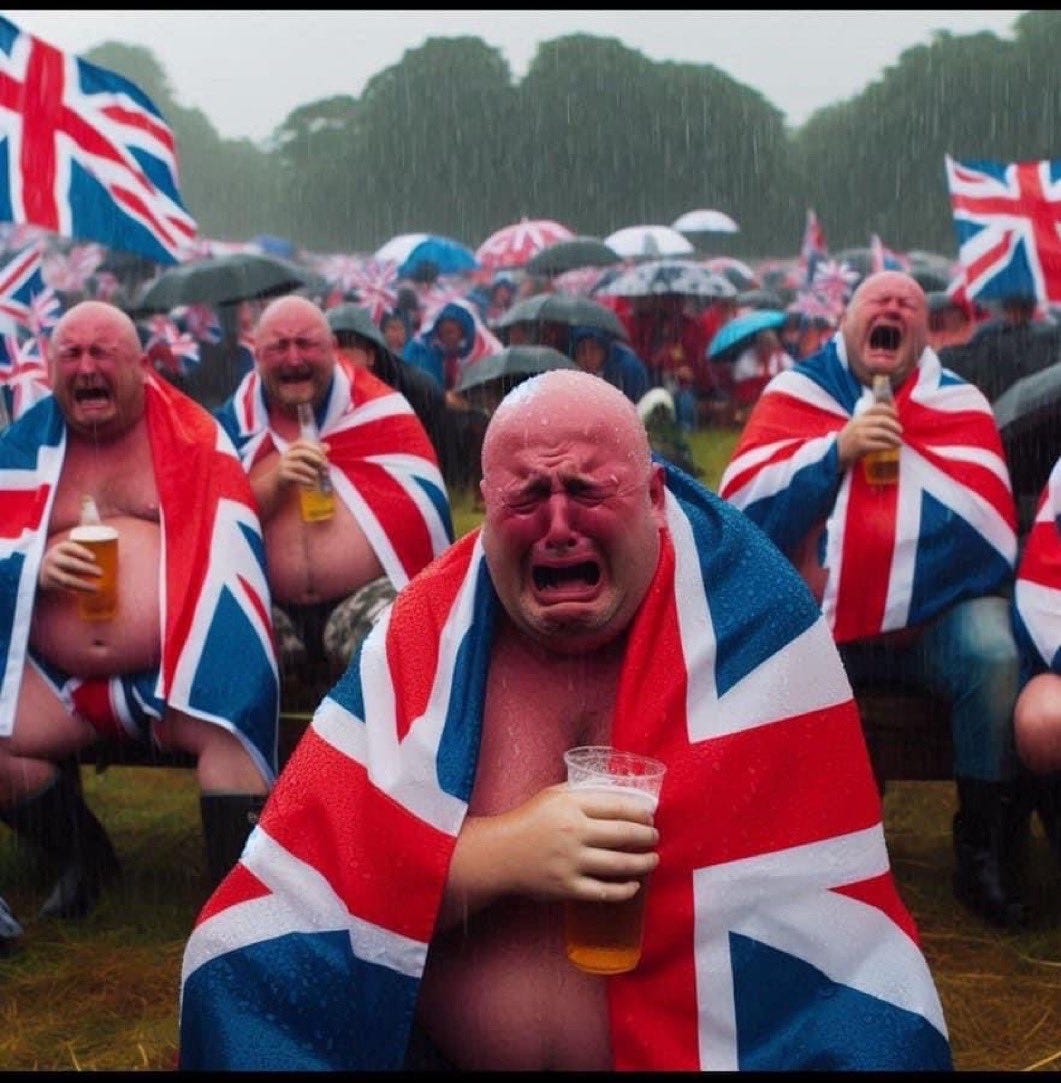
Jul 19, 202400:09:45Tap to summarizeIt’s been a bad week to be English after we came so near, yet so bloody far… again… in yet another major football tournament. Whilst a fair-weather fan, I felt the depths of disappointment around me amidst a 1000-strong sea of red and white at a family festival as faces dropped and the tears flowed amongst the under 10s. Football apparently wasn’t, and isn’t anytime soon ‘coming home’. England supporters get a bad press and often rightly so when seen barrelling out of pubs, chucking lager and starting fights on the continent... but when faded popstrel-turned-podcaster Lily Allen waded in on them this week, sharing the image below, she was derided as classist, snobby… and ignorant (flag-wise). One particularly biting repost ‘I guess working class accents are more useful than working class people’...Thanks for reading Antidoters! Subscribe for free to receive new posts and support my work.Because yes, pride in English identity does seem to have become a working-class thing or at least restricted to the ‘somewheres’. And football now seems to be the only time the St George’s flag is allowed to display anything akin to national pride (unless you’re a black cab driver - the Palestine flag is apparently fine, the St George not so much - although the one-sided press coverage of Sadiq Khan’s ‘woke’ ban also shows the class divide here). Whilst the UK (London especially) turns green for St Patrick’s Day, April 23rd is merely another date in the calendar, one that many English wouldn’t even know is St George’s. Want to celebrate being English? Just shush. You must be ‘far right’ or will at least be accused of it… gammon, Brexiteer, nationalist etc. Where exactly is Englishness amidst Britishness now that all the other Brits have dropped it in preference for their Scottish, Welsh and Irish identities? (Even the Cornish seem more inclined to their local identity than Englishness these days). As a result, the two are now frequently conflated, with the English the only nation to wave the Union Jack - and pretty much only during royal occasions, Wimbledon or at the Last Night of the Proms. It often gives me pause for thought as my husband is Scottish and proud - kilted and sporranned-up for every formal occassion - and now I have ‘dual-identity’ children. This makes the occasional football or rugby match difficult, but really little else besides. And for all the Scottish-English rivalry (which let’s be honest, only goes in one direction), I love that my children have Scottish heritage. Indeed, their Scottish family has much more interesting ancestry than my own, descended from Stevenson lighthouse builders and more recently, a successful female author. All ‘minority’ nationalities are allowed to be celebrated in our multicultural age of inclusivity, but we now lack any coherent umbrella under which we can all identify. In the US, immigrants (I believe!) are still required to pledge their allegiance to a flag that flies across the nation, with the national anthem played at every major event, but in the UK, we do neither and make little attempt to unify the various nationalities now on this island. Harking on about Britain’s illustrious past is now frowned upon. Too much controversy with regards to power-plays and empire. Modern Britain is no longer one evoked by Hovis adverts, ‘Last of the Summer Wine’, or John Major’s 1993 speech, where he said: Fifty years from now Britain will still be the country of long shadows on county grounds, warm beer, invincible green suburbs, dog lovers and pools fillers and – as George Orwell said – “old maids bicycling to Holy Communion through the morning mist” and if we get our way – Shakespeare still read even in school. Britain will survive unamendable in all essentials.But is it, only 30 years on? It is, at least in the main, still a ‘green and pleasant land’ as of the famous ‘Jerusalem’ lyrics, but perhaps only for as long as we can protect the green belt or keep the solar farms at bay. The outdoors lover in me adores the very ‘English’ Lake District, with my coast-to-coast walk across the North of England one of my most precious memories. The history student in me loves the beauty and traditions our history has bequeathed us: gorgeous cathedrals and stately homes - built over generations, not just lifetimes; well-planned towns, poetry, literature, philosophy and art. And for some reason this tiny island (and the English especially) has gifted the world some of the best music of the last century. And the love of all-things-British survives abroad, as the queues of tourists queueing for a photo outside the red phone box in the shadow of Westminster tower attest. A second cousin is the son of a GI-bride who adores British history and has written a history of York Minster over successive visits; a good friend in Canada sends me frequent forwards about British humour, conventions and history; all our overseas guests marvel at our history and generations-long traditions and would delight in my father regaling them with Shakespeare’s Henry V ‘St Cripsin’s day’ speech at parties. Which begs the question, what, if any of this, is worth us feeling pride in….? Even the monarchy itself is faced with the existential threat of a rising tide of republicanism and the National Trust seems hell bent on apologising for who we were throughout history. Last week, I saw an arresting tweet by Gad Saad, a Canadian Professor of Behavioural Science which stopped me in my tracks. World history is defined by the following simple rule. There are two groups on either side of a river. Each covets various resources from the other group. The only thing that stops a perpetual conflict between the two groups is the realization by each group that the other will respond in equal measure (or worse) if attacked. Now imagine that the West has decided to throw away this defining dynamic that shapes this fundamental historical reality. Defending what is ours is rooted in our genes; it is a central feature of our human nature. But the West has said that we are so progressive, so empathetic, so enlightened that we are not bound by pedestrian biology. Hence, we will not defend our culture; we will not defend our heritage; we will not defend our religion; we will not defend our women; we will not defend our children; we will not defend our values. According to our Western leaders, only barbarians worry about such defensive concerns. We are open, tolerant, kind, compassionate, welcoming. No amount of evidence can convince us that other groups might do us harm. And hence, we brainwash our children who become our politicians; we rejoice in the rape of our societies because this proves that we are kind…. But how can you change anything when your society is hellbent on committing orgiastic suicide?Ouch. Whilst somewhat apocryphal, I tend to agree that our inability to foster any sense of shared identity amongst the disparate groups that make up modern Britain is a serious error and yet another reason why modern Britain is so polarised. It strikes me that for a society to survive, let alone thrive, the people must feel proud of themselves, their culture, their values, their ideas, their history, and that they must pass that pride on to their kids. Yes, a reconciliation of the worst aspects of our past is hugely important - with many lessons to be learnt - but we seem hell bent on throwing out all the good with the bad and blaming ourselves for the mistakes of our ancestors. I’ll leave the last, more eloquent diagnosis of what might be going on to Thomas Sowell: “Despite a tendency in some intellectual circles to see the nation as just a subordinate part of the world at large — some acting, or even describing themselves, as citizens of the world — patriotism is, in one sense, little more than a recognition of the basic fact that one’s own material well-being, personal freedom, and sheer physical survival depend on the particular institutions, traditions and policies of the particular nation in which one lives. There is no comparable world government and, without the concrete institutions of government, there is nothing to be a citizen of or to provide enforceable rights, however lofty or poetic it may sound to be a citizen of the world.” God save the King! Ing-er-Land!Thanks for reading Antidoters! Subscribe for free to receive new posts and support my work. This is a public episode. If you would like to discuss this with other subscribers or get access to bonus episodes, visit antidoters.substack.com
Transcribe →
Rory-Sutherlanding the Kids & Smartphones Problem
May 24, 2024Tap to summarizeEntrepreneurs are optimists by nature and masters at turning problems into solutions. Many of the best harness counter-intuitive thinking that plays on human emotion rather than rationality - as best articulated by the Prince of behavioural interpretation Rory Sutherland (who may or may not appreciate being verbed). So how can we harness his antidoter ways of thinking to solve the teen smartphone problem? (or get him in a room with Jonathan Haidt for a brainstorm - I’ll make the tea and take notes).My career has been shaped by seeking to fuel the innovations of optimists. It’s why I’ve invested the last three years at Sweatcoin, an exciting business which took the huge problem of our increasingly sedentary, unhealthy lifestyles and turned it into an opportunity. They believed (and have since proven with over 150M global users) that incentives and rewards can represent a paradigm shift in how we think about movement: the difference between choosing to stand on a moving-up escalator or walk up it; of taking the stairs rather than the lift or proactively getting off a bus a stop early. Each additional step = points which can be spent on a range of goods and services. It provides daily nudges that have the power to impact life-long behavioural change. Thanks for reading Antidoters! Subscribe for free to receive new posts and support my work.Ultimately, the Sweatcoin vision is to create a ‘movement economy’, one to rival the attention economy - but unlike the latter, offering a win-win for all, connecting brands and users in a marketplace of reward and benefit, with the potential to save the taxpayer billions on preventable diseases. (Type2 Diabetes costs the NHS £14Bn a year, >10% of its total budget and more than the police, fire and judicial system put together(!!). With news this week that diagnoses are up 39% for Under-40s in just 6 years, move more, people. Move more). Being a small part of Sweatcoin’s success leads me to wonder how such incentive-led solutions might be harnessed for other problems I care about. Working closely with such do-ers also explains my frustration with the opportunity cost of so much navel-gazing social discourse and the negativity of tear-down strategies. Too many super-smart people get stuck in awareness-raising-mode (often misdirected by biased data) or rage, seeking to dismantle rather than build to take bites out of problems. Rory Sutherland is the master of positive alchemy and counter-intuitive thinking. He wrote the book on it. He is one of the most erudite, amusing and potentially irritating podcast guests, with his hosts struggling to get a word in edgeways as he goes off on tangents of whimsical anecdotes to highlight insights into behavioural science E.g. here, here, here (lesson to podcasters: just let him rip). He is particularly strong on how simple reframing can solve problems. E.g. repositioning the annoying bus that arrives to unload plane passengers as a VIP chauffeur direct to immigration to avoid the queues; how a fraction of the money earmarked for HS2 rail could have created greater opportunity if it went towards upgrading existing trains with greater comfort and reliable wifi for relaxation and deep work opportunities; or how the Uber live-map functionality is ‘a psychological moonshot’- not reducing waiting time but making it 90% less frustrating. As an Ad-man, he frequently references the many brands that have successfully played with perceptions, turning weaknesses into strengths - think Guinness’s ‘good things come to those who wait’, Stella’s ‘reassuringly expensive’ or Marmite’s ‘love it or hate it’. Some favourite quotes: “Engineers, medical people, scientific people, have an obsession with solving the problems of reality, when actually … once you reach a basic level of wealth in society, most problems are actually problems of perception.”“The skill you need to win an argument is not the same as the skill you need to solve problems, yet our education system conflates the two (and we only reward the former in politicians)”. “A flower is a weed with an advertising budget.”“The trouble with market research is that people don’t think what they feel, they don’t say what they think, and they don’t do what they say.”“It is much easier to be fired for being illogical than it is for being unimaginative. The fatal issue is that logic always gets you to exactly the same place as your competitors.”“what matters is not whether an idea is true or effective, but whether it fits with the preconceptions of a dominant cabal”‘A rich man is any man that earns more than his wife’s sister’s husband’ (*possibly not his but sounds like it should be)On listening to Rory, I find my brain fires in different directions. Of course, one strategy is simply to challenge preconceptions and problem-diagnosis with nuance (the antidoter blog strategy), but how can we also channel energies and his type of thinking into incentivising, positive solutions? Take kids and smartphones. Now the evidence is in for its many negative impacts, my fear is that we are at risk of creating a punishing vacuum for the young with few alternatives in our safety-first culture. Where are the incentives? There are fewer youth clubs or places to hang out; fewer parents willing to give their children the independence in real life (IRL) that they enjoyed (despite evidence it’s much safer than the online world); poor public transport, plus - most fundamentally - a huge chasm to cross before we can reach a tipping point of those without the internet in their pockets being numerous enough to occupy each other. We urgently need entrepreneurs to rush into this challenge. How do we reframe screen abstinence as IRL opportunities and make it cool? What incentives could we provide as an alternative to scare-mongering, nagging and abstinence? Can we connect IRL brands (who will be losing business to the 7 daily hours now spent on devices) with teenagers in a loop of reward akin to Sweatcoin’s model? How can we encourage investment in new offline business models when incentives are now so skewed towards the 100x returns that only tech-scalability can offer? One aspiring business I’ve discovered (through this blog and its associated Linkedin posts) and hugely appreciate is ‘The Den’ who are building a nationwide network of social clubs, designed by teenagers for teenagers. Take powerful video setting out the problem and their vision, alongside the brilliant social campaign they’ve kick-started #IRLRevolution. Invest if you’re so inclined…This week, a request: please share any others that you stumble across that you believe might have a role to play in tackling this problem, however obliquely. Holiday clubs, Forest schools, conversation-starter cards, geocaching ++ etc. We may still be in the problem-identification stage, but we need to move rapidly to solutions: knowledge-sharing, dot-connecting and market and network-building. Antidoters Assemble! * subtitle quote not actually Rory… credit: Charlie MungerMore: Do subscribe to Jon’s After Babel Substack to keep abreast of his work. Thanks for reading Antidoters! Subscribe for free to receive new posts and support my work. This is a public episode. If you would like to discuss this with other subscribers or get access to bonus episodes, visit antidoters.substack.com
Transcribe →