← Apologetics Profile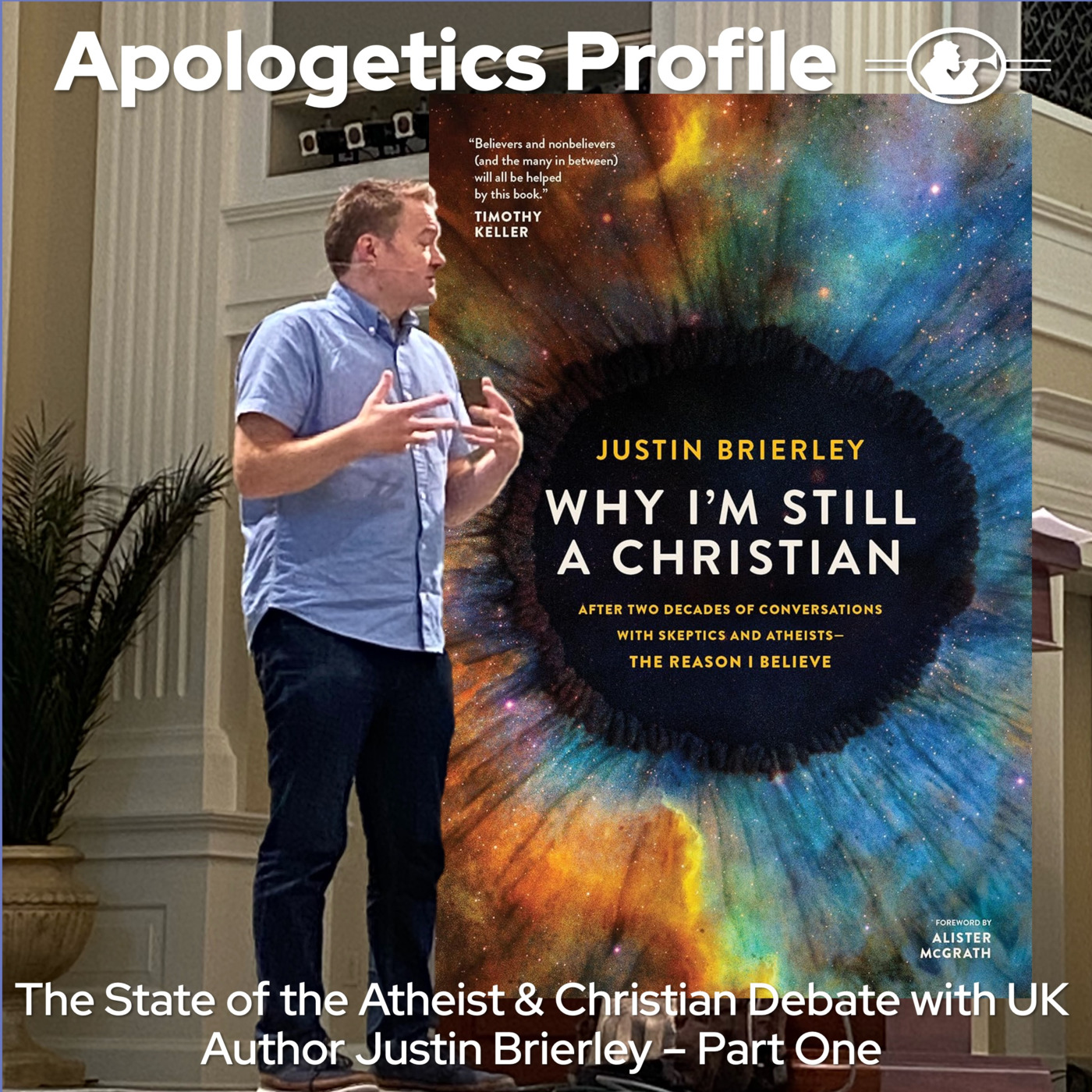
Apologetics Profile
Episode 298: The State of the Atheist & Christian Debate with Author Justin Brierley
00:49:47
New Atheism is in decline but atheism in general still persists. But so too does Christianity. Wh...
Loading summary
Transcript80 lines
- [00:00]
Podcast Host (Watchman Fellowship Announcer)
You are listening to Watchman Fellowship's Apologetics Profile podcast.
- [00:09]
Host / Interviewer (Apologetics Profile Host)
If you at all follow the Christian atheist dialogue these days, you are probably aware of at least a few things. One is that there seems to be a resurgence of interest in Christianity from atheists and agnostics who have never previously had any interactions with Christianity. They have been drawn to the Gospels and are sometimes impressed by what they see about Jesus. Here is someone, for example, from my own teenage years who was a feature VJ on mtv, Adam Curry, who has recently become a Christian. The following clip is from his appearance on the Joe Rogan Podcast from two years ago, talking about Jesus as the son of God.
- [00:55]
Adam Curry
I was very interested by this because I've looked at every conspiracy theory. You know, moon landing, 9, 11, JFK. I mean, all kinds of conspiracy, but the one I had never looked at. And now, you know, I'm 58, so I'm like, okay, let me look at this one. Is God. And I said, let me see about this God thing. I've never been a religious guy. And so I start reading and I start talking. I also found that around me, like a couple of people I was working with, they were all Christians, and not that anyone was ever pushing anything on me. When I asked them questions, they were gladly answered. And there's a lot of stuff written about Jesus. There's a lot written, you know, thousands of years of books, and there's some contemporary stuff, such as evidence demands a verdict. And, you know, there's just so much. And I gotta tell you, Joe, God is real. Jesus existed and has changed my outlook on life.
- [02:01]
Host / Interviewer (Apologetics Profile Host)
Adam's testimony is a sobering reminder of the intrinsic power of the Word of God to change people's hearts. Our guest this week and next on Apologetics Profile is author, speaker, and podcast host in the United Kingdom, Justin Brierly, who has spent over 20 years interviewing both atheists and Christians, first through his immensely popular Premiere radio show, Unbelievable, and now on his own platform on Patreon and YouTube. For many years, Justin's Unbelievable broadcasts were what I listened to in the car on long road trips. So it is once more an honor and a privilege to have spoken with him again here on Apologetics Profile. I spoke with Justin in person here in Texas in the fall of 2023 when he released his new book, the Surprising Rebirth of Belief in God. Links to those episodes and Justin's books can be found in the notes of this episode. Justin recently spoke to a popular YouTuber known as Sargon of Akkad, whose real name is Carl Benjamin. Benjamin no longer considers himself to be a hardliner new atheist and now leans more agnostic. He told Justin in the interview how he really enjoys reading CS Lewis and is presently attending church with his wife. While he has not yet become a Christian, he is seriously considering it much more than he used to. Here's Carl telling the story to Justin of how his children were recently baptized.
- [03:52]
Carl Benjamin (Sargon of Akkad)
Like, I've got four children, trust me, they all have the sense of wonder that Lewis is speaking of. They will be those people that Gaius and Titus are slowly but surely killing off. And we have to be very conscious of that. And if, I mean, if I were given control of the education system now, it would look very different and probably very Christian, even though I'm not on myself, which I realize is ironic, but I, I view myself as living in a paradigm where I've had something taken away from me. Before I was able to walk, this had been taken away from me, and I don't want to take away from my children. So, for example, my son a couple of years ago, he's 10 now, but six or seven, he's in a multicultural school as children are, and he has friends who are Indian and they're Hindus. And he's like, oh, dad, what am I? Am I Christian? I'm like, yes, you're a Christian. And I arbitrated a discussion between him and my eldest daughter which said, no, we're not Christian. I was like, yes, we are Christian. Like, just, you know, this is where we are in the paradigm where we're Christian Englishmen, English women, this is what we are. And you be aware of it, basically. And so he's very readily said, oh, I like being Christian. I like Jesus. That's brilliant, son. That's absolutely brilliant. You know, I'm glad you get to have something I didn't have.
- [05:16]
Host / Interviewer (Apologetics Profile Host)
Okay?
- [05:16]
Carl Benjamin (Sargon of Akkad)
And it really hit me when we got our children baptized. So my wife wanted all of our kids to be baptized in her local church, which I kind of hate. It's not the baptism, it's the church itself. It's just this empty red brick structure and it's, it's, it just kind of reeks of modernity, you know. And so I'm like, look, if I'm, if I'm going to go to religion, I want religion.
- [05:44]
Justin Brierly
You want an old building?
- [05:45]
Carl Benjamin (Sargon of Akkad)
Yeah, it's not just, it doesn't have to just be an old building, but I want like, they have like modern pop songs playing there.
- [05:50]
Justin Brierly
And I'm like, no, no, no, no.
- [05:51]
Carl Benjamin (Sargon of Akkad)
I want hymns. I want, you know, let's do.
- [06:19]
Host / Interviewer (Apologetics Profile Host)
Benjamin notes that he is impressed by C.S. lewis's argument in the Abolition of Man. Lewis's argument in Abolition is not, as Benjamin says, self evident. It requires deeper reflection. Lewis begins with a critique of an English grammar book he calls the Green Book and keeps the names of the authors a secret, calling them Gaius and Titius. The book is actually titled the Control of Language, written by Alec King and Martin Ketley, first published in 1919. I myself have a copy of the ninth printing from 1950. The control of Language was a widely used grammar school book in Lewis's day. In the Control of Language, King and Ketley suggest that calling a waterfall sublime is only a matter of one's own subjective feelings and emotions, not a statement about anything objectively real pertaining to the waterfall itself. Lewis, however, argues that if King and Ketley are right, then there is also nothing objectively real about virtue or morality, as those too would be nothing but the subjective feelings and emotions of individuals. Lewis says this impulse to relegate morality and virtue to mere feelings creates men without chests, where the chest is considered to be the seat of virtue. Lewis also points out the even bigger problem of introducing this idea to young students in a grammar book as merely a lesson in grammar, disguising its otherwise dangerous philosophical implications. The students believe they're just learning about the English language, when in truth they are being subtly indoctrinated in a philosophical commitment that engenders moral relativism. To put it another way, imagine standing on a ledge at the Grand Canyon and seeing a sign posted about the danger of standing too close to the edge. According to King and Ketley, however, the danger is merely the subjective feeling park rangers have about the canyon, not anything objectively true. And if virtue and morality are merely the result of our collective emotional dispositions, then what of our faith and belief in God? Is faith just emotive, wishful thinking? Will it just eventually disappear? During our conversation, Justin told me the story of something he'd recently heard atheist Richard Dawkins say during a live discussion with Canadian Steven Pinker and an atheist and a psychologist. In the following clip, you'll hear Pinker ask the question from an audience member, followed by Dawkins response, would you want religion to have never existed or ceased.
- [08:59]
Justin Brierly
To exist from now on?
- [09:01]
Richard Dawkins
I think both. I certainly would like it to cease to exist from now on. There are people who would say that historically religion has had beneficial effects. Some people say that Christianity provided a sort of climate in which science could evolve. I've never found That a very convincing argument, but some people would say that, but I think my own answer would be I would like it never to have existed.
- [09:42]
Justin Brierly
It's classic Richard Dawkins playing to type, really. But I was very disappointed because he, it seems crazy to me that he hasn't sort of at some level realized by this point that religion A is not going anywhere because it, we're sort of intrinsically religious. And he's witnessed that even, you know, traditionally non religious people can still get very religious about certain subjects, like gender, for instance, which is the main battleground he's been fighting things on recently. And secondly just, it just flies in the face of what he said about a year ago, which is that he's very glad to live in a Christian country because he really likes the cathedrals and the Christmas carols and the sung evensong. He doesn't want that to go away. Well, the problem is if religion goes extinct, it will go away.
- [10:33]
Host / Interviewer (Apologetics Profile Host)
Of course. Christianity isn't going anywhere. Despite the number of testimonies of those who no longer find it plausible. Belief in Jesus is far more than just emotional subjectivism. Waterfalls are truly sublime, the Grand Canyon is truly an objectively dangerous place. And Jesus really existed. Jesus really did die on the cross and really was resurrected from the grave. Whether or not you believe what the Bible says of Jesus, the centrality of his place in history cannot be denied. As the atheist historian and novelist H.G. wells said in a July 1922 article in the American magazine, of course you and I live in countries where to millions of men and women, Jesus is more than a man. But the historian must disregard that fact. He must adhere to the evidence which would pass unchallenged if his book were to be read in every nation under the sun. Now, it is interesting and significant, isn't it, that a historian setting forth in that spirit without any theological bias whatever, should find that he simply cannot portray the progress of humanity honestly without giving a foremost place to a penniless teacher from Nazareth. By contrast, Richard Dawkins has made a career out of downplaying that particularly curious fact. He has famously made a name for himself as one of the Four Horsemen of the New Atheist movement of the early 2000s. Dawkins does acknowledge that Jesus existed. And here, in a 2017 debate with Oxford mathematician John Lennox, Dawkins admits that Jesus did in fact exist, though he does not believe in the miraculous aspects surrounding his life.
- [12:32]
Richard Dawkins (Debate Clip)
When you look at history, and let's leave aside maybe I alluded to the possibility that some historians think Jesus Never exists. I take that back. Jesus existed. However, if you're going to say that Jesus was born of a virgin, that Jesus walked on water, that he turned water into wine, that is palpably anti scientific, there is no evidence for that. And if there were, you would be. Well, no, there simply isn't any evidence for that. And no scientist could possibly take the idea seriously.
- [13:06]
Host / Interviewer (Apologetics Profile Host)
Dawkins has repeatedly rhetorically downplayed Jesus influence in his atheistic polemics against Christianity. But what does science have to do with Jesus? Miracles. This is the modern myth of our time, that science is the only way we can really know what is true about the physical world. But how would Dawkins, for example, use science to show that science is the best or the only way one could investigate what the Bible says of Jesus? He simply could not. Three of the other four horsemen, Sam Harris, the late Christopher Hitchens and the late Daniel Dennett, also had a similar rhetorical approach to denigrating the centrality of Jesus and Christianity in the West. But they often failed to offer any kind of substantive arguments. Here's what Carl Benjamin had to say to Justin during their interview about these arguments.
- [14:11]
Carl Benjamin (Sargon of Akkad)
They didn't kill belief in Christianity, they buried it. They were essentially kicking an open door. The civilization had long become secular and since the boomers, really, the boomers were genuinely quite a secular generation and just found themselves choosing not to believe for whatever reason. And so by the sort of late 90s, early 2000s, when you had Hitchens and Dawkins and Sam Harris and Dennett having arguments with the religious rites, they had a kind of rootedness that the religious right didn't have in the popular culture. And so they could draw upon a set of everyone knows this sort of assumptions. And so, and even now, though, I look back and I think God, their arguments were terrible. Absolutely. I mean, I saw, I saw a clip of Sam Harris just from about a year or two ago saying, well, I look up into the heavens and I don't see God, so where is he? And it's like, Sam, after all of these, after all of this time, how, how have you not realized that the concept of God is outside of the material universe? Like, I'm sorry, I'm an atheist, you know, but, but your argument is just bad, right? And you fail to understand. But how did the religious right at the time let him get away with these arguments?
- [15:30]
Justin Brierly
Well, I, I think there were some people trying not to let him get away with it, but sometimes it's the person with the loudest megaphone that, that.
- [15:38]
Carl Benjamin (Sargon of Akkad)
You tends to, just as an atheist, I'm kind of embarrassed by it.
- [15:49]
Host / Interviewer (Apologetics Profile Host)
As we begin part one of our conversation with Justin Brierly, I asked him what he thought about what seemed to be two parallel trends in relation to Christianity on social media today. Agnostic and atheist intellectuals seriously contemplating Christianity for the first time and the popular hashtag trend of deconstruction, which is comprised of people who did once believe in the truth of Christianity, but who no longer find it credible. Here is Justin Brierly.
- [16:19]
Justin Brierly
I think there's a search for authenticity in Christianity and faith. And a lot of the deconstruction is from where I can see a lot of it is really stemming from a lot of evangelicals who have become disillusioned with a certain form of evangelical subculture, especially in the US Especially have quite politicized sort of form of Christianity. And, and to that extent, I don't think they're all rejecting Christianity full stop, but they're kind of rejecting the version that they've often grown up in and been, you know, and, and that in a way is. Yeah, that's been a trend for quite a long time. I think it's just become more noticeable in the era of Instagram and Twitter and everything it gave. It's given a more of a platform for some of the more significant voices to, to talk about that in public. I think the rebirth thing is, is interesting because that's a movement that's really about people. For me, that's about people who haven't ever really been exposed to much Christian faith in the first place starting to take an interest. And they are. A lot of those are people who are looking for a better story, you know, searching for, for kind of some meaning in a. What they feel is a quite kind of shallow and worrying culture. And, and a certain number who are, you know, are suddenly rediscovering Christian values and that they come from somewhere, you know, and so I think there's a sort of, yeah, they, they do pull against each other, those two, those two streams. But I suppose there's a certain number of the deconstructionists who kind of are actually not necessarily going off to complete atheism or skepticism, but coming around to a. More often they're deconstructing to something broader than the evangelical church. So a number of the people I've spoken to who have arguably gone down the deconstruction route from an evangelical perspective have ended up in like, Anglo Catholic, Catholic, Orthodox type circles. And that, interestingly, is one of the areas where you are Seeing the surprising rebirth manifesting most strongly. So there's a kind of, it's almost like certain parts of the evangelical church aren't benefiting that much actually from this rebirth. It's often located in these other streams of Christian tradition.
- [18:51]
Interviewer / Conversational Partner with Justin Brierly
Do you think that's because the Orthodox and the Catholic generally tend to have more of an emphasis on a long standing tradition, whereas Protestantism is seen as something that sort of is anti traditional?
- [19:06]
Justin Brierly
Yeah, I think that's right. I think, I think, I think there's an attraction for a lot of people too. The stability, the longevity, the tradition of those, of those places. They are looking for something that looks quite different to the culture and a lot of the evangelical churches. You know, this is painting with a very broad brush because obviously there's lots of evangelical churches doing very well, but are often appealing in similar terms to the culture that already exists. And it's, it's, it doesn't look or feel that different. It's, it's. And I think that's also why a lot of the, the mainline churches are kind of disappearing as well, is because they've, they've got really nothing extra to add to what people can already get in culture. I, so, so I think that's, that's part of it. The eastern, I mean the east, North. I, I think yeah, it's also something to do with that a lot. So a lot of the return people who are returning to church are these young men. And I think for whatever reason, Catholicism and Eastern Orthodoxy represent a kind of something that, that feels serious and gives a kind of grounding to a lot of young men that I don't think they necessarily see as clearly in other church traditions, interestingly so. But there are of course there are always exceptions to that. So there are lots of evangelical churches I know that have a, you know, have quite a thriving men's ministry now because of, because they're encountering so many of these young men looking for, for that kind of thing.
- [20:44]
Host / Interviewer (Apologetics Profile Host)
I've been reading this book and it.
- [20:46]
Interviewer / Conversational Partner with Justin Brierly
Was not really kind of related to our podcast, what we're talking about today, but this is a great book.
- [20:51]
Host / Interviewer (Apologetics Profile Host)
It's called A Walk in the Park. It's about two amateurs who decide to.
- [20:55]
Interviewer / Conversational Partner with Justin Brierly
Walk the length of the Grand Canyon, which turns out to be about a 700 mile walk. And I wanted to read something that triggered my thinking about your book about why you're still a Christian.
- [21:08]
Host / Interviewer (Apologetics Profile Host)
And I think it's one of the.
- [21:09]
Interviewer / Conversational Partner with Justin Brierly
More powerful arguments that I find when I'm reading non Christian literature necessarily I'm in an all atheist book club and I'm actually reading this book for our atheist club. And there's a part in the story where the hikers are rappelling down into.
- [21:23]
Host / Interviewer (Apologetics Profile Host)
What they call slot canyons.
- [21:24]
Interviewer / Conversational Partner with Justin Brierly
These are unexplored regions of the Grand Canyon that hardly any human being has ever set foot in.
- [21:29]
Host / Interviewer (Apologetics Profile Host)
And it's a little dangerous. But they were describing this one slot.
- [21:33]
Interviewer / Conversational Partner with Justin Brierly
Canyon that they slid down into and the author describes it as a, as a cathedral like. And one of the, one of the, one of the hikers says, I feel.
- [21:47]
Host / Interviewer (Apologetics Profile Host)
Like this is what people are trying to create when they build actual cathedrals.
- [21:53]
Interviewer / Conversational Partner with Justin Brierly
And when we entered into this gorgeous realm, we lowered our voices and spoke in whispers as if we had stepped into a place of worship. And you know, they're not theists, but.
- [22:05]
Host / Interviewer (Apologetics Profile Host)
The best metaphor that they can come.
- [22:06]
Interviewer / Conversational Partner with Justin Brierly
Up with is cathedral and a sacred place, a place of worship. And it seems in your conversations with people that are reconsidering the faith, Justin, how much does the universe design in the universe and creation play in their thinking about God? Do you find that to be a powerful argument?
- [22:27]
Justin Brierly
Absolutely. And I'd say it's, it's not just in a sense that those elements that, you know, we often talk about in Christian apologetic circles about the fine tuning of the universe and the way it's, you know, it's extraordinary complexity of life and everything else. I think it is the encounter with it and the, the, the, the sense of, or, and wonder that certain encounters with nature, the type you just mentioned there, going down into the Grand Canyon or, or, or a mountaintop experience or some kind of, you know, seeing the, the, the kind of vast expanse of the heavens. I think they do naturally create a sort of sense of transcendence in people. And I think those are probably the moments when, yeah, the average atheist maybe feels the greatest tug on their sense that this is, this is just, you know, all here by chance. You know, if they, if that, if that's their way of looking at it. I think that can often be challenged at that moment when you have a, an experience that seems to point beyond itself, point beyond you. So I've certainly, you know, encountered many, many atheists, well, converts from atheism to faith who have, have had those moments, you know, where they've just sensed there's something more here. And they've not, maybe given that, you know, they've not, they may be fleshed out entirely philosophically or intellectually, but it's perhaps been the starting point for something. I mean, Someone I'm reminded of on that front, a different kind of, or a wonder. But. And I tell her story briefly in the book is Jen Fulweiler, whose story you may be familiar with, but, you know, was a very much a confirmed atheist all her life. Brought up very much without any need for religion, very scientific, materialist kind of outlook, until the early years of her married life when she had a child. And it was really the experience of holding this newborn baby in her arms and this extraordinary feeling of love she had for it. And she sort of says she had this sort of internal dialogue with herself where she said, well, what is this feeling that I'm feeling for this child? At a purely materialist, atheist level? You know, it's my neurons firing in such a way as to create the chemistry that creates this feeling of love. And, you know, anything I feel for him is basically just my brain. And she looked at this child and said, that's. That, that's not true. That's not truth. She, she just couldn't reconcile herself in that moment to this idea that this is just brain chemistry. And that was, you know, that, that, you know, this, that was the, the. The moment really, which set her off on a journey which led eventually to. To Christian faith. Now, that's not going to be true of everyone, obviously, but I do sense that, yeah, those are the sort of. Whether it's the ore of the Grand Canyon, you know, the mystery of birth and the love that a mother feels for her child. Again, you could provide naturalistic explanations for all those things. It's not that there aren't potential, you know, a materialist sort of explanation you could reach for. It's just that I think in those moments when you're actually having the experience, a lot of people feel like that's a too thinner story to make sense of what's actually happening in this moment, you know.
- [25:53]
Interviewer / Conversational Partner with Justin Brierly
Well, I know Richard Dawkins has been notoriously, frequently corroded as saying that the design in the universe does appear to be there, but it is illusory that these things that seem to give us the sense of the most belonging and the most meaningful experiences seem to be real. But if it is just brain chemistry, it is. It is an illusion to some degree that is created by our.
- [26:26]
Justin Brierly
Yes, as he puts it, the universe. Well, he's. It's a bit contradictory, Richard Dawkins, because. Because he also says the universe has all the properties we should expect. If there is, at bottom, no good, no bad, no truth, no beauty, just blind, pitiless indifference. I'M slightly mangling the quote there, but. But the problem is that, you know, actually, Richard Dawkins does believe in truth and beauty. Now, he may give it a kind of chemical explanation, but he still sort of relies on those concepts. And it's very difficult to sort of pull yourself up by your own bootstraps and sort of simply anchor them in physical processes. And so you're. I think he always runs into a problem. There's, you know, and Richard Dawkins is the first to say how, meaning, how beautiful he finds even a cathedral coral, even song. He's. He goes along to coral Evensong in Oxford quite regularly because he loves the feelings it gives him. Now, he. He presumably says this is just brain chemistry. But, you know, I like to. I like the nice brain chemistry that happens when I'm in this scenario. I want to say to him, well, look, from where I'm standing, that is far better explained by the idea that there's something beyond just the brain chemistry. And the universe I observe does not have the properties of being this blind, pitiless, indifferent universe. It's a universe that is actually teeming, it would appear, with design and meaning. You know, even our best science seems to be pointing that direction. And in his most generous moments, even Richard Dawkins has said to me, you know, in conversations. Well, actually, if there was one argument that might kind of move the needle on me towards God, it's. It is the fine tuning of the universe. So even he recognizes there's something interesting going on there. Yeah, so. So he's. He's a. He's a sort of somewhat confusing and contradictory character because again, I, funnily enough, just two nights ago, as of recording, I went to see him in conversation with Steven Pinker in London. And, you know, interesting conversation. Obviously, they share most of their worldviews, you know, they hold in common. So there wasn't much disagreement between them. But during the Q A, one of their audience members asked Richard Dawkins because they were discussing the future of humanity. They asked, well, what do you think the future of religion is? Which hadn't really come up in their conversation. And he said, just very briefly into the point, he said, well, I hope religion goes extinct. And it was just. I was just very. I mean, it's. It's classic Richard Dawkins playing to type, really. But I was very disappointed because he. It seems crazy to me that he hasn't sort of at some level realized by this point that Religion A is not going anywhere because it. We're sort of intrinsically religious. And he's witnessed that even, you know, traditionally non religious people can still get very religious about certain subjects, like gender, for instance, which is the main battleground he's been fighting things on recently. And secondly just, it just flies in the face of what he said about a year ago, which is that he's very glad to live in a Christian country because he really likes the cathedrals and the Christmas carols and the sung evensong. He doesn't want that to go away. Well, the problem is if religion goes extinct, it will go away. You won't have these nice trappings of cultural Christianity that sort of you, you like Richard. So it's a strange sort of mixture of things that Dawkins says and, and I find it hard to reconcile them all most of the time.
- [30:12]
Interviewer / Conversational Partner with Justin Brierly
Yeah, yeah. I was watching your interview with Larry Sanger, the founder, co founder of Wikipedia you did a couple of weeks ago, became a Christian, very rational approach to Christianity. But he describes the moment in your interview when he's telling you he's praying to God and found it to be a very irrational act and was having a hard time making that leap, if you will, for lack of a better word. But then he finally recognized what the idea of faith means and he breaks through the stereotype. God seems to just kind of break his stereotype that faith is belief without evidence, as you commonly hear caricatured by skeptics. And Larry came up with this. He recognized what pistis means, the biblical word for faith, that it is an act of trust in God. It's the Hebrews 11. You place your faith in God. It is an active reliance upon an active trust. You live your life in accordance with your complete and total dependency on God. I found that to be fascinating. Larry being such a rational individual, obviously a philosopher, philosopher at heart, obviously gifted in that area. God being able to break that defense of his intellectual defense of what he thought faith was. And in this conversation, Justin, with believers and unbelievers, Larry's concept of faith seems to be his pre conversion conception of faith. Seems to be very common among skeptics, that they think if they put their faith in God that that's an irrational act that is just believing without evidence. But do you see that to be a common barrier for the people that haven't been able to cross over to full Christianity?
- [32:05]
Justin Brierly
Yeah, it's interesting because, you know, it does depend on the type of atheist skeptic you're talking to. And there are some for whom.
- [32:17]
Host / Interviewer (Apologetics Profile Host)
I.
- [32:18]
Justin Brierly
Think there's a level at which they really don't want to be persuaded, in a sense. And so they, they can talk. So they will talk about, well, once I've got enough evidence, you know, I, I'll, I'll, you know, think about changing my mind. But I'm, I'm kind of, I'm cautious of saying they'll ever have the amount of evidence that they seem to require because the goal posts often seem to move. And there's, there's some people that just, you know, it would appear so wedded to their naturalistic view that it's really not about evidence. It's about something else shifting in their mind to, to, to, to take them there. And then you've got people who are somewhere more in the middle who are, I think, actually interestingly, quite attracted to Christianity, would really like to believe, actually. And, and they will often say, I'm attracted to the values of Christianity. I love the idea of the community that you can get through church. I've kind of, maybe they've been convinced by the sort of Tom Holland thesis of the way in which Western civilization essentially runs on the operating system of Christianity. And they kind of. So they're all sort of the cultural importance of it and they may even have started going to church and trying to dip their, their toe in, but they find that, that they, they still sort of find that they can't make that intellectual leap just to sort of start believing in God and Jesus Christ being his son risen from the dead and so on. And, But I think with that. But what, what the difference is there is that I think there's a sort of an openness to go on the journey of, of investigating. And a number of those people who I've spoken to in that situation have, have, you know, perhaps they have found the kind of evidence they're looking for. I mean, one person for whom that happened quite recently is a very interesting woman called Molly Worthen, who you might have come across. Her story was that she was this sort of. At the University of North Carolina, Chapel Hill, had been basically a, a professor of religion in North America for a long time, but had been kind of agnostic pretty much all her life. And it was only because she, she sort of had a sideline in interviewing theologians, church leaders and other people for outlets like the New York Times and the Atlantic magazine and things. It was when she did a profile of, oh, the name of the, the church leaders go out my mind. But he, he used to be the president of the Southern Baptist Convention, J.D. greer. That's who I'M thinking of Greer. Yeah, big mega church in that part of the world. And he kind of challenged her once they'd kind of had a couple of interviews to sort of get off the agnostic fence and really look into the evidence for Jesus, who he was, what he claimed about himself, managed to put her in touch with theologians like N.T. wright and at the time, Tim Keller, who was still alive. And so she kind of had, she, she kind of took the challenge and really sort of started reading around this and you know, having interactions with some of those scholars and people. And what she discovered was the evidence for Jesus and his resurrection was far greater than she'd realized. And it was enough for her to, to kind of be able to jog her out of what she called this sort of materialist mindset that she sort of found herself in. So it really was the evidence that kind of gave her permission to start, invest to, to, to really take a step of faith. And she was baptized only a couple of years ago in J.D. greer's sort of megachurch. That, which is she, you know, she said, I'm, I've, I'd always been rather snobby about church tradition, so the last place I expecting to, to end up was in a mega church. But, but that was the way it happened for her. So, so it does happen, you know. Now she may be unusual. I think for most people in all honesty, the ground I think gets softened when they meet intelligent, thoughtful Christians most of the time. I find that's, that's kind of the trigger for, for helping them to. It's most often when people have kind of imbibed some sense of Christianity being irrational for kind of just extremist faith heads or whatever, that, that they, they kind of go away and sort of just, just put up the barriers. They never bother to even, you know, think about whether it could be true. I think that's been changing a lot and that's part of where my surprising Rebirth book sort of comes in. Just that I think the, the, the intellectual atmosphere has changed a lot. And so what people are now imbibing in terms of podcast and video and, and in the culture is just giving them a lot more permission to take Christianity seriously at an intellectual level. And that I think is tipping over into a lot of people kind of giving themselves permission to, to actually step into church to try praying, to do things. And, and as I say, I think we're seeing that probably most especially among young people for whom the new atheism they are, a lot of them just simply didn't encounter, you know, that, but they've been raised in a highly secular atmosphere, but one where they don't really have anything to kick against in terms of, you know, a religious framework. Certainly that's true here in the uk. Most young people have never been to church. They, they haven't really had a religious upbringing to kind of reject. And so they're actually ironically quite open to religion when they finally bump into it. And, and I think because it's so easy now to find good resources that do help to answer some of the classic questions around faith, it's sort of, there's a bit more of an open door. And just because that, that very new atheist style of engaging religion seems to have waned in the culture, I just feel like it's changed the way people interact with faith once they get to that point.
- [38:46]
Host / Interviewer (Apologetics Profile Host)
You have.
- [38:47]
Interviewer / Conversational Partner with Justin Brierly
In your why I'm Still a Christian. In the second edition I got, you had referenced your show where you had John Lennox and Lawrence Krauss, who is an atheist cosmologist, and you had talked about in the book that John had said he doesn't believe in the God of the gaps that Lawrence was positing to say that God is responsible for the universe, is a God of the gaps argument. That was Lawrence's argument. And it got into the discussion of meaning. You had talked about this, that the discussion between them had come down to the idea of telos or purpose. And Lawrence's argument seems to be that, well, why suggest purpose? What if there isn't any purpose? And so this idea of purpose seems to be driving the train as well, that how can this universe be meaningless? When I give talks about the universe, I use a helium balloon analogy. I say, if you come home and you see hundreds of helium balloons in the ceiling of your house, you're not just going to go look up at them and go, well, that's just helium. You're going to want to know why, you know, and so you multiply that ad infinitum with stars and you look it up and you're like, how can this be meaningless? How can there not be any purpose? How can we say that shoes have a purpose, but feet don't, or gloves have a purpose, but hands don't. How do you find, Justin, in your conversations with people, how important this idea of telos or purpose is in the cosmos and the universe and in their own personal lives?
- [40:21]
Justin Brierly
Yeah, Well, I was going to say most conversations you have with most people don't begin with the, you know, origins of the universe and why the stars are the way they are.
- [40:31]
Interviewer / Conversational Partner with Justin Brierly
Right.
- [40:32]
Justin Brierly
So most of the time when they're, when they're encountering the set, the questions of purpose, it is a personal sense of. Well, and that's where I think there is the most fruit to be had right now is, is a lot of people are asking those, those why questions of themselves in their own life and asking what's the point of my life? Because I do think that the new atheists like Lawrence Krauss have failed to deliver on that front as well. I don't think they've given a satisfactory story of what life is about. And so there's a kind of personal telos purpose question that I think is quite pertinent for people, but absolutely. I also do encounter it reasonably frequently with those who have taken some time to think about the bigger sense of why there is a universe. And like you, I think, I think Lawrence Krauss, it was a, it was a strange conversation, that one that he had with, with John Lennox because it does feel like he's trying to defend the indefensible when, when Lawrence Krauss says, you know, in that conversation, the why question is just a silly question.
- [41:37]
Interviewer / Conversational Partner with Justin Brierly
Yeah, that was unusual.
- [41:38]
Justin Brierly
Yeah, the why question is a silly question. He said it because, you know, as you say, what, what if there is no bigger purpose than just the brute fact of the universe.
- [41:49]
Host / Interviewer (Apologetics Profile Host)
Here's a clip from the discussion between John Lennox and cosmologist and atheist Lawrence Krauss on the topic of meaning and purpose.
- [41:57]
John Lennox
It seems to me that if you have a Ford motor car engine sitting in front of you, you can ask the scientific question of how it works and so on and so forth, but the why question is still a real question. Why did it came to be? And the answer to that question is in terms of a personal agent, Henry Ford. But the point is that that level of explanation doesn't conflict with the scientific explanation because it's an explanation of a different kind. And my impression from Richard Dawkins and Lawrence and others is they're still tilting away at the God of the gaps. They do that sometimes quite successfully, but they don't hit the real question.
- [42:40]
Justin Brierly
Okay, go on Lawrence, what's your response?
- [42:43]
Lawrence Krauss
Well, let me jump in.
- [42:44]
Host / Interviewer (Apologetics Profile Host)
I've been.
- [42:45]
Lawrence Krauss
Well, there's so much wrong with that statement, it's hard to pick on where to begin. But the first point is that even in the question that John just said, it's not the Ford motor, the fact that the Ford motor car came into existence doesn't presume an agent. It's how. It's the fact that Henry Ford had an idea. It's history. In fact. The point is that the why question. There is no a why question. In general, the why question is an invention. Because the why question presumes there must be purpose. But if there isn't purpose, then the question is irrelevant. So it presumes the answer before it asks the question. And so by asking why, you are immediately assuming that there's something that may not exist. And in every case, including the case of the Ford motor car that he just discussed, when we say why, we colloquially mean. We say that in a vague way. But what we really mean is how.
- [43:46]
John Lennox
I don't think that's the case at all. We mean why. If we ask why, it's a why of purpose. And you are, I think, falling into exactly the same trap you're describing.
- [43:59]
Lawrence Krauss
What purpose do you ascribe the universe to? What was the purpose of the universe?
- [44:03]
John Lennox
Oh, the purpose of the universe is that God.
- [44:06]
Lawrence Krauss
What if there's no purpose, John?
- [44:08]
John Lennox
Oh, well, I.
- [44:09]
Lawrence Krauss
Then what's the why question got to do with anything? It assumes there's a purpose. So I don't see. I see. Don't see how you can start with a question that presumes that there's something that there may not be. You should ask the question, is there a purpose?
- [44:22]
John Lennox
And then you should ask, I asked that question.
- [44:24]
Lawrence Krauss
Then you should ask the question, is there any evidence of purpose?
- [44:27]
John Lennox
Yes, exactly.
- [44:28]
Lawrence Krauss
Any evidence of purpose. It's a reasonable assumption that there probably is a purpose.
- [44:34]
Justin Brierly
And it's like, well, even if that were the case, that you're just going to sort of stop short at the universe. Why would that rule out a why question? You know, it's the most normal question in the world. It's the question that a baby asks, you know, or child, you know, repeatedly. But why did that happen? But why did that happen? It's. It's not a silly question. It's. It's a kind of fundamental question. Now, you may want to say, well, you know, there's a reason why it's. It. You cannot go beyond the science or the. The just the reality of material stuff, but that's.
- [45:11]
Host / Interviewer (Apologetics Profile Host)
That.
- [45:11]
Justin Brierly
Tell me why. You know, that's the point. And Lawrence Krauss never bothers to do that. He just. He's just working from an assumption, an unwarranted assumption that the material universe is all there is because he's committed to a sort of scientistic way of looking at things, which sort of assumes that nature is the Baseline. You know, material stuff is the baseline for everything. And. And I just want to say, well, why. Why assume that? And I just don't think he's ever wanted to give a. A genuine answer that he just wants us to accept by some kind of, you know, assumption that that that's all there is. Whereas it's perfectly clear to most people.
- [45:53]
Host / Interviewer (Apologetics Profile Host)
That.
- [45:55]
Justin Brierly
Universes there seems to. It just. Yeah. Intuitively we get the sense that stuff doesn't just come from nowhere. Helium balloons don't just appear on my ceiling for no reason. Universes don't just pop into existence for no reason. And so it's a sort of. Yeah, it's the most basic question you can ask. But that certainly doesn't make it a silly question. It makes it a really important question. And I think that that kind of attitude of Lawrence Krauss, which is so blinkered in some ways, is actually going out of fashion even in secular scientific circles. I think there's a lot more openness to a sort of transcendent question of, well, what. What's behind. What's the metaphysics behind the physics of the universe where people may not want to call it God, because that's a loaded term for so many people. But I hear a lot of people talking about agency, purpose, telos, you know, and these are just, at the end of the day, slightly more abstract terms for. Yes, for the same thing, I think.
- [47:03]
Host / Interviewer (Apologetics Profile Host)
Right.
- [47:03]
Justin Brierly
So when you hear of Paul Davies, you know, secular scientist, talking about there being some kind of purpose behind the universe because everything seems to be screaming that he doesn't like to call it God, but we all kind of know what he's talking about. You know, I've started to use the word logos, you know, the logos behind life, because that in some ways, people are slightly less allergic to that word because it's a Greek word that talks about purpose and sort of order coming out of chaos. And it just feels like there's a sort of principle, a logos principle behind the whole of the universe that, as Paul Davies said, sort of points everything in the direction of consciousness and us. And us being able to understand our place in the universe. And he does it and he says that doesn't look like a big cosmic accident to me. Looks like something different. And that I've. I've encountered more and more, as I say, these fairly secular voices saying similar things who, I think, who have just come to understand that that Lawrence Krauss view is. Is a faith position of its own. You know, it's a sort of. I'm just going to stick my fingers in my ear and say, you're not allowed to talk about purpose.
- [48:18]
Host / Interviewer (Apologetics Profile Host)
Right.
- [48:19]
Justin Brierly
And. And people are kind of just realizing it's okay to talk about that. It doesn't commit me to some kind of fundamentalist religion. But it's to say that science may, you know, that. That the natural laws of the universe may not be the end point of this quest.
- [48:42]
Podcast Host (Watchman Fellowship Announcer)
Apologetics profile is a production of Watchmen Fellowship Incorporated, Arlington, Texas. For more information about the Ministry of Watchmen Fellowship, visit our website@watchman.org that's watchman with an A dot org.
- [49:28]
Host / Interviewer (Apologetics Profile Host)
Sam.