← Apologetics Profile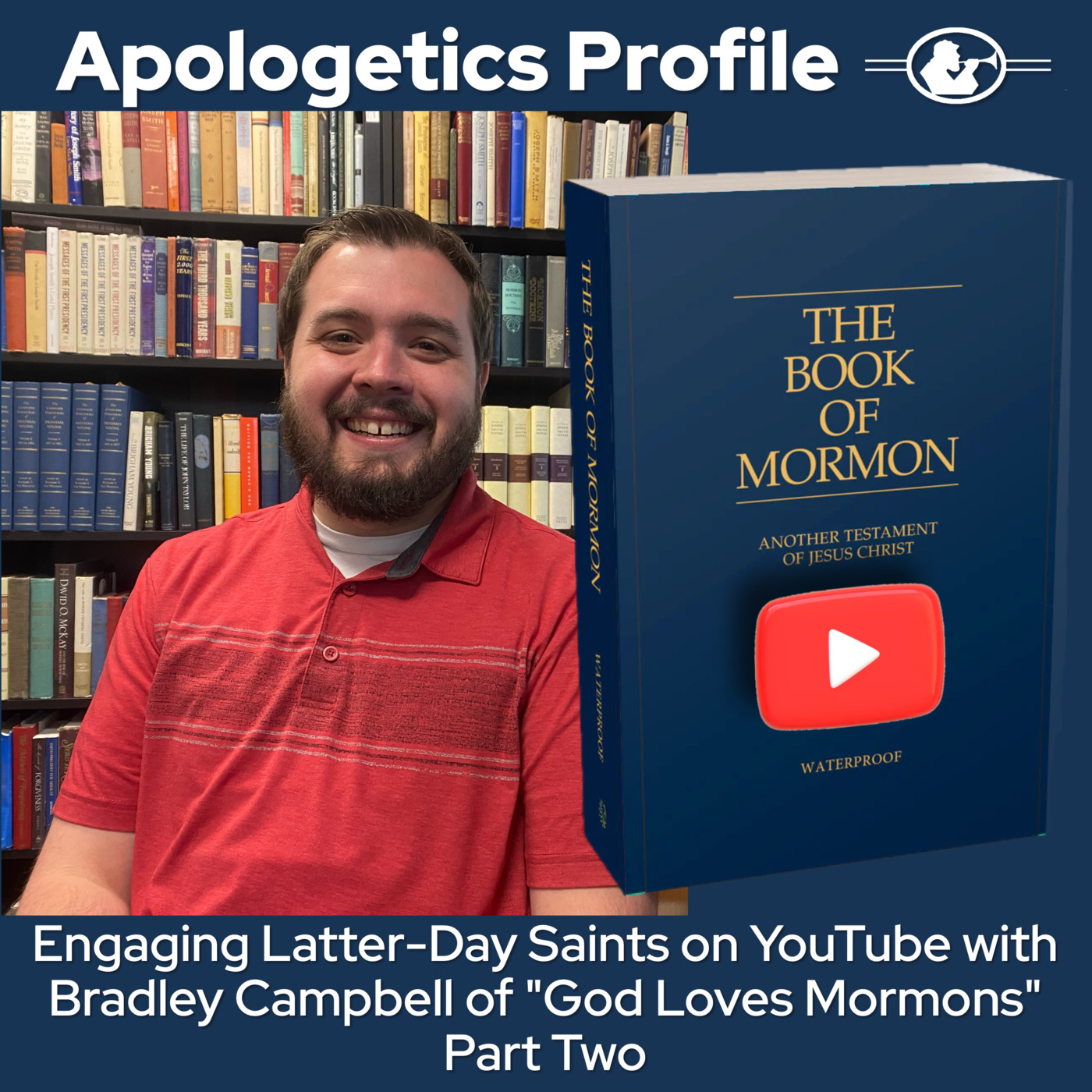
Apologetics Profile
Episode 301: God Loves Mormons with YouTube Host Bradley Campbell Part Two
00:51:58
Again this week we talking with YouTuber Bradley Cooper who hosts the God Loves Mormons channel. ...
Loading summary
Transcript80 lines
- [00:04]
Podcast Host
You are listening to Watchman Fellowship's Apologetics profile podcast.
- [00:16]
Bradley Campbell
To him who works, his wages are not counted as a gift, but as his due. So if you have a job and you get a paycheck, that's not a gift, that's what you've earned. Verse 5 says, and to him who does not work but believes in him who justifies the ungodly, his faith is counted as righteousness. So Paul is saying it's the person who doesn't work, who's not doing works and just trusts in God, who justifies ungodly people. That's the one who will be justified, who will be counted as righteous. And Smith changes that in the Joseph Smith translation to say that God justifieth, not the ungodly. He literally changes it to say that God will not justify ungodly people. That's a hundred and eighty degree flip. That flip flop fundamentally changes the nature of what Paul is saying. You know, Martin Luther felt this crazy burden. He was tormented day and night with the burden of his sin, and it drove him to despair. He said he didn't love God, he hated God because God was this tyrannical judge who was crushing him and he just could not be righteous. And then when he realizes that the gospel is the power of God unto salvation, for in it the righteousness of God is revealed from faith. For faith as it is written, the righteous shall live by faith. When Luther understands that he's freed, he now can delight in God and love in God. And his whole ministry is shifted. I mean, the entire course of human history was shifted because of that realization for him.
- [01:49]
Apologist/Christian Speaker
Latter Day Saints will often talk about their salvation. But if you're in a conversation with a Latter Day Saint and the topic of salvation comes up, it is of critical importance to understand that within the LDS tradition, what they mean by salvation is not the same as salvation understood within traditional historical Christianity. In fact, salvation in LDS theology is sometimes difficult to pin down, since their concept of the afterlife is radically different than traditional Christian doctrines of the afterlife. In LDS theology, the afterlife consists of three a telestial, a terrestrial, and a celestial realm. Every devout LDS strives to enter the celestial realm. But getting into such a realm requires LDS to have a temple recommendation and to participate in secret temple rituals. For example, in order to obtain celestial exaltation, the highest degree in the LDS afterlife, one must accept the Church's law of celestial marriage. As the 12th president of the LDS Church, Spencer W. Kimball noted, I remember we had in our community in Arizona a good man who passed away. He and his lovely wife had resisted the teachings of the church, and the wife, when he died, said, I know that we will be associated as husband and wife through eternity. But she could say that a thousand times and it would still not come true. Because they were not humble enough to accept the law of marriage, they may receive other blessings, but not exaltation. That is reserved for those who are faithful and who obey the commandments. So what are those commandments? Not only must the couple be married in an LDS temple by the proper LDS authority, the couple must remain married throughout this life and they also must obediently adhere to the terms and conditions of the priesthood. In other words, obtaining the highest degree of exaltation in the LDS afterlife is wholly contingent upon the obedience of Latter Day Saints to to perform their prescribed duties in this life. The official LDS Church website declares this exaltation requires that men receive the Melchizedek priesthood and that all church members make and keep sacred covenants in the temple, including the covenant of eternal marriage. But we know from the Bible that one does not need to be married in order to be in eternity with Jesus. This is but one of many examples of how LDS theology confuses and twists the traditional Christian understanding of salvation and the afterlife. While time does not permit here a detailed aside into what the Melchizedek priesthood is, suffice it to say it is a fabricated doctrine created by Joseph Smith. Allegedly, anyone without this priestly endowment cannot hope to obtain celestial exaltation. In the biblical doctrine of the afterlife. However, there are no hierarchical levels of exaltation based on our obedience here in this life. There is nothing that we can do here on earth that will earn us a first class status in eternity.
- [05:29]
Daniel Ray
In other words.
- [05:30]
Apologist/Christian Speaker
More importantly, LDS concepts of salvation are often synergistic. That is, in order to truly be justified by God, LDS must cooperate by means of obeying all the laws and ordinances of the gospel, including secret temple rituals. But the Bible's view of our being justified is not synergistic. Because of what Jesus has done for us in his living a sinless life, in perfect obedience to the law, his active obedience, and by his death on the cross for the forgiveness of our sin, his passive obedience, we are declared to be righteous by God Himself. That is a critical point to understand. God declares us to be righteous.
- [06:16]
Daniel Ray
Think of it.
- [06:17]
Apologist/Christian Speaker
This perfect righteousness is sinlessness, perfect obedience to God's law. If, however, God actually made our flesh righteous, if we actually became righteous in our physical bodies, we would no longer sin. But we know that we do sin. And so here is the gospel. The marvelous and wondrous news is that even though we will travail with the burden of sin for the remainder of our days on earth, God nevertheless declares us to be righteous. The penalty for sin has been taken away not because of anything we do, not through our works, but solely because of what Jesus has done. Our justification in God's sight is by and through Christ's perfect obedience to the law and by his shed blood on the cross, which legally takes away our condemnatory guilt before the law. Our righteousness, then, is not ours. It is not intrinsic to us. It is not created through anything we contribute to it. As Paul declares in Philippians3.9, he is in Christ not having a righteousness of my own derived from the law, but that which is through faith in Christ, the righteousness which comes from God on the basis of faith. There is no synergistic cooperation in the biblical doctrine of justification. Our justification in God's sight is a legal declaration given as a gift to us from God solely because of what Jesus has done for us. From God's vantage point, then, we are made righteous. But again, being declared to be righteous by God himself is not a process that includes any contribution whatsoever from us. As Paul says in Romans 5:19 for as through the one man's disobedience the many were made sinners, even so, through the obedience of the one, many will be made righteous. Only by what Jesus has done are we judicially, forensically declared to be righteous by God. Again, it cannot be overemphasized enough that to be made righteous in this passage from Romans is not to be understood as some kind of process requiring our cooperation. There is no way we could contribute to it. Rather, again, it is God declaring us to be righteous solely because of the obedience of Jesus and Jesus alone. The works necessary to make us acceptable to God have been fulfilled and completed in Christ. As Jesus cried out from the cross, it is finished. So knowing the truth about the doctrine of justification will help you better negotiate conversations about the topic of salvation with Latter Day Saints. But many LDs will quickly turn to the Book of James and claim that we need works to be saved as a means of justifying their temple rituals and attempts to attain celestial exaltation. James 2:24, for example, seems to many a contradiction of the Apostle Paul's teaching. James says, you see that a man is justified by works and not by faith alone. This was one of the key passages of the Protestant Reformation that divided Catholics and Protestants. But Martin Luther and Other reformers understood this passage to mean that one cannot merely say they have faith and show no outwardly visible works or fruits of the Spirit. In other words, if one's faith is truly regenerate, born from above, rooted in Christ's forensic justification, then good works will eventually be visible to others. You will know them by their fruits. Jesus told his disciples. It is not that these good works earn or contribute to our forensic justification. Only Jesus, perfect obedience to the law, his death on the cross can do that. Rather, these good works that James speaks of attest to the genuineness of a truly born again saving faith in Christ. As we pick up here, in part two of my conversation with Bradley Campbell, host of the God Loves Mormons YouTube channel, we talk about some of the curious differences between Joseph smith and later LDs prophets and presidents of the church.
- [10:44]
Daniel Ray
Church.
- [10:44]
Apologist/Christian Speaker
Here again is Bradley Campbell.
- [10:46]
Bradley Campbell
Typically, Latter Day Saints treat the prophets after Smith as somewhat less authoritative than Smith.
- [10:53]
Daniel Ray
Presidents and prophets of the church.
- [10:55]
Bradley Campbell
Yeah, that's right. So like when Brigham Young says something like, yeah, yeah, that's just Brigham, Crazy Uncle Brigham, we kind of keep him tucked away in the closet.
- [11:01]
Daniel Ray
Wish you wouldn't have said that.
- [11:02]
Bradley Campbell
We only bring him down for Thanksgiving and then we put him back up there because he says some weird stuff. And so all the time I hear people say that's not official. That was just his opinion, you know, from Brigham all the way down the line, all the LDS prophets, people really will throw the teachings of the prophets under the bus. But with Smith, there does seem to be more. He's more highly regarded, his teachings tend to be more authoritative. So to be honest, when it comes to Follet, most of the time people are not saying that's just his opinion. Maybe I've gotten that and I'm just not remembering. But it seems more often what's going on is people are saying you're misunderstanding what he's saying or. Or it wasn't recorded correctly, that the records we have are incomplete because supposedly it was a two hour sermon and the records we have are not two hours and it was really windy day. Maybe they heard wrong and he was sick. He'd been sick the last few days. Maybe he was difficult to hear. So there are parts there that probably are not recorded correctly. So honestly, when I interact with Latter Day Saints on this topic, it's usually one of those two things. You're not understanding this properly, you're interpreting it wrong. This is what he really meant or it's not recorded properly. I'm trying to think if I'VE ever really had someone say of Smith. That's just his opinion. He tends to be more highly regarded.
- [12:16]
Daniel Ray
Okay. But it's good to keep in mind, though, if you're bringing these things up, to be aware of the spiritual component of the principalities and powers, because as I've. This is my sixth or seventh trip to Utah. And what you're not prepared for is the spiritual barrenness of this place. It's a beautiful place and people are really nice. But there's kind of something like what Washington Irving describes in the opening of the Legend of Sleepy Hollow. There's kind of a spell that hangs over, and it's a very debilitating, spiritually difficult place to be. There's not a lot of evangelical Christians.
- [13:00]
Bradley Campbell
In the state where the least Christian state in the country, but the most religious state in the country.
- [13:06]
Daniel Ray
So you walk into these discussions especially here, Bradley, and as you know, you can find yourself spiritually, emotionally, physically tired. And I'm not saying this against our Latter Day Saint friends. I'm not saying that they're exhausting people. You're dealing with spiritual warfare, and it is exhausting. And you will be worn down to the point where you feel like. And I felt this every time I come up here where you're very tempted to just start throwing facts and arguing and getting angry with your Latter Day Saint interlocutors. And so if you bring up these hard issues, just be prepared to read body language and to know when to. For yourself and your conversation partner, when to just say, okay, maybe we can come back and talk about this at some other time. Don't let this get heated. Right. Because it can get very personal very quickly.
- [13:51]
Bradley Campbell
Yeah. I think one thing with evangelism that we have to watch out for is our flesh being stoked and provoked. And, you know, when we're out on the street, one of the great things about doing stranger evangelism with other very trusted brothers in Christ is you can start to get to know when people are getting bothered. And so all the time, I mean, people have done this to me on multiple occasions. You're in a conversation and you're starting to feel it. You know, you're starting to get frustrated. And, you know, in one sense, the reason we get frustrated is because we care.
- [14:23]
Apologist/Christian Speaker
Yeah.
- [14:23]
Bradley Campbell
It's because these things are important.
- [14:24]
Daniel Ray
It's not necessarily bad that you get frustrated.
- [14:26]
Bradley Campbell
We're worked up. These are precious doctrines for us. And for them, their doctrines are precious to them. Ours are to us. We think this matters for eternity. Eternity is at stake. I was just telling someone on Saturday, it's not like we're discussing Star wars lore. It's not just an interesting, oh, this is fun to talk about.
- [14:46]
Daniel Ray
Or when was the actor Kenny Baker actually in R2D2? And when was it a robot?
- [14:50]
Bradley Campbell
Right, right, exactly. Yeah. This is a matter of eternal life. Jesus says in John 8. 24, unless you believe that I am, you will die in your sins. Okay, well, we need to figure out what that means. What does it mean to say that Jesus is I am. We might have different understandings of that, but the point is dying in your sins is what's at stake. And so we're passionate, we care, we get invested. And that means our flesh can get riled. And so it's really useful to have some other trusted Christians out there. When you start doing that, they'll say, we have a code word for us. It's pearls. Come up and say pearls. The idea there is, hey, maybe disengage, maybe have someone else step in. Maybe it's time to end the conversation. And that's really a reference, what Jesus says when he says, don't throw your pearls before swine. And the idea is there's some personalities that really grade us the wrong way. We get frustrated more easily with. And it's okay to just say, hey, this person, you're gonna, you're gonna muddy the pearls. You might trample over the pearls in the way that you're gonna act. It's better to just disengage. And man, the accountability there is really useful. And I mean, I've had nights where we'll go out and we'll be talking with someone and you have a conversation and man, it's like you just wanna crawl into a ball and weep. Cause you're like, I shouldn't. I got all riled up. I didn't answer. Well, I was super frustrated or this guy was just so hard hearted. This seems hopeless. We. How in the world do we do this? It doesn't seem like there's any fruit. What are we doing? And having other believers there who can encourage you and pray with you is so useful. It's so incredibly useful. I think that Jesus principle of two by two, going out with another believer is really helpful for evangelism. For the sake of accountability and encouragement. We need encouragement. Encouragement to press on, encouragement that there's hope. First Corinthians 13. Paul says, these three remain faith, hope, and love. The greatest of these is love. Hope is a Christian virtue that I think is often overlooked even in the Hardest of conversations with your LDS friends and neighbors. It's good to have hope. I remember talking with this guy on one occasion, ironically, we were at a coffee shop, which I think is funny. It's a Latter Day Saint. He got a hot chocolate. So it's okay.
- [17:06]
Daniel Ray
Yeah, that's okay for them, right?
- [17:07]
Bradley Campbell
Yeah, but. And I've heard someone else, you know, say a very similar story. But when we were there, we're talking and talking for so long about doctrinal things, back and forth, back and forth. It was a good natured conversation, but like hours talking about this. And, you know, later on in the conversation, I made some comment and he was like, man, this just. You're right. This all of Mormonism isn't true. I don't believe this at all. I think it's fake, but I'm still in it. I don't want to leave for all these other reasons. I was like, what are you talking about? We've just talked for hours about these things. What do you mean you don't believe it? And it's just costly for them to leave. But he argued, he discussed, like he really believed it. And what that told me was, you just have no clue what's going on in people's hearts. You have no idea. He seemed so overt. He seemed so confident, and yet he was totally broken, didn't believe any of it. He was just arguing position and that. I have heard other believers tell very, very, very similar stories. What does that tell me? Well, it tells me that I ought not think myself so wise that I know what someone else is thinking and I know what God is doing in their hearts. I don't know what God is doing in their hearts. You know, I like to tell people in evangelism, our job is to be really bad farmers. What I mean by that is if you remember the parable of the sower. Parable of the sower. He's going around and he's throwing seed on rocks and on paths and on good soil. Well, he's a terrible farmer. Good farmers don't throw their seed on rocks. That's a bad idea. You throw it on ground, you know, soil that's going to grow. But the point of that is that I'm not sure this is the point Jesus is making with the parable. I'm just drawing another point here. But he's just sowing seed everywhere. He's like, I don't know what's going to grow.
- [18:47]
Daniel Ray
Well, there's another parable. I think it's in Mark follows similar Suit that the sower sows, the seed goes to bed, seed sprouts. He doesn't know what happened.
- [18:55]
Bradley Campbell
Exactly right. So the principle here is my job is to be bad farmer, just throw the seed, share the gospel. Here's the hope that we can have in Christ. Here's the truth about who God is and the nature of the gospel of grace. And then, all right, leave it up to the Lord. Some people water, some people plant, some people water. God gives the growth. It's in the Lord's hands. And there's great hope and encouragement that comes from that. Even when you at the end of a conversation, you're just drained.
- [19:24]
Daniel Ray
You just feel like. You just feel like, what did I just do? I get that way every time I come and I get back on the plane, I'm going home. I'm like, what did I just do? I'm like, now I'm just seated and can think about the last several days and like, did I accomplish anything? You know, only the Lord knows what we're doing. And so I think for me and my limited engagement up here when I come up here is to not force conversations, to let them happen naturally and to be as kind and as civil as I can. To give somebody a different opinion. If nothing else, to give somebody a different opinion about evangelicalism. Really quickly as we wrap up here here, since you're on YouTube, Bradley, I wanted to talk about a little bit of some younger, I would say, Mormon apologists, another generation of Mormon apologists who are on YouTube. Some former Mormon apologists have taken to YouTube. It seems like there's a whole new generation of people discovering Latter Day Saint theology all over again and having these discussions. I know Instagram seems like there's a lot Instagram. Right.
- [20:26]
Bradley Campbell
Influencers.
- [20:27]
Daniel Ray
Right. Cameron Bertuzzi of Capturing Christianity recently did a video on the, as he said, debunking or something like the Book of Abraham, which got the attention of a couple of other pro Mormon apologist website or video video YouTubers. You're on YouTube and we just had talked about the, the, the idea of being kind and gentle as you're sewing and doing evangelism for people that might be watching this or listening to this, what is the advice for engaging? Like, should we just take snippets of other Mormons YouTube channels and put them on our channel and make fun of them and how do you negotiate YouTube with this highly contentious issue?
- [21:10]
Bradley Campbell
Yeah, that's a great question. I don't even know that I have all the answers here. I just kind of do My thing. But I think there's a couple principles here. The Internet now is what the town Square was 100, 200 years ago. So 100, 200 years ago, if you wanted to interact with ideas, you'd go to the town square. That's where street preachers are going to set up. They're going to preach. It draws a crowd. It was a thing of interest in those days. That's really what the Internet is. It's the place where ideas are exchanged. And so if you use the town square kind of idea, if you just had a dude walking around the town square, screaming at people's faces as they're walking by, you're like, okay, all right, chill out.
- [21:47]
Daniel Ray
Am I living the Nietzsche's madman?
- [21:49]
Bradley Campbell
Yeah, yeah, right. And yet there is also a place for street preaching, you know, for standing up and saying, here's what the Lord has said, and that, you know, you can have cutting parts of that. And so there is a way in which I think here's. There's. There's a bunch of balance things here. I don't want to make it seem like. Honestly, I don't want to make it seem like. Like Mormonism is just another dish in the buffet that I can grab another idea. It's just something else. It's very interesting. You can take some of it if you want or not. I don't want to present it like that because I do think that it's damaging. I don't think it's true, ultimately. But I also don't want to do the thing where I'm screaming at people that are walking by in the town square. I want to do the thing where I proclaim and herald the truth. And sometimes that means evaluating lds teaching cultural things in a way that models dignified discussion. For me, the verse that has really been the paradigm for how I interact on YouTube is in 2nd Corinthians, chapter 4. I often come back to these verses. Here's what Paul writes. Therefore, having this ministry, by the mercy of God, we do not lose heart. This always encouraged me, because Paul's talking about how the Jews have a veil covering their face. And he says, we don't lose heart. Even if the success is not what you hope it would be, we don't get discouraged. He says in verse 2. We have renounced disgraceful, underhanded ways. We refuse to practice cunning or to tamper with God's word, but by the open statement of the truth, we would commend ourselves to everyone's conscience in the sight of God and even if our gospel is veiled, it is veiled to those who are perishing. So he talks about, we renounce. We're renouncing disgraceful, underhanded ways. Like we're not playing games, we're not hiding things, we're not trying to be tricky, we're not trying to lure people into a trap. We're not tampering with God's word. And I think the reason he brings all those up is because perhaps those things would be more visibly successful. He says we don't lose heart. Maybe there's limited success in what he's doing, but he's saying we're not going to change our method just to, just to be appear more successful. No, it's the open statement of the truth. We are going to put out there what's true. We're going to deal with it in a dignified manner. We're going to not practice cunning and the ball's in their courts. Even if our gospel is veiled, it's veiled to those who are perishing. I think about what Paul elsewhere says in second Timothy. He talks about God's servant must not be quarrelsome. But he corrects his opponents with gentleness. There's a real place for correction and there's a real place for gentleness. And so one of the things I think if you're gonna have a YouTube presence, you have to keep in mind you're not just interacting with the grumpy segments of Latter Day Saints that are on YouTube that might be really upset, might be grumpy. I honestly think some of the tone of Latter Day Saint youtubers is very foolish. If you read Proverbs and the way Proverbs speaks about how we should speak and then you watch their stuff, I'm like, I don't think that's wise. I, I think that's folly. We ought not do that. We ought model for people how to discourse about these things with gentleness. And so I just, I want to encourage people like, hey, don't give up on correcting people. There does need to be correction here. Correct your opponents and don't just do it by screaming in people's faces. Correct your opponents with gentleness. I think both of those are really important. And because it's public, you're not only talking to Latter Day Saints, you're modeling for other believers how to talk to Latter Day Saints. And I think that's equally as important.
- [25:32]
Daniel Ray
Yeah, don't load up your dump truck of anti Mormon facts. Take it to Salt Lake and think you could put it all on the street corner and have a successful engagement.
- [25:41]
Bradley Campbell
Jesus says, what does it profit a man if he gains the whole world and loses his soul? So what does it profit someone if they realize Mormonism is false and lose their soul? Who cares if they become ex Mormon? That's not helpful for them. Our aim is not to make former Mormons. Our aim is to preach the gospel. And the gospel is the power of God unto salvation for all who believe. I am not here to just point out all the ways in which Joseph was a historical scumbag in order to make you hate Mormonism. Maybe what I should do is say, hey, I'm going to critique Joseph Smith because the Bible told me that I should test prophets. And I'm doing this as a Christian who's been commanded by Jesus to beware of false prophets. I actually think that's really important. We're not just grumpy atheistic secularists dealing with historical oddities that seem really appalling. I'm a Christian and I should deal with these things like a Christian deals with them.
- [26:38]
Daniel Ray
Yeah, I've heard a lot of Latter day Saints, the YouTube variety, as I've been delving into this relatively recent development of Latter Day Saint apologetics, accusing evangelical Christians who are critical of Mormonism as arguing like atheists. In other words, evangelicals will come at them with a polemic only here's what's wrong with your doctrines and beliefs in history. And it's just anti, anti, anti. There's no gospel. It's just. And when you are solely polemical, you do sound like an atheist, because the atheist polemic against Christianity offers nothing. It's just a shutting down of an attempt to shut down Christian theism. And if you're just attempting to shut down Latter Day Saints and just make ex Mormons out of people without any hope of the gospel. Like, my approach when I talk to them is to have a discussion that involves the gospel.
- [27:38]
Bradley Campbell
Right.
- [27:39]
Daniel Ray
I'm not just coming at Elder Medina with anti Mormon facts. That just doesn't work. I don't think. I don't think it's. And that's one thing that impressed me when I first ran across your channel, Bradley, was the gentle demeanor that comes across that you don't see in a lot of YouTube videos. So I think that that's. I hope people will go to your channel. If you've got kids in YouTube and if you're interested in this dialogue with Latter Day Saints, that Bradley's channel, your channel is great for a great place to begin And I understand too that you actually have. You have some folks, Latter Day Saints that have reached out to you on YouTube because of your approach, correct?
- [28:20]
Bradley Campbell
Yeah, yeah, yeah. I actually have had recently a good number of Latter Day Saints reaching out to me on different platforms. Just wanting to meet up for lunch and talk about stuff, which is great. I'm happy to talk with people.
- [28:31]
Daniel Ray
But if you're angry and your fists are always up, you're not going to have those kind of invites. You're not going to have that kind of conversation.
- [28:37]
Podcast Host
Yeah, you can listen to all of our past episodes of Apologetics Profile for free. And if you are enjoying Apologetics Profile, be sure to leave a rating or review on Apple Podcasts.
- [28:52]
Bradley Campbell
Yeah, you know, even our stuff, a lot of Latter Day Saints will still say, oh, we're anti Mormon, of course. And I, you know, honestly, 2 Corinthians 4 is just such an encouragement to me. Like, hey, if the open statement of the truth offends you, then so be it. Okay, I'm not going to adjust what I'm doing and make it really cushiony so that it doesn't offend you. But I'm not going to go out of my way to try and be a jerk either or offensive. I just want to honestly and straightforwardly critique what I think is a huge problem. Now you make a great point about dealing with anti Mormon stuff. I just released a video very recently called five More Things the LDS Church no Longer Teaches. Part of what I'm trying to I've been dealing with some LDS history things because I want to show how Christians can critique historical issues from a thoroughly Christian perspective. When I ended that video, I was talking about how in Ezekiel and Jeremiah, one of God's indictments against the false prophets of Israel is that they spoke the inventions of their own mind, not what God told them. That's what marked them as false prophets. They created things that they would say and the people would listen to. So when Latter Day Saints look at their past prophets and apostles and the changes that have happened in what I would argue are doctrines and practices, they say, well, that was just his opinion in the past. Those are just opinions. That was just his mind. I wanted to show in that video. At the very end, I said, well, this is. That's what defined a false prophet in Ezekiel. I think it's Ezekiel 13 and Jeremiah 21 or 23, something like that. That's what made a false prophet. So it's not. Just look at all these changes. Wow, how silly. It's. No, the Bible Gives me categories to say, this is a problem. This is not how we should expect prophets to act. And that's thoroughly Christian. It's thoroughly biblical, even though it's dealing with historical issues that I think we should deal with from time to time.
- [30:48]
Daniel Ray
And when you're talking to missionaries, a lot of times when you talk about and you start leaning heavily on the Bible, you will probably get into the conversation about the Bible being corrupted.
- [30:58]
Bradley Campbell
Oh, yeah.
- [30:58]
Daniel Ray
And that's always a difficult. And we could spend another hour talking about that, of course. But that's where if you start to bring up doctrines that challenge the Book of Mormon and you're relying heavily on the Bible to do so, they will try to point to the idea that the Bible is corrupted. But just recently, the LDS Church has acquired the actual manuscripts of the Joseph Smith translation of the Bible. And a lot of the questions that come up about the corruption of doctrine, I think it's fair game. It's public knowledge. You can get the Joseph Smith translation online. You can see it for yourself. If Christianity is corrupted or has been corrupted and Smith was to restore it, there's not a whole lot. He left a whole lot of the King James Version alone in his translation. I mean, he quotes big chunks of Isaiah in the Book of Mormon. So it's a fair question to ask Latter Day Saint friends, where exactly and when exactly were our Scriptures corrupted?
- [31:53]
Bradley Campbell
Right, right. Honestly, I think that that is a line that is used. And if you push back even a little bit and just say that's actually not true. If you check out some details on textual criticism and the work that goes into that, you'll find very quickly that the Bible's actually, actually very reliable. Just from a historical standpoint. People are like, oh, okay, I don't really know anything.
- [32:22]
Daniel Ray
Just the idea of there being somewhere near 6,000 manuscripts, 5,800 to 6,000 New Testament manuscripts alone, in part or in whole, and that the copies, despite the number of scribal and textual variants, nothing changes doctrinally. Right.
- [32:38]
Bradley Campbell
I sometimes have done this, though I haven't recently. This is years ago. I really did this a lot more. But I have a Greek New Testament. And in the bottom of a lot of the Greek New Testaments, it has the textual apparatus, which basically is a list of all of the viable textual variants. A viable textual variant are those differences between ancient manuscripts that may have been original. There are places where we're like, we're not 100% confident this is the original reading. And the most complicated of those will end up in Footnotes of our Bibles. If you see some manuscripts, say, xyz, that's a textual variant that has some really good reading behind it. And they want to put all the information out there. But I would like bringing the textual apparatus and saying we're not hiding what parts have issues. Here's the list of the manuscripts that have this particular reading. If you know Greek and if you know your different manuscript families, you can do the work to see which you see is original. And the point is, we're not hiding anything. We're putting it all on the table. I'll tell people, like, what the apostles wrote is contained in this book. Maybe it's down on the bottom at some places and not in the text, but it's here. We just have more than we need, and we're trying to figure out what is original, but nothing's missing. And when you read a lot of the variants, a lot of times they're so boring. Like, sometimes instead of Jesus Christ, it's Christ Jesus. A lot of those are viable variants because we don't know which order it was originally. What does that change?
- [34:05]
Daniel Ray
It doesn't change any doctrine whatsoever.
- [34:06]
Bradley Campbell
And so you'll have people point to your major textual. If they're at all familiar with this, they'll go to John 8, Mark 16.
- [34:13]
Daniel Ray
Or 1 John, the omissions, Right?
- [34:15]
Bradley Campbell
And they'll use the worst examples of textual issues to characterize the entire Bible. And that's just not how that works. You don't use the worst example of something to characterize the whole. Those are exceptions because they're exceptionally problematic. The Bible is usually very, very reliable.
- [34:29]
Daniel Ray
If you talk about the woman at the. Well, the woman caught in adultery or the ending of Mark, okay, I say, well, let's say that those are late additions. What does that change doctrinally?
- [34:39]
Bradley Campbell
Right, right, exactly.
- [34:40]
Daniel Ray
And every scholar, liberal or conservative, acknowledges these things are later. And nobody except the acerbic critic is pointing, well, if these were additions, we don't know what else were additions. And so what it is is really an argument from silence. Like, if this is possible, then we don't know where the other corruptions are. But if Joseph is a prophet, seer, revelator, and he's translating the Scriptures supposedly authentically, but even the LDS Church is acknowledging that Smith's translation, the Joseph Smith translation. Smith consulted no Greek lexicons, no Hebrew lexicons. He was just sort of. It was basically more like a Joseph Smith commentary. But the question can be asked, Bradley. It's like, well, how reliable is Smith as a translator. And where do Smith's additions and deletions appear in any of the ancient manuscripts that we have?
- [35:32]
Bradley Campbell
Yeah, I think one of the greatest examples of this is John 1:1 in JST, which says in the beginning was the Gospel preached through the Son, and the Gospel was the Word, and the Word was with the Son, and the Son was with God, and the Son was of God. There is zero manuscripts that have ever said anything like that. I mean John 1:1 is very, very well known. In the beginning was the Word, the Word was with God, the Word was God. But what's really interesting about this is just a couple verses later in verse 14, John 1:14 says the word became flesh and dwelt among us. Well, Smith doesn't change that in the Joseph Smith translation. He keeps it the same. So he says the Gospel was the Word and the Word was with the Son. And then he says this same word was made flesh and dwelt among us. Well, he just said the Gospel was the Word, not the Son. So he's like internally inconsistent in John 1. I think it's just evidence that this is not a real dealing with the textual corruption of the Bible. This is Smith adding in things that Smith wanted to add in. And in some cases he adds things in that totally change the nature of the text. Like for example in Romans 4:5, Romans 4:4 and 4:5 are just excellent verses. Talk about the nature of the gospel and the relationship between faith and works. It says to him, this is the actual Bible. Says to him who works, his wages are not counted as a gift but as his due. So if you have a job and you get a paycheck, that's not a gift, that's what you've earned. Verse 5 says, and to him who does not work but believes in him who justifies the ungodly, his faith is counted as righteousness. So Paul is saying it's the person who doesn't work, who's not doing works and just trusts in God, who justifies ungodly people, that's the one who will be justified, who will be counted as righteous. And Smith changes that in the Joseph Smith translation to say that God justifieth, not the ungodly. He literally changes it to say that God will not justify ungodly people. That's a hundred and eighty degree flip. That fundamentally changes the nature of what Paul is saying. You talk about Galatians one and the whole warning of if someone's preaching to a different Gospel, here it is. Smith put a not does God Justify ungodly people? Or does God not justify ungodly people? Those are different gospels.
- [37:54]
Daniel Ray
But it fits with Smith's evolutionary theology of where is it? In Nephi, it is by grace you are saved. After all you can do. If you get into the idea of works faith, Latter Day Saints will say, well, the fivefold plan of salvation in Latter Day Saint theology is faith in Jesus Christ, repentance, baptism, and then a perpetual willingness on your behalf.
- [38:29]
Bradley Campbell
Gift of the Holy Ghost.
- [38:29]
Daniel Ray
Gift of the Holy Ghost, yes. And then your willingness to continue in the laws and the ordinances of the Gospel. So there really is. And the Latter Day Saint website says that your salvation really is contingent upon your works, which is antithetical to the true gospel, where you're not striving to work towards salvation. Now, the whole works faith issue comes down to Bradley, as you know very well that the Latter Day Saint theology teaches that we have to work. Salvation is contingent upon our behavior and what we continue to do. But the gospel is what Jesus says on the cross, that the work that was necessary for salvation has been completed.
- [39:13]
Bradley Campbell
It is finished.
- [39:14]
Daniel Ray
It is finished. I have fulfilled all righteousness. Luke 4. Today this has been fulfilled in your hearing. Why are they irate? Because this is Isaiah 60:1 and Jesus is proclaiming himself to be. They very well know what he's saying in Mark 2, in John 8, in Matthew 26, Caiaphas knows what Jesus is saying. This is offensive, like we're earning our righteousness. Jesus comes to a culture of people who are self satisfied with the righteousness that they have acquired on their own behalf, and Jesus abolishes all of that. And so it is offense to Jew and Gentile believer and unbeliever alike, that Jesus consults first his own people who reject him, and then he goes to the Gentiles, of course, but the works faith. Christians are not saying that we shouldn't have works. We're saying that the works that we have are as a result of justification, not in an attempt to obtain justification.
- [40:03]
Bradley Campbell
We actually believe in James 2.
- [40:05]
Daniel Ray
Yeah, we do.
- [40:06]
Bradley Campbell
Latter Day Saints always point to James 2, faith, that our deeds is dead. And what they usually mean by that is that faith includes in its definition, works. That's how they use it. It's not really faith unless there's works with it. Whoa, whoa, whoa, whoa. I think faith produces works, but faith is distinct from works. So James 2 is totally right. The demons believe. The demons have a kind of faith that doesn't save them. They shudder knowing God is one. But we, if we're going to have faith that that produces genuine works. That's what James is saying. We substantially agree with James too. Latter Day Saints use it as a quick little gotcha without understanding what it's actually saying and how that relates to our theology of justification by faith.
- [40:48]
Daniel Ray
Yeah, so it's a mix up of sanctification, justification.
- [40:52]
Bradley Campbell
That's right.
- [40:52]
Daniel Ray
Inflating them. Yeah. Sanctification is the long, slow obedience in one direction. We're not perfect, but the works that we do. I'm here in Utah because of Jesus mercy and grace. And I'm not doing this to check a block to earn anything of God's favor. Whereas door to door evangelism for missionaries is a kind of work. We have to do this.
- [41:12]
Bradley Campbell
Think about what Jesus says in John 3 when he's talking with Nicodemus. He says, even as the just as Moses lifted up the serpent in the wilderness, so too must the Son of Man be lifted up, that all who believe in him shall have eternal life. That is a glorious text that I think people skip over often. It's right after John or right before John 3:16. And that's why John 3:16 overshadows the.
- [41:35]
Daniel Ray
Context, the magisterial passage.
- [41:37]
Bradley Campbell
But what he's saying there is okay, in Numbers. There's this story of the people are grumbling against God. They're like, we should have gone back to Egypt. We want meat, we want meat. We're thirsty.
- [41:49]
Daniel Ray
I'll give you meat.
- [41:50]
Bradley Campbell
That's right. And because of their grumbling, God sends fiery serpents among them who bite them and they're dying. And so Moses cries out to the Lord and the Lord says, hey, make a bronze serpent, stick it up on a pole, and everyone who looks to the serpent will be healed. It's not that they look to the serpent and. And then they have to go offer a sacrifice. It's not that they look to the serpent and then they have to go make an antidote for the poison. Looking to the serpent was the instrumental means of them receiving their physical healing. And Jesus is saying, just as in the same way that Moses lifted up the serpent, everyone who looked at the serpent would be healed physically, so too must the Son of Man be lifted up. When Jesus is lifted up on the cross, what is required of us? The same thing that was required of Israel looking to him. We look to him. We don't look to him and then have to go get baptized. And that doesn't mean baptism is unimportant. I'm just talking about what is the instrumental means. Of us receiving not our physical healing, but our spiritual healing, spiritual cleansing, new life. Just looking to Christ, looking to him lifted up on the cross. That's how we're forgiven. That's how we're cleansed. That's how the problem is fixed. What was going on with Moses and the serpents was a type of what happens with Jesus on the cross in salvation. And that's the point Jesus is making. And that immediately precedes John 3:16. So it goes right out of that into For God so loved the world he gave his only begotten Son. Whoever believes in him shall not perish but have eternal life. So the whole idea here is Jesus is explaining what belief is. Belief is not all of these list of works that somehow get crammed in the definition of belief. It's just looking.
- [43:29]
Daniel Ray
Yeah, just look. Well, there's an issue that has come up. I'm sure you know that the church is changing the nature of the female garments, the undergarments, the sacred undergarments. I don't know what the proper title is for those things, but there's a debate raging now. Well, why are they changing these things? I faithfully have been wearing these things all my Mormon life. Now I get to now the undershirt is sleeveless. Well, this is kind of demeaning. What does that do to my covenant? But it's starting. The topic itself is touching upon this workspace righteousness. Some LDS ladies are like, woohoo. I'm relieved that now that I can do that. We can wear these things now. We can be sleeveless now. This is fantastic. And some are confessing that they don't wear their garments all the time because they're uncomfortable or whatever the case may be. And some are like, well, I wear my garments all the time. I don't care if it's 100 degrees outside. But this whole issue is bringing to the surface. I was watching a video where the ladies were discussing how they felt by some other LDs that they were being judged. People were looking to see if they were wearing their garments, somehow trying to figure out, do you have your garments on? And so there's this whole culture of when you're in a works based system like this, everybody's eyeing each other, everybody's envying one another. Everybody's got to have a certain way in which their performative efforts are yielding God's favor. The longer I wear these, the more God is pleased with me. But I think this is an opportunity, especially if you're a lady and you're engaging LDS Friends, this is a great topic to bring up to touch on that idea of a works based righteousness. It's exhausting, Bradley. The system that Smith has introduced to people, the burdens that Smith has placed upon people, the temple rituals, all these things that you have to do, baptisms for the dead. It's an exhausting, never ending cycle of workspace righteousness. And Jesus says, you will know the truth and the truth will truly set you free. So I think, tell me this as we wrap up here. When I started engaging with Latter Day Saints five years ago, God had to this is just me being honest here. God had to deal with my internal Excel spreadsheet of workspace righteousness.
- [45:39]
Bradley Campbell
Sure.
- [45:39]
Daniel Ray
Which I think we all harbor. And it's not until you encounter it being practiced in reality by people who are in a workspace righteousness system that you might see in your own life as you outreach to lds that you have a check mark, you have a.
- [45:57]
Apologist/Christian Speaker
Rat wheel of repetitive thoughts.
- [45:59]
Daniel Ray
You might be able to pass an orthodox theological exam on paper. But maybe, maybe we too, because it's human nature, want to have that workspace righteousness. We think we do this for God and God is pleased. But in my encounters, in my early encounters with Latter Day Saints, I realized I was keeping a ledger. And if I did this, then God was happy with me. If I didn't do this, then God was displeased with me and I was in the exact, I had to admit I was in the exact same frame of mind as exactly I'd be a good Latter Day Saint. Because I was at least I know the tally system. But that's not the gospel. I mean, I knew it wasn't the gospel, but in my thought life, Romans 12, I was not renewing my mind about what it meant to be justified and to be righteous. And so I just my own advice to people would be, and you can speak to this however you see in your own experience would be to examine yourself and to look at the plank in your own eye before coming to Utah or you know, hammering Latter Day Saints before you we go and examining the spec because when you look at yourself in light of who Jesus is and your own sin, that should lead to a humble, gracious and compassionate engagement as you've been talking about.
- [47:09]
Bradley Campbell
Yeah, part of what I think is so useful for Christians who are wanting to interact with Latter Day Saints is expressing the freedom that we have in Christ. You know, their catchphrase these days is come unto Christ lather. Day Saints love using that. In Matthew 11, Jesus says you know, come to me all who are weary and burdened, and I will give you rest. He says, you know, my yoke is easy, My burden is light. The idea of what Jesus is saying is that the Gospel is one of freedom, rest, peace. And part of when we're interact, what we're doing, when we're interacting with Latter Day Saints, is we're saying, I have experienced this peace and this rest in my soul. And I want for you who are burdened with all of these things that you need to do in order to be exalted, I want you to have that same kind of rest, that peace. I want you to wear Christ's burden, which is easy and light, not the burden of Mormonism. And I think one who has experienced that in their soul is poised to speak about it on more than just a proof, texting, doctrinal level. It is, come and look at what Christ offers in the Gospel. Look what his work accomplished. It's an outpouring of what we ourselves have experienced. So if you are sitting there like, I don't know what you're talking about, you know, I feel this crazy burden. You know, Martin Luther felt this crazy burden. He was tormented day and night with the burden of his sin, and it drove him to despair. He said he didn't love God, he hated God because God was this terrible tyrannical judge who was crushing him, and he just could not be righteous. And then when he realizes that the Gospel is the power of God unto salvation, for in it, the righteousness of God is revealed from faith, for faith as it is written, the righteous shall live by faith. When Luther understands that he's freed, he now can delight in God and love of God. And his whole ministry is shifted. I mean, the entire course of human history was shifted because of that realization for him in the Reformation. And so when people experience that, when they have experienced the power of God unto salvation in their hearts, they're all the more poised to talk with their LDS friends. So I would encourage you, if you're listening and you want to talk with your LDS friends, don't just make it a doctrinal back and forth. Let your experience of one having been forgiven come out. I think of David in Psalm 51, when he's, when he's, It's a psalm of repentance. And then Psalm 34 where he's, I'm sorry, Psalm 32, where he's talking about the experience of being forgiven by God. David is expressing his, his delight in God as the God who forgives him. That's the kind of thing I think we can really offer Latter Day Saints really effective. And you don't need to know a lick of the Book of Mormon or the lick of Doctrine and Covenants or to the Pearl of Great Price. You don't need to know anything about the Joseph's polygamy or anything about Brigham Young in order to talk about the experience of being forgiven and cleansed. You just say, this is what the Lord has done for me. Here's what he says in His Word and here's what is offered to you this day truly come unto Christ. Latter Day Saints.
- [50:44]
Podcast Host
Apologetics Profile is a production of Watchman Fellowship Incorporated in Arlington, Texas. For more information about the ministry of Watchmen Fellowship, visit our website@watchman.org that's watchman with an A dot org. You can also email Daniel Ray, the host of Apologetics Profile at drayatchman. That's d r a yatchman.org he would love to hear from you.