← Apologetics Profile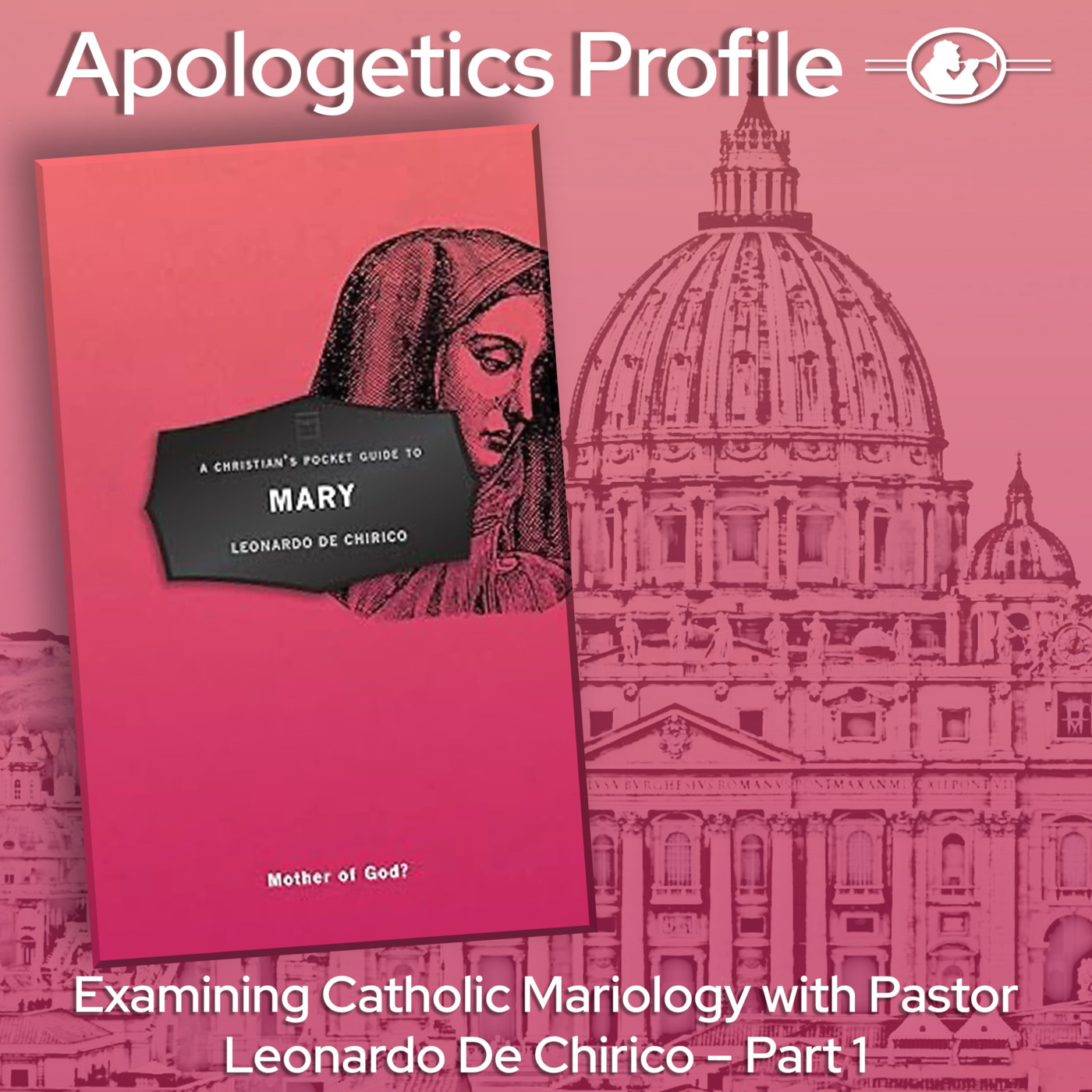
Apologetics Profile
Episode 327: Examining Catholic Mariology with Pastor Leonardo De Chirico - Part 1
00:45:59
What role does Mary, the mother of Jesus, have in traditional Catholic theology? This week and ne...
Loading summary
Transcript23 lines
- [00:04]
A
You're listening to Watchman Fellowship's Apologetics Profile podcast.
- [00:18]
B
If you are an Evangelical Protestant, you likely know someone, friend, family member or co worker who professes to be a Catholic. The dialogue between Catholics and Protestants has a long and somewhat difficult history, especially since the advent of Martin Luther's 95 Theses and the Protestant Reformation they engendered over 500 years ago. On the next two episodes of apologetics Profile, we will be discussing a specific aspect of Catholic doctrine, that of Mariology, with Evangelical Protestant pastor in rome, Italy Leonardo DiCarico. For some three decades now, Pastor Leonardo has been reaching out to Catholics for substantiative and meaningful dialogue about the theological and practical differences between Catholics and Protestants. He is also the author of a number of books on the topic of Catholic and Protestant theology and engagement, including his short 2017 book, which we will be discussing this weekend next, titled A Christian's Pocket Guide to Mary, Mother of God. Pastor Leonardo's efforts are not just a superficial ecumenicalism, but a concerted theological and practical engagement with doctrines and dogmas that shape both Protestant and Catholic theology. Mariology, the dogma pertaining to Mary decreed by the Catholic Church's magisterium, the official teaching authority of the Church, is an indispensable and requisite dogma for anyone desirous of joining the Church or remaining a faithful communicant member. A devout Catholic is not free to disagree with the dogmas pronounced by the magisterium. Accepting these dogmas is absolutely essential to one's good standing in the Church and ultimately to one's salvation. To disagree willfully, knowingly, and intentionally with the magisterium's dogmas is nothing short of heresy. Such ongoing, willful rejection of official Catholic teaching ultimately will result in excommunication. In addition to jeopardizing one's salvation, There are at least four main tenets of Mariology put forth by the magisterium. Each of these are not mere opinions of popes, but are believed to be essentially necessary truths for one's admission into the Catholic faith, into eternal life. The foundational teachings on Mary include her being the Mother of God, of being a perpetual Virgin, of being immaculately conceived, and of being bodily taken up into heaven. The following summary is not meant to be exhaustive by any means, but only provides a quick overview of Mariology and some traditional Protestant responses. There is far more that can be said about these topics than could possibly be covered in the introduction here. The Greek term for Mother of God, theotokos, was first employed by the 431 AD Council of Ephesus in order to defend the biblical understanding that Jesus is both fully divine, that is, fully God, and fully human. Theotokos is not meant to convey the idea that God's divine, eternal nature ultimately originated in and through Mary, but for God, who exists eternally is without beginning or end. Theotokos is meant to convey that Jesus was, is, and will always be fully God and fully human, even when he was in Mary's womb. On this, both Catholics and Protestants agree. In that sense, Theotokos was meant to preserve, uphold, and venerate our Lord Jesus Christ as the Son of God, both fully God and fully human. Theotokos, however, was never intended to exalt or venerate Mary to the extent of Catholic devotion to her as practiced today. Catholic dogma insists Mary remained a virgin for her entire earthly life. Both Catholics and Protestants do affirm that Mary was a virgin when she gave birth to Jesus, but there has been much debate and disagreement as to whether she remained a virgin after Jesus birth. But according to the Catholic Church's magisterium, this is not a matter of interpretive opinion or debate. Rather, it is a foundational doctrinal truth that must be unequivocally accepted in order to be a communicant member of the Catholic Church. Catholic theologians will routinely cite early church fathers in defense of this doctrine, such as Jerome and Gregory of Nyssa. In addition, Mary's perpetual virginity became codified doctrine at the Fifth General Council at Constantine in 553 AD in the Catechism of the Catholic Church, widely published in English in 1994. Sections 499 through 501 outline this doctrine more succinctly. But according to Protestant theologians, a careful examination of the biblical texts does not specifically reveal that Mary remained a virgin throughout her lifetime. In fact, the Bible seems to indicate that Mary had children sometime after Jesus birth who are referred to as Jesus brothers and sisters. See Matthew 13:55 and Mark 6. 3. For example, Catholic theologians say that the plural form of the Greek word used by Matthew and Mark for brothers and sisters, adelphoi, can also mean cousins. But there is not a single New Testament use of adelphoi from Matthew to Revelation, which is utilized to mean cousin. Without the necessity of reading the dogma of Mary's perpetual virginity into the texts of Matthew 13:55 and Mark 6. Three, it seems a faithful contextual reading of these passages strongly points to Jesus having literal blood brothers and sisters by means of his earthly mother, Mary. In addition, the apostle Paul actually does use a Greek word for cousin. In Colossians 4:10, Paul describes Mark as the literal cousin Anepsios of Barnabas, which is never used by Gospel authors in identifying Jesus brothers and sisters. In addition, there is nothing in the Bible that unambiguously declares that Mary took a vow of chastity and abstained from sexual intercourse with Joseph after Jesus birth. Birth While not entirely impossible, it does seem unusual at the very least that Mary would marry Joseph but abstain from consummating her marriage. Matthew 1:25, for example, says that Joseph kept Mary as a virgin until she gave birth to Jesus. While not conclusive proof, this passage does at least suggest that Mary could have had intercourse with Joseph after Jesus was born. Thirdly, the dogma of Mariology dictates that Mary herself was immaculately conceived, that is from her own birth. By divine decree, Mary was spared from the sin that has engulfed and tainted everyone else who has ever been born. It is crucial to note that this dogma did not officially come about until the papal decree of Pope pius IX on December 8, 1854. The most blessed Virgin Mary was from the first instant of her conception by a singular privilege and grace granted by God in view of the merits of Jesus Christ, the Savior of the human race, preserved, exempt from from all stain of original sin, according to Protestant theology. However, if you search the New Testament from beginning to end, you will not find any biblical support for this particular dogma save in the particular words of the angel Gabriel's greeting to Mary. Greetings highly favored 1:28 the Catholic Church traditionally interprets Gabriel's words as Hail Mary from full of grace. But one particular interpretation of a single verse does not a dogma make. We cannot examine by textual or historical evidence that Mary was perpetually sinless just from Gabriel's greeting alone. Consider that if Mary was indeed sinless from birth, why then does she later proclaim God as her Savior in the opening of the Magnificat? From what does Mary need to be saved if she is in fact sinless? If she cannot be sinless without God's declaration that she is sinless, then she stands in need of salvation from sin and death, just like the rest of us. The Bible, however, is resplendently clear that there is no one without sin, including Mary, with the exception of Jesus. Of course, to say that we have no sin is to deceive ourselves. The Bible says that all have sinned and fallen short of the glory of God, including Mary. To assume Mary has been sinless from birth is to assume egregiously far more than what the biblical texts actually tell us. Lastly is the dogma of Mary's bodily assumption into heaven, first decreed on November 1, 1950, by Pope Pius XII in the Kidron Valley just outside of Jerusalem. However, at the foot of the Mount of Olives is a church set over the traditional site of Mary's tomb. Now the tomb is empty, but this raises a question about Mary's sinlessness and her bodily assumption. Physical death is one of the chief consequences of sin. If Mary was indeed freed from the stain of original sin, why would she have physically died? Why would she even have a tomb in the first place? The Catholic answer is that Jesus was also sinless, yet suffered death on our behalf. And in Catholic theology, Mary is so closely tied to the missional experiences of her Son that she too could be sinless and yet experience death. But there is a dramatic difference between Jesus as the sinless Son of God, fully divine and fully human, dying on the cross in our place, and Mary, who was only human. There is nothing in the pages of the New Testament which attests to Mary being taken up bodily into heaven, as is the case with Enoch, Elijah and Jesus. Nor is there any kind of advocacy on our behalf associated with Mary's physical death. If Mary really was sinless, she was some kind of unique hybrid human of no relatable use for us who are sinful, as she cannot finally empathize or understand what it is like to struggle with the stain of sin, as we all do. In November of last year, the current Pope, Leo xiv, noted that the Church needs Mariology. It should be considered and promoted in academic centers, shrines and parish communities, associations and movements, institutes of consecrated life, as well as in places where contemporary cultures are forged, valuing the limitless inspiration offered by art, music and literature. As we begin Part one, I asked Leonardo about Pope Leo's commitment to Mariology and what it means for the Catholic Church today. Here is Pastor Leonardo DiCarico.
- [12:13]
C
The fact that Pope Leo not only endorsed, as we would expect from a Pope, all the Mariological set of doctrines and practices, but also encouraged the growth and the development of Mariology in the life of the Church, is an indication of the fact that popes, they, they come and go. They may be different, they may be Argentinian, North American, they may come from the south, the north, the West. But Mariology lies at the core of the Catholic faith. It is not in the periphery. It is not a fringe aspect of it. It's not an add on it. It has to. It belongs to the DNA It. And so even a North American pope who perhaps was less exposed to the folk religion aspects of Mariology that you may find in other parts of the world, think of Latin America or the Philippines or Southern Europe. Even a pope like Pope Leo is convinced of the fact that Mariology is central. Mariology is defining in terms of the core of Catholic identity. And Mariology is expansive. Mariology is not something that is a static body of doctrines or practices, but it's a ever growing part of what Roman Catholicism is all about. And so it is. It is indicative of the fact that, you know, a North American pope is at ease, to say the least, with the whole of the Mariological framework and even encouraging an investment in Mariological spirituality and doctrine for the future. Mm.
- [14:20]
D
And the. The engine of, for lack of a better word, the. The engine of doctrinal development you speak of, this being an evolving ecclesiastical body of theology kind of has its genesis, if you will. I know you start, you say this in the book back to one of the early councils, one of the early church councils where the term Mother of God was used in defense of Jesus's divinity. And this has kind of been utilized, taken advantage of, if you will, to maybe exploit what seems to me in this development of Mariology, a kind of. They love the word mystery and mysticism. There's a kind of mystique, a mystery mysticism that kind of makes biblical theology rather ambiguous and subject to our own subjective imaginations. How has the Church, the Catholic Church, developed from this early council? I think it was Ephesus. Ephesus, right. How has Mariology would you say that that would be the sort of the seed of. Of Mariology? And I'm sure that would include some of the patriarchs, the early patriarchs or the Fathers. But how have they changed the Ephesus Council in terms of that statement?
- [15:55]
C
Yeah, it's a very good question, and it's a crucial question to ask if we want to begin to grasp what is at stake with this Mariological development or engine driving force of Catholicism. The Council of Ephesus introduced and approved the title Theotokos, the Mother of God or the God's bearer. And the theological discussion there had to do with the natures of Christ, the human and divine natures of Christ in the one person of Jesus. And in times when the divine nature was questioned, the council thought it right and appropriate to strengthen the. The argument or the belief that Jesus was fully and truly divine by reinforcing it. The doctrine with the title applied to Mary as Mother of God and So if Mary is the mother of God, it means that Christ was fully God. And, and that is, that is right, that is biblical. There is a sense in which Mary being the mother of Jesus Christ and Christ being God the Son incarnate, there is a sense in which she is the mother of God. The problem there was that there was another stream of Mariological development that had to do with the prayers, the devotions, the affections and the liturgy. And these two levels, these two streams went on parallel in the early church. In fact, it was the lex orandi, the, the way that people prayed, the way that people worshiped, that actually impacted and influenced the lex credendi, the way people believed, the way people articulated their. Their faith. So the theotokos title was an example of the lex credendi, that is a doctrinal affirmation that Mary is the mother of God insofar as Jesus Christ is God incarnate. But that was the. As far as the lex orandi is concerned, as far as this growing devotional attitude towards Mary, that was the entry point for the lex orandi to become also a. An expansive force in the doctrinal body of Catholic beliefs. Out of that title, the Mother of God, every other title that was ascribed to Mary found its legitimacy. Since Mary is the Mother of God, so there is a sense in which she needed to be considered as immaculately, immaculately conceived. As Jesus was sinless, so Mary as his mother needed to be elevated to the point of being considered as having been conceived immaculately, that is, without the sting of original sin. Then it went on and on. Since Mary was the mother of God and Jesus raised from the dead, there should have been a way to recognize in Mary a specific exaltation next to the sun in terms of the end of her life. Thus the dogma of Mary's bodily assumption, as soon as she died, she was taken body and soul, to the glory of God. Now, you see, the entry point has always been this Mother of God title that allowed Mariological devotional practices to have a theological description and a theological entry point into Catholic doctrine. And the title then became the springboard for subsequent Mariological developments. Now, the lex credendi, you know, the way people, the way the Church believes, and the lex orandi, the way the Church prayed, found a. A crossing point. And, and after the Council of Ephesus, the two lines became to be intertwined and no longer distinguishable. So Mario logic, Mariology actually starts in the lex oran, in the. In the devotional practices that. That's the Origin of Maria Catholic Mariology and it was only after the Council of Ephesus that Mary became also part of the doctrinal account of Catholic faith. If we think of the, you know, this year 2025 marks the 1700 anniversary of the Council of Nicaea, the first Council of the Church after the Council of Jerusalem. We are told of in Acts 15 now the council of Nicaea. The statement, the doctrinal statement about the nature, the, the. The consubstantiality of Jesus the Son with regards to the Father, the fact that Jesus had the same divine nature as this as the Father had and has divine nature didn't contain a reference to Mary. It was only added in Constantinople 381 when the, the. The. The expression born of the Virgin Mary was added in order to give more historical framework to the affirmation of the divinity and humanity of Christ. So the very first doctrinal statement of the Church was all about Christ and his relationship to the Father and in the context of the Trinitarian framework of the Christian faith, but didn't contain any reference to Mary. It was only added few decades afterwards. And then the Council of Ephesus added the title Mother of God. And you see, you see the development, you see the, the growth and after Ephesus, the Mariological development at full legitimacy and citizenship in the theological reflection and even dogmatic expressions of the Church.
- [23:37]
D
And it's interesting too, contrasting Mariology, the development of this young woman in Church history and ecclesiastical thought and practice, beginning with a kind of a devotion. I think the Apostle Paul in Galatians all he says is a woman. He doesn't even name Mary. We're not told how she dies in Scripture. She seems to be just like everyone else under the necessity of receiving Jesus as her Savior. And in fact, the Magnificat in Luke begins with and my Spirit has rejoiced in God my Savior, which is in Luke 1:47.
- [24:25]
B
Now why would Mary.
- [24:27]
D
What does the Church do with this? Leo, when Mary confesses God, Jesus, the God, man, Jesus, that, that God is her Savior, if she is Immaculate, removed from the taint of sin, as we all are struggling with, how does she. Why does she call God her Savior if she doesn't need to be saved from sin, how do they process that?
- [24:54]
C
Yeah, that's a very good question. And the way they handle it is by saying that she was preserved by God and so she needed God in order to be preserved. If she was left on her own, she would have been conceived the same way we are conceived. So she still needed God to preserve her. She still needed God to be exalted after as soon as she died. And so they don't want to break the distinction between the Creator and, and the creature. So she belongs to the creaturely realm. She's not elevated to the place of becoming God or a goddess or neck or divine in a sense of sharing divine, the divine nature. But she is considered to be the most perfect creature or the most pure, the purest creature, the most eminent, the most glorious, the most. The creature that reflects the most, the glory, the image of God and the glory of Christ. So they don't want to break the line, the distinction line. But they in fact, then when it comes to devotional prayers and practices and affections, in practice, they do break the line. Yeah. If you think of countries that have been shaped, shaped by Catholic theology over the centuries when they have been told people have been taught to pray to Mary as their first character or person to pray to when they need a prayer, when they need someone to. To pray to, they don't pray to Jesus. They pray to Mary.
- [27:04]
B
Roger Staubach, a Hall of Fame quarterback for the Dallas Cowboys, in December of 1975, in a game against the Minnesota Vikings with just 32 seconds remaining, threw a desperate and deep touchdown pass to Drew Pearson, giving The Cowboys a 1714 victory over the Vikings.
- [27:25]
E
32 seconds left. He is going to throw. Drew Pearson.
- [27:38]
C
He got it.
- [27:39]
E
Touchdown. Drew caught it. We won the game. And after the game, the. An AP rider just said to me, what were you thinking about when you threw the ball? And I said, I closed my eyes and said a Hail Mary. I was a Catholic kid from Cincinnati and that's, you know, the NFL's recognized that's the first time it was ever said.
- [27:59]
B
That phrase has since become an iconic term for quarterbacks. Desperate last second deep pass attempts to score a touchdown. The Catechism of the Catholic Church, published widely in English in 1994, says in section 2277 that we can entrust all our cares and petitions to her. She prays for us. In section 2279, we are told why we should pray to. By asking Mary to pray for us, we acknowledge ourselves to be poor sinners and we address ourselves to the Mother of Mercy, the All Holy One. We give ourselves over to her now in the today of our lives and our trust broadens further already at the present moment to surrender the hour of death wholly to her care. May she be there as she was at her son's death on the cross. May she welcome us as our mother at the hour of our passing to lead us to her son Jesus in paradise. Yet for Mary to be able to hear our prayers and to be present somehow at the hour of our death would require Mary to be at least omniscient and omnipresent, able to hear all Catholic prayers to her simultaneously, and able to be present with any Catholic at the moment of their death, which would require her to be in more than one place at the same time. But how could Mary, a human being with no divine attributes, suddenly acquire divine attributes? In November of last year, Pope Leo XIV decreed and clarified the that Catholic dogma does not endorse Mary as a co mediator with Jesus. As many Catholics do rightly affirm, there is only one mediator between God and man, the man Christ Jesus. However, Catholics do view Mary as an intercessor between us and Jesus. But this intercessory role has no foundation in Scripture. According to Romans 8:26, 27, He, Hebrews 4, 14, 16 and Hebrews 7:25, Jesus and the Holy Spirit intercede for us. Nowhere in these intercessory texts do we find any exhortation to pray to Mary. This is indeed a different Gospel altogether.
- [30:18]
C
Now, in practice, this means that, however, they want to guard the distinction between the Creator and the creature, and they want to distinguish between Christ being God and Mary being a creature. In practice, then, when for centuries the teaching has been given that Mary is closer to us because she's a mother, Mary's nearer to us because she understands us, Mary is more compassionate because she is a woman, etc. That ultimately means that we have a more remote Christ, we have a removed mediator and we have a gap. We have a vacuum. And Mary fills it with her maternity, maternal love and clo and closeness to us. So that's the. The way, the way it works on paper, they don't want to break the distinction. In practice they do. And ultimately there is no place in Scripture that warrants us to have the need to believe that she was preserved from original sin. Remember that this is not an opinion, this is a dogma. This is a doctrine that the Church has committed itself at the highest level of authority. It is a dogma, is part of the core of the Gospel, is part of the deposit of faith. Like the Trinity, like the human and divine natures of Christ, they belong to the core of the Gospel. And likewise, when the Church elevates or promulgates a dogma, she tells us that what she's promulgated promulgating belongs to the deposit of Faith.
- [32:18]
A
What do your non Christian neighbors believe? Watchman Fellowship can help you better understand the beliefs and practices of other religions and worldviews with our Comprehensive Profile Notebook, a collection of nearly 700 pages of high quality 4 page articles on everything from atheism to Zoroastrianism. We offer the notebook in both print and digital format. The digital notebook is perfect for your smartphone, tablet or computer and features a handy search engine for looking up any word or topic. To find out more about the notebook, visit watchman.orgbookbook that's watchmen with an a.org.
- [33:10]
B
Notebook in the Catechism of the Catholic Church, Section 88 declares that the Church's magisterium exercises the authority it holds from Christ to the fullest extent when it defines dogmas, that is when it proposes in form obliging the Christian people to an irrevocable adherence of faith truths contained in divine revelation, or also when it proposes in a definitive way truths having a necessary connection with these. In other words, to reject dogmas pronounced by the Church's magisterium is nothing less than heresy. And heresy cuts you off from Jesus salvation. As the Catechism declares in section 2089, heresy is the obstinate post baptismal denial of some truth which must be believed with divine and Catholic faith. Or it is likewise an obstinate doubt concerning the same End quote. Leonardo Dicarico how can we receive it.
- [34:15]
C
As a belonging to the deposit of faith if there is no indication in Scripture? Actually it's the contrary. Paul says that we are all fallen short. All. All. There is no exception, no one. And after, after death there is a judgment. There is no exception. There is no no third way. Even as far as Mary is concerned, after Acts number two, when she is part of the believing community waiting for the fulfillment or the coming of the Holy Spirit, she disappears from the narrative not because she's not important, but because she is one of the many believers who happen to belong to the early church. And then the work of the Spirit narrated by Luke in the Book of Acts moves on in following, you know, Peter and Paul and the the growth of the Gospel. But Mary disappears because she is not the center of the narrative. She's not part of the core of the Gospel, right?
- [35:25]
D
And another phrase in the in Luke, in in the opening chapter I wanted to talk about because it seems like another portal to this Marian theological development where Gabriel in the Annunciation, as many Catholics have translated this Hail Mary highly favored one is some translations, but the Catholic Church is Fond of saying full of grace. And that's a loaded statement in Catholic theology that a lot of interpretive additions, as you say toward the end of your book, a lot of additions have been hammered into Gabriel's phrase what full of grace means. Can you expand on that in terms of how they've taken advantage of the angel's words there as well?
- [36:16]
C
Yeah. Full of grace is the Latin, is the translation of the Latin version of that Bible text. And it has been interpreted as meaning a space that is filled with grace and so filled that there is no, there's nothing, no void, nothing that has not been filled with grace. So the, the, the growth of that interpretation has to do with this, the use of this metaphor, the spatial metaphor that has to do with a space that has been filled with grace. And so they say because it has been filled with great. With grace, there is no sin left, there is no dirty. That, that, that, that has not been removed. And, but that's, that's the, the result of a, of the translation of a Latin version of the text. In, in the Greek it is. The angel tells Mary that she is favor. She has received God's grace, she's favored, she's been favored of God. And it's standard language when angels, when prophets, when God himself, they address the people of God or individuals and they want to want them to appreciate the fact that it is out of God's grace that what is happening is actually happening. And there is no special status, there is no eminent place that is given and there is no reference to any, a space being filled to the point of not having any, any room left. So once we remove this accretions these interpretations away from the announcement of the angel, we receive what the angel actually told Mary. She was chosen of God, she was blessed in becoming the mother of Jesus, but not because she was particularly holy or pure or we're all saved by grace as sinners. And she, she was like we are chosen to, to be a vessel in the out unfolding and of God's promises and God's plans.
- [39:10]
D
I, along those lines, I know that one of the most Marian popes of our time was John Paul Carol wativa, who in 1987 wrote that encyclical, the Redemptoris Mater, and I think it's in number 37 where he likens Mary to the new Eve. And so there's this dynamic typology in Catholic theology about Mary and Eve that has expanded beyond the ways in which the Bible talks about our relationship to Eve and to sin. Can you talk a little bit about what John Paul's statement means and how this has furthered Mariology.
- [39:57]
C
Yeah, well, it relied on a long history of theological thought going back to the church fathers like Justin Martyr and especially Irenaeus of Leon. They were the first ones to use this analogy, Mary as the new Eve. And they worked, especially Irenaeus, they worked with the assumption that as Jesus is the new Adam, so Mary is the new Eve. Now, the analogy, the parallel or the typology, more technically speaking, between Adam and Christ, the first Adam, the last Adam is biblical. We're told of this analogy in Romans chapter 5, 1st Corinthians 15. Paul uses it extensively to, to give us a kind of architecture of the how the plan of God unfolds in history. The first Adam fails. The second Adam doesn't fail, is actually and becomes our, our Savior. Now, Irenaeus, he wanted to strengthen and to illustrate the importance of that analogy used by the Apostle Paul. And he used the analogy of Mary as the new Eve as a reinforcement, illustration, or if you want an application of that analogy. The problem was that from being used as a illustration, like preachers would use illustrations to illustrate a biblical point, a biblical principle or biblical teaching. We pre. We preachers. I'm a preacher, so I know that that is kind of intuitive and natural, so to speak, for preachers wanting to illustrate the great truths of the Gospel. When that illustration from being an illustration became part of the analogy, became a theolog, the theological point. And so instead of supporting the point that Paul had made, the illustration became a theological point in. In and of itself. That was another entry point for the growth and ever expanding development of Mariological statements. Every attaching whatever could be ascribed to Christ, relating it to Mary as Christ is something, the mother is something as well. So Pope John Paul II had a long history of use, or if I may say, abuse of that analogy that had been misused after Irenaeus of Leon, from it being an illustration into it becoming a theological point in and of itself. But to. To strengthen the. The point, John Paul II was also the one whose papal motto was Totus Tuscan, totally yours in Latin, Totus Tools. It was a programmatic statement that he chose for his own papacy to indicate his willingness to think of his life and ministry and work, totally dependent and dedicated from Mary and dedicated to her. Now that is something that moves far beyond the honor that we are to give to Mary and all the saints of old. Hebrews tells us that we have to honor our leaders and we have to, we have a great cloud of witnesses we we have to learn from and in order to imitate their faith. But dedicating one's own life to Mary totally yours is a is an act that speaks of the danger of Mariology becoming an idol or Mary becoming an idol or Mariology running the risk of becoming an an instance of idolatry. We are to dedicate our lives to Christ and Christ alone, who is the Son of the Father and filled with the Spirit. Our lives need to be dedicated to the triune God, not to Mary or a saint or whoever we may think of.
- [45:17]
A
To financially support the ministry of Watchman Fellowship and Apologetics Profile, visit our secure online donations page@watchmen.org give that's watchmen with an a.org give apologetics profile is a production of Watchmen Fellowship Incorporated, Arlington, Texas. For more information about our ministry and resources and our sister podcast Good Heavens, visit our website today@watchman.org that's watchmen with an A dot org.