← Apologetics Profile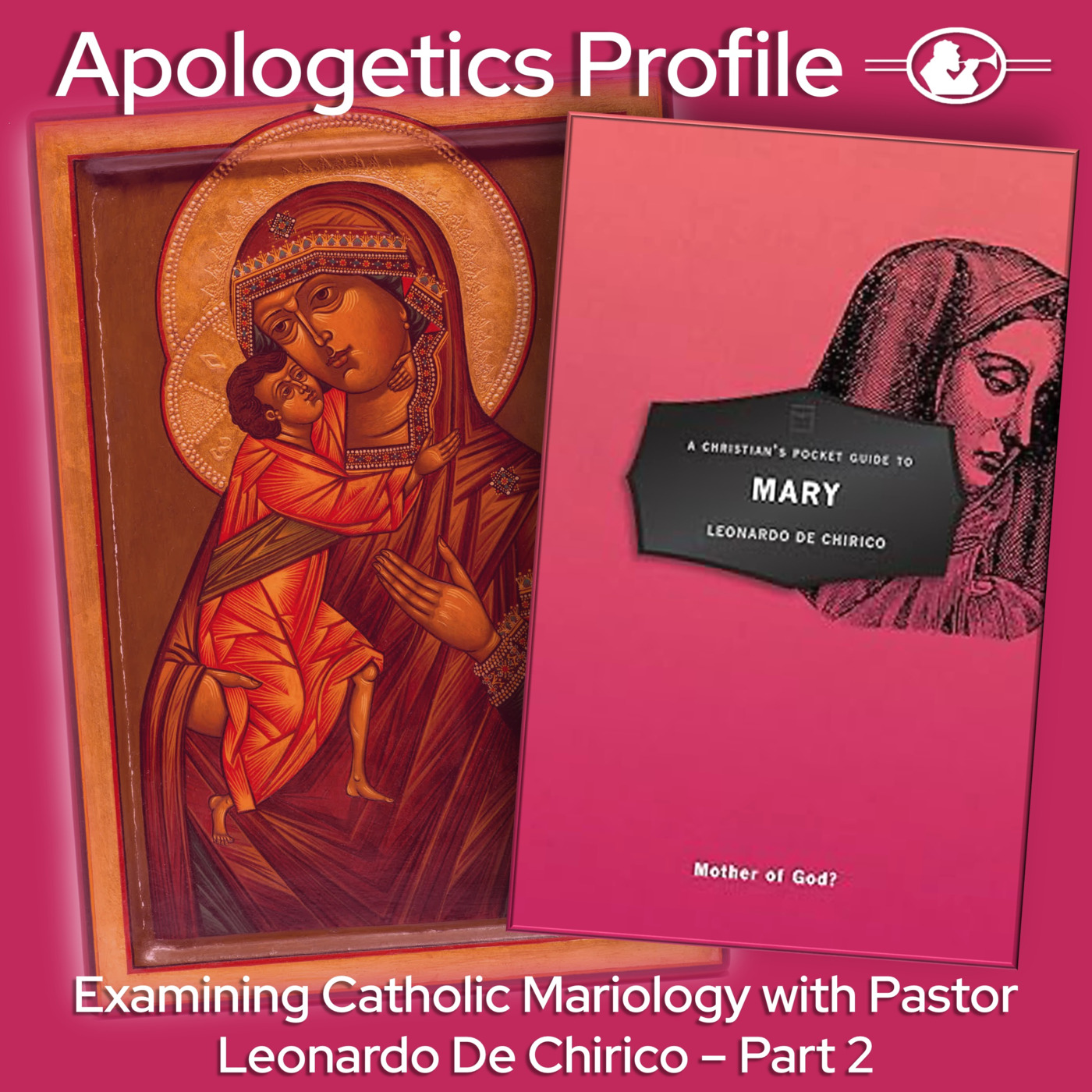
Apologetics Profile
Episode 328: Examining Catholic Mariology with Pastor Leonardo De Chirico - Part 2
00:31:49
The official teaching of the Catholic Church directs its parishioners to pray directly to Mary to...
Loading summary
Transcript39 lines
- [00:02]
A
You shall know the truth, and the truth shall set you free. This is Apologetics Profile.
- [00:15]
B
Last week on Apologetics Profile, we began our discussion with Leonardo DiCarico, an evangelical pastor and theologian who reaches out to Catholics in and around Rome, Italy. He is the author of several books.
- [00:27]
C
On the topic of Catholic and Protestant.
- [00:29]
B
Engagements, one of which we will continue to discuss here on part two of the profile. His 2017 book A Christian's Pocket Guide to Mother of God. Links to Leonardo's works can be found in the notes of this episode. In case you had not heard it, in the introduction to last week's episode, we briefly outlined four basic tenets of Catholic teaching on Mary, also known as Mariology. They include Mary's perpetual Virginity, Mary as the Mother of God, her Immaculate Conception, and her bodily assumption into heaven. This week we will focus on how the Catholic Church interprets Mary's confession in the Magnificat that all generations will call her blessed. We will also talk more about her intercessory role as the alleged Queen Mother and how we can best understand Marian apparitions. We conclude the episode with a brief discussion about whether or not Catholics and Protestants can be unified in theology and practice, and how we might best conduct ourselves as Protestants when discussing our theological differences with Catholics. As Pastor Leonardo reminds us, it should not be seen as some kind of us versus them argumentative diatribe.
- [01:44]
D
I always want to point people to Scripture, and so the sooner I can introduce the Bible, the better. It's not my word over against their word, it's not my message or against their message. It is us coming under the authority of Scripture. And so it is not us versus them, me versus you, my Protestant position versus your Catholic position, but it is us wanting to listen to God's Word and to respond faithfully to it.
- [02:21]
B
As we begin part one. Here I asked Leonardo more about section 971 in the Catechism of the Catholic Church, where the Magisterium's doctrine expands the meaning of Mary's confessions that all generations will call her blessed to mean that Christian devotion to Mary is an indispensable facet of normative Christian worship. The Catechism states that the Church's devotion to the Blessed Virgin is intrinsic to Christian worship. Here once again is pastor and theologian Leonardo DiCarico.
- [02:55]
D
Of course, when we think of the Incarnation of Christ and as we are about to celebrate Christmas, we remember the story of Christ's birth and we remember what happened with the Annunciation and the conception and the birth of Jesus. And so we bless the Lord, for the miracle of the incarnation of the Son of God in the person of Jesus Christ. And of course, we bless the. The memory of Mary and the way in which God used her to introduce to the earth his. His Incarnate Son. But we're still praising God, we're still glorifying the triune God, and we're not including Mary in that praise. She was chosen to be the mother of Jesus and even to receive, you know, the recognition of the people around her, but not to the point of becoming an object or a subject of our worship. The fact that the catechism speaks of the intrinsic nature of Mariology to the Catholic faith is an indication of the fact that Mariology is not a peripheral accretion that has been added and then, you know, remains within the. The fringes of Catholic faith and practice. But actually it has infiltrated the core. It has become part of the DNA. You cannot have, you cannot be a Catholic without subscribing to the full Mario, logical picture that the Catholic Church believes of her. The Immaculate Conception, the bodily assumption, the mediation of Mary and the nearness of Mary to us. All these things are integral, if I may use this language, integral to the package, the Roman Catholic package with regards to the Gospel. And you cannot pick and choose. You cannot select this and that. You cannot do that with Mary. Mary is a. Is a. It belongs to the core. And the fact that belongs to the core is an indication of the fact that the Roman Catholic account of the Gospel has been going in a different direction than the biblical boundaries we are to follow in our response to the Gospel.
- [05:57]
C
You mentioned in those four points there, and you mentioned in your book, the.
- [06:00]
B
Intercession and the nearness of Mary.
- [06:04]
C
And you quickly, in the hundred pages that you have in the book here, I was quickly taken by how Mariology and this portrait of Mary being nearer to us. I think it was Pope Benedict who emphasized this being nearer to us than.
- [06:20]
B
Jesus himself and that Mary can intercede for us. In other words, we can pray to her and she can intercede for us to Jesus on our behalf.
- [06:32]
C
But as Christians will rightly point out, there's only one mediator. Of course, I know the Catholic Church tries to downplay the mediation that Jesus does between the mediation that they invoked with Mary. But, Leo, it seems that we here at Watchman Fellowship are always working with and studying and exploiting the teachings of cults and aberrant worldviews and religions. And one of those things you can.
- [07:00]
B
Find throughout all cultic beliefs is prayers to things, prayers to Physical man made things and prayers to the dead.
- [07:10]
C
And this is troubling for me in the sense that Mariology seems to be.
- [07:14]
B
Encouraging us to communicate with the dead and believe that Mary as a deceased.
- [07:21]
C
Person, just like we all will be.
- [07:23]
B
One day, that Mary can actually hear us and actually receive our prayers. This to me she takes on.
- [07:30]
C
I know the Catholic Church denies her divinity outrightly, but yet she's, she's taken.
- [07:37]
B
Upon a role that can only be mediated by.
- [07:41]
C
By God himself.
- [07:42]
D
Yeah, yeah, I totally agree with you. And it also undermines. It undermines the mediatorship or the mediator mediation of Christ. Because if she's nearer, it means that our mediator Christ is not that effective, is remote, is far away. If we need someone who is closer to us, we're actually saying that is mediate mediation is not that helpful or useful. But it also undermines the work of the Spirit because we are told that when we pray, the Spirit helps us to come to the Son and ultimately to the throne of the Father. So there is a trinitarian involvement. We have a me, one mediator, we have one comforter, the Holy Spirit, mediator, the, the Lord Jesus, one comforter. And we are drawn to the Father by this trinitarian work. If we say that Mary is nearer, we're actually saying that Christ is remote or removed and the Holy Spirit is passive. And we're actually introducing a different discourse, a different narrative.
- [09:12]
B
According to Vatican II's 1964 Lumen Gentium, Mary quote occupies a place in the Church which is the highest after Christ and yet very close to us. And just as a clarification, as we mentioned in last week's broadcast, in November of last year, Pope Leo XIV decreed that the Catholic Church does not endorse Mary as a co mediator with Jesus. As many Catholics do rightly affirm. There is only one mediator between God and man, the man Christ Jesus. According to 1 Timothy chapter 2, however, Catholics do view Mary as an intercessor between us and Jesus. But as Leonardo has shared with us, this intercessory role of Mary, being able to hear and answer our prayers not only diminishes the role of Jesus and the Holy Spirit in our lives, it has no foundation in Scripture. According to Romans 8:26 and Hebrews 4, 14:16 and Hebrews 7:25, Jesus and the Holy Spirit are the only ones who intercede for us. Nowhere in these intercessory texts do we find any exhortation to pray to Mary. In fact, there is strong forbidding language in the Old Testament. Regarding consulting with the dead, consider Deuteronomy 18:10 12. There shall not be found among you anyone who burns his son or daughter as an offering. Anyone who practices divination or tells fortunes or interprets omens or, or a sorcerer, or a charmer, or a medium, or a necromancer, or one who inquires of the dead. For whoever does these things is an abomination to the Lord. And because of these abominations, the Lord your God is driving them out before you. End quote.
- [11:05]
D
And that is what happens in global Catholicism. Mary is the most prayed to figure because she's pictured as the mother who cares for us. But if we need a mother who cares for us in terms of our relationship with God, we are undermining the work of the of the Lord Jesus as well as the work of the Spirit. And if we do so, we're actually rearranging the whole account of the gospel. We are introducing a different account of the Gospel. And the fact that Pope Benedict, who is often thought of as, you know, being a conservative theologian and denouncing the dangers of nihilism and relativism, is still teach taught that Mary is nearer and we need her in order to approach God, indicates that no matter how you can have conservative Catholic theologians, but at the same time their conservativism is marred by this Mariological abnormal developments. And so the ultimate result is a combination of different elements leading to a confused Gospel indeed.
- [12:44]
C
And I would be remiss if I didn't mention this, you mentioned it in your book and I know our audience will be extremely interested to know what you might have to say about Marian apparitions, Leo, because these things, these appearances allegedly of Mary in various places, Fatima and I think one of the most recent ones was actually in 1968 outside of Cairo in Zaytun, I think it is Zeitoun, where thousands of people allegedly saw an apparition like figure atop the basilica. These seem to reinforce the doctrine and the practice of Mariology, wouldn't they? I mean, when I talk to atheists a lot of times they say, well, you don't believe in Marian apparitions, do you? And lots of people claim to see them there in Italy, in Rome Central there. How do you process as an evangelical what these are and how they reinforce the Catholic Church teaching?
- [13:47]
B
Is there something genuinely supernatural about them?
- [13:51]
C
Or are Catholics just being delusional? Or is this a manifestation of something other than like a real manifestation, but something intrinsically evil, like an angel, like a demonic entity appearing as an angel of light. How do we as evangelicals process the apparitions? And how can we have an intelligent dialogue with Catholics who believe in them?
- [14:13]
D
There are lots of apparitions. Not all of them have been recognized by the Catholic Church. So there is a selection. Even within the Catholic Church there is a, you know, a process that these apparitions have to go through in order to be officially recognized. And, and so Catholic churches guards from endorsing all of the alleged apparitions. But having said that, there are hundreds of apparitions that have been approved as having had a supernatural origin and a supernatural message and deserving adherence and from, from the faithful. And at times the apparitions have also been accompanied by messages given by the appeared Mary. And these messages at times have been considered as being secrets to be revealed at the appropriate time. In other words, we're entering a, the world of Marian apparitions that opens up a universe that needs to be appreciated in its own terms. From an evangelical perspective, I would distinguish between the suggestions and things that are not objective, not real in the sense of being made up imaginations from a real supernatural events that probably possibly took place as supernatural events. So I, I, I, I, I, I don't want to buy into this skeptical, entirely skeptical attitude saying they're all made up imaginations at the same time. Biblically speaking, we have a, some criteria for us to, to use in order to appreciate whether or not we're dealing with something that comes from God or comes from another supernatural source that God allows to, to be, to be seen. And biblically speaking, I think we have to say that when a supernatural event leads people to Christ and to confess their sins and to recognize the glory of Christ, then we can, we can say that it has a divine origin. It has, it is something that God has originated in order to bring glory to his Himself and to bring people to Himself. But when these supernatural events lead people to even more profound Marian devotions or lead people to Marian practices, Marian rosaries, Marian chains of prayer, and that is an indication that their origin is not divine in the sense of coming from God. It may be supernatural, but not necessarily divine because the divine origin translates into a divine intention leading to a divine response, divinely appointed response. If that response is different, we may question the divine origin of the event. And so I think that in most cases we're dealing with something that as has nothing to do with, with God, but it has to do with a God allowed supernatural event to occur to confuse people rather than to draw people to himself.
- [18:23]
A
What do your non Christian neighbors believe Watchmen Fellowship can help you better understand the beliefs and practices of other religions and worldviews with our comprehensive Profile Notebook, a collection of nearly 700 pages of high quality 4 page articles on everything from atheism to Zoroastrianism. We offer the notebook in both print and digital format. The digital notebook is perfect for your smartphone, tablet or computer and features a handy search engine for looking up any word or topic. To find out more about the notebook, visit watchman.orgbookbook that's watchmen with an a.org.
- [19:14]
C
Notebook I know a lot of the dialogue between evangelicals and Catholics is often rather acerbic, uncharitable, condemnatory. There's no gentleness and reverence coming from a lot of evangelicals who just hate Catholicism. I've seen this a lot and I.
- [19:34]
B
Know in your experience there in Rome.
- [19:36]
C
That your ministry is dedicated toward having engaged, meaningful conversations that are not mere ecumenically superficial, that you're trying to get to the heart of the teachings and practice this is of Catholicism with a loving intent, a gentleness and reverence, as 1st Peter 3:15 says. So as we're wrapping up, I would love for you to offer some of your wisdom from your engagement with Catholics to us as to how we might better go about having dialogue with our Catholic friends and neighbors.
- [20:07]
D
Yeah, I think that what I've been learning in more than 30 years of ministering in, in a Catholic majority context is that I, I, I always want to point people to Scripture and so the sooner I can introduce the Bible, the better. It's not my word over against their word, it's not my message over against their message. It is us coming under the authority of Scripture. And so it is not us versus them, me versus you, my Protestant position versus your Catholic position, but it is us wanting to listen to God's Word and to respond faithfully to it that relieves me from going about hand wrestling with Catholics but, or even punching them, but presenting myself as a listener of the Word and inviting them to listen to the same word. That is one, one lesson that I've learned and, and also it has freed many relationships from the Catholics becoming self defensive if I attack them. Saying what do you believe? As far as Mary is concerned is idolatrous, is, you know, pagan in, in a sense there is an element of truth. But I, I will then find them reacting in a self defensive way and maybe not even hearing what I'm, I'm telling them. Whereas if I say let's look at what the Bible says Let's read it together. What do you, what do you understand here? What is the message that the Bible is here saying to us? That at least takes away from my own position the responsibility to, to, to say that they're wrong on the basis of my position. But it's the word of God that will eventually speak to them. Then I want always to talk about how the Christian faith shapes my whole life. For many Catholics around me, their Catholicism is a set of traditions, practices, duties they have to do on certain days, etc, but there's little personal involvement, there is little personal faith. Whereas the Gospel is all about having been, having received a personal faith, responding to the message of the Gospel. So reading the Bible, but also sharing a living testimony on how the Gospel impacts my life, that is also important. I, I also need to thirdly always be conscience of the fact that as I talk to Catholics, my Catholic friend, sooner or later, sooner than later, the exclude, the exclusive edges of the Gospel will, will come to, to the fore. Christ alone, Scripture alone, faith alone, these, these things will be. Subject to, to discussion. They will be questioned because they will say yes, Scripture is important, but not the ultimate voice. Yes, Christ is the mediator, but not excluding Mary and the saints. Yes, faith is necessary but not sufficient. So we should be aware of the fact that as soon as we share the Gospel with them, we read the Bible together. These three questions will come sooner or later. The exclusivity, exclusivity of, of Christ as mediator, the ultimate authority of the Bible and the sufficiency of faith as the empty hand by which we receive the gift of salvation. And then, and, and then fourthly, I, in my context here, I always want to, as soon as I can show them that I belong to a community of believers, inviting them to come and see. The Catholic mindset is communal. It tends to be involving, always involving a sense of a communal practice. And as I want to witness on a personal, from, you know, personally as far as my life is concerned, I always want to them to, to see what it, what it, what the, what it looks like for the Gospel to bring about different people so they, they, they understand that it is not a, an individualistic faith. I don't, I'm not, I don't belong to a cult, but I belong to the church that is the community of believers coming together to listen to His Word, to celebrate his triumph, the triune God, to respond faithfully to the ordinances that God himself has established and to go on in mission. So these are, you know, some of the tips that I have gathered along the years of ministering in a majority Catholic context like Rome.
- [26:29]
C
Now, here's what I always like to do to my guests. Ask them a huge question with only a couple of minutes remaining. But one of the big questions, of course, always comes up is how united can evangelicals and Catholics be together about the truth of the Gospel?
- [26:45]
D
They can be united in co belligerence acts in society, in defending life and common shared concerns. But the accounts of the Gospel are so different because they're grounded on different commitments, that there is no real fellowship in the Gospel that is possible. So we. There can be friendship, there can be cooperation when it comes to issues of common concern, but not unity in the gospel, because the council of the Gospel is so different. Mary is one example. We're not talking about something external that doesn't touch on the core. It is integral to the core. And, and so other major things, the view of the church being the prolongation of the incarnation, tradition being the voice of the Bible and supplementing it at times contrasting with it, and so on and so forth. Salvation not being a gift to be received, but something that needs our cooperation. All these things belong to the core of the gospel. And so I wrote a book entitled Same Words, Different Worlds. We use the same words, but we're actually operating within different worlds. And so it is out of honesty, not out of our desire to be nasty with one another, out of honesty and respect for one another, that we have to realize that we don't have the same basic accounts of the Gospel. There can be no real unity at that level, while there can be cooperative efforts in society, in culture, when issues of common concerns are at stake.
- [28:42]
C
All right, well, thank you, Leo. That was a wonderful synopsis of the book, I thought. I know we didn't touch on everything, but a fantastic effort in trying to really talk to Catholics. I know, I've read about, and you have one excerpt in your book about when people within Catholicism start to understand Christianity, they start to see, well, we don't need this Mariology. I think you have one example. Where was it Pope Francis had visited this couple? And they're like, well, we don't need this Mariology, do we? They're starting to recognize what the Gospel is. And Francis is like, no, no, no, no, no. If you don't accept Mary, she becomes your mother in law.
- [29:27]
D
An angry mother in law.
- [29:28]
C
An angry mother in law. And indeed, I thought there was a lot of truth to that. In my youth, I was in foster care for a while. I had a difficult childhood. And the people that took me in were a huge Catholic family. They were actually the first people. The mother was actually the first person to ever introduce me to Jesus. I mean, I don't remember her ever getting theologically detailed, but she was always talking about Jesus with me. And so, you know, to some degree, I think under the veneer of all the works based things that a Catholic must do. Would you say that there can be Christians in Catholicism?
- [30:04]
D
Yeah, it is possible. God is at work. Different places, even strange places. But I would say not because of their Catholicism but in spite of there must be some inconsistency. If one follows 100% the the teaching of the Catholic Church, he or she may be led astray. But if there is, if there are inconsistencies and then, you know, if one person trusts Christ as her his own savior, Christ, Christ alone, on the basis of the Word of God alone, then of course God is at work in that person. But if one follows 100% what the church teaches, she will be confused to say, to say the least, if not totally disoriented.
- [31:01]
A
To financially support the ministry of Watchmen Fellowship and Apologetics Profile, visit our secure online donations page@watchmen.org give that's watchmen with an a.org give apologetics profile is a production of Watchman Fellowship Incorporated, Arlington, Texas. For more information about our ministry and resources and our sister podcast Good Heavens, visit our website today@watchman.org that's watchmen with an A dot org.