← Apologetics Profile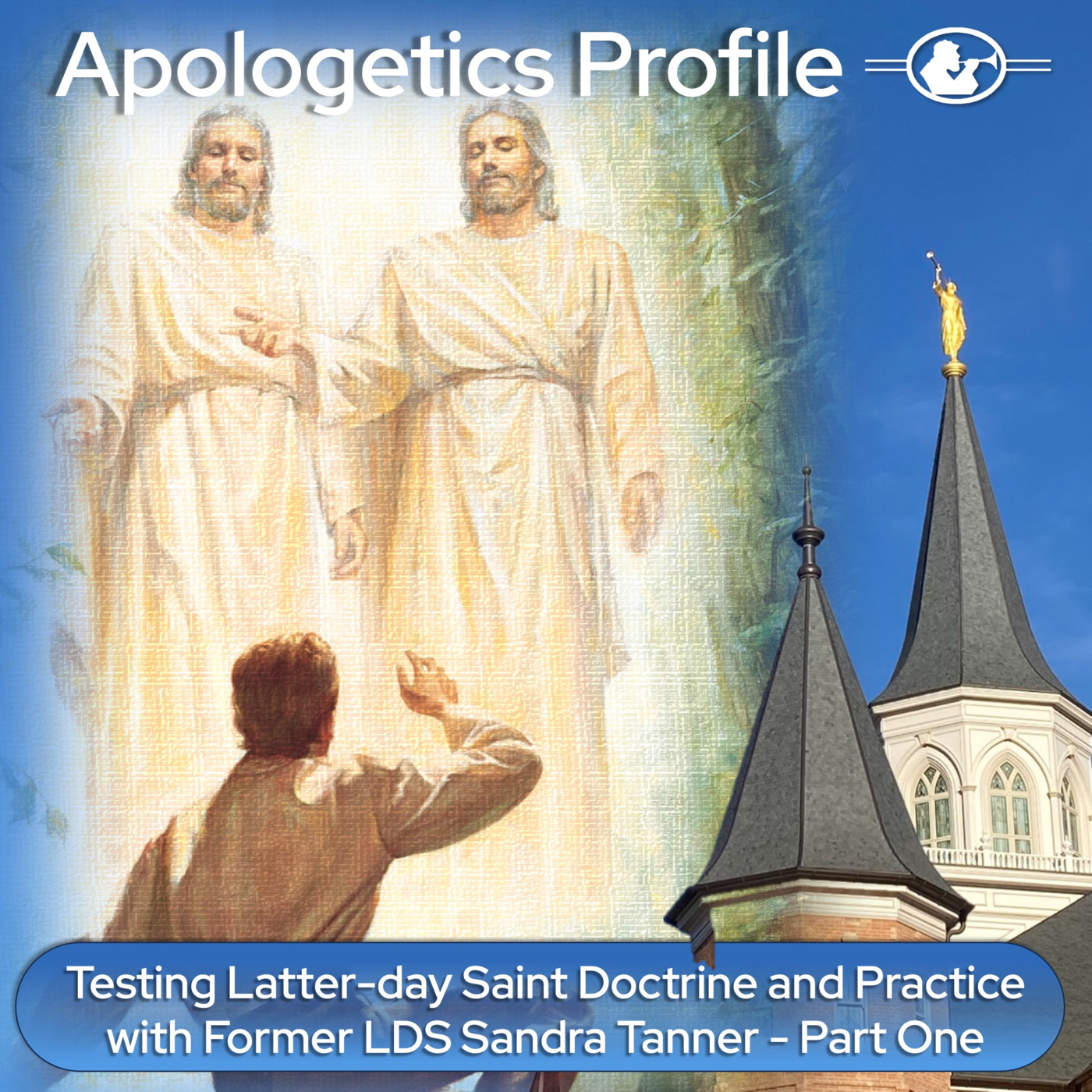
Apologetics Profile
Episode 329: Testing Latter-day Saint Doctrine and Practice with Sandra Tanner - Part One
00:45:48
The Bible gives us a standard by which we may discern truth from falsehood, especially when someo...
Loading summary
Transcript57 lines
- [00:06]
Host
You're listening to Apologetics Profile.
- [00:10]
Sandra Tanner
I had a woman who had been LDS and then had been pursued by a man to come into polygamy, to go into one of the polygamous groups here in Utah. And she says, but Sandra, I had a spiritual manifestation in my front room that this polygamous group was God's group. How do I deny that? So we had this big discussion about you may have truly had such an experience, but that doesn't mean it came from God.
- [00:59]
Narrator
The Church of Jesus Christ of Latter Day Saints began shortly after the early 19th century publication of the Book of Mormon, translated by the church's founding prophet and first president, Joseph Smith Jr. First published in Palmyra, New York in 1830, the Book of Mormon contains close to 270,000 words, nearly 600 pages. But is the Book of Mormon a work of clever fiction, the result of Joseph Smith's creative imagination? Is it the result of occultic or demonic influences? Or is the Book of Mormon a divinely inspired addition to the canon of the Bible? The Book of Mormon is accepted by Latter Day Saints primarily because most Latter Day Saints have prayed to receive an inner confirmation of its truth, a burning in the bosom as described in Doctrine and Covenants, Section 9, Verse 8. The official LDS scriptures are known popularly as the Quad. The LDS canon is comprised of the Book of Mormon, Doctrine and Covenants, the Pearl of Great Price, and the King James Version of the Bible. And as you may already know, there has been no shortage of controversy about the additional books added by LDS as divinely inspired scripture. The Book of Mormon's backstory is more in keeping with Joseph Smith's involvement with treasure seeking than it is with anything related to divine revelation. The Book of Mormon is alleged to have come from a set of gold plates revealed to Joseph Smith by an angel named Moroni who used to be a human being. Moroni, as a human being, is the one who supposedly buried the plates sometime in the 5th century AD near Smith's home in Manchester, New York. Smith claims that Moroni appeared to him three separate times on the night of September 22, 1823. This thrice appearance of a magical or celestial being in treasure seeking folklore of Smith's day often served as a kind of confirmation that the message of the hidden treasure was indeed legitimate. On these enigmatic gold plates allegedly had been inscribed the history of the Lamanites and Nephites, who were descendants of some of the lost tribes of Israel. Their ancestor Lehi allegedly made an open voyage across the Atlantic or Pacific Ocean to Mesoamerica and sometime in 600 B.C. the events described in the Book of Mormon from Lehi's transoceanic trip through his descendants, activities such as temple building, fighting, numerous large scale battles and their encounters with Jesus allegedly take place between 600 B.C. and 421 A.D. smith claimed the gold plates were engraved with reformed Egyptian writing, but such a language has never been confirmed by history or archaeology. In Smith's day, it was believed that Egyptian hieroglyphics were a condensed language and that each of the characters contained a compacted meaning. Smith supposedly translated the unusual characters from the plates using a small kidney shaped seer stone that illuminated much like a cell phone. He would place the seer stone in a hat and then would read aloud the translation to a scribe who would record Smith's words. The scribe would read back the words to Smith, who would eventually verify that they were written correct. Smith believed the words on the seer stone came to him through the gift and power of God. Prior to translating the Book of Mormon, however, Smith often used this very same stone in attempts to locate buried treasure. He never found any. It is worth noting that the word translation today for Latter Day Saints does not mean that Smith studied ancient Egyptian hieroglyphics and then applied his scholarly insights to the characters on the gold plates to render a faithful English translation. Rather, translation in LDS contexts often means some type of divine inspiration or spiritual understanding. If you ask a Latter Day Saint what exactly this might mean, many will often echo what Smith himself said. It just came through the gift and power of God. Consider, though, that if the reformed Egyptian of the gold plates was used by the ancient descendants of the lost tribes of Israel in order to save space, it seems difficult to imagine why there is so much repetition within the pages of the Book Mormon. For example, the phrase and it came to pass, in addition to slight variations.
- [05:32]
Interviewer
Like for it came to pass appear.
- [05:35]
Narrator
Well over a thousand times. Additionally, third Nephi chapter 21, verses 1 through 7 is one continuous run on sentence of close to 400 words. Allegedly, this single sentence contains the actual words of Jesus, but a quick linguistic comparison between, say, the Sermon on the Mount beginning in Matthew chapter 5, also Jesus own words, and this sentence from 3 Nephi 21 shows that there is no conceivable way that these passages were spoken by the same Jesus. These are just a few examples of the questionable nature of the Book of Mormon's origins, its contents and its awkward grammatical style, a style that more resembles the vernacular of Smith's day than it does the actual words of the Biblical Jesus. Another chief difficulty that presents itself to non Latter Day Saints in addressing Latter Day Saint doctrine is the LDS belief in modern day prophets. In the history of the Church There have been 18 prophets who have also served as the Church's President, including the most current prophet, President Dallin H. Oaks. As noted by LDS historian of the church, B.H. roberts, latter day Saint prophets are not infallible. The position is not assumed that the men of the new dispensation, its prophets, apostles, presidencies and other leaders are without faults or infallible. Rather they are treated as men of like passions with their own fellow men. And even Joseph Smith himself said in volume five of his multi volume History of the Church that a prophet is a prophet only when he is acting as such. But just how infallible are Latter Day Saint prophets allowed to be? How many errors can a prophet make and still be a prophet? This belief that prophets can make mistakes in what they pronounce to be from God is wholly counter to the warnings found in Deuteronomy 13 and 18. In 1870, for example, the second prophet and president of the LDS Church, Brigham Young, for whom the well known university in Provo is named, said at least twice in two public sermons that his words were as authoritative as Scripture. I have never yet preached a sermon and sent it out to the children of men that they may not call it Scripture. That can be found in Young's Journal of Discourses Volume 13 on page 95. Young also said of his sermons on page 264 of that same volume, I say now when they are copied and approved by me, they are as good as Scripture as is couched in this Bible. One of the doctrines Young believed and taught was that Adam was not just the first man but God himself. Yet the LDS Church today has made numerous emphatic public declarations that Young's Adam God doctrine was just Young's own opinion. But then how can any Latter Day Saint today know if their current prophet is speaking for God or is just proclaiming their own personal opinion? This weekend, next on Apologetics Profile, we have the distinct privilege of once again visiting with former Latter Day Saint and the great great granddaughter of Brigham Young himself, Sandra Tanner. Sandra and her late husband Gerald spent the last several decades of the 20th century examining in great detail the history, changing doctrines and practices of the Church of Jesus Christ of Latter Day Saints long before the advent of of the Internet and Google. Here on Part one, Sandra and I will talk about Smith's involvement with the treasure seeking culture of early 19th century America. We will also discuss her ancestor Brigham Young and the Adam God doctrine, as well as how LDs today claim that they know their beliefs about Joseph Smith and the Book of Mormon are true. As we begin here, in part one, I mentioned to Sandra a conversation about LDS prophets I had with a Latter Day Saint at the Church History Museum in downtown Salt Lake City this past fall.
- [10:05]
Interviewer
Yesterday we went, our team went to the museum downtown. I had a nice, very nice 30 minute conversation with an employee. It came up in the context of our conversation that I felt like I could ask her a question about Spencer W. Kimball and in relation to what your ancestor Brigham Young had talked about in terms of Adam God, the Adam God doctrine. But it was interesting what she said and I thought we could start here. She said that within the Presidency and the office of Prophet and President within the LDS Church, a current presiding President Prophet can override or make more relevant or make irrelevant what previous prophets or presidents have said. How accurate was she in saying that?
- [11:03]
Sandra Tanner
In today's world that would be accurate? That is the scenario the Church is pushing today. Because with the Internet, with all the research that's come out in the last 20, 30 years or last 50 years, especially with the Internet though there is so much information out there about contradictions between the different prophets that the Church is needing to do a course correction on its training its people to not have a knee jerk reaction when someone outside of Mormonism presents them with a contrary statement by one of their leaders. So they say, oh well, no, we just go by the living prophet. And yet they still use the Doctrine and Covenants. Well that's dead prophets. They use the Book of Mormon. That's all dead prophets. They use the Bible and that's dead prophets. It all leads back to the problem of their claim of the great apostasy. What made the original Christian church fall into error, that it needed to be restored by Joseph Smith. And so they're even changing the rhetoric on that today because in the past they said the early Christian leaders went corrupt and changed everything and brought in strange new doctrines and, and didn't stick with the true Gospel and they modified it and changed. So we had to have Joseph Smith bring everything back to the original.
- [12:40]
Narrator
The Church of Jesus Christ of Latter Day Saints believes and teaches that shortly after Jesus ascension and the deaths of the last remaining apostles, a great apostasy took place where in essence there existed no earthly ecclesiastical authority and that the message of the Gospel had been completely removed from the earth. Latter Day Saints believe God came to Joseph Smith in order to restore the true gospel. LDS author Tad R. Callister, in his comprehensive 2006 book the Inevitable Apostasy and the Promised Restoration, puts it this the Church of Jesus Christ of Latter Day Saints makes a bold and startling statement. It declares there was a turning point that occurred shortly after the death of the apostles, an apostasy or falling away that eventually resulted in a total loss of Christ's church from the earth. Yet over the years, church officials have equivocated somewhat on whether or not there was a total and complete apostasy. As LDS Church historian B.H. roberts wrote in 1992 in his two volume work, the Defense of the Faith and the Saints, when we proclaim this apostasy from the Christian religion and the destruction of the Church of Christ, it does not follow that we hold that all truth, that all virtue had departed from the world, or that God had absolutely withdrawn from his creation. Not so. That can be found in volume two on page 561. On the other hand, Spencer W. Kimball, the 12th president of the LDS Church, proclaimed that there was a long period of centuries when the gospel was not available to people on this earth because it had been changed. That can be found in the teachings of Spencer W. Kimball on page 423. So, according to LDS doctrine, it isn't exactly clear as to what was lost in the Great Apostasy. Was the Gospel completely removed from the earth, or did God leave a remnant of faithful believers? According to Doctrine and Covenants Section seven, Joseph Smith himself received a revelation from God that the Apostle John was still alive, winning souls and prophesying for the glory of God. If John was indeed still living, then this goes counter to the narrative that there was a complete and total apostasy. If, however, there really was no great apostasy, then there would be no need for Joseph Smith to have restored anything. Consequently, if Smith was mistaken, the LDS Church is presently teaching not only a false and misleading history of Jesus true church, but also a false and misleading doctrine. One key problem about the Great Apostasy idea is that it really all hinges upon Joseph Smith himself. There was a great apostasy because God allegedly told Smith there was a great apostasy. But how do we know it was lost in the Great Apostasy? Curiously, most everything Smith himself compiled in the Book of Mormon Doctrine and Covenants and the Pearl of Great Price, in addition to temple ordinances and rituals that borrowed heavily from Masonry, extra biblical commandments, ordinances, laws, etc. To include polygamy, celestial marriage, special undergarments, prohibitions regarding food and beverages, the existence of a plurality of gods, and a belief that sinful men can one day become gods themselves. The problem is that there is no biblical precedent for anything Smith allegedly has restored, not in the Bible or in the early centuries of the growing church. A thoughtful Latter Day Saint may reply to this by telling you, well, that's simply because those truths and practices were lost. But you see the problem. Smith says there was a great apostasy. But Smith also seems to have been the only one who claims to know exactly what was lost. The Bible, however, gives us the confidence that Jesus church has never been removed from the face of the earth. Consider one such passage in Daniel chapter two, where Daniel tells King Nebuchadnezzar of the fourth kingdom of iron and clay in which the God of heaven will establish his kingdom. It is highly likely that this fourth kingdom is the Roman Empire, the epoch of Jesus incarnation and earthly ministry. From the time of Jesus birth to 100 AD, at least 13 Caesars ruled Rome from Augustus and Tiberius in Jesus day to Caligula, Claudius and Nero. During the time of the writing of the Gospels and Paul's missionary journeys. It was in the first century, in the midst of the Roman Empire that Jesus begins to build his church. One may consider that Jesus was likely encouraging the Apostle Peter to stand firm in the midst of the persecution he knew would befall his disciple under the Emperor Nero's tyrannical reign. As Jesus says to Peter in Matthew 16:18, and I also say to you that you are Peter and upon this rock I will build my church, and the gates of Hades will not overpower it.
- [17:45]
Interviewer
End quote.
- [17:47]
Sandra Tanner
Well, the Mormon historians know that you can't support that position from the Mormon viewpoint, that they are doing the very same thing today that they accused the Catholics of doing. That was the justification for Joseph Smith during the Restoration. But his restoration has had to be continually revised, updated and redirected. Different doctrines. Most historians concede that Brigham Young's Adam God doctrine, they wouldn't say it's false doctrine. And I don't even know that they would say it's incorrect. They just want to paint it today. That was his personal opinion. And I say to Mormons, how many of your leaders can just give personal opinions on the nature of God without you wondering if there's any stability here? I don't understand on such a basic doctrine. I thought that was one of the arguments against the early Christian church is they're going to get rid of all those Catholics, brought in a terrible new doctrine of God. The Trinity and that original Christianity would have taught the Father, Son and Holy Ghost as being separate deities. That was always their claim before.
- [19:11]
Interviewer
Right.
- [19:11]
Sandra Tanner
But now they have to rethink all of their answers to problems that the outside world might bring to the Mormon because the old answers don't work anymore. The Mormons face all the problems that they claim they were here to correct.
- [19:29]
Narrator
Yes.
- [19:30]
Interviewer
And you hear, Sandra, when you talk about Mormon doctrine, the Book of Mormon, Joseph Smith. The authoritative weight of Smith and of the Book of Mormon rests on the idea that he is a Latter Day Saint prophet. How did Joseph become prophetically authoritative in the early days of Mormonism? Was it before 1830, before the book of Mormon, or was it as the movement developed in the early 19th century? When did the office of prophet fall upon him? How did that develop within Mormon history and theology?
- [20:08]
Sandra Tanner
Well, you have the difference here of how you tell the origin story. So the Mormons want to start the origin story with Joseph Praying in 1820 to know which church to join. And then God and Jesus, according to their pearl of great price, shows up and tells Joseph Smith not to join any of the churches, that he's going to do a work through Joseph. And then the story goes that in 1823, an angel comes to Smith to tell him about this hidden scripture that God's going to call him to translate. And then in 27, God finally gives him the gold plates that have this record of this ancient civilization. And he spends the next three years translating this record to be published in 1830 as the book of Mormon and the start of Mormonism. That's a standard story. However, historians now realize it's a much more complicated story and not as faith promoting. In actual fact, we know that in 1820, there's no evidence that he told anyone of a vision experience at that time. Nothing. That's early in Mormon history. And so you don't really get people talking about Joseph smith up until 1823, when it's not because of an angel coming to tell him about gold plates, it's because he's becoming known as a glass looker. And this is a magician type of situation where Joseph Smith found a stone in a well. And in today's Mormonism, the Mormon leaders now admit this and even print photographs of the stone in the church publications. People in the New England area that believed in different forms of folk magic, and this included using a divining rod, which was a forked stick that you could hold in your hands and walk over property and find water or some felt you could find Mineral or metal things. Also, in the 1820s, there was this idea of certain stones having magical power, like crystal balls. When you think of a gypsy having a booth with a crystal ball to tell your fortune, there were those that felt that there were certain rocks that had some sort of power in them that you could use. As they would say, Mormons would say today, as a seer stone. In the day, it was more like going to the gypsy to have your fortune read.
- [23:09]
Interviewer
I even heard President Nelson recently liken the seer stone to a cell phone.
- [23:15]
Sandra Tanner
Yes.
- [23:15]
Interviewer
Where I can see a message on my phone, but you can't see it. And he was like, this is how the stone worked.
- [23:21]
Sandra Tanner
Yes. So that's. They have. The Mormon Church has had to be more forthright in how the process worked for Joseph Smith in the early days of him using a stone in his hat to discern hidden objects or to do translation. So the claim is that when he gets to the part of translating the Book of Mormon, and I use the word translate loosely, the Mormons use translate. But what they're really talking about is a magic situation where Joseph is looking at a magic rock and a hat and magically words appear on it that he can then read to a scribe to write out the Book of Mormon. But the problem with this is that Joseph becoming known in the area as this glass looker, as this man that can do these special divinations and go on your property and help you find hidden treasure. If someone buried gold in your backyard, he could help you find it. So when you say, how does he become a prophet? He first is. Well, they don't like the word magician, but he. I can imagine he's the local seer that can be hired to walk over your property to tell you if you have any gold or silver buried or any important object to find.
- [24:52]
Interviewer
He was never successful in that, by the way. Right.
- [24:54]
Sandra Tanner
Yes, that's the problem. See, he never was successful. So the Mormon Church says today, oh, he really had this gift. And as a teenager, he used it in sort of a childish way. And then he matured and realized this was a gift that God had given him that God wants to use in a very special religious way. So he's building a reputation of some sort of divine power that can help him find treasures, except he doesn't find any treasures. So in 1826, we know now that a man that he had worked for that hired him to help him find a silver mine, that the man's relatives felt that the man was being taken advantage of by Joseph Smith. And charges were brought against Joseph, Joseph Smith, the Glass Looker. And it says that specifically on the judge's docket book, Joseph the Glass Looker. And he's being tried on a misdemeanor. But this whole case, which the Mormon Church admits to this 26th trial hearing where Joseph's arrested and appears before this judge, Joseph's defense is, I really have this gift of seeing in the rock, but I don't use it lightly because it hurts my eyes to stare at it. So the reason he has to plead not guilty and that he really has the power is because there's a law against fortune telling. People that are going around claiming these magic powers for money that don't have any visible job, and it looks like a scam. And so he has to argue, oh, no, I'm not really running a scam on these people. I truly have the gift. But I don't do it now because it hurts my eyes. And at this 26 hearing, the man that hired him testifies in Joseph's behalf. And he says, oh, I know Joseph really has the gift. Because when we went out to dig for this treasure, he said when we dug down, we would find a feather. And when we dug down, we did find the feather. And then he said we went further down that we'd find the treasure, but it was too hard and the treasure slipped away. And so we weren't able to get it. But because we found the feather, like he said, we know he really has the gift. Well, I don't think it would be very hard if you're helping a guy dig a hole for you to slip a feather into the dirt and then claim, oh, here's the feather. We must be almost to the treasure. So Mike Quinn, a Mormon scholar, wrote a book called Early Mormonism and the Magic Worldview. And he estimated that the first hundred converts into Mormonism were people from the New England area that already believed in these magic practices in these kinds of seer stones, water witching, and doing magic incantations, magic circles at night to bind spirits so that you could get the treasure out of the ground. So they all were ready, were predisposed to believe that a certain man could have greater powers than the rest of them. So I don't see it as being very hard to move people from believing Joseph had the gift of finding buried treasure to the idea that an angel came and told him about the real treasure. Is this religious record that he's going to dig out of the ground and translate to be the Book of Mormon?
- [28:51]
Interviewer
Yeah, and it's interesting too, because I know this is somewhat of an aside, but if Washington Irving published his book Legend or his story the Legend of sleepy hollow in 1820, which is about 10 years before Smith. But the description of Sleepy Hollow, we might suggest, is pretty apt for the kind of environment in which Smith existed. That there was a sleepiness, a bewitching over the town that people were. It was either a kind of supernatural revivalism where everybody was speaking in tongues and there was a great deal of confusion. And, you know, scholars, historians have called it the burned over district because so many itinerant pastors, preachers would come in and excite the people and they would leave and that that movement would die. But in addition to all the. What seems like revivalism to some degree, especially with itinerant Methodist preachers, you have this whole culture of what you just described, of magic and witchcraft and glass looking. So it seems like the legend of Sleepy Hollow where anybody was ready to believe in anything. So we have, like Ichabod Crane, who is vulnerable to the myths and superstitions and legends.
- [29:57]
Narrator
People are seemingly being easily misled, or.
- [30:00]
Interviewer
At least they're tired of the confusion and want somebody to rise up and give them clarity. And that seems to be what Smith was able to do in that milieu, is to become someone who can clarify and consolidate and clear up the spiritual confusion of that time.
- [30:15]
Sandra Tanner
Right, right. And there was in this revival period, you had what was known as the seeker movement. So people that were dissatisfied with established churches, the standard denominations, were looking for some new work of God, some new restoration, some way that they could see God was working in the world today and that there should be unity, there should be gifts, there should be things going on spiritually in a static kind of revival meetings that shows the power of God was with them. And so you see people coming into Mormonism because of looking for some sort of manifestation that God's speaking to us today. And a lot of people are surprised when they find out that the early Mormon church, a lot of the people spoke in tongues. And this was the thing that first attracted Brigham Young about Mormonism was going to meetings where he saw people speak in tongues and that said to him, the spirit of God is here. And then it took him a while to get converted to the Book of Mormon. But one of the attractions for him was the manifestation of some sort of spiritual gifts visibly in the congregations.
- [31:38]
Interviewer
Right. March of 1830 is when the Book of Mormon is. The first edition of the Book of Mormon is published. No verse numbers in that book, you can get a replica of the 1830 in Mormon Historia in bookstores. It's very easily accessible. But back in your time when you and Gerald first started investigating this, how easy was it to obtain a copy of the 1830 edition of the Book of Mormon?
- [32:07]
Sandra Tanner
When we were studying clear back in 1959, there was no photo reprint. The Wilford Woodruff Wood. Wilford Wood. I keep confusing the words Mr. Wood, furrier guy that lived up in Bountiful, Utah, had just done a reprint of the Book of Mormon. But we didn't. When we first started studying, we didn't know that we were down in California. We weren't aware of what was going on up here in Utah. But we knew from Fawn Brody's book and a few different little pamphlets and stuff that we ran across that there were changes made between the 1830 Book of Mormon and the 1837 second edition. And some of these changes were important in our early questioning. The whole issue of God was a major factor in our search. Who is God? Who is Jesus? How do they fit together? As we read the Book of Mormon and thought, well, if there's problems and questions in Mormonism, we got to look at the very beginning of Mormonism, okay, the first thing Joseph brings out is the Book of Mormon. So if we have questions, we're going to use the Book of Mormon as our litmus test for truth. Now, it didn't occur to us we could go one step further and go back to the Bible because as Mormons were trained not to trust it that much, so the Book of Mormon would be a more sure guide to us. Well, when we read the Book of Mormon, it's all just one God. The Father, Son, Holy Ghost is one God.
- [33:54]
Narrator
He.
- [33:54]
Sandra Tanner
It wasn't teaching the current Mormon view of deity. Well, then we read these little pamphlets, and in Fawn Brodie's book where she tells about these specific phrases where the Son of is added into several places where it's talking about God. So one place, it prophesies that this girl Mary will be the mother of God. But in 1837, Joseph changes that to Mary will be the mother of the Son of God. So adding the Son of to a lot of people doesn't sound like that much of a change. But when you're looking specifically at the nature of God, that becomes important when you realize the Mormons are making a big separation between God and Jesus as two separate people.
- [34:50]
Interviewer
Right, right.
- [34:51]
Sandra Tanner
So those changes became important to us, and that led us eventually to do a whole study of reading the first edition of the Book of Mormon to the current Book of Mormon in the 1960s.
- [35:06]
Interviewer
3100, 3939, 3913.
- [35:10]
Sandra Tanner
Changes in the Book of Mormon. And I had a BYU guy later tell me that our count was off. It was more like 4,000. I didn't go back to recount, but I'll take his word on it. It's hard when you're sitting across from each other reading a book to someone else to catch all the times there's any differences.
- [35:34]
Interviewer
Yeah, well, I bring this up because Doctrine and Covenants, as you know, and just for our audience, it seems to be filled with the sections. Each of the sections, it begins with a header where Smith, for lack of a better term from an outsider's perspective, Smith has an idea. He gets a revelation and he writes down the date. He's very specific about this. And then the section goes into the text of what came to Smith. And these come after the Book of Mormon is published. And there are several over 100 doctrine and covenant sections. But I wanted to read one because this touches upon something that your great, great, two greats.
- [36:15]
Sandra Tanner
Yeah, Grandpa.
- [36:16]
Interviewer
Your great great grandpa, Brigham Young, who is the reason we are here in Utah today. You mentioned it earlier, the Adam God doctrine. Now, it's not really. If you're an evangelical and you're having interfaith dialogue with your Mormon friend, you don't necessarily want to lead with the Adam God doctrine.
- [36:35]
Narrator
Foot.
- [36:36]
Interviewer
But it's a controversy. But I wanted to read a section from doctrine and covenants 2711. This is Joseph Smith, a revelation given in August of 1830. So this is five months after the Book of Mormon is published. And Smith says, and also with Michael.
- [36:53]
Narrator
Or Adam, the father of all, the.
- [36:56]
Interviewer
Prince of all, the ancient of Days. This is Doctrine and Covenants, section 27, verse 11. And in the verse 11, footnote, footnote B, Sandra refers to Daniel 7, 2213. So it seems like this is maybe the Genesis, if you will, of the Adam God doctrine. Is that fair to say? Is this where Brigham Young carries on this? Is this where.
- [37:21]
Sandra Tanner
I'm sure it's one of the things Brigham Young said that Joseph Smith taught him his Adam God doctrine. And so people have said, well, Young was wrong, because there's no early teachings of Joseph Smith on that. But I think that you see the seeds of it right there in that revelation, because the Ancient of Days would have been understood as God. And to make that be Michael, who the Mormons say is Adam, then it seems to be the support for Adam God doctrine. So in Mormonism in Brigham's day, you have this hierarchy of gods. So you have Adam and then Jehovah Elohim and then the Council of Gods. So in Mormonism now is trying to backpedal on how many gods there are, and they want to talk about, well, we're only concerned with the God of our universe. And when we say there's only one God, we mean for us, there's only one God. And they qualifying because the earlier church leaders were teaching this whole pantheon of gods that as each person from a given earth progresses to the point of becoming a deity, he can go off and make his own world, and he becomes the God for that world. But there are gods above him, ruling universes and countless creations before that. And the church today is trying to get people to stop thinking too deeply on the nature of God and to make Mormonism sound more like a standard Christian view.
- [39:11]
Interviewer
They should stop singing high into Kolob if they want that to happen.
- [39:15]
Sandra Tanner
I don't know how much they sing about Kolob anymore.
- [39:18]
Interviewer
I heard that in a. In an LDS Church service here a.
- [39:20]
Narrator
Couple of years ago.
- [39:21]
Interviewer
Oh, really? That's the first time I'd heard the hymn. And I was like, what is this? But at the end of that hymn, the hymn writer, it was W.W. phelps, says, can we even be. I'm paraphrasing. Can we even begin to imagine where God's gods, plural, begin to be? So it opens up a can of worms about the infinite regress of. Was there a first God? Is there an infinite regress of God? Who was God before God? And how did God promulgate God and all these other gods? So, yeah, to your point. So the Adam God doctrine is. You're saying it's downplayed today. But here's the question that I kind of began with as we were talking. Okay. This changes the current. Like, Kimball and Joseph F. Smith both were like, well, that's just a theory, Uncle Brigham. We wish he didn't say these kinds of things. Just kind of a theory, just kind of his own opinion. But when you go back and you look at the records, it's clear, at least from what Brigham said about it, that this is as doctrinal as anything that anything that Joseph Smith wrote down. So you have, on the one hand, well, it's just an opinion, it's just a theory, but you have Brigham believing that it was fully and completely from God himself, and so was the prophet in error. And how much error does an LDS Today allow for past prophets. Do they actually say this man was in error or that things just change, like we're in a new era, a new covenant, or something like that?
- [40:48]
Sandra Tanner
I don't think they want to use the word error. It's always personal opinion. That was his personal opinion. Even when I bring up Joseph Smith's King Follet sermon, which is one of his late sermons before his death, where it's very specific about progression of God, that I'm going to tell you how God came to be God. And Mormons today will say, well, that was his personal opinion. And then I have to remind them, well, wait a minute. Joseph Smith's the guy that talked to God and Jesus face to face. If he doesn't know who God is, what hope is there for any of the rest of us to ever know anything about God? That if I'm to take Joseph serious, if you really want me to consider him as a prophet of God, then I would expect his sermons on the nature of God, since he's the one that talked to him. I would expect his sermons on God to be something I could absolutely stake my faith on. And yet now the Mormons are trying to move away from that. And I said, well, what is the standard then? And then they want to bring it back to personal revelation. You pray and God personally reveals to you the truthfulness of Mormonism. And then my challenge to them is, how is that any different from someone that prays about any of the polygamist groups or prays about Jehovah's Witness or prays about Islam or Catholicism or whatever you want to name. Seventh Day Adventist, Jehovah's Witness. If we're only going by prayer and feeling, then looks like you could just take your pick and whatever you want to believe.
- [42:31]
Interviewer
Right, Right. I want to talk a little bit about this very sense of the sensation of testing truth by feelings. My conversation yesterday with a young woman in the museum, she was wonderful. She was super sweet and answering all my questions and was not at all defensive. But there were some things that I had raised. This very issue was one of them in discerning the strength of one's personal testimony in deciding what is true. Because as you know, the rllds faith is a splinter group that began with Joseph's son, Joseph Smith iii. Correct.
- [43:06]
Sandra Tanner
Right.
- [43:07]
Interviewer
And so that's the Reformed.
- [43:08]
Narrator
Reformed, correct.
- [43:09]
Interviewer
Reformed Latter Day Saint.
- [43:11]
Sandra Tanner
Well, reorganized.
- [43:12]
Interviewer
Reorganized. That's right. My Reformed theology is speaking there. Reorganized Latter Day Saint with Joseph Smith iii, Joseph's son. And I asked her, because she said, she had visited, I reorganized Latter Day Saint Church in Wyoming. And I said, well, that's interesting. So what did you feel when you were in that service? And she paused and she looked at me and she said, it felt like a boardroom with nice people. I didn't get the feeling. And that was her line, Sandra, of demarcation between what she thought was true and what she thought was false. And it really didn't go beyond that. And she said, well, logic can only take us so far. And, you know, really only you have is your testimony. And she said a few times in our conversation, I just want to share you my testimony. And that seems to be, if you're going to encounter and talk with Latter Day Saints about these heady topics, that that's what you're going to bump into. If almost like, well, I don't have an answer for that except I have my testimony.
- [44:10]
Sandra Tanner
Oh, yes. And I had real hard experience of this years ago when I had a woman who had been LDS and then had been pursued by a man to come into polygamy and to go into one of the polygamous groups here in Utah. And she was all confused and she came and talked to me and she says, but, Sandra, I had a spiritual manifestation in my front room that, that this polygamous group was God's group. How. How do I deny that? So we had this big discussion about, you may have truly had such an experience, but that doesn't mean it came from God.
- [45:11]
Host
You have been listening to Apologetics Profile, a production of Watchman Fellowship Incorporated to financially support the ministry of Watchmen Fellowship and Apologetics Profile, visit our secure online donations page@watchman.org give that's watchmen with an a.org give.
- [45:37]
Narrator
Sa.