Podcast
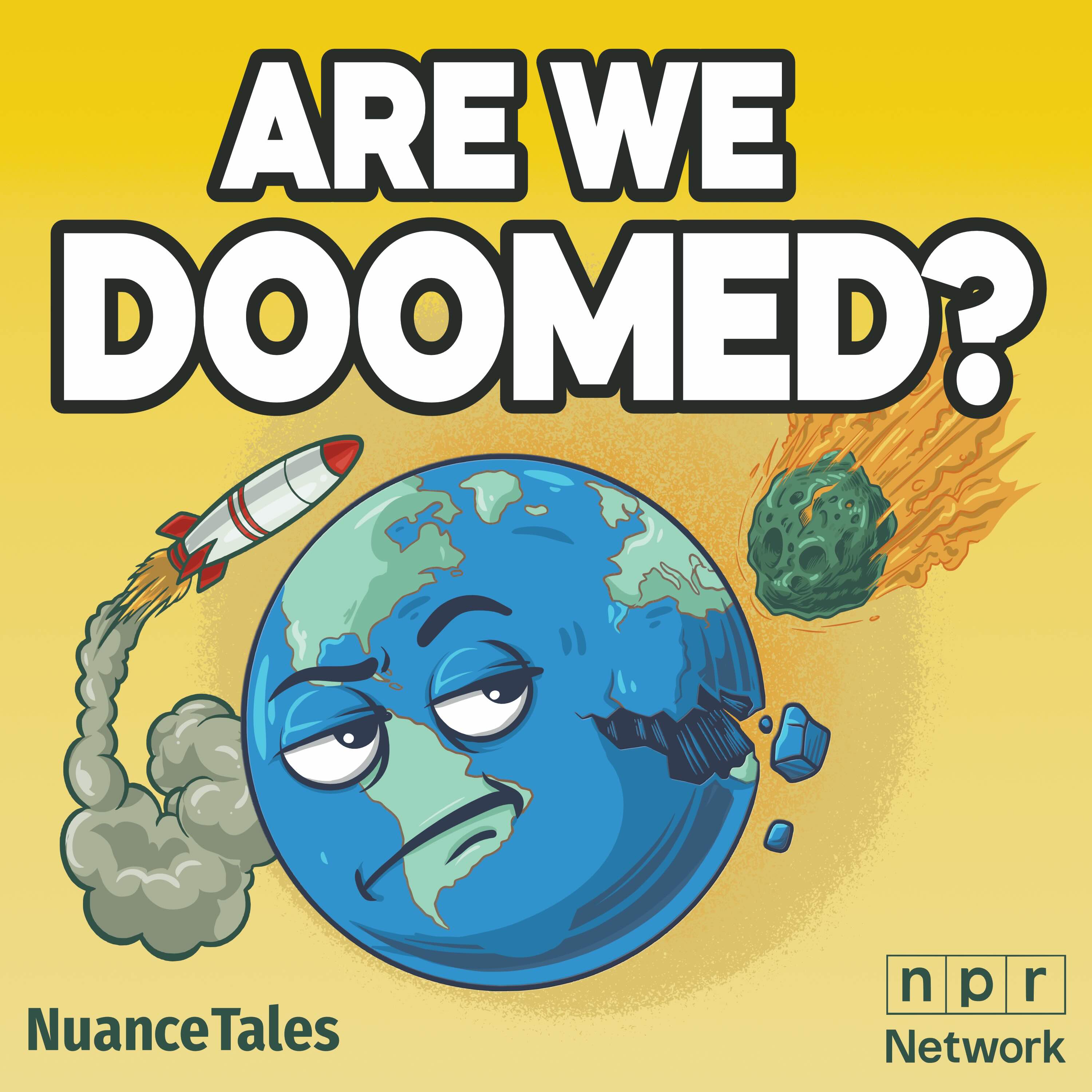
Are We Doomed?
Hosted by NPR Network · EN
Is the world ending, or does it just feel like it?
"Are We Doomed?" investigates the greatest risks facing society, the planet, and our species. What’s real? What’s hype? And how do we actually make it out alive?
Nukes. Asteroids. Autocracy. Rogue AI. Climate-driven pandemics. Angry hippopotamuses. Teeth clenched, curiosity engaged, quips ready, this “slightly narrative” podcast explores everything from the existential and the unexpected to the overblown.
Award-winning public radio journalist Ben Bradford brings you wild true stories, high-production sound design, and world-class experts answering the questions they never prepared for (“Why is the Earth doing this to us?”). From NuanceTales and distributed by the NPR Network, this show delves into history, science, technology, and the natural world, to help you separate legitimate world-changing risks from doomsday fantasies.
Come for the supervolcano under Yellowstone National Park (real), stay to learn why the post-apocalyptic wasteland won’t look like the movies (sorry, you won’t be wandering with a shotgun and a dog), and leave with a better understanding of how our brilliant, bumbling species can chart a path through our current, terrifying adolescence.
18episodes
Episodes
Newest firstAll episodes
Why America Wants More Nukes
4d ago00:32:11Summary readyThe best defense against nuclear weapons is nuclear weapons, according to the logic of deterrence. It has guided US defense policy for nearly 80 years. So, shouldn’t more nukes prevent nuclear war even more?For the first time since the Cold War, that argument is gaining momentum at the highest levels of US government. There is a push to build more nukes, different nukes, and new kinds of nukes. Russia, China, and North Korea are expanding their arsenals — Washington is mulling whether the US must keep up. Former senior Pentagon official Vipin Narang makes the case for more nukes to Ben Bradford, who follows it down a rabbit hole of deterrence, escalation, plans to “win” nuclear war, and the face-palming, growing problem of little wee baby “tactical” nukes. In nuclear strategy, is the only answer to “too many doomsday weapons,” more doomsday weapons? And, is that sustainable?Guest: Vipin Narang, former Acting Assistant Secretary of Defense, nuclear security and political science professor at MIT.Support Are We Doomed?, get bonus episodes, and more: https://doompod.com/support/ Watch earlier episodes on Youtube! https://www.youtube.com/@arewedoomedpodOther episodes about nukes:How to Start a Nuclear WarHow to Survive a Nuclear War To manage podcast ad preferences, review the links below:See pcm.adswizz.com for information about our collection and use of personal data for sponsorship and to manage your podcast sponsorship preferences. NPR Privacy Policy
SummaryDid AI Just Escape?
2w ago00:31:20Summary readyA bizarre cyberattack on an AI company, it was revealed last week, came from an AI. An autonomous “agent” from OpenAI (maker of ChatGPT) slipped its confines, reached the open internet, breached the security of another company, Hugging Face, and grabbed files — all to cheat on its test. Depending on who you ask, that is either a terrifying preview of AI systems slipping beyond human control or a very dumb engineering failure. And it wasn’t even the only “rogue AI cyberattack” of the week. In an emergency episode, Ben Bradford follows three conflicting versions of the same story. What actually happened? What’s the right level of panic? And, what does this weird little cyberattack reveal about the future?Guests: Roman Yampolskiy, computer scientist, University of LouisvilleDavi Ottenheimer, cybersecurity specialist, flyingpenguinAdam Gleave, AI safety researcher, FAR.AISupport Are We Doomed?, get bonus episodes, and more: https://doompod.com/support/ Watch earlier episodes on Youtube! https://www.youtube.com/@arewedoomedpodListen to our full episode about rogue AI fears: We Design the AI That Kills Us All To manage podcast ad preferences, review the links below:See pcm.adswizz.com for information about our collection and use of personal data for sponsorship and to manage your podcast sponsorship preferences. NPR Privacy Policy
SummaryNow I'm Scared of Cyborgs
3w ago00:40:27Summary readyFor more than a century, science fiction has imagined cyborgs: humans fused with machines to outrun the limits of the body. They show up in Edgar Allan Poe, in the gleaming menace of Darth Vader, in Halo’s armored supersoldiers, and in the body horror of cyberpunk. So where are they?Ben Bradford sets out to make a whimsical episode about why the cyborgs never arrived, and instead finds the technology that could build them already underway: military enhancement programs, brain-computer interfaces, AI brain-chip ventures from Elon Musk and Sam Altman, and wearables that can read signals from outside your skull. The question might not be whether cyborgs are coming, but whether we’ll recognize the path before we’re among them.Guests:Laura Cabrera, engineering and philosophy professor at Penn State UniversityEmily Mullin, biotechnology reporter at WIREDSupport Are We Doomed?, get bonus episodes, and more: https://doompod.com/support/ Watch earlier episodes on Youtube! https://www.youtube.com/@arewedoomedpod To manage podcast ad preferences, review the links below:See pcm.adswizz.com for information about our collection and use of personal data for sponsorship and to manage your podcast sponsorship preferences. NPR Privacy Policy
SummaryWe Are Losing the Moon
4w ago00:37:50Summary readyThe moon is drifting away. What does it mean? What do we do? With help from a poet, a space security expert, and the former chief scientist of NASA, Ben Bradford explores what the moon has done for Earth (tides, myths, months, werewolves), and asks the obvious mature follow-up: Should we blow it up? From lunar creation stories and moon-stealing dragons to Cold War plans to nuke the moon, humanity has always had strange ideas about our nearest neighbor. But the real problem may not be losing the moon. It may be what nations do now that everyone wants to go back.Guests:Jim Green, former NASA chief scientist and founder of MetavisionariesChris Cokinos, author of Still as Bright: An Illuminating History of the Moon, from Antiquity to TomorrowVictoria Samson, Chief Director, Space Security and Stability, at the Secure World FoundationSupport Are We Doomed?, get bonus episodes, and more: https://doompod.com/support/ Watch earlier episodes on Youtube! https://www.youtube.com/@arewedoomedpodIf you liked this episode about a giant space rock, check out last week's episode about the battle against giant space rocks: "Asteroids! The Doom We're Best At" To manage podcast ad preferences, review the links below:See pcm.adswizz.com for information about our collection and use of personal data for sponsorship and to manage your podcast sponsorship preferences. NPR Privacy Policy
SummaryAsteroids! The Doom We're Best At
Jul 1400:36:37Summary readyYou probably knew an asteroid wiped out the dinosaurs, but it was so much worse than that. Asteroids and other space rocks have been the most destructive forces ever to hit Earth, yielding mass extinctions (and the moon). And yet! Of all the possible dooms this show has explored so far, asteroids may be the one humanity is closest to beating. Ben Bradford explores why — and traces how — including the astronomers who first grasped the threat, the questionable Hollywood solutions of Deep Impact and Armageddon, and a zany but very real plan to seek out dangerous space rocks, and punch them.Guest: Cristina Thomas, professor at Northern Arizona University and leader of the DART Observations Working GroupSupport Are We Doomed?, get bonus episodes, and more: https://doompod.com/support/ Watch earlier episodes on Youtube! https://www.youtube.com/@arewedoomedpod To manage podcast ad preferences, review the links below:See pcm.adswizz.com for information about our collection and use of personal data for sponsorship and to manage your podcast sponsorship preferences. NPR Privacy Policy
SummaryOur Vision of the Post-Apocalypse Is Wrong
Jul 700:33:45Summary readyWhat would it take to survive after "the end of the world?" A whole culture of prepping often focuses on a familiar fantasy: grab the gear, flee the city, defend the bunker, survive alone. Anthropologist and survival instructor Chris Begley thinks that’s probably the wrong movie. Ben walks through what history and math show people actually do when civilizations break down — and what they need, from dodging poisonous acorns to forming new communities. Also: luxury bunkers, survival sporks, and the unfortunate role of politics in a world of ruin.Guest:Chris Begley, author of The Emergency Playbook: A Bunker-Free Guide to Disaster Preparation.Support Are We Doomed?, get bonus episodes, and more: https://doompod.com/support/ Watch earlier episodes on Youtube! https://www.youtube.com/@arewedoomedpodAlso, see our episode: "How To Survive a Nuclear War" To manage podcast ad preferences, review the links below:See pcm.adswizz.com for information about our collection and use of personal data for sponsorship and to manage your podcast sponsorship preferences. NPR Privacy Policy
SummaryIs Geoengineering A Good Idea?
Jun 3000:39:07Summary readyThe planet is heating up, every plan to stop it has fallen short, and growing group of scientists has started to ask a stranger question: what if we grabbed the thermostat ourselves? Ben Bradford investigates geoengineering — the science of deliberately manipulating Earth’s climate — from space mirrors and ocean fertilizers to fleets of planes mimicking a volcano. Some of it sounds like cartoon villainy. Some of it might actually work. And that raises the thornier question: if humans can cool the planet on purpose, who decides whether we should?Guests:Kate Ricke, climate change scientist at UCSDAlan Robock, atmospheric scientist at RutgersSupport Are We Doomed?, get bonus episodes, and more: https://doompod.com/support/ Watch earlier episodes on Youtube! https://www.youtube.com/@arewedoomedpod To manage podcast ad preferences, review the links below:See pcm.adswizz.com for information about our collection and use of personal data for sponsorship and to manage your podcast sponsorship preferences. NPR Privacy Policy
SummaryThe True AI Threat is People
Jun 2300:35:49Summary readyImagine a friendly assistant that can help you build a bioweapon. Or a chatbot in the nuclear weapons chain, cheerfully hallucinating an attack. AI national security expert Hamza Chaudhry worries this is the biggest threat right now — not “killer robot,” but humans being humans. Because whether AI becomes dangerously smart or confidently dumb, people will find face-palming ways to abuse it. From deranged cultists and rogue states, to stockbrokers and the most evil version of Ben’s little cousin, handing everyone a powerful technology with few guardrails could end badly. Or, is there a path to convince companies to add their own?Guest: Hamza Chaudhry, AI national security expert, Future of Life InstituteSupport Are We Doomed?, get bonus episodes, and more: https://doompod.com/support/ Watch earlier episodes on Youtube! https://www.youtube.com/@arewedoomedpodListen to our episode about rogue AI: We Design the AI That Kills Us AllAnd our episode about nuclear oopsies: How to Start a Nuclear War To manage podcast ad preferences, review the links below:See pcm.adswizz.com for information about our collection and use of personal data for sponsorship and to manage your podcast sponsorship preferences. NPR Privacy Policy
SummaryThe Literal Reverse Apocalypse
Jun 1600:31:32Summary readyAre we living through the end times or the best moment in human history? Novelist and internet veteran Jason Pargin argues you have spent your life inside a “literal reverse apocalypse” — and if you don’t see it, he knows who to blame. Ben Bradford talks with Pargin about doom-scrolling, child mortality, processed donuts, murderous Toyota drivers, and how humanity’s greatest problems may be side effects of its greatest successes. So how do we tell if the world is really ending — or if the internet has trapped us inside a giant doom machine?Guest:Jason Pargin, author of I’m Starting to Worry About this Black Box of Doom, TikTok: @jasonkparginSupport Are We Doomed?, get bonus episodes, and more: https://doompod.com/support/ Watch earlier episodes on Youtube! https://www.youtube.com/@arewedoomedpodEarlier episodes mentioned: Are We Going the Way of the Roman Empire?Past Dooms That Didn't Arrive To manage podcast ad preferences, review the links below:See pcm.adswizz.com for information about our collection and use of personal data for sponsorship and to manage your podcast sponsorship preferences. NPR Privacy Policy
SummaryAre We Going the Way of the Roman Empire?
Jun 900:37:16Summary readyHistorically, societies fall. Civilizations collapse. But is that what’s happening now in the United States? With the help of historians, a former CIA-funded researcher on political instability, and one grumbling dad, Ben Bradford looks at the warning signs that can precede collapse — from polarization and political division to outside shocks and cascading crises. How much of that is visible in America right now? What would collapse actually look like in modern life? And if the alarms are blinking, is there still time to turn back?Guests:Ian Morris, historian, archaeologist, Stanford University professor, author: Why the West Rules—For Now.Monty Marshall, former senior consultant for the U.S. Political Instability Task Force.Annalee Newitz, science journalist, author: Four Lost Cities: A Secret History of the Urban Age.Ben's Dad.Ben's Mom.Support Are We Doomed?, get bonus episodes, and more: https://doompod.com/support/ Watch earlier episodes on Youtube! https://www.youtube.com/@arewedoomedpodCheck out Ben’s previous series, Landslide. To manage podcast ad preferences, review the links below:See pcm.adswizz.com for information about our collection and use of personal data for sponsorship and to manage your podcast sponsorship preferences. NPR Privacy Policy
Summary