← Art + Audience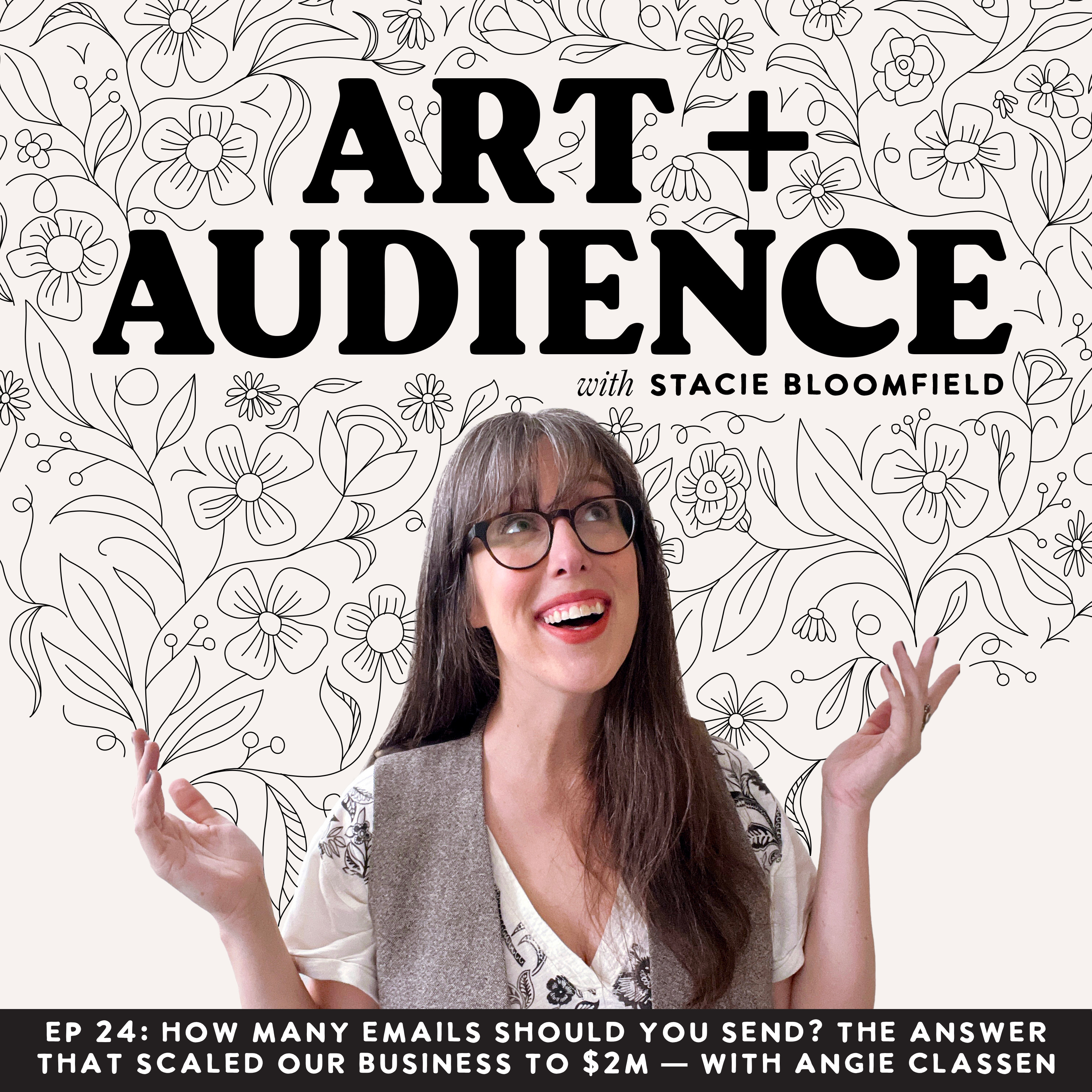
Art + Audience
Ep. 24: How Many Emails Should You Send? The Answer That Scaled Our Business to $2M — with Angie Classen
00:31:08
Today on the show, Stacie is joined once again by her long-time business partner and sister, Angie Classen. Together, they pull back the curtain on how consistent email marketing helped grow their handmade brand, Gingiber, from a $100k Etsy shop to a...
Loading summary
Transcript91 lines
- [00:01]
Angie
Ever notice how ads always pop up at the worst moments when the killer's identity is about to be revealed during that perfect meditation flow. On Amazon Music, we believe in keeping you in the moment. That's why we've got millions of ad free podcast episodes, so you can stay completely immersed in every story, every reveal, every breath. Download the Amazon Music app and start listening to your favorite podcasts. Ad free included with Prime.
- [00:34]
Stacey Bloomfield
If you're not asking for the sale, people aren't going to buy from you. You're spending a lot of time making pretty things with no return. And yes, you can be a creative and you can be authentic in your voice and you don't have to sell out, but selling is not selling out.
- [00:49]
Angie
That's right.
- [00:49]
Stacey Bloomfield
We have to be able to have consistent income if we want creatives to be able to support themselves.
- [00:54]
Angie
Right. And we assume that you're here because you want a business, not just a hobby.
- [00:59]
Stacey Bloomfield
Right?
- [00:59]
Angie
And so if that is your goal, then that means you're going to have to do what business people do.
- [01:04]
Stacey Bloomfield
Wouldn't it be nice if your art business loved you back? Hi, I'm Stacey Bloomfield. After years of trial and error and late night doodling, I went from being a coffee shop manager to running a vibrant seven figure art business that I love. And now I'm on a mission to help more artists create an art business.
- [01:22]
Angie
That they love too.
- [01:24]
Stacey Bloomfield
So I invite you to find a cozy spot, pull out your favorite sketchbook, and listen in. It's never too late to chase your creative dreams. Welcome to the Art plus Audience Podcast. Hello. I'm so excited. We're back for another episode of the Art plus Audience podcast. The podcast where we're helping creatives all over the world learn how to build business and meet their customers and create like a career for themselves. Right, Angie and I love geeking out on what's working. Yes. In our business. Gingerbread. Sixteen years we've been around. People often know me because I'm the face of the business. I founded it. I went out there and did the scary first steps that so many businesses struggle to do. I built it to about a hundred thousand dollars a year gross sales selling on Etsy. And then Angie joined the party and helped me go from that to now. We are what, 2, 2 million a year gross sales. It's been a slow and steady growth process for us and in each phase of that, we've had to figure out how to best use the time we have to make the most impact with the people we wanted to buy our products. And so what we wanted to talk to you about today is marketing your business through email. I can't tell you how many times I sit down with people, even people who are making money in their business, like good, consistent money. And I'll be like, when's the last time you sent an email to your email list? And they will say, either I don't have an email list, everyone comes to me on Etsy and I don't have one.
- [02:55]
Angie
Or they'll say, it's been like four.
- [02:57]
Stacey Bloomfield
Years since I sent anything. They're like, well, I guess I could send one once a quarter. And then we tell them, how often should they be sending emails?
- [03:04]
Angie
Oh, multiple times a week. We'll talk a little bit more about why that is and why it's important to do that.
- [03:09]
Stacey Bloomfield
Yeah, but the thing is, no one's going to market your products for you. Gone are the days where we had bloggers who part of their incentive was to send people to your site. That was like the golden early 2000s, 2010s. Whenever we saw traffic that way, we weren't even trying. People would find us on Etsy, someone would share our product with them and we would have traffic coming to us. And we just loved it and took.
- [03:34]
Angie
Advantage and we took it for granted, honestly. It was during, you know, handmade revolution period of time. And you know, unfortunately, as all things, whenever money can be made from something, usually larger companies find ways to take that and leverage it for themselves. And that's what we've seen with the rise of things like, which aren't bad necessarily, but it's taken a lot of the momentum away from smaller handmade artists. So, you know, nowadays there's huge incentives for influencers to spend their time promoting things from Amazon or from Target or from Walmart. And that's all well and good, but we can't compete with the affiliates income that they're going to get from doing, you know, a Walmart try on. And so instead we have to be really thoughtful and creative about how am I creating my own audience. And even though the handmade revolution was 10 years ago, it's coming back.
- [04:27]
Stacey Bloomfield
It's coming back, it's coming back, we.
- [04:29]
Angie
See it, we believe it.
- [04:30]
Stacey Bloomfield
Not only that, I mean, people, artists want this. They want the ability to tell their story and draw people in and build those connections, but they want to do it in a way that makes them not feel like they're actually selling to their customers. Yeah, and that's actually what we're going to talk about today because it's not enough just to be cool, not enough to be likable. It's not enough to have a cute product. If you're not asking for the sale, people aren't going to buy from you. In fact, you have to be in front of people multiple times making an offer. And that does not make you icky. No, it does not make you bad. That means you're running a business. You're not asking for a sale. Then what are you doing? You're spending a lot of time making pretty things with no return. And yes, you can be a creative and you can be authentic in your voice and you don't have to sell out, but selling is not selling out.
- [05:17]
Angie
That's right.
- [05:17]
Stacey Bloomfield
We have to be able to have consistent income if we want creatives to be able to support themselves.
- [05:23]
Angie
Right. And we assume that you're here because you want a business, not just a hobby.
- [05:27]
Stacey Bloomfield
Right.
- [05:28]
Angie
And so if that is your goal, then that means you're going to have to do what business people do. So if you think about it, who are the people, who are the companies who you get emails from in your inbox and how often are you getting emails from them? I will tell you that I shop at Anthropology and let me say, they email me multiple times, constantly. If I'm on their website and I'm looking at something and then I'm like thinking about it and I leave, wouldn't you know, I get an email in my inbox two hours later saying, oh, hey, hey girl, hey, did you want to buy this? I'm like, indeed I did. And so then I end up purchasing it. Right? And so that is just a email marketing strategy to get people pulled in and why do they do it? It works.
- [06:09]
Stacey Bloomfield
And the thing is, it's not just for the anthropologies out there who can take advantage of this. Individual makers and creatives and small businesses and artists can actually take these strategies and implement them themselves. You don't have to have a huge marketing team to do this. You just have to be willing to type emails and send them consistently. Consistently. So, Angie, why don't you talk about.
- [06:28]
Angie
The strategy that we recently used to.
- [06:30]
Stacey Bloomfield
Help us really amplify our sales?
- [06:33]
Angie
Well, one of the things that we have done consistently for several years now is we are always sending a weekly newsletter email. If you don't already do that. That is step one. You need to train your customers to expect to hear from you at the same time every single week. So for us, it is going to be Monday morning at 9:00am Central Time and then we are doing a resend later in the week to people who are engaged but didn't buy from us. And that is something that we can talk about another time. Cause there's amazing tools out there to help you target your email marketing really effectively. But all that to say is you have to train your customer base that they're not surprised to get an email from you. They're like, yay, I can't wait to hear from you again. So coming up to an event like Mother's Day, a sales event, what we do is we're going to do a lot more communication because as you probably know, we're busy people. Your customers are busy. They are doing in May. It's May.
- [07:29]
Stacey Bloomfield
May, yeah. It's just as busy as Christmas.
- [07:30]
Angie
It's like the turning of the season. And what they can't do often is remember who emailed them even two hours ago. And so we did a 5, 4, 3, 2, 1. Email breakdown campaign this year leading up to Mother's Day, we had a sale going on. And of course, we're promoting that in our weekly newsletters. But in the last five days of the sale, we emailed every single day. Five days left of the sale, four days, three, two. Last day to shop, last hour to shop. And you know what? It was fine. Our spam rate did not go through the roof. Our unsubscribe rate did not go crazy because people were excited. We made money on every single email that we sent out because people simply forget what's going on or they meant to buy and then they got distracted. You guys know how that is. You cannot be afraid to do stuff like that with your audience. And what it does is, is you have to remember, if they don't want to hear from you, they'll just unsubscribe. If somebody doesn't want to hear from me, they leave.
- [08:26]
Stacey Bloomfield
But, Ang, yes, you probably do care right now because I know you. It's taken us a while to not care. And we right now, we can sit here and be confident. Like, yeah, we now understand that we want to repel the people who are not our customers and retain the people who are ideal for our business and our products. But I know because I, I've worked with so many of you who are listening that first of all, you don't want to send multiple emails because you don't want to be annoying. You're like, I don't want to annoy people. I don't want them to think of me as just that annoying person who's marketing all the time. So if I do send something, it's going to be like, hey, girl, just checking in. I'm making art. Do you like it? Bye. And it's just. There's no call to action, right? It's just casual. It's like pen palling almost. And that's where a lot of people start. Because in truth, coming up with the ideas of what to say, really hard. We'll talk about that in a second. How to come up with ideas of what to talk about in your newsletter. But I also know because I'm talking to a lot of creatives that, like, we're feelers, it's really easy to take things personally. In fact, I'll tell you that early on, when I first started being on Instagram, like a fool, I had one of those apps that would tell me who had unfollowed me. And I was like a glutton for punishment. I took it personally every unfollow. I thought, people don't like me. People don't like me. The truth is people. People get to decide what they're consuming and when they're consuming it. And so we have actually found that a lot of people will unsubscribe from our newsletter because I'm so engaged on Instagram, they figure I'll just hear it from her on Instagram. But the thing is, we gotta get used to the idea that, like, we cannot please everybody.
- [09:58]
Angie
Right? Actually heard this story from someone recently. She had a customer who was buying from her consistently and huge tickets. And she just was like one of her best customers. And that customer unsubscribed. And she saw it and she was aghast. She was like, what? So she reached out and you know what the customer said? She's like, girl, I'm spending so much money and I just have to go on a one month, like, spending freeze. So I had to unsubscribe because if I saw one of your juicy emails, I knew I would buy. Like, her marketing worked so well in this customer that the customer's like, I'm opting out for a month. I'll be back. I just had to, like, do it as, like a little cleanse. And so it had nothing to do with what she was doing except for that the customer had to do what was best for her. And I thought that was a really funny story because, like, so often we take it personally. Yeah, it's not personal.
- [10:43]
Stacey Bloomfield
Whenever we talk about the handmade revolution coming back, it's not just the handmade revolution in the sense that people are celebrating making. We also have progressed a lot in terms of how e commerce works and how much wisdom we have in terms of how to run a business and sell. So it'd be foolish for us not to take advantage of the fact that, like, you guys are talented, you make amazing products. Let's help you figure out how to use your time better. Use email marketing to get in front of those people and make enough money that you can keep doing what you love to do.
- [11:10]
Angie
Yeah. And email is actually a really affordable way for you to grow and keep selling to your audience again and again. And so what's a shame to me is whenever people do such hard work to acquire a new customer, they go to the craft fairs, they meet people, they're posting on social. They get all these new people, they get sales, and. And then they don't do anything with them.
- [11:31]
Stacey Bloomfield
Angie, do you remember our first trade show? We went to Chicago, and I'll never forget, we were tearing down the booths, and a woman across from us. I don't remember who it was. Oh, yeah. She had a stack of business cards this thick, and she just tossed them in the garbage. And Angie and I go, what are you doing? She goes, well, yeah, I just never like to follow up with people after these shows. It's a lot of work. And we looked at each other. Not that we were that big of a deal. We weren't, like, we were new. It was our very first trade show. We had no idea what we were doing. So please know we weren't judging, like, from a. Like a. We know better, but we had enough, like, aghastness to be like, oh, no, there's email addresses. You can email those people. Right. And we can get more orders.
- [12:06]
Angie
Right. If you're at a show or at an event or selling and you aren't collecting email addresses, that's just step one. You do that, and then you actually have people who are. They're literally saying, I'm interested in you. And it's just like, hey, I'm interested in you too, girl. Let me sell something to you. And they want it. Okay. If they don't want it, they will.
- [12:24]
Stacey Bloomfield
They will unsubscribe, and you'll learn more about who your ideal customer is. They aren't. Yes. If you want to learn more about ideal customer, Mother's Day, we referenced the success of that sale that's in our previous episode that we released earlier, so you can go check that out.
- [12:37]
Angie
Yeah. So anyways, the whole point about marketing is that it's really important One that if you believe in your product and in your business that you have enough pride in it that you're actually going to tell people about it. Because like Stacy said earlier, nobody else is going to sell your products except for you.
- [12:53]
Stacey Bloomfield
No one else is. So for Mother's Day, we did a five day, four day, three, two, one. What have we put in those emails? Angie, let's talk about like what specifically? We didn't just say one more day. What did we do Whenever we're talking about it.
- [13:04]
Angie
Okay, so this is really fun because one of the things I also talked about in the Mother's Day episode episode is that I've been doing some blogging for search engine optimization. And so one of those blogs, I took our data from Shopify and and I picked our top eight bestselling products in different categories and I highlighted and featured each one of those in that blog. So when we were creating our 5, 4, 3, 2, 1 email, it literally took that blog and I split it up and said, hey, the sale is going on five more days. Here's our best selling flower tea towel. Check it out, you're going to love it. Here's all of our customer reviews and what customers are saying about it. Use our discount code, spend $90, get 20% off plus free shipping. You don't want to miss it out. The next day I featured a bestseller from a different category and so on and so forth. And so what that did is it helped engage our customers and it also had some link backs to our website. So you're getting clicks, you're getting interest, you're referencing the blog. It's a win, win, win.
- [14:02]
Stacey Bloomfield
And also I want you to notice like Angie did work once and then reused it over and over again. So she blogged, she pinned with it. I see this all the time. People like, well, I need five blogs if I'm gonna do five emails. No, break it up. Because actually one idea to hit home on an email is better than like tons and tons of things. Customers are going to look at the very top and they're going to go all the way to the very bottom and they're not going to read anything else. So yeah, it's way better to be focused on one thing. So she took a great blog post, broke it up five times and featured a different part of it in each.
- [14:29]
Angie
And if you are in like an email program, I love Klaviyo. It can be a little pricey when you're first starting out. To me, totally worth it. If you have an audience that's a already buying from you. You should be on Klaviyo anyways. You can look and probably in all of these different mailchimp it should show you visually where people are clicking and where they're scrolling to. And so like I actually look at this every single week. I pull open the sent campaigns or emails and I look to see where did I get the most clicks and the most views. It's always the top.
- [14:59]
Stacey Bloomfield
So we don't need too much information.
- [15:00]
Angie
Yeah, you don't need to add five sections. You need to have one strong call to action right there at the top. And that way you're just engaging customers right away.
- [15:09]
Stacey Bloomfield
I want to mention like if you're in our mastermind or you're in our small group coaching program Thrive, we literally are pushing every single person we're working with into Klaviyo if they're selling product. Now I think it's really important to mention here that we are talking right now about product selling product, direct customer. There's a completely different strategy for online education selling courses and workshops and unfortunately I think a lot of people will think that it's interchangeable. It's not. And guess how we know? It's because we run two multimillion dollar companies. One is product based and one learned with Stacy Bloomfield. Which is like why you're here where we teach our courses and we have memberships and the way we acquire customers for each business is different, very different.
- [15:47]
Angie
What's just so critical? I was sitting in a workshop with somebody who was very skilled in one area of business but not in product. They were saying, oh, you shouldn't use a discount pop up on your website. Which is like not true for product. Now is that true for education?
- [16:02]
Stacey Bloomfield
Education you never want to discount.
- [16:03]
Angie
You would never do a discount pop up. But they just didn't know what they didn't know because they don't sell product. And so when you have people who are like, oh, I'm good at this one thing and I'm going to take this and blanket it all across every industry, it's a huge mistake and you should not, I'm just going to tell you, do not listen to people and who are not selling product consistently over time to understand.
- [16:22]
Stacey Bloomfield
So we have 16 years of this. So like you shouldn't be taking your product based business advice from someone who's just now launching their product based business.
- [16:29]
Angie
Yeah, because they just won't know, especially if they're new to the industry.
- [16:32]
Stacey Bloomfield
And also like we piecemeal together a business and we Started with no money investment. The only thing I had was a 500 savings bond that we cashed in to be able to buy a printer. We know what it's like if you have a thousand dollars right now. Like, you're also, like, killing it because, like, most people don't have that money. It's like, I can invest a little bit. I can get a return on that. I can reinvest it. And that's what we've done over and over again for 16 years.
- [16:53]
Angie
Seriously, we don't. We don't have debt, we don't have that. We don't operate on debt, and we never have. And so that's one thing that is unique about what we're trying to tell you. And it's really, really important that you find people to align with your values of how you want to build your business. Because there are plenty of people out there who, they've already achieved success, and they're talking from a place of already succeeding, having a huge safety net. A safety net maybe because their spouse makes a ton of money that they can borrow from to invest. That's not how this business started. So it's just kind of like it's dangerous to get tips from people who are coming from a very different position. But if you're here, it's because you believe that you can build something from the ground up. We can do this, but it takes some strategic work, and so we want to encourage you to do that.
- [17:38]
Stacey Bloomfield
And on that note, you know, we're here talking about selling your product. And no matter whether you're starting out from scratch, building it with nothing, or you're someone who is able to come in and maybe launch a new dream business after having a successful run somewhere else, you won't get anywhere if you're not marketing your products. That's right. And you have to send emails. And let me just tell you, I know we have a lot of people here who love licensing, because for so long, people have known me as someone who's an expert in licensing, and I still am. But, you know, licensing used to be a much bigger piece of my pie. When I was making 3 to $400,000 a year gross sales, and over 100,000 was licensing. I mean, that was a big old chunk of my pie. But the truth is, I've maintained about the same amount of licensing money, between 80 and $100,000 a year, while the rest of my pie has gotten a lot bigger. So licensing for so many years, it's still great. But you can scale a product based business or even an online education business much bigger than you can only licensing.
- [18:34]
Angie
And the reason why is because there's a bigger audience. So licensing, there's a limited number of people who are looking to license designs in any given time. That doesn't mean it's not great and it can't be a good opportunity. It absolutely is and can be. But when you have millions of people out there who are looking to buy a detail or looking to learn about something that you're an expert in, like Photoshop, if that's your thing, then that is the thing that you have the best opportunity to, to actually grow and scale. And so that's why it's encouraging you to not just get fixated on one thing, but lean into where the opportunity lies.
- [19:09]
Stacey Bloomfield
And I guess I want to say that why I mentioned licensing also is because the truth is the way to be successful at licensing is to pitch your work, which is email sales. It's all sales. And so I feel so disheartened whenever I see people who will go through Leverage youe Art and they'll get through Module one and Module two and they'll stop right there because those are like the licensing modules and they won't even get to the other parts, which is building the business and product based and kind of scaling and stacking multiple income streams. They stop because they're like, this sounds great and it is great when it works. It's like, okay, I don't have to make anything other than art, I just need a portfolio. And then I'm going to post on Instagram and it's going to work. You have to be sending those emails and in fact you need to be sending more emails if you're doing art licensing than if you're selling products, which is crazy scary for people more because you're pitching business to business. Someone who wants to put your art on products. And so your role is to make marketable art and pitch it to the right people and then make more art and pitch it and make more art and pitch it.
- [20:11]
Angie
You know, it's interesting. Just this week our wholesale coordinator and I were meeting together. We've been doing an incredible amount of cold pitching this year for getting new wholesale accounts because as everybody knows, Ferris King and that is where you get a lot of your wholesale accounts, if you're doing B2B that way for product. But we are interested in growing our organic reach. And so we've been pitching about 250 different places every month since March. We started it so March, April and May. So that is a lot of pitching. And we have had just a handful of people respond so far. You might say, oh, that's so disheartening because here I am, I'm a small business, I can't pitch that many people. But here's the thing. One, you can. But two, we were doing some research on how long does it take from when you start pitching to when you start to see some payoff. And I bet you think, oh, maybe a few months. No, nine to 12.
- [21:06]
Stacey Bloomfield
Nine to 12 months is how long.
- [21:07]
Angie
To get less than a 10% return on your pitches. So if you tell me, I pitched.
- [21:13]
Stacey Bloomfield
To 50 people this year, not enough.
- [21:15]
Angie
There'S not a good chance that you're going to land something if you're only pitching to like one or two accounts a week and you aren't doing any follow up. You just are pushing one and done. It takes a lot of time and a lot of effort. And anything worth building takes a lot of time and a lot of effort.
- [21:30]
Stacey Bloomfield
And if anyone is telling you that it's simple and easy and fast, they're lying. They're lying or they're selling you something. And I mean, I sell you things too. I have courses, but I'm a big believer in the transparency, that it takes time. Yeah, I talk about slow growth being good growth. Well, that means that you're still showing up. If you're slowly growing but you are doing the work consistently, you need to know that it's normal for it to take time. And even with email marketing, you may think, I only have a 50 people on my email list, like, how do I grow? That it is consistently doing the work of showing up. It is showing up in places even when you don't want to. You have to show up on social media. Angie and I were talking about it before we were recording. A lot of people are sold this really appealing fantasy that everything can be automated, that you don't have to put effort into these things, that it doesn't matter.
- [22:16]
Angie
It does matter. You have to actually put effort into anything that you want to grow, grow. If you put your focus on it, it will start to grow, it will start to pan out. But if you're unwilling to do the work, nothing's going to happen. Automation is great. It's a wonderful tool. Lots of things can be automated, but the thing that can't be automated is you're showing up and consistently targeting your market and your ICA because it changes AI man. It's a great tool, but it's a tool in the hand of the user. If you are relying on AI to be the mastermind behind everything you're doing, I'll tell you what you're going to find. Elevate your artwork, elevate your kitchen experience everything.
- [23:00]
Stacey Bloomfield
The beautiful tapestry of a cornucopia of beauty with your art. It's telling everyone the same thing.
- [23:06]
Angie
That's right, it does. So it's, it's not going to make you stand out in the market. I heard someone say this AI is only as good and powerful as the user. And so you have to be the one engaged in pointing the tool in the right direction in order to actually grow and scale your business using something that's fantastic, but it's not going to pay off if you aren't willing to be the one doing the work.
- [23:25]
Stacey Bloomfield
And I guess I want to say that, like, if you're like, I've been at this for a while, Stacy, I've been working with you since 2020 and it's still slow. That's normal. That's actually the most normal thing possible. Yes. There are people who, based off of maybe the skill they're already coming in with or with their background, maybe they're really good at sales. Like, I've worked with some people who just naturally know how to market because of what they've done in past are just how they're built. Angie's a natural marketer. I've learned how to market over time, but it takes time. It's normal. There's not a single business out there. Small business. Create a business that you're not investing time and money and consistently showing up in order to get where you want to go.
- [24:01]
Angie
And another thing is everybody needs to like, get out of their head about what your top line revenue is and instead needs to understand your profitability, which this is a little bit of a side. No, but I'm just going to say it. You might actually be more profitable than the person who you are idolizing on Instagram, who you think has it all together, because they may be making $500,000, but they might only be clearing 50,000 because they didn't grow and scale in a smart way. They just were chasing the revenue, chasing the revenue. And the problem is, is that the bigger you get, the bigger your team gets, the higher your expenses go and you can actually scale yourself out of business accidentally. It happens all the time. And so what we want to be smart about is saying slow growth is good growth. When you're growing slowly and steadily and you've got your eye on the real prize of profitability, not just revenue. You're actually going to be able to do better. Because what matters isn't what other people think. What matters is are you happy with your life? Are you happy with your business? Are you making money to live the dream that you have? Not just the dream you see somebody else have.
- [25:06]
Stacey Bloomfield
And you know, we have a really great sized business, but a lot of people are surprised. Like when I'm launching Leverage your art and I do run ads, I get so many comments like, she's lying. There's no way they're making this much money. There's no way this is successful. I guess that I just don't show up flashy enough in a way to where I've convinced people that what I'm doing works. That's a marketing thing. But at the end of the day, I know that I have a very profitable business that's growing and scaling, that's been around for a long time. And sometimes, to Angie's point, the businesses that you're looking at, where you're like, wow, they have this big collaboration or their social media looks perfect and beautiful and highly curated and highly edited. You don't know what's happening behind the scenes in the business. In fact, I ran into someone who I'd met in person years ago and I followed them online and I ran into them. We're sitting down and talking about our businesses and I was kind of talking a little bit about my team size and this and this. And she was like, wow, you have a way bigger business than I think people realize. And I'm like, well, we're still a small business. Or like. But yeah, like you're doing things like you have a really well run business. So at the end of the day, you're here, we think, because you're not necessarily wanting the flashiest business. You're wanting the most profitable business, the one that will grow over time, the one that you can make fit into your life. Right. And I think that we've done a pretty good job here at Gingerbread showing that that's possible and showing that it just takes time and consistency. And there are strategies that you can use to make this happen. Because at the end of the day, it doesn't matter what other people think about your business.
- [26:35]
Angie
That's right.
- [26:35]
Stacey Bloomfield
It matters your numbers and what your goals are.
- [26:38]
Angie
Because like, for instance, we both have three kids, each of us, and we're finally to the phase where our kids are starting to be really independent. But this business has been building and supporting our families for years, and we have been able to show up. I get to show up at all of my kids stuff. I get to be there. That's the life I want. Right. I want a life where I'm not just, you know, Instagram goals. My goal is to be able to be with my family, build something that I love, do work that I love, work with my sister, which is so.
- [27:11]
Stacey Bloomfield
It's my favorite thing.
- [27:12]
Angie
Yeah, it's amazing. And it's something that maybe Instagram influencers, they're not touting that, but that's the real wealth.
- [27:20]
Stacey Bloomfield
And in truth, for me, the favorite thing about my business is that I can wake up in the morning, I go sit on my pink chair, all of my dogs come sit in my lap, they snuggle me. I drink my coffee, my kids come downstairs, they have breakfast, we get to take them to school, either my husband or me. And then I get to do the work that I love to do.
- [27:39]
Angie
Right? And her dream has made my life possible and possible for all the people on our team. It's really cool and it's really rewarding.
- [27:45]
Stacey Bloomfield
Sorry, no. Thank you for saying that.
- [27:47]
Angie
Yeah.
- [27:47]
Stacey Bloomfield
I just think it's because sometimes we're measuring the wrong metrics of success. And so, yes, it's about your business and growing it in the wisest way possible. But also, like, the life that you want to have may not be the life that your mentor has or the person you follow on Instagram who gives you all the inspiration, which we need to be inspired to see what's possible. But also it comes down to, like, how do you want to live your daily life?
- [28:09]
Angie
Right. Are you satisfied with the life that you're building? Are you chasing someone else's dream?
- [28:14]
Stacey Bloomfield
Yeah.
- [28:14]
Angie
Put that on a shirt.
- [28:15]
Stacey Bloomfield
Put that on a shirt. I will say that I am so grateful that my business has unfolded the way it has, that it's grown the way it has, that it's given me the space to, like, focus on my personal life, but also have something ambitious to chase that I can pour my energy and my soul into.
- [28:32]
Angie
Because the funnest part of growing a business really, to me, is, like, coming up with new ideas and strategies and learning. Like, it's super fun to be able to run a profitable business. But I just also just want to encourage you. If you're out there in, like, the algorithm, it's feeding you all the stuff you don't want to see. It's feeding you these things that are saying, I grew my Instagram subscribers by 25,000 in two days. Let me tell you how, like, just, you know, cleanse the algorithm a little bit.
- [28:59]
Stacey Bloomfield
Goodbye.
- [28:59]
Angie
Say goodbye. Unfollow. Say, I'm not interested because those are not real.
- [29:04]
Stacey Bloomfield
It's like a unicorn. And you know what? I'll tell you, sometimes I've been a unicorn and didn't realize it. Like, I've had things happen in my business. Like, my first pitch, I landed with a big major retailer, and I was like, this is how it works. You just send an email and people give you money. And then I was like, yay, I'm so good at this. I'm so good at this. I didn't teach it yet, though, thank God, because actually, then I had to put in years and years of practice with licensing to realize, oh, no, it doesn't always happen. And it's. It's a numbers game, and it's a focusing on who you're creating for and making marketable artwork. And at the end of the day, it takes time. Us telling you we have our. Our life that we love doesn't mean we're also not working really hard. Hard. We work hard. Yeah. And every job is hard.
- [29:48]
Angie
Right. But, like, we love getting to do what we get to do. And we can wake up in the morning and go to sleep at night and be like, hey, I'm proud of the work that I did today. The opportunity for you is that we can actually build a life that we love, and so can you. And it takes time and effort, and you're doing the hard work now, and it will pay off.
- [30:07]
Stacey Bloomfield
So this whole episode was about emails, as you can tell. But the truth is, one of the ways to make that happen is, like we talked about at the top of this episode, is sending these emails and not being afraid to get in people's inboxes and remind them. Don't make it complicated. Make it simple. Five days, four days, three days, two days, one day. And here's one little nugget that goes.
- [30:26]
Angie
Back to our product and show up as yourself, because your business is unique. You don't need to copy anybody else. You need to just shine through for who you are and connect with your customers. And don't be afraid to keep showing up because they want you in their inbox or they'll unsubscribe.
- [30:42]
Stacey Bloomfield
And that's the big lesson. If people unsubscribe, it's okay. Don't take it personally. So I hope that this episode helped you, in a myriad of ways to put yourself out there a little bit more to be braver and to remember that, like, if it's taking a while, if it feels hard, it's supposed to. That's a normal part of it. But as long as you're willing to learn from it and refine and just not stop sharing about the product that you're making and the art that you're creating and share your work with the world, you're going to grow.
- [31:08]
Angie
That's right.
- [31:08]
Stacey Bloomfield
All right, we will see you for our next episode. Talk to you later. Bye. Thanks so much for tuning in. Hey, could you do anything me a favor? Could you subscribe to this podcast and then share it with one of your best art friends? I'd really appreciate it. And then head on over to Instagram and follow me at the leverage your art account and you can keep up with all of our future episodes. Thank you so much for your support. It means everything to have you here, listening and learning. Bye.
- [31:41]
Libsyn Ads
Marketing is hard, but I'll tell you a little secret. It doesn't have to be. Let me point something out. You're listening to a podcast right now and it's great. You love the host. You seek it out and download it. You listen to it while driving, working out, cooking, even going to the bathroom. Podcasts are a pretty close companion. And this is a podcast ad. Did I get your attention? You can reach great listeners like yourself with podcast advertising from Libsyn Ads. Choose from hundreds of top podcasts offering host endorsements or run a pre produced ad like this one across thousands of shows. To reach your target audience in their favorite podcasts with Libsyn ads, go to Libsynads.com that's L I B S Y N ads.com today.