← Art + Audience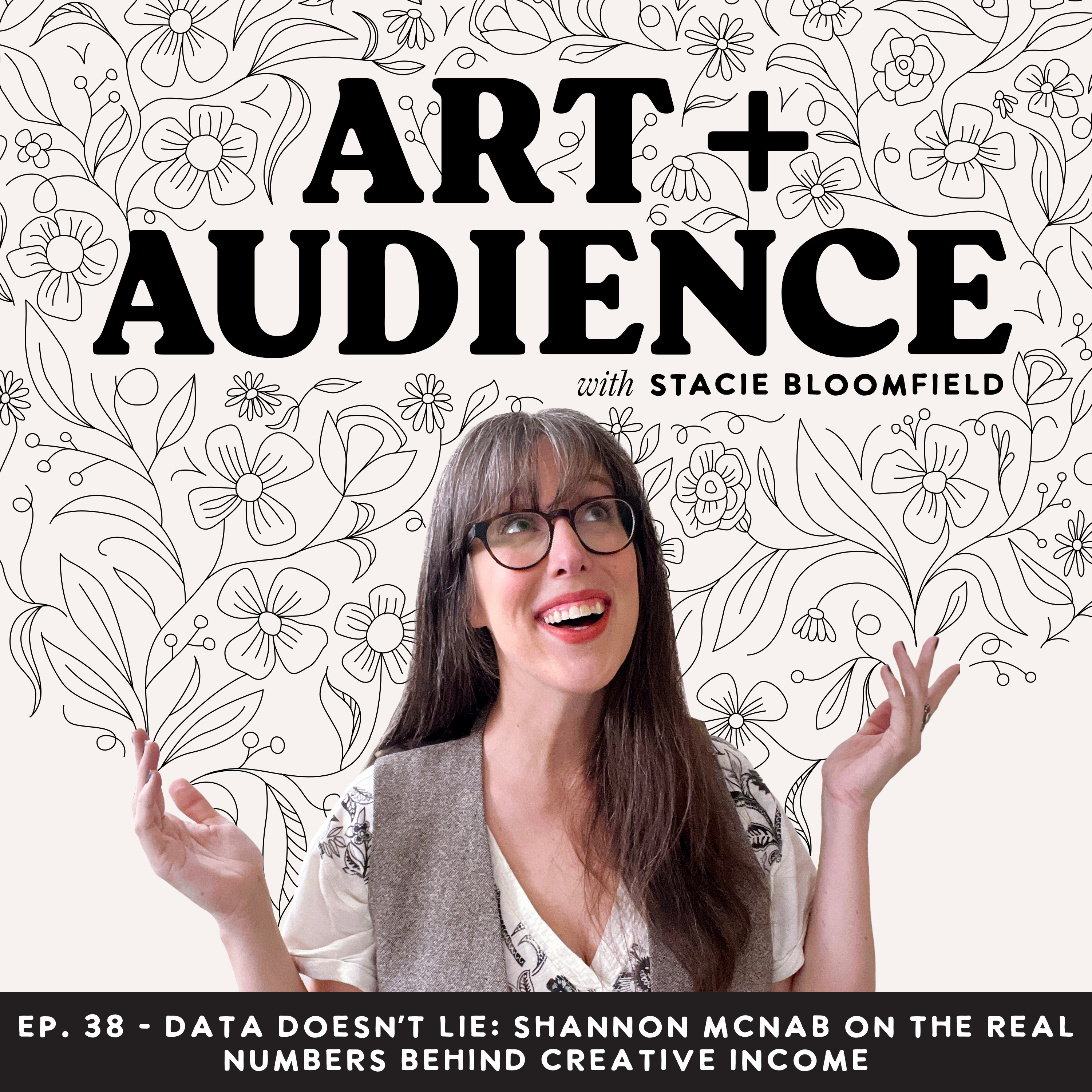
Art + Audience
Ep. 38: Data Doesn't Lie: Shannon McNab on the Real Numbers Behind Creative Income
00:36:23
Loading summary
Transcript73 lines
- [00:00]
A
I'm no designer, but I know my brand inside and out. And I know a generic looking website when I see one. Wix Harmony has blown me away. It's a website builder that lets me switch back and forth between using AI and hands on editing tools so I can create a website exactly the way I pictured it. I even get a personal AI agent that's an expert in web design and helps me out. Try it out for free@wix.com harmony that's wix.com harmony. Every income stream and your total art income and everything. I give you the details for all of those so you can kind of compare yourself to other people around you in the same band. Right. Like a newbie shouldn't be comparing themselves to the average because. Or the median.
- [00:45]
B
Right.
- [00:45]
A
Because they're at the beginning of their journey.
- [00:49]
B
Wouldn't it be nice if your art business loved you back? Hi, I'm Stacy Bloomfield. After years of trial and error and late night doodling, I went from being a coffee shop manager to running a vibrant seven figure art business that I love. And now I'm on a mission to help more artists create an art business that they love too. So I invite you to find a cozy spot, pull out your favorite sketchbook, and listen in. It's never too late to chase your creative dreams. Welcome to the Art plus audience podcast. Hello, my lovely friend Shannon. It's so good to have you here.
- [01:25]
A
Thank you for having me.
- [01:26]
B
I'm so excited to talk with you specifically today about something near and dear to both of our hearts. But I know you specifically are all about the data and numbers when it comes to creative entrepreneurship, and there's no doubt why. It's because you are the founder of, like, the survey for our industry, which we're going to dive into today. So tell everyone a little bit more about you and the survey and why you care about it. Sure.
- [01:54]
A
Yeah. So I have always been an artist that kind of straddles the art and the numbers. I've always told people if I wasn't an artist, I'd be an accountant. And I do truly mean that I'm that much of a nerd. And so I got started in the surface design space specifically in 2016. Right away, there was a lot of information I couldn't find that I was interested in. Like, you know, at the beginning it was. I was doing a trade show, but there was almost no information on how to actually do Surtex. And so I basically started blogging about that and it kind of just snowballed into Being an educator for a while. And in 2020, I started the only survey for our industry, the Surface Design Industry Survey, and have run it every year since. So this 2025, last year was. Would be the sixth installment of it. Yeah.
- [02:53]
B
That's incredible.
- [02:54]
A
It is exhausting, not gonna lie. But it is also so much fun for me.
- [02:59]
B
Well, you're doing something really important, and, you know, I'm a huge fan of what you do. I always share about the survey because I want as many creatives to fill it out as possible so we can actually know what's happening in our corner of the world. Whenever people, you know, ask, like, can I make it as an artist? Like, that means so many different things depending on the area that you're focused on, the median that you're working in, how long you've been creating art. There's all these little pieces that, you know, we can't just throw out a general number. And I know, like, in the US if you look up, like, how much does a, you know, creative director or artist make? You know, they go from this, like, census data that is not always up to date, and there's a lot of things that are missing from that. Furthermore, you know, I've had a pretty cool, successful career where I've been able to support myself and my family as an artist for a while, but it took me a long time to build that and get there. So a lot of people who are creative and they come to me and they're like, how much can I expect to make as a licensed artist within my first year of pitching? I'm like, crickets?
- [04:04]
A
Yeah. Not much.
- [04:05]
B
How much? How much? There's so many variables. And plus, like, well, a lot of actors have, like, we don't have a union. You know, we don't have anything that standardizes things and allows us to have specific negotiating power when it comes to what we're getting paid. But short of having a union, what we need is good data, because data doesn't lie for the most part, as long as you're doing it like you do, Shannon, which is, like, ethically and, you know, really trying to get, like, the full gambit of what's happening today. Which brings me to, like, the survey itself. You said this is six years of doing it. You've probably seen a lot of changes in the results over the past six years. Want to chat about that?
- [04:43]
A
Sure. Yeah. So the first two or three years, I was still gaining traction in the industry as, you know, an expert in this, as an educator and everything. And so it started off obviously fairly small. I think the first year we had around 300 participants and the first couple years it only grew to like 3, 400 people. So year four is really when things kicked into gear. I think we got over 600 that fourth year and it's just kind of snowballed since this survey that is coming out. This year we had 1290, which is insane to me because the previous year was 763. So I am so excited and happy for every single person on my email list and your email list and all my marketing partners that helped get the word out because it's making it so much easier to do a little bit deeper dive on some of the things and actually share a little bit more because the more data you have, the deeper you can go.
- [05:42]
B
Yeah. So thank you for everyone who's listening who filled out based off of our plentiful emails. We need it so that we can make this industry as transparent as possible, as honest and healthy as possible. What are some of the transfer changes like trend wise that you've seen? Like, did it used to be with that smaller group of people, like more licensing income was coming in or what's really hot right now, what's happening?
- [06:06]
A
So I feel like there are some things that are always constant. Like POD has always been the most popular income source for artists like Barnett as one example. But as the size of the audience grew who actually participated, we definitely did see some numbers change and things like that, which has been really interesting. I think for me, especially the, like the first two years primarily who were taking the survey were my direct audience, like those people who were, you know, in my email list. And so it's not unsurprising to me, especially because one of the things I taught was pricing for service design, that prices were higher and, you know, people were, you know, getting those higher numbers that I talk about all the time. And so like that is something that I have seen over the six years is that especially on the licensing side, the pricing has been slipping year over year. And I do think again, it kind of goes to just how large the participation is getting.
- [07:09]
B
I was seeing this trend too. I didn't have a survey, but I've taught for so many years. When we were getting surveys from our students starting our program, the majority of people were part time, you know, 15, 20 hours a week or less, but majority less than that with the hours they were able to devote to it, which I love that people are building something slowly and methodically. I actually think that's how people learn to have longevity, right, is to keep going year after year and slowly and surely grow and not get discouraged and stop. But side hustling isn't going away. In fact, I think we're probably going to see more of that in today's world economy. What were you seeing specifically trending with side hustlers? Where are they focusing their energy? How long have they been side hustling?
- [07:51]
A
Part time artists obviously make less money than full time artists, but not all part time artists make no money. Like there are some part time artists that actually make a decent income. It is kind of interesting, like the interplay between full time versus part time versus hobbyist in all these different income streams.
- [08:12]
B
Psychological. If you want the real numbers and data, don't worry because by the time this episode is out, the report should officially be available.
- [08:20]
A
I'm sure in the show notes we will probably leave a link directly to it. So where you can download it, we'll.
- [08:25]
B
Make sure you have that information. But in my dream world, you're downloading it and looking through it as Shannon and I are talking about what's happening in this industry. Speaking of multiple income streams, based on your survey results, are you seeing any specific like mashups of certain income streams that people are pursuing at the same time? Like what is happening, happening right now in our world?
- [08:46]
A
For artists this year, the top three, and they've pretty much been the top three, but they kind of sometimes switch. This year it's Print on demand is number one and it always is. Physical products is number two and licensing is number three. I believe physical products and licensing actually flipped. Like last year, I think licensing was number two. So like, that was kind of an interesting thing. And it definitely tracks with some of the other, you know, pieces of data that licensing has, you know, kind of slowed last year, which is not surprising. Probably a lot of you hearing this are like, yeah, I felt it too, right? So it's not surprising that physical products were more popular among artists.
- [09:25]
B
It's always hard for me as someone who's an educator and is also in this world because something you and I know is I like to be honest about my personal experience, knowing it could be different. But I do have the benefit of getting to talk to all these other artists that I'm colleagues with or I've mentored or first getting in the game. And I think that's what everyone is looking for right now is the direction of like, well, if it's not working, what do I need to do next to get better? That makes me just say, like how old are the artists? Are we seeing in terms of like years of art creation that are participating in the survey this year?
- [09:59]
A
One interesting factoid is I feel like the longer I run the survey, the more veteran artists have taken survey.
- [10:06]
B
That's awesome.
- [10:07]
A
Yeah. Which of course is like, it's more helpful, I feel like, especially to the newbies who get the survey to kind of see the lens of those who have been in the industry for a long time. Those with 25 years or more of experience was 16.8% this year.
- [10:22]
B
Wow, that's amazing.
- [10:23]
A
Which I think it increased 2.8% over the previous year. Over 50% of the artists this year were veterans, which I count as six years or more. A newbie is one to two years of intermediate, three to five and then six or more. You're a vet.
- [10:38]
B
And are you seeing those veteran artists having more earning potential according to the survey results?
- [10:42]
A
Yes. Both veterans and full time artists tend to be the higher earners, which again is probably not surprising.
- [10:49]
B
Right.
- [10:50]
A
I usually, at least in the past several years that I've done the survey, most of it is income focused, but I do always include based on years of experience. So like every income stream and your total art income and everything, I give you the details for all of those. So you can kind of compare yourself to other people around you in the same band. Right. Like a newbie shouldn't be comparing themselves to the average because. Or the median.
- [11:19]
B
Right.
- [11:19]
A
Because they're at the beginning of their journey. My favorite has always been the little matrix that I do on the gross income page, which has experience on one side and then whether you're a hobbyist part time or full time and then gives the kind of average range for each of those. And we had enough hobbyists this year to give income ranges for most. We didn't have that in 2024, so that was kind of cool. But yeah, you can very easily see that there is a distinct bump in incomes at the six year mark. And then if you're a veteran full time artists, it's even a greater income potential.
- [12:00]
B
So what I want everyone to focus on hearing this. Two points. One, you want to become a veteran, you want to stay in this longer than six years. You want to improve your art skills between year one and six to where you are not just showing up, having the motions, but actually becoming really good at what you do, becoming an expert at your medium. And then like there is a path for full time income career artists. We are seeing it now in this survey more than ever. So to anyone who ever feels discouraged when I say that I think art licensing needs to be probably a part time income stream, it's not to discourage your pursuit of it. I still license my art. But Shannon, I'm just, what I'm saying is like, it can be unpredictable. Like, okay, my life last year was bananas. I don't need to go into details I've talked about on the podcast before. My time could not be spent pitching like I've done in years past. And so if you look at my, like, new clients from last year, I don't have a lot of new clients. I have a lot of consistent returning work, thankfully. And I guess what I want to say is it can be inconsistent based off of where your life is at. And if you're a solopreneur like most artists I imagine are, you know, they're working alone. And so I have the benefit of scaling enough that I have a team that can keep a lot of these income streams going. But for licensed artists, a lot of the times it's you, right? It's you. You are the life force. So when I say it's part time, usually there's a lot of things out of your control. So you can only control what you can control. So focus on those things and do those as much as possible. Pitch, create new work. I'm going to Atlanta gift market and I'm going to be walking, looking for new trends and seeing like what is happening outside of my Instagram and TikTok algorithms. And I think it's important to always get out there and see what is changing in our industry in terms of trends. But the whole tangent I have is don't be discouraged whenever, you know, things need to shift in your life as an artist, you know, because the goal is just to stay in the game, keep creating, keep pitching, keep finding the best opportunity with what's been handed to you in that moment. Right? And then you still fill out the survey every year, no matter what. And we help each other grow as an industry gets stronger. Now, you told me something before we came on the call that you noticed buyouts were higher this year. Can you kind of talk about that with me for a minute?
- [14:23]
A
Sure, yeah. So I will also put a caveat that buyouts are, I think, dead last in the popularity of income streams. Like not that many artists do buyouts, which personally, side note, I think is a shame. I understand keeping the copyright and all of that, but buyouts can be an incredible boost to your overall income. So buyouts, it was less than 10% of the people who we surveyed had buyouts this year, which. So the data is probably not as accurate as some of the others, but it's always been that low. So we still had more participation than we did last year. This year I did something different. When I asked how much someone made specifically for each income stream that they had last time, they were like wide ranges. Right. And that was it. Well, we still asked the wide ranges to get a baseline, but then whatever your range you picked, I then asked a follow up question that like, was more nuanced. Like, okay, within this range, what range do you fit into? And the reason I did that was so that we could give more nuanced income numbers. And I was honestly shocked that the median buyout income was 3,000 to $4,000.
- [15:38]
B
Good.
- [15:38]
A
Which was the second highest of all the income streams. The only thing that beat it was graphic design. Everything else was below it. Again, the median, it was three to 4,000. Like that's pretty fantastic. You know, and I was honestly not expecting that. Like, I was expecting it to be with the other ones like licensing and freelance, you know, that they would just be like, oh yeah, 1 to $2,000 is the median. Right. So. So that was kind of a cool aha. From the data, do you have like.
- [16:04]
B
The top 10% on either side, what that number looks like? I'm just curious about that. Like, were there any impressive numbers that you saw?
- [16:12]
A
So graphic design saw the largest number of artists who earned over a hundred K just with that winning income stream. Like by far, those who earned with graphic Design income over 6% earned over a hundred K, which is incredible. Yeah. Teaching is another one that does fairly well. But if I'm being honest, it has been slipping over the years. The last couple of years, it has slowly decreased a little bit. We still saw some decent numbers, but of those who earned more than I'd say 50,000, that only accounted for about 7% of those who taught. Yeah, right. So it's not as lucrative as I feel like we've seen it in past years.
- [16:55]
B
I will tell you, I'm friends with a lot of educators who are not artists. And there is a lack of trust that is bigger than ever. It's not specifically our industry, but I think it's pervasive online with just general. I'm going to teach you how to be a coach. Who coaches who coaches. That's not who our group is. Our group is typically providing value through instruction, helping people improve their skills. We have people on skillshare. I have my own. You know, site where I'm teaching up to date business practices. But I do think the pool of newer people being found online to maybe like sell programs to, maybe the pool's bigger, but the trust is lower. So you're not seeing as many people I think have those sales. But every year I say this, I hope we see more in person things happening as people start to be like a little disgusted with their little phones. Even though my business is online, I hope more people are going to stores and buying brick and mortar. Which means we would see an increase of success with our product based businesses who are doing, you know, wholesale, you know, people doing pop ups and selling things, people teaching in person. Like, I think that data always is delayed, right. And so it'll be interesting this time next year to see if we see any shifts towards popularity and success with things that require in person. You know what I'm saying, Shannon?
- [18:13]
A
Yeah, no, I totally do. And I think especially, I mean, last year was a bit of a train wreck for a lot of the world. A lot of us collectively had a lot to deal with. And so there is that kind of pull to go back to, you know, analog things. Like I picked up cross stitching hard last year, you know, like I'd been dabbling, you know, for years. I've been doing it since I was a kid. But like it became a balm for me. The agency that I work with, she also runs a retreat business. And so I actually ran a lettering retreat last summer. And it was so fantastic to have that like in person vibe again, you know. And so I do think, I totally agree with you that there is going to be kind of a shift back into like analog methods for us creating and that kind of community focus. And I do think that can still happen online. I think that small businesses, individual artists like us, right? Like that to me is a huge benefit in the age of AI Like, I know AI it feels like AI is taking over everything, but honestly, people want connection. And so if they can see that you're the artist and this is what you created, like to me that is such an asset.
- [19:27]
B
And P S I'm still having a lot of success with all of my online businesses. So I want to make that really clear. We actually were more profitable even though our gross sales were down because one of my income streams grew. I have multiple income streams. And so some income streams are more profitable than others at the end of the day to keep in mind. But we actually ended up being slightly more profitable than the year before, which I was super grateful For. But what I like to tell a lot of people who are interested in teaching because I still think there's something like people need to learn art somewhere. Whether it's through a YouTube channel that that person is monetizing through ads or sponsorship, or, you know, they're doing it on skillshare or at their local community center, people still need to learn how to be skilled creatives. And it's so much more fun. And you do. You're more likely to show up if you do it with a group of people. So if you're someone who's teaching online, you don't need thousands of students. You actually just need to build relationships with a few people who are perfect for you to serve. And, and I have people. I was analyzing some data myself last night, Shannon, for myself and the amount of repeat buyers that we have for the past like four or five years coming back for every little thing that I can offer like that is so valuable. So building those relationships, it's not about set it and forget it. It's a relationship business no matter what. And so if you made a course or a class on skillshare and it didn't take off before you throw the baby out with the bathwater, maybe go answer some questions, build your online community. So now we're going to dive into two specific income streams. One I know a lot about and one I use sometimes. So a lot of people want to learn about print on demand and I use it for some products in my business at Gingerbread, but I am primarily a manufactured product based business where we are manufacturing and shipping out ourselves. But on occasion, you know, we do woven blankets which are essentially print on demand. They're woven on demand and it's the same process. What did you learn this year? Let's start with print on demand because it's so popular. It's the point of entry is so approachable. What do we learn?
- [21:30]
A
Yes. Yeah. I mean it, it, it is really the lowest barrier of entry, which is why it's so popular. Like it it. Every year we've run the survey, Print on Demand, always the most popular. Interestingly, it wasn't the bottom this year. Last year it was absolutely dead last. This year it's 9th. So. And it. We did increase in the average income with Print on demand. I think it was a couple hundred dollars more than the average last year the median stayed the same. But Spoonflower is still like it's the top selling platform that our participants used and it was also the platform that provided people with the most sales so it was 82% of those who did print on demand who took the survey said they used Spoonflower provided you with the most sales. 61.7% of those who use POD said it was Spoonflower.
- [22:20]
B
Just to interject real quick, Spoonflower just announced that they're changing how people can sell on their platform. So I'm very curious. Do you remember how Society 6 last year shut it down to where not everyone can have a store? Last month, although the last two months are a blur, they announced that they're going to be, like, removing users and you're going to have to go through an application process to have a store.
- [22:42]
A
Interesting. I have something specific to say about this because Society 6 was, I think, third. Yeah, it was the third most popular in 2024. Well, they made all those changes. Right. It was ninth this year. It tanked in popularity. And I think a lot of that has to do with the changes that they made. And so I'll be curious to see if that affects how Spoonflower ranks next year. Yeah, I know.
- [23:09]
B
I'm super curious myself. You know, we're seeing a lot of changes in our industry. Before we talk about product, this is happening for two reasons, and I don't know, because I haven't gone through the terms right now with Spoonflower, if they're doing anything to say no to AI art on Spoonflower. I don't think there's any barrier right now to prevent someone from uploading an AI generated pattern onto Spoonflower, is there? Shannon?
- [23:33]
A
I'm not fully versed because just like you, I have not been on it myself. But I want to say they at least at one point tried to have like a caption. This was AI kind of thing. Because I remember this was a year or two ago, AI, someone who did an AI pattern won a challenge and everyone went crazy, nuts. Like, are you kidding me? And so from that, they got so much backlash that I think they did make some steps, but I honestly don't know exactly what steps they took.
- [24:04]
B
Well, you know, on that note, what I imagine is it's really hard to filter that out whenever we don't have people manually approving each person who is like, I guess, a verified user. For Spoonflower, what I'm thinking of is from a user perspective, whenever I go on there, it is so hard to find what I want. And I think it's because the volume is so huge and people are great at tagging and they're learning all of these skills. But, like, sometimes I know there's something out there. That's perfect for me, but I'm inundated with things that have the wrong tags. They show up and search higher or this or that. I imagine they're seeing, like, they want their user experience to be better from the purchasing side, and so they probably need to curate a little bit. So what does that mean? Again, get real good. Be very, very good at what you do. Have a unique point of view. It doesn't have to be dramatically different. But, like, if you're going to do a pattern with Dalmatian puppies, just do it different than the other ones that are Dalmatian puppies. Make sure it has a different little something something. I just think that's important to say get better, not bitter.
- [25:07]
A
That's all. I love that line. Well, and I would also say, like, with what happened with Society 6 specifically, the volume issue was. Was there too. Like, that was one of the things that Society 6 at least said that that's why they were closing all these shops is the quality of the art also needs to be there. And so, you know, make sure that your skills are decent. You know, you don't want to be putting up patterns that are misaligned and all those kind of things that are just gonna get you kicked off really easily. You know, you want to make sure that you got the technical stuff down and you're building your portfolio and, you know, bit by bit, you can get there, you know.
- [25:45]
B
No, absolutely. What about products? What did you see?
- [25:48]
A
So it was the first year, like, we asked about SKU numbers the year before, but we didn't ask about how many sales. And so I was also curious, you know, based on people's income, like, how does that, you know, jive with how many sales? And so again, I've never personally been in the physical product space, and so I can't speak to whether this is good, bad, or indifferent, but the median was 50 to 99, and the average was 238, which averages out to be about 20amonth. Again, I was just really curious to see, like, how many sales are people having, you know, and then on the income side, we saw a pretty decent increase in the average. So it was 10,600. This year was the average income, which is 3,200 more than the previous year. So, like, it. Physical products definitely did increase in the rankings, and the median also increased because last year it was less than a thousand and. And it got bumped up to the 1 to 2000 range, which I thought was great.
- [26:52]
B
So that does my heart a lot of good. Oh, Yay. That makes me super happy. Good job. And I hope that you priced it so that your margins are fair and good for you. That's a whole other topic. People who are product based businesses. My whole goal when I'm talking about that is to teach people how to do it in an approachable way. So there's actually money to pay yourself with. Because you know, if you're just sitting on an inventory, it can eat up like all the success that you've had because you've over ordered. Do you ever find that you have one or two outliers who have so much income that they've reported that it screws all of your reports up? So you gotta like, absolutely, yes.
- [27:29]
A
Actually it's a big reason that last year is the first year I introduced medians. Right. The 2024 report was the first time I did. And it was so that people had a more realistic view of what the majority of people made. And so that's why, you know, this year again, I'm doing both median and average. For there have been actually a couple in this report where I specifically had to call it out. Like there was one new artist who earned, I think maybe it was even a hundred thousand dollars or $50,000 or something ridiculous on one stream of income. And then everyone else was like, had earned very little. And so they totally skewed the average number for the new artists. And so I do, when things like that happen, I do include kind of a little caveat at the bottom. And I've done that a couple times in this report where it was like, hey, this number is skewed. If you take that outlier out, here's what the average becomes so that you kind of have a better, better view. Yeah.
- [28:27]
B
And I think it's important for you who are listening even if you're not a data nerd like us. That's why this report is so valuable for our industry. It's because Shannon's looking at it in every way. So we are giving you honest, non personally skewed data because it's one thing, and I can say this from my own experience, you know, when I teach people, I'll have a couple of people who will just be these anomalies the right out of the gate with my program, someone will just like hit a home run and they'll, you know, their first product will land in, you know, Barnes and Noble and they'll just be like, this is crazy. You know, that happens. And of course we want their testimonials and to talk about them but, you know, we are required as educators to try to give a realistic view of what's possible. So you actually would see on a lot of my sales pages where it says, like, a lot of these voluntarily given testimonials can represent the very top of the top of people. You know, it would be disingenuous for me to say, like, yeah, you know, the graduates of my class all are doing this and this and this. I get a tiny bit of visibility of people who actually report things to me, and they're probably telling me it in the best way possible because, you know, they want to, you know.
- [29:37]
A
Yeah, they want to celebrate with you. Yeah, I did.
- [29:40]
B
And I'm not saying you can't trust those things. Those are inspiration stories. Those are real stories. And I think that those are a corner of our world. It's aspirational, where we want to be. But if you're looking at real, like, what's really happening over the past 12 months in our industry, what's growing, what's shifting, what's decreasing, this is the place to get it. And my hope, Shannon, is that over the next several years, more and more creatives in different, you know, areas can be reached so that we can just literally blow the top off of this thing and make it the go to place for any artist who wants to know really and truly what's happening and what can be expected. You know, you said you can, like, find the person who, like, is most similar to you in the survey. I've been doing this for two years. I've been focusing on art licensing. I have a couple, you know, I'm part time, like, where do I fit in that matrix? Right.
- [30:30]
A
Absolutely. Well. And that's, I think the biggest takeaway from this is, you know, like, it can be sometimes disheartening seeing a lot of, you know, those. Those big, amazing testimonial stories or, you know, someone talking about how they made six figures. Those really are the. In the minority. And so one thing I do like about this survey is it humanizes everyone's experience and that wherever you are, whatever income source you have, whatever work experience, how many hours you work, all of that, someone else is just like you.
- [31:07]
B
Yeah.
- [31:08]
A
You know, like, you are not alone in whatever struggles you're having. If you want to earn more, there are other people out there, like, feeling the exact same way, making very similar incomes. So don't ever feel like your art's bad or you're broken. You're not. It's absolutely normal not to be making buckets of money as an artist.
- [31:29]
B
And I guess on that I'll say, like, I've been hanging out on Tick Tock a lot. I'm not, like, successful on Tick Tock, but I've been following on just to see, like, how it's different than Instagram. And I get served all the time. These incredibly talented. I'm gonna talk about music for a second. Musicians, the most beautiful voices I've ever heard, singing and sharing their own original songs, practically making their own music videos, trying to get traction, trying to get enough people to, you know, pay them for their music. It's a lot harder to get paid for your music than it is to get paid for your art. I just want to say that, like, we are a creative field and I think that we are best positioned in so many ways to continue to adapt and thrive. There's probably going to continue to be a resurgence of mediums that are, you know, old school, painterly, printmaking experience based. That doesn't mean digital is bad. I do often get people who think my art is AI because it's digital. And I'm like, nah, I've been around forever, y'. All. But I just want to say there's always a way forward if you are willing to pivot a little bit. But you don't have to reinvent the wheel. We're really well positioned to grow and thrive. And our whole goal is to give you the best information possible so that you know what you can ask for, what you can expect, set your expectations appropriately and actually celebrate the wins instead of, like, feeling deflated at the end of the day.
- [32:49]
A
If you made more than $2,000 last year with your art, you should celebrate because 50% of the people in our survey made less than that. You know, like, so you should celebrate every sale, every licensing deal. Right? It's important.
- [33:08]
B
As we wrap up today, is there anything that you would want anyone who's listening to take away? We talked about some important topics, but the what's the last takeaway you want to give people as we in the end of the podcast.
- [33:18]
A
So reading this survey, I think some people who read it think that the incomes and especially the pricing is like, oh, this is the industry average. This is what I should, should actually charge. That should not be your takeaway. So I always, my students, anybody I'm talking to, like, I will always challenge you to charge more. So don't use the pricing in the report as a guideline of what you should charge. Use the, like, tippity toppity range that you see in the licensing and the buyout section, that is where you should be charging. So that would be my biggest takeaway for people is don't use that as like the gospel of like, oh, yeah, I should charge $200 for, you know, this piece. No, you shouldn't.
- [34:09]
B
Would you be adding takeaways like that to the survey results this year? Because a lot of people, like, I was looking at some data yesterday and I had an assumption and then my husband was like, oh, that's the wrong assumption to make based off of this data. The assumption isn't to delete all these people from your email list. The assumption should be put them in a different segment or blah, blah, blah. And I was like, right on, man. He's a smart little computer dude. Anyway, Shannon, what is the website that everyone can find the survey results on? I know we can follow you on Instagram.
- [34:41]
A
Yes. So I don't actually currently have a running website, if I'm being honest.
- [34:46]
B
That'll change in the near future though.
- [34:47]
A
Sketch Design Repeat shut down. So I no longer have that open. So signing up for the survey is going to be through ThriveCart specifically still through Sketch Design Repeat. Yes. Eventually I will probably have a spot where it's going to be, but that is not happening right at this moment.
- [35:05]
B
At the very least, you know me. Go to staceybloomfield.com and go to the blog and you'll be able to find a link to be able to sign up up and get the survey results from Shannon. Follow her on Instagram and I will be talking about it like bananas whenever it comes out too. Thank you for the work you do. Shannon doesn't get paid for this work. Shannon does this voluntarily because she cares about the industry. And I just want to reiterate, it's a lot of work, what she puts together and it makes our industry better. So thank you so much, Shannon, for what you do for us.
- [35:35]
A
You're welcome. It really is a labor of love. I would not do this if, if I wasn't absolutely invested. I would not spend the time and to do it. But it is nice to hear that people, I like people all over do tell me how much they get out of it. You can download it for free. It will like it's never going to be gatekeeped, like no money at all. But if you want, you can pay, you know, something for it to help me recoup some of my time for putting into it. But obviously, you know, only do that if, if it moves you, if you feel like it, you know, all right.
- [36:08]
B
Thank you so much for tuning in for this episode of Art plus Audience Podcast. We'll be back really soon with more amazing episodes from industry movers and shakers just like Shannon. All right, thanks, Shannon. Talk to you later.
- [36:20]
A
Thank you. Bye Bye.
- [36:23]
B
Thanks so much for tuning in. Hey, could you do me a favor? Could you subscribe to this podcast and then share it with one of your best art friends? I'd really appreciate it. And then head on over to Instagram and follow me at the Leverage your art account and you can keep up with all of our future episodes. Thank you so much for your support and you thank means everything to have you here listening and learning.
- [36:45]
A
Bye.